Breaking News
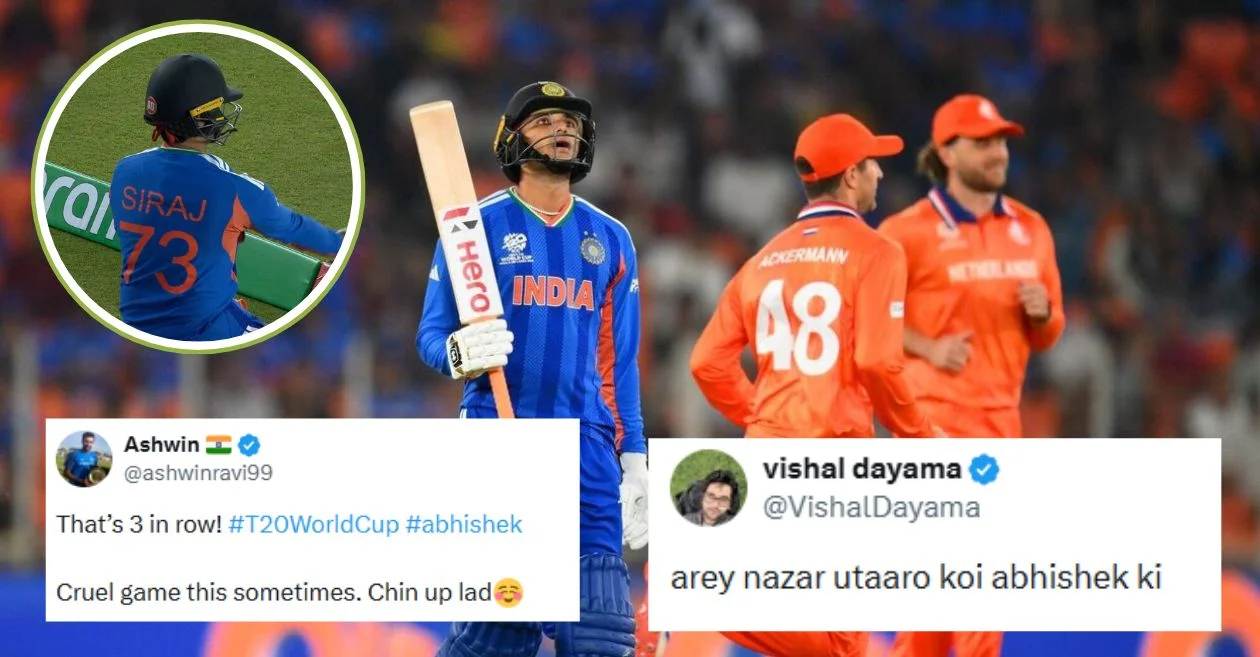
IND vs NED: Fans express shock as Abhishek Sharma records third consecutive duck in T20 World Cup 2026


In a statistical anomaly that has stunned the cricketing world, India‘s Abhishek Sharma has completed the league stage of the T20 World Cup 2026 without scoring a single run. On February 18, 2026, during India‘s final group-stage match against the Netherlands in Ahmedabad, the explosive opener was dismissed for his third consecutive duck, cementing a nightmare start to his maiden World Cup campaign.

Abhishek Sharma’s Ahmedabad nightmare: Clean bowled by Aryan Dutt for third straight duck

In a dramatic turn of events at the Narendra Modi Stadium on February 18, 2026, India’s opening sensation Abhishek Sharma reached a career-low as he was clean bowled for a 3-ball duck in India’s final group-stage encounter against the Netherlands. Arriving at the crease under immense scrutiny and even attempting to break his “jinx” by wearing teammate Mohammed Siraj’s jersey under his kit, Sharma faced the Dutch spin threat of Aryan Dutt in the very first over.

After tentatively defending the first two deliveries, Abhishek attempted a forceful cross-batted swing at a shortish, quicker delivery that skidded through. The ball completely evaded his bat and crashed into the middle and off stumps, sending the world’s top-ranked batter back to the pavilion without a run yet again. This dismissal marked a historic low for the young left-hander, who has now become the first player in T20 World Cup history to record three consecutive ducks, leaving the Ahmedabad crowd in stunned silence as he trudged off the field.

Also READ: T20 World Cup 2026: Here’s why Kuldeep Yadav and Axar Patel are not playing today’s IND vs NED game

World No.1 T20I batter: Abhishek Sharma’s horror T20 World Cup 2026 run

Despite enduring the worst statistical start for an Indian opener in World Cup history, Abhishek remarkably continues to hold his position as the World No. 1 ranked T20I batter with 908 rating points in the latest ICC update. His tournament has been a tale of total frustration, beginning with a golden duck against the USA in Mumbai, a match he played while battling a high fever that later escalated into a severe stomach infection, requiring two days of hospitalisation in New Delhi.

This health crisis forced him to miss the clash against Namibia, and although he returned for the high-pressure game against Pakistan in Colombo, he looked a shadow of his former self, miscueing a pull shot to mid-on for a 4-ball duck. With four ducks in his last seven T20I innings, Abhishek’s ‘points bank’ from a dominant 2025 season is the only thing keeping him at the top of the rankings, while the surge of teammate Ishan Kishan has put his spot in the playing XI under intense pressure as India moves into the Super 8s.

Here’s how fans reacted: 

Also READ: Fans erupt as Sahibzada Farhan and Shadab Khan power Pakistan into T20 World Cup 2026 Super 8 stage with ruthless win over Namibia


Source link

‘Exhibitors must not display…’: IT secretary’s warning amid Galgotias University’s Chinese robodog row | India News


'Exhibitors must not display...': IT secretary's warning amid Galgotias University's Chinese robodog row
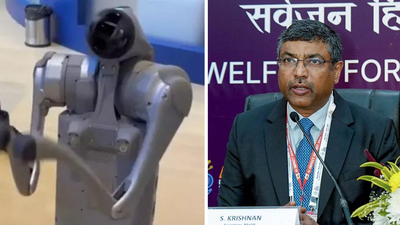
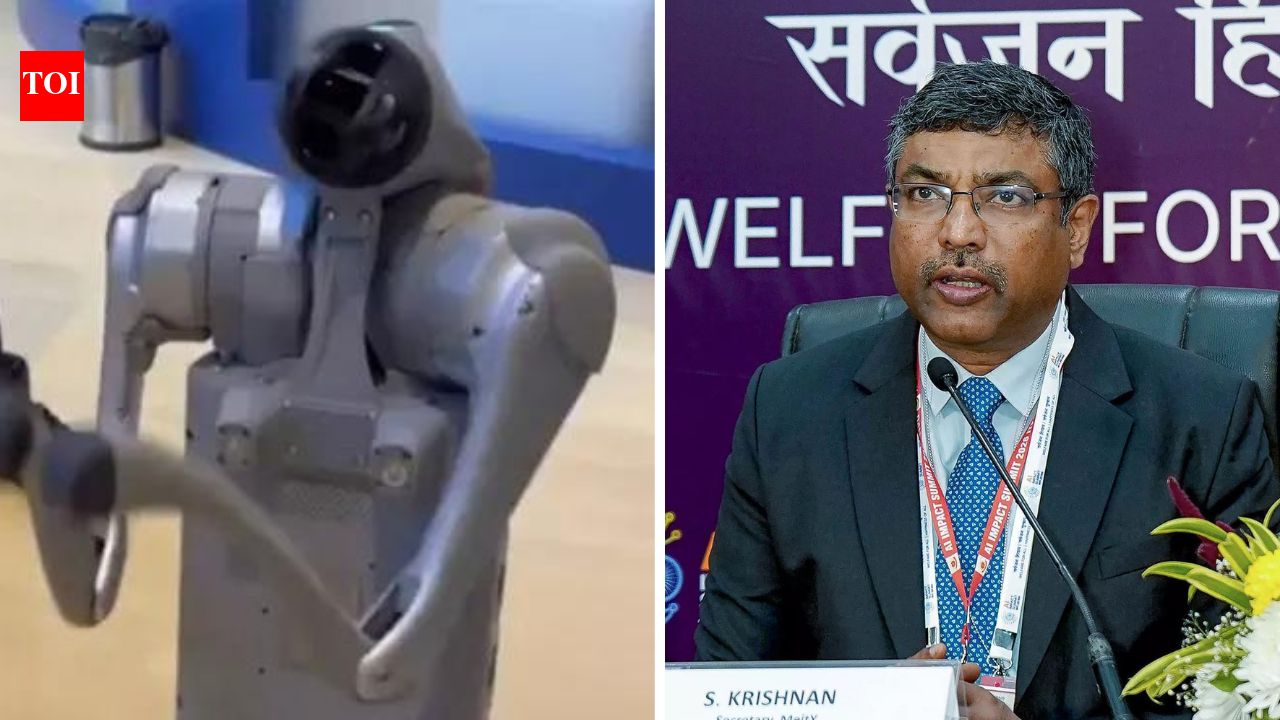
IT secretary S Krishnan (ANI image)

NEW DELHI: IT secretary S Krishnan on Wednesday said that exhibitors at the AI Impact Summit must not display items that do not belong to them, as a controversy continued over a Chinese-made robotic dog showcased by Galgotias University.“Exhibitors must not display items that are not their,” Krishnan said, amid questions over the display of the robot at the summit venue in New Delhi, news agency PTI reported. The controversy erupted during the AI Impact Summit 2026, held at Bharat Mandapam after a robotic dog exhibited by the university under the name “Orion” was identified as the Unitree Go2, a commercially available quadruped robot manufactured by Chinese firm Unitree Robotics and sold in India for around Rs 2–3 lakh.The summit, inaugurated by Prime Minister Narendra Modi is positioned as a flagship event to showcase India’s advancements in artificial intelligence. The display drew criticism as the machine was alleged to have been presented as an in-house innovation at an event focused on promoting domestic AI capabilities.Government sources earlier said that the university was asked to vacate its stall following the row, and its pavilion’s power supply was reportedly cut off after it was directed to leave the expo.In a press statement issued after being asked to vacate the premises, the university expressed regret over the confusion and said it arose because Professor Neha Singh, who was managing the stall, was unaware of the product’s technical origins.“We at Galgotias University wish to apologise profusely for the confusion created at the recent AI Summit. One of our representatives, manning the pavilion, was ill-informed. She was not aware of the technical origins of the product and in her enthusiasm of being on camera, gave factually incorrect information even though she was not authorised to speak to the press… Understanding the organisers’ sentiment we have vacated the premises,” the statement read.The issue escalated after Professor Singh, while presenting the robot to DD News, said, “We are the first private university investing more than 350 crore rupees in artificial intelligence… So Orion has been developed by the Center of Excellences and as you can see, it can take all shapes and sizes.” She also described the robot as capable of surveillance and monitoring tasks.Her remarks triggered scrutiny after observers recognised the machine as an off-the-shelf product sold globally by Unitree Robotics.In an earlier clarification, the university said it had neither built nor claimed to have built the robotic dog, and that its objective was to help students learn using globally available technologies.“Let us be clear – Galgotias has not built this robodog, neither have we claimed. But what we are building are minds that will soon design, engineer, and manufacture such technologies right here in Bharat,” it said.Professor Singh later said the controversy stemmed from a lack of clarity in communication and that the university had introduced the robot to inspire students, not to claim manufacturing credit.


Source link

‘Western nations spread fundamentalism’: RSS chief Mohan Bhagwat hits out at US, China | India News


'Western nations spread fundamentalism': RSS chief Mohan Bhagwat hits out at US, China

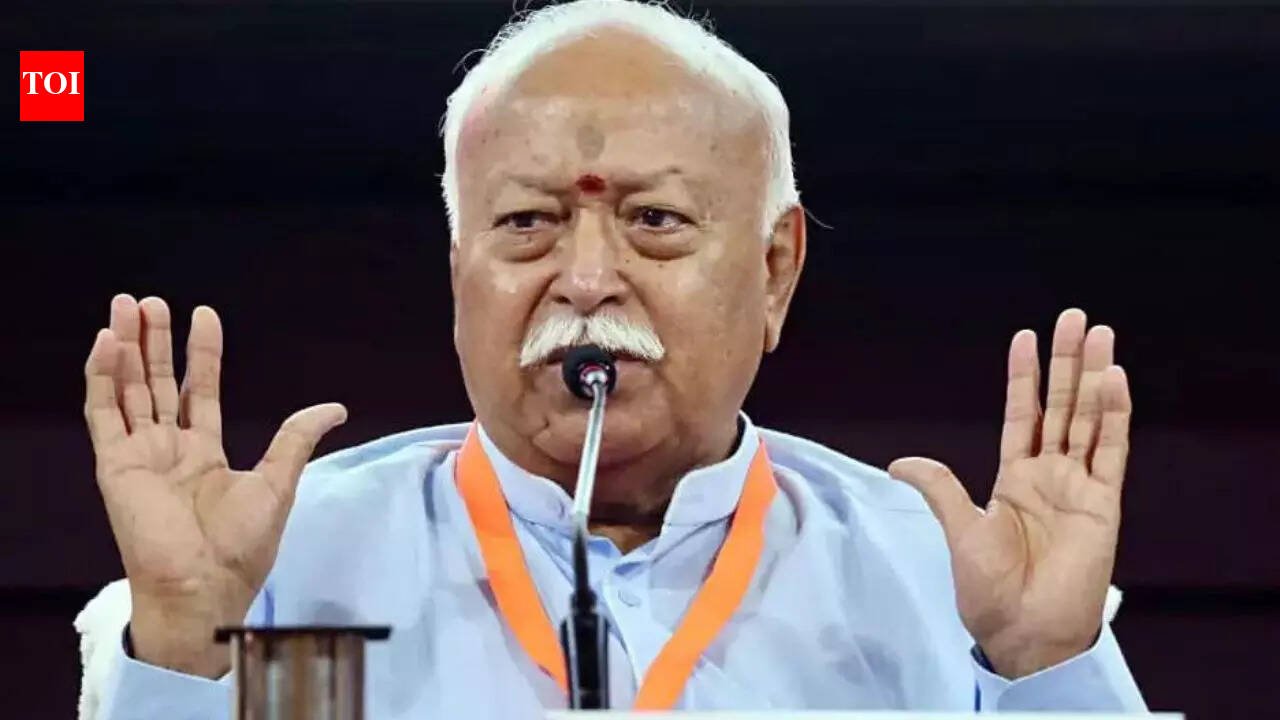
NEW DELHI: RSS chief Mohan Bhagwat on Wednesday criticised the United States and China, alleging that “Western countries spread fundamentalism,” and asserting that India holds solutions to many of the world’s problems.Speaking at a Shodharthi Samvad programme at Lucknow University, Bhagwat said, “Western countries spread fundamentalism. Their thinking is to become powerful, live on their own, and abandon the rest, eliminating those who become obstacles. This is what America and China are doing today.”

Mohan Bhagwat Credits RSS Grind For BJP’s Success, Draws Line Between Sangh And Political Power

Bhagwat maintained that India can offer solutions to global crises but must first strengthen itself.“Today, India has the answers to the problems the world is facing. If we want to become a world leader, we must become powerful in all areas. The world only believes it when truth is backed by power,” he said.“Research plays a major role in changing India’s direction and condition. Truthful information should be brought to light. We will not be able to understand India through ignorance,” he added.He further alleged that Western powers had distorted India’s traditional education system. “Westerners have messed with education. They replaced our education system and imposed their own, so they could find black Englishmen to do the work. What the British did wrong must be rectified,” he said.“Today globalisation means marketisation, which is dangerous. We talk about Vasudhaiva Kutumbakam. That means we consider the entire world as our family. Unless everyone is happy, no one can be happy,” he said.“Therefore, our lives should be restrained, not consumerist. A life of restraint and sacrifice is in our cultural self-realisation,” he added.‘Not a single speck of dust can be secular’Speaking on religion, Bhagwat said that religion remains eternally relevant and governs the laws by which the universe operates. “The eternal nature of religion is always relevant. Religion is the laws by which the universe operates. Not a single speck of dust can be secular,” he said.“Religion brings happiness to everyone. Religion is applicable in everything we do. Our behaviour changes according to religion, country, and time. Religion tells us that we should live with everyone, not alone,” he added.Bhagwat also stressed the importance of environmental protection, urging people to adopt sustainable practices in daily life.Ghar Wapsi (homecoming) should be acceleratedEarlier on Tuesday, Bhagwat expressed concern over “a decline in the Hindu population”. According to a release, he called for a halt to religious conversions allegedly driven by greed or coercion.He said the process of “Ghar Wapsi” (homecoming) should be accelerated and that those who return to Hinduism must be supported.Bhagwat further stated that Hindus should have at least three children. Citing scientific studies, he claimed that a society with an average of fewer than three children faces long-term decline. He added that newly married couples should be informed of this view.


Source link

National Pension System: Not just a tax-saving tool — new rules, retirement benefits & more explained


National Pension System: Not just a tax-saving tool — new rules, retirement benefits & more explained

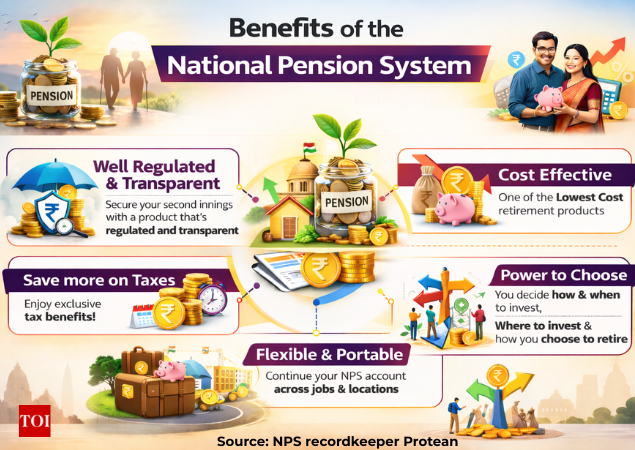
For millions of salaried professionals and self-employed Indians, financial concern is not just job loss or market volatility — it is securing a safety net in retirement.Unlike most government employees who are covered under pension schemes, most private sector workers today must build their own retirement fund. This has made the National Pension System (NPS), regulated by the Pension Fund Regulatory and Development Authority, one of the more sought-after financial tools for long-term security.Introduced as a structured pension savings scheme, the NPS has grown into a widely used retirement platform for government employees, corporate workers, professionals and self-employed individuals. For years, the NPS was the default retirement savings framework for central government employees who joined service on or after January 1, 2004, replacing the old defined benefit pension system. Under NPS, retirement income depends on accumulated contributions and market-linked returns, without any guaranteed minimum pension.However, the government has now introduced the Unified Pension Scheme as an alternative, offering assured payouts and greater income certainty after retirement. With both options now available, employees must weigh the flexibility and return potential of NPS against the guaranteed pension benefits offered under UPS. However, this option is not available to private sector employees, and hence NPS assumes significance for them.A series of NPS reforms introduced last year have made it more flexible, allowing greater withdrawals, extended investment horizons, and more investment choice.The changes signal a broader transformation; NPS is no longer just a tax-saving instrument, but a comprehensive retirement planning framework.So, let’s dive deeper into what NPS is and how it’s more than just a “tax deduction” in income tax returns.

What is NPS and why it matters

According to the NPS website, the scheme is defined as, “National Pension Scheme is a government-backed retirement savings plan where you invest during your working years to get income after retirement, with tax benefits and flexible investment choices.”Protean eGov Technologies Limited manages the core recordkeeping infrastructure of the National Pension System.NPS is open to:

  • Government employees
  • Private sector employees
  • Corporate subscribers
  • Self-employed professionals
  • Individual citizens under the All Citizen Model
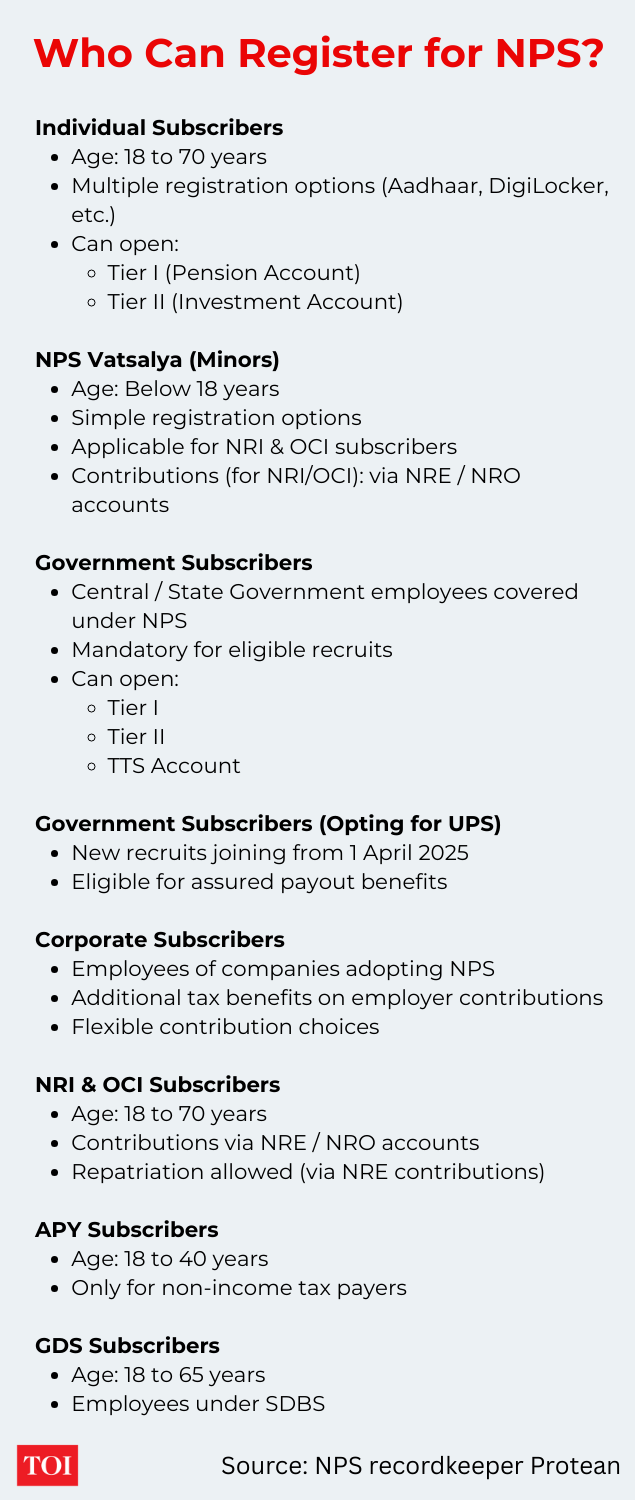
Who can invest in NPS

One of its biggest strengths is portability. The account, identified by a Permanent Retirement Account Number (PRAN), remains the same even if a subscriber changes jobs, cities or employers.Experts say its disciplined structure makes it particularly effective for retirement planning.“Think of NPS as a mutual fund designed specifically for your retirement. Its main purpose is to help you stay disciplined by keeping your funds invested until you reach age 60,” Archit Gupta, Founder and CEO of ClearTax told TOI.

Tier I and Tier II: Understanding the NPS account types

NPS has two types of accounts:Tier I Account (Primary pension account)This is the primary pension account, which has restricted withdrawal facilities. The contributions made to this account are locked until the subscriber retires, with limited facilities for partial withdrawals. This account is eligible for tax benefits.Tier II Account (Voluntary savings account)This account is more like a normal investment account, which allows the subscriber to withdraw money at any time. However, this account is not eligible for tax benefits, unlike Tier I accounts for most subscribers.The Tier I account is the foundation of retirement planning in the NPS. “Employer’s contribution to NPS Tier-I Account has been kept under preview of allowed deduction to promote NPS. For those who prefer a steady monthly pension, NPS is still the best alternative as its effective return rate increases once we incorporate tax saving of 30-33% in the New tax Regime,” CA Ashish Niraj, Partner, A S N & Company, Chartered Accountants told TOI.Further talking about Tier-II investments, he added, “For Tier II 100% Equity can be allocated. Therefore whether you are equity focused or debt inclined, if you consider the Tax Deduction aspect, there are chances that NPS will always have an edge if you prefer to have regular income.”

NPS features

How NPS invests your money

NPS is a market-linked scheme. Contributions are invested across multiple asset classes, namely:

  • Equity (stocks)
  • Corporate bonds
  • Government securities
  • Alternative investments such as REITs and InvITs

Subscribers can choose their allocation based on risk appetite or opt for automated lifecycle funds that adjust risk over time.This diversified structure balances growth and stability.Aarti Raote, Partner at Deloitte India, explained to TOI that NPS combines flexibility with retirement income security. she said.

As a retiral benefit, NPS is a well-structured fund that provides a simple, voluntary, portable and flexible option for saving for retirement. The scheme provides a benefit that is market linked and based on the investors risk appetite, one can invest in a debt, balanced or a high risk – high return equity option.

Aarti Raote, Partner at Deloitte India

CA Ashish Niraj, Partner, A S N & Company, Chartered Accountants also gave his view on if one should go for NPS for investment. “As per my view if you have risk appetite then Market linked retirement options is better as it can offer greater returns also better liquidity. Market linked funds allow you to withdraw up to 100%, annuity restrictions are there in NPS. Whereas Market Linked Plans have mostly 5 year lock in, you need to stay invested in NPS till 60 years of age, except some cases where partial withdrawal is allowed. Also except small amounts of Rs 5 to 8 Lacs, you are required to choose annuity in NPS which is not the case in Market Linked schemes. This feature of liquidity sometimes get preference over returns as money in hand gives you freedom,” he said.“For Investment also you can choose up to 100% equity option in Market linked whereas some debt component is compulsory in NPS,” he added.

NPS benefits

NPS offers several structural advantages:

Embed

Advantages:

  • Long-term retirement focus
  • Tax benefits (in certain conditions)
  • Relatively safer option for investment
  • Employer contribution advantage
  • Regulated by government authority
  • Diversified investment portfolio
  • Lifetime pension component

Limitations:

  • Limited liquidity before retirement
  • Mandatory annuity component
  • Less flexibility compared to mutual funds and few other investment options

“If you prioritize having easy access to your funds or the ability to change your investment strategy at any time, regular mutual funds may be more suitable. The right choice depends on whether you prefer the structured, long-term nature of NPS or the flexibility offered by other market-linked options,” said ClearTax founder Archit Gupta.One of the most important benefits of NPS is the returns that it provides. However, it does not provide a fixed rate of interest; instead, it provides market-linked returns, which may have a higher potential for growth in the long run compared to other retirement savings options but also involves a risk component.The investments made in NPS are diversified across equities, corporate bonds, and government securities, which enables the subscribers to share the benefits of the performance of the financial markets.

Major NPS reforms

One of the biggest recent changes allows non-government subscribers to withdraw up to 80 per cent of their retirement corpus as a lump sum at exit, compared to the earlier limit of 60 per cent.Under the amended rules:

  • Up to 80% can be withdrawn as lump sum
  • Minimum annuity requirement reduced to 20%, down from 40%

This applies to private sector employees, corporate subscribers and individual contributors. The change increases liquidity and gives retirees greater control over their savings. However, annuity remains mandatory to ensure pension income. Offering an important clarification, Rohit Shah, Certified Financial Planner & Founder of Getting You Rich told TOI, “The recent revision now permits up to 80% lump-sum withdrawal at vesting—a significant jump from the earlier 60%. However, investors should note that the Income Tax Act currently exempts only 60% under Section 10(12A); clarity on the tax treatment of the additional 20% is still awaited, and this gap must be factored into exit planning.Experts say this annuity requirement plays an important protective role. “Investors who require liquidity at retirement find this option extremely attractive as 60% of the balance is available at their disposal without taxation and the balance provides for retirement expenses – thus one can say that it is a balanced fund,” said Deloitte’s Aarti Raote.Full withdrawal allowed for smaller corpusThe rules also make it easier for subscribers with smaller retirement savings.

  • If retirement corpus is up to Rs 8 lakh: full withdrawal is allowed.
  • Between Rs 8 lakh and Rs 12 lakh: partial lump sum and staggered withdrawals is allowed.
  • Above Rs 12 lakh: minimum 20% must go into annuity.

This benefits individuals with modest retirement savings by improving access to funds.Investment horizon extended to age 85Another major reform is the extension of the investment and exit age. Subscribers can now remain invested in NPS until age 85, compared to earlier limits of 70 (entry) or 75 years (exit).This allows:

  • Longer compounding period
  • Higher potential retirement corpus
  • Flexibility for individuals working beyond traditional retirement age

New investment flexibility through multiple schemes

The Multiple Scheme Framework (MSF) is a structural upgrade to NPS that gives subscribers greater control over how their retirement savings are invested. Under MSF, investors are no longer restricted to a single pension fund manager or a limited set of predefined schemes. Now, they can allocate their contributions across multiple schemes and even different pension fund managers within the same PRAN. This allows subscribers to tailor their investments based on their risk appetite, financial goals, and market outlook, including the option of higher equity exposure, which is up to 100% for non-government subscribers.This enables:

  • Greater diversification
  • Schemes tailored to age and risk profile
  • Potential for higher equity allocation
  • More personalised retirement planning

Tax benefits: Old vs new tax regime

NPS offers tax benefits under both tax regimes, though the structure differs.Under the old tax regime:

  • Up to Rs 1.5 lakh deduction under Section 80C
  • Additional Rs 50,000 under Section 80CCD(1B)
  • Employer contributions up to prescribed limits deductible

Under the new tax regime:

  • Employer contribution up to 14% of salary deductible under Section 80CCD(2)
  • No deduction for employee contribution
  • The additional tax deduction of up to Rs 50,000 under Section 80CCD(1B) for self-contribution is also not available.

ClearTax CEO said employer contribution benefits remain a key advantage.

.

ClearTax’s founder also said, “When you reach 60, you can now take out up to 80% of your money as a lump sum. However, under current tax laws, only 60% of the total fund is tax-free. You must use the remaining 20% to buy an “annuity,” which provides you with a monthly pension.”Deloitte partner Aarti Raote also compared the benefits in terms of tax regimes saying, “Contribution to NPS is one avenue of tax saving that is available under the old tax regime as well as the new tax regime. Under the old tax regime the employee contribution up to INR 1,50,000, Additional contribution of INR 50,000 and employer contribution up to 14% of the salary are allowable. However under the Simplified tax regime deduction for employer contribution to NPS is allowable. Thus the benefit under the old regime is significantly higher.”

Loan access and withdrawal flexibility improved

In a first for the scheme, NPS withdrawals no longer necessarily require a permanent exit of funds. According to Protean eGov Technologies Limited, subscribers can now use their NPS account as collateral to secure a loan from a regulated financial institution instead of withdrawing money outright. The loan is limited to 25% of the subscriber’s own contributions. This means that frequent NPS contributors, including salaried and private sector employees, can access funds for meeting urgent financial requirements such as medical expenses without withdrawing from their retirement savings.

Not just tax saving — but retirement discipline

For many investors, NPS offers something that other investments do not – forced discipline. Unlike mutual funds, where money can be withdrawn easily, NPS ensures savings remain protected for retirement.Experts say this structure helps build meaningful long-term wealth. Getting You Rich’s Shah’s, said, “One often-overlooked structural advantage is forced long-term discipline. Unlike mutual funds or ULIPs, NPS locks investors into a retirement-only vehicle, eliminating the temptation to dip into retirement savings for short-term goals—a behavioural edge that compounds powerfully over 20–30 years.”Further explaining the advantages beyond tax he added, “though the Section 80CCD(2) benefit remains a compelling sweetener. From FY 2025-26, employer contribution deduction has been raised to a uniform 14% of salary (Basic + DA) for all employees, private and government alike—a benefit no other retirement product matches. Even without employer contribution, NPS offers a unique combination: multi-asset diversification (equity, corporate bonds, government securities, and alternative assets) within a single account, portability across jobs and cities, regulatory oversight* by PFRDA, and a *built-in annuity component that guarantees lifelong income—something voluntary market-linked products cannot structurally ensure.Another way of validating the emerging significance of NPS is the growing subscriber base over the years. The system’s subscriber base has expanded steadily over the past decade, more than tripling from 6.5 million in 2013–14 to over 21.3 million in 2025–26. The growth has been increasingly driven by state government employees, corporate participation, and retail investors.

The bigger picture

India’s workforce is increasingly responsible for its own retirement security, especially in the private sector.Traditional pension guarantees have largely disappeared outside government employment. The increase in life expectancy and inflation rates has made retirement planning more important than ever before.The NPS reforms reflect this shift.By allowing greater withdrawals, extending investment duration, and improving flexibility, the system is adapting to modern workforce realities.“NPS is no longer just a tax-saving tool. It has evolved into a genuinely flexible, diversified, and disciplined retirement solution. The cost-benefit equation has changed—but on most counts, in NPS’s favour, not against it,” said Rohit Shah.Thus, while it may not replace flexible investments like mutual funds, NPS remains one of India’s most comprehensive retirement planning instruments


Source link

‘Join Galgotias as Professor of Spin’: Mahua Moitra jabs Ashwini Vaishnaw amid robodog row, asks him to quit | India News


'Join Galgotias as Professor of Spin': Mahua Moitra jabs Ashwini Vaishnaw amid robodog row, asks him to quit
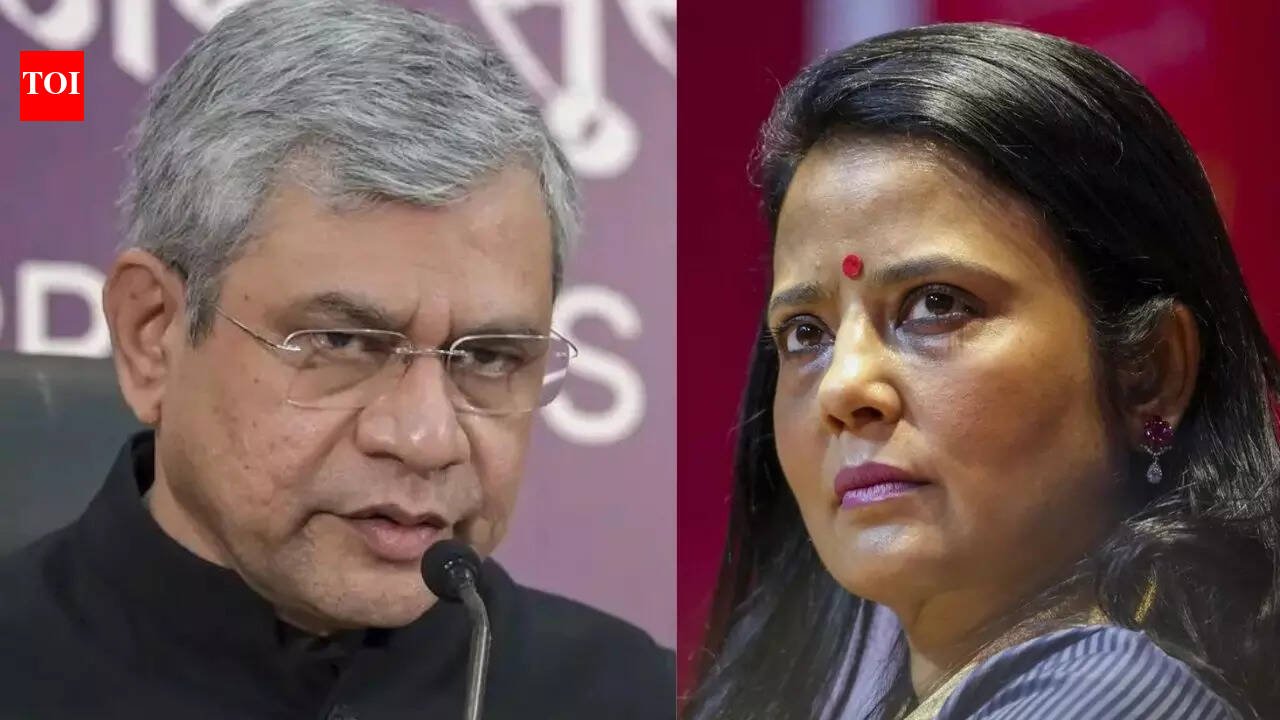
Ashwini Vaishnaw and Mahua Moitra

NEW DELHI: The Modi government’s ambitious AI summit on Wednesday was overshadowed by controversy over Galgotias University’s contested displays of robotic exhibits, with Trinamool (TMC) leader Mahua Moitra calling the I-T minister Ashwini Vaishnaw to quit.Taking a sharp dig at the minister, who also holds crucial railway and information & broadcasting portfolios, the Lok Sabha MP wrote Vaishnaw has “made India a laughing stock”.

AI Impact Summit: Facing Backlash Over China-made Robo Dog, Galgotias University Told To Leave Event

Mahua also shared a Vaishnaw’s deleted X post in which he had purportedly praised the Galgotias University’s robodog, which triggered a massive backlash online over its Chinese origins. In the post, as was posted by the TMC leader, Vaishnaw had said: “Bharat’s sovereign models are performing well on global benchmarks.”Mahua, considered a fierce critic of the ruling BJP, said the minister “maybe join Galgotia as Professor of Spin?”“Deleting tweets doesn’t change reality @AshwiniVaishnaw – you have made India a laughing stock. Quit the chair if you can’t do your job. Maybe join Galgotia as Professor of Spin?” Mahua wrote on X.Government acts against Galgotias As the controversy escalated into a major embarrassment, the government asked Galgotias University to vacate its stall at the AI Summit Expo in Bharat Mandapam.The robot, showcased by the university as “Orion,” was recognised by observers as the Unitree Go2, commercially available product, made by Chinese robotics firm Unitree. The quadruped robot is reportedly sold in India for about Rs 2–3 lakh.The incident quickly escalated into a wider controversy at the India AI Impact Summit 2026, a flagship AI event that PM Modi himself inaugurated.The university pins all blame on the professorHours after the drawing intense flak, Galgotias University apologised in the statement that blamed the woman professor for the fiasco.In the statement, it expressed regret over the confusion and said it arose because Professor Neha Singh, who was managing the stall, was unaware of the product’s technical origins.


Source link

This day, that year: When India launched the world’s first official airmail service | India News


This day, that year: When India launched the world’s first official airmail service

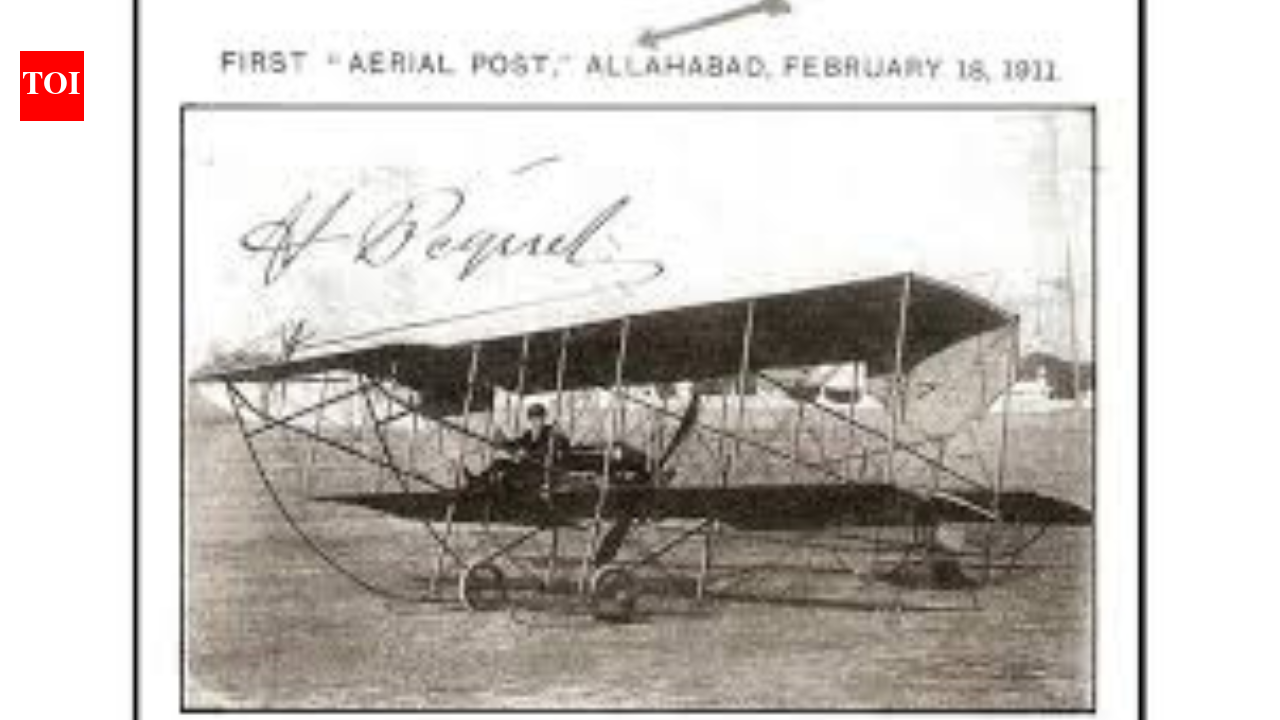
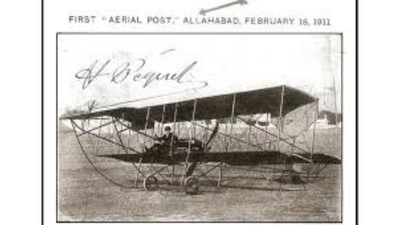
On a winter evening in 1911, as the sun dipped over the confluence city of Prayagraj, a small crowd gathered on the banks of Yamuna to witness what many believed was little more than a spectacle. Kumbh Mela pilgrims thronged the city, traders and farmers moved through the UP Exhibition grounds, and curious onlookers looked out for a strange contraption of wood, fabric and wire. Few were aware that they were about to watch a moment that would quietly reshape global communication.At around 5.30 pm on February 18, 1911, French aviator Henri Pequet climbed into his Heavyland aircraft, its engine clinking against the evening air. In the cockpit, alongside fuel and instruments, were 6,500 letters — ordinary envelopes entrusted to an extraordinary experiment. When Pequet lifted off, crossing the Yamuna and steering towards Naini, he carried with him not just mail, but the idea that any distance could be conquered by air.The flight lasted just 13 minutes. It covered roughly 15 kilometres, from the exhibition grounds in Prayagraj to a landing site near Naini Junction, close to what is now the Central Jail. But the journey’s brevity concealed its significance.This was the world’s first official airmail service, launched from colonial India at a time when powered flight itself was barely eight years old. Around one lakh people, according to contemporary accounts, watched in astonishment as the machine rose, crossed the river, and descended safely on the other side.The setting was as symbolic as the event. The UP Exhibition, an agricultural and industrial fair, had brought together innovation and tradition on the riverbanks. Two aircraft had been shipped in parts by British officers and assembled in full public view, turning engineering into theatre. The airmail flight was staged as a highlight, but its implications would ripple far beyond the fairgrounds.More than a century later, postal services have transformed beyond recognition, from fragile biplanes to drones and satellites. Yet, India’s role in inaugurating the airmail era remains a lesser-known chapter in aviation and communication history.On that February evening in 1911, amid pilgrims, farmers and curious citizens, a modest flight across the Yamuna quietly launched a global revolution in how the world sends its messages.

Before wings of metal, wings of feather

.

Long before engines roared and wings of fabric and wood lifted off the ground, messages travelled on feathers. For at least two thousand years, pigeons have carried letters across distances that were otherwise difficult, dangerous or slow to traverse. A small note would be tied to the bird’s leg, released from a distant point, and the trained pigeon would instinctively fly back to its home loft—where the intended recipient waited.Ancient civilisations relied on this method with remarkable sophistication. The Romans used homing pigeons to relay military and administrative messages; the Greeks employed them to announce the results of sporting contests; Persian and Chinese networks also integrated pigeons into their communication systems. In many ways, these birds formed one of the earliest organised long-distance messaging systems.The practice did not vanish with antiquity. In the late 19th century, a structured pigeon-based postal service briefly operated in New Zealand. Between 1897 and 1901, the New Zealand Pigeon Post carried messages between the mainland and Great Barrier Island, issuing stamps that are today prized by philatelists. It was an ingenious solution to geographic isolation in an era when reliable telegraph or ferry services were still developing.

.

Yet pigeon post had an inherent limitation that often went unremarked. The bird could only fly home. To send a message from a remote location, someone first had to transport the pigeon there—usually confined in a cage. Even the earliest “airmail” required its own logistics chain.Against this backdrop, the leap from pigeon legs to powered flight was not just technological; it was conceptual. When Henri Pequet carried mail across the Yamuna in 1911, he was building on centuries of experiments in conquering distance—this time with a machine, not a bird, and with the promise of transforming how nations would communicate.

Magenta mail and a 13-minute leap into history

The idea itself was quite audacious for its time. According to Postmaster General Krishna Kumar Yadav, Colonel Y Wyndham first approached postal authorities with a proposal that sounded closer to fantasy than policy: sending mail by aeroplane. The postal chief of the day gave his consent, and preparations began for what would become a landmark experiment in communication.The mail bag prepared for the flight was intentionally distinctive. It carried the markings “First Air Mail” and “Uttar Pradesh Exhibition, Allahabad,” with an illustration of an aircraft printed on it. Instead of the customary black ink, magenta was used, giving the consignment a distinctive identity.Organisers were acutely aware of the aircraft’s limitations. Weight was a critical concern, and strict calculations were done to ensure the load would not exceed what the machine could lift. Each letter was weighed, restrictions were imposed, and finally, the number of items was capped at 6,500. The flight itself would last only 13 minutes, but everything leading up to it had been planned with military precision.Yadav, who has noted down India’s postal history in his book ‘India Post: 150 Glorious Years’ notes that the service was not merely symbolic; it was also structured as a special premium offering. A surcharge of six annas was levied on each letter, and the proceeds were donated to the Oxford and Cambridge Hostel in Allahabad. The hostel became the nerve centre of this unusual operation. Letters were accepted for booking until noon on February 18, and the rush was such that the building resembled a miniature General Post Office. The postal department had to deploy three to four staff members on-site to handle the volume.Within days, nearly 3,000 letters had reached the hostel for onward transmission by air, a testament to the novelty and prestige attached to the service. Among the senders were local elites—rajas, maharajas, princes, and prominent citizens of Prayagraj, eager to have their names associated with history.One envelope even bore a postage stamp worth Rs 25, an extraordinary sum at the time, underscoring how much symbolic value people placed on this pioneering flight.

From balloons to biplanes: The making of Henri Pequet

Henri Pequet’s journey to the banks of the Yamuna was anything but straightforward. Born on February 1, 1888, in Bracquemont, a small town in France’s Seine-Inférieure region, he was drawn to flight at a time when aviation was still an experiment more than a profession. He began in 1905 with balloon flights under the guidance of Baudry, later moving on to work with the dirigible Ville de Paris built by Paulham. These early years were spent learning the fundamentals of aeronautics, often through trial, error, and mechanical improvisation.

Henri Pequet

By 1908, Pequet was working at the Voisin brothers’ aircraft factory in Mourmelon, one of the pioneering centres of European aviation. His transition from mechanic to pilot was almost accidental. While on an assignment in Châlons to repair an aircraft abandoned in a field after its Anzani engine failed, Pequet secured permission to test the plane himself. It was there that he experienced the thrill of controlling an aircraft for the first time, discovering a talent that would soon define his career.The following year, he was hired as a pilot and mechanic by Chilean aviation entrepreneur José Luis Sánchez. In 1909, Pequet travelled to Johannisthal, near Berlin, to attend an aviation meeting. Circumstances led him to replace another pilot, Edwards, on a flight, on a condition that he would no longer be employed as a mechanic. On October 30, he took off, executed a short but controlled flight, and landed smoothly. The performance marked his emergence as a professional aviator.Pequet soon returned to the Voisin factory and went on to participate in aerial exhibitions in Argentina, flying Voisin biplanes powered by 60-horsepower engines. On March 24, 1910, he made a notable flight at Villa Lugano. Later that year, he returned to France and enrolled at the Voisin brothers’ flying school in Reims, earning his pilot’s brevet from the Aéro-Club de France on June 10, 1910, with licence number 88.Less than a year later, the young French aviator would find himself in colonial India, piloting an aircraft over the Yamuna and writing a small but enduring chapter in the history of global postal and aviation.


Source link

Stock market today: Which are top gainers and losers on NSE and BSE on February 18? Check list


Stock market today: Which are top gainers and losers on NSE and BSE on February 18? Check list

Market ended in green for the third straight session on Wednesday, with benchmark equity indices rising on the back of last-hour buying in banking, metal and FMCG stocks.The 30-share BSE Sensex jumped 283.29 points, or 0.34 per cent, to settle at 83,734.25 in a volatile trade. The 50-share NSE Nifty gained 93.95 points, or 0.37 per cent, to close at 25,819.35.Among the Sensex constituents, Tata Steel, ITC and Kwality Walls were the major gainers. On the other hand, Eternal, Tech Mahindra and Infosys were the laggards.“Indian markets witnessed a late surge driven by broad-based buying after a cautious start, as positive domestic sectoral cues helped offset lingering global uncertainties,” Vinod Nair, Head of Research, Geojit Investments Ltd, said.He added that banking and financial stocks remained resilient on the back of steady asset-quality expectations, while selective buying in FMCG names contributed to relative outperformance.Broader indices also traded firm, with the BSE Smallcap Select Index rising 1.02 per cent and the Midcap Select Index gaining 0.40 per cent.“Indian equity markets extended gains for the third consecutive session staging a gradual recovery, with the Nifty rising 0.4 per cent, supported by strength in PSU and metal stocks. On the flows front, FIIs remained net buyers on Tuesday, purchasing equities worth Rs 995 crore, while DIIs also bought shares worth Rs 187 crore, providing support to sentiment,” Siddhartha Khemka, Head of Research, Wealth Management, Motilal Oswal Financial Services Ltd, said.

Nifty50 top gainers

Company Name Current Price (Rs) Price Change % Change
Kwality Wall’s 29.33 1.38 ↑ 4.94% ↑
HDFC Life 729.60 23.80 ↑ 3.38% ↑
Tata Steel 209.03 5.95 ↑ 2.93% ↑
ITC 332.45 7.00 ↑ 2.16% ↑
Tata Consumer 1,170 21.20 ↑ 1.85% ↑
Bajaj Auto 9,980 154.00 ↑ 1.57% ↑
Axis Bank 1,377 19.80 ↑ 1.46% ↑
Reliance Industries 1,441 18.30 ↑ 1.29% ↑
Nestle India 1,301 15.60 ↑ 1.22% ↑
M&M 3,531 41.30 ↑ 1.19% ↑

Nifty50 top losers

Company Name Current Price (Rs) Price Change % Change
ONGC 264.60 -7.25 ↓ -2.67% ↓
Wipro 211.95 -3.75 ↓ -1.74% ↓
Eternal 277.35 -4.15 ↓ -1.48% ↓
Adani Enterprises 2,211 -31.71 ↓ -1.42% ↓
Infosys 1,374 -17.50 ↓ -1.26% ↓
Tech Mahindra 1,505 -19.00 ↓ -1.25% ↓
HCL Technologies 1,467 -15.40 ↓ -1.04% ↓
Adani Ports & SEZ 1,551 -15.50 ↓ -0.99% ↓
Coal India 418.00 -3.56 ↓ -0.85% ↓
TCS 2,695 -22.50 ↓ -0.83% ↓

Sensex top gainers

Company Name Current Price (Rs) Price Change % Change
Kwality Wall’s 29.33 1.38 ↑ 4.94% ↑
Tata Steel 209.03 5.95 ↑ 2.93% ↑
ITC 332.45 7.00 ↑ 2.16% ↑
Axis Bank 1,377 19.80 ↑ 1.46% ↑
Reliance Industries 1,441 18.30 ↑ 1.29% ↑
M&M 3,531 41.30 ↑ 1.19% ↑
Larsen & Toubro 4,326 46.10 ↑ 1.08% ↑
Bajaj Finance 1,024 9.65 ↑ 0.96% ↑
Bajaj Finserv 2,061 16.20 ↑ 0.80% ↑
UltraTech Cement 13,052 68.00 ↑ 0.53% ↑

Sensex top losers

Company Name Current Price (Rs) Price Change % Change
Eternal 277.35 -4.15 ↓ -1.48% ↓
Infosys 1,374 -17.50 ↓ -1.26% ↓
Tech Mahindra 1,505 -19.00 ↓ -1.25% ↓
HCL Technologies 1,467 -15.40 ↓ -1.04% ↓
Adani Ports & SEZ 1,551 -15.50 ↓ -0.99% ↓
TCS 2,695 -22.50 ↓ -0.83% ↓
Asian Paints 2,432 -5.31 ↓ -0.22% ↓
NTPC 368.00 -0.40 ↓ -0.11% ↓
HDFC Bank 924.70 -1.00 ↓ -0.11% ↓
Maruti Suzuki 15,164 -15.00 ↓ -0.10% ↓

In Asian markets, Japan’s Nikkei 225 benchmark closed 1 per cent higher, while markets in China, Hong Kong and South Korea remained closed due to Lunar New Year holidays. European markets were trading higher in mid-session deals, and US equities had settled in positive territory on Tuesday.Foreign institutional investors bought equities worth Rs 995.21 crore on Tuesday, while domestic institutional investors purchased stocks worth Rs 187.04 crore, according to exchange data. Brent crude, the global oil benchmark, rose 0.33 per cent to USD 67.64 per barrel.(Disclaimer: Recommendations and views on the stock market, other asset classes or personal finance management tips given by experts are their own. These opinions do not represent the views of The Times of India)


Source link

Sahibzada Farhan: Once challenged Babar Azam, made documentary on hitting sixes off Bumrah, now a World Cup centurion | Cricket News


Sahibzada Farhan: Once challenged Babar Azam, made documentary on hitting sixes off Bumrah, now a World Cup centurion
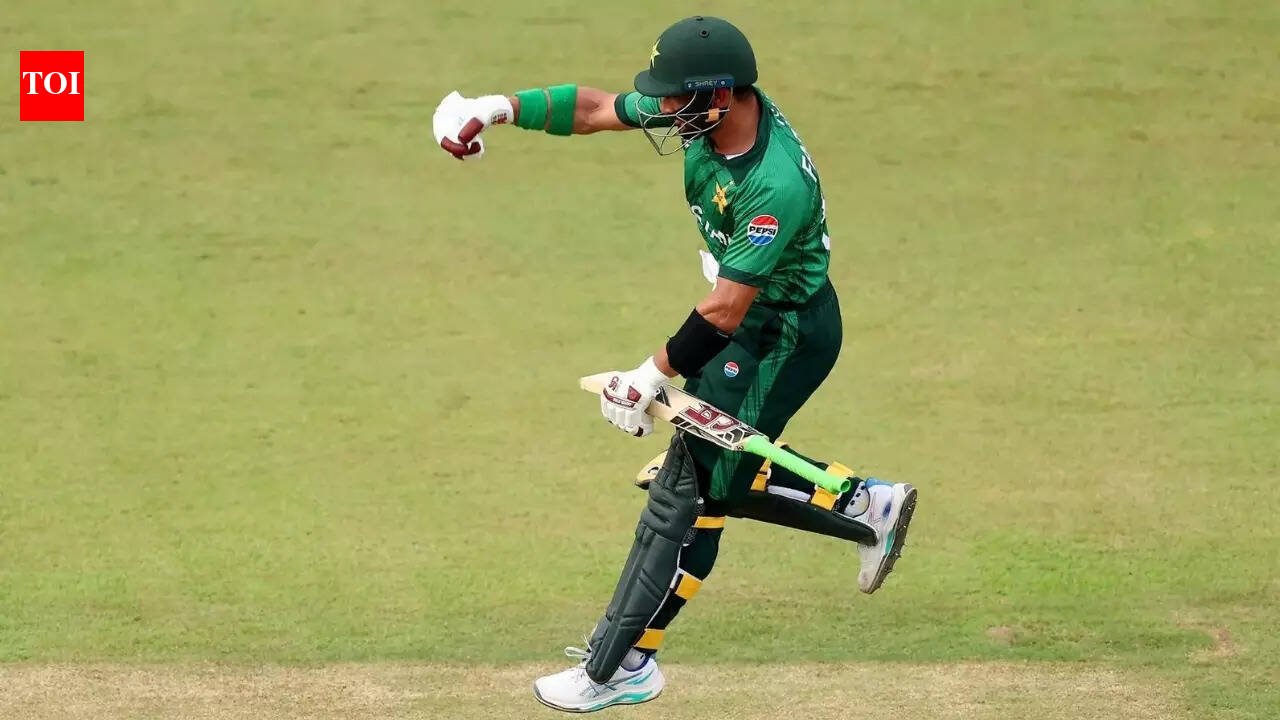
Sahibzada Farhan of Pakistan celebrates making a century during the ICC Men’s T20 World Cup India & Sri Lanka 2026 match between Pakistan and Namibia at Sinhalese Sports Club on February 18, 2026 in Colombo, Sri Lanka.

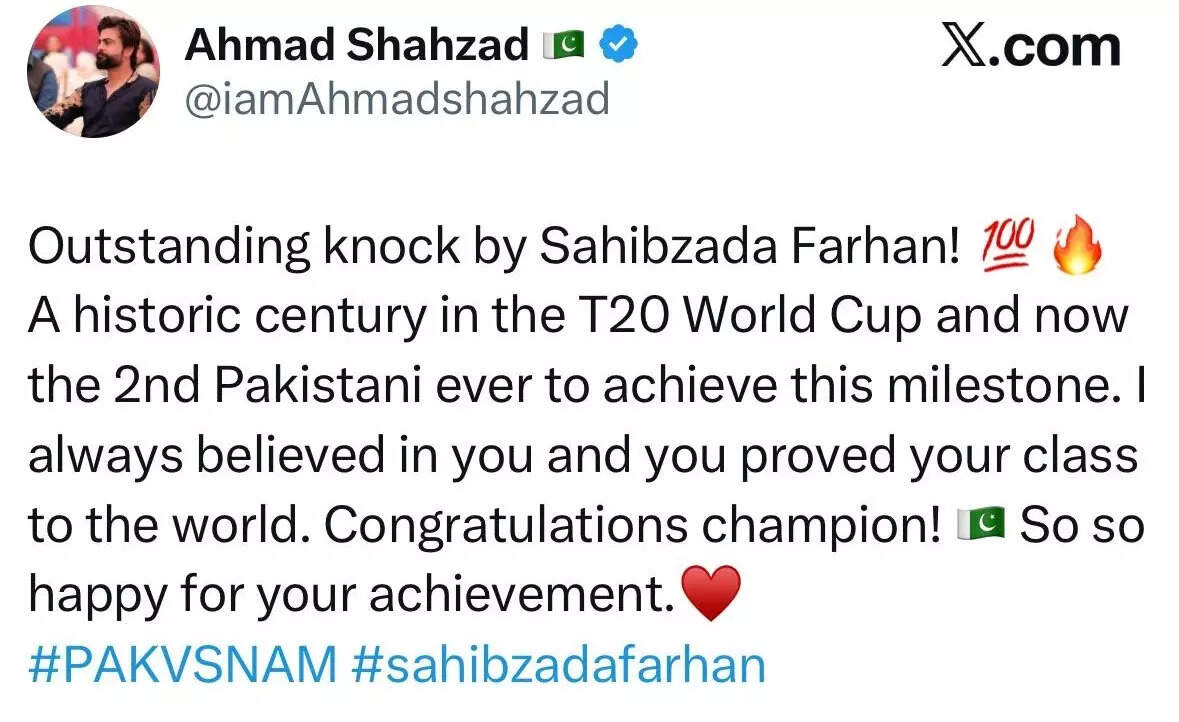
TimesofIndia.com in Colombo: Sahibzada Farhan has rarely been out of the news. From making a documentary after hitting Jasprit Bumrah for three sixes during the Asia Cup, to picking Ahmad Shehzad over legends like Sachin Tendulkar and Brian Lara, or his gunshot celebration after scoring a fifty against India, Farhan has never shied away from expressing himself.Having gone unsold in the Pakistan Super League, he finished as the leading run scorer in domestic cricket. He’s also challenged Pakistan cricket management over the lack of opportunities at the top of the order. On Wednesday, the 29-year-old completed a remarkable full circle at the Sinhalese Sports Club Ground in Colombo, becoming only the second Pakistani batter to score a century in T20 World Cup history, after his idol Ahmad Shehzad.Ahmad Shehzad was among the first to applaud Farhan’s outstanding knock. He wrote on X: “A historic century in the T20 World Cup and now the second Pakistani ever to achieve this milestone. I always believed in you and you proved your class to the world. Congratulations, champion. So happy for your achievement.”

-

Farhan produced a memorable hundred to steer Pakistan to a commanding 199 for 3 against Namibia. It was an uphill chase for Namibia, and the fall of wickets at regular intervals also didn’t help their case, as they skittled for 97 runs. Pakistan defeated Namibia by 102 runs and with this convincing win the Salman Ali Agha-led team cemented their place in the Super Eight.

Scratchy start

Opting to bat first, Pakistan made two changes from their heavy defeat against India, leaving out Shaheen Shah Afridi and Abrar Ahmed. Khawaja Nafay and Salman Mirza were brought in, with Afridi’s omission following a poor outing against India.The start was cautious. JJ Smit delivered an excellent opening over, keeping Saim Ayub on the back foot with movement into the batter before finishing with an outswinger. Just three runs came from it. Farhan opened his account with a boundary off Gerhard Erasmus, courtesy of a misfield at cover, but Namibia kept things tight early.Ayub showed flashes of intent against Ruben Trumpelmann with a swivel off his pads, though he rode his luck as a thick outside edge flew past a diving Zane Green. That over yielded 12 runs and allowed Pakistan some breathing space.Jack Brassell’s introduction unsettled Farhan initially with his back of a length bowling, but the opener finally broke free when a delivery flew over the keeper for four, his first authoritative stroke after 24 balls. Confidence followed quickly as Farhan struck back to back boundaries off Trumpelmann.Ayub’s stay ended in the fifth over. A harmless wide delivery tempted him into a loose poke and he edged behind for 14. Captain Salman Ali Agha then joined Farhan and immediately injected momentum with a crisp cut past the point.Pakistan reached 47 for 1 at the end of the powerplay, but the middle overs brought pressure. Spinners Willem Myburgh and Bernard Scholtz bowled with discipline, conceding little and choking strike rotation.

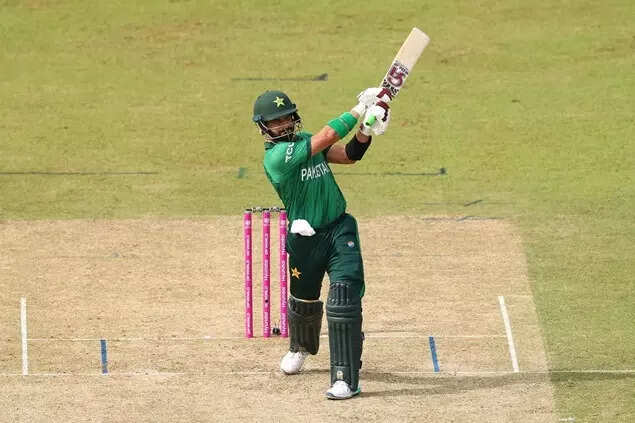
Sahibzada Farhan of Pakistan bats during the ICC Men's T20 World Cup match between Pakistan and Namibia at Sinhalese Sports Club on February 18, 2026 in Colombo, Sri Lanka. (Photo/Getty Images)

Finding his groove

The release came when Salman danced down the track to loft Myburgh straight for the first six of the match. Farhan followed three balls later, clearing mid wicket twice as Myburgh’s second over went for 22. Farhan was visibly struggling with cramps but refused to slow down.At the halfway stage, Pakistan were 85 for 1. Salman continued to attack, swiping Smit over fine leg and lifting Scholtz for another six. Farhan reached his fifty off 37 balls, scratchy but effective, built on perseverance rather than fluency.The 67-run stand ended when Brassell induced a mistimed loft from Salman, who departed for a brisk 38. Salman had also played a key role in helping Farhan refine his technique against short-pitched bowling.“Salman gave me valuable tips that helped improve my balance and on-side play. Now I’m scoring more freely in that area,” Farhan had told Geo Super during PSL 2025.Khawaja Nafay was sent ahead of Babar Azam and struck a boundary first ball, but his stay was brief as Erasmus removed him with a well-judged catch.Shadab Khan walked in next, and Pakistan’s intent was clear. Farhan, now in full flow despite severe cramps, accessed his fourth gear. He hammered Smit over long off, forcing a ball change, and greeted the new ball with another boundary. Brassell was then taken apart for a six and a four as Farhan closed in on history.On his knees between deliveries, Farhan finally reached his century off 57 balls, raising his arm in celebration. He became only the second Pakistani to score a T20 World Cup hundred. The knock was built on resolve, muscle and perfect timing, and was studded with eleven fours and four sixes. His fifty came off 37 balls, and he raced to the next fifty in just 20.Shadab provided the finishing touches with an unbeaten 36 off 22 balls as Pakistan posted 199 for 3, powered by a defining innings from Sahibzada Farhan.

The rocky journey

Farhan made his international debut in 2018. His career began in bizarre fashion, stumped without facing a ball off a Glenn Maxwell wide. In his next game against Australia, he opened with Babar Azam and scored 39 off 38 balls. He played nine matches for Pakistan, batting at multiple positions, before being pushed down the order and fading from the setup.In 2024, while captaining Pakistan A, he publicly criticised the management for unfair treatment and challenged the opening slots of Babar Azam and Mohammad Rizwan. “I did not get proper chances as an opener. I have the right to play as an opener for Pakistan,” he said then.Despite aggregating 605 runs in the 2025 National T20 Cup – the most in a single season – Farhan initially went unsold at the PSL 2025 auction. Islamabad United later picked him in the supplementary category, and he repaid the faith by finishing as the tournament’s leading run scorer with 449 runs in 12 innings.Farhan once dreamed of becoming a fast bowler. “I started as a fast bowler in tape-ball cricket, but after a disastrous over, my coach asked me to focus on batting,” he had told Cricfrenzy during the BPL.After a long and rocky journey, the explosive opener has found his groove. Since 2025, he is the only batter in the world to score five T20 centuries. If Pakistan are to go deep in the tournament, much will depend on how Farhan bats at the top.Cricket careers rarely move in straight lines, and Farhan’s has been anything but smooth. Yet on a humid Colombo afternoon, the opener who once waited on the fringes, questioned, doubted and overlooked, answered every question the only way that truly matters in cricket – with runs.Brief Scores Pakistan: 199 for 4 in 20 overs (Sahibzada Farhan 100 not out, Salman Agha 38, Shadab Khan 36 not out; Jack Brassell 2/48)Namibia: (Louren Steenkamp 23, Alexander Busing-Volschenk 20; Shadab Khan 3/19, Usman Tariq 4/16)


Source link

‘Bachcha bhaaga nahi’: Dwarka car accident accused’s lawyer says teen’s behaviour should be commended | Delhi News


NEW DELHI: The lawyer representing a 17-year-old accused in a fatal road crash in Delhi’s Dwarka has sparked controversy after appealing for sympathy for the teenager, citing “academic stress” and alleged threat calls to his family.The crash, which took place near Lal Bahadur Shastri College in Dwarka South on 3 February, left 23-year-old Sahil Dhaneshra dead.

Dwarka Accident: Accused’s Father Says Sorry As Sahil Dhaneshra’s Mother Seeks Adult Trial For Minor

Police say a car allegedly driven by a juvenile without a licence collided with Dhaneshra’s motorcycle, which was travelling in the opposite direction, before hitting another parked vehicle.An FIR has been registered at Dwarka South police station under Sections 281/106(1)/125(a) of the Bharatiya Nyaya Sanhita (BNS). According to Delhi Police, a PCR call about the incident was received at around 11:57am. Officers who reached the scene found three vehicles damaged and the motorcyclist dead.The accused minor’s lawyer, Lal Singh Thakur, said the incident had deeply affected the teenager and his family.“The incident that happened on February 3rd is very unfortunate and painful. I am also a parent. The entire family has been severely stressed and traumatised by this until today. Especially that child, who has to take his board exams today, he isn’t able to do so properly. And he is a child with a studious background, a gold medalist. But unfortunately, an accident has had a huge impact on his life,” Thakur said.He added that the matter remains under investigation and that the defence has not admitted the boy was driving at the time of the crash.“The matter is currently at the investigation stage. Everything right now is based on speculation. We are not admitting anywhere yet that the boy was the one driving. Regarding the allegations, this is an incident of an accident, and if what you are talking about is true, then look at it this way: appreciate the boy’s conduct. This boy did not flee the scene.”“This boy is not someone who took the car and ran away. He did not do that. This family was not one that tried to cover up the case or manage it from somewhere; nothing like that. They called you to the police station, presented the child at the police station, they were kept there all night, the parents were kept there all night,” Thakur told ANI.The lawyer said the minor was later produced before the Juvenile Justice Board.“The board formed an opinion that we should send this boy away for a few days so he can undergo some improvement; we said we would cooperate, even though the boy has board exams, classes all day, and tuitions going on. But despite that, as the board ordered, we immediately complied. On the 3rd, the board sent him to what we call ‘juvenile jail’. And on the 10th, we got interim bail so that in the meantime his studies are not ruined. No doubt, the boy who left this world, it is regrettable, we cannot express in words the damage and loss the family is sustaining and feeling. But this child is also a young boy of 17 years who is under tremendous pressure, his family is under so much pressure, that besides all the media since yesterday, they are getting personal calls, threat calls. I feel there is so much pressure on the child that some mishap might happen to him. This is very unfortunate,” he said.Thakur also urged restraint in coverage of the case.“The level of this torture has increased so much that we fear the child might do something to himself. His family might do something. So many abuses, so many threats, in such foul language that I cannot show you. If I count now, there must have been around 1,400 calls to his family. These poor people are sitting with their phones switched off. I told them to attend the calls, to talk. Just now I was going to lodge their complaints. My request to you is: this is a question of a child’s future, please do not make it a media trial,” he stated.Police have not publicly commented on the defence’s claims regarding threat calls. The investigation into the crash is ongoing.


Source link

Fans erupt as Sahibzada Farhan and Shadab Khan power Pakistan into T20 World Cup 2026 Super 8 stage with ruthless win over Namibia


Pakistan officially secured their place in the Super 8 stage of the T20 World Cup 2026 by delivering a ruthless 102-run thrashing of Namibia on February 18, 2026. This victory stands as their most dominant performance of the tournament, coming at a time when their campaign was teetering on the edge after a heavy loss to India.

The “Men in Green” showcased absolute clinical precision at the Sinhalese Sports Club, outclassing the African nation in every department to claim the final remaining spot in the next round. Led by a record-shattering century from Sahibzada Farhan, Pakistan posted a formidable 199/3 before their bowling unit dismantled the opposition for a mere 97 runs. The emphatic nature of the win not only eliminated the USA from contention but also restored a massive sense of belief within the Pakistani camp.

Sahibzada Farhan’s historic century for Pakistan and Shadab Khan’s late-overs blitz ignite Colombo

The Sinhalese Sports Club witnessed a masterclass in T20 batting as Farhan became only the second Pakistan in history to score a T20 World Cup century, finishing with a magnificent, unbeaten 100 off 58 balls*. After Pakistan won the toss and elected to bat, Farhan anchored the innings with a blend of surgical precision and calculated aggression, reaching his milestone in the final over of the innings.

The early phase saw a cautious start following the loss of Saim Ayub, but Farhan found an able ally in captain Salman Ali Agha, who contributed a quick-fire 38 to steady the ship. A brief stutter occurred when Khawaja Nafay was dismissed for 5, but this only cleared the path for a devastating 81-run partnership between Farhan and Shadab Khan. Shadab was equally destructive, smashing 36 off just 22 deliveries*, including three towering sixes that shifted the momentum irrevocably in the final five overs.

Farhan was particularly savage against the Namibian seamers, plundering 22 runs in a single over from Willem Myburgh and showcasing a full array of sweeps, pulls, and drives. His hundred, punctuated by 11 boundaries and 4 sixes, was the bedrock of Pakistan’s massive total, leaving the Namibian bowlers looking completely shells-shocked as they conceded 65 runs in the death-over surge. By the time the innings closed at 199, the body language of the African side suggested the chase was already beyond their reach.

Usman Tariq and Shadab Khan orchestrate a bowling masterclass to seal Super 8 spot for Pakistan 

Defending a target of 200, the Pakistan bowlers delivered their most disciplined performance of the 2026 campaign, bundling Namibia out for just 97 runs in 17.3 overs. The chase began with a brief flicker of intent from Louren Steenkamp, but the Pakistani pace attack, bolstered by the tactical decision to bench Shaheen Afridi, quickly exerted control through Salman Mirza’s early breakthrough.

However, the true architect of the collapse was the mystery spinner Usman Tariq, whose unconventional action and deceptive ‘long pause’ left the Namibian middle order in total disarray. Tariq finished with sensational career-best figures of 4/16, consistently finding the edge or hitting the stumps as the batters struggled to read his release point. Supporting him was a rejuvenated Shadab Khan, who followed up his batting heroics with a clinical 3/19, including the prized wicket of Namibian captain Gerhard Erasmus, who was caught behind attempting a late cut.

The pressure was relentless; Pakistan’s fielders were equally sharp, effecting a crucial run-out early in the powerplay that saw Namibia slip to 40/2 and never recover. As the required rate soared past 15 runs per over, the tail stood no chance against the spin duo, with Tariq eventually wrapping up the tail in a whirlwind final spell. The 102-run victory not only confirmed Pakistan’s qualification but also ensured they finished with the highest Net Run Rate in Group A, setting them up as a formidable threat for the Super 8 matches ahead.

A

Here’s how fans reacted:

A


Source link