Breaking News
Shikhar Dhawan ties knot with girlfriend Sophie Shine, pic goes viral | Cricket News


Shikhar Dhawan ties knot with girlfriend Sophie Shine, pic goes viral
Shikhar Dhawan ties knot with girlfriend Sophie Shine

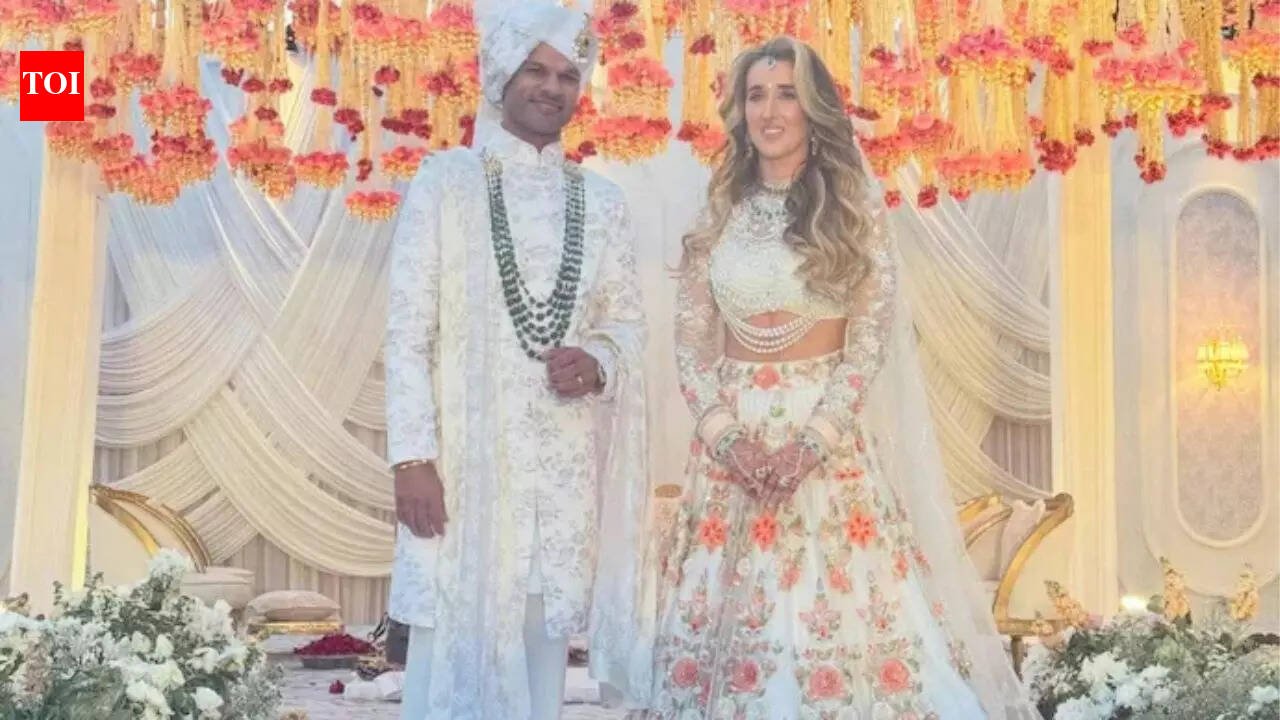
Former India cricketer Shikhar Dhawan has tied the knot with his girlfriend Sophie Shine in a private wedding ceremony on February 21. The couple had been dating for more than a year and had made their relationship public in May 2025. They had earlier announced their engagement on Instagram on January 12, and many fans were expecting the wedding soon after that.Dhawan and Sophie were first seen together during the Champions Trophy 2025 in Dubai. Later, they also appeared together at a media conclave, where Dhawan hinted that he had found love again. The wedding pictures quickly went viral after India cricketer Yuzvendra Chahal shared photos from the ceremony on Instagram with the caption, “Mere Yaar Ki Shaadi Hai.”Before the wedding, the couple also celebrated their haldi ceremony on February 20. Sophie shared pictures from the event on her Instagram account, giving fans a glimpse of the celebrations.This is Dhawan’s second marriage. He separated from his former wife Ayesha Mukherjee in October 2023 after an 11-year-long marriage. Dhawan had married Ayesha in 2011, and she has two daughters from her previous marriage. Their relationship reportedly faced many issues over the years, which eventually led to their separation.During the divorce proceedings, a Delhi court noted that Dhawan had gone through mental stress, observing that his former wife had kept him away from his son Zoravar for several years. The court recorded that Ayesha either did not contest these claims or did not respond to them properly. However, Dhawan was not given permanent custody of his son. Instead, he was granted visitation rights and allowed video calls for a “reasonable duration” in both India and Australia, where Ayesha lives.


Source link

‘Made-in-India chips crucial for a self-reliant India’: PM Modi virtually inaugurates semiconductor facility in UP | India News


Beyond Oil: How India & US Are Securing the Future of AI Chips

Photo credit: ANI

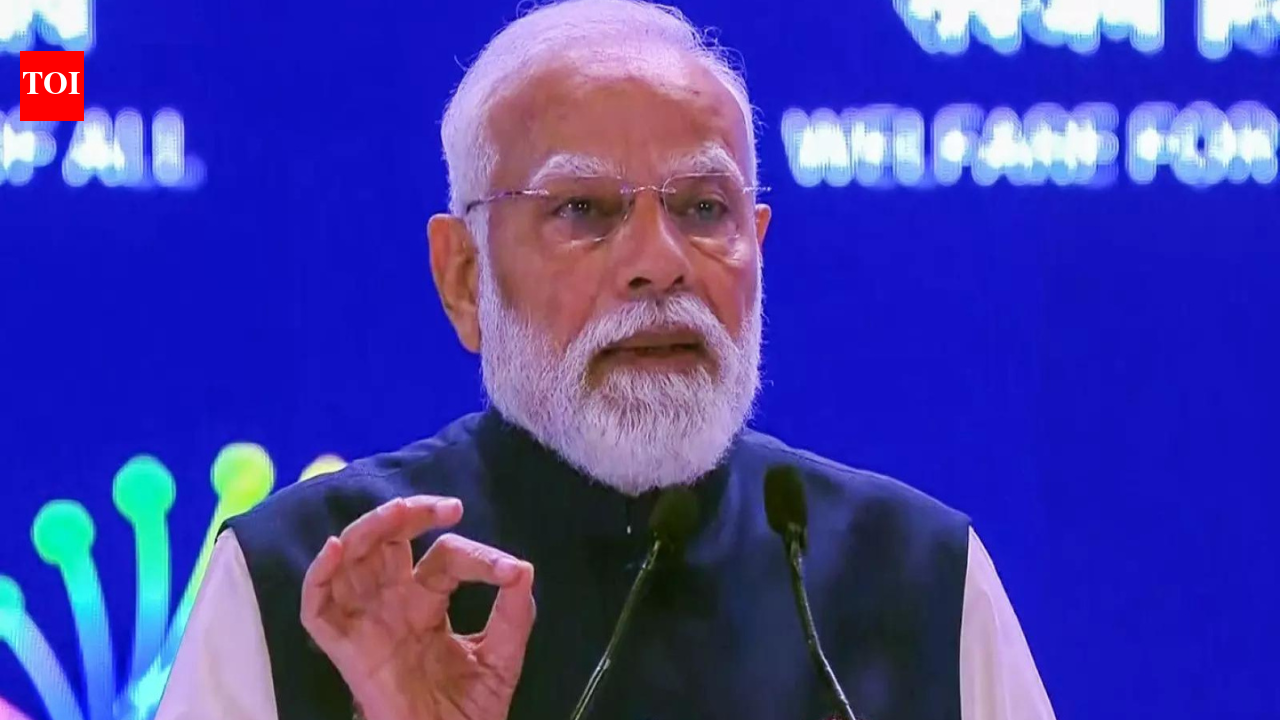
Prime Minister Narendra Modi on Saturday emphasised the importance of self-reliance in India’s technological future, stating that “Developed India will be built only when India is self-reliant. For this, Made in India chip is very important.”Addressing the virtual ceremony to lay the foundation stone of India Chip Pvt Ltd — a joint venture between the HCL Group and Foxconn — PM Modi noted that the global shortage of semiconductor chips during the Covid-19 pandemic had disrupted economies and halted production in factories worldwide.

Beyond Oil: How India & US Are Securing the Future of AI Chips

“Whatever India is doing in the field of technology in this decade, it will become foundation of our capability in the 21st century, the Prime Minister added.Prime Minister Narendra Modi highlighted India’s growing semiconductor ambitions, noting that “India has so far approved 10 semiconductor fabrication and packaging projects under its Semiconductor Mission,” adding that “four of these units are set to commence production very soon.”The PM also welcomed the entry of major companies into India’s chip manufacturing sector, emphasising the need for self-reliance. He called for “atmanirbharta” in the process, underlining the goal of strengthening India’s leadership in the global market.“Today, the arrival of major companies like Foxconn in India and their collaboration in chip manufacturing also sends a global message. A democratic country like India is a trusted partner for the world. Therefore, India’s recognition as the world’s factory is a win-win situation for both India and other countries,” PM Modi said.The new Outsourced Semiconductor Assembly & Test (OSAT) facility will be located in the Yamuna Expressway Industrial Development Authority (YEIDA) area at Jewar, Greater Noida. The 60:40 joint venture between HCL Group and Foxconn represents an investment of Rs 3,700 crore, with operations expected to commence by 2028. The plant will manufacture display driver chips, supporting India’s growing domestic demand for semiconductor components.According to PTI, the project is expected to generate more than 3,500 direct and indirect jobs, foster local supply chains, and attract partners across the semiconductor ecosystem. The facility is designed to process up to 20,000 wafers per month, strengthening a resilient and self-reliant chip supply chain in India.“In the last 11 years, the Prime Minister has established India as powerhouse of electronics manufacturing. India is now ranked third among nations that export electronics. In a month, 3.6 crore chips will be produced from this plant. The brain of the digital screens that you see will now be made in Jewar,” said Union electronics and IT minister Ashwini Vaishnaw.UP chief minister Yogi Adityanath described Jewar as a “jewel not only for UP but also for the country,” adding that the state’s development will be aligned with the Prime Minister’s vision for chip manufacturing.Bob Chen, President of Foxconn’s Semiconductor Business Group, was quoted by news agency PTI as saying, “Today we are ground breaking for India chip. We want to establish reliable semiconductor assembly and testing facility in India. We look forward to growing together and contributing to India’s growth in global technology landscape.”HCL Group Chairperson Roshini Nadar highlighted that the facility will serve both domestic and international markets, positioning India as a significant player in the global semiconductor sector.


Source link

‘Shirtless’ protest row: BJP & Congress workers clash in Indore, pelt stones – watch | India News


'Shirtless' protest row: BJP & Congress workers clash in Indore, pelt stones - watch
Visuals from protest (Video/X)

NEW DELHI: A clash broke out on Saturday between Congress and Bharatiya Janata Party workers during a protest by the BJP against a “shirtless” demonstration by Indian Youth Congress (IYC) members at the India AI Impact Summit. According to the video circulating on social media, the confrontation saw stone-pelting, prompting police intervention to control the situation and ensure public safety.Deputy Commissioner of Police Krishna Lalchandani said that the clash occurred near the Congress office, where the BJP protest was underway. “There were two parties involved. One party was protesting. The protest was near the Congress office. The area had been barricaded, and proper police arrangements had been ensured. Suddenly, some rumour-mongering occurred, and some stones were thrown. Then, the other side also threw stones. Some people were injured… It’s too early to say who threw the first stone,” Lalchandani added.The incident follows a “shirtless” protest staged by Youth Congress workers on Friday inside the Bharat Mandapam, accusing Prime Minister Narendra Modi of compromising the country’s interests during the AI summit. During the demonstration, protesters removed their shirts and raised slogans, drawing attention to what they described as a political and national concern.Patiala House Court on Saturday rejected bail applications for four arrested Youth Congress workers, Krishna Hari, Kundan Yadav, Ajay Kumar, and Narasimha Yadav and sent them to police custody for five days. Police said that the custody was needed to investigate a potential larger conspiracy, including the funding and planning of the protest. Three policemen were reportedly injured during the confrontation.Delhi Police officials said that the protesters had registered online to obtain QR codes to enter the venue and initially planned to use black umbrellas with printed stickers to convey their message.“However, they later felt that the black umbrellas might draw the attention of the security personnel manning the gates, so they changed their plan and got the printed stickers placed on T-shirts instead,” a police source said.The accused reportedly engaged in a scuffle with security personnel and police staff during the protest. Investigators are also examining if the demonstration was part of a wider conspiracy linked to similar protests in Nepal.The lawyer for the accused argued that the protest was a form of political dissent and that the workers were being targeted because of their party affiliation. “Political dissent shouldn’t be crushed like this. The accused are educated office bearers exercising their right to protest peacefully,” the lawyer said.

‘BJP’s reign of terror is ongoing in MP’: Congress reacts to the protest

The Congress party reacting to the incident, blamed the state BJP leadership for the violence. In a post on X, the party wrote, “The BJP’s reign of terror is ongoing in Madhya Pradesh. BJP goons have stormed into the state Congress office. There, these goons engaged in scuffles with Congress workers and caused widespread vandalism. All this thuggery was carried out under the patronage of the BJP government. Here, the government itself is tearing the law to shreds. Immediate action must be taken against these BJP goons.


Source link

Eye-popping rise in one year: Betting on just gold and silver for long-term wealth creation? Think again!


Eye-popping rise in one year: Betting on just gold and silver for long-term wealth creation? Think again!
Before you make the decision on which asset class to invest in, experts believe it’s prudent to look at historical data. (AI image)

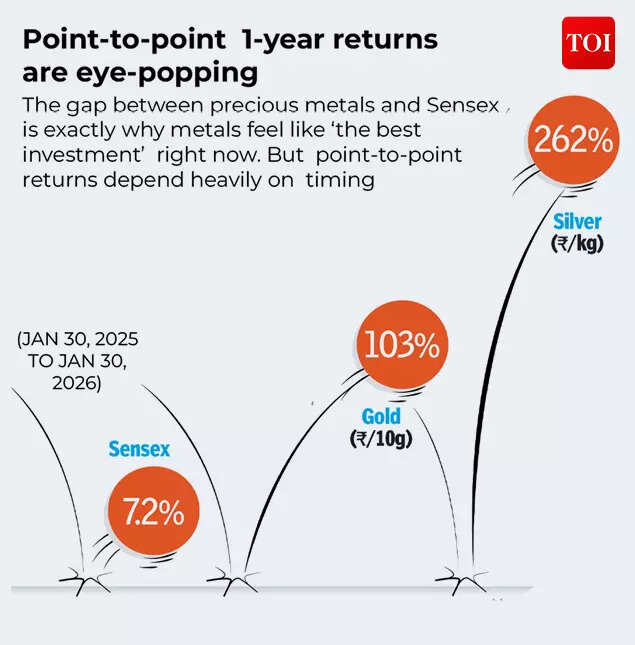
Gold and silver have delivered eye-popping returns over the last one year. In contrast, Sensex and Nifty have delivered a muted performance. Gold and silver have already delivered an exceptional run over the past year, with silver posting gains of around 160% and gold posting over 80% gains domestically in 2025. Over the past one year, precious metals have clearly outpaced equities. Gold in India is hovering around Rs 1.55–1.60 lakh per 10 grams and silver is near Rs 2.60–2.70 lakh per kg after a sharp rally driven by geopolitical tensions, strong central bank buying, inflation concerns and currency weakness. In comparison, the Nifty 50 and Sensex have delivered relatively moderate single-year returns, reflecting a more measured earnings environment.This has prompted investors to wonder if their portfolios should be oriented more towards gold and silver, than equities. But gold and silver have also seen a brutal selloff in the recent weeks, dropping from their record highs, though the precious metals are still sitting on decent returns. Before you make the decision on which asset class to invest in, experts believe it’s prudent to look at historical data to understand how returns in gold, silver and equities shape up over longer time periods.

Point-to-point 1-year returns are eye-popping

Gold, silver, stocks: How do the returns compare over a 1-year, 5-years, 10-years time period?

A commonly asked question in the minds of investors is: where should the hard earned money be put to earn the best returns? Over a 1-year, 5-year and 10-year time period, which asset class has offered the highest returns – gold, silver or equities?Looking at performance across time periods gives useful perspective, and a deeper understanding into investments should ideally be allocated.According to Somil Mehta, Head of Retail Research at Mirae Asset Sharekhan, equity markets tend to be volatile. Stocks can outperform sharply in good years, but also see corrections. Gold and silver usually provide stability, especially during global uncertainty, he tells TOI.Over a 5-year time frame, equities (Nifty and Sensex) generally outperform precious metals, supported by earnings growth and economic expansion. Gold performs well during risk-off phases, while silver remains more volatile, Mehta says.However, according to Mehta, over a decade, equities clearly emerge as the strongest wealth creators. Gold delivers steady returns, acting more as a hedge than a growth asset. Silver’s performance is uneven due to its industrial demand cycle.

Same year, different story- Annual averages & benchmark funds

Experts note that the last one year has been an outlier for precious metals as they significantly outperformed equities, with silver and gold delivering strong gains amid safe-haven demand due to global trade concerns (US tariffs) and geopolitical uncertainty, while Nifty returns remained relatively muted. An analysis by TOI on gold, silver and stock markets over various time-frames notes that annual averages smooth out the ups and downs within the year — closer to how most people actually experience prices.

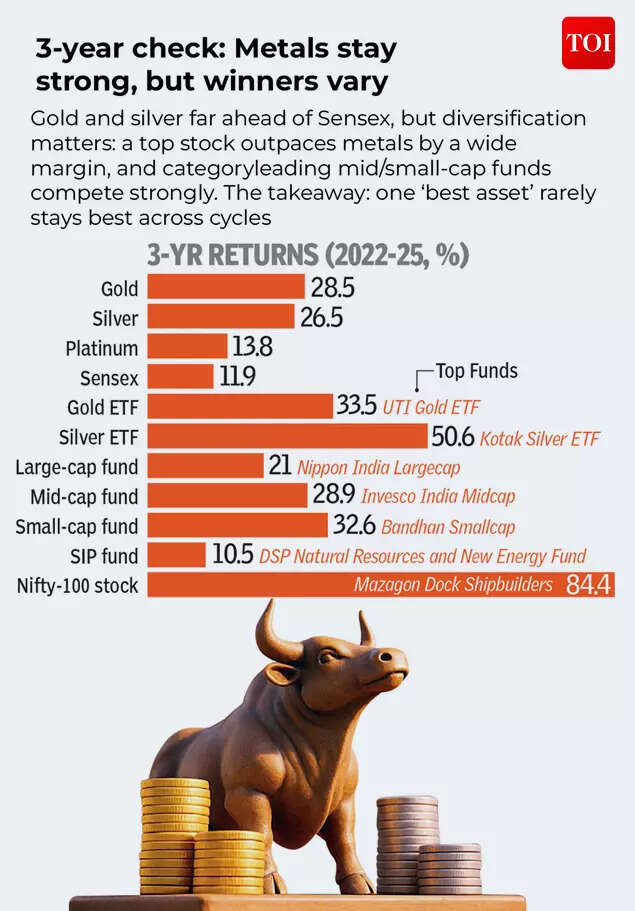
3-year check- Metals stay strong, but winners vary

On a 3-year horizon check the TOI analysis notes: “A top stock outpaces metals by a wide margin, and category-leading mid/small-cap funds compete strongly. The takeaway: one ‘best asset’ rarely stays best across cycles.”

Over 5 yrs, ‘winners’ start looking more alike_ standout stocks sprint

For a 5-year period the winners look different: strong equity funds (mid/small-cap leaders near the high-20s CAGR) look better than metals, and the top-performing NSE-100 stock is in a different league. Message: metals can be easy; equity wealth often comes from riding volatility, says the TOI analysis.

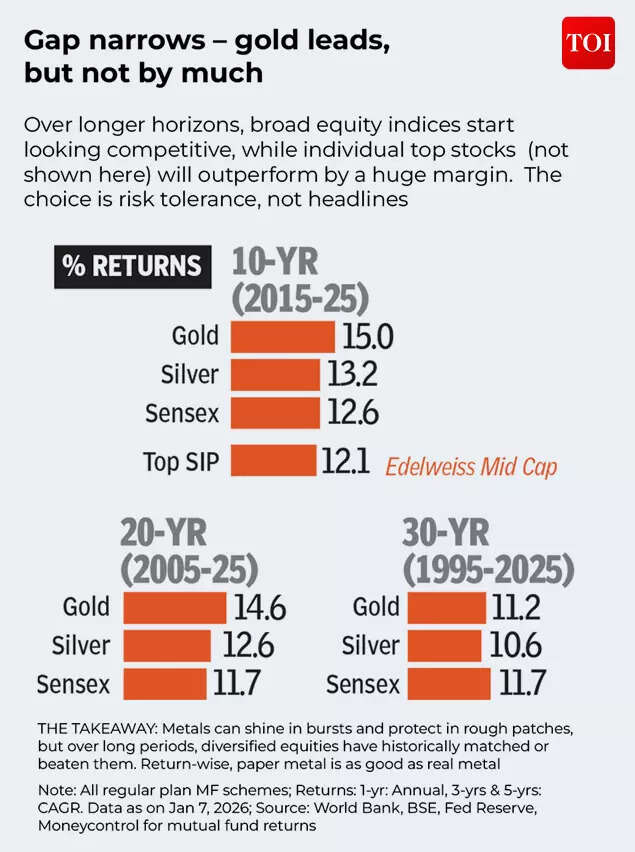
Gap narrows – gold leads, but not by much

Akshat Garg, Head of Research and Product at Choice Wealth notes that when the time frame is expanded, equities continue to demonstrate the power of compounding. “Businesses grow revenues, expand margins and reinvest profits, which creates sustainable wealth over long periods. Gold and silver, on the other hand, do not generate earnings; they primarily act as stores of value and crisis hedges. They outperform during uncertainty, but over full economic cycles equities tend to lead,” he tells TOI.

Will gold and silver outperform stock markets in 2026 as well?

According to Somil Mehta, Head of Retail Research at Mirae Asset Sharekhan, this year equities are likely to outperform precious metals, provided economic growth remains stable.“Gold may deliver moderate returns if global uncertainty, geopolitical risks, or currency volatility persist. Silver could underperform gold due to higher volatility and dependence on industrial demand,” he tells TOI.However, Maneesh Sharma, AVP – Commodities & Currencies, Anand Rathi Shares and Stock Brokers still sees gold and silver outperforming equites.“As far as equity outlook is concerned, fundamental growth numbers remain crucial for the current year. This is evident from the fact that as the Nifty’s price-to-earnings (P/E) ratio hovers around 22.5 as of mid-February 2026, it trades near its 3-year average of 25.2x, but with the Sensex P/E exceeding its 15-year average, it leaves little room for multiple expansion without fundamental earnings acceleration. Hence cautious optimism persists for Nifty returns this year,” he tells TOI.“Gold & Silver are still expected to outperform equities amid persistent global uncertainties, including geopolitical tensions & structural imbalances in developed economies leading to growing deficits. Central bank demand remains a bullish pillar for gold prices, with many central banks indicating plans to increase their holdings this year although pace of increase is expected to moderate,” he says.While anticipating a good year for gold and silver, Sneha Poddar, VP-Research, Wealth Management, Motilal Oswal Financial Services sees equities giving a 10% return.“Broader commodities space, especially precious metals, could continue to stay resilient in 2026, though not in a one-way rally like last year; instead, may see phases of consolidation with the price levels subject to revision as per evolving macro and liquidity conditions,” she says.The expert anticipates that equities will return to the forefront with an expected 10% price return for Nifty over one year, considering improving earnings trajectory with PAT expected to grow at around 12% CAGR over FY25-27E. “We anticipate improved earnings growth, given the supportive domestic policies (both fiscal and monetary) and strengthening global trade opportunities following recent announcements of trade deals (US, EU) and foreign trade agreements,” she told TOI.Akshat Garg, Head of Research and Product at Choice Wealth sees volatility in the prices of gold and silver this year. “Metals may remain supported if global risks and liquidity trends persist, but after a strong rally volatility cannot be ruled out,” he says.“The bigger lesson for investors is that leadership rotates. Instead of chasing the recent outperformer, diversification and disciplined rebalancing work better,” he tells TOI.Taking a different view, Jateen Trivedi, VP Research Commodity, LKP Securities sees both gold and silver performing due to ongoing global uncertainties. “Given continued geopolitical tensions, trade uncertainties, currency volatility, and sustained central bank buying, bullion may remain structurally supported into 2026. At the same time, equity markets could face sectoral challenges, particularly from global AI disruption and earnings pressures,” Trivedi tells TOI.Broadly he sees gold in the Rs 1,75,000 – Rs 1,85,000 range; silver in the Rs 3,00,000 – 3,25,000 range and Nifty at around 27,000 (assuming no major geopolitical escalation).“Metals may continue to outperform if uncertainty persists, though volatility will remain high,” he says.

So, should gold stay in your portfolios?

Time is a greater teacher: What’s the biggest lesson?

The biggest lesson from the historical performance of gold, silver and equities is clear: don’t chase the recent winner, don’t bet blindly on last year’s outperformer!“This is perhaps the oldest mistake in investing, and also the most common. Investors who rushed into silver after its 2025 rally are taking on far more risk than they realise. Those who ignored gold for years before 2025 paid a price too. The data across decades tells us clearly: no single asset stays on top forever,” says InCred Money.Somil Mehta, Head of Retail Research, Mirae Asset Sharekhan

  1. No single asset wins every year.
  2. Equities create long-term wealth, but gold protects portfolios during uncertainty.
  3. Timing markets is difficult, asset allocation matters more than asset selection

For a 5-10 year time horizon, Somil recommends a portfolio that has 55-65% in equities (focus on quality large caps and structural sectors); 10-15% for gold and silver with gold as the main hedge; 20-30% in debt or fixed income for stability and liquidity.Somil Mehta says: “Equities remain the best long-term wealth creator, while gold plays a supporting role. A balanced portfolio, not chasing short-term winners, is the most reliable way to build wealth over time.”For Sneha Poddar of MOFSL the sure-shot way to win in the long-term is that investing ultimately hinges on discipline, diversification and a clear understanding of the asset class.

20/02/2026 Unit Close YoY % 5 Year % 10 Year %
Commodity
Spot Gold $/oz 5,107 73.96% 169.05% 307.07%
MCX Gold Rs/10 kg 607.83% 82.39% 212.81% 443.29%
Spot Silver $/oz 84.65 160.80% 220.60% 417.49%
MCX Silver Rs/kg 2,52,944 162.94% 271.40%
Equity
Nifty 50 Index 25,571.30 12.17% 82.89% 228.83%
Sensex BSE 82,814.70 9.96% 73.43% 226.30%

Source: Anand Rathi Shares & Stockbrokers“While metals often outperform during volatile macro phases, equities deliver steadier returns and should remain the core long-term allocation, with gold and silver serving as strategic hedges within a well-balanced portfolio,” she says.“For a balanced and relatively stable portfolio, gold should ideally carry a slightly higher weight than silver depending on investors risk profile and tenure of investment. Therefore, portfolios can ideally comprise 85-90% equities and 10–15% gold/silver. Over longer periods, equities historically deliver steady wealth creation, while metals act as portfolio stabilisers rather than return drivers,” she says.Akshat Garg of Choice Wealth is of the view that a portfolio with roughly 60–70% equities, 20–30% debt and 5–10% allocation to gold and silver offers a balanced blend of growth, stability and protection for a 5-10 year time period.The important thing to understand is that equities, metals, bonds — all carry cycles of outperformance and correction. “The key lesson is diversification. Chasing recent winners without balance increases portfolio risk. A balanced mix helps capture upside while managing long-term volatility,” says LKP Securities’ Jateen Trivedi.InCred Money notes that there is no one-size-fits-all allocation, but a simple rule of thumb is this: over a 5-year horizon, lean balanced, around 50–60% equities and 40–50% high-quality fixed income, so you participate in growth without exposing near-term goals (like a home down payment or business capital) to excessive volatility. Over a 10-year horizon, you can afford to tilt more toward growth, 60–75% equities and the rest in bonds or other stable assets, because time smooths out market cycles and compounds returns. The real driver is your risk appetite and goal clarity: if a 15–20% drawdown keeps you up at night, dial down equities; if your goals are long-term wealth creation and you can stay invested through volatility, lean into growth. Allocation should protect your sleep first, and then grow your wealth, says InCred Money.As InCred Money concludes: Gold is your safety net. When stock markets fall, gold tends to hold its ground or rise. It doesn’t make you rich overnight, but it protects what you already have. Silver is more of a wild card, unfortunately, because of speculators. It can shoot up in good times, but it can fall just as hard. Stocks, over time, are the real wealth builders, but they demand patience.The investor who wins over the long run is rarely the one who picked the hottest asset of the year. It’s the one who stayed diversified, stayed calm, and didn’t let headlines drive their decisions.

Gold, Silver Under Pressure After Peaks: Should You Invest And Hold Precious Metals Or Sell Off?

(Disclaimer: Recommendations and views on the stock market, other asset classes or personal finance management tips given by experts are their own. These opinions do not represent the views of The Times of India)


Source link

‘Why did we compromise our … ‘: Congress raises 7 questions after US court strikes down Trump tariffs


'Why did we compromise our ... ': Congress raises 7 questions after US court strikes down Trump tariffs
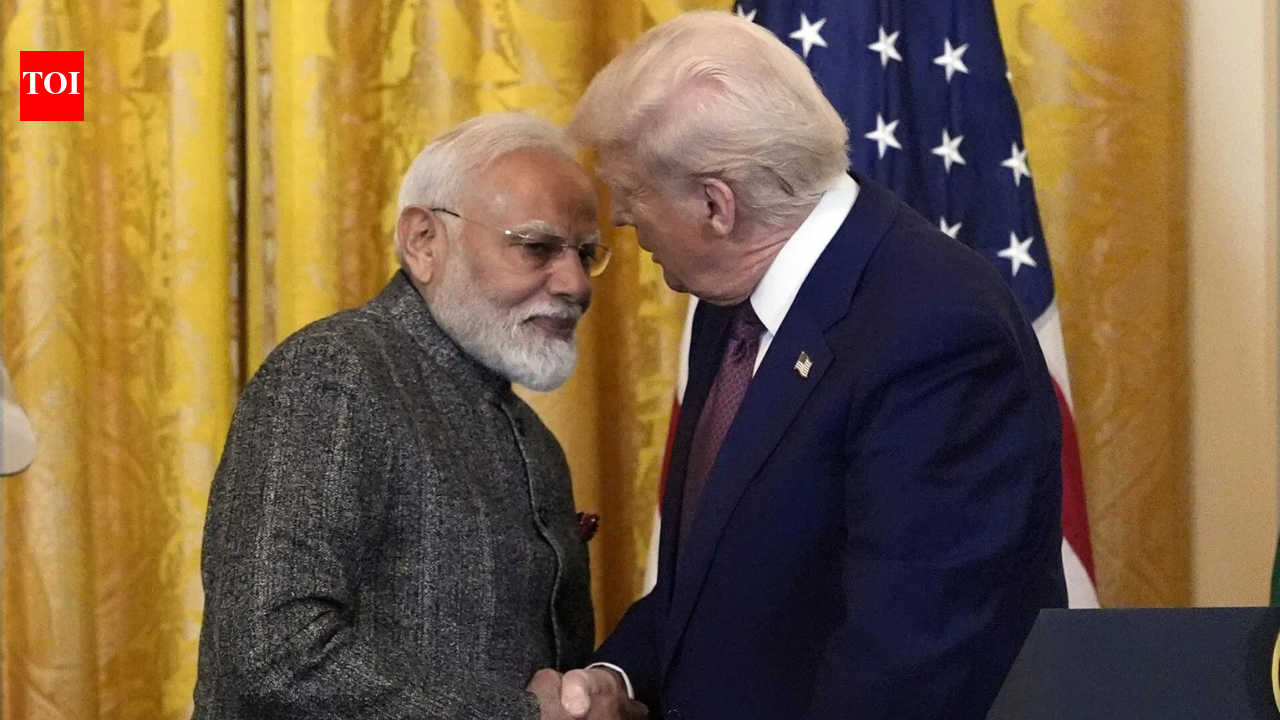
PM Modi and US President Donald Trump (File photo)

NEW DELHI: The Congress on Saturday once again targeted Prime Minister Narendra Modi over the recently finalised interim trade agreement, earlier this month, between India and the United States, which took nearly a year to reach mutual consensus. The largest opposition party’s attack on PM Modi came after the US Supreme Court struck down Donald Trump’s tariffs, a key weapon of the trade policy pursued under the MAGA supremo.In a post on X, the party outlined what it called the story of a “trade deal and compromised PM,” listing key developments after the top court’s decision. Referring to the Friday’s ruling, the Congress said that the US Supreme Court had struck down Trump’s reciprocal tariffs, after which he invoked Section 122 of the Trade Act of 1974 to impose a fresh 10 per cent global tariff on imports.The grand old party claimed that the ruling would mean India now faces a 10 per cent tariff rate, while also pointing to the interim trade deal announced earlier this month that fixed tariffs on Indian goods at 18 per cent. It further alleged that “India committed to reducing tariffs on various US goods to 0% and buying goods worth $500 billion over 5 years from the US”Congress also raised a series of pointed questions about the trade pact signed between New Delhi and Washington.“What was the rush to plead for a trade deal, bending backwards and agreeing to an anti-India deal?” the party asked.“The trade deal had been pending for months, why did Modi push for it suddenly and agreed on a 30 min phone call?” it said, questioning the timing of the agreement.The Congress further asked, “Why did we agree to huge imports from US, and reducing tariff on its products to zero?” It also questioned the impact on the agricultural sector, asking, “Why did we agree to sacrifice the interests of our farmers?”Raising concerns over data and energy security, the party said, “Why did we agree to giving all our data on a platter to the US?” and “Why did we compromise our energy security by agreeing not to buy Russian oil?”It also took aim at the tariff structure under the deal, asking, “How foolish were we to celebrate a 6X increase in our tariff from under 3% to 18%?”“The answer to all these and other questions is a COMPROMISED Prime Minister,” the Congress alleged. Meanwhile, the PM Modi-led government said it is closely examining the implications of the US Supreme Court’s ruling on tariffs.In its first official response, the ministry of commerce and industry said, “We have noted the US Supreme Court judgement on tariffs yesterday. President Trump has also addressed a press conference in that regard. Some steps have been announced by the US administration.”“We are studying all these developments for their implications,” the ministry added.Meanwhile, the PM Modi-led government said it is monitoring the situation and assessing the implications of the US Supreme Court’s ruling.In its first official response, the ministry of commerce and industry said, “We have noted the US Supreme Court judgement on tariffs yesterday. US President Trump has also addressed a press conference in that regard. Some steps have been announced by the US administration.”“We are studying all these developments for their implications,” the ministry added.


Source link

‘Beating Australia in Australia really special’: Smriti Mandhana after India’s 3-1 T20I series win | Cricket News


'Beating Australia in Australia really special': Smriti Mandhana after India's 3-1 T20I series win
Smriti Mandhana (Photo by Mark Brake/Getty Images)

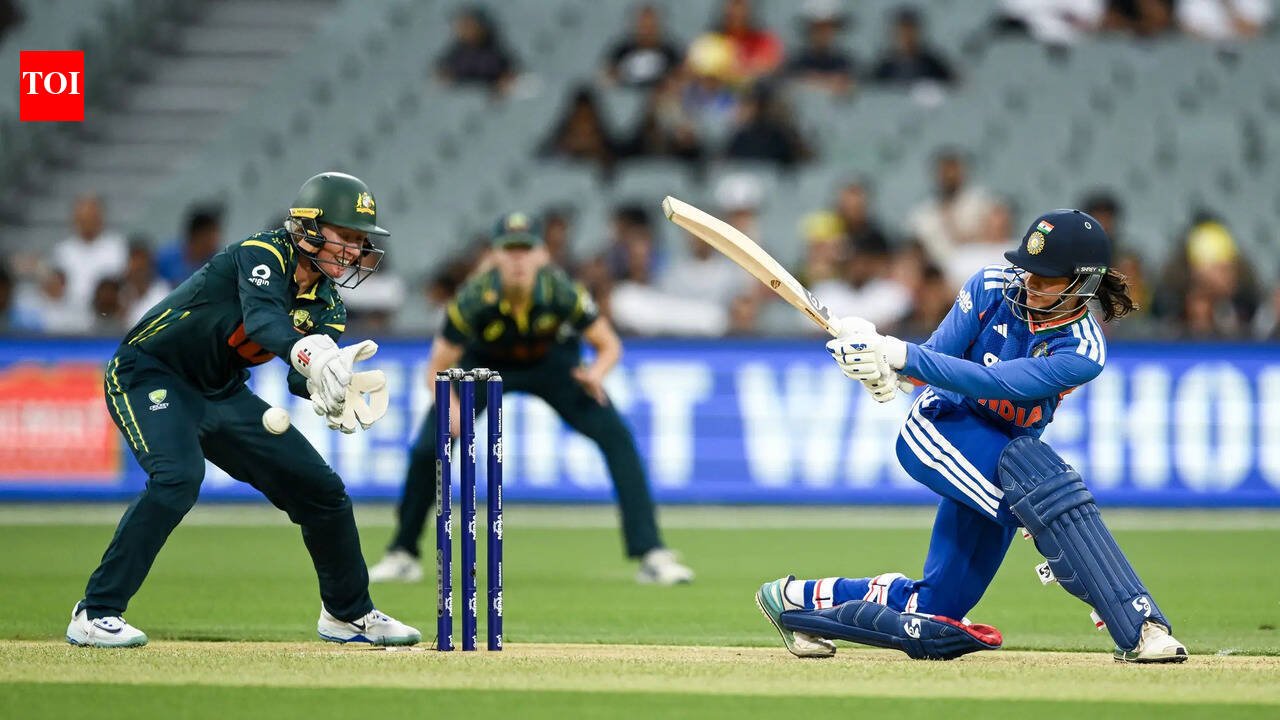
NEW DELHI: Smriti Mandhana expressed her delight after India’s 17-run win over Australia in the series-deciding T20I, calling the victory “really special.” She also stressed that the team will “not celebrate too much” and will quickly shift focus to the upcoming ODI series, starting Tuesday.India clinched the final match in Adelaide to take a 4-2 lead in the multi-format series. A match-winning 121-run partnership between Mandhana and Jemimah Rodrigues helped India post a strong 176/6. Mandhana scored 82 off 55 balls and was named Player of the Match, while Rodrigues added 59.

T20 World Cup: Pakistan coach Mike Hesson on Babar Azam, Salman Ali Agha and Shaheen Shah Afridi

Speaking after the game, Mandhana said, “It was good to contribute to the series win. I think beating Australia in Australia is something really special. I’m really happy for the team and glad that I could contribute.” She praised Rodrigues for changing the momentum early in their partnership, saying, “When she came in, I think I was 16-ball 15 and still getting my timing, and she came in, got three or four boundaries, got the momentum going, and I could take some time.” She added that those quick boundaries helped calm her down and credited Rodrigues for her knock.Mandhana also spoke about the importance of the win, saying, “I think we did beat them in 2016 back when we had come here, but I think we’ve played T20 after a very long time in Australia, so beating them is really nice.”India’s bowlers then delivered a strong performance, picking early wickets and keeping Australia under pressure. Ashleigh Gardner scored 57, but India’s disciplined bowling and fielding, including a stunning diving catch by Rodrigues, restricted Australia to 159/9.Despite the memorable win, Mandhana remained grounded and focused on the future. “We will move on to the ODI series and not celebrate too much,” she said.With confidence from the T20I triumph, India will now prepare for the ODI series starting February 24, as they look to continue their strong run in Australia after their historic World Cup win last year.


Source link

Bomb threats, pollution alerts and online classes: The new holiday calendar in schools | India News


Delhi Schools On High Alert After Khalistan Bomb Threat Emails Trigger Panic Across National Capital

Amid online classes, pollution and bomb threats, school calendar today has new holidays

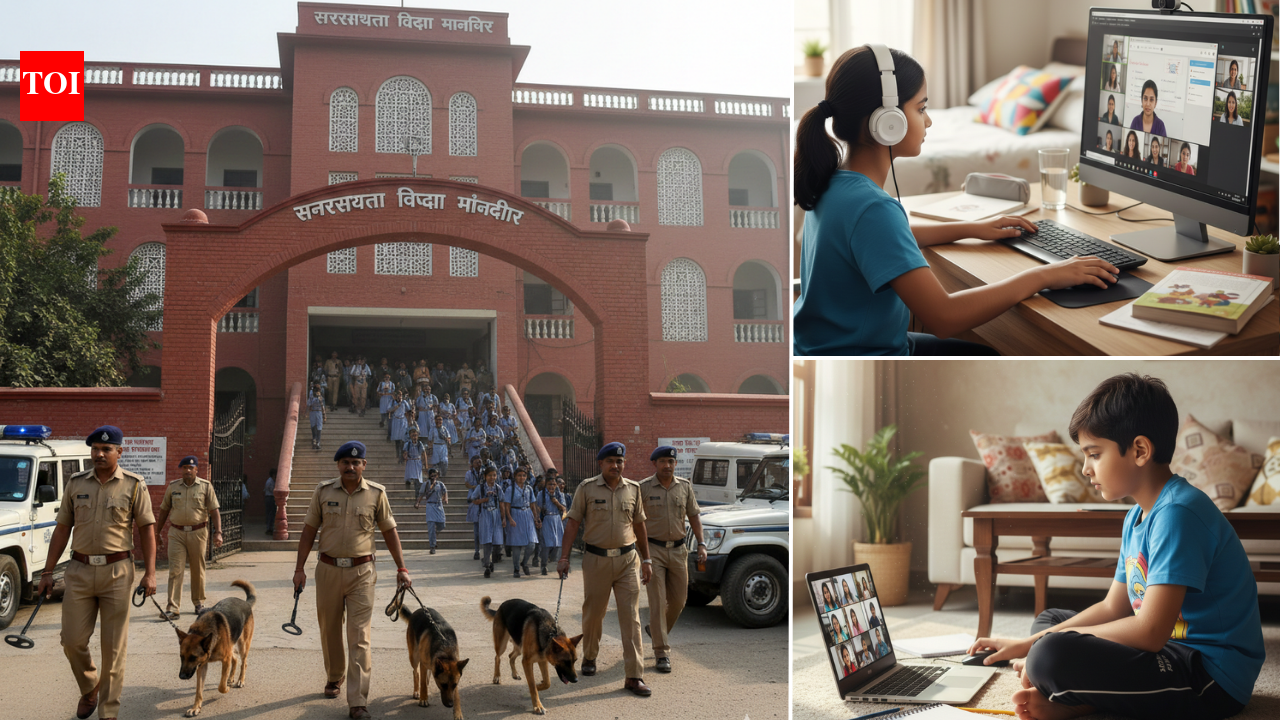
Remember waking up as a child to the sound of rain pouring and clouds rumbling, your very first thought whispering, “Will it be a rainy holiday today?”Let’s say the modern-day school life has a new form of rainy holiday.Books have given way to tablets, chalkboards to smart boards. And the much-anticipated rainy-day “chutti” has been replaced by pollution-triggered online classes and bomb threat evacuations.In a recent incident, multiple schools in Ahmedabad, Gujarat, received bomb threat emails.

Delhi Schools On High Alert After Khalistan Bomb Threat Emails Trigger Panic Across National Capital

Students were dispersed, investigations were launched, and nothing suspicious was ultimately found. Yet the disruption was real.Such incidents are no longer isolated. They mark a shift few could have imagined — a shift that is fast becoming routine.So, in this evolving landscape, has the idea of the impromptu day-off also transformed?Technology is no longer an add-on; it is the norm. Distance learning now runs parallel to physical classrooms. Since Covid, technology has been intricately woven into the students’ daily lives. Online classes have become the default response to disruption. For today’s children, a cancelled school day no longer translates into freedom.But in preserving continuity, something else has changed.But the larger question lingers: How is this reshaping the academic landscape? And more importantly, what is it doing to the children growing up within it? Have repeated pollution alerts and bomb threats begun to feel routine? Is a generation slowly being desensitised to dangers that should provoke alarm?The topography of the golden days of one’s life, the school life, has changed on a grand scale.For caregivers, the transition brings layered emotions. There is comfort in knowing education no longer collapses at the first sign of disruption. Technology offers stability.Yet there is unease, too. A nostalgia for simpler interruptions.And somewhere between nostalgia and necessity, a new version of school life is quietly taking shape — one that no one fully anticipated, yet one that an entire generation is learning to call normal.

The “Rainy Day” logins

Parents describe a clear post-Covid shift in school life, where technology and online classes have moved from an emergency measure to a default backup for almost any disruption.Tejash Tarun, a Bengaluru-based parent, points to how even logistical inconveniences now trigger digital shifts rather than cancellations.“Even for relatively minor issues, say road renovations on the last stretch leading to the school, the classes are not cancelled now. Instead, the school would send out notifications for a week of online classes,” he says.His observation underscores a broader structural shift. Continuity now outweighs interruption, and the idea of a pause once embedded in school culture is steadily disappearing.Radhika Ashok Kumar, another parent, also notes that administrative and logistical needs increasingly push learning online.“Last year, the school was the centre for boards. So some sessions were planned online.”But online classes come with their own set of challenges. Tarun highlights the material demands that online education imposes on households.He says, “If a child is attending classes from home, they also need a proper space to study. Secondly, they need a suitable device. It cannot just be a mobile phone for a few minutes. A laptop or a computer is essential.”He further goes on to highlight the drawbacks the parents might face in their professional life, saying, “In case of working parents, and the work-from-home arrangements at offices largely over, if a child’s school suddenly shifts to online classes, it creates an immediate challenge. They may have to take leave or try to manage work from home, if that option is even available.”An idea largely promoted as institutional flexibility can, at the household level, translate into logistical strain.

Space, screen and social life

The learning space has extended beyond the school campuses.Across conversations, there is broad agreement that offline school remains irreplaceable for social, emotional and overall personality development – “no alternate” to going to school for real-world interaction with peers and teachers, learning social norms, and building discipline and routine.Manish Masoom, a Delhi-based parent whose child’s classes have witnessed an online shift due to the implementation of GRAP measures, shares the value of real-world interactions over online classes.

Delhi AQI

He says, “Ideally, children should go to school, sit in a classroom, and learn alongside others. After all, human beings are social by nature. Whether the reason is pollution, a strike call, or any other disruption, shifting to online classes creates its own set of problems.”Tarun further elaborates on how he views the micro-lessons embedded in everyday school life.He says, “Beyond academics, school is where children learn community interactions. A classmate may borrow my pencil today; tomorrow, I might borrow their notebook. These small exchanges teach cooperation, sharing, and understanding.”When asked about the drawbacks of online classes, the parents highlighted the lack of preparation for their kids as offered by the offline classes.Radhika shares, “For the lower grades, I feel it was still manageable, at least in my son’s case. But in the higher classes, I have noticed that children struggle with subjects like Mathematics, Science, and Chemistry.”She further goes on to add that online classes often fall behind in preparing the students for a broader grasp on the pressure, as she says, “When students were in Class 9 during online sessions, some of them could not build a strong foundation. As a result, when they moved to Class 10, they found it hard to handle the academic pressure because their basics were not clear.”

Dangers of SO2

In preserving academic calendars, schools may have inadvertently widened conceptual gaps. And to top it, screen time has emerged as another difficult battle for parents.For some, e-learning sessions have significantly increased the number of hours their children spend in front of screens. For others, avoiding screens altogether feels nearly impossible.Parents point out that online classes add a non-negotiable stretch of screen exposure to a student’s day. However, beyond that, televisions, mobile phones, gaming, and social media continue to contribute to consistent digital engagement.In a landscape where education itself is mediated through devices, setting boundaries is no longer as simple as taking a gadget away. It becomes a delicate balancing act which calls for weighing academic necessity against cognitive rest, connectivity against overexposure.

Shadows in the hallway: The new security normal

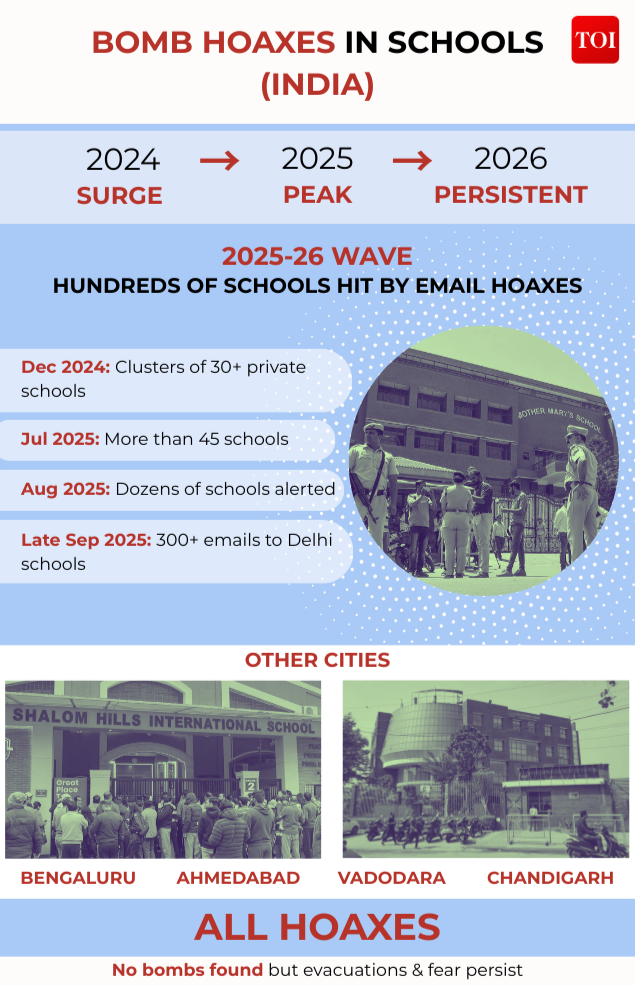
If digital shifts represent one dimension of change, recurring bomb threats and hoax emails represent another. It not only becomes a logistical issue but also influences the emotional climate.When it comes to bomb threats and hoax emails, parents’ memories cluster around a new kind of routine disruption. But how is this new chaos impacting children? Where is it driving their sensibility, and how are the schools and parents able to handle it?In a unanimous vote, the parents shared that the schools have done a commendable job in managing the situation without causing unnecessary panic for the students. There might or might not be an evacuation based on the intensity of the threat, but the students were surely not conveyed the panic.The evacuation was carried out calmly, without triggering direct panic among students, and was accompanied by clear and timely communication with parents.

Bomb threats in Indian schools

Bomb threats in Indian schools

For rather younger kids, parents found it best keep the situation discreet for them.Neha Arora, a teacher and a parent based in Delhi, sheds light on the approach. She says, “Considering how young the children are, the school did not make any effort to explain the situation to them in clear or direct terms. We have also consciously kept him away from such news and incidents, as he is still too young to fully understand these concepts.”Older children, however, operate in a different information ecosystem. With access enabled, they have an extended curiosity about what happened.Aakansha Aashu shares how her 15-year-old reacted after his school was evacuated following a bomb threat message. She describes how curiosity shapes their reactions.“My son got deeply involved in discussions. Setting everything else aside, they start talking about who was involved, who the culprit might be, and who did what,” she says, “He didn’t enjoy these conversations, but there was no real sense of fear among them. They didn’t seem frightened either.”Masoom on the inevitability of information flow in the digital age. He goes on to add that his son has been curious about the incidents around in general. Despite being only 10 years old, he reads and understands everything.He attributed this awareness to access to technology. Whether they talk about certain things or not, the kids themselves go on to explore and understand and as a final step, they come back to their parents to get the answers.He says, “In today’s situation, whether I explain things to him or not, he already knows a lot. This information reaches children directly. Even if he does not watch the news, countless content creators are discussing such topics in different ways, some in a serious tone, others humorously or theatrically.He further adds, “Naturally, when children come across such content, they become curious. They try to understand it at their own level and then come to us with questions. He is only 10 years old — but they are certainly aware of more than we might expect.”

The new landscape of normal

At first glance, the contrast can feel almost apocalyptic. But history reminds us that every generation grows up in a version of the world reshaped by its time.What we are seeing today is not just a change in how schools function — it is a shift in what “normal” feels like for children.The simple thrill of an unexpected holiday, the shared pause when life briefly slowed down, the innocence of being shielded from larger anxieties — these small but meaningful parts of childhood are not fading, but is remolding itself.In their place stands a system optimised for stability, but one that asks children to adapt continuously while keeping their curiosity well fed.The question is no longer whether education can continue amid disruption. It clearly can.The more important conversation lies elsewhere: as schools evolve between nostalgia and necessity, how do we preserve the human rhythms, the joy, the pause, the sense of ease of the school day?


Source link

‘Lured with games, money, gifts’: In landmark order, UP couple get death for sexually abusing 33 boys, selling their videos | Prayagraj News


JHANSI/LUCKNOW: A Pocso court in UP’s Banda sentenced to death Friday a former govt junior engineer and his wife for sexually abusing 33 boys over a decade, some as young as three, and selling videos and pictures of their torture on the dark web to customers across 47 countries.Additional district judge PK Mishra said convicts Ram Bhawan (50) and Durgawati (47) inflicted such physical and psychological trauma on the survivors – some required hospitalisation for injuries to their genitals and a few developed squint eyes – that their crimes deserved to be categorised as “rarest of rare”.Also read: ‘Caused severe psychological harm’: Why court called it a ‘rarest of rare’ case; UP couple gets death for sexually abusing 33 boys“The sheer scale of this victimisation across multiple districts, combined with the extreme moral turpitude of the convicts, marks this as a crime of such an exceptional and heinous nature that it leaves no room for reformation, necessitating the ultimate judicial deterrent to meet the ends of justice,” states the sentencing order.The court directed the UP govt to pay Rs 10 lakh in compensation to each of the 33 victims.Ram Bhawan, who worked in the UP jalkal (waterworks) department, and Durgawati would lure children by offering them access to online video games along with money and gifts. The couple remained active in Banda and Chitrakoot from 2010 till 2020, when Interpol got CBI involved in an investigation into dissemination of content showing child sexual abuse on the dark web.CBI registered an FIR on Oct 31 that year after the trail led to Ram Bhawan and Durgawati. The agency filed a charge sheet documenting their crimes on Feb 10, 2021.Special public prosecutor Kamal Singh Gautam said the case stood on overwhelming evidence of what the children were subjected to. “The survivors are still suffering the psychological trauma caused by the predators,” he said.CBI got medical experts from AIIMS Delhi to examine 25 of the children who suffered severe injuries at the hands of the convicts. The prosecution relied on their reports, digital evidence and the testimonies of the children to build their case and seek capital punishment to the perpetrators.Additional district judge Mishra convicted the couple of offences ranging from aggravated penetrative sexual assault and using children for pornographic purposes to abetment and criminal conspiracy under relevant sections of the Pocso Act and IPC.


Source link

Deep Dasgupta unveils his preferred India XI for the T20 World Cup 2026 Super 8 showdown against South Africa


As the ICC T20 World Cup 2026 shifts into high gear, the Super 8 stage presents a mouth-watering clash between two undefeated heavyweights: India and South Africa. Set to take place at the iconic Narendra Modi Stadium in Ahmedabad on Sunday, February 22, this fixture carries significant weight for the Men in Blue as they look to defend their crown. Amidst the tactical buzz, former Indian wicketkeeper-batter and renowned commentator Deep Dasgupta has weighed in on the selection headaches facing the Indian management, specifically regarding the balance of the bowling attack.

Deep Dasgupta reveals his India XI choices for the Super 8 clash against South Africa

Dasgupta believes that India’s final XI will hinge on two “interconnected” decisions, primarily involving the choice between spin-bowling all-rounders Axar Patel and Washington Sundar. According to Dasgupta, the selection is not just about the individual players, but how they facilitate the usage of India’s spearhead, Jasprit Bumrah.

If Arshdeep Singh is playing, they might go with Axar Patel,” Dasgupta noted during an interaction on Star Sports. However, he argued that if the team decides to bench Arshdeep to bolster another department, Sundar becomes the primary choice. The rationale lies in Sundar’s proficiency with the new ball. By having Washington bowl the initial powerplay overs, captain Suryakumar Yadav gains the “freedom” to preserve Bumrah’s four overs for high-impact phases later in the innings.

Dasgupta also pointed out that South Africa’s batting lineup—featuring left-handers like Quinton de Kock, Ryan Rickelton, and David Miller—makes a compelling case for Washington’s off-spin. He observed that Washington was likely given a game against the Netherlands specifically to get into the groove for this specific tactical matchup. Importantly, Dasgupta reassured fans that opting for Sundar over Axar wouldn’t hurt the team’s batting depth, stating that “Washington is no mug with the bat either” at the number eight position.

Also READ: T20 World Cup 2026: R Ashwin reflects on India’s form, highlights bright signs before Super 8

India’s dominant path with an unbeaten streak to the Super 8s

India enter the Super 8 stage riding a massive wave of momentum, having finished the group stage with a perfect record. Their journey through Group A was a testament to their clinical consistency, securing four wins in as many matches.

The Men in Blue kicked off their campaign with a 29-run victory over the USA, followed by a dominant 93-run win against Namibia. The high-voltage clash against arch-rivals Pakistan in Colombo saw India emerge victorious by 61 runs, a result that effectively sealed their progression. In their final group game against the Netherlands in Ahmedabad, India posted a formidable 193/6, headlined by Shivam Dube’s explosive 66 off 31 balls. Despite a spirited chase from the Dutch, India held their nerve to win by 17 runs, extending their T20I winning streak to an incredible 12 matches.

This unbeaten run has been defined by a different “Player of the Match” in nearly every game, from Suryakumar Yadav and Hardik Pandya to Ishan Kishan and Dube, showcasing a squad where everyone is contributing to the collective goal.

Deep Dasgupta’s predicted India XI:

Abhishek Sharma, Ishan Kishan, Tilak Varma, Suryakumar Yadav, Hardik Pandya, Shivam Dube, Rinku Singh, Washington Sundar, Axar Patel, Kuldeep Yadav, Jasprit Bumrah

Also READ: ICC announces complete list of teams qualified for the T20 World Cup 2028


Source link

India seal three-match T20I series in Australia as Smriti Mandhana hits fifty in final match | Cricket News


India seal three-match T20I series in Australia as Smriti Mandhana hits fifty in final match
Smriti Mandhana of India (Photo by Mark Brake/Getty Images)

India Women beat Australia Women by 17 runs on Saturday in the third T20I match in Adelaide to win the series 2-1. Smriti Mandhana was the star with the bat, while Shree Charani and Shreyanka Patil impressed with the ball for India.India won the toss and chose to bat first. Mandhana and Shafali Verma opened the innings. India had a steady start, but Shafali got out early.

How Suryakumar Yadav and Tilak Varma are hurting India | T20 World Cup

Mandhana then built a strong partnership with Jemimah Rodrigues and helped India take control of the match. She played a brilliant innings and scored 82 runs off 55 balls, hitting several boundaries and sixes. Mandhana reached her fifty in just 38 balls and kept the scoreboard ticking with confident strokes.Jemimah Rodrigues also played well and scored 59 runs, while Richa Ghosh added quick runs at the end with 18 off 7 balls. India lost a few wickets in the final over but still finished with a strong total of 176 for 6.In response, Australia started aggressively. Openers Georgia Voll and Beth Mooney scored quickly in the first over, but India struck back fast. Shreyanka Patil dismissed Voll, and Shree Charani got Mooney out soon after. Ellyse Perry was also dismissed early, leaving Australia in trouble at 32 for 3.Ashleigh Gardner fought hard for Australia and scored 57 runs, but she did not get much support from the rest of the batters. India’s bowlers kept taking wickets regularly, and Australia finished on 159 for 9, falling short by 17 runs.Shree Charani and Shreyanka Patil took three wickets each and played a big role in restricting Australia. Mandhana was named Player of the Match for her match-winning innings.With this win, India sealed the T20I series 2-1 in Australia.


Source link