Breaking News
T20 World Cup: India’s winning streak ends in humiliation; lose by 76 runs to South Africa | Cricket News


T20 World Cup: India's winning streak ends in humiliation; lose by 76 runs to South Africa
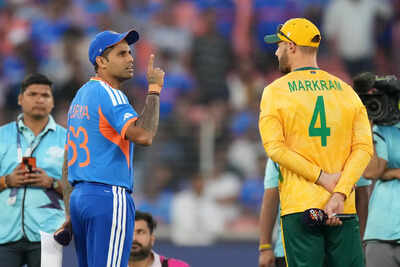
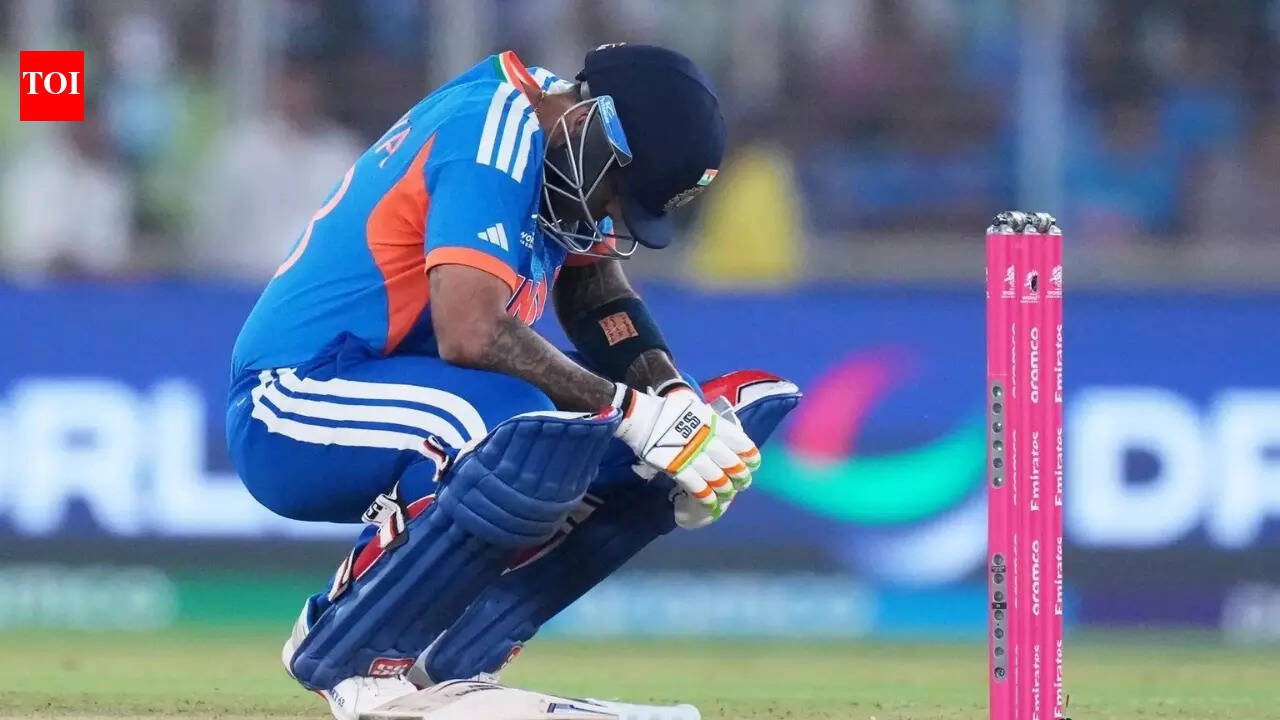
Suryakumar Yadav takes a breather after getting hit by a delivery from South Africa’s Lungi Ngidi during the T20 World Cup cricket match between India and South Africa in Ahmedabad, India, Sunday, Feb 22, 2026. (AP Photo)

TimesofIndia.com in Ahmedabad: The first game of their Super 8 campaign was a reality check for the Indian cricket team as they were completely outplayed by South Africa at the Narendra Modi Stadium in Ahmedabad. Chasing the 188-run target, the famed batting line-up never got going and succumbed to the big-game pressure in front of over 90,000 people. The run-chase lacked application, intent, and discipline. Whatever could go wrong, went wrong for Suryakumar Yadav & Co as they lost the fixture by a heavy 76-run margin.Questionable shot selection, a lack of partnerships, and some fine bowling by South Africa led to the hosts’ downfall, ending their unbeaten 12-match streak in T20I World Cups. For a side that had dominated the format since winning the title in the Caribbean in 2024, Sunday’s showing, particularly the batting, was nothing short of an embarrassment. The team, which effortlessly posted huge scores and breezed past massive totals, managed only 57 at the half-way mark of the run-chase and had half their side cooling their heels in the dugout.Concerning signs were apparent in the group stage too, but the bowlers continued to find a way and do the job. However, the cracks were completely exposed when they were asked to chase. The pressure of the big stage clearly overwhelmed the batting as Ishan Kishan, Abhishek Sharma and Tilak Varma played some very ordinary shots. Abhishek sighed with relief when he scored his first run of the tournament, courtesy of a boundary, but he never looked at ease during his stay in the middle. The left-hander looked very short on confidence, and so did India’s designated No.3 Tilak Varma.Tilak has been scrutinised for his poor strike rate, and while he has enjoyed the backing of the men who matter, his performances aren’t inspiring much confidence. India tried to shake things up by promoting Washington Sundar up the order but even that backfired, just like his overall selection for this game ahead of the experienced Axar Patel. India’s vice-captain was on the bench for the second match in a row, and his absence was dearly felt with both bat and ball.Shivam Dube fought a lone battle to get the side’s total closer to the target and minimise net run-rate damage but writing was clearly on the wall, leaving only mere formalities before South Africa sealed the comprehensive win. Marco Jansen & Co. combined to completely dominate the hosts and their smart use of the pitch, and conditions, helped them make a statement.

Bumrah and the rest

Earlier, Jasprit Bumrah and Arshdeep Singh combined to keep the Proteas under the 200-run mark. The innings can be divided into three phases. India dominated the powerplay, taking three wickets. South Africa rebuilt with David Miller and Dewald Brevis, but India seized control again between overs 16 and 19. In four overs, the Aiden Markram-led unit scored 23 runs and lost three wickets, undoing the middle-phase efforts of Miller and Brevis. They also lost the same number of wickets in the powerplay but had a plan for the spin threat that was coming their way. The left-right combination targeted Varun Chakravarthy and never allowed India’s X-factor to settle down on a pitch that offered little for spin. The first two overs of the World No.1 T20I bowler leaked 28 runs and Miller looked dangerous in front of the capacity crowd. From the moment he walked out to bat in the fourth over, the left-hander operated with calculated intent. He hit the ball where it was meant to be hit and didn’t retreat after the early wickets. The presence of a busy Brevis at the other end gave the innings the much-needed impetus, and the two put on a breezy 97-run stand off just 50 deliveries.When they were batting, a total of 200+ seemed very achievable, but India did well to pull things back in the final phase. Bumrah was in the mood today and at his menacing best in both the powerplay and the death overs. His last two overs conceded only 8 runs and another wicket added to his match tally made him India’s most successful bowler in T20I World Cup history. Arshdeep sustained pressure from the other end with just a 7-run 18th over but the 20th over, bowled by Hardik, swayed momentum in South Africa’s favour. Tristian Stubbs hit back to back sixes off the final two deliveries to end the innings emphatically at 187/7. T20I cricket is all about riding the momentum when it is on your side. South Africa did that with the bat in the final over and then the bowlers later rode on it to outplay India in their first Super 8 clash.Brief Scores:South Africa: 187 for 7 in 20 overs (David Miller 63, Dewald Brevis 45, Tristan Stubbs 44; Jasprit Bumrah 3/15, Arshdeep Singh 2/28).India: 111 all out in 18.5 overs (Shivam Dube 42; Marco Jansen 4/22, Keshav Maharaj 3/24, Corbin Bosch 2/12).


Source link

Access Denied


Access Denied

You don’t have permission to access “http://www.ndtv.com/world-news/irans-gen-z-rallies-for-second-day-as-fears-of-war-with-us-mount-11122289” on this server.

Reference #18.34a21ab8.1771789114.138d6835

https://errors.edgesuite.net/18.34a21ab8.1771789114.138d6835


Source link

‘Drop the ego’: Aiden Markram after South Africa thrash India in opening T20 World Cup Super 8 clash | Cricket News


'Drop the ego': Aiden Markram after South Africa thrash India in opening T20 World Cup Super 8 clash
India vs South Africa (AP Photo/Ajit Solanki)

NEW DELHI: South Africa hammered India by 76 runs in their opening Super 8 match of the T20 World Cup, handing the hosts a reality check and exposing serious flaws in their batting at the Narendra Modi Stadium in Ahmedabad on Sunday. Chasing 188, India collapsed to 111 in 18.5 overs on a tricky surface, with the Proteas bowlers dominating throughout. Marco Jansen, Keshav Maharaj and Corbin Bosch led a collective bowling effort, while Jasprit Bumrah’s brilliant spell earlier in the game went in vain. For South Africa, David Miller, Dewald Brevis and Tristan Stubbs played crucial roles in lifting the total to 187/7 after an early wobble.

Jay Shah: Kapil Dev deserves more credit for 1983 World Cup triumph

After the match, South Africa captain Aiden Markram praised his team for reading the conditions well and executing their plans. “Great performance. Very different type of wicket to what we’ve had here, so great to see the boys assess that pretty early and adapt their skills to execute their plans,” he said at the post-match presentation. Markram highlighted the importance of the Miller-Brevis partnership, adding, “I think first and foremost was the partnership. (Miller and Brevis) The guys were great, put that together for us, steadied the ship and kept us in the game.”He explained how the team adjusted its approach in the latter half of the innings, noting, “so it was about finding space where we could run hard, drop the ego and take as much as we could at the back end.” Markram also praised his bowling group, calling their performance a big boost after a slow start to the tournament. “We’re going to make mistakes, we don’t mind that as a group, so we’ll brush those aside. We feel like Lungi is a threat whenever he bowls and that he can take wickets for us in that middle phase. It depends on conditions,” he added.Looking ahead, he warned against complacency, describing West Indies as “a dangerous T20 side” and stressing the need to stay sharp for the upcoming clash.India, meanwhile, endured a disastrous batting display. Early wickets put them on the back foot, and none of the top-order batters managed to build a meaningful innings on a surface where the ball gripped, and timing was difficult. Even Suryakumar Yadav struggled to find fluency, while the middle order could not recover from the early collapse. Hardik Pandya and Shivam Dube tried to rebuild, but South Africa’s disciplined bowling plans shut down any late fightback.


Source link

After humiliating loss, Suryakumar Yadav promises: ‘We’ll come back stronger’ | Cricket News


After humiliating loss, Suryakumar Yadav promises: 'We'll come back stronger'

NEW DELHI: Indian captain Suryakumar Yadav vowed a stronger comeback after India suffered a crushing 76-run loss to South Africa in their Group 1 Super Eights clash of the ICC Men’s T20 World Cup.“I feel we were always in the game when we started. I think we bowled really well in the beginning, 21 for 3, and the way they batted after that from 7 to 15, I think they batted really well, and then we came back again in the game later on. Overall, if we see, we bowled really well, but we could have batted a little better. My thing is sometimes you’ve got to think, if you’re chasing 180-185, you can’t win the game in the powerplay, but you might lose the game in the powerplay. We lost too many wickets in the powerplay and then we couldn’t have small, small partnerships which we wanted for chasing 180-185, but that’s part of the game. We learn from it, we’ll sit back and then come back stronger,” Surya said after the match.

Jay Shah: Kapil Dev deserves more credit for 1983 World Cup triumph

After winning the toss, South Africa posted 187/7, powered by David Miller’s 63 off 35 balls and Dewald Brevis’ 45 off 29 balls. The duo stitched a 97-run fourth-wicket partnership off just 51 balls. Marco Jansen (4/22), Keshav Maharaj (3/24), and Corbin Bosch (2/12) also contributed with the ball, while Lungi Ngidi kept things tight with 4 overs for 15 runs.“I think everyone knows their combination (Bumrah-Arshdeep) has been very lethal. Both of them have played together. If you see today also, both of them bowled eight overs, picked around five wickets and gave around 45-50 runs. If I’m not wrong, I’m not good with numbers. But they bowled really well in partnership and that’s what we want from them. Both are experienced and it’s good to have both of them in our side,” Surya added.India’s reply faltered from the start. Ishan Kishan fell for a duck to Markram, while Abhishek Sharma (15) and Tilak Varma (1) were dismissed in the powerplay. Shivam Dube top-scored with 42, and Hardik Pandya contributed 18, but India were bowled out for 111 in 18.5 overs.“Hopefully bat well, bowl well and field well (Talking about the plans for the next game vs Zimbabwe). That’s it. We’ll try and keep it simple, play the same brand of cricket which we want to play and nothing changes. I think we’ll come back strong,” Surya said.The loss, in front of 90,954 fans, is India’s first ICC event defeat since the 2023 ODI World Cup final, leaving them needing wins against Zimbabwe and West Indies to stay in semi-final contention with a net run rate of -3.8.


Source link

EU seeks clarity after US court blocks Trump tariffs, warns commitments must be honoured


EU seeks clarity after US court blocks Trump tariffs, warns commitments must be honoured

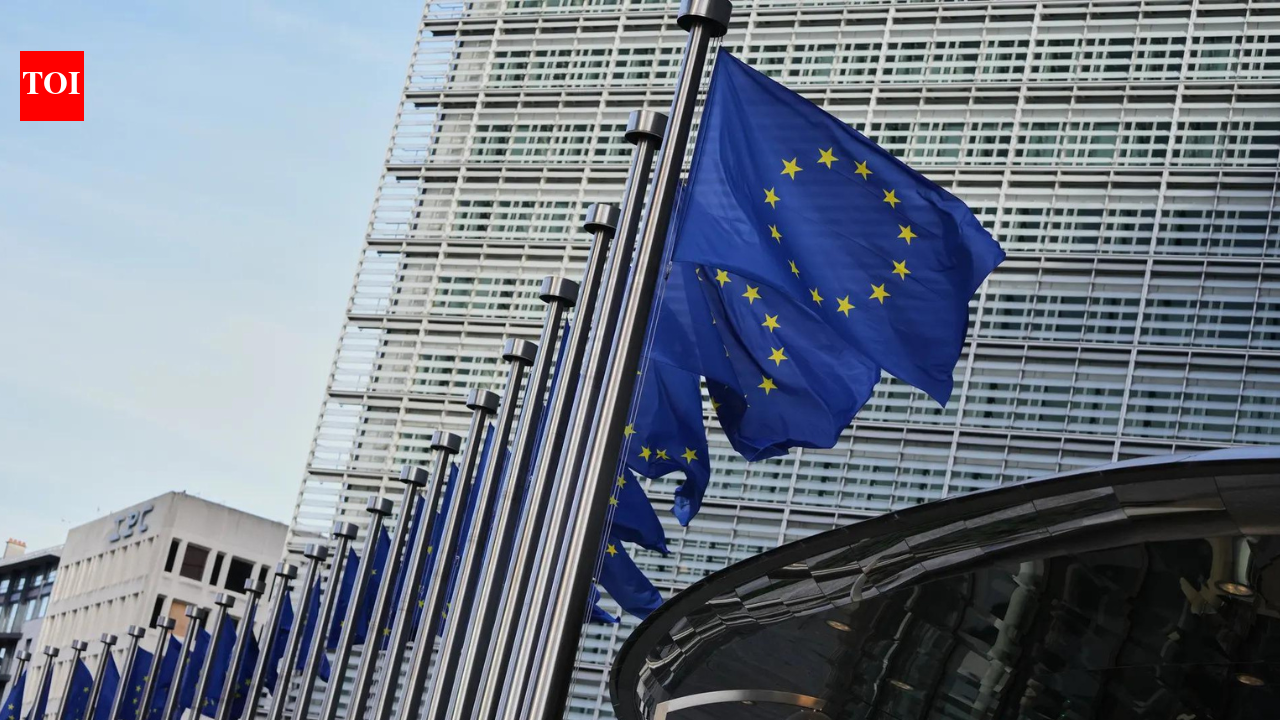
The European Union has sought “full clarity” from the United States and urged Washington to honour agreed trade commitments after the US Supreme Court struck down some of President Donald Trump’s sweeping tariffs, raising fresh uncertainty over trans-Atlantic trade ties, AP reported.The European Commission said the evolving situation risks undermining the framework for “fair, balanced, and mutually beneficial” trade and investment outlined in the EU-US Joint Statement of August 2025, calling for adherence to previously agreed terms.

‘Historic Embarrassment’ For Trump; US Supreme Court Blocks Global Tariffs In Shock Ruling

According to AP, the EU’s executive arm stressed that commitments made under the bilateral arrangement must remain intact even as the US administration considers new tariff measures following the court ruling.Trump criticised the judgement and said on Saturday he intends to raise a global tariff to 15 per cent, up from the 10 per cent level announced a day earlier.American and EU officials had sealed a trade deal last year imposing a 15 per cent import tax on 70 per cent of European goods exported to the United States. The European Commission oversees trade policy for all 27 EU member states.A senior EU lawmaker signalled political pushback within Europe, with Bernd Lange, chair of the European Parliament’s international trade committee, saying he would propose pausing the ratification process of the agreement.“Pure tariff chaos on the part of the US administration,” Lange wrote on social media. “No one can make sense of it anymore — only open questions and growing uncertainty for the EU and other US trading partners.”Reaffirming its stance, the European Commission said: “A deal is a deal. As the United States’ largest trading partner, the EU expects the US to honor its commitments set out in the Joint Statement — just as the EU stands by its commitments. EU products must continue to benefit from the most competitive treatment, with no increases in tariffs beyond the clear and all-inclusive ceiling previously agreed.”EU officials warned that unpredictable tariff actions risk destabilising global trade flows. “When applied unpredictably, tariffs are inherently disruptive, undermining confidence and stability across global markets and creating further uncertainty across international supply chains,” the commission added.EU-US trade in goods and services was valued at 1.7 trillion euros (USD 2 trillion) in 2024 — roughly 4.6 billion euros a day — according to Eurostat data.Europe’s major exports to the US include pharmaceuticals, cars, aircraft, chemicals, medical instruments, and wine and spirits, while key American exports to the bloc range from professional and scientific services such as payment systems and cloud infrastructure to oil and gas, pharmaceuticals, aerospace products and vehicles.The EU also retains the option of deploying its Anti-Coercion Instrument, a mechanism allowing retaliatory measures against countries exerting economic pressure. Possible actions include restricting trade and investment, excluding firms from EU public tenders, limiting foreign direct investment, or, in extreme cases, curbing access to the bloc’s 450-million-consumer market — potentially inflicting billions of dollars in losses on US companies and the broader American economy.


Source link

Odisha Rape: 3 teachers, peon held for raping minor in school over 2 years in Odisha | Bhubaneswar News


KENDRAPADA: Three teachers and a peon of a private English medium school in Kendrapada district were arrested on Saturday for allegedly raping a Class VII student multiple times over the past two years. A woman teacher was also arrested for abetting and concealing the crime. The case came to light after the 12-year-old survivor’s father lodged an FIR on Saturday, alleging that three teachers and a peon had sexually assaulted his daughter repeatedly on the school premises when no one was present, and had threatened her into silence. The woman teacher was accused of helping them.

Bhubaneswar: Govt Clears ₹44k-Cr Projects, Police Killed, Hoteliers Seek 15-Destinations Plan & More

The girl had refused to go to school on Jan 14, following which her mother questioned her. The child then disclosed that three teachers aged 37, 31 and 47, and a 32-year-old peon had sexually assaulted her several times. She also said a 28-year-old woman teacher facilitated the abuse by taking her to the school’s rooftop. The survivor’s mother said she had complained to the school principal last month about inappropriate behaviour by the teachers, but no action was taken. The 24-year-old school has around 600 students and 20 teachers. The survivor’s father, a plumber in Delhi, approached the district child welfare committee (CWC) after returning home on Friday. “After receiving the complaint, we visited the school and spoke to the girl, her parents, teachers, staff and the principal. The survivor told us she had been sexually assaulted by three teachers and a peon multiple times in the past two years, and that a woman teacher took her to the rooftop. We advised the father to lodge an FIR. Police are investigating and CWC is monitoring the case,” said Swagatika Patra, chairperson of the committee. All five accused were arrested under sections 65(2) (rape of a girl under 12 years), 70(2) (gang rape of a minor), 351(2) and 351(3) (criminal intimidation), and 3(5) (common intention) of BNS, along with sections 4 and 6 of the Pocso Act. The woman teacher was also booked under sections 49 (abetment) and 60 (concealment) of BNS.The survivor was medically examined at a govt hospital, said Kendrapada SP Siddharth Kataria. All five accused were produced before a court on Saturday, which rejected their bail pleas and remanded them in judicial custody. The minor girl was produced before a judicial magistrate to record her statement.A BJD women’s team led by Minati Rout, chairperson of Rajkanika block, met the survivor and her parents on Saturday, and later spoke to police, demanding strict action against the accused.(The victim’s identity has not been revealed to protect her privacy as per Supreme court directives on cases related to sexual assault)


Source link

T20 World Cup 2026 [WATCH]: Corbin Bosch and Keshav Maharaj nearly collide in heart-stopping catch to dismiss Abhishek Sharma


The high-voltage Super 8 Group 1 clash between India and South Africa at the iconic Narendra Modi Stadium in Ahmedabad witnessed a breathtaking moment in the powerplay as Corbin Bosch pulled off a sensational catch, nearly colliding with Keshav Maharaj, to dismiss Abhishek Sharma. The dramatic effort came at a crucial juncture, leaving India in early turmoil while chasing a challenging 187-run target set by the Proteas in the ICC Men’s T20 World Cup 2026.

South Africa, led by Aiden Markram, had earlier posted a competitive 187/7 after winning the toss and electing to bat first. With scoreboard pressure mounting, India needed a steady start. Instead, they found themselves rocked by early strikes.

Corbin Bosch takes a stunning catch to get rid of Abhishek Sharma

The turning point in the early overs came on the third ball of the fifth over. Marco Jansen banged in a clever knuckle ball to Abhishek, who failed to pick the variation. Already through with his shot, Abhishek ended up mistiming it badly. The ball ballooned high into the Ahmedabad night sky but did not carry much distance.

From mid-wicket, Bosch sprinted to his right, while from mid-on, Maharaj tracked back sharply. For a moment, confusion loomed large as neither player called decisively. The two almost collided under the swirling ball. It nearly slipped from Bosch’s grasp as it dipped sharply, but the South African all-rounder kept his eyes fixed and clutched it safely to his chest.

The stadium, packed to the rafters, fell into stunned silence. India had been rattled, and so had the crowd. What could have been a costly misjudgment turned into a spectacular breakthrough for the Proteas.

Here’s the video:

Also READ: IND vs SA: Jasprit Bumrah breaks Ravichandran Ashwin’s T20 World Cup record

Proteas seize control as India struggle in the chase

Chasing 187 was always going to require composure, but India’s innings never found stability. Ishan Kishan fell in the very first over, putting immediate pressure on the batting line-up. Tilak Varma followed soon after in the next over, compounding India’s troubles.

Abhishek’s dismissal only worsened the slide. The early intent backfired as South Africa’s bowlers executed their plans to perfection. Washington Sundar failed to steady the innings and departed cheaply, while skipper Suryakumar Yadav could not anchor the chase either.

At one stage, India were reeling at 51/5, a position few would have anticipated at the start of the innings. The Proteas bowlers maintained disciplined lines and cleverly mixed their pace, exploiting the conditions superbly. Markram’s side looked charged up in the field. The near-collision between Bosch and Maharaj symbolised their aggressive approach and hunger. While the moment could have resulted in embarrassment, Bosch’s safe hands ensured South Africa tightened their grip on the contest.

With the pressure mounting and the required rate spiralling, India’s collapse only deepened as more wickets tumbled in quick succession. From 51/5, things went from bad to worse, with the scoreboard now reading a worrying 88/8. South Africa have completely tightened the screws, sensing a massive Super 8 victory. India, on the other hand, are staring at a heavy defeat unless something extraordinary unfolds in the closing overs.

Also READ: Fans slam Team India for ignoring Axar Patel in the Super 8 clash against South Africa at T20 World Cup 2026


Source link

Online bingo to offline Zumba: Solo seniors plug into new communities | Mumbai News


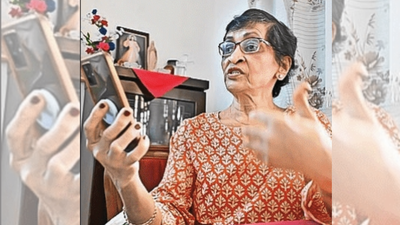
Fiona Pinto, 75, uses a senior app daily (Uma Kadam)

The sudden popularity of the Chinese safety app Demumu, formerly called Sileme or Are You Dead?, has thrown fresh light on the risks of living alone. Designed for young city-dwellers, the app alerts emergency contacts if a user goes silent for too long.In Mira Road, a group of ageing adults who live by themselves have their own analogue version of this safeguard.Twice daily, Zarina Ramzan Vadsariya, 66, receives a WhatsApp greeting from 35-year-old Anjum Virani: ‘Yaa Ali Madad, Good morning / evening, Kem cho?’. If she doesn’t respond, Virani calls. If there’s still no answer, she drops by.The women are part of an outreach programme called Sathi, launched last year by the Aga Khan Social Welfare Board for the Ismaili community, that pairs seniors living alone with community members who help them negotiate daily life. Volunteers are trained in ways to assist the elderly, such as accompanying them to the bank or doctor, or shopping for their groceries, says Virani, who leads the initiative at Nav Yuvan Jamatkhana in Mira Road.Vadsariya, whose husband passed away ten years ago and whose children live abroad, says she’s less lonely these days thanks to Virani’s calls and visits.Once dependent on the goodwill of neighbours and family, elders going it alone today are discovering more dependable forms of support. From community-based initiatives to digital platforms, they have access to more support systems than before and are readily embracing these networks.Such networks have grown as living alone has become increasingly common among ageing adults, a trend shaped by choice, widowhood, separation or divorce or children migrating for work. According to the Longitudinal Ageing Study in India (LASI) 2020, about 6% of Indians aged 60 and above live alone, with women (9%) three times more likely than men (3%) to do so. A more recent survey by the Agewell Foundation’s survey (2024), based on a smaller sample, places the figure much higher at 14.3%, with a slight urban skew (15%) compared to rural areas (13.4%).Ageing alone offers autonomy but also increases the burden of self-care—from running households to managing finances. It can also lead to social isolation. One-third of respondents in Agewell’s survey said loneliness was the biggest disadvantage.

Ageing online

Apps have emerged as a new social commons for older adults, offering daily interactive sessions designed to keep them cognitively sharp and emotionally connected. Fiona Pinto, 75, was introduced to the seniors’ app Khyaal by her sister-in-law to help her cope with the loneliness of widowhood. “I’ve come to depend on it,” she says. Her day starts with yoga, moves into an interactive hobby or life-skills session at midday, and ends with bingo after lunch. Over four years, she has won Rs 9,000 worth of digital gold in prizes. “I live alone and take part in whatever I can to pass the time,” says the IC Colony resident, who has even travelled with Khyaal on senior-friendly tours to Kashmir and Kerala. A similar app, GenS Life, was launched last year by Meenakshi Menon, 67, to look at every aspect of senior life. With free and paid plans, the platform offers yoga and Zumba classes, health and financial advice from vetted experts, live concerts and karaoke, interest-based communities, and steep discounts on third-party services such as accident insurance, domestic worker verification, concierge services, and even fact-checked news. Like Demumu, it also has an SOS feature. Apps for seniors deliver what they want, where they want it most: at home. “Roads and public infrastructure are not senior-friendly, and confidence in navigation declines with age,” Menon says. These challenges make older people reluctant to leave their homes.

Ageing in place

Adhata Trust draws them out. Every evening, 20-25 ageing adults gather at each of the nonprofit’s 18 free ‘holistic well-being centres’ in Mumbai and Navi Mumbai, to practice art, senior Zumba and chair yoga, play sudoku and scrabble, or just shoot the breeze. There are weekly lectures from subject experts on digital literacy, environmental conservation and other topics, as well as the occasional outing or social campaign–on issues such as e-waste and elder rights—creating a culture of learning and community engagement.“As they get to know one another, the support they need comes from within the group itself,” says Clara D’Souza, gerontologist and CEO of the 14-year-old organisation. Members have accompanied each other for cataract surgeries and even to police stations to report online fraud.Some seniors are striking out in ways they never did before. When her building went into redevelopment, 79-year-old Hemangi More single-handedly looked for a rental flat, negotiated with movers and set up her new home. She credits Adhata for her newfound independence. “Previously, my late husband handled everything. Now I do, and I’ll continue to as I grow older.” The organisation taught her to use a computer and smartphone, navigate Facebook and Instagram, and manage digital payments confidently.Adhata also runs a programme called Shared Assistance for Elders that rents medical and mobility equipment to the elderly at nominal rates, and livestreams several of their in-person fitness sessions and webinars for house-bound elders–supporting its core mission of enabling ageing in place rather than institutional care.

Seniors step up and out

This emphasis on staying put is echoed across eldercare initiatives today, in striking contrast to the senior housing sector, which often frames relocation as aspiration. “Today’s seniors place a high value on dignity, autonomy, and staying connected to familiar environments,” says Hemanshu Jain, founder of Khyaal, which has over 5 million members. Ageing in place, he admits, require access to reliable healthcare, strong social networks, digital literacy, and responsive support systems, but “technology-led, community-driven platforms have made strides in bridging these gaps.In Mumbai’s Parsi baugs, a different kind of technology is closing the distance between isolation and social interaction for ageing adults: the motorised wheelchair. Four years ago, the World Alliance of Parsi Irani Zarthoshtis(WAPIZ) donated 19 of them to baugs and independent Parsi buildings to address a mounting challenge: elderly Parsis marooned on higher floors. “Lack of lifts is a major issue in our baugs,” admits Anahita Desai, a trustee of WAPIZ and Bombay Parsi Punchayet. The community has a staggering proportion of members older than 60 years—31% by the 2011 census and likely 60% today, says Desai. They are looked after by community-led welfare initiatives, including one that provides volunteers to bathe and groom seniors who can’t look after themselves, and helps clean their homesand arrange daily tiffins.The Punchayet and some Parsi charitable trusts also provide needy seniors with monthly income ranging from Rs 1,500 to Rs 5,000 and help with medical expenses. But with its low-rent apartments and vibrant community life, Desai says, the strongest safety net for ageing Parsis is the baug itself.


Source link

Stan Wawrinka Exclusive: ‘To beat Novak Djokovic in the Roland Garros final was really special’ | Tennis News


Stan Wawrinka Exclusive: 'To beat Novak Djokovic in the Roland Garros final was really special'
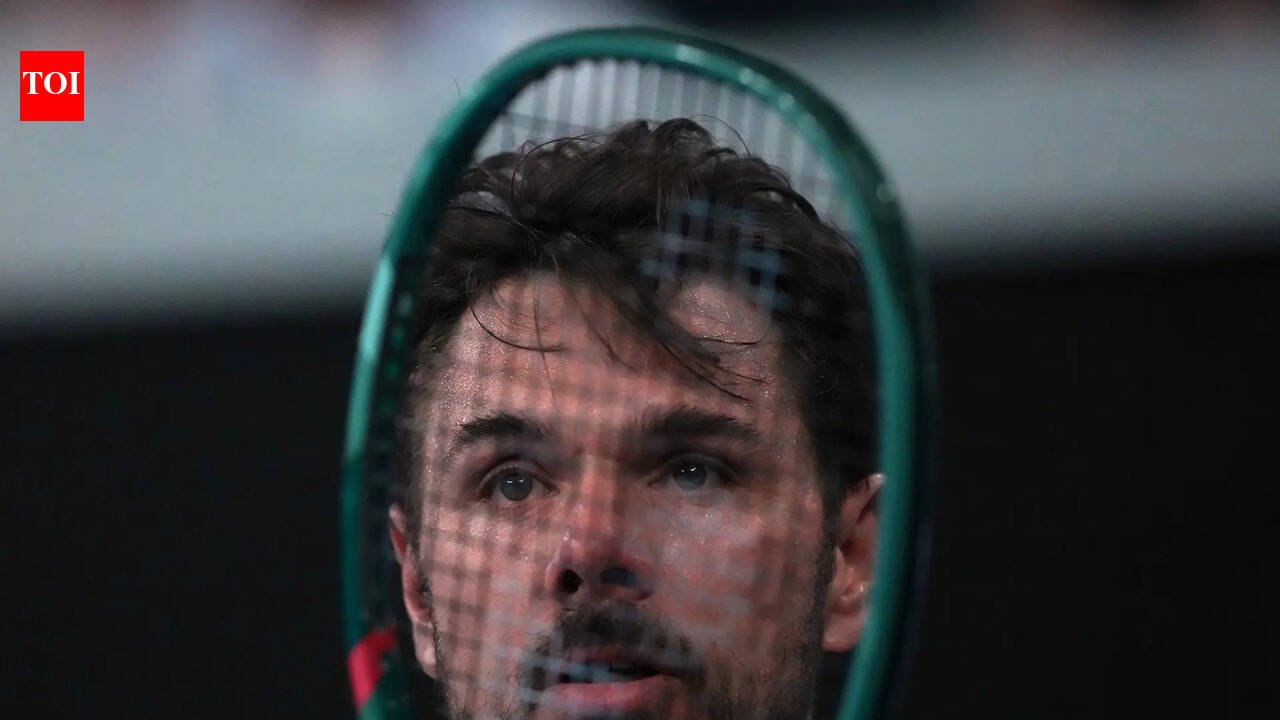
Stan Wawrinka of Switzerland (AP Photo/Asanka Brendon Ratnayake)

DUBAI: Stan Wawrinka returns to a place of cherished memories this week, back at the Dubai Duty Free Tennis where he lifted the trophy in 2016. Now 40 and competing in the final season of a storied career that once saw him rise to a career-high No. 3 in the world, the Swiss great is embracing one last chapter on the Tour.

Jay Shah: Kapil Dev deserves more credit for 1983 World Cup triumph

Excerpts:Stanimal captured the physical power of your game, do you think the mental strength behind your success was sometimes overlooked?That’s the beauty of tennis, it has many parts to it. It’s a big puzzle. You need to put every piece of the puzzle in its place — fitness, tennis, mentally, and also you need to be in the right place. It took a lot of hard work, a lot of energy to push and find myself as a player. It was important for me to work on myself, my mindset, and how I was going to go in with confidence, ready to beat the best players in the world. It took me years to achieve that. I’m really happy with what I’ve done. Was it tougher to break through in the Federer-Nadal-Djokovic era than it is today in the Alcaraz-Sinner duopoly?Those five players you mentioned, and also Andy Murray are the best players we saw in the game. It has been amazing for me to face them, to be able to play against the Big Four for more than 15 years. It was a challenge. But first I’m a fan of tennis, I’m passionate about the game. I always enjoyed watching them, as a tennis fan and player. It was an opportunity for me to play the best players in the game. Right now we are seeing that the level of Jannik Sinner and Carlos Alcaraz has been amazingly high. What they’ve been doing already for a few years, winning all the Grand Slams between them, is amazing to watch. Which of your three Grand Slam titles gave you the most satisfaction?It’s tough to choose, but it’s also my job to answer the question. If I have to pick one title… (exhales) they have all been really special, but one is the French Open (2015). I grew up playing on clay, I practised a lot in Spain, also coming from the French part of Switzerland, Roland Garros was the one that we watched the most as kids. That’s also the one I won as a junior (2003). To beat Novak in the final there was really special. Was retirement a sudden decision, or something that had been building in the months before your announcement?The last few years, I’ve been asking myself when to stop but I never had an answer. At the end of last year, I finally had the answer. I realised that I was most at peace to play for one more year, to push one last time. I’m still passionate about the game, I wish I could play forever, but nobody can play forever. I also wanted to finish my 20-plus year career on a good note. So I’m happy that my level is still there and physically I’m feeling good. You appear leaner now than at your peak? I always try to push myself to be the best player I can to be. You have to do that to be able to stay in the game for 20 years. It was challenging, fitness wise, especially with the injuries. I have always been trying to optimise, to do what’s best for me, what’s best for my body so that I could push my own limits. You were known for those statement shorts and now, in your final year, you’re making a statement with this 40-Love tee…Last year I turned 40, so Yonex did this for me as a present. The ‘Love’ stands for my love of the game, my passion.


Source link

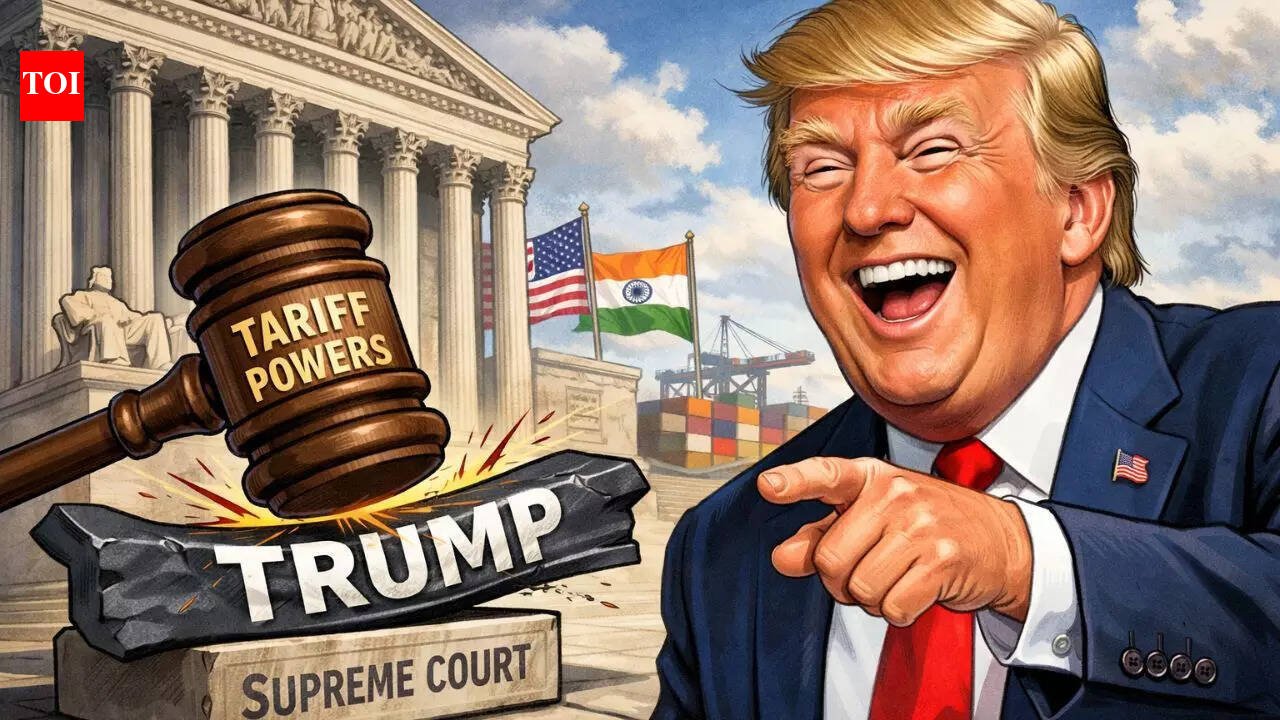
Explained: How the SCOTUS tariff ruling may be secretly a gift for POTUS


Explained: How the SCOTUS tariff ruling may be secretly a gift for POTUS

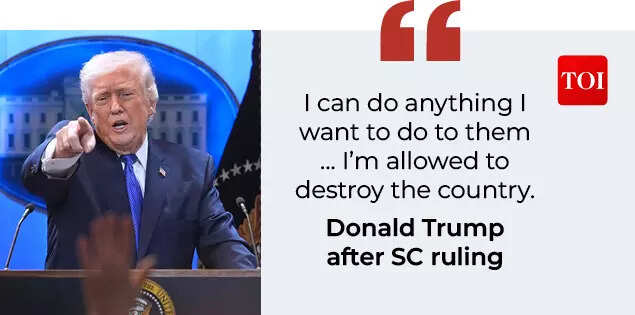
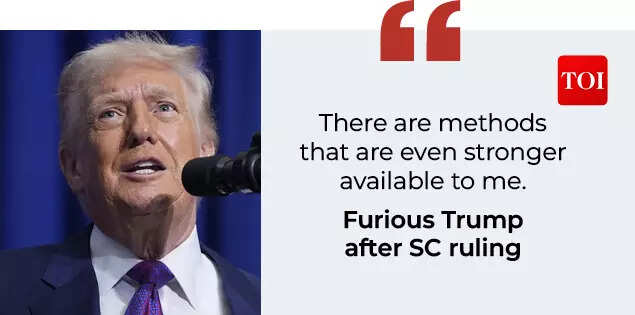
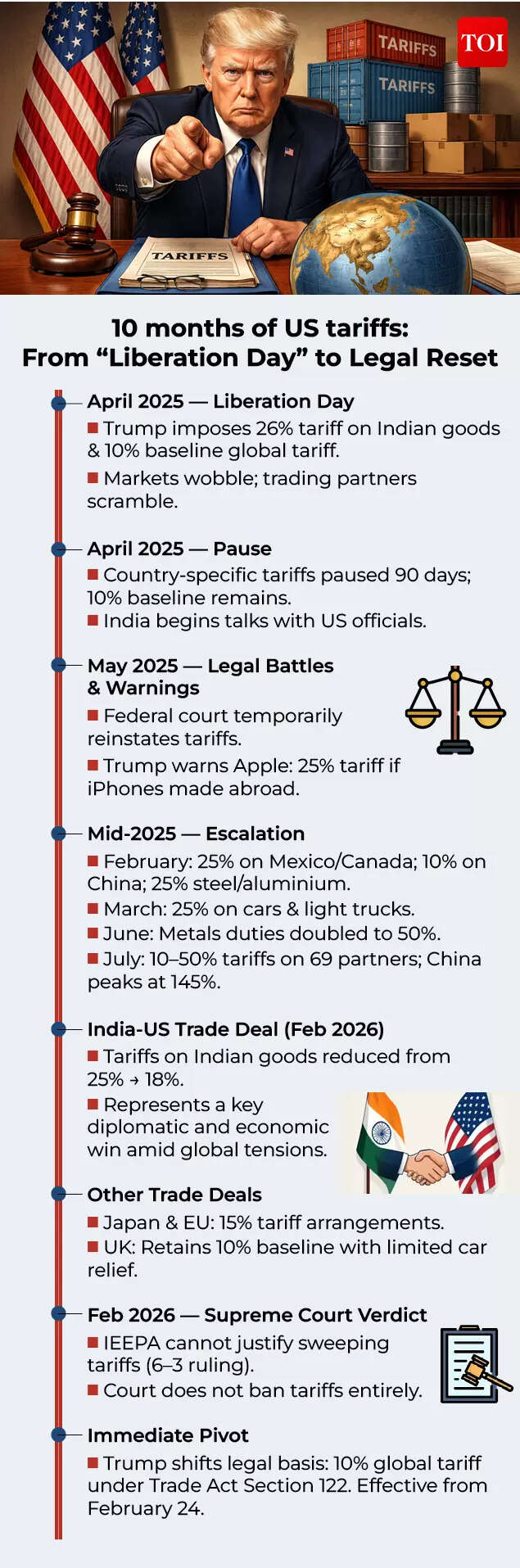
“I can do anything I want,” declared Donald Trump, quickly venting his anger at the US Supreme Court’s landmark ruling on February 20 rebuking his use of emergency powers to impose sweeping import duties, one of the most consequential defeats of his second term.The ruling invalidated his use of emergency powers to impose the largest increase in US tariffs since the 1930s, a cornerstone of his trade and economic strategy.“There are methods that are even stronger available to me,” he further roared in his White House address, even as he ordered a 10% global tariff over and above normal tariffs already being charged.Frustrated and agitated by the Supreme Court ruling, Trump doubled down on Truth Social, “It is my Great Honor to have just signed, from the Oval Office, a Global 10% Tariff on all Countries, which will be effective almost immediately.”Invoking Section 122 of the Trade Act of 1974, he announced an executive order imposing the additional levy, a provision that allows a temporary import surcharge of up to 15% for 150 days to address balance-of-payments deficits.“Effective immediately, all the national security tariffs under Section 232 and existing Section 301 tariffs remain in place,” Trump added.A day later, he escalated. Blasting the court’s judgment as “ridiculous and poorly written” and “extraordinarily anti-American,” Trump raised the global tariff to the “fully allowed, and legally tested” 15%.“Based on a thorough, detailed, and complete review of the ridiculous, poorly written, and extraordinarily anti-American decision on tariffs issued yesterday, after MANY months of contemplation, by the United States Supreme Court, please let this statement serve to represent that I, as President of the United States of America, will be, effective immediately, raising the 10% Worldwide Tariff on Countries… to the fully allowed, and legally tested, 15% level,” he posted.His defiance underscored a broader political reality! Even constrained, Trump is unlikely to retreat from tariffs as an economic and geopolitical instrument.Could the court’s intervention paradoxically offer Trump a strategic reset?

,

What did the Supreme Court say?

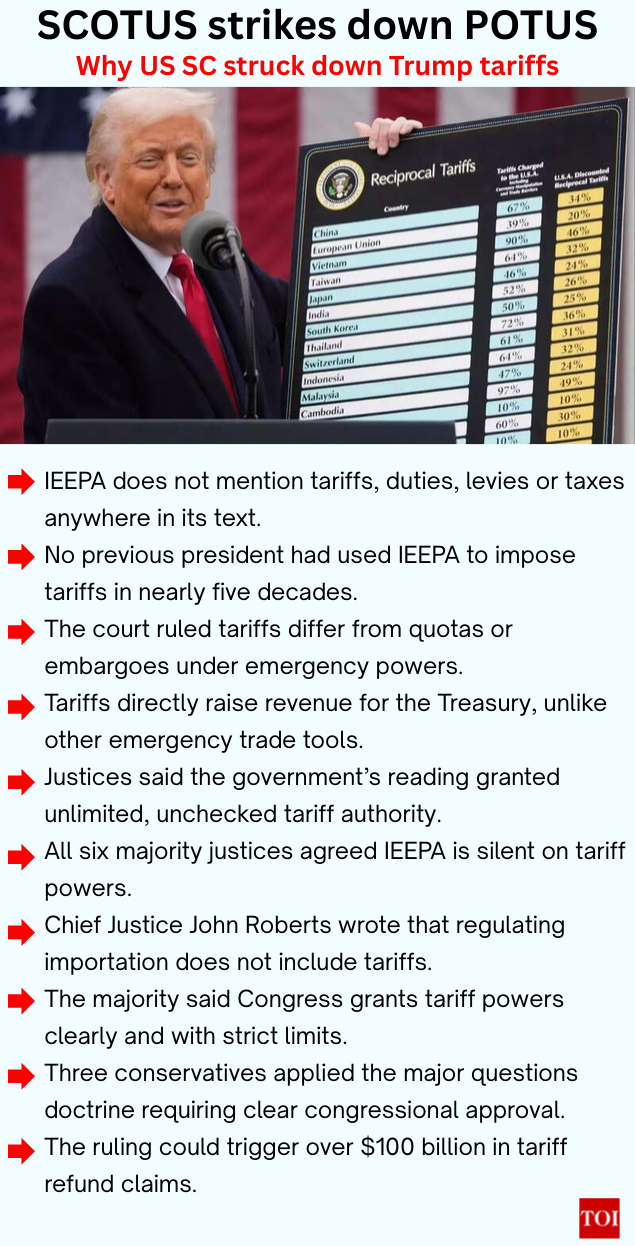
In a 6–3 ruling, the Supreme Court examined tariffs imposed under IEEPA, a statute typically used to freeze assets or block financial transactions during national emergencies.Writing for the majority, Chief Justice John Roberts delivered a pointed rebuke. The President, the court held, does not have authority under IEEPA to impose import tariffs.The judgment stated that “had Congress intended to convey the distinct and extraordinary power to impose tariffs, it would have done so expressly.”The ruling upheld earlier findings by the US Court of International Trade and a federal appeals court, both of which had concluded that IEEPA does not automatically grant the president unilateral tariff authority.Crucially, the decision invalidated the use of the 1977 statute that had been responsible for nearly two-thirds of the $200 billion in tariff revenue collected in 2025.In constitutional terms, the court reasserted Congress’ authority over taxation and placed clear boundaries on presidential emergency powers.Note: Trump later hiked the 10% to 15%
,

Note: Trump later hiked the 10% to 15%

The Kavanaugh factor: SC ruling strengthen presidential tariff authority

Trump was quick to highlight dissenting opinions. He praised Justices Clarence Thomas, Samuel Alito and Brett Kavanaugh for voting to preserve his tariff authority.He gave special attention to Kavanaugh.Addressing the briefing Trump said, “As Justice Kavanaugh whose stock has gone so up, you have to see, I’m so proud of him wrote in his dissent, “Although I firmly disagree with the court’s holding today, the decision might not substantially constrain a president’s ability to order tariffs going forward.””Trump seized on that line.“So think of that, ‘the decision might not substantially constrain.’ And it doesn’t. He’s right. In fact, I can charge much more than I was charging. So I’m going to just start,” he said.“That’s because numerous other federal statutes” which is so true” authorize the president to impose tariffs and might justify most, if not all, of the tariffs issued in this case.” Even more tariffs, actually,” he added.

,

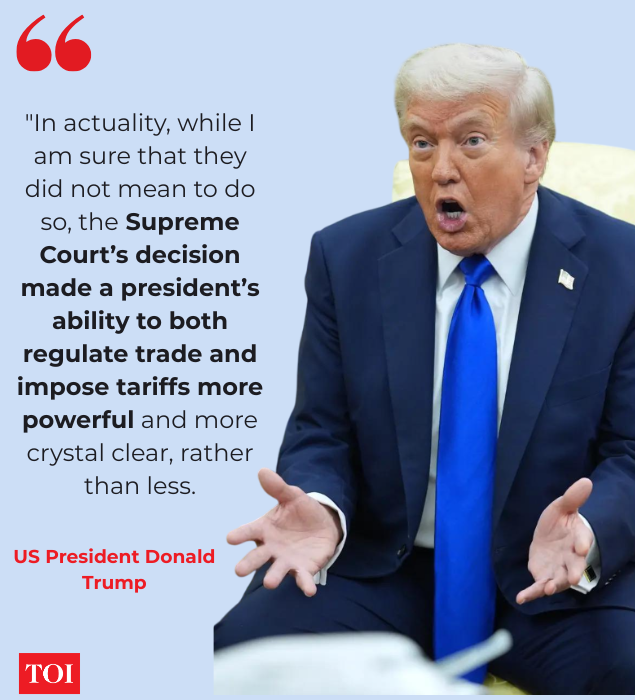
“‘Those statutes include’ think of that ‘those statutes include, for example, the Trade Expansion Act of 1962, Section 232’ all of these things I know so well ‘the Trade Act of 1974, Sections 122, 201, 301, and the Tariff Act of 1930, Section 338.'”“I would also like to thank Justice Kavanaugh for his, frankly, his genius and his great ability. Very proud of that appointment,” Trump said.“In actuality, while I am sure that they did not mean to do so, the Supreme Court’s decision today made a president’s ability to both regulate trade and impose tariffs more powerful and more crystal clear, rather than less. I don’t think they meant that. I’m sure they didn’t. It’s terrible,” he added.Whether rhetorical flourish or legal strategy, Trump appears determined to treat the ruling as a clarification rather than a constraint.

A political slap or strategic cover?

From a domestic political standpoint, the verdict was widely interpreted as a blow to Trump. The court includes several justices appointed during his tenure, and its ruling targeted what many saw as his favourite executive lever, the ability to rapidly impose tariffs as economic pressure or geopolitical retaliation.

,

The decision temporarily removes his ability to threaten immediate tariff action against European nations opposing his Greenland plan or countries such as India for maintaining oil trade with Russia.Yet the ruling is narrower than it first appears.While the court invalidated tariffs under IEEPA, it did not strike down other statutory authorities available to the president. Trump has already pivoted to Section 122 of the Trade Act of 1974. Trade experts note he can also rely on Sections 232 and 301 for sector-specific duties.US Trade Representative Jamieson Greer signalled as much in December. “From the outset of these negotiations, at least internally, there’s been a view that there would be recalibrations at some point,” he said.Greer maintained the administration remains committed to tariffs as a tool to manage trade deficits and counter unfair practices. “I’m confident that with other tools we have related to unfair trading practices we can produce the tariff rates we need,” he added.Seen through this lens, what appears to be a humiliating judicial defeat may provide political cover to refine an unpopular tariff regime while preserving its strategic objectives.The economic consequences of Trump’s tariff policies have been debated intensely. While inflation and consumer prices dominate headlines, economists argue the more corrosive impact lies in growth, investment and labour markets.Kent Smetters of the Penn Wharton Budget Model argues that tariffs made the US less attractive for investment by raising business costs. “There’s very little evidence that a big renaissance of US production is happening,” Smetters says.He compares the tariffs to a substantial corporate tax hike, akin to raising the rate from 21% to 36%, cutting profits by a similar magnitude.Research from the Federal Reserve Bank of Kansas City estimates that the direct impact of the import taxes led to 19,000 fewer jobs per month from January to August 2025 — likely an understatement.Meanwhile, analysts at the Urban-Brookings Tax Policy Center estimate that if the invalidated tariffs are not replaced, real incomes could rise by $1,200 per family in 2026.Public sentiment reflects the strain. A December NPR-PBS News-Marist survey found only 36% of Americans approved of Trump’s handling of the economy, with two-thirds concerned about tariffs’ impact on their finances.In this context, the court ruling could allow Trump to recalibrate without appearing to capitulate.“Yes there is a loophole as you know that as he has again put a tariff of 15% across the world through a different law,” Rajan Kumar, a professor at Jawaharlal Nehru University told TOI.

,

Does the ruling give India more room to negotiate?

On August 6, the US had announced an additional 25% tariff linked to India’s Russian oil purchases, taking the total tariff burden on Indian exports to 50%, effective August 27, 2025.In early February, the two countries agreed to an interim trade deal cutting US tariffs on Indian goods to 18%, down from 25%. India, in turn, reduced tariffs on US goods to zero.After the Supreme Court deemed the country-specific tariffs illegal, Trump imposed a 10% global tariff applicable to all countries — later raised to 15% under Section 122.For now, India pays the universal rate “until another authority is invoked,” according to a White House official quoted by ANI.

,

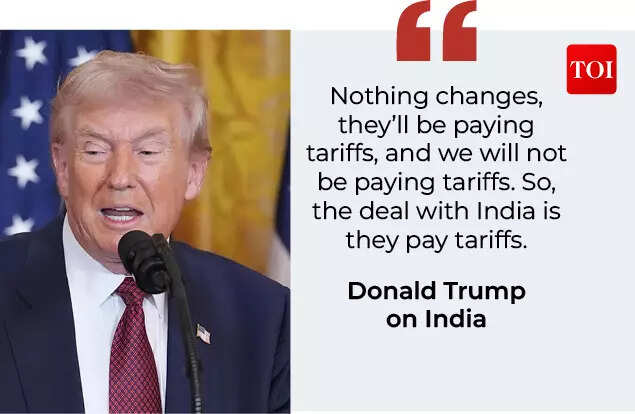
Yet Trump had earlier said nothing “changed” for India and that trade deal terms would continue.The result is a diplomatic grey zone.“From a broader American domestic political view it is a slap on the face of Trump without any doubt but Trump being Trump, the way he takes. And there is huge uncertainty and everything that has been negotiated now has to be renegotiated,” Rajan Kumar told TOI.He also noted that if the tariff regime is deemed illegal, prior negotiated reductions may face scrutiny. “So far as India is concerned this is a phase of uncertainty because if the entire process is illegal the entire negotiation of tariff coming from earlier 50% to 18% is illegal, with a total lack of clarity,” he said.Uncertainty, in trade diplomacy, can cut both ways. It may weaken credibility, but it also reopens bargaining space.

So is the Supreme Court’s tariff ruling secretly a gift to the president?

Legally, it reasserts congressional authority and restricts executive overreach under emergency powers. Politically, it allows Trump to blame the judiciary for economic friction while reconstructing his tariff framework under alternative statutes.As Kumar observes, Trump “will definitely try to mould the uncertainty into a gift negotiating with the countries on his terms again.”



Source link