Breaking News
‘Maha govt plans permanent fix for Andheri subway waterlogging’ | Mumbai News


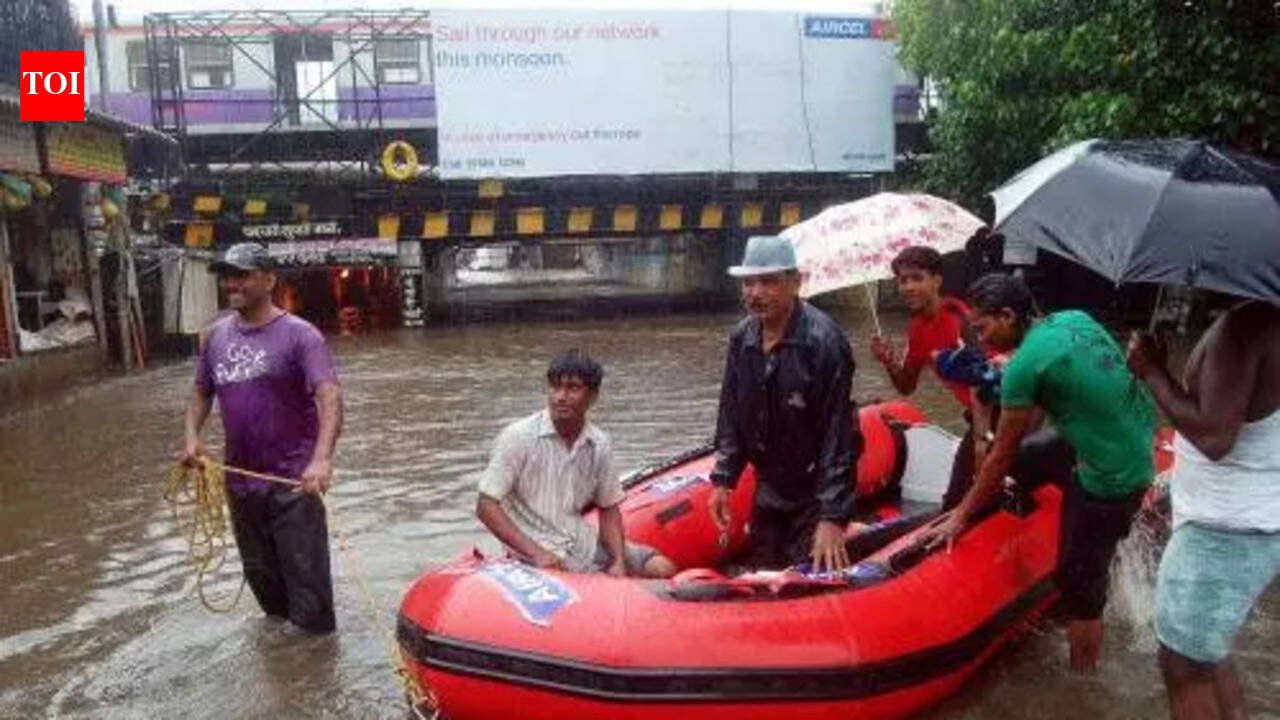
Mumbai: Maharashtra government on Friday said it is working on a permanent solution to recurring traffic congestion caused by waterlogging at the Andheri subway in western Mumbai during the monsoon.Replying to a calling attention motion in the assembly, MoS Madhuri Misal said the BMC is undertaking multiple measures to address the issue.MLA Murji Patel raised the issue, stating that the subway is the only link between Andheri East and Andheri West and frequently gets flooded during heavy rainfall, leading to severe traffic congestion.Misal said the subway is located in a low-lying area and Western Railway’s suburban network runs above it, making widening or deepening technically difficult.She said waterlogging occurs when rainfall exceeds 19mm per hour.To mitigate the situation, the BMC deploys three pumps with a combined drainage capacity of 2,250 cubic metres per hour during the monsoon.She added that the renovated Gokhale Bridge has been opened to traffic and is used as an alternative route when the subway is closed. Traffic from SV Road is diverted to the bridge to prevent congestion in Andheri West.The minister said a Rs 197 crore project has been proposed to prevent flooding during heavy rainfall exceeding 55mm and added that a joint meeting of all departments will be convened to work out a permanent solution. PTI


Source link

Decoding 7.8% GDP growth: What changes in the new series & what it tells us about India’s road to becoming 3rd largest economy?


Decoding 7.8% GDP growth: What changes in the new series & what it tells us about India's road to becoming 3rd largest economy?
Several methodological improvements have been made in the way GDP is calculated. (AI image)

India has retained its tag of the world’s fastest growing major economy in the third quarter of the financial year 2025-2026, with a better-than-expected GDP growth of 7.8%. This is despite the third quarter being the first full three months of Donald Trump administration’s 50% tariffs. Aiming for a more accurate picture of economic growth, the first GDP data for India under a new series has been released on Friday. The growth projections for the full year 2025-26 have been revised upwards to 7.6%.Several methodological improvements have been made in the way GDP is calculated. For one, the base year for calculations has been revised from 2011-12 to 2022-23. Other changes involve changing the relative weights of output sectors and demand segments, better coverage by the use of additional and more disaggregated data including GST data and by better methods of scaling up economic activities of the informal sector and companies. Incidentally, last year IMF had rated India’s national accounts data in a ‘C’ category, highlighting outdated base year.What does the GDP data tell you about the Indian economy? When will India become the third largest economy? What’s changed in the new GDP series and why is it important? We take a look:

Decoding GDP data: What does it tell you about the health of India’s economy?

The first GDP data under the new series presents a picture of largely broad-based growth. Experts are of the view that the series is in line with the older one in terms of divergence in GDP and GVA growth estimates.Sujan Hajra, Chief Economist & Executive Director, Anand Rathi Group says, “India’s Q3 FY26 GDP and FY26 Second Advance Estimates exceeded 7.5%, marginally above expectations, with trends broadly consistent across the new and old series. Nominal growth remains below 9%, but manufacturing and services momentum is reassuring.” “On the demand side, both private consumption and investment grew over 7%, indicating balanced expansion. The stronger-than-expected data support an improved outlook for corporate earnings and enhance fiscal prospects, underpinning both equity and debt market sentiment,” he tells TOI.Ranen Banerjee. Partner and Leader, Economic Advisory Services Government Sector Leader, PwC India notes that the manufacturing sector printed strong. “This was expected given the GST boost in Q3 that was reflected in high frequency indicators. The services sector has also printed strong given it was a quarter of festivities with the year end travel boosting the travel and hotels component,” he told TOI.“Agriculture has printed softer but it is likely owing to the double deflation method adopted for output and input and other methodological changes. We would need to watch the next quarter release of the Agricultural sector data to understand how much of the softness is owing to methodological changes,” he said.Experts also believe that the new methodology will help address concerns raised by the IMF on India’s GDP data.DK Srivastava, Chief Policy Advisor, EY India says that the methodology changes would improve India’s rating of the NSO data from category ‘C’ to a better category in terms of the IMF framework of assessing the reliability of a country’s national income statistics.Ranen Banerjee of PwC India explains that the new GDP series methodology is more aligned to global SNA methodology. “An important change is that it will now relatively be dynamic as far as the informal sector is concerned as it will use the Annual Survey of Unincorporated Enterprises data. Another important change is use of the GST data for the Net Tax impact in the computation of the GVA. The double deflation method will also help in better estimation of the value added by industry as the outputs and inputs would be deflated separately,” he said.“The quarterly numbers would also be more comparable over the years when the annual data is revised in subsequent releases of the GDP as the Proportional Denton method will smoothen the quarterly data revisions as it will be based on some of the high frequency data points for the relevant quarter. There are several other improvements that have been made that will enhance the confidence on the estimates of growth and will make it more aligned to international standards,” he adds.

The Road To Becoming the 4th Largest Economy

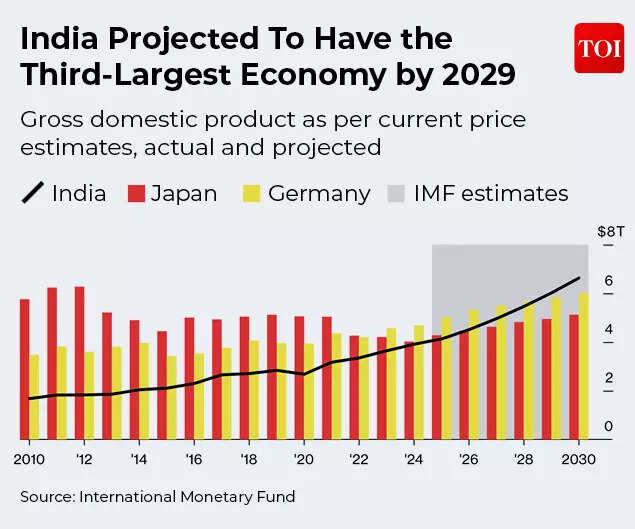
The GDP growth estimates paint a strong growth story for India – which is also the fastest growing major economy in the world. IMF estimates at the start of 2025 projected that India would overtake Japan to become the fourth largest economy by the end of FY 2025-26. However, the rupee’s depreciation seems to have played spoil sport.

India Projected To Have the Third-Largest Economy by 2029

Chief Economic Adviser V. Anantha Nageswaran estimates that India will become a $4 trillion economy in the next financial year, growing at 7-7.4% in FY 2026-27.“We are on course to becoming the top three or the top four largest economies in the world. There is no doubt about that. It will happen in the course of the next few years. Our growth rate post covid has been probably one of the best if not the best in the world, especially among G20 economies. In India’s case, the exchange rate did not go in our favor in 2025-26. That will naturally have an impact. So the timing, given global uncertainty, given what happens to exchange rates, and the growth rates in other countries could be variable,” he said.

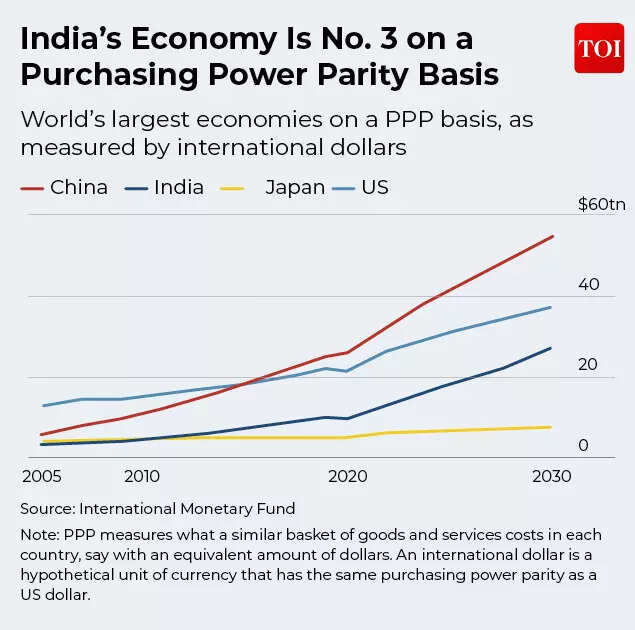
India’s Economy Is No. 3 on a Purchasing Power Parity Basis

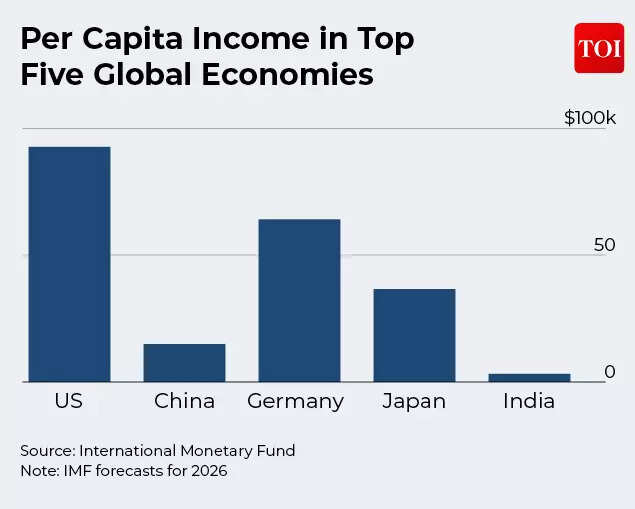
While India is on the road to being among the top 3 economies in the world, its per capita income is very low compared to the other top 5 global economies. China, which is the world’s second largest economy also has a much lower per capita income compared to the US, Germany and Japan.

Per Capita Income in Top Five Global Economies

Why is base year and its revision important?

To put it simply, the base year acts as a reference year. It is for this year that the prices are used to calculate any change in the real growth of an economy. Over a period of time, a base year becomes outdated as price levels rise. To present a more accurate picture of an economy’s real GDP growth, the revision of the base year is important.Hence, the base year is updated by the government periodically to reflect the changes that have happened in the economy over the years. The aim is to ensure a more accurate method to calculate major economic indicators.

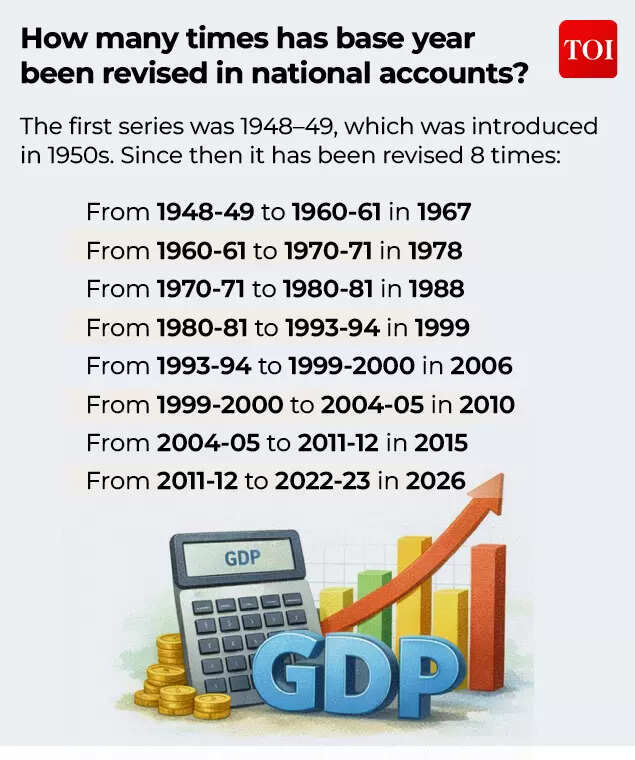
How many times has base year been revised in national accounts?

According to MoSPI, the methodology and data sources that are used in the compilation of GDP and other macro-economic indicators for a particular series are finalized when the base year is being revised. MoSPI has said that the revised GDP data series is in line with the international statistical standards.

What’s new in the series?

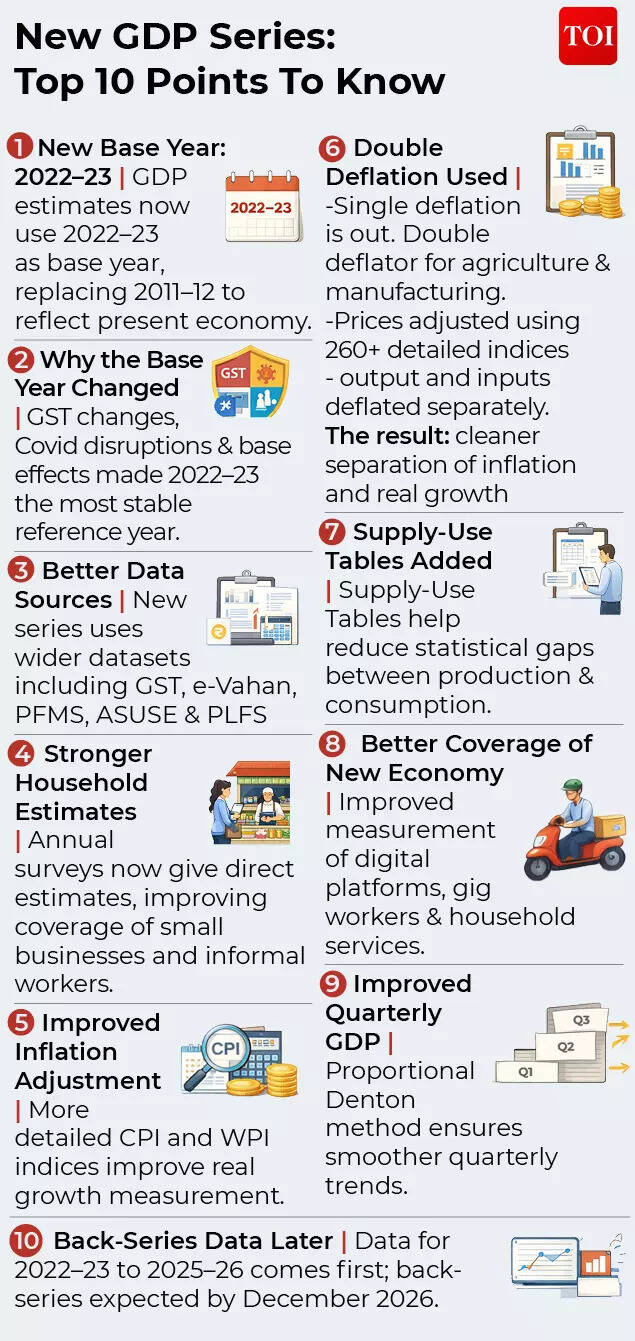
“Under the revised base year (2022–23), the quarterly GDP estimation framework has been strengthened through important methodological improvements, most notably the shift from the earlier Pro-Rata benchmarking method to the Proportional Denton method,” says MoSPI.“The new benchmarking method will remove artificial discontinuities, commonly known as the “step problem,” and ensure smoother and more consistent quarterly series that better reflect underlying short-term movements in economic activity,” it adds.While several new data will now be made part of the GDP calculation, the top 5 that stand out are:GST: Data from GST will now be made use of for allocation of all-India estimates with regard to the private corporate sector. This holds across states. The GDT data will also help in cross-validation in annual accounts. The data also finds extensive use in quaternization and as an indicator in Quarterly National Accounts, MoSPI has said.Household Sector Measurement: Regular annual surveys will not be used to understand and assess the growth rates for the household sector. Earlier, the rates were calculated between surveys or through proxy indicators. The surveys that will now be used are Periodic Labour Force Survey (PLFS), and Annual Survey of Unincorporated Sector Enterprise (ASUSE). GST data will be used to cross-check the assessments of interpretations drawn from these surveys.e-Vahan data: Private Final Consumption Expenditure or PFCE that is related to spending on road transport services will now be assessed using e-Vahan data. Public Finance Management System (PFMS): This will be used to look at central government estimates and allocate them accordingly among states. According to MoSPI, this step will allow for the use of actual expenditure data instead of revised estimates.Studies: MoSPI has said that new and updated rates and ratios will be used that will be based on recent studies conducted by expert institutions. These rates include:

  • Study on transport services by JNU for PFCE
  • Study on milk and related products by the National Dairy Research Institute for PFCE
  • For agriculture, grass and fodder study by the Indian Grassland and Fodder Research Institute
  • Fisheries studies by Central Marine Fisheries Research Institute and the Central Inland Fisheries Research Institute

Interestingly, the government has moved to capture the contribution of gig workers, and even hired domestic workers such as drivers and cooks. Such activities have been termed as ‘activities of households as employers of domestic personnel’. Their contribution is being included in the estimation of the GDP. The estimation for this data based on the number of such workers and their wages, that is available from the annual PLFS data.

New GDP Series: Top 10 Points To Know

How does the methodology change?

According to MoSPI, there are seven major changes in the GDP calculation methodology under the new series:Double deflation: The new GDP series replaces single deflation with a more refined method. Agriculture and manufacturing now use double deflation, while other sectors rely on single extrapolation.Prices are adjusted at a far more detailed level – using over 260 granular CPI indices and item-level WPI in manufacturing. By deflating output and inputs separately, the method better isolates real growth from price changes, improving the accuracy of GVA estimates.Rates and ratios have been updated: Many of the ratios and rates that are used when compiling data are being revised from surveys that have now become available in the intervening period. Studies conducted by expert organisations are also being used by MoSPI.Measurement of household sector: As explained above, ASUSE and PLFS will be used for a more accurate data compilation.Supply and Use Tables: This framework is being integrated with the National Accounts framework. MoSPI aims to reduce, to the maximum extent possible, the discrepancy that can be there between GDP from production and expenditure approaches. Supply and Use Tables show what industries produce – that is supply – and how products are used by industries or final consumers – the use. A balanced Supply and Use Table will see that the total supply matches total demand in the economy. New data sources: As explained above, new sources of data such as GST data, PFMS, e-Vahan that are not only more comprehensive, but also available at a shorter time lag will augment existing data sources.Multi-activity private corporations and their segregation: This is an important one, since treatment of entities as individual and whole will change. As per MoSPI, in the earlier series, the total value added of multi-activity enterprises was allocated to the major activity of the enterprise.However, as per the new GDP series, MGT-7/7A data has become available. Under this corporations are mandated to report activity-wise share in their turnover. Now this will be used to segregate total value added (and other aggregates) across different activities. Estimation of PFCE: According to MoSPI, the new series uses a mixed approach; enhanced use of the Household Consumer Expenditure Survey; direct estimation based on production and other data sources; the commodity flow approach.



Source link

NBCC to redevelop DDA staff quarters in Delhi with Rs 775 crore project


NBCC to redevelop DDA staff quarters in Delhi with Rs 775 crore project

State-owned NBCC (India) Ltd will redevelop Delhi Development Authority (DDA) staff quarters in two colonies in the national capital at an estimated cost of nearly Rs 775 crore, PTI reported.In a statement, NBCC said it has signed two separate Memorandums of Understanding (MoUs) with DDA for the comprehensive redevelopment of staff quarters located at Old Rajinder Nagar (ORN) and Safdarjung Development Area (SDA), New Delhi.The MoUs were signed in the presence of N Saravana Kumar, Vice Chairman, DDA, and K P Mahadevaswamy, CMD, NBCC.The projects will involve development of a total built-up area of 1.66 lakh square metres across the two sites. Currently, 117 dwelling units at Old Rajinder Nagar and 152 dwelling units at Safdarjung Development Area are being used as staff quarters by DDA.NBCC will act as the Project Management Consultant and implementing agency, overseeing execution from concept to commissioning.“The redevelopment will follow a self-sustainable model wherein a portion of the developed built-up area will be sold through a transparent process, and the proceeds will be utilised to finance the project, while the remaining built-up area, as decided by DDA, will be handed over for staff use,” the statement said.NBCC’s scope of work includes comprehensive master planning of about 4 hectares at each location, preparation of a Detailed Project Report (DPR) with cost and revenue models, securing statutory approvals in line with MPD-2021 and CPWD norms, architectural and engineering design, tendering and EPC-based construction, third-party quality audits, and completion and commissioning.N Saravana Kumar expressed confidence that NBCC will create a new benchmark by delivering world-class architecture and state-of-the-art amenities in the capital.The NBCC CMD said the signing of the MoUs marks an important step towards sustainable urban redevelopment and optimal use of valuable land assets in Delhi.


Source link

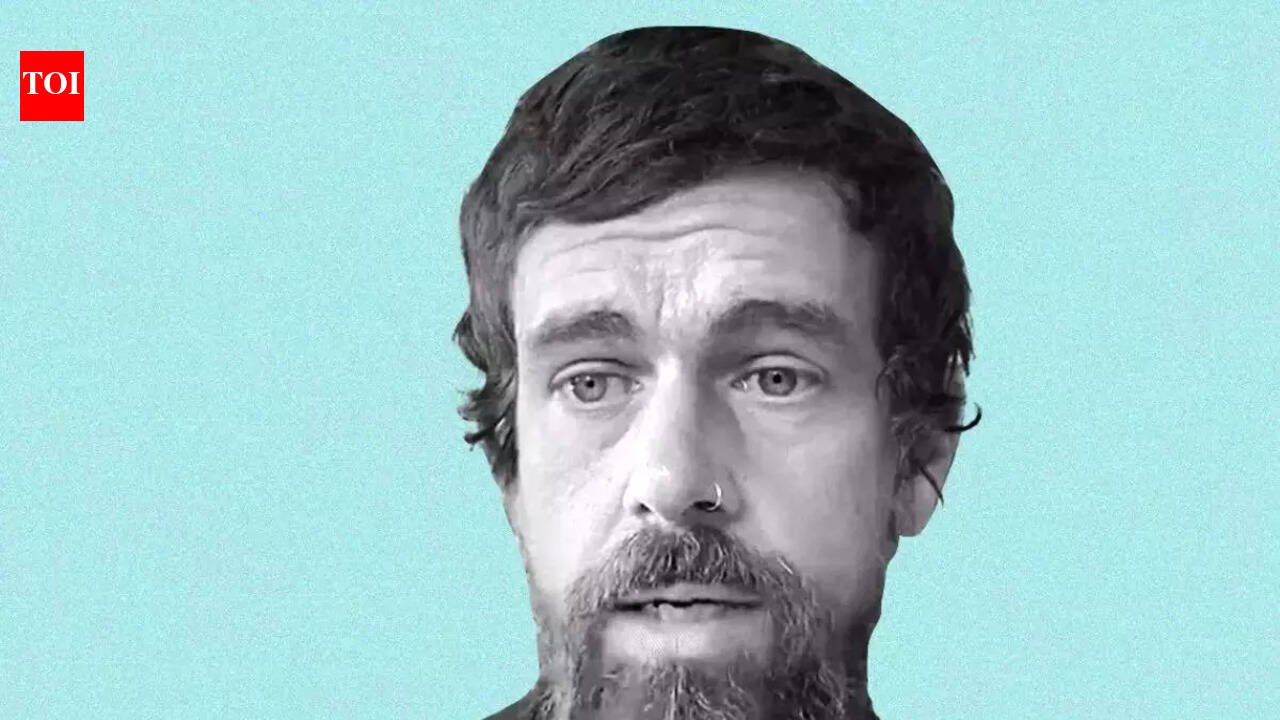
Block Layoffs: Block lays off 40% employees; after thousands of job cuts CEO Jack Dorsey tells staff: Repeated rounds of layoffs are “destructive to morale,” so … |


Block led by CEO Jack Dorsey has announced the most dramatic layoffs in the recent times. The company has slashed around 40% jobs which is nearly half of its workforce in a single round of layoffs. The company’s workforce has dropped from over 10,000 employees to just under 6,000. Speaking about the layoffs Dorsey said that he wanted to avoid repeated round of layoffs as it leads to morale damage and comes with prolonged uncertainty. “Repeated rounds of layoffs are destructive to morale, focus, and to the trust of customers and shareholders. I’d rather take a hard, clear action now and build from a position we believe in than manage a slow reduction of people toward the same outcome,” he wrote in a post on X.Dorsey framed the cuts as part of a broader shift toward leaner, AI-driven operations. “We’re already seeing that the intelligence tools we’re creating and using, paired with smaller and flatter teams, are enabling a new way of working which fundamentally changes what it means to build and run a company,” he said. On Block’s earnings call, he predicted that more companies will follow suit, using AI to drive efficiency gains.Analysts noted that while the scale of Block’s layoffs is extreme, the severance packages offered were relatively generous. Georgetown University professor Brooks Holtom told Business Insider that one-time cuts may be less damaging than repeated rounds, though the sheer size of Block’s reduction is striking.

Jack Dorsey admits over hiring

Responding to a post of social media platform X, Dorsey admitted that he over-hired during the COVID era. “Yes we over-hired during covid because i incorrectly built 2 separate company structures (square & cash app) rather than 1, which we corrected mid 2024. but this misses all the complexity we took on through lending, banking, and BNPL. and that we’re now targeting $2M+ gross profit per person, 4x our pre-covid efficiency, which stayed flat at ~$500k from 2019 until 2024. we have and do run an efficient company… better than most,” wrote Dorsey.

Read Jack Dorsey’s complete post on Block layoffs here

Today we’re making one of the hardest decisions in the history of our company: we’re reducing our organization by nearly half, from over 10,000 people to just under 6,000. that means over 4,000 of you are being asked to leave or entering into consultation. i’ll be straight about what’s happening, why, and what it means for everyone.first off, if you’re one of the people affected, you’ll receive your salary for 20 weeks + 1 week per year of tenure, equity vested through the end of may, 6 months of health care, your corporate devices, and $5,000 to put toward whatever you need to help you in this transition (if you’re outside the U.S. you’ll receive similar support but exact details are going to vary based on local requirements). i want you to know that before anything else. everyone will be notified today, whether you’re being asked to leave, entering consultation, or asked to stay.we’re not making this decision because we’re in trouble. our business is strong. gross profit continues to grow, we continue to serve more and more customers, and profitability is improving. but something has changed. we’re already seeing that the intelligence tools we’re creating and using, paired with smaller and flatter teams, are enabling a new way of working which fundamentally changes what it means to build and run a company. and that’s accelerating rapidly.i had two options: cut gradually over months or years as this shift plays out, or be honest about where we are and act on it now. i chose the latter. repeated rounds of cuts are destructive to morale, to focus, and to the trust that customers and shareholders place in our ability to lead. i’d rather take a hard, clear action now and build from a position we believe in than manage a slow reduction of people toward the same outcome. a smaller company also gives us the space to grow our business the right way, on our own terms, instead of constantly reacting to market pressures.a decision at this scale carries risk. but so does standing still. we’ve done a full review to determine the roles and people we require to reliably grow the business from here, and we’ve pressure-tested those decisions from multiple angles. i accept that we may have gotten some of them wrong, and we’ve built in flexibility to account for that, and do the right thing for our customers.we’re not going to just disappear people from slack and email and pretend they were never here. communication channels will stay open through thursday evening (pacific) so everyone can say goodbye properly, and share whatever you wish. i’ll also be hosting a live video session to thank everyone at 3:35pm pacific. i know doing it this way might feel awkward. i’d rather it feel awkward and human than efficient and cold.to those of you leaving…i’m grateful for you, and i’m sorry to put you through this. you built what this company is today. that’s a fact that i’ll honor forever. this decision is not a reflection of what you contributed. you will be a great contributor to any organization going forward.to those staying…i made this decision, and i’ll own it. what i’m asking of you is to build with me. we’re going to build this company with intelligence at the core of everything we do. how we work, how we create, how we serve our customers. our customers will feel this shift too, and we’re going to help them navigate it: towards a future where they can build their own features directly, composed of our capabilities and served through our interfaces. that’s what i’m focused on now. expect a note from me tomorrow.jack


Source link

VIDEO: Tilak Varma’s reply to Brad Evans’ sister wins hearts


In a tournament filled with high-voltage drama and record-breaking performances, sometimes the most memorable moments happen off the field. Following India’s commanding 73-run victory over Zimbabwe in the T20 World Cup Super 8 clash at the MA Chidambaram Stadium on Thursday, young batter Tilak Varma captured millions of hearts with a heartwarming gesture – recording a special video message for Zimbabwe pacer Brad Evans’ sister, who is a massive fan of the Indian cricketer .

Brad Evan’s sister’s special demand from Tilak Varma

After the match concluded, as players from both sides mingled on the field in the traditional post-match interaction, Zimbabwe pacer Brad Evans approached Tilak with a unique request. Evans’s sister Rebecca, back home, is a huge admirer of the young Indian batter and had been begging her brother for a special video message.

“My sister is a very big fan of his, so she asked if she could get a video message from him,” Evans told ICC, capturing the moment that would soon go viral across social media platforms.

Tilak, ever humble and grounded despite his rising stardom, responded positively without a moment’s hesitation.

Tilak Varma fulfils Brad Evan’s sister demand

What followed was a warm, genuine message that has since won hearts across the cricketing world. In the video, Tilak addressed Rebecca directly with words that reflected both humility and sportsmanship.

“Hi Rebecca, thank you for being a big fan. It means a lot. Hope to see you when I am in Zimbabwe. I will meet you, and your brother is amazing. He has bowled really well, and I will see you very soon. Thanks once again,” Tilak said in the video message.

Evans later revealed just how much the message would mean to his sister. “She actually messaged me only the other day asking for a message. She is going to be very embarrassed, but she has got the message now,” he concluded with a smile.

Tilak’s match-winning performance against Zimbabwe

The request came shortly after Tilak had produced a breathtaking performance that helped propel India to the second-highest total in T20 World Cup history – a mammoth 256/4. Batting at an unfamiliar No. 6 position after being shuffled down the order due to Sanju Samson’s inclusion, the left-hander smashed 44 runs off just 16 deliveries at a staggering strike rate of 275.

His innings, which included 4 fours and 6 sixes, came in a crucial 84-run partnership with Hardik Pandya off just 31 balls. The late blitz took the game away from Zimbabwe and ensured India posted a total that proved far too many for the Chevrons, who were eventually restricted to 183.

Speaking after the match, Tilak opened up about his new role in the batting order. “I always say that whatever team needs, I am up for it. I have done the same role since last four years in IPL for Mumbai Indians and also in few games for the Indian team, so I am up for it. I can adjust,” he said during the post-match press conference.

He added, “I was just waiting for one innings, so I am really grateful to God for that it has come at the right time. I am pretty confident now that going forward I can win the games for the team.”

Also READ: Fans mourn tragic demise of Rinku Singh’s father during T20 World Cup 2026

Fans praise Tilak’s humility

The video quickly spread across social media platforms, with fans praising Tilak for his humility and warmth. Many noted that in an era where cricketers are often inaccessible to fans, such gestures restore faith in the human side of the sport.

The interaction also highlighted the unique camaraderie that develops between opponents during multi-nation tournaments, where brief on-field battles give way to lasting off-field friendships.

What’s next for Tilak and Team India?

With this victory, India kept their semifinal hopes alive, setting up a virtual knockout against West Indies at Eden Gardens in Kolkata on March 1. Tilak’s form, having registered 151 runs in six outings at an average of 30.20 and strike rate of 142.45, will be crucial to India’s chances of progressing further.

Also WATCH: Brian Bennett’s Beckham-style reflexes deny Jasprit Bumrah a stunning yorker dismissal during T20 World Cup 2026 Super 8 clash


Source link

US senators make two demands as Anthropic CEO Dario Amodei says ‘No’ to Pentagon


US senators make two demands as Anthropic CEO Dario Amodei says ‘No’ to Pentagon

The standoff between the Pentagon and AI company Anthropic has now has a new party – the US Congress. Senators from both sides of the aisle are reportedly calling on the Department of War to withdraw its Friday 5pm ultimatum against Anthropic, arguing that the decision of this magnitude cannot be made without legislative oversight, and that the Congress must be included in the debate over military use of artificial intelligence (AI) technology.

What lawmakers are saying on the Pentagon vs Anthropic issue

According to a report by Axios, Democratic and Republican senators have made two demands: First is to stay the Friday ultimatum and, second, that Congress Congress must be brought into the process of establishing clear rules governing the use of AI in military operations.“Why in the hell are we having this discussion in public?. Why isn’t this occurring in a boardroom or in the secretary’s office? I mean, this is sophomoric. It’s fair to say that Congress needs to weigh in if they have a tool that could actually result in mass surveillance,” (Rep.) Senator Thom Tillis, a member of the Armed Services Committee, was quoted as saying.“The deadline is incredibly tight. That should not be the case if you’re dealing with mass surveillance of civilians. You’re also dealing with the potential use of lethal force without a human in the loop. There’s a contract in place that was signed with the administration, and now they’re trying to break it,” added Senator Gary Peters.According to Senator Elissa Slotkin, this is a “fundamental issue of our time”, and “This is happening because Congress has not put clear limits — left or right — on the use of AI in lethal weapon systems.”Senator Mark Kelly was more direct. “DOD is trying to strong-arm Anthropic into providing every tool they have to surveil US citizens. I have serious concerns about that. That’s unconstitutional. That’s not the role of the Department of Defense.”

Where things stand between the Pentagon and Anthropic

Anthropic CEO Dario Amodei said that there has been “virtually no progress” in negotiations with the Pentagon. Anthropic has refused to accept Pentagon and US defence secretary Pete Hegseth’s contract terms that would allow its Al to be used without limits on domestic surveillance and autonomous lethal weapons. The refusal came hours before the Friday deadline of 5:01pm. If Anthropic refuses, Hegseth reportedly warned he will either declare the company a “supply chain risk” or invoke the Defence Production Act, which would compel Anthropic to modify Claude to meet the military’s requirements.On Wednesday, a report said that the Pentagon began contacting major defence contractors to assess how dependent they are on Claude.


Source link

‘Unwarranted’: Why Delhi court rapped CBI for ‘South Group’ tag in liquor policy case | India News


"No Overarching Conspiracy" Court Clears Arvind Kejriwal, Manish Sisodia In Excise Case

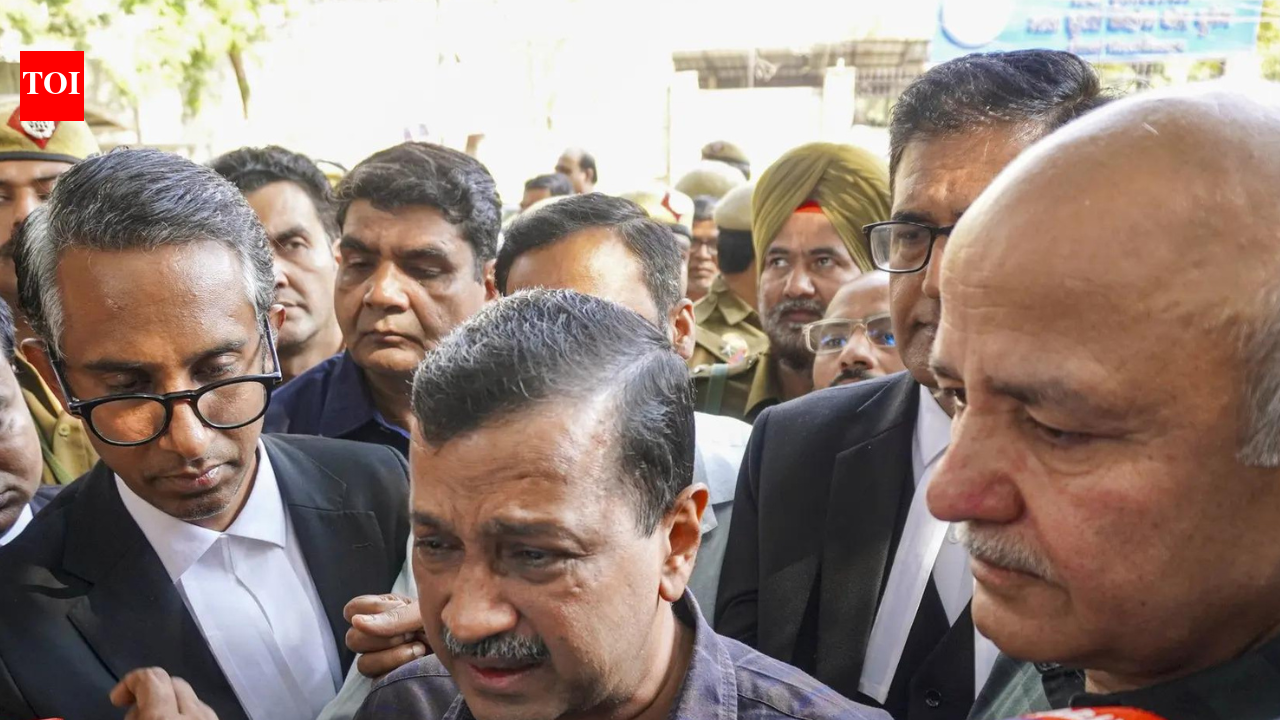
Kejriwal, Sisodia after being cleared of all charges

NEW DELHI: A Delhi court on Friday sharply criticised the Central Bureau of Investigation (CBI) for repeatedly using the term “South Group” in its chargesheet, while it discharged former chief minister Arvind Kejriwal, former education minister Manish Sisodia and 21 others in the liquor policy case.The court said the nomenclature had no basis in law and cautioned the agency to exercise restraint in its choice of language in investigative narratives.

“No Overarching Conspiracy” Court Clears Arvind Kejriwal, Manish Sisodia In Excise Case

Special Judge Jitendra Singh said, “The court considers it necessary to place on record its concern with the repeated and deliberate use of the expression, ‘South Group’, by the investigating agency to describe a set of accused persons, ostensibly based on their regional origin or place of residence.”“It is equally significant that no comparable regional descriptor has been employed for the remaining accused persons. The prosecution narrative does not speak of any ‘North Group’ or similar categorisation. The selective adoption of a geographically-defined label is, therefore, plainly arbitrary and unwarranted,” he added, as quoted by news agency PTI.The court also said that region-based labelling could create a prejudicial impression and was inconsistent with constitutional principles.“The continued use of this label, despite the absence of any legally-sustainable basis, carries a real risk of colouring perception, causing unintended prejudice and diverting focus from the evidentiary material, which alone must guide adjudication,” it said.Observing that the issue was not merely semantic, adding that, “Identity-based labelling, whether by ethnicity, nationality or regional origin, cannot be employed as a prosecutorial shorthand where such identity is irrelevant to the offence. Such labelling is not a mere irregularity of expression, it constitutes a constitutional infirmity capable of undermining the fairness of the proceedings themselves.The Judge Jitendra Singh asked the central agency to exercise “greater care, circumspection and restraint” while drafting chargesheets and investigative narratives. “Descriptions of accused persons must remain strictly neutral, evidence-based and free from expressions that carry a stigmatic, divisive or pejorative overtone,” he said, adding that the use of such terminology violates constitutional provisions.“Persistence with such nomenclature risks undermining the due process of law and is best avoided in the interest of an impartial and constitutionally-compliant administration of criminal justice,” he added.


Source link

‘Did Robert Vadra, Rahul Gandhi go to jail?’ Kejriwal hits back as Congress questions relief in liquor policy case | India News


"No Overarching Conspiracy" Court Clears Arvind Kejriwal, Manish Sisodia In Excise Case

Arvind Kejriwal (PTI photo)

NEW DELHI: The political tremors from the Delhi excise policy verdict rippled beyond the courtroom on Friday as the Congress lashed out at the ruling BJP, alleging that Arvind Kejriwal’s discharge was timed against the backdrop of the Gujarat and Punjab elections.Kejriwal, who had briefly allied with the Congress ahead of the 2024 general elections, hit back at his former ally, accusing it of having “no shame” and drawing a contrast between AAP leaders going to jail and the Congress high command remaining out of legal clutch.

“No Overarching Conspiracy” Court Clears Arvind Kejriwal, Manish Sisodia In Excise Case

Soon after a Delhi court granted relief to Kejriwal in the alleged liquor scam case, Congress spokesperson Pawan Khera attacked the BJP, likening it to an “Icchadhari Naag” (shape-shifting serpent).In a post on X, he alleged that the BJP was deploying central agencies as “campaign tools” with key state elections approaching, calling it “vendetta as governance.”Khera argued that the BJP’s ideological positions were secondary to its “obsessive goal”: the realisation of a “Congress-Mukt Bharat.” He cited what he described as the party’s “fluctuating relationship” with the Trinamool Congress (TMC) as evidence of political opportunism.“The BJP is not a political party. It is a shape-shifter, a wishful serpent – Icchadhari Naag. It will stoop to any level for one obsessive goal: defeat Congress – Congress Mukt Bharat. For 12 years they spewed venom at the TMC. And now? Narendra Modi himself is showering it with praise – not out of respect, but to land a cheap blow at Congress,” Khera’s post read.Khera also predicted that cases against Congress leaders would intensify as elections draw closer, citing senior leader P Chidambaram as an example.“Elections are coming. So the script is predictable. Cases against Congress leaders will suddenly accelerate – @PChidambaram_IN has already been dragged back into the spotlight because Tamil Nadu is going for polls,” he wrote in the post.The Enforcement Directorate (ED) recently granted prosecution sanction against Chidambaram in the Aircel Maxis Deal and INX Media cases.“Meanwhile, proceedings against their “convenient allies” in the AAP and others will quietly vanish in light of the Gujarat and Punjab elections,” he wrote on X.Describing the developments as part of the “BJP playbook,” Khera alleged that the ruling party uses central agencies as “campaign tools”.“This is the BJP playbook: vendetta as governance and agencies as campaign tools,” he said.

Kejriwal hits back with ‘Congress has no shame’ remark

Responding to the Congress’ remarks, Kejriwal targeted Pawan Khera, who suggested that the narrative was being pushed to politically corner the Congress ahead of the Punjab and Gujarat elections.Questioning how many Congress leaders had gone to jail, the AAP supremo said the party had “no shame.”“I want to ask the Congress – Kejriwal went to jail. Did Robert Vadra go to jail? Sanjay Singh went to jail. Did Rahul Gandhi go to jail? Sanjay Singh went to jail. Did Sonia Gandhi ji went to jail? What is Congress saying? Does it have no shame?” Kejriwal asked.The political exchange followed a detailed order from a Special Court in Delhi, which held that the prosecution had failed to disclose “even the threshold of a prima facie suspicion, far less the grave suspicion” required for framing of charges in the CBI case linked to the Delhi Excise Policy 2021-22.In a strongly worded ruling, Special Judge (PC Act) Jitender Singh of the Rouse Avenue Court said the prosecution’s case was “legally infirm, unsustainable, and unfit to proceed any further in law”.The court further observed that when the material collected by the agency was tested on admissibility, relevance and probative value, “the appearance of a coherent conspiracy dissolves,” exposing the allegations as being founded on inadmissible material and post-facto reconstruction.Among those discharged are Arvind Kejriwal, and former deputy chief minister Manish Sisodia and 21 others.The court was also critical of the Central Bureau of Investigation’s (CBI) reliance on approver statements, cautioning that granting pardon to an accused and then using his testimony to fill gaps in the prosecution’s case or implicate additional accused would undermine constitutional safeguards.The FIR in the case was registered in August 2022 following a complaint by Delhi Lieutenant Governor VK Saxena, alleging that the now-scrapped excise policy was designed to favour select liquor licensees by reducing licence fees and fixing profit margins, leading to kickbacks and losses to the exchequer.


Source link

Real Madrid face Manchester City, PSG draw Chelsea in Champions League last 16 | Football News


Real Madrid face Manchester City, PSG draw Chelsea in Champions League last 16
Real Madrid’s Vinicius Junior, left, celebrates with teammates after scoring his side’s second goal during the second leg of the Champions League playoff soccer match between Real Madrid and Benfica in Madrid, Spain, Wednesday, Feb. 25, 2026. (AP Photo)

PARIS: Real Madrid and Manchester City will face off in a Champions League knockout tie for the fifth season running after being drawn Friday to play each other in the last 16, while reigning champions Paris Saint-Germain will take on Chelsea.The Spanish giants, record 15-time European champions, will host City in the first leg at the Santiago Bernabeu next month before travelling to England for the return the following week. The clubs have already played each other this season, with Pep Guardiola’s City winning 2-1 in Madrid in December during the league phase, in which the Premier League club finished eighth and Real ninth.That allowed City, Champions League winners in 2023, to advance straight to the last 16 while Madrid had to come through the knockout phase play-offs, in which they beat Benfica 3-1 on aggregate.This is the eighth season in which the teams have played each other since 2012. Real beat City in the knockout phase play-offs last season, and in the quarter-finals on the way to winning the trophy in 2024. They also emerged victorious in the semi-finals in 2022 with City winning at the same stage the following year.PSG will be at home to Chelsea in the first leg after qualifying for this stage with a 5-4 aggregate win over Ligue 1 rivals Monaco in the play-offs. Chelsea progressed straight to the last 16 after finishing sixth in the league phase.The sides played each other in the knockout stages in three consecutive years from 2014 to 2016, with Chelsea winning the first of those confrontations in the quarter-finals and PSG triumphing in the last 16 in the following two.Their last encounter came in July’s Club World Cup final in the United States, when Chelsea won 3-0 against last season’s European champions.Chelsea have been coached since January by Liam Rosenior, who had previously come up against PSG in Ligue 1 as coach of Strasbourg.– Arsenal face Leverkusen, Newcastle play Barcelona –There is a record total of six English clubs in the last 16. None will play each other in the last 16 but there are two potential all-English quarter-finals.Liverpool will have a last-16 rematch against Galatasaray, the Turkish giants having defeated the Anfield club 1-0 in September in the league phase.The winner of that tie will play either PSG or Chelsea in the quarter-finals, meaning there is a chance Liverpool will get the opportunity to avenge their defeat by the Parisians on penalties a year ago.Meanwhile, Newcastle United will take on Barcelona with the first leg at St James’ Park — the Spanish side won 2-1 there during the league phase in September.Tottenham Hotspur were drawn to play Atletico Madrid, with the winners of that tie then facing Newcastle or Barcelona in the last eight.Arsenal, who finished first in the league phase, will come up against Bayer Leverkusen and if they win that would then be huge favourites in a quarter-final against Bodo/Glimt or Sporting of Portugal.The last-16 meeting with Sporting is the Norwegian upstarts’ reward for knocking out last season’s beaten finalists Inter Milan in the play-offs.German champions Bayern Munich will play Atalanta, the sole Italian club left in the competition.The first legs will take place on March 10 and 11, with the second legs a week later. The teams who qualified directly for this stage after finishing in the top eight in the league phase will all be at home in the return matches.This season’s Champions League final will take place at the Puskas Arena in Budapest on May 30.


Source link

Ex-captain Sourav Ganguly’s message to India selectors: Take Auqib Nabi to England | Cricket News


‘England is the place to start in the summer,’ said former India captain Sourav Ganguly, backing Jammu and Kashmir pacer Auqib Nabi for national selection after his five-wicket haul in the Ranji Trophy final against Karnataka at the KSCA Hubli Cricket Ground on Friday.Nabi returned figures of 5/54 in 23 overs as J&K bowled Karnataka out for 293 to secure a first-innings lead of 291 runs in the summit clash. He now leads the wicket charts this season with 60 wickets in 10 matches at an average of 12.56, including seven five-wicket hauls.

India keep T20 World Cup dream alive, over to Kolkata now

In a post on X, Ganguly said Nabi should be considered for India’s white-ball tour of England in July 2026, where India are scheduled to play five T20Is and three ODIs. The series will be part of preparations for the 2027 ODI World Cup in South Africa.“J&K has shown the world what effort and intent can do ..They have made that region so proud of them. Tough environment makes tough people. Aqib nabi on his way to national colours. England is the place to start in the summer,” Ganguly wrote.With only a few sessions left in the final, a draw appears likely, which would hand Jammu and Kashmir their maiden Ranji Trophy title on the basis of the first-innings lead.Earlier, former India wicketkeeper Dinesh Karthik had also praised Nabi’s season, noting that he has featured in all matches and performed across conditions.“Watching this Ranji Trophy campaign and following it closely, one thing I can say for certain, for all the young boys and girls out there playing this sport and wanting to represent the country, do it the AAQIB NABI way. Can’t think of any pacer/player in a long time doing what he’s done,” he wrote on X.“Domination from start to end and almost single-handedly winning the domestic tournament that matters the most to get into the national side,” he wrote.“Fitness across the whole campaign, bowling those long spells and across different soils and weather conditions and whether there’s been any help for a pacer or not, he’s been there for his team with the belief every time he’s had the ball to STRIKE for his team.“Hats off to you, AAQIB, you’re an absolute champion and hope you get a lot of success that comes your way and may you be the lesson on how it’s done to break the doors through sheer will power, skill and resilience,” he added.


Source link