Breaking News
Columbia student detained by ICE agents to be released after Mamdani–Trump meeting


Columbia student detained by ICE agents to be released after Mamdani–Trump meeting
(Image credits: X @NYCMayor)

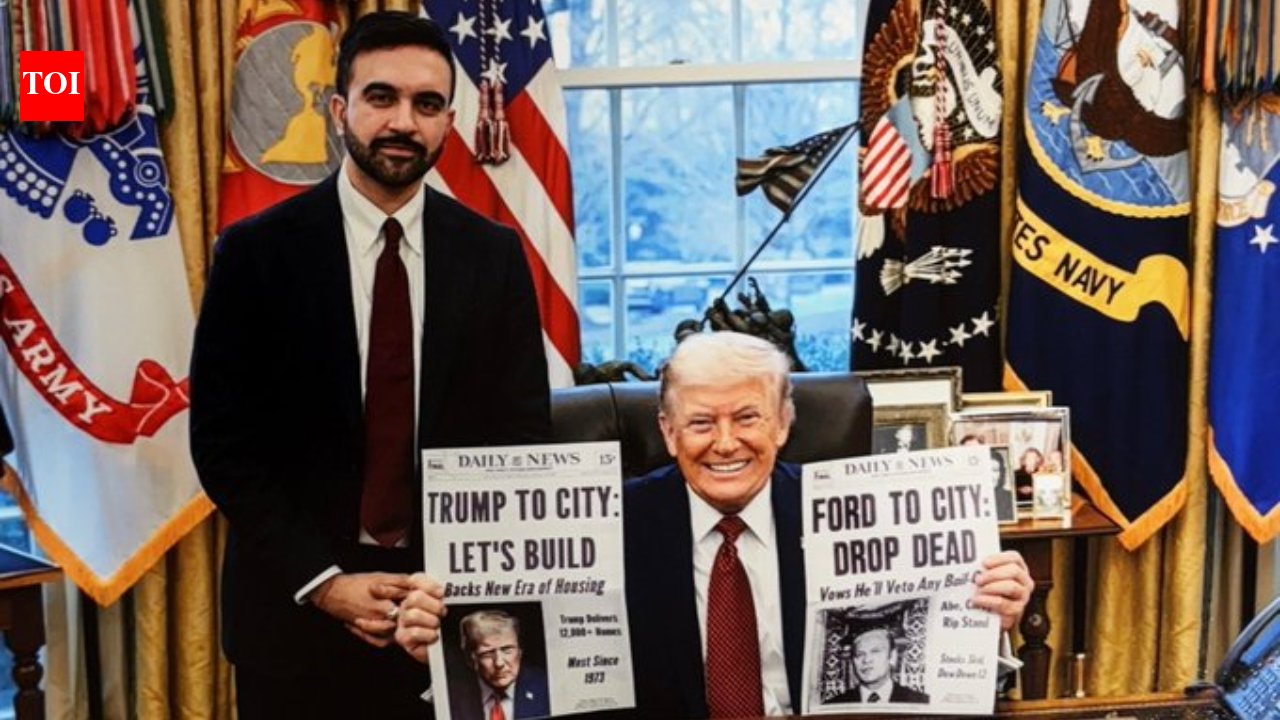
New York City mayor Zohran Mamdani met with President Donald Trump at the White House on Thursday for a previously unannounced meeting that lasted about an hour, focusing on major new housing investments in the city while also addressing the arrest of a Columbia University student.After the meeting, Mamdani posted on X, “I had a productive meeting with President Trump this afternoon. I’m looking forward to building more housing in New York City.”As part of his visit, Mamdani presented Trump with a mock newspaper front page created by his team. It featured the headline, “Trump to City: Let’s Build” — a riff on the famous 1975 New York Daily News cover that read “Ford to City: Drop Dead,” referring to Gerald Ford’s vow to veto financial assistance to the city.Mamdani’s office declined to provide details about the housing proposal, but Anna Bahr, the mayor’s communications director, said Trump was “very enthusiastic” about it. She said that during their first one-on-one meeting at the White House in November, Trump encouraged Mamdani to return with an idea to build major projects together in New York City. Bahr added that the mayor’s team created the mock front page and headlines to show what kind of reaction new federal housing investments could generate. During Thursday’s meeting, Mamdani also raised the arrest of Columbia University student Ellie Aghayeva, who had been detained earlier in the day by federal immigration authorities. The arrest triggered protests on campus and allegations that agents gained entry to a university-owned residence by posing as police officers searching for a missing child.Just hours after detaining Aghayeva, the federal government reversed course and allowed her to walk free following what appeared to be an intervention by Donald Trump. Mamdani also gave White House chief of staff Susie Wiles a list of four other students targeted by federal authorities and asked for the administration’s help.“He has just informed me that she will be released imminently,” Mamdani wrote on social media, referring to Aghayeva.The rapid developments underscored the evolving relationship between Trump and Mamdani, a democratic socialist whom Trump once threatened to have deported. During the mayoral campaign, Trump repeatedly criticised Mamdani as a “communist,” but appeared more receptive after their November meeting.




Source link

Uber India’s FY25 sales rise 2.3%, losses widen


Uber India's FY25 sales rise 2.3%, losses widen

BENGALURU: Uber’s India business posted total sales of Rs 3,849.2 crore in FY25, up 2.3% y-o-y, reflecting a sharp slowdown in growth even as losses widened significantly, according to consolidated financials accessed via Tofler.Operating loss surged to Rs 1,052.3 crore from Rs 84.8 crore in FY24, with operating margin deteriorating to -27.3% from -2.2%. Net loss stood at Rs 1,511 crore for the year, compared with Rs 89 crore a year earlier. Net margin slipped to negative 38.8%, versus -2.3% in FY24.


Source link

With eye on AI, deeptech funding rises 37% to $2.3bn


With eye on AI, deeptech funding rises 37% to $2.3bn

BENGALURU: Deeptech funding in India surged 37% year-on-year to $2.3 billion in 2025, outpacing broader venture capital growth and cementing artificial intelligence as the primary engine of the country’s startup ecosystem, according to Nasscom and Zinnov’s latest Indian Tech Start-up Report.Overall tech startup funding rose 23% to $9.1 billion during the year, even as investors grew more selective and milestone focused. The report characterised the shift as a transition from “volume-driven expansion” to “execution-led maturity,” with capital increasingly directed at validated, commercialisation-ready ventures.India is now home to over 4,200 deeptech startups, including more than 550 founded in 2025. AI dominates the segment, accounting for 84% of deeptech startups and 91% of deeptech funding. Its influence spans enterprise software, cybersecurity, defence and industrial systems.Rajesh Nambiar, president of Nasscom, said the ecosystem has entered “a more disciplined phase of growth,” with AI emerging as core infrastructure for the next wave of innovation. “This signals growing global confidence in India’s ability to build, deploy, and commercialize AI at scale across sectors ranging from enterprise software and cybersecurity to defense and industrial systems,” he said. Despite the rebound, funding remained concentrated in early stages. Nearly 74% of total deals in 2025 were at seed and early stages. However, about 85% of seed-stage ventures failed to progress to Series A within five years, pointing to a persistent gap between proof-of-concept and scalable revenue.Pari Natarajan, CEO of Zinnov, said the challenge has shifted from startup creation to conversion.


Source link

AI use in warfare: Anthropic rejects US demand for ‘unrestricted’ military access


AI use in warfare: Anthropic rejects US demand for ‘unrestricted’ military access
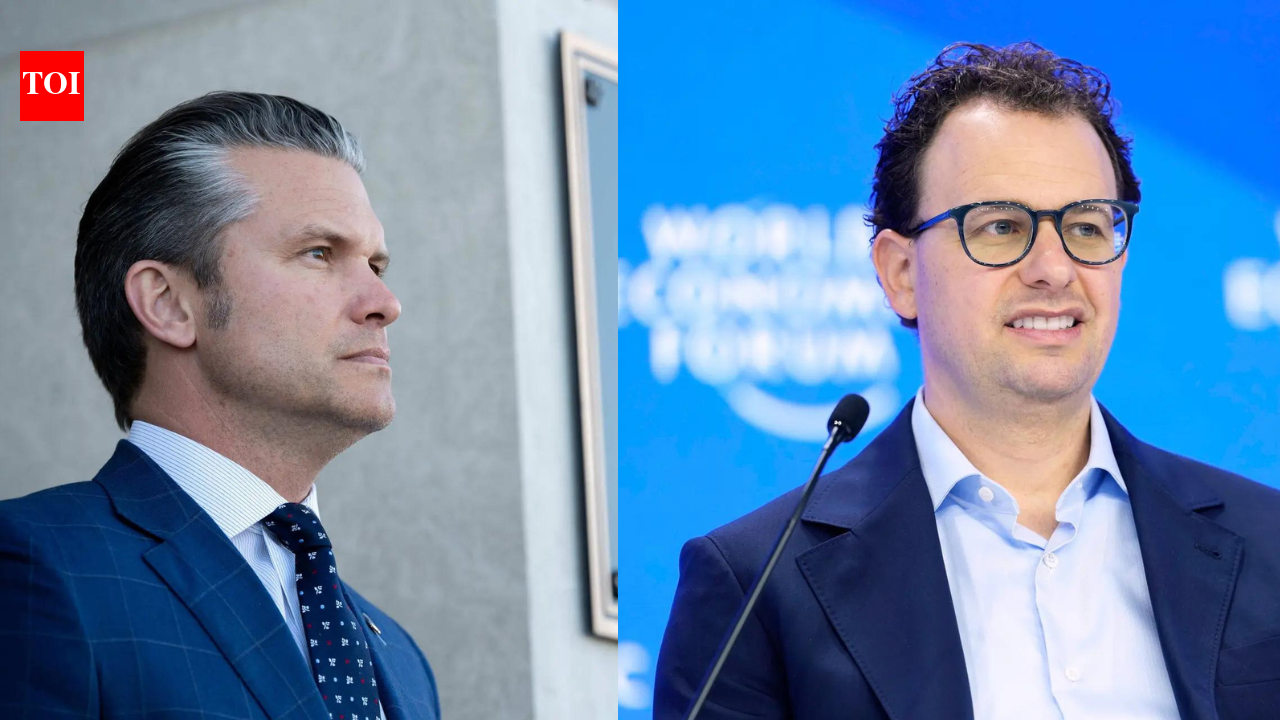
The AI battle: Defence secretary Pete Hegseth and Anthropic CEO Dario Amodei.

Anthropic CEO Dario Amodei on Thursday said the artificial intelligence company “cannot in good conscience accede” to Pentagon demands for unrestricted use of its technology, escalating an unusually public standoff with the Donald Trump administration that could cost the firm its government contract as early as Friday.The company behind the AI chatbot Claude said it remains open to negotiations, reported AP, but warned that revised contract language from the defense department “made virtually no progress on preventing Claude’s use for mass surveillance of Americans or in fully autonomous weapons.”Pentagon chief spokesman Sean Parnell pushed back on those concerns, writing on social media that the military “has no interest in using AI to conduct mass surveillance of Americans (which is illegal) nor do we want to use AI to develop autonomous weapons that operate without human involvement.”Anthropic’s internal policies prohibit such uses. The company is currently the only major AI developer — alongside firms such as Google, OpenAI and Elon Musk’s xAI — that has not agreed to supply its technology to a new internal U.S. military network.“It is the Department’s prerogative to select contractors most aligned with their vision,” Amodei said in a statement. “But given the substantial value that Anthropic’s technology provides to our armed forces, we hope they reconsider.”The dispute intensified after defense secretary Pete Hegseth issued an ultimatum on Tuesday following a meeting with Amodei: allow unrestricted military use of Anthropic’s AI technology by Friday or risk losing the Pentagon contract. Officials also warned that the company could be designated a supply-chain risk or that the Defense Production Act — a Cold War-era law — could be invoked to grant the military broader authority over its products.Amodei criticised the threats as inconsistent, saying that “those latter two threats are inherently contradictory: one labels us a security risk; the other labels Claude as essential to national security.”Parnell reiterated that the Pentagon seeks to “use Anthropic’s model for all lawful purposes,” without specifying what those uses would include. He argued that wider access to the technology is necessary to avoid “jeopardizing critical military operations.”“We will not let ANY company dictate the terms regarding how we make operational decisions,” he said.Negotiations between the two sides have been ongoing for months. Amodei said that if the Pentagon does not revise its position, Anthropic “will work to enable a smooth transition to another provider.”The public nature of the dispute has drawn criticism on Capitol Hill.Republican Sen. Thom Tillis of North Carolina said the Pentagon had handled the issue unprofessionally and suggested Anthropic was “trying to do their best to help us from ourselves.”“Why in the hell are we having this discussion in public?” Tillis told reporters. “This is not the way you deal with a strategic vendor that has contracts.”He added, “When a company is resisting a market opportunity for fear of negative consequences, you should listen to them and then behind closed doors figure out what they’re really trying to solve.”Sen. Mark Warner of Virginia, the top Democrat on the Senate Intelligence Committee, said he was “deeply disturbed” by reports that the Pentagon was “working to bully a leading U.S. company.”“Unfortunately, this is further indication that the Department of Defense seeks to completely ignore AI governance,” Warner said. It “further underscores the need for Congress to enact strong, binding AI governance mechanisms for national security contexts.”Pentagon officials maintain that AI systems will be used in accordance with the law, even as the department has sought to reshape its internal legal culture.Hegseth told Fox News last February that the military wants lawyers who provide constitutional advice but do not serve as “roadblocks.” The same month, he dismissed the Army and Air Force’s top legal officers without explanation. The Navy’s top lawyer had resigned shortly after the 2024 election.


Source link

iPhone surge: At $30bn, smartphones top exports in 2025


iPhone surge: At $30bn, smartphones top exports in 2025

NEW DELHI: Smartphones, led largely by Apple’s iPhone, emerged as India’s top export category for the first time, overtaking automotive diesel fuel in 2025, official data showed, indicating the impact of policy measures to boost exports. Exports of smartphones during Jan-Dec 2025 rose to about $30.1 billion, up 47.5% from $20.4 billion in 2024, while automotive diesel fuel exports were at $16.3 billion. Other major export categories were cut and unmounted diamonds at $12.4 billion, medicines for retail sale at $10.7 billion, motor gasoline at $9.7 billion, and aviation turbine fuel at $9.5 billion.Data on export destinations shows that the US widened its lead as India’s largest market, as exports to the US rose 14.2% to $92.3 billion in 2025 from $80.7 billion a year earlier. The UAE remained the second-largest destination at $38.6 billion, while exports to China rose 19.3% to $18 billion, and shipments to the Netherlands and the UK declined.The surge in smartphone exports was driven largely by Apple’s iPhone shipments from India to the US and UAE. Industry estimates indicate that iPhones accounted for nearly three-quarters of total smartphone exports, with shipments reaching about $23 billion in 2025 as Apple’s exports nearly doubled from the previous year. Experts said several policy initiatives unveiled by govt, including the performance-linked incentive scheme, had helped push exports of smartphones significantly.Nilanjan Banik, professor of economics at Mahindra University, said India’s rise as a major iPhone exporter reflects both policy support and demand trends. “India is emerging as the world’s largest seller and exporter of iPhones due to massive local manufacturing scale-up and booming domestic demand. Apple now produces about 25% of global iPhones in India,” he said.He added that shipments hit a record 14 million units in 2025, capturing 9% volume share and 28% value share, making India Apple’s third-largest market. Rising incomes, premiumisation, easier financing, festive discounts, and expansion into Tier-2 and Tier-3 cities supported growth. “India built a formidable supply chain ecosystem, especially in states like Tamil Nadu and Maharashtra, to sustain this growth further,” said Banik.


Source link

Access Denied


Access Denied

You don’t have permission to access “http://www.ndtv.com/world-news/pak-declares-open-war-bombs-kabul-kandahar-after-afghanistan-attacks-11142824” on this server.

Reference #18.cdf5d217.1772160320.fa1229d4

https://errors.edgesuite.net/18.cdf5d217.1772160320.fa1229d4


Source link

SC seeks experts for panel on Aravalis; mining ban to continue | India News


SC seeks experts for panel on Aravalis; mining ban to continue

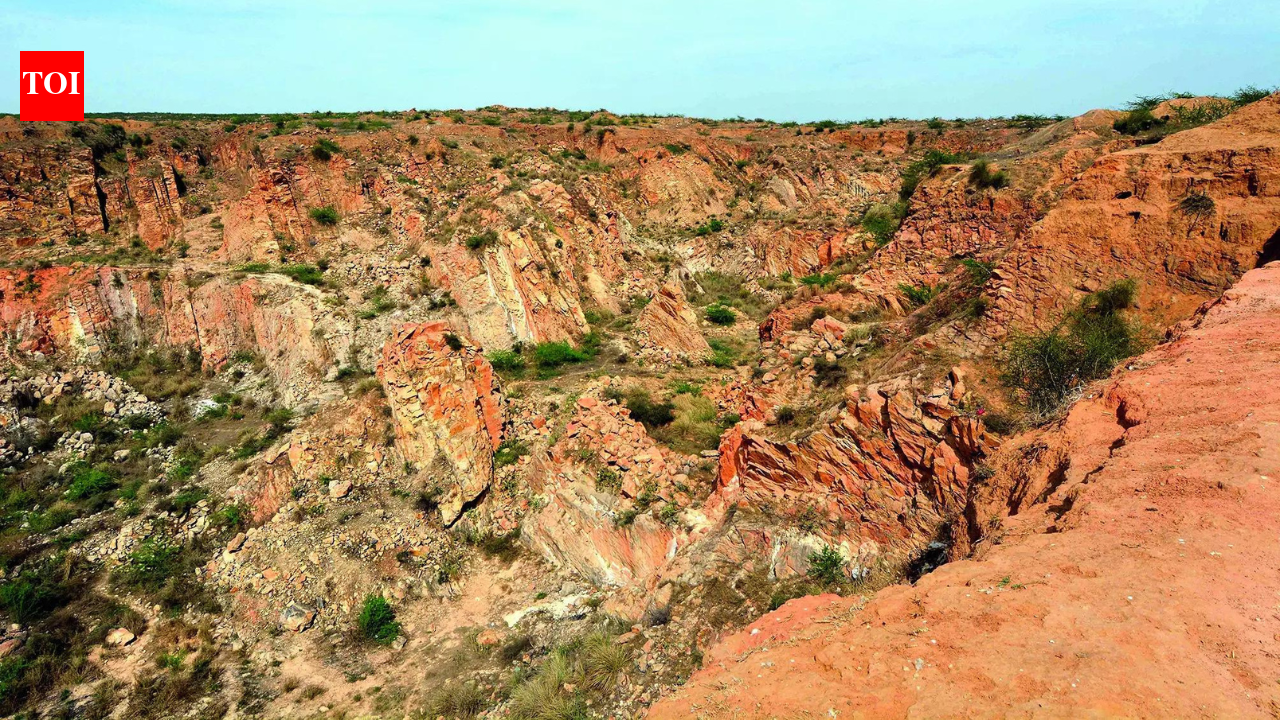
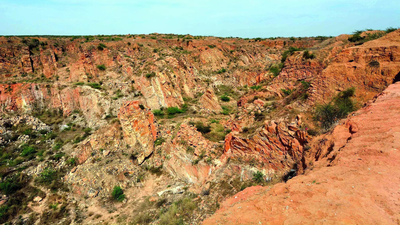
NEW DELHI : SC asked the environment ministry and other stakeholders on Thursday to suggest names of domain experts for the committee to be tasked with defining the Aravali hills and ranges, and observed that only lawful mining would be allowed in the region.The top court, on Dec 29, had taken note of the outcry over the new definition of Aravalis and kept in abeyance its Nov 20 order accepting a uniform definition of the hills and ranges. It had also put all mining on hold.On Thursday, a bench of CJI Surya Kant and Justices Joymalya Bagchi and Vipul M Pancholi extended its earlier stay order on mining for the time being.Aravali case: We will allow lawful mining only, says SCDuring the hearing, senior advocate Mukul Rohatgi, appearing for a litigant, said the company had a mining license and had won the right to mine after a protracted battle. Now, because of the court order, mining had been stalled.“We will allow lawful mining only… let the experts tell us (the definition). We will cross all bridges and reach the right destination,” the CJI said.The bench asked lawyer Jay Cheema to assist it. Senior advocate K Parmeswar is already assisting the bench as amicus curiae.“We request the (environment) ministry to suggest a panel of domain experts along with their profiles. Senior counsel are also requested to give profiles of some eminent domain experts for the purpose of constituting the committee, as was observed by this court,” the bench said.The bench said it was conscious of the fact that all activities, especially mining by licenced firms, have come to a halt. “However, status quo will have to be maintained for the time being till some preliminary issues are answered in a phased manner. Post this matter for the constitution of the committee,” the CJI said.The bench asked stakeholders to submit written notes by March 10 after the amicus curiae submitted his suggestions on the aspect of definitions of the Aravali hills and ranges.The bench said it will set up the panel of experts and frame issues to be decided on the next date of hearing.Earlier, the bench said it seemed prima facie that the earlier report of a committee and the verdict had “omitted to expressly clarify certain critical issues” and there was a “dire need to further probe” to prevent any regulatory gaps that might undermine the ecological integrity of the Aravali region.“There has been a significant outcry among environmentalists, who have expressed concern about the potential for misinterpretation and improper implementation of the… definition and this court’s directions,” the bench had said.


Source link

Social media companies must pay creators fairly: Vaishnaw | India News


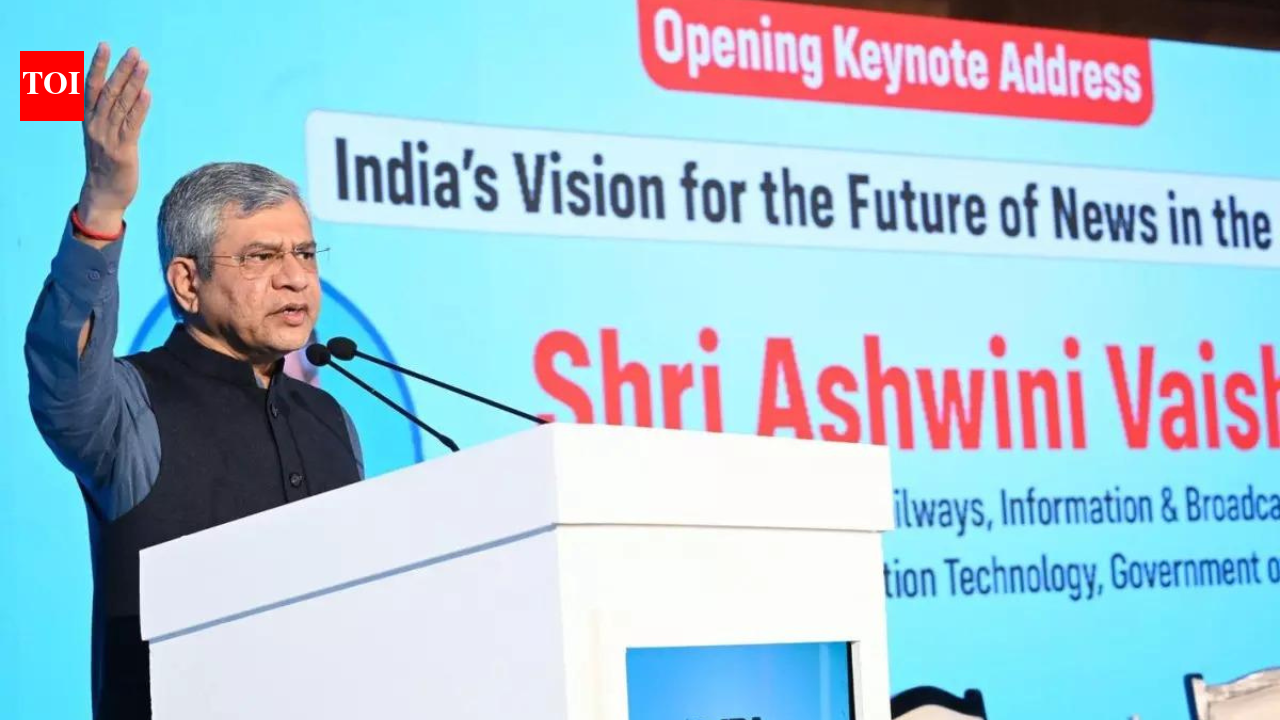
Fair Pay, Consent, Online Safety: Ashwini Vaishnaw Draws Red Line For Digital Platforms

NEW DELHI: Information and broadcasting minister Ashwini Vaishnaw said Thursday social media platforms should compensate creators of the content they use for earning billions in profit.“Social media platforms must also share revenue in a fair way with the people who are creating content, whether it is news persons, conventional media, creators in far-flung areas, influencers, or professors and researchers disseminating their work using the platforms... there has to be a fair share of revenue with the people who are creating the content,” Vaishnaw said at the Storyboard 18 Digital News Publishers Association Conclave.

Fair Pay, Consent, Online Safety: Ashwini Vaishnaw Draws Red Line For Digital Platforms

‘Social media giants must be accountable’Information and broadcasting minister Ashwini Vaishnaw’s pitch for “fair compensation” comes amid a debate raging globally over the refusal of social media giants to compensate creators of content which they have used to make huge profits.The conduct of platforms was under focus in the deliberations at the conclave, with Vaishnaw saying that social media companies can no longer function as neutral intermediaries. They now operate like publishers and must be accountable for the content they host and amplify, he said.Vaishnaw said internet’s evolution into a powerful media ecosystem demands a redistribution of responsibility. “The nature of internet has changed… today it has become a powerful media outlet, where, like media, the platforms must take responsibility,” he said, adding, “Platforms must take responsibility for what they are publishing.”Warning deepfakes, disinformation and synthetic media are corroding public trust, the minister said the damage goes beyond individual harm. “The entire society is built upon trust in institutions… that core tenet of trust is under threat,” he said, pointing to the rapid spread of fabricated images and videos through algorithm-driven virality.The I&B minister also emphasised that synthetic content must not be created without explicit consent.


Source link

‘Seagull Boy’ Cooper set to visit DHR in April | Kolkata News


Darjeeling: Cooper Wallace, the 10-year-old British sensation famously known as ‘Seagull Boy’ for his award-winning European gull-screeching performances, will visit the Darjeeling Himalayan Railway in April. A railway enthusiast, Cooper will be accompanied by his younger sister, Shelby, who plans to explore Darjeeling and learn Nepali dance on the visit.Cooper’s fascination with the DHR runs in the family. His grandfather, David Charlesworth, is a longstanding member of the Darjeeling Himalayan Railway Society (DHRS), while his mother, Lauren, shares his passion and is revisiting the DHR after more than two decades.

Kolkata: Politics, Policy Shifts, New Services, Business Moves & More

From Chesterfield in Derbyshire, Cooper first made headlines in 2024 as the first UK participant in the European ‘Meeuwenschreeuwen’, or gull-screeching championship in De Panne, Belgium. He won the title twice, competing against 21 participants, including Shelby, who finished fourth. Speaking to TOI from the UK, Charlesworth said Cooper’s admiration for the railway was rooted in childhood experiences. “Cooper even recognises Darjeeling No 19 ‘Alfred’, the only class ‘B’ engine to leave India preserved at the Statfold Barn Railway Museum. He knows what the DHR looks like and is keen on seeing it in person. Shelby is excited to learn Nepali dance while we all enjoy the hills and the historic railway,” said Charlesworth. The DHRS, based in England, was formed in 1997 with the mission to promote awareness and appreciation of the Darjeeling Himalayan Railway (DHR). Born in 1954, Charlesworth is an English fine arts artist, designer and author with a wide portfolio including graphic design and illustrations and cartoons. He is acclaimed for his paintings and drawings of transport and historical subjects, and is regularly commissioned for portraits and book illustrations. Raised by his maternal grandparents, he has been fascinated by India all his life as his grandfather was in India and Burma in 1943 and brought back books and photographs from Darjeeling. Charlesworth was a co-founder of the DHRS and has just completed 113 issues of their magazine, ‘The Darjeeling Mail’. The 10 volumes are now recognised as a highly prized source of historical reference. He is also the author and producer of ‘Up the Line to Darjeeling’, where he has mapped and described the whole length of the line and the current DHR guide book. His children’s story book ‘Baby Sivok’, released by Foothills Publishing in Siliguri, aims at driving new interest in the DHR.The DHRS, based in England, was formed in 1997 with the mission to promote awareness and appreciation of the DHR. DHR director Rishab Choudhary confirmed the family’s visit, saying it promises to be a memorable experience combining family tradition, cultural exploration, and a young champion’s quirky talent. The family will reach Darjeeling on the evening of April 2. “Lauren is also a DHR enthusiast and visited in 1999, when she was 13. She has finally got time to make her second break during the Easter holidays,” Charlesworth said. Charlesworth also shared a humorous update on the siblings’ gull-screeching skills. “Cooper’s voice is starting to change, and Shelby can now hit higher pitches. She might just beat Cooper next time.” Cooper’s fascination with seagulls began with a personal encounter when he was pecked by one. Reflecting on the moment, he told the media, “Spiderman got bitten by a spider, and I got bitten by a seagull — so now I am Seagull Boy.”


Source link

Bangladesh tension leads to 9% fall in foreign tourist arrivals | India News


Bangladesh tension leads to 9% fall in foreign tourist arrivals

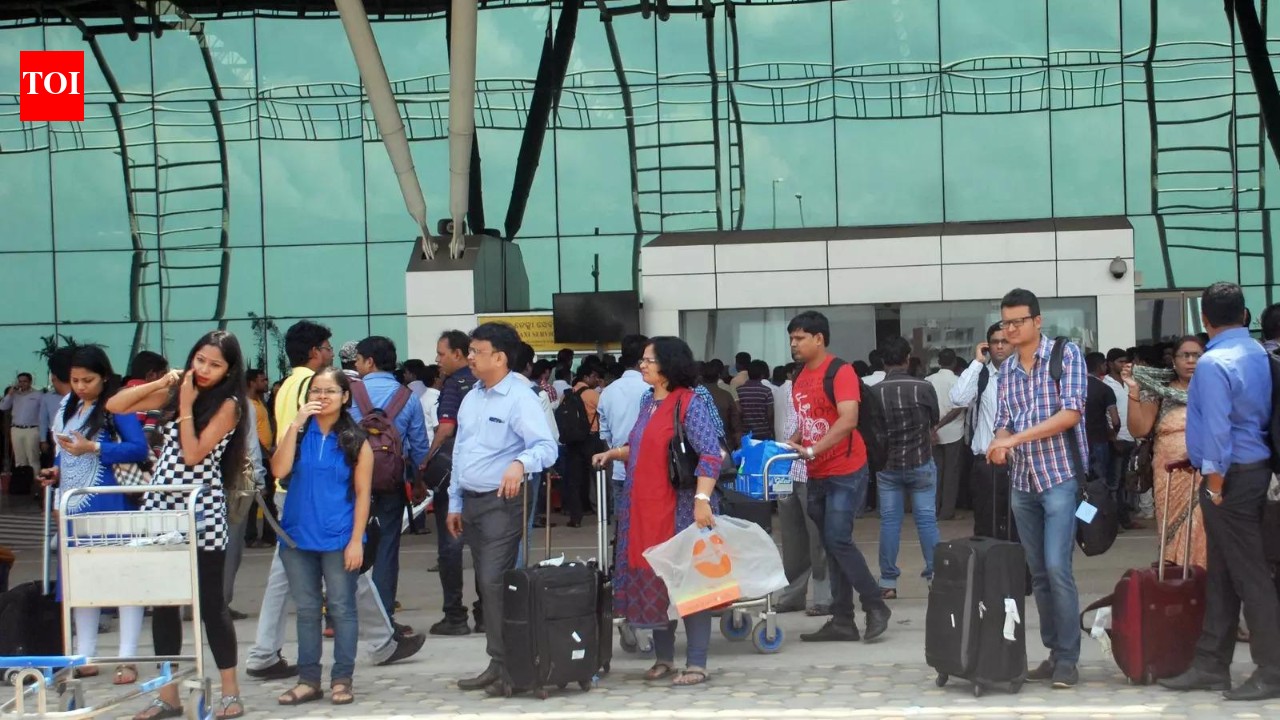
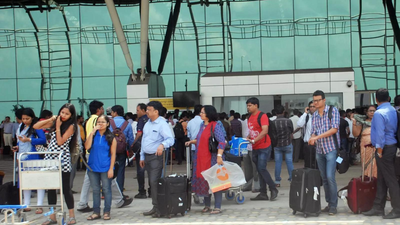
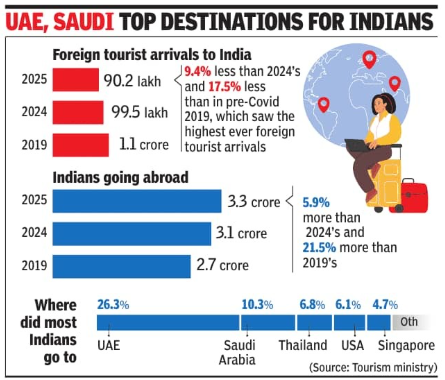
NEW DELHI: The tension between India and Bangladesh, which resulted in fewer visas by both sides, resulted in an over 9% fall in foreign tourist arrivals to 90.2 lakh in 2025, with the eastern neighbour slipping from the second largest source to being the fifth biggest.Latest official data estimated tourist arrivals from Bangladesh at 4.7 lakh in 2025, 73% lower than the level in the previous year. The 12.8 lakh decline was more than the 9.3 lakh fall in the overall foreign tourist arrivals during the year.Travel industry insiders are not exactly moaning about this decline as they always questioned adding Bangladesh arrivals into FTA numbers as majority of them come for non-tourism purposes such as medical treatment and work and don’t exactly fill up hotels and line up at tourist spots.

-

On the other hand, the number of Indians going abroad rose 6.6% to a record 3.3 crore in 2025, although there was a dip in those going to Saudi Arabia and the US. Last year, the number of Indians flying to Canada also declined nearly 16% to 8 lakh.“India is outpricing itself in terms of star hotel rates despite reasonable domestic airfares in non-peak seasons. So, the Indian middle class now finds it cheaper to go to places like the UAE, CIS countries, Sri Lanka, Thailand, Vietnam and Malaysia than going to domestic destinations such as Goa or Kerala. And foreign tourists find a cheaper alternative to us,” said a leading travel agent.Many frequent Indian travellers say they get “good” hotel rooms for Rs 5,000-8,000 in these places while the same in India is at least double in low season and can increase manifold in peak holiday time.Asked about high tariffs, a leading hotelier said: “India is seeing a rise in business travel and domestic travel remains strong. So, we have no reason to worry over foreign tourists skipping till such time that our properties are full. The demand for luxury stays is far more than the supply and this imbalance will ensure good yields (rates) for the big players here.” Indian carriers are also expanding majorly on foreign routes to cash in on the boom in outbound travel.


Source link