Breaking News
T20 WC warm-up: Ishan Kishan secures opening spot as India crush South Africa by 30 runs | Cricket News


T20 WC warm-up: Ishan Kishan secures opening spot as India crush South Africa by 30 runs
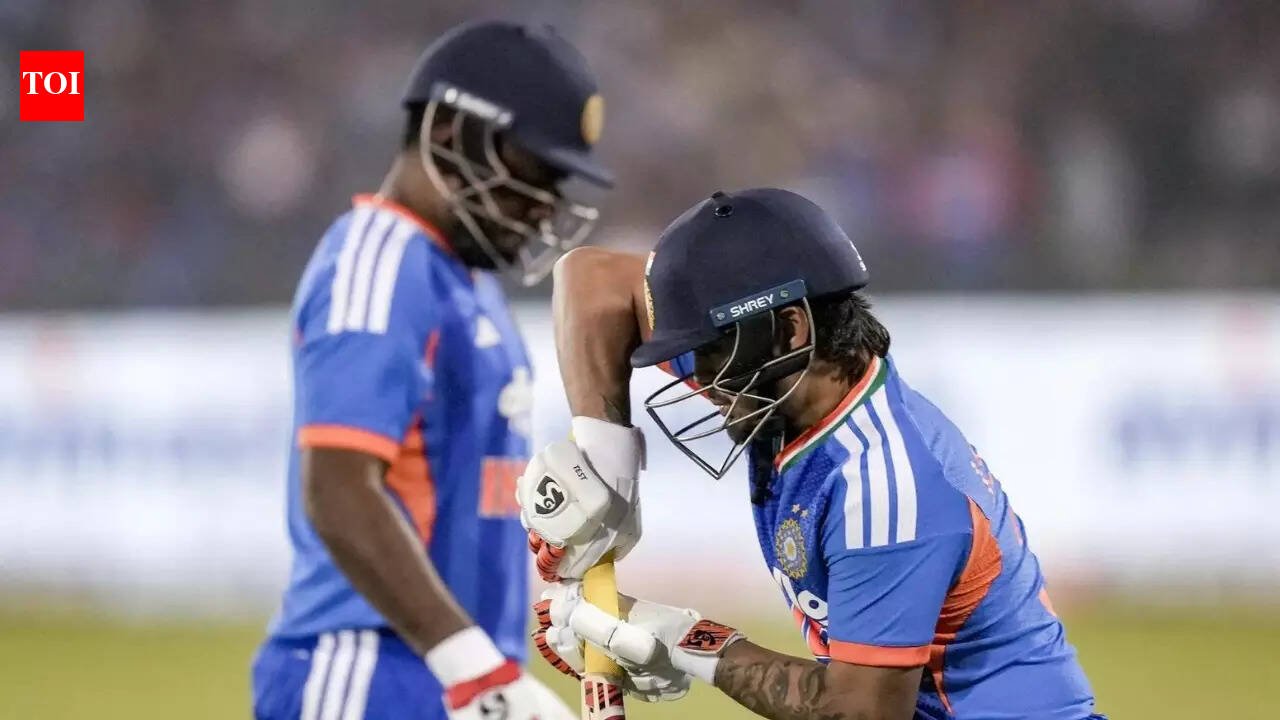
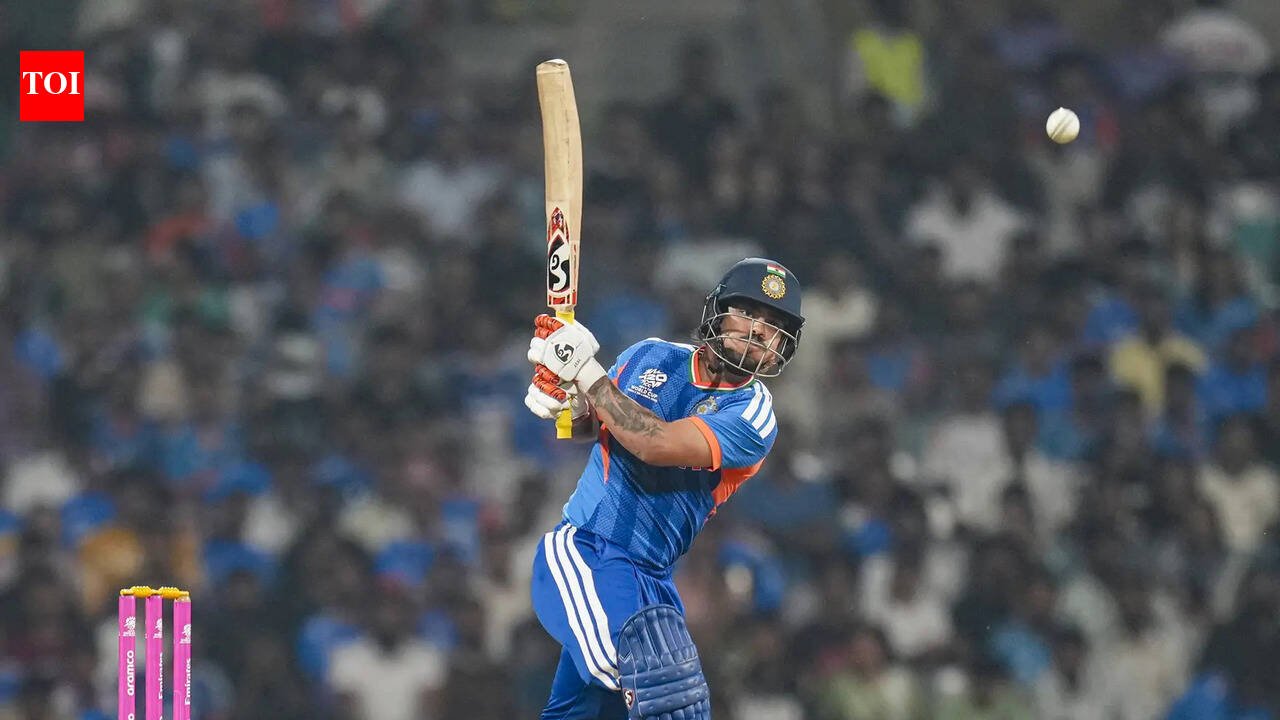
Navi Mumbai: India’s Ishan Kishan (PTI Photo/Shashank Parade)

In-form Ishan Kishan continued his red-hot form with a rapid half-century as India secured a 30-run win over South Africa in their only warm-up match ahead of the T20 World Cup on Wednesday at DY Patil Stadium. The wicketkeeper-batter raced to 53 off just 20 balls, smashing seven sixes and two boundaries, cementing his spot in the top order alongside Abhishek Sharma. The Indian batters collectively posted a daunting 241 for five on a flat track, with Ishan and Abhishek putting on an explosive 80-run partnership inside the powerplay. Abhishek contributed 24 off 17 balls before retiring, allowing Ishan to continue his onslaught and retire unbeaten after reaching his fifty, ensuring both got a final hit ahead of India’s opener against the USA on February 7.

Are India favourites to win 2026 T20 World Cup? | Greenstone Lobo makes a HUGE PREDICTION

India rotated their bowling arsenal, using nine different bowlers, including Abhishek Sharma, who picked up 2/32 in three overs, to restrict the Proteas to 210/7. Harshit Rana, however, was forced to leave after just one over due to discomfort in his run-up. South Africa’s experimental opening pair of George Linde (0) and Aiden Markram (38 retired out) failed to make an impact, with Linde dismissed for a duck by Arshdeep Singh. Ryan Rickelton top-scored for the visitors with 44 off 21 balls, while Jason Smith contributed 35 off 23. Dewald Brevis fell cheaply, but Tristan Stubbs provided resistance with a 21-ball 45 not out, including four sixes. Other notable performances for India included Tilak Varma, who made a quick 45 off 19 balls before being bowled by Marco Jansen, and Suryakumar Yadav, who struck 30 off 16 balls. Vice-captain Axar Patel added 35 off 23, while Hardik Pandya finished with a fiery 30 from just 10 deliveries. Rinku Singh contributed 16 before being hit on the helmet. India’s batting dominance, combined with disciplined bowling, ensured a comfortable 30-run victory in their final warm-up ahead of the tournament. Brief scores: India 240/5 in 20 overs (Ishan Kishan 53, Tilak Varma 45; Marco Jansen 1/18) beat South Africa 210/7 in 20 overs (Ryan Rickelton 44, Tristan Stubbs 45*; Abhishek Sharma 2/32) by 30 runs.


Source link

Top JeM operative among 3 shot dead in J&K ops | India News


Top JeM operative among 3 shot dead in J&K ops

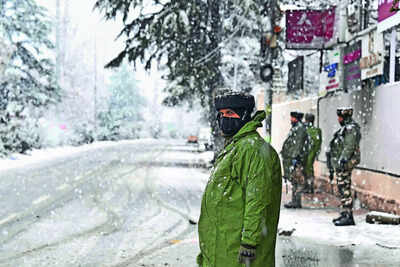
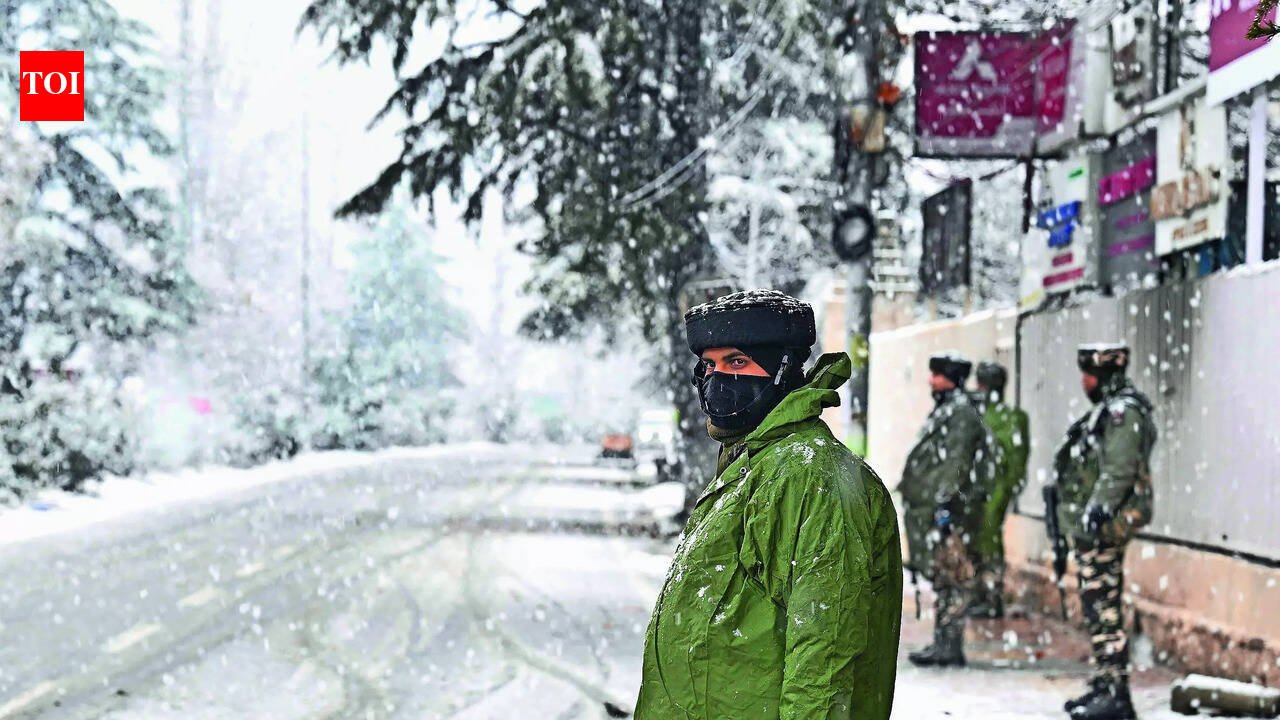
JAMMU: A Jaish-e-Mohammed (JeM) commander was among three terrorists killed in separate gunfights with security forces in snow-covered forests of Udhampur and Kishtwar districts in J&K’s Jammu division Wednesday, officials said.Sources identified the slain JeM man as Rubani, alias Abu Mavia, though there was no official confirmation of his identity by authorities. Security forces launched a seek-and-shoot operation Tuesday in Jopher forest near Basantgarh — a mountainous area of Udhampur district about 65km northeast of Jammu city — acting on specific intelligence inputs.“Heavy exchange of fire rocked the forest around 4pm Tuesday when the terrorists attempted to break out of the cordon,” an official said. Reinforcements, including paratroopers and dog squads, were rushed in to seal escape routes across the rugged terrain.For several hours overnight, troops maintained a tight vigil using drones and ground surveillance before launching a final assault at daybreak. Both terrorists were killed in the morning operation, officials said.In Dichhar area of Kishtwar district, a suspected Pakistani terrorist was killed Wednesday evening in a running hunt across snowbound mountains.The Army’s White Knight Corps said on X the action followed renewed contact with terrorists on the run. Forces have pursued the group since Jan 18, when a clash broke out at Sonnar village near Mandral–Singhpora — hill hamlets south of Kishtwar town — killing a paratrooper and wounding seven soldiers. Terrorists slipped away through dense vegetation and broken ridgelines.Search teams had been combing Sanjinala–Dichhar axis inside Chingam forest, part of the Chatroo belt — a rugged stretch of terrain roughly 190km northeast of Jammu. The area has remained under deep snow for weeks.They were intercepted again several km away on Jan 22. Contact broke. Two more gunfights followed on Jan 26 and Jan 31 as snowfall crossed two feet across upper reaches, slowing movement but not search grids.


Source link

Tech stock under pressure: AMD slumps 15.7%, fresh selling in software stocks drags US markets lower


Tech stock under pressure: AMD slumps 15.7%, fresh selling in software stocks drags US markets lower

US markets traded mixed on Wednesday as renewed selling in technology stocks — led by a sharp fall in Advanced Micro Devices — weighed on sentiment despite gains in several non-tech sectors, according to AP.Advanced Micro Devices plunged 15.7% even after reporting stronger quarterly profit than analysts expected and issuing revenue guidance for early 2026 that also topped estimates. The decline came as investor expectations remained elevated after the stock had doubled over the past 12 months.Technology stocks more broadly faced pressure even where earnings remained strong. Market participants have increasingly questioned whether valuations in major technology companies had risen too sharply following years of market leadership.The S&P 500 slipped 0.2%, marking its fourth modest drop in five sessions. The Dow Jones Industrial Average rose 389 points, or 0.8%, while the Nasdaq composite declined 1% as of 11:30 a.m. Eastern time, reflecting weakness concentrated in technology shares.Software companies are also facing uncertainty over whether artificial intelligence-led competition could disrupt existing business models.Uber Technologies fell 3% after reporting quarterly results below analyst expectations and issuing weaker profit guidance for the current quarter, while also announcing a new chief financial officer.Some technology-related names moved higher. Super Micro Computer rose 14% after reporting stronger-than-expected quarterly profit, supported by demand for artificial intelligence servers and related equipment.Outside the technology segment, Eli Lilly gained 9.2% after beating profit expectations, supported by strong demand for its Mounjaro and Zepbound products.Match Group rose 5.7% after reporting better-than-expected results and raising its dividend, citing early success from safety improvements including a facial verification feature for Tinder.Walmart edged up 0.2%, a day after its market capitalisation crossed $1 trillion for the first time.In commodities, gold traded nearly flat at $4,935.60 per ounce after earlier rising above $5,000, while silver rose 3.7%, extending volatile moves seen in recent sessions.In the bond market, the yield on the 10-year US Treasury eased slightly to 4.27% from 4.28% in the previous session after mixed economic data, including weaker-than-expected private hiring and steady services sector expansion.In global markets, Japan’s Nikkei 225 declined 0.8% from record highs, while South Korea’s Kospi rose 1.6% to a fresh record level.


Source link

Remove unfit garbage trucks pronto: BMC | Mumbai News


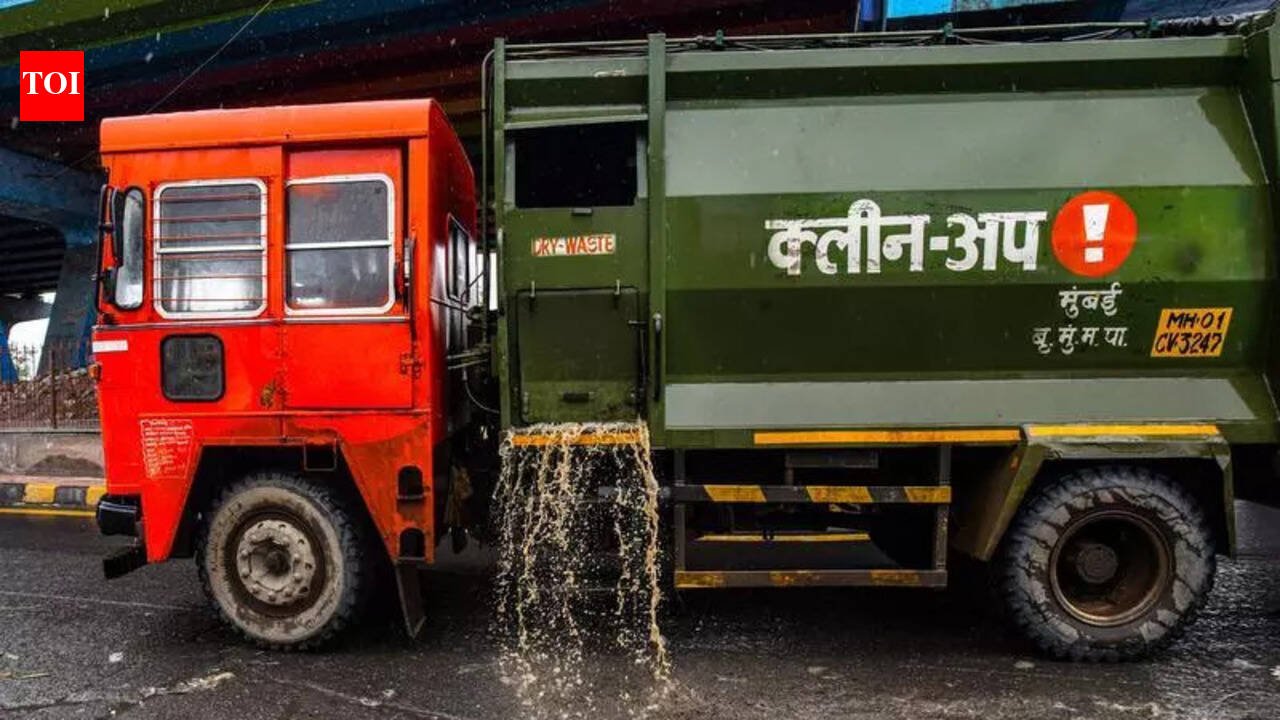
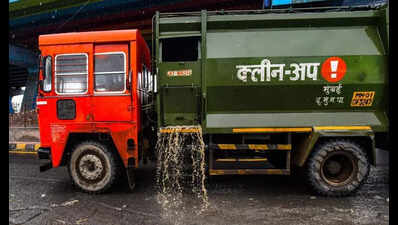
Mumbai: BMC has ordered an urgent, citywide inspection of all garbage trucks after a routine check in Dharavi revealed several decrepit large and mini compactors.Citing risks to sanitation workers, motorists and pedestrians, the solid waste management (SWM) department said vehicles found to be mechanically unsafe or prone to breakdowns will have to be immediately pulled out of service. SWM and transport departments’ assistant engineers have to jointly inspect every garbage vehicle in their wards. Engineers will also have to flag any shortage that could affect daily waste clearance.BMC reiterated that all garbage must be cleared before 8am, failing which action will be taken against the supervisors. TNN


Source link

If India stops buying Russian oil, what it could mean for Moscow’s revenues — explained


If India stops buying Russian oil, what it could mean for Moscow’s revenues — explained

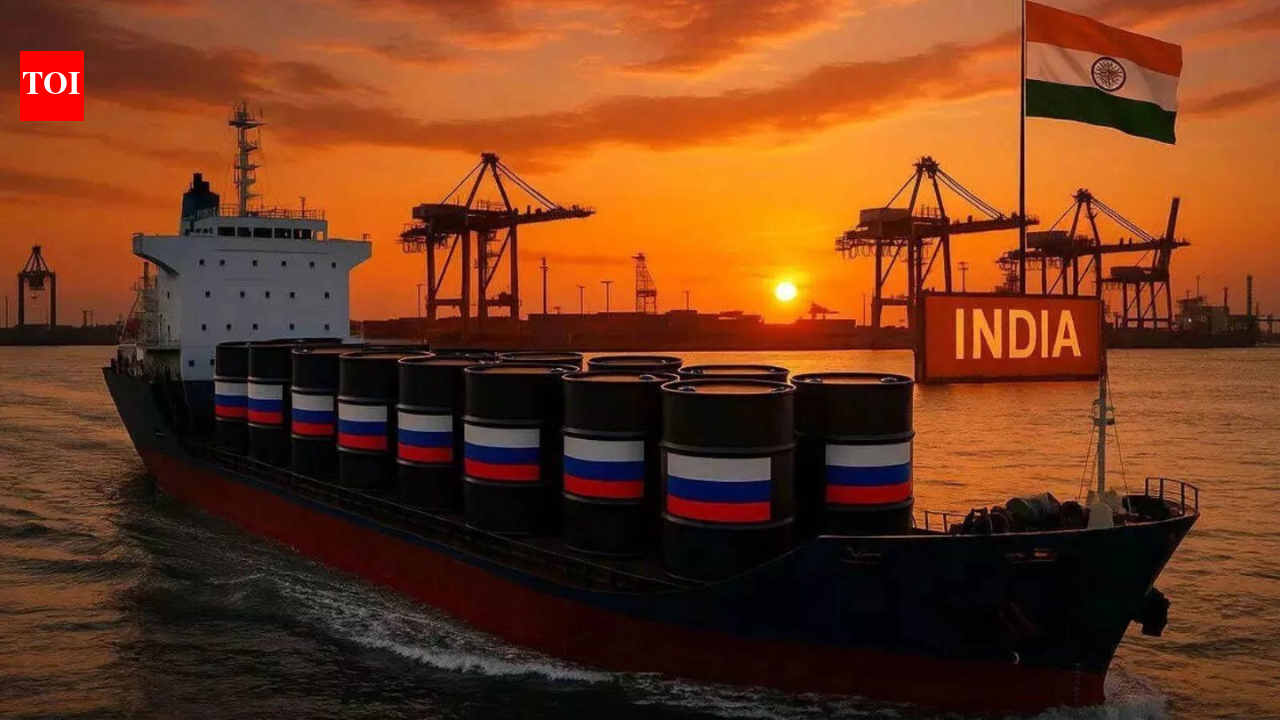
Russia could face a sharp drop in oil revenues if US President Donald Trump succeeds in pushing India to scale back or halt purchases of Russian crude, potentially forcing Moscow to cut prices to attract alternative buyers, analysts and traders told Reuters.The development comes after Trump said a recent US-India trade deal included provisions linked to India halting Russian oil imports, even as Washington increases pressure on Moscow amid ongoing Ukraine peace negotiations.India has not officially halted purchases, citing energy security needs and the importance of access to cheaper crude. However, recent data indicates Indian refiners have adopted a more cautious approach, already affecting Russia’s earnings.According to Reuters calculations, India’s imports of Russian oil fell 22% to 1.38 million barrels per day in December from November — the lowest level since January 2023. Russia’s share in India’s oil imports dropped to 27.4%, while OPEC’s share rose to 53.2%. This follows a peak of nearly 2 million barrels per day in June 2025.“Any further reduction would already be meaningful, because there is only one relevant alternative buyer — China — which has also its limitations in taking in sanctioned crude,” David Wech of Vortexa consultancy told Reuters.Analysts said widening discounts and shrinking buyer pools are already pushing Russian oil prices to record lows, while Moscow’s budget is facing strain due to weaker energy revenues.

Sanctions pressure and supply re-routing risks

Russia has faced nearly 30,000 Western sanctions linked to the Ukraine war since 2014 but has managed to redirect oil flows from Europe towards China, India and Turkey. However, Turkey has also reduced purchases in recent months.Russia’s total oil exports stood at 4.91 million barrels per day in December, with China accounting for about 2.3 million barrels per day, according to the International Energy Agency.If India were to sharply cut imports, Russia would likely need to divert supplies to China at deeper discounts or cut production, said Igor Yushkov of Russia’s government-run Financial University.“Output and export cuts would lead to an oil shortage. Hence we are not seeing a full US ban on Russian oil imports — they would suffer themselves from higher oil prices,” Yushkov said.

Short-term flows may fall further

Indian refiners have not received formal instructions to stop buying Russian oil and would require time to wind down existing contracts, sources told Reuters.Imports could decline further in April when Nayara Energy, a Russian-backed refinery with capacity of 400,000 barrels per day, undertakes scheduled maintenance for one month, traders said.Beyond April, trade flows will likely depend on the trajectory of Russia-Ukraine peace talks and India’s broader strategic stance.Trump has suggested India could increase purchases from the US or Venezuela to replace Russian crude. However, US crude differs in quality and cannot directly substitute Russian grades, while Venezuela’s export capacity remains limited, Alexandra Hermann of Oxford Economics told Reuters.Instead, crude from Saudi Arabia, the UAE and Iraq may emerge as more practical alternatives. However, analysts said steep discounts may continue to make Russian oil attractive for Indian buyers despite geopolitical pressure.


Source link

Celina Jaitly gets relief as Delhi High Court directs MEA to facilitate legal aid for detained brother Vikrant Kumar Jaitly in UAE |


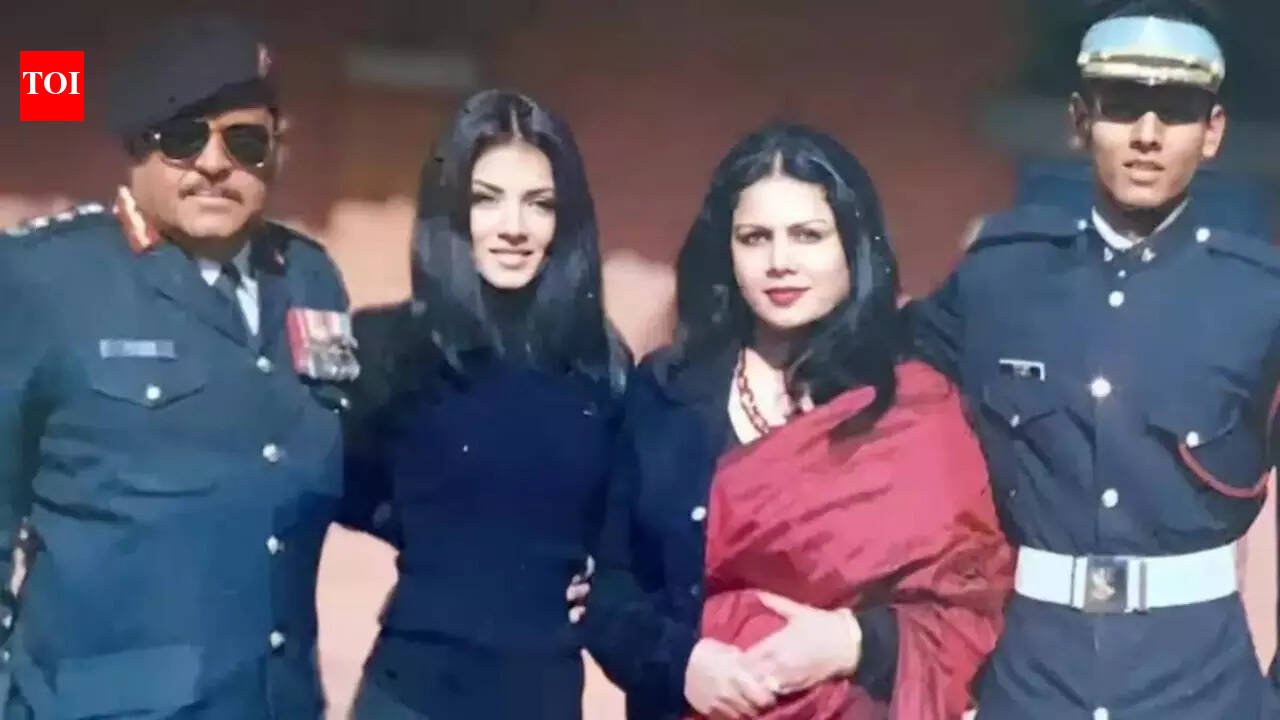
In a fresh development in the case concerning the detention of Bollywood actor Celina Jaitly’s brother in the United Arab Emirates, the Delhi High Court on Tuesday directed the Ministry of External Affairs (MEA) to facilitate legal representation for Major (Retd.) Vikrant Kumar Jaitly in Dubai and Abu Dhabi.As reported by ANI, Justice Purushaindra Kumar Kaurav asked the MEA to issue an order in favour of Al Maree Partners, a law firm willing to represent Vikrant Jaitly on a pro bono basis. The court further said that if there is any impediment in issuing the order, the same must be stated in an affidavit. The next hearing in the matter is scheduled for February 10.

Celina Jaitly’s Legal Battle: Divorce, Abuse, And Survival

“An 18-month-long battle for us”: Celina Jaitly on Delhi HC order

“This has been an 18-month-long battle for us. Today, after 18 months, my brother and our country’s soldiers finally has his dignity given back to him. The Justice kindly passed the order for Almarri Partners and advocates in the UAE to represent Major Vikrant Kumar Jaitly… We want to bring him back, and I’m sure now things will move in a very positive direction and very fast,” she said.Her counsel, advocate Raghav Kacker, described the order as “very positive” and significant for the defence of Major Jaitly. He said the Delhi High Court had directed the Ministry of External Affairs (MEA) to appoint a lawyer identified by the family in Dubai. He further explained that the appointment letter would enable the legal team to obtain a power of attorney from Major Jaitly and to initiate an appropriate defence.“We have got a really good order from the Delhi High Court. The Justice has agreed to direct the MEA to appoint a lawyer we had found in Dubai. This is very important because that appointment letter will now enable them to get a power of attorney from Vikrant and initiate a proper defence for Vikrant, and we are very hopeful, especially after the deal that has happened between India and the UAE, that we will secure a very quick release for our soldier,” Kacker said.Also See: Preity Zinta asks Celina Jaitly to not lose faith as Delhi HC rules in her favour, orders to facilitate help for her brother Major Vikrant Jaitly

Pro bono firm ready to take up case

The firm was suggested by Celina Jaitly’s counsel, Raghav Kacker, assisted by advocates Madhav Agrawal and Suradhish Vats. It was submitted that the firm has independently obtained the case details and is ready to represent Vikrant Jaitly free of cost.However, the submission was opposed by counsel for the MEA, who stated that the firm’s name already figures among the four legal firms suggested by Vikrant Jaitly himself. It was also argued that Vikrant had informed embassy officials that the decision to engage a legal firm would be taken by his wife, Charu Jaitly.

‘What is the impediment?’ court asks

Countering the MEA’s submissions, Celina Jaitly’s counsel argued that crucial facts were being suppressed, stating that Vikrant Jaitly does not wish to communicate with his wife. Taking note of the arguments, the court questioned the objection, noting that the firm was willing to represent him without any financial burden.“What is the impediment if the name is suggested by his father, mother or sister?” the court observed.

Celina Jaitly Appeals Medical And Legal Assistance For Brother Major Vikrant Detained In UAE!

Celina Jaitly alleges illegal detention since September 2024

In her petition, Celina Jaitly has alleged that her brother was illegally abducted and detained in the UAE in September 2024. She further contended that despite more than a year having passed, the Centre has failed to secure even basic information regarding his welfare, legal status, or communication. Earlier, on November 3 last year, the Delhi High Court had directed the MEA to provide legal assistance to Vikrant Jaitly, facilitate communication between the siblings, and appoint a nodal officer to oversee the matter.


Source link

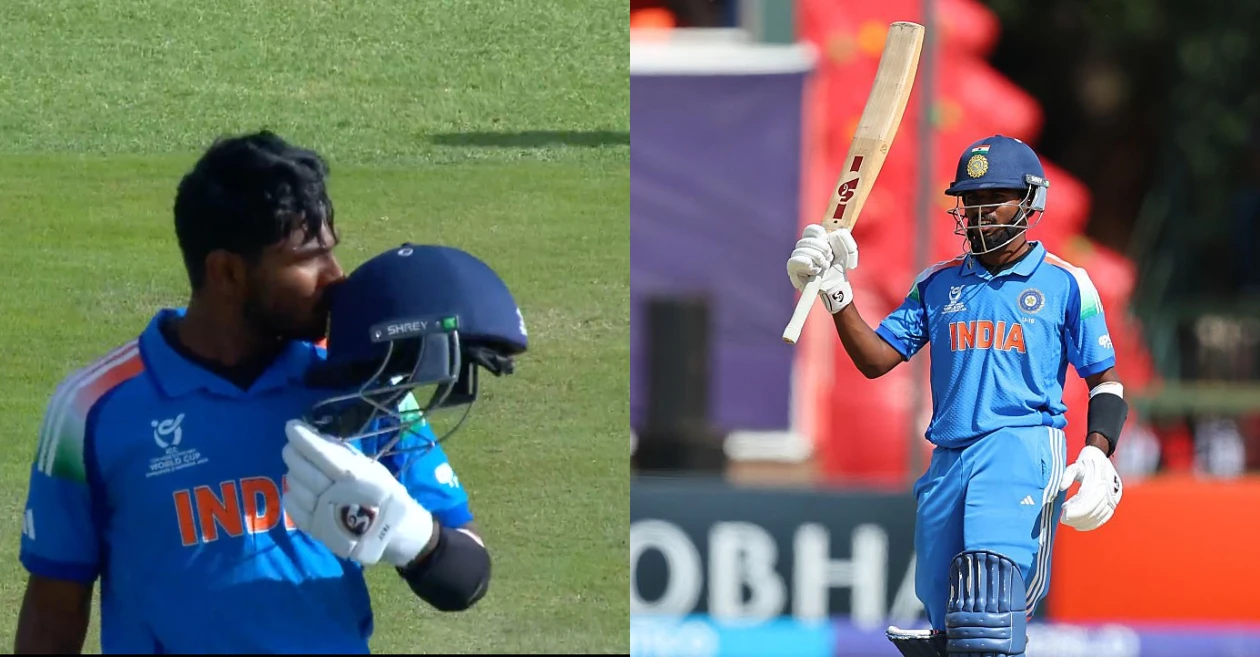
Aaron George powers India to U19 World Cup 2026 final with brilliant century against Afghanistan


India produced a commanding all-round performance to defeat Afghanistan by seven wickets in the second semi-final of the ICC Under 19 World Cup 2026 at the Harare Sports Club on Wednesday. Chasing a daunting target of 311, the Indian youngsters showcased composure, depth and firepower to seal the contest with 53 balls to spare, underlining their title credentials.

Afghanistan U19 post impressive 310/4 after choosing to bat

After winning the toss, Afghanistan opted to bat first and made full use of the conditions to post an imposing 310 for 4 in 50 overs. The innings was anchored by Uzairullah Niazai, who played a superb unbeaten knock of 101 off 86 balls, striking 12 fours and 2 sixes at a healthy strike rate.

Earlier, Khalid Ahmadzai set the tone with a fluent 31 off 39 balls, while Osman Sadat added stability at the top with a 70-ball 39. The backbone of Afghanistan’s innings, however, was the 148-run partnership between Faisal Shinozada and Niazai. Shinozada’s attacking 110 off 93 deliveries, laced with 15 fours, accelerated the scoring through the middle overs.

India bowlers showed discipline despite the onslaught. Deepesh Devendran was the standout performer, returning figures of 2 for 64 from his full quota of overs, while Kanishk Chouhan also picked up two crucial wickets. Though Afghanistan managed to maintain a run rate above six, India’s ability to restrict wickets in the final overs prevented the total from ballooning further.

Aaron George, Vaibhav Sooryavanshi and Ayush Mhatre lay the perfect foundation

India’s chase began with intent and clarity. Aaron George and Vaibhav Sooryavanshi added a brisk 90-run opening stand, immediately putting Afghanistan under pressure. Sooryavanshi was particularly aggressive, smashing 68 off just 33 balls, peppering the boundary with ease.

George played the anchor role to perfection, rotating strike and punishing loose deliveries. Even after Sooryavanshi’s dismissal, the momentum remained firmly with India, as the asking rate never spiralled out of control.

Skipper Ayush Mhatre walked in with maturity beyond his years and combined with George for a vital 114-run partnership. Mhatre’s knock of 62 off 59 balls balanced caution with calculated aggression, ensuring India stayed ahead of the required rate.

George went on to score a composed 115 off 104 deliveries, a knock that blended patience with authority. His dismissal with just 11 runs needed was merely a footnote in what had already become a one-sided chase.

Also READ: ICC T20I Rankings – Abhishek Sharma retains numero uno spot amongst batters, Saim Ayub becomes No. 1 all-rounder

With the heavy lifting done, Vihaan Malhotra and Vedant Trivedi guided India home without fuss. Malhotra remained unbeaten on 38, while Trivedi chipped in with 5 to take India to 311 for 3 in 41.1 overs, sparking celebrations in the Indian camp.

Also READ: Will MS Dhoni enter the commentary box? Former skipper opens up on a potential new role


Source link

T20 World Cup dream over for Sanju Samson? Suryakumar Yadav confirms ‘definitely Ishan Kishan’ to open | Cricket News


T20 World Cup dream over for Sanju Samson? Suryakumar Yadav confirms 'definitely Ishan Kishan' to open
Ishan Kishan, right, arrives to bat as Sanju Samson walks off the field after his dismissal during the second T20I cricket match between India and New Zealand, in Raipur, Chhattisgarh. (PTI Photo)

India got the new T20 opening pair on Wednesday as Ishan Kishan and Abhishek Sharma walked out to open the innings as Men-in-Blue played South Africa in their only warm-up match ahead of the T20 World Cup 2026 at the Dr DY Patil Stadium in Navi Mumbai. India won the toss, and captain Suryakumar Yadav chose to bat first.At the toss, Suryakumar confirmed a change at the top of the batting order, indicating a possible setback for Sanju Samson’s World Cup plans. The Indian captain said that Ishan Kishan will open the innings alongside Abhishek Sharma, pushing Samson out of the opening role.

Sanju Samson or Ishan Kishan? | Greenstone Lobo predicts the ideal player for T20 World Cup

“We are going to bat first. It is something we have been doing well. There might be some dew later in the evening, we want to test our bowlers in challenging conditions and defend the total, whatever we get,” Suryakumar said at the toss.Follow live updatesWhen asked about the opening combination and handling pressure at home, the India captain made the team’s plan clear. “Definitely Ishan and Abhishek. [On dealing with pressure and expectations] See, I think when you are playing in India in front of your home ground, there are expectations. But at the same time so many people in the stadium cheering you on, I think it gives you an extra advantage,” he added.Sanju Samson’s position has been under scrutiny for several months. Before the Asia Cup 2025, Samson and Abhishek Sharma opened the innings and delivered steady returns. However, the team management later brought Shubman Gill into the side, which pushed Samson into the middle order. That change affected Samson’s output, and calls grew to restore him as an opener.Gill’s lack of runs and slow scoring rate led the selectors to bring back Ishan Kishan after his strong Syed Mushtaq Ali Trophy season. Samson then got another chance at the top but managed only 49 runs in five innings against New Zealand. During the same series, Kishan batted at No.3 and scored his maiden T20I century.With Tilak Varma returning to the squad, the management has now decided to move Kishan to the opening slot. That shift has left no clear place for Samson in the playing XI. The team’s thinking was hinted at earlier as well, when Kishan was asked to keep wickets in the fifth T20I.The warm-up match decision has raised questions about whether Samson’s chances of making the T20 World Cup XI are slipping, with the captain’s “definitely Ishan” comment underlining the current pecking order at the top.


Source link

India-US trade deal decoded: What does it mean for economy, markets & Russian oil imports? Explained in 10 charts


India-US trade deal decoded: What does it mean for economy, markets & Russian oil imports? Explained in 10 charts
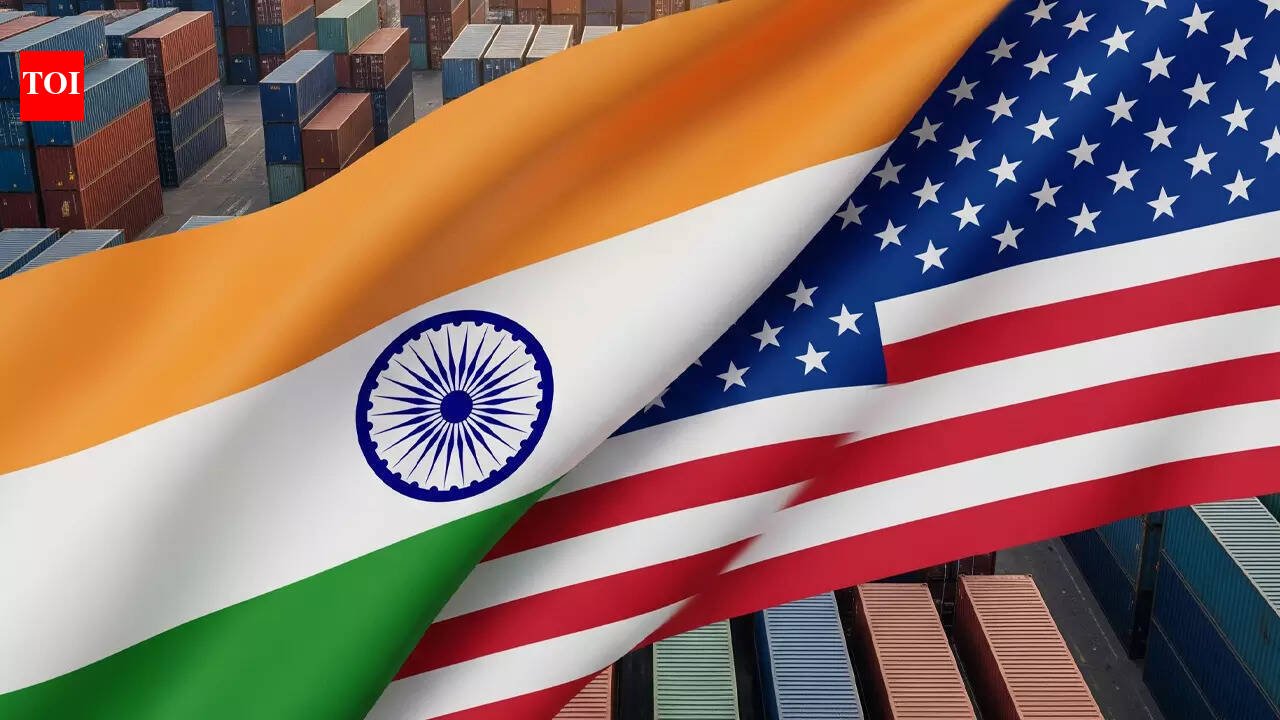
India-US trade deal (AI image)

Has India managed to secure the ‘father of all deals’ with the US? American President Donald Trump and Prime Minister Narendra Modi took everyone by surprise this week when they announced that the tariff rate on Indian goods to the US will be reduced to 18%. While a trade deal remains to be signed, and final nuances are being worked out, the stalemate in ties has finally ended, paving the way for two big world economies to resume normalcy in trade ties.The US is India’s single largest trading partner, and the 50% tariffs imposed by the Trump administration had hit exporters. With an 18% tariff rate, India’s exports are back to being competitive. Trump’s Truth Social Post spoke of several aspects to the deal including what he claimed was commitment to stopping Russian crude and also buying $500 billion worth of American goods.

“India Will Buy Oil From US…” White House After Trade Deal

Even as details of trade deal emerge, we explain the importance of the agreement for India in top 10 charts: Take a look:

Comparative advantage for India

With an 18% tariff, India has managed to secure a deal which places its duty rate lower than its neighbouring countries and competitors. Some of the main countries which compete with India’s labour-intensive sectors in the global markets are: Vietnam (20%), Malaysia (19%, Bangladesh (20%), Cambodia and Thailand (19%), China (34%). India has also got a lower rate than Pakistan which gets tariffed at 19%.
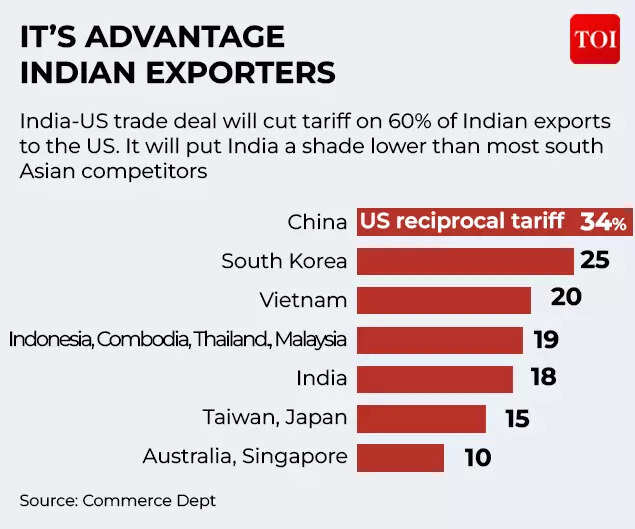
It's Advantage Indian exporters

It’s Advantage Indian exporters

Commerce minister Piyush Goyal has also stressed on this point, saying that India got a ‘very good’ deal with the US, better than the competitors.Agneshwar Sen, Trade Policy leader, EY India says that the biggest takeaway is that India has shifted from being a passive tariff-hit exporter to a partner with a negotiated stake in the US market.“For India, the deal matters less for the headline concessions and more for what it signals. Since the new tariff rates will come into effect immediately, to start with it will arrest the export erosion we have been facing. India was steadily losing competitiveness in the US because the high tariffs were wiping out marginal advantages of quality and dependability. The deal will effectively cap further damage and restore predictability, allowing exporters to price, plan and retain market share rather than bleed slowly,” he tells TOI.“It will reinforce India’s credibility as a supply-chain alternative. The deal positions India as a reliable, lower-risk sourcing partner at a time when US buyers are seeking to de-risk from China,” Sen explains.
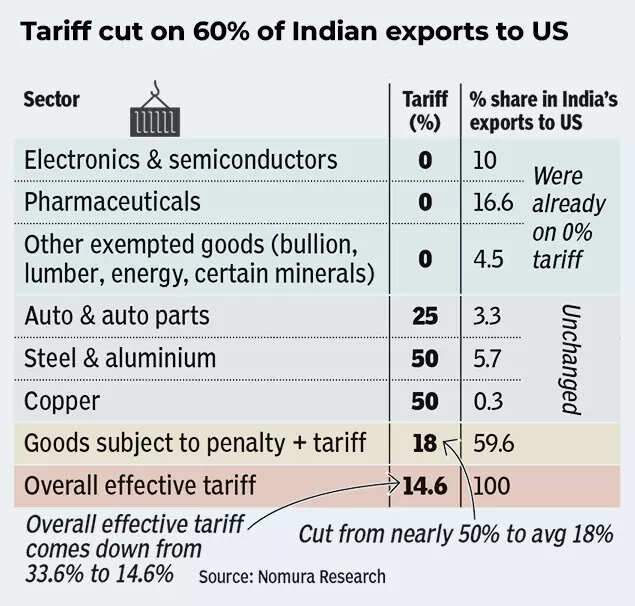
Tariff cut on 60% of Indian exports to US

Tariff cut on 60% of Indian exports to US

“Finally, it will nudge Indian exporters to move up the value chain. Tariff relief will push Indian firms toward scale, compliance and higher value manufacturing, rather than operate on pure price arbitrage. The bottom line is that the deal doesn’t just recover lost exports – it reanchors India in the US market – and on a more durable, strategic basis, which is far more valuable over the medium term,” Sen adds.Gulzar Didwania, Partner, Deloitte India also highlights the important point that India has secured a level playing field in terms of tariff treatment vis-à-vis key competing economies in South Asia such as Vietnam, Bangladesh and Sri Lanka.“Unlike earlier situations where some countries enjoyed distinctly preferential access, India is now broadly aligned within the same tariff bracket, reducing relative disadvantages for Indian exporters,” he tells TOI.

Will India stop buying Russian oil?

As part of the newly announced trade deal, US President Donald Trump claimed that India would stop buying Russian oil. “We spoke about many things, including Trade, and ending the War with Russia and Ukraine. He agreed to stop buying Russian Oil, and to buy much more from the United States and, potentially, Venezuela,” Trump posted on Truth Social. Meanwhile, Russia has maintained that it received no official communication from India on the matter. Kremlin spokesman Dmitry Peskov said, “so far, we haven’t heard any statements from New Delhi on this matter.”According to officials, imports from Russia have already been declining since November after the US imposed sanctions on major exporters Rosneft and Lukoil.Data from Kpler show Russia’s share of India’s crude imports fell to 33.7% between April and November 2025, from 37.9% in the same period last year. Over the same time, US share rose to 8.1 per cent from 4.6%. In absolute terms, Russian crude imports dropped from about 1.8 million barrels per day in November to 1.2 million in December and 1.16 million in January 2026.
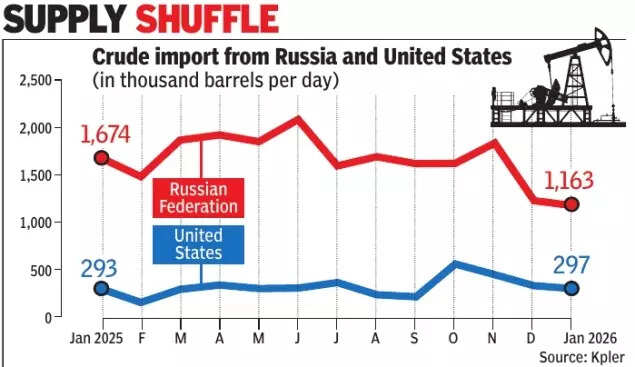
Supply shuffle of oil

Supply shuffle of oil

Despite this trend, analysts say the trade deal is unlikely to result in an immediate or sharp fall in Russian supplies. “The deal is unlikely to result in a near-term reduction in India’s Russian crude imports. Russian volumes remain largely locked in for the next 8-10 weeks and continue to be economically critical for India’s complex refining system, supported by deep discounts on Urals relative to ICE Brent,” said Sumit Ritolia, lead research analyst at Kpler.According to experts Russian imports will remain broadly stable through the first half of 2026–27, with any further moderation likely to be balanced by higher inflows from West Asia. A recent SBI Research report suggests that India could potentially save almost $3 billion in its crude imports bill annually, by redirecting part of its Russian oil purchases to Venezuela.The report said replacing some Russian crude with Venezuelan heavy crude could deliver meaningful savings for India, even after accounting for higher freight, logistics and related costs. It noted that Venezuelan crude would need to be priced at a discount of about $10–12 per barrel to make the switch commercially workable for Indian importers.SBI said, “India’s fuel import bill could even decline by $3bn in the event of shifting to Venezuela… discount of $10–12 could make the choice agnostic.”According to Oil Price data cited in the report, Venezuelan heavy crude is currently trading at around $51 per barrel. The study further added that the actual benefit would depend on several factors, including the size of the discount compared with Brent crude, longer shipping routes, and additional time and insurance costs associated with sourcing oil from Venezuela.

How does a trade deal with the US benefit India?

The India–US trade deal cuts tariffs on almost 60% of Indian exports to the US, lowering reciprocal duties to 18% from 50%. The agreement is expected to deliver a clear boost for exporters while also supporting GDP growth and investor sentiment.Sectors ranging from garments, leather, footwear, carpets, shrimps and gems and jewellery are set to benefit, as Indian products will become more competitive in the US market. For garments, the 18% levy is marginally lower than the 20% faced by Bangladesh and Sri Lanka. Meanwhile, the jewellery and gems sector is also waiting for the deal’s fine print.With tariffs now rolled back, uncertainty has also eased sharply. “We estimate an incremental boost of around 0.2 percentage point of GDP (annualised), if the new lower tariffs are enforced,” Goldman Sachs said, adding that the estimate is based on India’s goods exports exposure of roughly 4% of GDP to US final demand and a goods export demand elasticity of about 0.7.
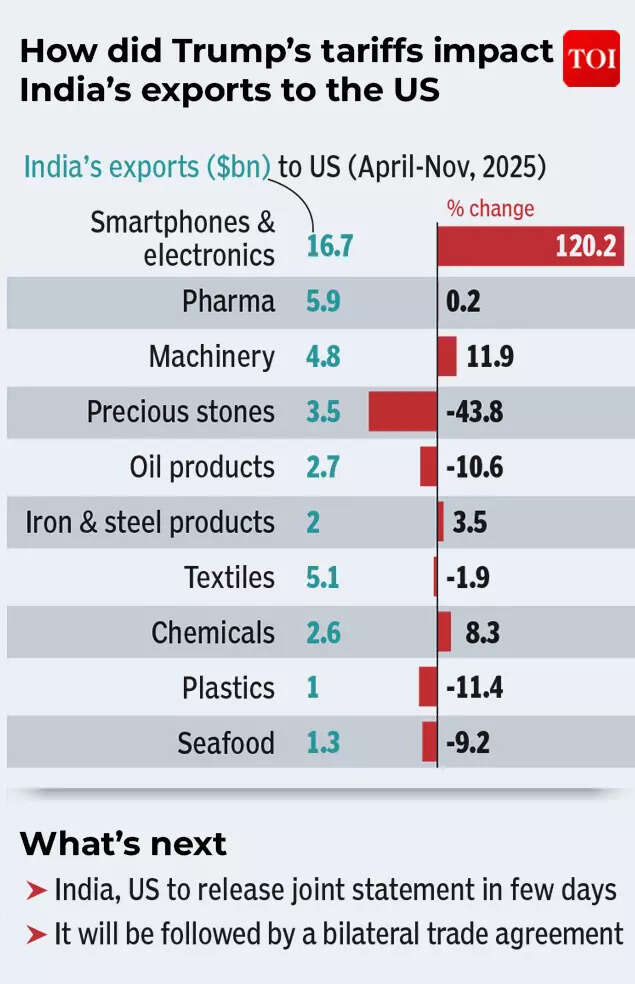
How did Trump's tariffs impact India's exports to the US?

How did Trump’s tariffs impact India’s exports to the US?

Earlier estimates had suggested a GDP impact in the 30–50 basis points range. Barclays said, “Statistically speaking, we estimate lower tariffs will add 30 basis points to headline GDP growth (essentially reversing the threat posed by 50% tariffs until now).”Latest projections show the economy growing 7.4% in the current fiscal year ending March, with growth for FY27 seen in the 6.8%–7.2% range. Moody’s Ratings said the reduction in US tariffs on most Indian goods would reinvigorate exports to the US, India’s largest goods export market, accounting for about 21% of total goods exports in the first eleven months of 2025.Arvind Shrivastava, secretary, department of revenue, said that the deal would deepen trade ties and create new opportunities for labour-intensive and manufacturing sectors, while also giving a push to collaboration in high and advanced technology areas. M. Nagaraju, secretary, department of financial services, said that the rollback to 18% lifted the “dark clouds of uncertainty” and would help exporters.
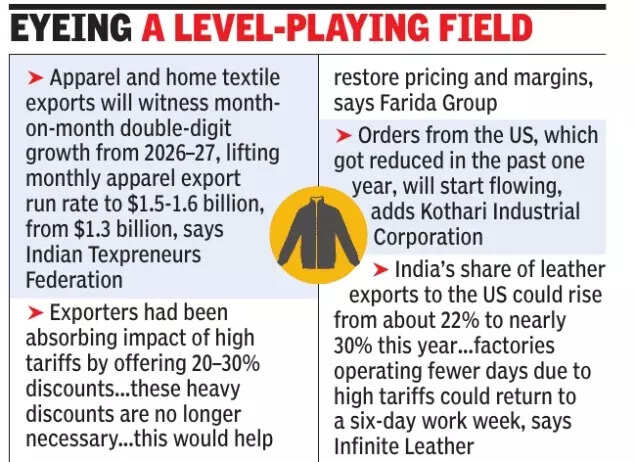
Eyeing a level playing field

Eyeing a level playing field

For exporters, especially smaller firms that had slowed or halted shipments, the timing is critical. With summer consignments already dispatched and fears looming over the next season, the tariff cut has restored competitiveness and eased pressure after months of discount-led survival.

Stock markets and rupee cheer

The Indian stock market and rupee which have been hit badly by the persistent outflow of foreign investors’ money have taken a breather – both rallying strongly after the trade deal announcement. The surge in Sensex left Indian investors richer by a massive Rs 12 lakh crore on Tuesday! In fact, it was the fifth biggest single-day gain in history. The market had been languishing, with some spurts of rallies and some downturns in the last few months, waiting for the conclusion of the trade deal which lifted clouds of uncertainty.
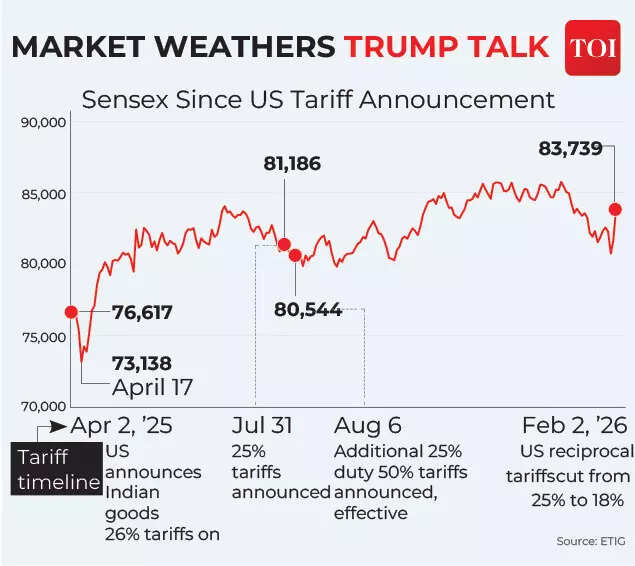
Market weathers Trump talk

Market weathers Trump talk

Market experts expect the rally to continue as more details of the trade deal emerge in the coming days.“With this deal announcement, we believe that the market will now begin to accord correct weightage to the improving trajectory of corporate earnings growth, which has shown successive improvement over the quarters with an improving earnings revision trend,” Motilal Oswal Financial Services said in a report.
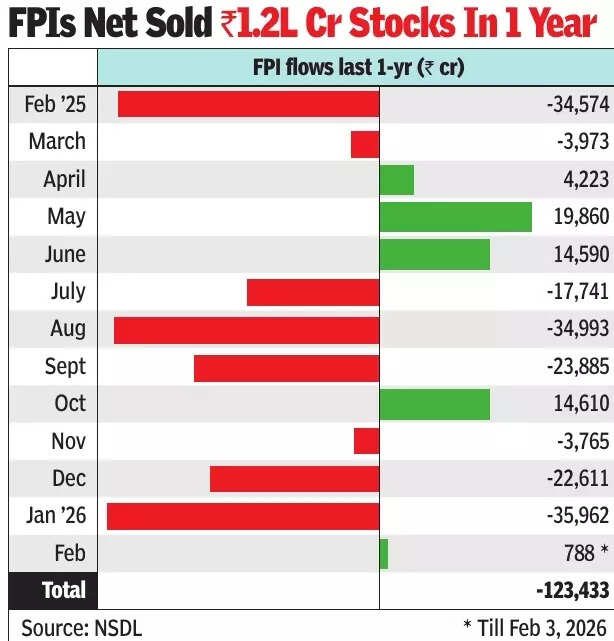
FPIs net sold Rs 1.2 lakh crore stocks in 1 year

FPIs net sold Rs 1.2 lakh crore stocks in 1 year

“This is a high-impact development and will have a multi-layered positive effect on the Indian economy, prevailing market sentiments, and sectors exporting to the US, which will benefit from better competitiveness,” it said.Tuesday’s rally was proof that the announcement has been met with cheer from foreign institutional investors as they led the rally, with their net inflow in stocks at Rs 5,236 crore.
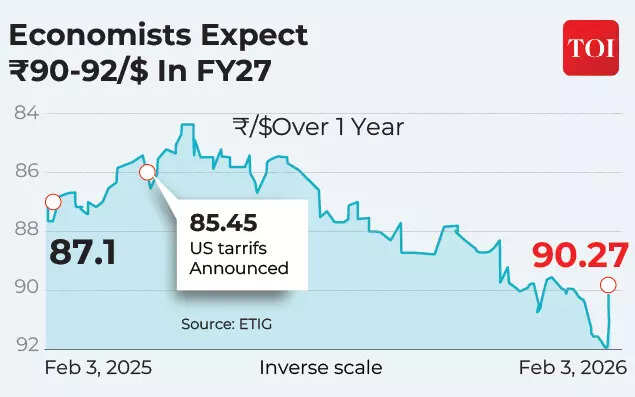
Rupee outlook

Rupee outlook

The Indian rupee, the worst performing Asian currency last year, appreciated 124 paise to 90.27 against the dollar. It logged its strongest single-day gain in seven years and the best since late 2018.

What happens to agriculture, dairy sectors?

Trump’s announcement that India has agreed to “BUY AMERICAN” at a higher level than before triggered concerns, particularly over agriculture. Since trade negotiations began, India has drawn a firm line on protecting its dairy and farm sectors.Piyush Goyal has clarified that the priorities still have not shifted and the dairy and agriculture sectors are still protected. Speaking in Lok Sabha, the minister said, “during negotiations, the Indian side successfully ensured the protection of its sensitive sectors, particularly agriculture and dairy,” he said, noting that the US too had areas it considered sensitive.On the US side, trade representative Jamieson Greer also confirmed that though India agreed to cut tariffs on industrial goods to zero from 13.5%, the agriculture segment is still safeguarded.Agriculture has long been the biggest flashpoint in India-US trade talks, with Washington pressing for greater access to India’s dairy and agricultural markets. US commerce secretary Howard Lutnick had even accused India of shutting out American farmers, questioning why it would not import “even a bushel” of US corn.The decision to safeguard the sector is not solely commercial, rather it is non-negotiable. The agriculture and dairy sector sits at the heart of rural life and food security. Farming and allied activities, including animal husbandry, support the livelihoods of over 700 million people.India is largely self-sufficient in food production, while countries such as the US, Australia and the European Union treat agriculture as a major export business. Opening Indian markets to heavily subsidised farm products from these regions could flood the country with cheap imports, sharply undercutting farmer incomes.India already maintains agricultural tariffs ranging from zero to 150%. The US also follows a similar approach, imposing steep duties on select products such as tobacco, which attracts tariffs of up to 350%.

What led to the sudden trade deal?

The ‘mother of all trade deals’ – the recently concluded India-EU Free Trade Agreement – may have been what finally spurred the Trump administration into action. According to a News Week analysis, it led the US government to blink.While discussions for a trade deal with the European Union had been ongoing, this time, “the trade agreement with the EU appears to have provided a strong goad for the US to wrap up the long-lingering negotiations with India,” says a TOI report.
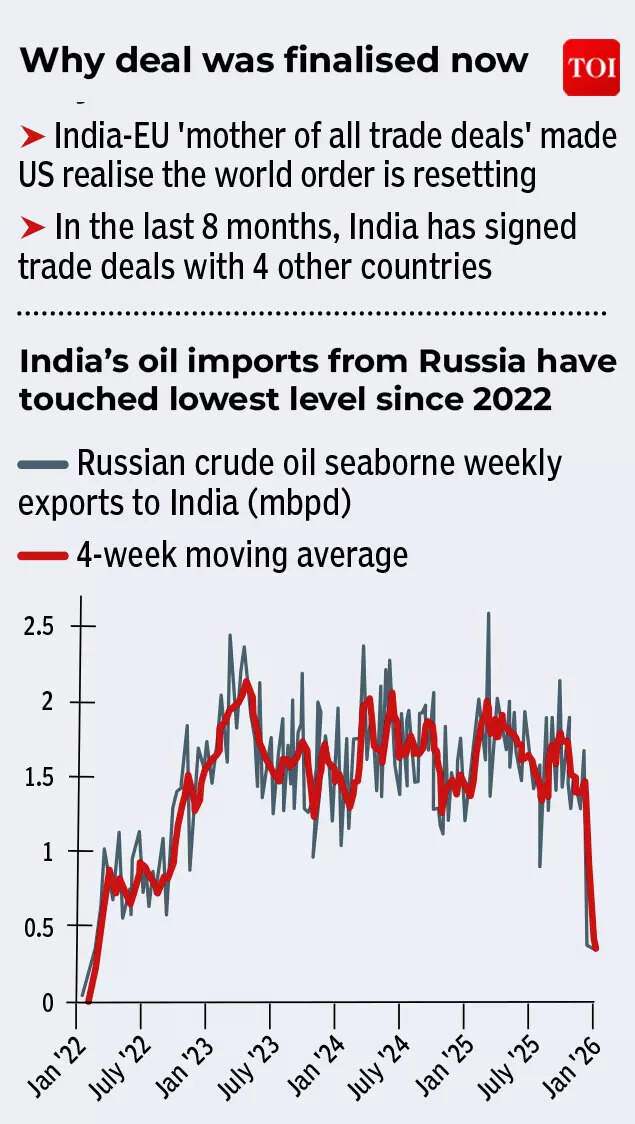
Why deal was finalised now

Why deal was finalised now

Talks between India and the US for a trade deal had continued, despite the 50% tariffs imposed by the latter. While Trump and PM Modi continued to talk, Commerce Minister Piyush Goyal and External Affairs Minister S Jaishankar also engaged in talks with their respective counterparts. The arrival of the new US Ambassador to India Sergio Gor also seems to have worked to help push for the trade deal.Now, the wait for the fine printWhile experts and analysts have welcomed the news as a positive for the Indian economy, they also caution that details of the deal need to emerge for a better understanding of what it holds for each sector and the economy as a whole.
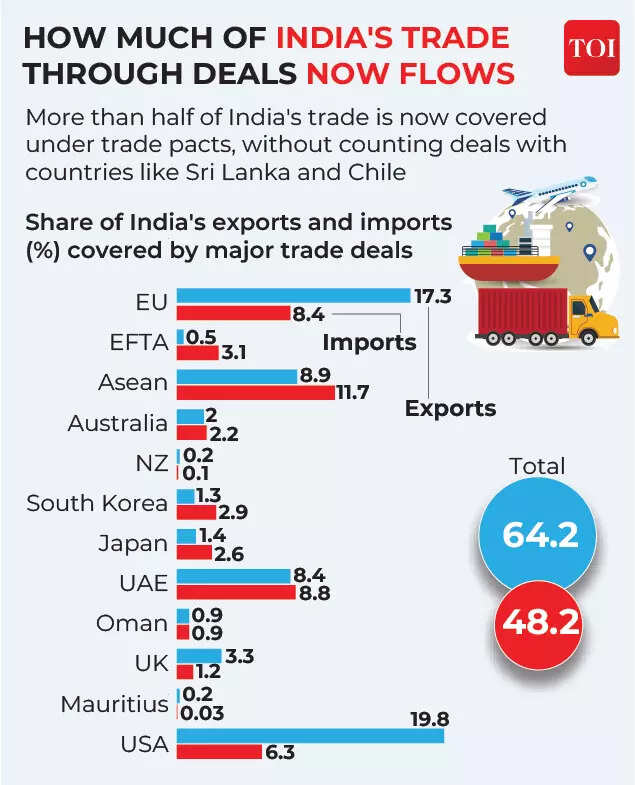
India's trade through deals

India’s trade through deals

Piyush Goyal has said that a joint statement by the countries will be issued soon.“Experience suggests caution. The US–Korea FTA showed how initial optimism can be diluted by ‘later’ safeguards and reinterpretations while recent tariff threats linked to Greenland-related geopolitical tensions underscore how strategic considerations can quickly reshape trade outcomes,” says JM Financial in a report.

Source link

No PM Modi speech in Lok Sabha: What happened in a minute that led to adjournment | India News


No PM Modi speech in Lok Sabha: What happened in a minute that led to adjournment

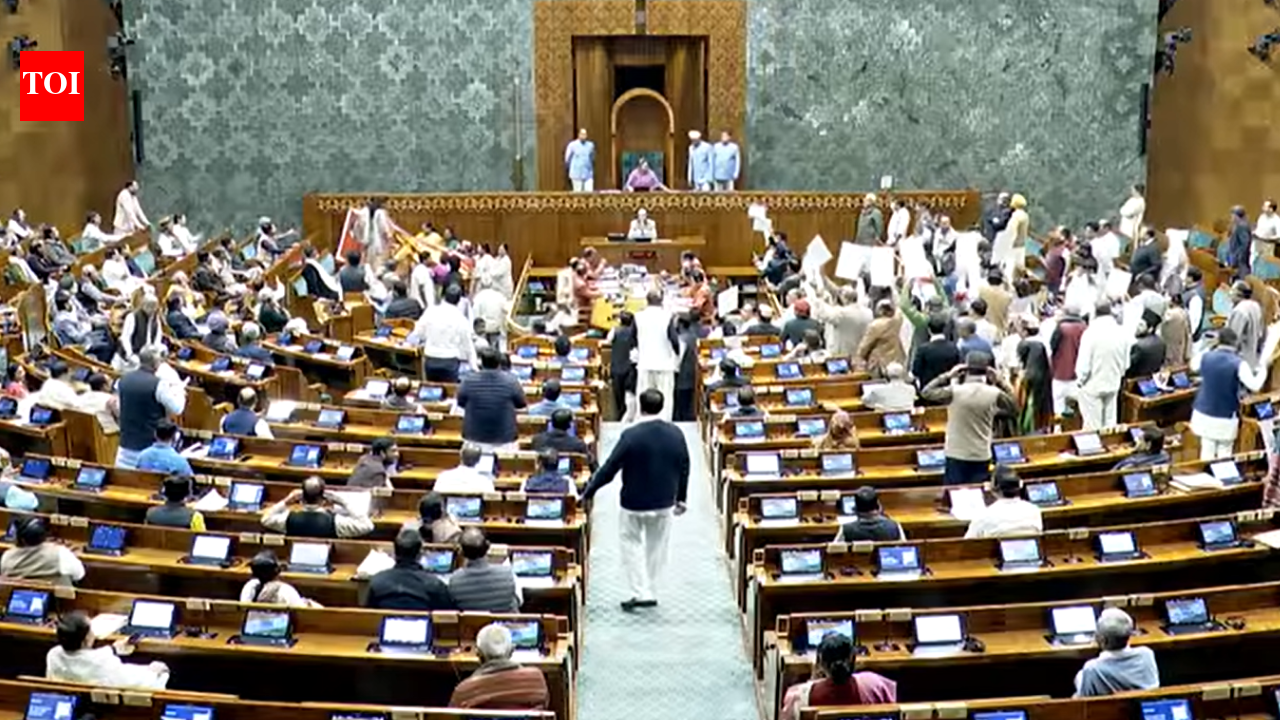
NEW DELHI: Proceedings in Lok Sabha were adjourned for the day seconds after it assembled for Prime Minister Narendra Modi’s reply to the debate on Motion of Thanks on the President’s Address.The House went into chaos as soon as the proceedings began at 5pm. Congress MPs entered the well and aisles and raised slogans over the suspension of eight MPs during the ongoing Budget Session.

‘PM Modi Under Pressure From Trump’: Rahul Gandhi Claims As Trade Deal Debate Paralyses Lok Sabha

Several women MPs from the opposition blocked the seats in the treasury bench, including the seat of the Prime Minister. They also displayed a large banner which read “Do what is right.”Subsequently, BJP MP Sandhya Rai, who was the acting speaker, adjourned the proceedings.‘PM Modi got scared’While walking out of the Parliament, Congress MP Priyanka Gandhi Vadra claimed that PM Modi did not arrive at the House because “he got scared.”“He (PM Modi) got scared and that’s why he did not arrive at the house…Union Railway Minister and BJP MP Nishikant Dubey ran away like a bullet train.” Priyanka said.Also Read: Rahul Gandhi ‘traitor’ remark against Bittu snowballs into huge controversy, protests – top developmentsRahul Gandhi also launched a broadside against the Prime Minister and said that he “doesn’t want to face the truth,” “As I said, PM Modi won’t come to Parliament because he’s scared and doesn’t want to face the truth,” Rahul wrote in a social media post on X.Earlier in the day, Gandhi said he would present Prime Minister Modi with General Naravane’s book, claiming it reveals how political leadership left the Army to act alone during the 2020 standoff with China in eastern Ladakh.In another post on X, he said the book was written by India’s former Army Chief and not by any opposition leader or foreign author.“Today, if the Prime Minister comes to Parliament, I will present him with a book. This book is not by any opposition leader. This book is not by any foreign author. This book is by the country’s former Army Chief, General Naravane, and the surprising thing is that, according to the Cabinet Ministers, this book does not even exist,” he wrote.‘Behaving like kids’Meanwhile, the ruling side slammed the opposition MPs for not letting the House to function. Union minister Giriraj Singh said, “This is unfortunate. This is the first time such a ruckus has been created during the President’s address. They are behaving like children. What do they think? Do they think this is the Nehru family’s kingdom, or the Congress party’s office, or Sonia Gandhi’s house?”Union minister Chirag Paswan also criticised the opposition MPs for their conduct in the Lok Sabha and said that the chaos in the Parliament prevented any meaningful discussion.“This is extremely unfortunate. The way the Opposition behaved during the President’s address prevented any meaningful discussion. Because of the Congress, even other Opposition parties were denied the opportunity to present their views. The President’s address is a platform to raise every issue. With elections due in several states, regional parties should have been allowed to speak,” Chirag said.“This is extremely unfortunate. The way the Opposition behaved during the President’s address prevented any meaningful discussion. Because of the Congress, even other Opposition parties were denied the opportunity to present their views. The President’s address is a platform to raise every issue. With elections due in several states, regional parties should have been allowed to speak,” he added.Also Read:Oppn, BJP MPs spar in Speaker office as Nishikant Dubey flashes ‘Bofors’ book in LS to target Gandhi familyThe Lok Sabha has witnessed repeated showdowns between the opposition and the ruling party after Rahul Gandhi, in his address, raked up India-China border skirmishes during August 2020..Rahul Gandhi, leading the Congress charge, raised the issue of Chinese aggression during Galwan stand-off while citing ‘uncomfortable facts’ from the memoirs of former Army Chief Naravane, where he is understood to have written about ‘political indecision’ about response mechanism to the then Chinese misadventures.This drew strong counter from Union ministers and also rejection from Speaker Birla, who rebuffed Rahul Gandhi’s repeated reference to Galwan, on grounds of violation of Parliamentary norms.On Tuesday, eight Congress MPs were suspended for the remainder of the Parliament session after ruckus erupted in the Parliament over Rahul Gandhi’s address.


Source link