Breaking News
Hate speech now non-bailable offence in Karnataka: Assembly passes Bill; includes 7-year jail term | India News


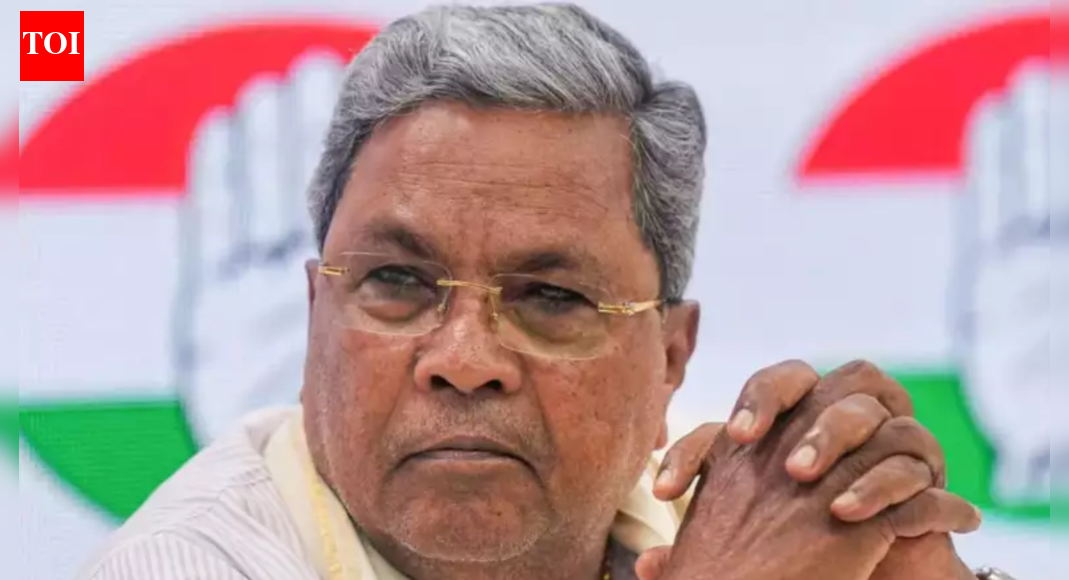
Karnataka CM Siddaramaiah (File photo)

NEW DELHI: The Karnataka assembly on Thursday passed the hate speech bill amid protests by BJP MLAs. The bill, cleared by the cabinet on December 4, was presented in the state assembly by home minister G Parameshwara on December 10.The minister said the provision for 10 years jail term in the event of repeated offence has been reduced to seven years.According to the bill formulated by CM Siddaramaiah-led Congress governe, any expression, which is made, published or circulated in words either spoken or written or by signs or by visible representations or through electronic communication or otherwise, in public view, with an intention to cause injury, disharmony or feelings of enmity or hatred or ill-will against person alive or dead, class or group of persons or community, to meet any prejudicial interest, is hate speech.

‘Roz Gandhi Ko Maarte Ho’: BJP MP Nishikant Dubey’s Fiery Speech Targets Cong, Triggers Chaos in LS

During the discussion, Urban Development minister Byrathi Suresh said coastal Karnataka is “burning” due to hate speech and hate crime, reported news agency PTI.BJP MLAs from the region raised objections to this and then trooped into the well of the house. Other BJP legislators followed them.There is also a provision for compensating victims based on the severity of the offence. Definitions under the Bharatiya Nyaya Sanhita, 2023, and the Information Technology Act will apply to the new legislation.Home minister G Parameshwara introduced the bill in the assembly amid protests from BJP members.“Whoever commits hate crimes shall be punished with imprisonment for a term which shall not be less than one year, but which may be extended to seven years, and with a fine of Rs 50,000. Furthermore, for subsequent or repetitive offenses (two or three times), the punishment will be increased to two years and a fine of one lakh rupees (instead of Rs 50,000),” the state home minister G Parameshwar said.The bill seeks to make hate speech a cognizable, non-bailable offence for which offenders can face trial at the court of the Judicial Magistrate First Class (JMFC).“In case of an organisation or institution, every person who, at the time of the offence, was in charge and was responsible, shall be deemed guilty and shall be liable to be proceeded against and punished accordingly,” the bill states.Exemptions cover publications proven to be in public interest — such as those related to science, literature, art, learning or heritage — as well as acts done in good faith by public servants. Materials kept for bona fide heritage or religious purposes are also excluded from the ambit of the law.Deputy CM DK Shivakumar, backed the bill saying: “Of course, hate speech [prevention] is part of the government’s agenda. We must maintain peace, law and order in the state.”Though senior BJP member Sunil Kumar sought a division of votes, the Speaker went ahead with tabling the bill, which was later taken up for discussion in both Houses.Union minister of heavy industries and JD (S) functionary HD Kumaraswamy on Tuesday claimed that the state government introduced the Bill only to “silence the opposition”.After offering puja to deity Chamundeshwari atop Chamundi Hills in Mysuru on his birthday, the minister told reporters that it is an attempt to suppress the opposition leaders, but they will not be intimidated by such tactics.
Source link

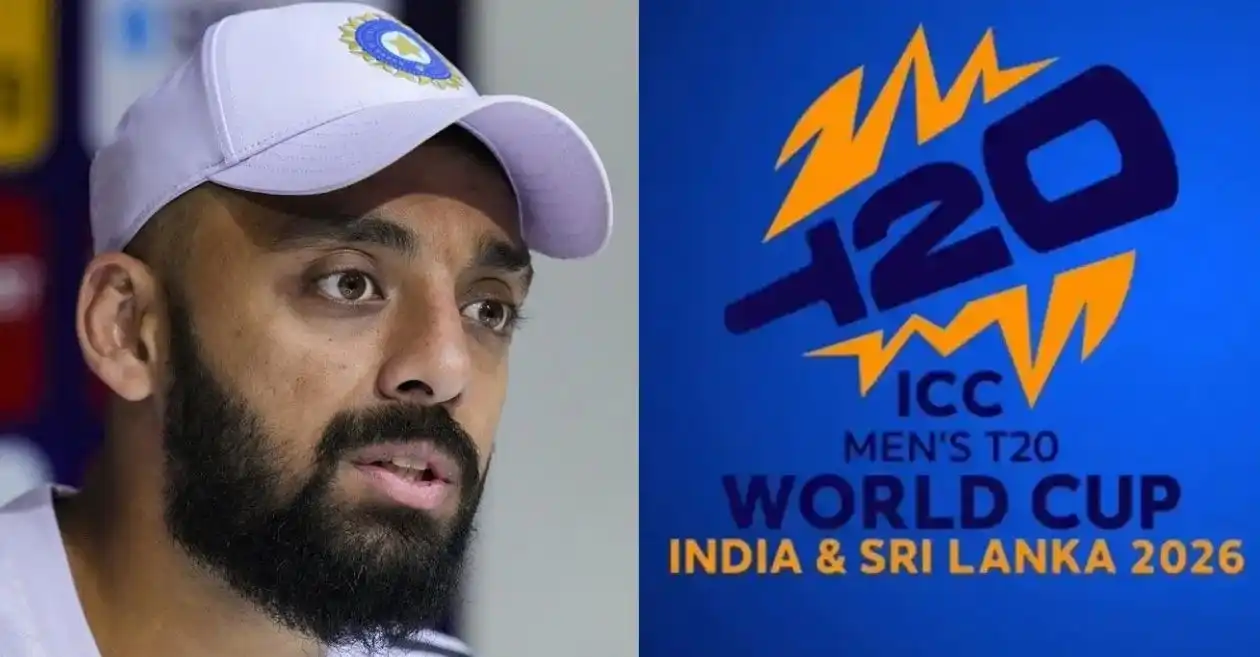
Varun Chakaravarthy details mental blueprint ahead of T20 World Cup 2026


As India build towards the ICC T20 World Cup 2026, Varun Chakaravarthy has offered a rare insight into the mental and tactical framework shaping his preparations for the global event. Speaking ahead of the fifth and final T20I against South Africa, the off-spinner stressed that success at the elite level begins long before match day, with players needing to constantly challenge themselves—even when conditions appear comfortable.

Varun Chakaravarthy shares major takeaways heading into T20 World Cup 2026

With India drawn in Group A alongside Namibia, the Netherlands, Pakistan, and the United States, Varun believes preparation is as much psychological as it is technical. India are set to begin their World Cup campaign against the USA in Mumbai on February 7, and the spinner feels that waiting for big moments to arrive naturally is a mistake.

Varun explained that elite cricketers must manufacture intensity in training and matches where the challenge does not seem obvious. According to him, creating internal pressure sharpens decision-making and ensures readiness when the stakes are highest. Confidence, he noted, comes from knowing one’s role, bowling the right lengths, and entering a contest with a clear understanding of the opposition’s strengths and weaknesses.

One of Varun’s major takeaways heading into the tournament is the importance of opposition analysis. He believes that reading batters, identifying patterns, and adapting to different match situations can give bowlers an edge in T20 cricket, where margins are razor-thin.

Rather than constantly reinventing his bowling, Varun highlighted the value of trusting his existing skill set. He pointed out that overthinking variations can sometimes be counterproductive, especially when rhythm and confidence are intact. For him, clarity of thought remains the foundation of consistent execution.

“It is very important to keep putting pressure on yourself to get ready for the World Cup. You have to challenge yourself even when there is no challenge. If a match feels easy, you have to create that pressure mentally and start challenging yourself. Confidence, bowling the right lengths, and understanding the opposition are key. That is one major factor I want to take into the World Cup. With a better understanding of the opposition, I think I can do well.” said Varun on Star Sports.

Also READ: Jacques Kallis explains why South Africa have a real shot at winning T20 World Cup 2026

The key to recent success for Varun

Reflecting on his strong recent performances, Varun credited his success to keeping things simple. He emphasised that sticking to basic plans and bowling consistent lengths has helped him find control and effectiveness. While not every delivery produces immediate results, he believes patience and discipline eventually force batters into mistakes.

Varun also acknowledged that confidence directly influences skill execution. A dip in belief can affect decision-making and accuracy, whereas backing one’s ability allows a bowler to perform freely. For him, consistency at the highest level is non-negotiable, and regular exposure to international cricket plays a vital role in refining that consistency.

The spinner recalled his early international outings, admitting that initial struggles taught him valuable lessons. Those experiences pushed him back to the practice nets, where he worked on technical corrections and mindset adjustments. Varun feels that playing against top international batters provides clarity about areas of improvement and helps players understand where they truly stand.

“Sometimes it works, and thankfully, in the last three matches, it has worked well. I will try the same in the next match. It is about mindset and skill. When you are not confident, your mindset affects your skill. The key is to stay confident and back your skills. That is when you execute well, without much change. That is the secret to being consistent. At this level, you must be consistent; playing at the highest level is important to know where you stand. In my first match at the international level, I struggled a bit initially, and that is when I understood a few things. I went back to practice and made corrections. So, it is very important to keep playing at the highest level,” added Varun.

Also READ: Rohit Sharma predicts the finalist of T20 World Cup 2026


Source link

One of the youngest to become GM at 13, India’s Raunak Sadhwani still struggles to have a full-time chess coach | Exclusive | Chess News


One of the youngest to become GM at 13, India's Raunak Sadhwani still struggles to have a full-time chess coach | Exclusive
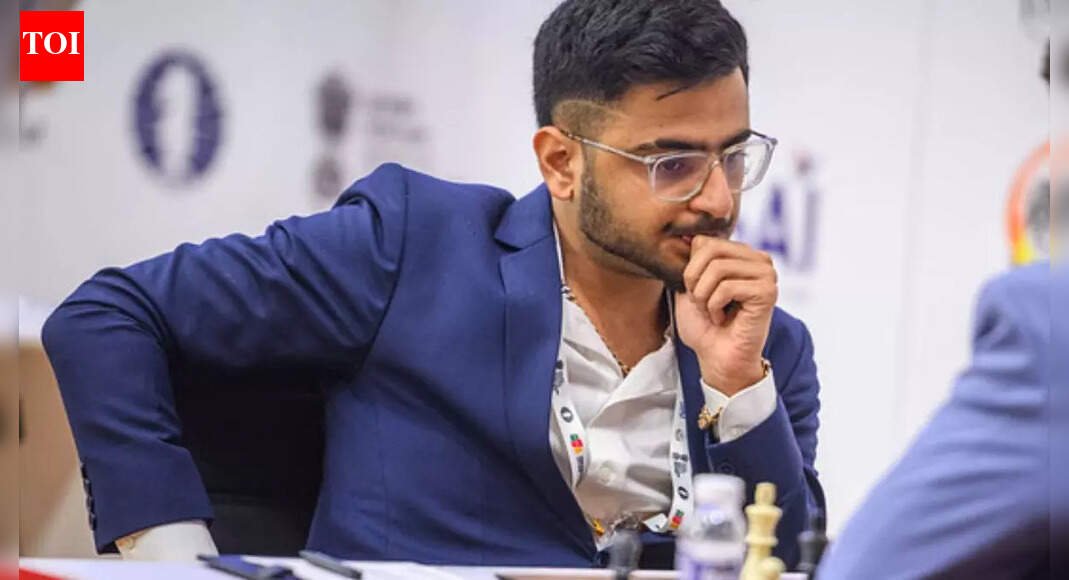
Indian GM Raunak Sadhwani during FIDE World Cup Goa 2025 (FIDE Photo)

NEW DELHI: The COVID-19 outbreak had not yet caused a hullabaloo across the globe, Lionel Messi was still without a FIFA World Cup title, artificial intelligence (AI) had not entered everyday conversations, and Russia and Ukraine were still “non-hostile” neighbours when Nagpur’s Raunak Sadhwani attained his Grandmaster (GM) title in 2019.At 13 years nine months and 28 days, Raunak earned the highest title in chess, becoming one of the youngest Indians to achieve the feat. In the record book, he joined the likes of current World Chess Champion Gukesh Dommaraju (12 years, 7 months and 17 days), Rameshbabu Praggnanandhaa (12 years, 10 months and 13 days), and Nihal Sarin (14 years, 1 month and 1 day).

Exclusive | Yosha Iglesias, World’s 1st Trans WIM & 2025 French Chess Women’s Champion

As Gukesh and Praggnanandhaa remain the top two names in the current FIDE rating list for juniors, Raunak, currently stationed at number eight, is not too far behind.Well, all he can recall about pursuing the GM title is the pressure during the first norm.“I was never bothered about the GM title. I’ve always felt that I would get there,” Raunak told TimesofIndia.com during an exclusive conversation on the sidelines of the Global Chess League (GCL), currently taking place in Mumbai. “But my first norm was difficult. It took some time, and then it was really easy. I knew I belonged there. So I just kept playing and eventually got it.”However, the journey since then has not been easy. With the pandemic putting daily life to a standstill, and players not able to travel abroad to play in higher-rated tournaments, some players slowed down.While the likes of Gukesh, Praggnanandhaa, and Nihal are three of the most celebrated chess players in the country, Raunak is still figuring his way around.“I definitely have to improve more. I lost rating in the last six months, so I definitely want to get back and win some tournaments and get my ELO back. So I’m working on it,” added the 2638-rated 19-year-old, who achieved a peak rating of 2681 back in January 2025.Nevertheless, the plan to “definitely have to improve” requires a proper framework, guidance, and mentorship, which the teenager is currently struggling to afford due to what many consider the dark side of professional chess: the expense.While the chess ecosystem has evolved in a way where a player is made to bear all his/her expenditures, even hiring a full-time coach is proving to be a challenge due to the lack of adequate private sponsorship.“It’s a big problem in the game. Even I still face this issue myself. I don’t have a full-time coach right now because it’s really expensive. You need a sponsor for that, and I’m waiting for one,” he revealed.“At the moment, I don’t have any. So yeah, it’s a very expensive game. Coaching isn’t easy to afford because the rates are much higher compared to other sports. So yeah, it’s not very easy for people to manage it.”In GCL this season, Raunak is sharing the same team with five-time World Chess Champion Viswanathan Anand, 2025 FIDE World Cup winner Javokhir Sindarov, and German talent Vincent Keymer.“It’s an interesting team with the likes of Viswanathan Anand sir, and everyone else is quite young, so I know them quite well myself. So it will be fun,” he further noted.Raunak sees the GCL as a preparatory step for the upcoming FIDE World Rapid and Blitz Championships, where he will take the field in Doha, Qatar.“It will be very good to stay in the flow. You’re playing rapid here and then immediately you go to Qatar to play rapid again. So it’s definitely a good warm-up to have,” the teenage Grandmaster concluded.


Source link

On This Day: India’s horror show at Adelaide Oval — bowled out for lowest-ever Test total | Cricket News


On This Day: India's horror show at Adelaide Oval — bowled out for lowest-ever Test total
File Pic: India vs Australia at Adelaide Oval in 2020. (Getty Images)

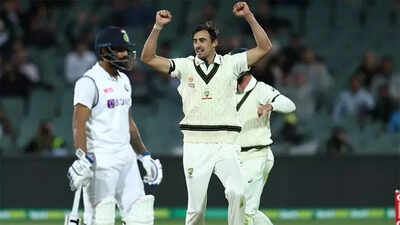
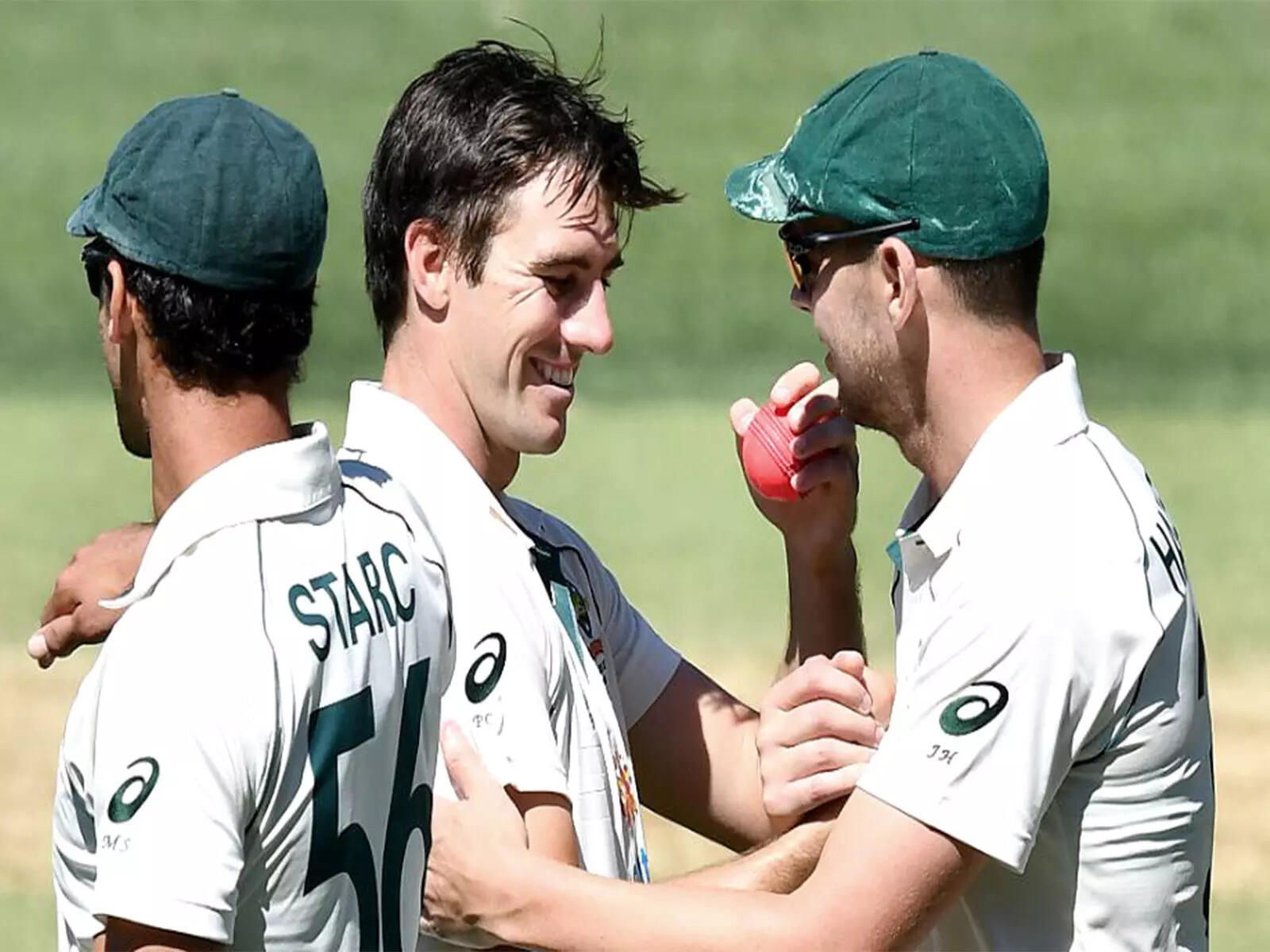
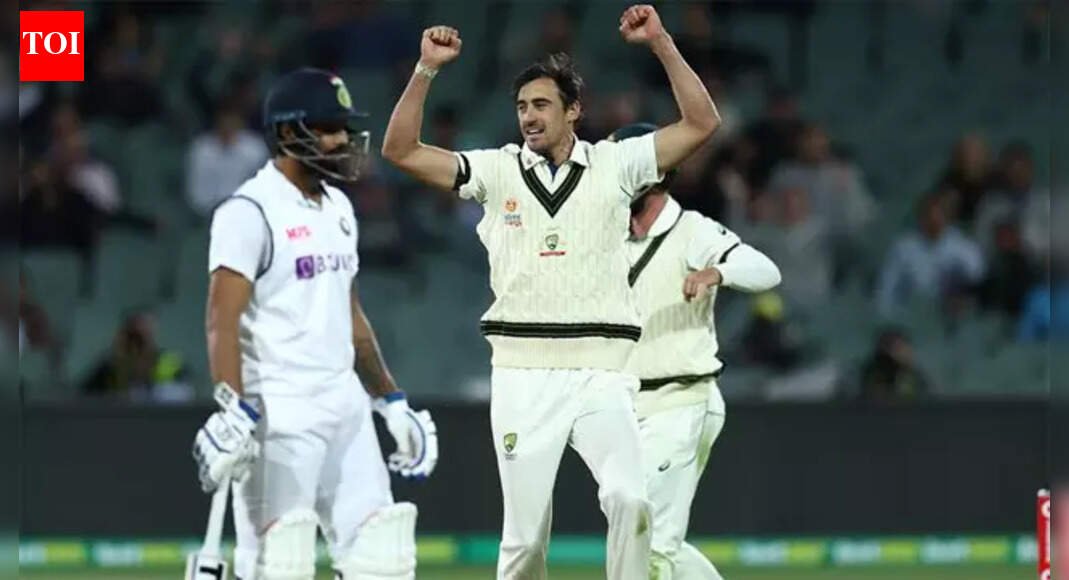
Five years ago on this day – on December 19, 2020, the Indian Test team, under their charismatic captain Virat Kohli, came face to face with their worst nightmare Down Under. On the third day of the opening match of their four-match series in Australia, India batters tumbled like a pack of cards against the spirited bowling of Josh Hazlewood and Pat Cummins at the Adelaide Oval. They were bundled out for their lowest score ever in the history of Test cricket – 36 all out in 21.2 overs.Go Beyond The Boundary with our YouTube channel. SUBSCRIBE NOW!Such was the collapse that no Indian batter managed to touch the double-digit mark and there were three ducks, including that of middle-order mainstays Cheteshwar Pujara and Ajinkya Rahane. Cummins started the mayhem and Hazlewood finished off the Indian defence with precision as they shared nine wickets between them.

Franchise boom vs Test cricket: Tom Moody’s honest take

That day, India broke their previous lowest total of 42 against England at Lord’s, scored way back in 1974. And it still remains their lowest point in Test cricket, before the team came close to match the horror show four years later in Bengaluru against New Zealand, when they were bowled out for 46 in 2024 – their lowest total at home.

The Adelaide Test India would like to forget

It was a sombre Saturday morning, India were in the driver’s seat after taking 53 runs first-innings lead at the Adelaide Oval. At stumps on Day 2, India had lost their opener Prithvi Shaw early in the second innings to Cummins and reached 9/1, a lead of 62 runs with nine wickets in hand, little did the visitors know what was in store the next day.Opener Mayank Agarwal and nightwatchman Jasprit Bumrah were on crease for India on Day 3. On the last delivery of the second over of the day, Cummins opened the floodgate by removing Bumrah – caught and bowled for 2.India were 15/2 at that stage, a lead of 68 with Pujara joining Agarwal in the middle. Three probing maiden overs followed as the pressure mounted on India batters in the middle. Cummins then forced an edge off Pujara’s bat in the 12th over and captain Tim Paine pounced on it – a 8-ball duck for India’s No.3 batter. Next over Hazlewood joined the party, removing Agarwal (9), India’s top scorer in the innings – out caught behind, before making it a double-wicket maiden by dismissing Rahane for a 4-ball duck.

Adelaide Test

Australia’s pace trio: Mitchell Starc, Pat Cummins and Josh Hazlewood. (ANI Photo)

India were in total disarray by then, 15/1 had turned to 15/5 in no time. All the advantage they generated by bowling out the hosts for 191 on Day 2 after posting 244 had vanished in thin air.It was left to skipper Kohli and wicketkeeper-batter Wriddhiman Saha to steady the India innings against the two marauding pacers in Cummins and Hazlewood. Kohli had a good outing with the bat in the first innings, top-scoring for India with a composed 74 off 180 balls, which included eight fours. So, India had hopes. But, Cummins had other ideas. In what could be considered as a stunning bowling spell, Cummins made Kohli his fourth victim as the pacer returned figures of 4 for 21 in 10.2 overs.Kohli’s wicket was the last hope for India, and after that Hazlewood ran through the lower middle-order and tail to complete his five-wicket haul – a 5 for 8 in five overs which included three maidens too.India were folded for 36 with Mohammed Shami retiring, after being hit by a Cummins bouncer, for the visitors’ final wicket. Despite taking a substantial first-innings lead, India set just a 90-run target for the hosts in the end.Australia then knocked off the target on the same day, with openers Joe Burns (51 not out) and Matthew Wade (33) adding 70 in quick time as India pacers failed to replicate the exploits of Cummins and Hazlewood.The match, which saw 21 wickets in the first two days, witnessed a dramatic collapse on the third day and India started the series with a disappointing 8-wicket defeat in the series.

Brisbane Test

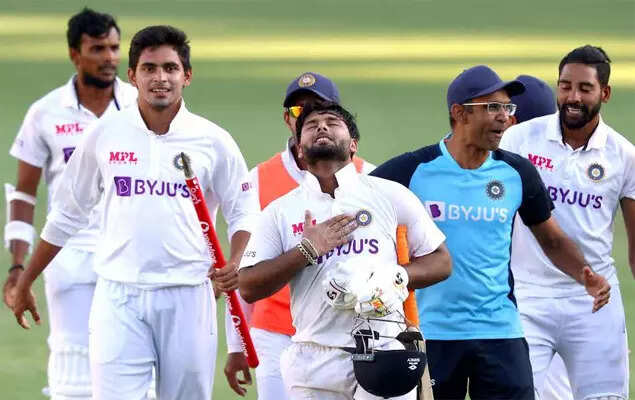
File Pic: Rishabh Pant celebrates after winning the Brisbane Test.

The turnaround as famous as the crumble

After the humiliation in Adelaide, the series moved to Melbourne and India were without their regular captain, Virat Kohli left the series due to personal reasons. Ajinkya Rahane led the side at MCG, and India made an emphatic comeback in it by beating Australia by 8 wickets to level the series 1-1.It was followed by a drawn Test in Sydney, as both teams reached for the finale in Brisbane with the series on the line.And Team India made sure that fans forgot what happened in Adelaide a month back, as they stunned the hosts by 3 wickets to win the series 2-1 – making it a back-to-back Test series win Down Under for the visitors. It was a turnaround to remember for Team India. They moved on from the Adelaide humiliation to script Test history in Australia.


Source link

Manufacturing consent? Decoding Jeffrey Epstein’s friendship with Noam Chomsky – after release of new photos | World News


Manufacturing consent? Decoding Jeffrey Epstein's friendship with Noam Chomsky - after release of new photos

With the benefits of hindsight, it’s hardly surprising that Noam Chomsky and Jeffrey Epstein were pals. Both are of course experts at manufacturing consent. Chomsky explained how the powers-that-be pulled the levers to manufacture the narrative. And turns out it was Epstein who was the lever which was pulling the powers-that-be. In earlier letters, Chomsky had thanked Epstein for explaining how the global finance system worked. Newer pictures released by Republicans of the House Oversight Committee shows that the academic and the financier were birds of the same feather.That opening unsettles because it violates an unwritten rule. You are not supposed to place Chomsky and Epstein in the same moral paragraph. One is meant to explain power. The other is meant to exemplify its abuse. One belongs in footnotes and seminars. The other in courtrooms and documentaries. And yet, once you stop resisting the discomfort, the pairing begins to feel less shocking and more revealing.

Epstein Photo Dump: Dems Share SHOCKING Images; Bill Gates & Mystery Girl, Chomsky ‘Chilling’ With…

This is not a story about crimes. There is no evidence linking Noam Chomsky to Jeffrey Epstein’s sexual offences. That boundary must be stated clearly and repeatedly. What is documented, however, is a sustained association — described in emails, letters, calendars, financial records, and now photographs — that raises questions not of legality, but of judgement and proximity.

New photo revelations: what images confirm, not imply

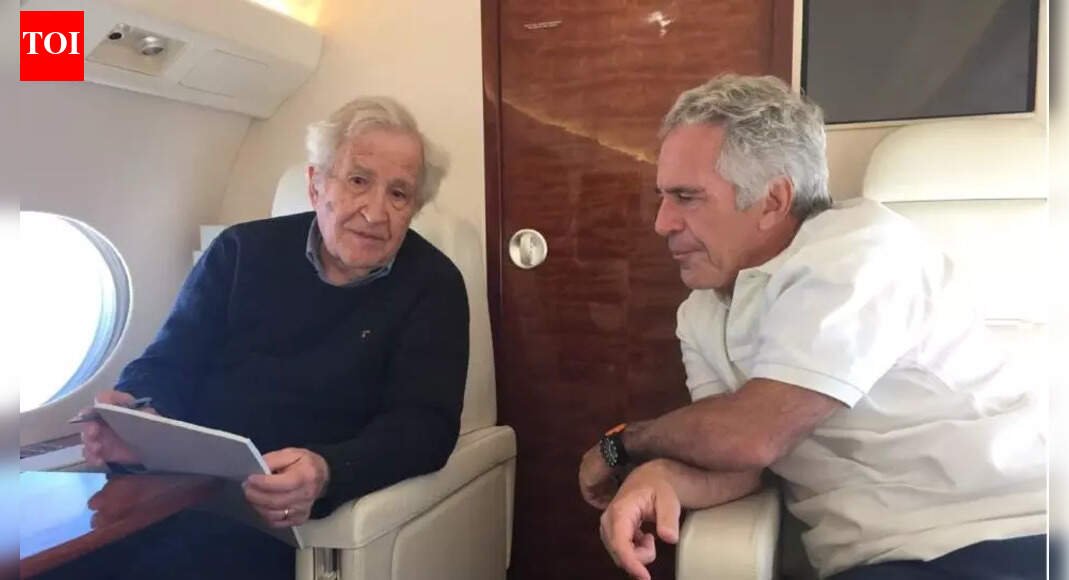
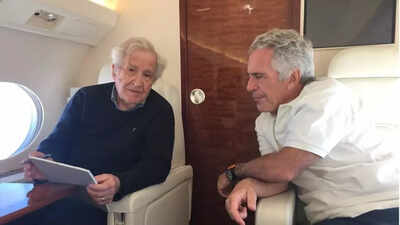
The Epstein saga has reached a stage where little is legally new, but reputational damage accumulates through artefacts. The latest release of photographs from Epstein’s estate, made public via the US House Oversight Committee, falls squarely into that category.Among the images is a photograph showing Epstein seated next to Noam Chomsky aboard a private aircraft. The image is undated and does not depict wrongdoing. But it establishes fact: Chomsky and Epstein were physically together in elite, private settings.That matters because Epstein’s pattern of interaction was not incidental. Private planes, residences, and small controlled environments recur across investigations and reporting on his social world. These were not neutral backdrops. They were spaces of access.The wider image set reinforces the same atmosphere. Passports from multiple countries laid out together. Young women photographed without context. Visual references to Lolita used provocatively rather than literarily. None of this implicates Chomsky directly. But it situates him inside Epstein’s curated world rather than outside it.Photographs do not explain intent. They establish presence. And presence, in Epstein’s case, has always been the first threshold.

The bond between the two: what the record actually shows

Chomsky has never provided a detailed public account of his relationship with Epstein. When contacted by The Wall Street Journal, Chomsky wrote in an email in mid-2023: “First response is that it is none of your business. Or anyone’s. Second is that I knew him and we met occasionally” That statement is one of the few clear, on-the-record responses Chomsky has given. It neither denies contact nor elaborates on its nature.The more detailed characterisation of their relationship comes instead from documents released later, including correspondence attributed to Chomsky that was obtained and reported by The Guardian and others following disclosures to the House Oversight Committee.In one such letter, Chomsky wrote that he had met Epstein several years earlier and that they had since been in “regular contact”, with “many long and often in-depth discussions about a very wide range of topics”. He described these exchanges as “a most valuable experience for me” The same correspondence records Chomsky thanking Epstein for explaining the “intricacies of the global financial system”, suggesting that Epstein provided insights unavailable in mainstream business journalism or academic literature. The documents also describe Epstein acting as a facilitator. In one instance, Epstein reportedly arranged a call with a Norwegian diplomat involved in the Oslo Accords. In another, he helped arrange a meeting with former Israeli prime minister Ehud Barak, a figure Chomsky had written about critically.Epstein also offered Chomsky access to his residences in New York and New Mexico. It is not publicly established whether those offers were accepted. There was also a financial link. In 2018, approximately $270,000 was transferred to Chomsky from an account associated with Epstein. Chomsky has publicly stated that this money was his own, routed through Epstein-linked accounts while reorganising shared funds after the death of his first wife, and that it “did not involve one penny from Epstein”. That explanation stands unless contradicted. What is undisputed is that a financial transaction occurred. Taken together, the record shows repeated contact, logistical cooperation, and written expressions of appreciation. It does not show criminal complicity. It does show a relationship that extended well beyond a chance encounter.

Why Epstein’s circle extended so far up

Epstein’s reach was not built on secrecy alone. It was built on usefulness. The documents show him acting as a connector: arranging meetings, facilitating conversations, collapsing distance between people who normally encounter one another only through intermediaries. This was central to his social capital. For academics, Epstein presented himself as a curious and well-informed interlocutor with resources and connections. For politicians and diplomats, he functioned as an informal channel. For business elites, he spoke fluently about leverage and systems.Association with Epstein did not require endorsement of his private conduct. It required engagement. That distinction explains why his circle cut across ideological and moral lines. The cost of association was not framed as moral compromise, but as ordinary social interaction. Over time, engagement became routine. This is how elite normalisation works. Not through overt coercion, but through familiarity.

Who is Noam Chomsky, and why this matters

Noam Chomsky is not merely a prominent academic. He is one of the most influential public intellectuals of the last century. In linguistics, his work on universal grammar reshaped cognitive science and theories of language acquisition. In politics, his critique of US foreign policy and corporate power made him a global symbol of dissent. Most famously, in Manufacturing Consent, Chomsky argued that modern democracies manage public opinion not through censorship, but through structure: media ownership, advertising dependence, elite sourcing, and ideological boundaries.For decades, Chomsky was valued precisely because he did not seek proximity to power. He analysed it from a distance. That is why the Epstein association resonates. Not because it disproves Chomsky’s arguments, but because it tests them. Epstein was not an aberration. He was a product of elite systems Chomsky described. Wealth laundering legitimacy. Access substituting for accountability. Networks insulating themselves through complexity.The documents do not show Chomsky endorsing Epstein’s crimes. They show something more mundane and more troubling: that even the most incisive critics of elite power can underestimate how power presents itself socially. Chomsky analysed systems. Epstein navigated them. This is not a story about hypocrisy. It is a story about blind spots. About how proximity dulls scepticism. About how critique does not guarantee immunity. Epstein did not refute Chomsky’s work. He illustrated it.


Source link

ED searches Dream11 office, co-founder Bhavit Sheth, Anand Jain, Jai Corp in Rs 2,000 crore money laundering probe | Mumbai News


MUMBAI: ED conducting search at office of Dream 11, its co-founder Bhavit Sheth, Anand Jain, his company Jai Corporation Ltd and others in a money laundering case. The ED is investigating the money laundering case against Anand Jain for fraudulent misappropriation of over Rs 2,000 crore and found financial connection with Dream 11 & Dream Sports.The money laundering case based on the CBI FIR against Jai Corporation, Jain and others following the Bombay High Court order.In Feb, the Court had directed the CBI to form a special investigation team (SIT) to conduct a thorough and impartial investigation in the allegations. The order was in response to a petition by activist Shoaib Richie Sequeira, who alleged misuse and misappropriation of public funds for personal gains, defrauding investors, round-tripping of funds through shell companies based in tax havens, and creation of dubious invoices.According to the CBI FIR, HC ordered the formation of an SIT to investigate Sequeira’s two complaints, previously filed with Mumbai police’s economic offences wing (EOW). The primary investigation areas include real estate fund fraud in India, fraudulent activities in Mauritius and Jersey private real estate funds, improper trading in Reliance Petrochemical Ltd futures, unlawful bank loan transfers to Mauritius, and fraudulent exports to New South Wales, Australia, and California, USA.The allegations suggest that Jai Corp Ltd, under Anand Jain’s control, along with its subsidiaries, conspired to misappropriate funds collected from financial institutions and investors.


Source link

Access Denied


Access Denied

You don’t have permission to access “http://www.ndtv.com/world-news/bangladesh-crisis-news-behind-mob-attack-on-leading-bangladesh-dailies-and-what-muhammad-yunus-said-9848168” on this server.

Reference #18.14092017.1766143513.70827d6

https://errors.edgesuite.net/18.14092017.1766143513.70827d6


Source link

‘Might appoint Hardik Pandya’: Shubman Gill not to be vice-captain for T20 World Cup? Former cricketer drops bombshell | Cricket News


'Might appoint Hardik Pandya': Shubman Gill not to be vice-captain for T20 World Cup? Former cricketer drops bombshell

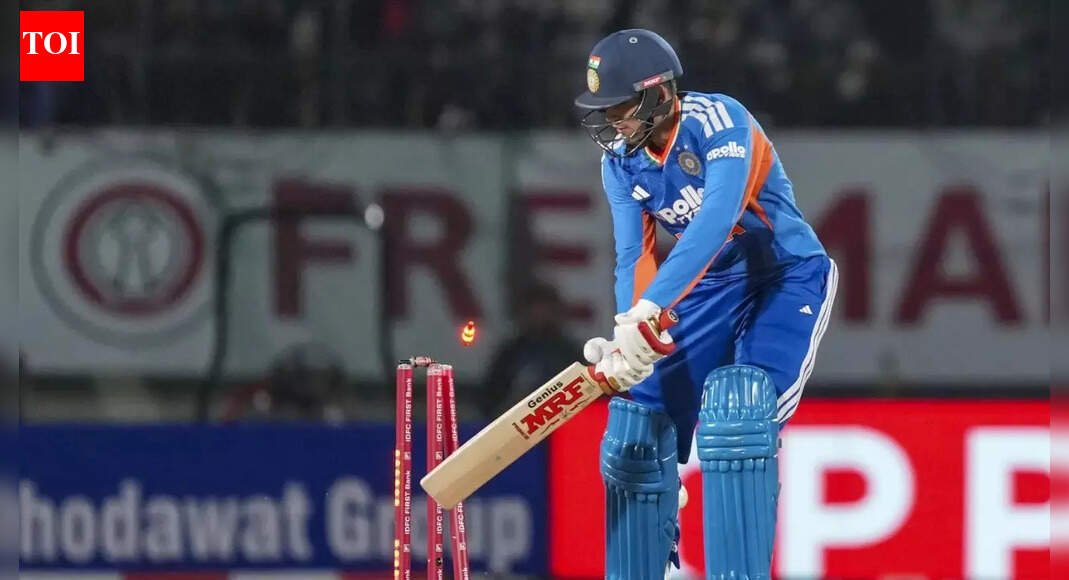
Former India batter Aakash Chopra said Shubman Gill is likely to continue as vice-captain for the T20 World Cup 2026, though he noted that Hardik Pandya remains an option. Gill was named vice-captain under Suryakumar Yadav ahead of the Asia Cup 2025, but a drop in form has led to criticism. While selecting his India squad for the T20 World Cup, Chopra included Gill but said the team management may not finalise the vice-captaincy yet and could also consider Hardik.“The fact is that Abhishek Sharma, Shubman Gill, and Sanju Samson will be the three openers in this team. I have picked Sanju Samson as the second wicketkeeper and an opening option. As for Abhishek Sharma, let’s not even talk about it, because I feel he could be the highest run-scorer of the World Cup,” Chopra said on his YouTube. channel

Ryan ten Doeschate backs under-fire Suryakumar Yadav, Shubman Gill to regain form

“If you are wondering why Shubman Gill has been picked-if you have appointed someone vice-captain, you won’t pivot that soon. I am not going to put my neck on the line and say that Shubman definitely will be the vice-captain. The team might leave the vice-captain slot open, or they might appoint Hardik Pandya just to keep their options open,” he added.Chopra named Jitesh Sharma as the first-choice wicketkeeper, with Sanju Samson as the second option. In the pace department, he selected Jasprit Bumrah, Arshdeep Singh and Harshit Rana as specialist fast bowlers, with Hardik Pandya and Shivam Dube as seam-bowling all-round options.“After that, Jasprit Bumrah-let’s not discuss him; why waste time? Arshdeep Singh, let’s not discuss; why waste time? Then Varun Chakaravarthy-there is no discussion. Why should we waste your and my time? I feel Varun Chakaravarthy could be the highest wicket-taker of this tournament,” Chopra said.“After that, you have to keep Kuldeep Yadav in the team to give yourselves options. Then only one slot is left. You can pick any fast bowler there, so I am keeping Harshit Rana. He also provides a batting option at No. 8,” he added.


Source link

Five years, nearly a million left: Over 2 lakh Indians renouncing citizenship every year – what’s behind the exodus? | India News


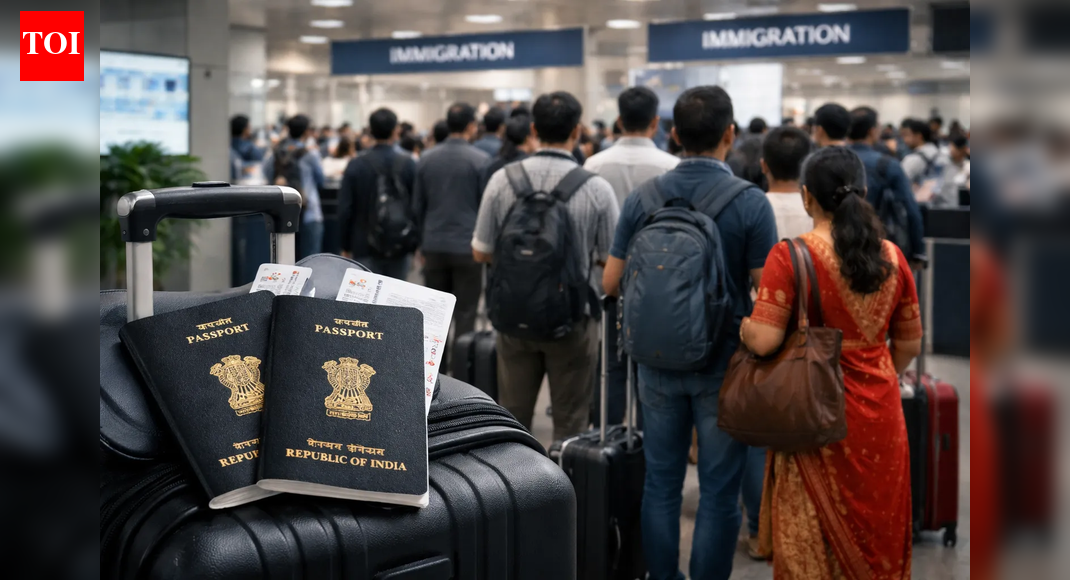
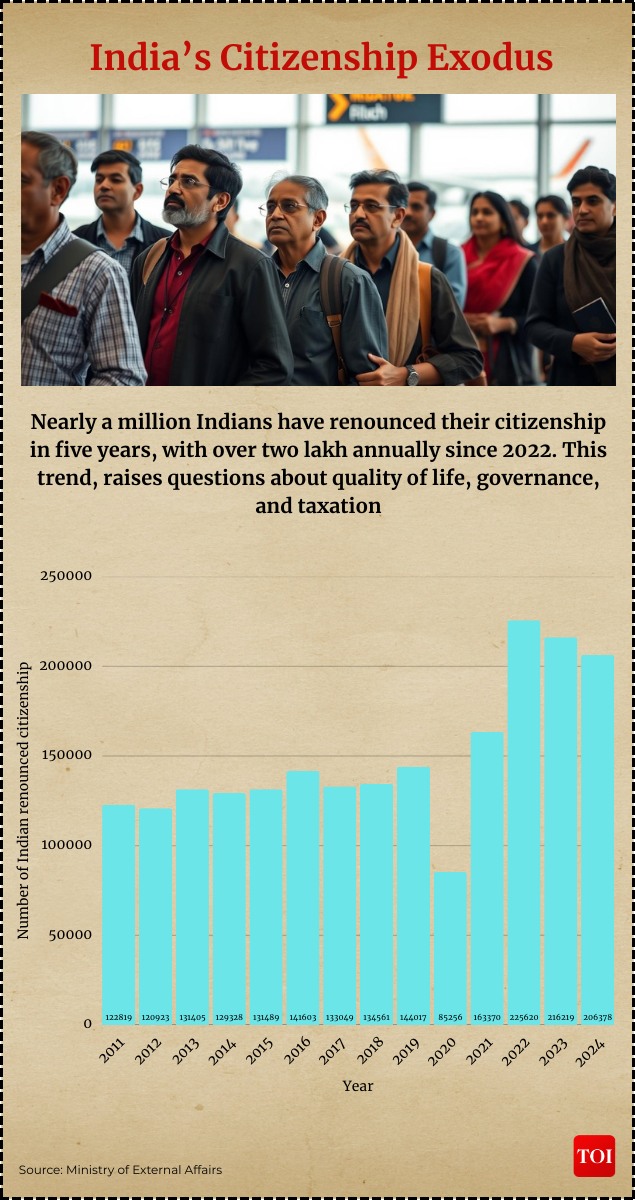
NEW DELHI: Close to one million Indians have renounced their citizenship over the last five years, with annual numbers crossing the two-lakh mark consistently since 2022, according to data presented by the government in Parliament. The trend has reignited a crucial question why a growing number of Indians – particularly the wealthy and highly skilled – are choosing to give up their Indian passports.

India’s Silent Exodus: Over Two Lakh Indian Citizens Quit Passports Yearly Amid Changing Aspirations

Responding to questions raised by Congress MP KC Venugopal in the Lok Sabha, the ministry of external affairs (MEA) said that 2.06 lakh Indians gave up citizenship in 2024, following 2.16 lakh in 2023 and 2.25 lakh in 2022. Earlier, 1.63 lakh renunciations were recorded in 2021, while the figure stood at 85,256 in 2020, the lowest in a decade due to Covid-related disruptions.Between 2011 and 2024, a total of over 20.6 lakh Indians renounced citizenship, with nearly half of them doing so in just the last five years, the government presented data during the ongoing winter session showed.Venugopal sought details on whether the government had studied the reasons behind the rising trend and what steps were being taken to curb citizenship renunciation, particularly among younger Indians. The issue has also been raised by other opposition leaders in recent years, who have flagged what they describe as a growing “exit of the successful” from India.Leading opposition members including TMC MP Mahua Moitra have previously as well questioned the government as to why people are renouncing Indian passports. During a debate on the economy she had asked whether this indicated a “healthy economic environment” or a “healthy tax environment”. Moitra alleged that an “atmosphere of terror” created by the enforcement directorate (ED), with investigations primarily targeting opposition leaders and businessmen, was a contributing factor.Sanjaya Baru, media adviser to former PM Manmohan Singh, in his book ‘Secession of the Successful’, argued that India is witnessing a fourth wave of emigration, marked by the departure of high net worth individuals (HNIs), their families, and elite professionals. Citing Morgan Stanley data, Baru noted that around 23,000 Indian millionaires left the country between 2014 and 2023.Opposition leaders have repeatedly questioned whether rising wealth migration reflects concerns over quality of life, governance, education, taxation and long-term security, especially when compared to developed economies.

.

MEA: Reasons are ‘personal’, diaspora an asset

In its written reply, minister of state for external affairs Kirti Vardhan Singh said the reasons for renunciation are personal and known only to the individuals concerned.“The Government recognises the potential of the global workplace in an era of knowledge economy,” the MEA said, adding that a successful and influential Indian diaspora is an asset. It added that the government’s focus was on engaging the diaspora and leveraging its expertise and soft power, rather than discouraging overseas citizenship.The MEA also placed on record a list of 135 countries whose citizenship Indians have acquired, underlining the global spread of the trend.

No dual citizenship a key factor

One of the most cited reasons for Indians giving up citizenship is India’s lack of dual citizenship. Under Section 9 of the Citizenship Act, 1955, any Indian who voluntarily acquires foreign citizenship automatically loses Indian citizenship.For Indians abroad, citizenship often decides access to voting rights, social security, permanent residence, public-sector employment and legal protections. While Overseas Citizen of India (OCI) status allows visa-free travel and limited economic rights, it does not give much of political rights.As a result, many long-term migrants – especially those with families – are left with little choice but to formally renounce Indian citizenship.

Post-Covid surge, not just backlog

While the sharp jump in 2022 was partly attributed to pandemic-era backlogs, the continuation of high numbers in 2023 and 2024 suggests a new baseline, analysts say.Before the pandemic, annual renunciations largely remained within a range of 1.2 lakh to 1.45 lakh for nearly a decade.Though occupation-wise data is not available, global studies show that Indians form one of the world’s largest skilled migrant populations. According to the UN, India has remained the largest source country of international migrants, with a diaspora of 17.5 million as of 2019.In the US alone, 81 per cent of Indian immigrants aged 25 and above hold at least a bachelor’s degree, significantly higher than both native-born and other immigrant groups, according to the Migration Policy Institute.Migrants often cite better pay, cleaner environments, reliable infrastructure, stronger civic services, education systems and clearer pathways to residency and citizenship abroad. For many, citizenship becomes the final step in a long migration journey that begins with education and employment.

Remittances high, but concerns persist

India remains the world’s top recipient of remittances, receiving an estimated $125 billion in 2023, according to the World Bank. However, opposition leaders argue that the steady outflow of citizens/ brain drain – especially among the affluent and skilled – calls for the need for reforms in urban living conditions, public health, education, social security and income parity.As renunciation numbers moves upwards of two lakh annually, the issue is likely to remain a political and policy flashpoint, particularly amid concerns over talent retention and long-term economic competitiveness.


Source link

Sarfaraz Khan shares emotional note after getting picked by CSK in IPL 2026 auction


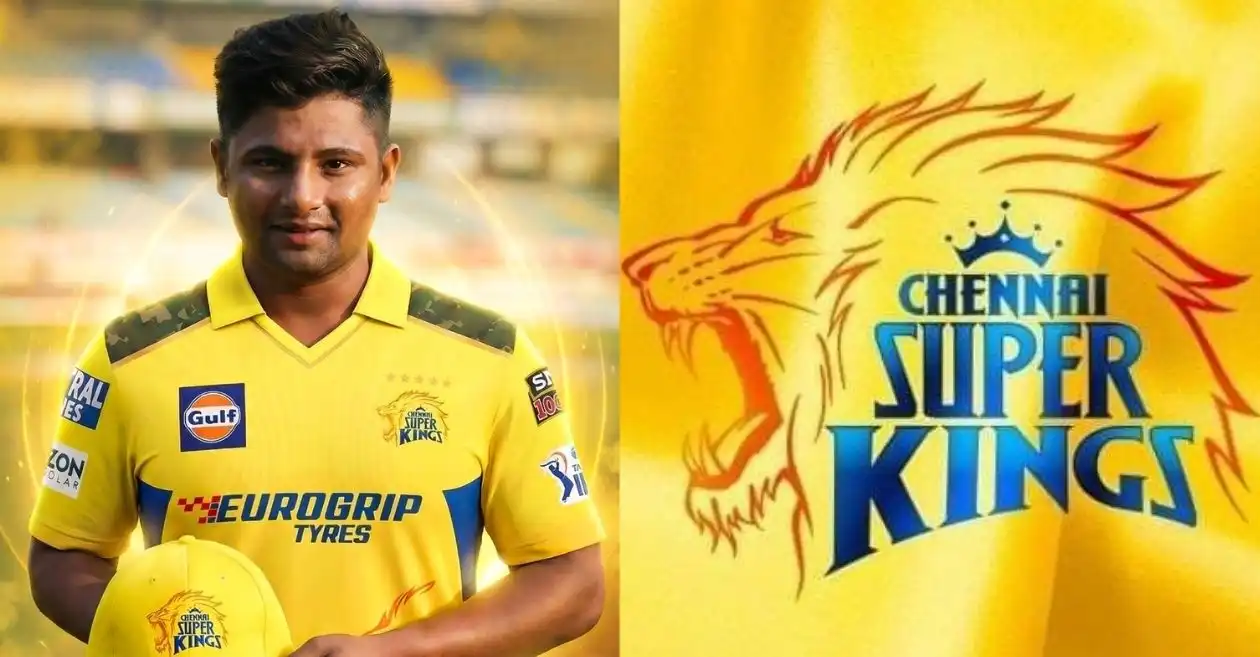
The Indian Premier League (IPL) 2026 auction delivered its usual dose of drama, big spends, and heart-stopping moments. Amidst the flurry of high-profile retentions and multi-crore bids for international stars, one story truly resonated with cricket fans: the emotional comeback of Sarfaraz Khan. After going unsold in the initial rounds, the prolific domestic batter found a new home with the Chennai Super Kings (CSK) for his base price of ₹75 lakh, sparking a wave of relief and gratitude from the player himself, who declared his selection a “new life.”

A return from the wilderness: Sarfaraz Khan’s IPL journey

Sarfaraz has long been a perplexing figure in Indian cricket. Despite his undeniable talent and a sensational record in domestic red-ball and white-ball formats, the IPL had proven to be a particularly tough nut to crack. Having previously played for franchises like Royal Challengers Bengaluru (RCB), Punjab Kings (PBKS) and Delhi Capitals (DC), his last IPL appearance was in 2023. The subsequent 2024 and 2025 auctions saw him go unpicked, a baffling situation for a player consistently churning out runs at an extraordinary rate.

His exclusion from previous seasons often sparked debates among fans and pundits, many arguing that his aggressive style and ability to score quickly in various situations made him an ideal T20 fit. Yet, for two seasons, the call never came. This period of being overlooked undoubtedly tested the young batter’s resolve, making his eventual selection by CSK all the more poignant.

The turning point: A Syed Mushtaq Ali masterclass

Just hours before the accelerated auction began, Sarfaraz delivered a performance that might have been the final, decisive nudge for the CSK management. In a Syed Mushtaq Ali Trophy match, he unleashed a breathtaking 73 runs off just 22 balls, showcasing his explosive hitting and reminding every franchise of his destructive potential. This knock, coming at such a crucial time, served as a powerful testament to his current form and readiness for the biggest T20 league in the world.

Also READ: Top 5 best steal deals from IPL 2026 Auctions ft. David Miller and Prithvi Shaw

Sarfaraz’s emotional response after getting picked by CSK

The moment CSK raised their paddle for Sarfaraz was met with widespread relief, not just for the player, but for his legion of supporters. His reaction, shared on Instagram, was raw and heartfelt.

“Thank you so much, CSK for giving me new life,” wrote Sarfaraz on his Instagram story.

Also READ: Best playing XI of unsold players from the IPL 2026 mini auction ft. Jake Fraser-McGurk


Source link