Breaking News
Dunki route probe: Haryana contractor took property papers as collateral; ED raids conducted in 3 states | India News


Dunki route probe: Haryana contractor took property papers as collateral; ED raids conducted in 3 states

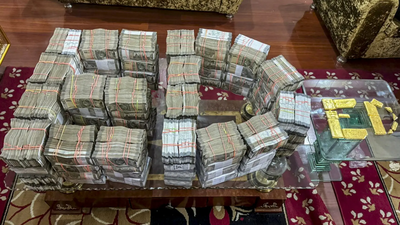
NEW DELHI: The Enforcement Directorate (ED) in its probe into the ‘donkey’ or ‘dunki’ route found Thursday that a key operator based in Haryana allegedly collected property papers from aspirants as security to guarantee payments for arranging illegal travel to the US through Mexico.‘Dunki’ route is a network used to send Indians illegally to the United States. The searches spread across Punjab, Haryana and Delhi were focused on what officials described as “second and third layer persons involved in the chain” of the donkey route syndicate.“Chat with other involved persons and other incriminating evidence regarding dunkey business has been found,” officials associated with the probe told news agency ANI.“From premises of a key donkey player in Haryana, records and documents related to donkey business has been found. It has been revealed that he used to keep property documents of candidates as surety for payment of amount for sending USA through Mexico donkey route,” said the officials, adding “some incriminating documents and mobile have also been recovered from the premises of other persons covered under search operations.”During the operation, the agency seized assets worth Rs 19.13 crore from the premises of a travel agent based in Delhi. Cash amounting to Rs 4.62 crore, along with 313 kg of silver and 6 kg of gold bullion was seized. The latest search operations covered premises linked to Richi Travels in Jalandhar, Tarun Khosla in Delhi and Balwan Sharma in Panipat.In a related development, the ED recently attached assets worth Rs 5.41 crore belonging to agents Shubham Sharma, Jagjit Singh and Surmukh Singh- individuals accused of generating illegal proceeds by facilitating unlawful migration through the donkey route. The properties include agricultural land, residential and commercial properties, as well as bank accounts held in their names and those of their family members.The searches were initiated based on specific intelligence inputs in a case that took shape after multiple FIRs were registered in connection with the deportation of 330 Indian nationals by US authorities in February 2025. The individuals were flown back to India on military cargo planes after it was found that they had entered the US illegally.The ED said that “these agents and their associates used to cheat gullible people by luring them under the pretext of sending them to the USA legally and charged hefty amounts for this.” The agency added that the victims were instead taken through risky routes via several South American countries before being pushed across the US-Mexico border illegally. “Throughout the way, people were tortured, extorted for even more money and made to commit illegal acts. These ‘agents’ and their associates generated proceeds of crime by cheating various persons on false pretexts and obtaining large sums from them.


Source link

Piramal Finance exit: Firm to sell 14.72% stake in Shriram Life to Sanlam; Rs 600 crore deal


Piramal Finance exit: Firm to sell 14.72% stake in Shriram Life to Sanlam; Rs 600 crore deal

Piramal Finance on Friday said it has decided to exit Shriram Life Insurance Company by selling its entire 14.72% stake to South Africa-based Sanlam Group for Rs 600 crore, as part of its strategy to monetise non-core assets.The company said it has signed a share purchase agreement with Sanlam Emerging Markets (Mauritius) Limited (SEMM), the foreign partner in the insurance joint venture with Shriram Finance. SEMM is a wholly owned subsidiary of Sanlam Emerging Markets Pty Ltd and part of the Sanlam Group.The transaction is expected to be completed in the quarter ending March 31, 2026, subject to receipt of necessary regulatory approvals, including clearance from the Insurance Regulatory and Development Authority of India (IRDAI), Piramal Finance said in a regulatory filing.Shriram Life Insurance Company’s contribution to Piramal Finance’s revenue remained marginal. For the year ended March 31, 2025, the company received Rs 12.68 crore as dividend from Shriram Life, accounting for 0.12% of its total revenue, the filing said.“This transaction is aligned with our focus on monetising non-core assets, and we will continue doing the same for our other residual non-core assets,” Piramal Finance said, adding that the proceeds from the sale would help strengthen its balance sheet.Sanlam Group is a pan-African financial services group headquartered in South Africa, with operations across more than 30 countries, including India.


Source link

Jharkhand crowned SMAT champions, Ishan Kishan’s bhangra celebration steals the show – WATCH | Cricket News


Jharkhand crowned SMAT champions, Ishan Kishan's bhangra celebration steals the show - WATCH
Ishan Kishan (Image credit: BCCI Domestic)

NEW DELHI: Jharkhand made history on Thursday by winning their first-ever Syed Mushtaq Ali Trophy, defeating Haryana in a thrilling final. Go Beyond The Boundary with our YouTube channel. SUBSCRIBE NOW!Captain Ishan Kishan spearheaded the victory with a breathtaking 101 off just 49 balls, smashing 10 sixes in a dazzling display of power-hitting.

Shashi Tharoor vs Rajeev Shukla breaks out on India match in Lucknow

The highlight wasn’t just his century—Kishan’s bhangra-inspired celebration went viral, a refreshing departure from the usual struts seen in modern cricket, as Jharkhand became the 12th state to lift India’s premier domestic T20 title.Kishan’s innings helped Jharkhand post a formidable 262/3, anchored by a 177-run second-wicket partnership with Kumar Kushagra, who contributed a lively 81 off 38 balls. Medium pacer Anukul Roy delivered a crucial all-round performance, taking two early wickets and adding a rapid 40 off 20 balls, while Haryana’s Yashvardhan Dalal top-scored with 53 in a losing cause. The opposition was eventually bowled out for 193.Watch the video hereThe triumph is historic, marking the first time in 19 years that the tournament crowned a new champion, underlining the rise of smaller teams in Indian domestic T20 cricket. Kishan’s vibrant celebration, combined with the team’s collective effort—stellar batting and disciplined bowling—made Jharkhand’s maiden title a memorable milestone in the tournament’s history.


Source link

Most-liked tweets: In top 10 posts from India, PM Modi in top 8 – check the posts | India News


Most-liked tweets: In top 10 posts from India, PM Modi in top 8 - check the posts

NEW DELHI: Prime Minister Narendra Modi continues to dominate social media engagement in India, emerging as the most influential political voice on X both in terms of followers and public response.

Ethiopia Confers Top National Honour On PM Modi, Citing Visionary Leadership And Global Impact

X recently rolled out a feature that shows the most-liked tweets in a country over the past 30 days. For India, eight of the top 10 most-liked tweets during this period were posted by Prime Minister Narendra Modi, with no other politician featuring in the top 10.

.

This comes as PM Modi has climbed to become the fourth most-followed person globally on X, overtaking pop stars Justin Bieber and Rihanna. According to data compiled by Statista, the Prime Minister has around 105 million followers, placing him behind only X owner Elon Musk, former US President Barack Obama, and footballer Cristiano Ronaldo.

.

Justin Bieber follows closely with around 108 million followers. PM Modi is currently the most-followed world leader in office on the platform. US President Donald Trump is the only other serving head of government to feature in the global top 10 list.

.

Among non-political figures in the top ranks are musicians Taylor Swift, Katy Perry, Rihanna, and Justin Bieber, highlighting Modi’s rare position among entertainment and sports icons.

.

In 2024, PM Modi crossed the milestone of 100 million followers on X, adding nearly 30 million followers over the previous three years.

.

The Prime Minister remains highly active on X, using the platform to share updates on government policies, public engagements, and interactions with global leaders, while also responding to citizens.

.

Beyond X, PM Modi also leads on Instagram, where he is the most-followed politician with over 97 million followers.

.

According to Statista, the top X accounts globally as of October 2025 are Elon Musk, Barack Obama, Cristiano Ronaldo, Narendra Modi, Justin Bieber, Donald Trump, Rihanna, and Katy Perry.

.


Source link

BMC polls: BJP, Shiv Sena reach consensus on 150 electoral wards in Mumbai; final list by Dec 22 | Mumbai News


MUMBAI: The BJP and Shiv Sena have reached a consensus on more than 150 electoral wards for the BMC election, said BJP Mumbai unit president Ameet Satam.There are 77 seats to which both parties have laid claim in Dahisar, Bandra East, Worli, Sewri, Ghatkopar, and one each in Colaba and Malabar Hill, said sources.“We have reached an understanding on 150 seats that we shall fight as Mahayuti. It is not important who contests which of the 227 seats. What is important is to win the elections and to give a corruption-free administration and governance to the people of Mumbai. We want to ensure the city’s development and security,” said Satam.Shiv Sena sources said the party at the discussion pointed out that the undivided Sena had won 88 wards besides another 21 former corporators have joined the party. “We have asked for 109 seats and the BJP 102. Of these 211 seats we have reached a consensus on 150 seats today. We shall be meeting daily and we should finalise the seat-sharing by December 21. Our first list should be out by December 22,” said a Sena source.The consensus is that BJP will contest 102 seats, including the 82 seats it won in 2017 and the seats on which it stood second. Sena will contest 55 seats.On Thursday, representatives of the two parties met for the second time at the BJP Mumbai unit office at Dadar to continue their discussions on seat-sharing. Present for the meeting were BMC election in-charge Ashish Shelar, Satam, Kandivli East MLA Atul Bhatkalkar, and BJP leader of the house in the legislative council Pravin Darekar. The Sena was represented by industry minister Uday Samant, senior leader and former MP Rahul Shewale, MLAs Prakash Surve and Yogesh Kadam, MP Milind Deora, and Sheetal Mhatre.The factors considered were the ground situation and each party’s winnability quotient. “The discussion for the remaining seats will be held soon ,” said Satam, adding that once the seat sharing is finalised, it will be ratified by CM Devendra Fadnavis and Dy CM Eknath Shinde. The BJP’s election committee will decide the candidates for seats it will contest.


Source link

Shriram Finance inks pact with Japan’s MUFG Bank for investment of Rs 39,618 crore; MUFG to acquire 20% stake


Shriram Finance inks pact with Japan's MUFG Bank for investment of Rs 39,618 crore; MUFG to acquire 20% stake

Shriram Finance Limited (SFL) has entered into a definitive agreement with MUFG Bank Ltd., Japan’s largest bank and a part of Mitsubishi UFJ Financial Group (MUFG), for an investment of Rs 39,618 crore, the company informed stock exchanges in a regulatory filing on Friday.According to the filing, the Board of Directors of Shriram Finance approved the proposal at its meeting held on Friday. Under the agreement, MUFG Bank will invest Rs 39,618 crore, equivalent to around USD 4.4 billion, in Shriram Finance through a preferential issuance of equity shares. This investment will result in MUFG Bank acquiring a 20.0 per cent stake in Shriram Finance on a fully diluted basis.It stated “The Board of Directors of Shriram Finance Limited (“SFL”) at their meeting held today approved entering into definitive agreements with MUFG Bank Ltd. ( “MUFG Bank” ) for an investment of Rs 39,618 crore”.The company said the proposed minority investment by MUFG Bank is subject to shareholder approval, regulatory clearances and other customary closing conditions. Once completed, this transaction will mark one of the largest foreign investments in India’s non-banking financial sector.Shriram Finance stated that the collaboration brings together its strong domestic franchise and extensive distribution network with MUFG Bank’s global expertise and financial strength. The fund infusion is expected to significantly enhance Shriram Finance’s capital adequacy, strengthen its balance sheet, and provide long-term growth capital to support its future expansion plans.The company further noted that the partnership is expected to unlock synergies across multiple areas, including technology, innovation and customer engagement. These synergies are likely to help drive sustainable growth and improve operational efficiency over the long term. In addition, the investment is expected to improve access to low-cost liabilities for Shriram Finance and could potentially strengthen its credit ratings.Shriram Finance also said that the collaboration will help align its governance and operational practices with global best standards, supported by MUFG Bank’s international experience and established risk management frameworks.MUFG Bank is a wholly owned subsidiary of Mitsubishi UFJ Financial Group, one of the world’s leading financial groups. MUFG has a long-standing presence in India, with a legacy of over 130 years. The group has invested around USD 1.7 billion in India so far and has contributed to job creation for approximately 5,000 people in the country.The investment in Shriram Finance will be MUFG’s largest investment in India to date, the company said.


Source link

Gurgaon-Noida RRTS route takes shape, 6 stations in draft plan | Gurgaon News


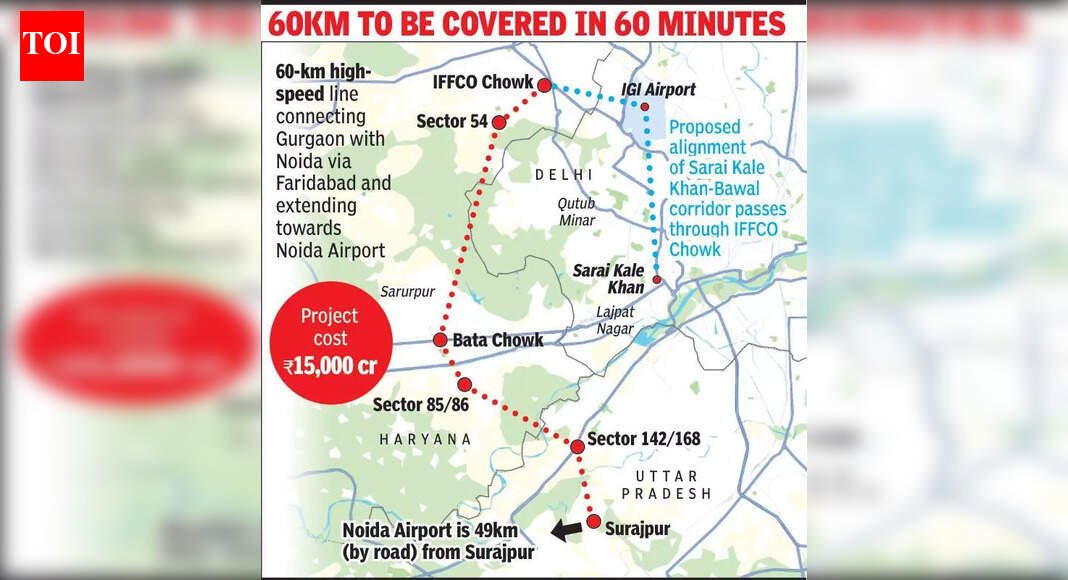
Gurgaon: NCR Transport Corporation has submitted a draft detailed project report (DPR) to Haryana govt for a rapid rail corridor between IFFCO Chowk in Gurgaon and Surajpur in Greater Noida.The proposed corridor is crucial for the connectivity blueprint the Centre is working on for a high-speed rail link between IGI airport in Delhi and the upcoming Noida International Airport in Jewar in the long term.The DPR has been submitted to Haryana govt for its feedback. According to the draft report, the corridor will pass via Sector 54, enter Faridabad at Bata Chowk and proceed through Sector 85-86 intersection towards Noida sector 142/168 before terminating at Surajpur. The route with six stations bypasses Delhi. The project is estimated to cost around Rs 15,000 crore. This will be the third RRTS corridor on the drawing board traversing Haryana. The other two projects — Delhi-Gurgaon-Manesar-Bawal and Delhi-Panipat-Karnal — have received approval from the public investment board and are awaiting final clearance from the Union Cabinet. The Delhi-Bawal corridor (93km) is projected to cost around Rs 32,000 crore, while the Delhi-Karnal corridor (136km) is estimated at Rs 33,000 crore. Both are supposed to originate at Sarai Kale Khan, which is the terminal station for the Delhi-Meerut RRTS line, which has been completed and is waiting for commissioning.The Centre and UP govt are also exploring an RRTS corridor either from Sarai Kale Khan to Jewar or from Ghaziabad to Jewar. Depending on which corridor passes the feasibility test, the others could be tweaked. The Gurgaon-Noida RRTS corridor will link up with the Delhi-Bawal corridor, which is supposed to have a station at IGI, at IFFCO Chowk. Similarly, Surajpur is a station proposed on the Ghaziabad-Jewar RRTS corridor. An RRTS ride from IFFCO Chowk to Faridabad will take just 22 minutes and to Noida only 38 minutes, transforming commute in NCR and taking major load off the Delhi transport grid.While NCRTC has planned the corridor as an elevated line, Haryana govt has suggested an underground line within Gurgaon, citing high land cost and dense urbanisation. This corridor was discussed at a meeting on Tuesday that was attended by officials of NCRTC, HSVP, FMDA, GMDA, GMRL and HMRTC, among others. Senior Haryana govt officials said building such a high-speed corridor on elevated tracks through Gurgaon, with only one or two stations in the city, would do little to serve local commuters and could permanently constrain future road and mobility upgrades. “An underground route eliminates this issue and preserves valuable surface land for future city needs,” a senior official said.An official of NCRTC said discussions are still at a preliminary stage as they have sought feedback from all stakeholders. Haryana govt has also expressed concerns that elevated RRTS tracks along arterial roads would hinder future vertical expansion of already saturated corridors. These roads are expected to require flyovers, multilevel junctions, pedestrian infrastructure, and integrated bus systems in the coming years. “An elevated viaduct will permanently limit surface-level upgrades and cause years of traffic disruption during construction,” an official said. Another issue being discussed is whether the number of stations in the city can be increased. Urban mobility planning consultant Ashok Bhattacharjee said the choice between underground and elevated systems is no longer a technological issue but one of cost, land availability, and urban context. “Technology is not a challenge. The real constraints are cost implications and right of way. Also, from a city-to-city connectivity perspective, both underground and elevated systems can serve a similar purpose. But whenever a mass transit corridor is planned, it must have multiple stations to capture where people actually live and work,” Bhattacharjee said. He also cautioned that limited stations would fail to shift commuters away from private vehicles. “A large working population in Gurgaon will only move to public transport if stations are easily accessible. A station serving a sparse catchment within a 3-5 km radius will not attract riders. The focus should not be on merely running a system, but on serving people,” he added.


Source link

Top 5 best steal deals from IPL 2026 Auctions ft. David Miller and Prithvi Shaw


IPL 2026 Auction in Abu Dhabi on December 16 delivered high drama, with teams spending ₹215.45 crore on 77 players across intense bidding wars. Kolkata Knight Riders dominated headlines by breaking records, while franchises like Delhi Capitals and Mumbai Indians smartly targeted value picks amid a purse-conscious market.​

Cameron Green emerges as the most expensive buy from IPL 2026 Auction

Cameron Green shattered records as the priciest overseas player ever, joining KKR for ₹25.20 crore after a fierce battle with CSK, who bid up to ₹25 crore. Sri Lanka‘s Matheesha Pathirana followed at ₹18 crore to KKR, underlining their aggressive overseas strategy despite LSG’s interest. CSK stunned with uncapped Indians Prashant Veer and Kartik Sharma at ₹14.20 crore each, tying the highest for uncapped buys and signaling faith in domestic talent. Other big spends included Liam Livingstone (SRH, ₹13 crore), Mustafizur Rahman (KKR, ₹9.20 crore), and Josh Inglis (LSG, ₹8.60 crore), pushing total spends sky-high while highlighting all-rounder demand.

Also READ: IPL 2026 Auction: Salary of Royal Challengers Bengaluru (RCB) players; check out how much Virat Kohli and Venkatesh Iyer earn

Top 5 best steal deals from IPL 2026 Auction

  1. David Miller (Delhi Capitals, ₹2 crore) 
(Image source: X)

South Africa’s finishing powerhouse landed at his base price with no competing bids, a massive coup for DC after LSG released him post-2025. David Miller brings 3,077 IPL runs at a 138.60 strike rate from 141 matches, including a century and 13 fifties, plus Gujarat Titans glory. At 36, his death-over expertise (average 35.77) bolsters DC’s lower order at bargain value.​

  1. Akeal Hosein (Chennai Super Kings, ₹2 crore)
Top 5 steal deal Akeal Hosein
(Image source: X)

CSK’s first buy was the West Indies left-arm spinner Akeal Hosein at base price, ideal for spin-friendly Chepauk after his lone SRH outing last season. Hosein’s accuracy thrives in T20 leagues like PSL and BBL, offering control and variety to CSK’s attack. This steal enhances their spin depth without auction frenzy.​

  1. Quinton de Kock (Mumbai Indians, ₹1 crore)
Top 5 steal deal Quinton de Kock
(Image source: X)

MI used half their ₹2.75 crore purse to reclaim the explosive opener at base price, despite his lean 2025 KKR stint (152 runs in 8 games). Quinton de Kock‘s IPL legacy shines with over 3,300 runs, two centuries, and starring roles in MI’s 2019-2020 titles. His powerplay aggression and keeping skills add left-hand balance to a tight budget.​

  1. Prithvi Shaw (Delhi Capitals, ₹75 lakh)
Top 5 steal deal Prithvi Shaw
(Image source: X)

After going unsold twice and missing IPL 2025 entirely, DC recalled the dasher in the third round at base price. Prithvi Shaw‘s 1,892 IPL runs at 147.46 strike rate highlight his explosive opening potential, despite recent domestic resurgence. DC regains a high-risk, high-reward top-order talent cheaply.​

  1. Wanindu Hasaranga (Lucknow Super Giants, ₹2 crore) 
Top 5 steal deal Wanindu Hasaranga
(Image source: X)

The Sri Lankan leg-spin all-rounder went unsold initially before LSG snapped him at base price, rebuilding spin after releasing Ravi Bishnoi. Wanindu Hasaranga boasts 332 T20 wickets at 17.46 economy, with a 142.53 batting strike rate, making him a dual-threat post-Rajasthan Royals release. LSG gains a proven T20 specialist from global leagues for middle-order stability and wickets.​

These steals contrast mega-buys, proving smart auctioning wins in IPL’s escalating market. Franchises prioritized experience and upside over hype, setting up intriguing 2026 battles in the cash rich league.

Also READ: IPL 2026 Auction: Full list of unsold players along with their base price


Source link

Gold price today: How much gold costs today in Delhi, Mumbai & other cities; check rates for 22K and 24K gold


Gold price today: How much gold costs today in Delhi, Mumbai & other cities; check rates for 22K and 24K gold

Gold prices began the day on a softer note on the Multi Commodity Exchange (MCX), with the yellow metal opening at Rs 1,34,027 per 10 grams, a decline of Rs 494 or 0.37%. Despite the dip, gold has managed to stay above the key Rs 1.34 lakh level, a zone closely watched by market participants amid shifting global signals.Spot gold slipped 0.3% to $4,319.07 an ounce on Friday, while US gold futures fell 0.4% to $4,346.70. Silver prices also retreated, with spot silver down 1% at $64.79 an ounce, easing after scaling a record high of $66.88 earlier this week.Here’s how much gold costs in your city today:

Gold rate in Delhi today

In the national capital, 22K gold is priced at Rs 12,315 per gram, while 24K gold is selling at Rs 13,433 per gram.

Gold rate in Mumbai today

Mumbai is seeing 22K gold at Rs 12,300 per gram, and 24K gold available at Rs 13,418 per gram.

Gold rate in Bengaluru today

Bengaluru markets list 22K gold at Rs 12,300 per gram, whereas 24K gold is priced at Rs 13,418 per gram.

Gold rate in Chennai today

Chennai recorded 22K gold at Rs 12,380 per gram and 24K gold at Rs 13,506 per gram.

Gold rate in Kolkata today

In Kolkata, 22K gold is being sold at Rs 12,300 per gram, while 24K gold is available at Rs 13,418 per gram.

Gold rate in Hyderabad today

In Hyderabad, 22K gold is priced at Rs 12,300 per gram, and 24K gold at Rs 13,418 per gram.

Gold rate in Ahmedabad today

Ahmedabad buyers are paying Rs 12,305 per gram for 22K gold and Rs 13,423 per gram for 24K gold.

Gold rate in Jaipur today

Jaipur has 22K gold priced at Rs 12,315 per gram, and 24K gold at Rs 13,433 per gram.

Gold rate in Bhubaneswar today

In Bhubaneswar, 22K gold stands at Rs 12,300 per gram, while 24K gold is priced at Rs 13,418 per gram.

Gold rate in Kanpur today

In Kanpur 22K gold was sold at Rs 12,315 per gram, with 24K gold selling for Rs 13,433 per gram.


Source link

Mumbai’s costliest push yet to clean the Mithi river: Will deep tunnels finally turn the tide? | Mumbai News


Mumbai’s costliest push yet to clean the Mithi

Mumbai’s latest attempt to revive the long-polluted Mithi river is also its most ambitious and expensive so far. Anchored by a 6.6-km underground diversion tunnel and a sweeping overhaul of the river’s tidal stretch, the new plan seeks to intercept nearly 60% of the sewage currently choking the river. Together, the two projects involve an investment of over Rs 2,000 crore, adding to more than Rs 2,200 crore already spent over the past two decades on earlier clean-up efforts.If executed on schedule — and supported by strict controls on dumping, encroachment and untreated effluents — officials believe the projects could significantly reduce pollution and ease flooding in some of the city’s most vulnerable areas.

-

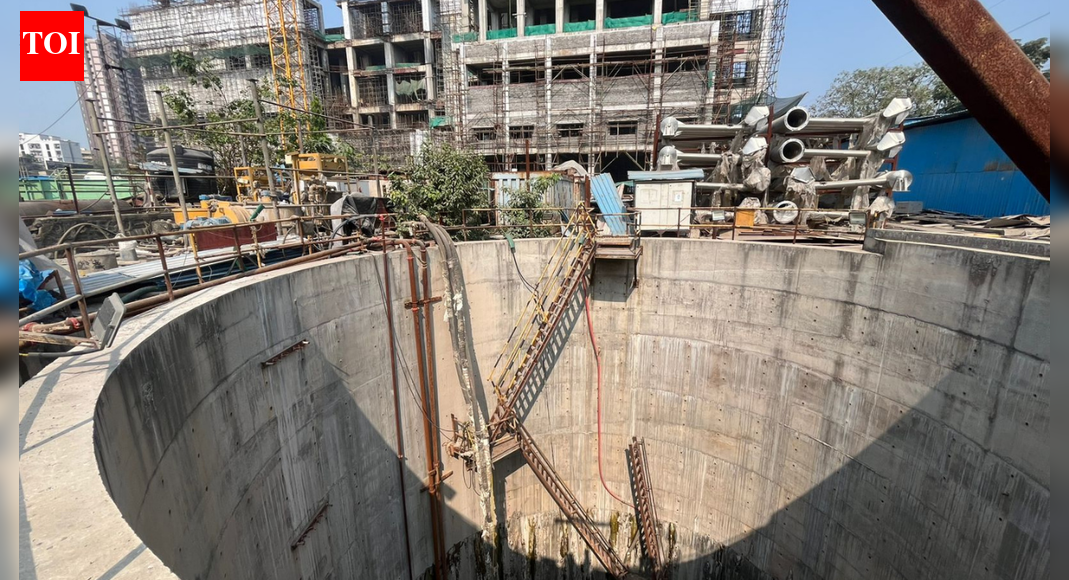
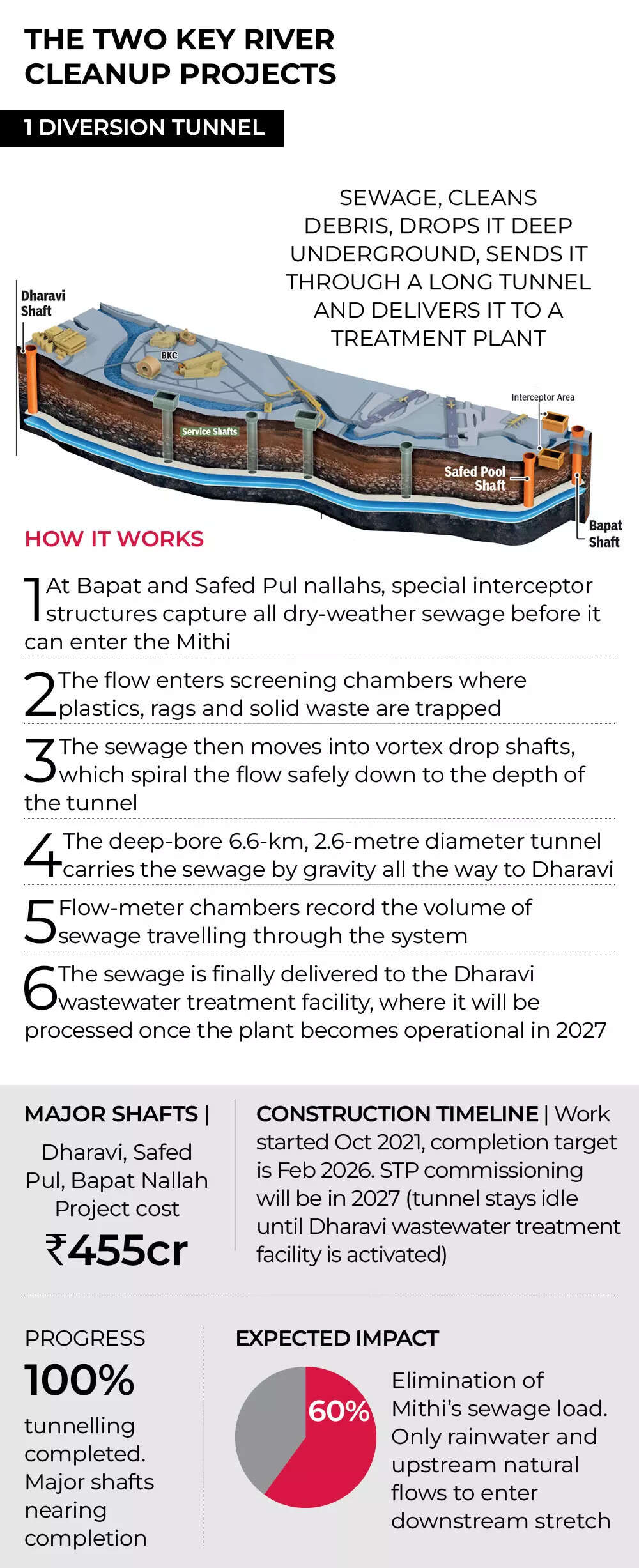
Critics, however, caution that engineering solutions alone cannot restore a river whose degradation is rooted in decades of unregulated urban activity.The two key river cleanup projects1. Diversion tunnel: Taking sewage deep undergroundAt the heart of the clean-up strategy is a massive diversion tunnel designed to intercept dry-weather sewage before it enters the Mithi.Special interceptor structures have been built at the Bapat Nallah and Safed Pul Nallah, two of the river’s biggest sewage carriers. These capture all dry-weather sewage and channel it into screening chambers, where plastics, rags and other solid waste are removed. The flow then descends through vortex drop shafts — spiral structures that safely carry sewage deep underground — before entering the main tunnel.The 6.6-km-long tunnel, with a diameter of 2.6 metres, carries sewage by gravity all the way to Dharavi, where it will eventually be treated at a new wastewater treatment facility. Flow-meter chambers along the route measure the volume of sewage transported through the system.

-

In effect, the system traps sewage, removes debris, drops it far below ground level, transports it across the city and delivers it to a treatment plant — a process officials say will transform the river’s downstream water quality.Key details

  • Major shafts: Dharavi, Safed Pul, Bapat Nallah
  • Project cost: Rs 455 crore
  • Construction start: October 2021
  • Completion target: February 2026
  • STP commissioning: 2027 (the tunnel will remain idle until the Dharavi plant becomes operational)

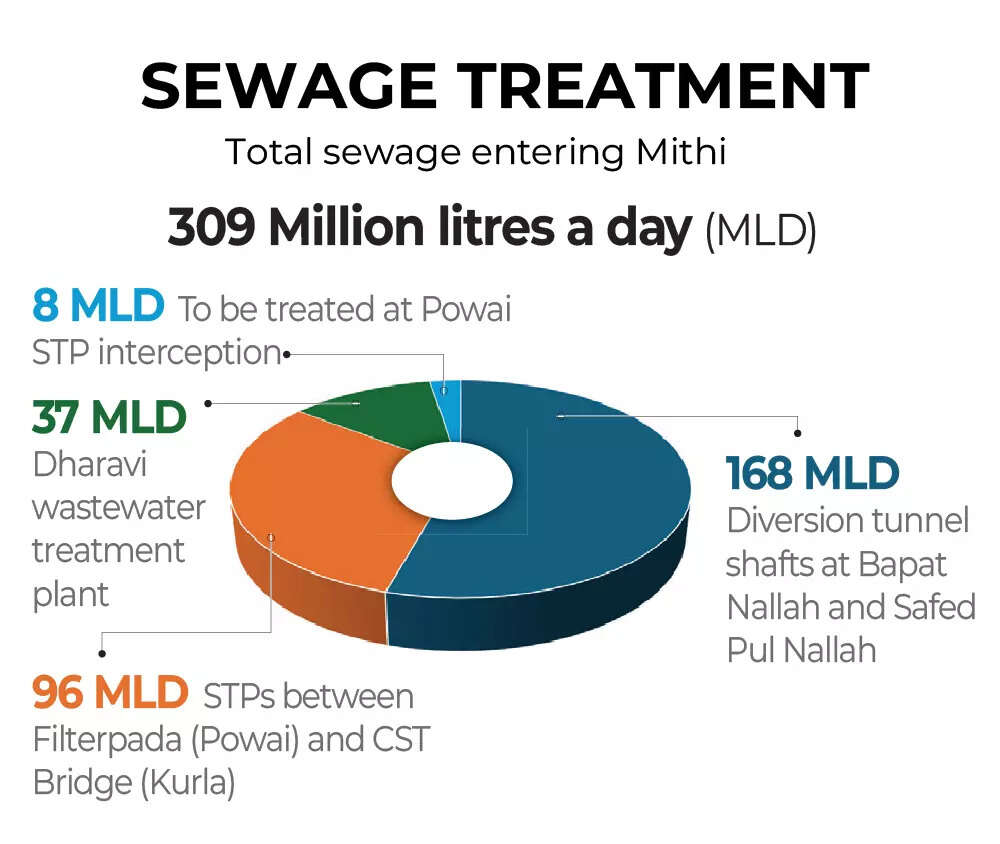
Tunnelling work is already complete, and the main shafts are nearing readiness.Once operational, the diversion tunnel is expected to eliminate about 60% of the Mithi’s sewage load, allowing only rainwater and natural upstream flows to reach the downstream stretch.Officials say around 168 million litres a day (MLD) of sewage — more than half the river’s estimated total load of 309 MLD — will be diverted away from the river.

-

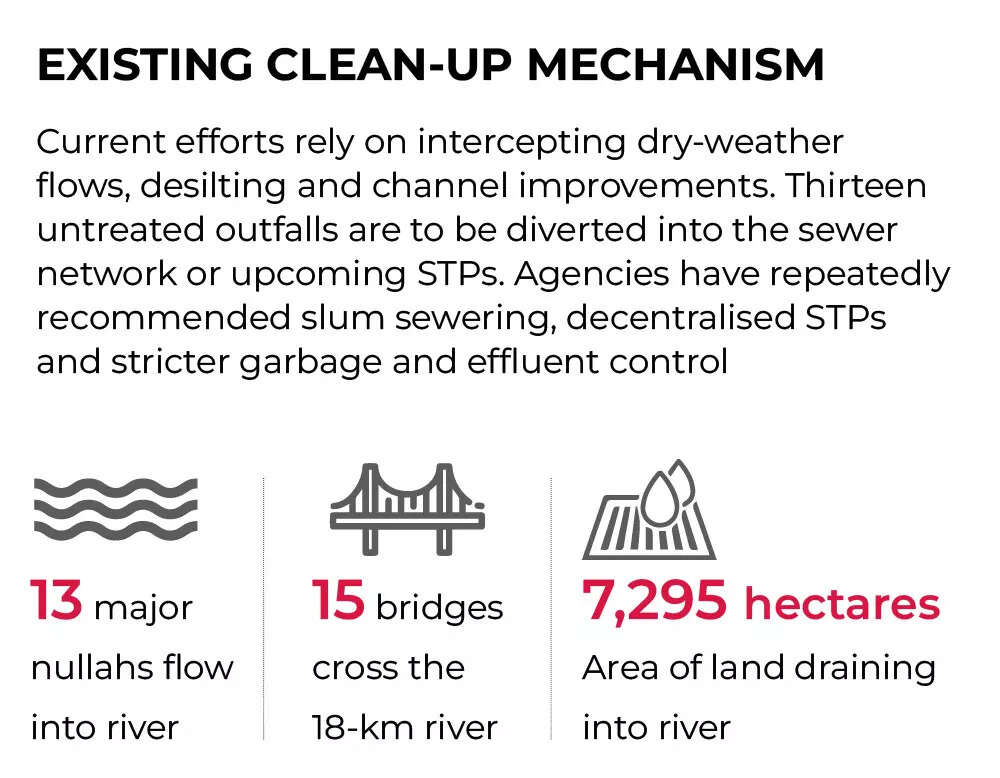
Why the tunnel’s impact depends on DharaviMunicipal officials acknowledge that the tunnel’s benefits will only materialise once the Dharavi wastewater treatment plant is commissioned.“The river’s black, foul water today is because untreated sewage continues to flow directly into it,” said an official overseeing storm-water drainage works. “While tunnelling and shaft construction are advancing, the full impact will be visible only after the Dharavi plant comes online, likely by mid-2027.”The tunnel itself has a carrying capacity of about 440 MLD, providing some buffer for future flows.Existing clean-up efforts — and their limitsSo far, Mithi clean-up measures have largely relied on intercepting dry-weather flows, desilting the riverbed and improving channel geometry. Thirteen untreated outfalls are slated for diversion into sewer networks or upcoming treatment plants, while agencies have repeatedly flagged the need for slum sewering, decentralised treatment systems and stricter garbage control.Key facts underline the scale of the challenge:

  • 13 major nullahs drain into the river
  • 15 bridges cross the 18-km-long Mithi
  • 7,295 hectares of land drain into its catchment

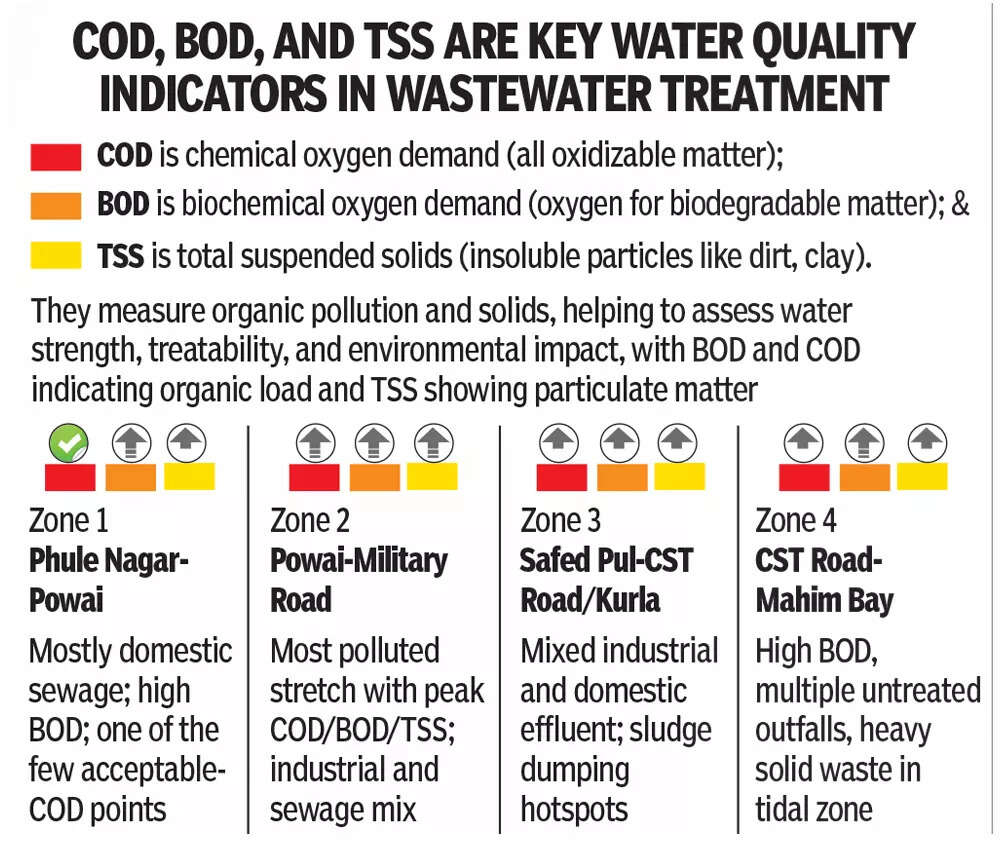
Where the river begins — and endsThe Mithi originates inside the restricted zone of Vihar Lake, where overflow water directly forms the river. Powai Lake contributes additional flow further downstream.The river ends at the Mahim Causeway, where it meets the Arabian Sea. This lower, tidal stretch is heavily littered and tide-driven but plays a critical role in draining the city during the monsoon.Where the pollution comes fromPollution enters the river through multiple pathways. Domestic sewage and industrial effluents flow in via 13 major nullahs and dense slum belts lining the banks. Workshops, unauthorised units and scrap yards discharge untreated waste, while plastic, solid waste and construction debris are routinely dumped into the channel. Encroachments, particularly in the BKC stretch, choke flow and trap pollutants.The river carries untreated sewage, industrial waste, plastics, debris and hazardous sludge. Levels of biochemical oxygen demand (BOD) and chemical oxygen demand (COD) routinely exceed permissible limits, while dissolved oxygen often falls below 4 mg/l during dry months — effectively turning parts of the river into an open drain.Measuring pollution: COD, BOD and TSSWater quality along the Mithi is assessed using three key indicators:

  • COD: chemical oxygen demand, measuring all oxidisable matter
  • BOD: biochemical oxygen demand, indicating biodegradable pollution
  • TSS: total suspended solids such as silt and clay

These parameters help gauge organic pollution, treatability and ecological impact.

-

Monitoring shows sharp contrasts along the river:

  • Powai stretch: mostly domestic sewage, high BOD but relatively acceptable COD
  • Powai–Military Road: the most polluted segment, with peak COD, BOD and TSS
  • Safed Pul–Kurla: mixed industrial and domestic effluent, sludge dumping
  • Kurla–Mahim Bay: high BOD, multiple untreated outfalls and heavy solid waste in the tidal zone

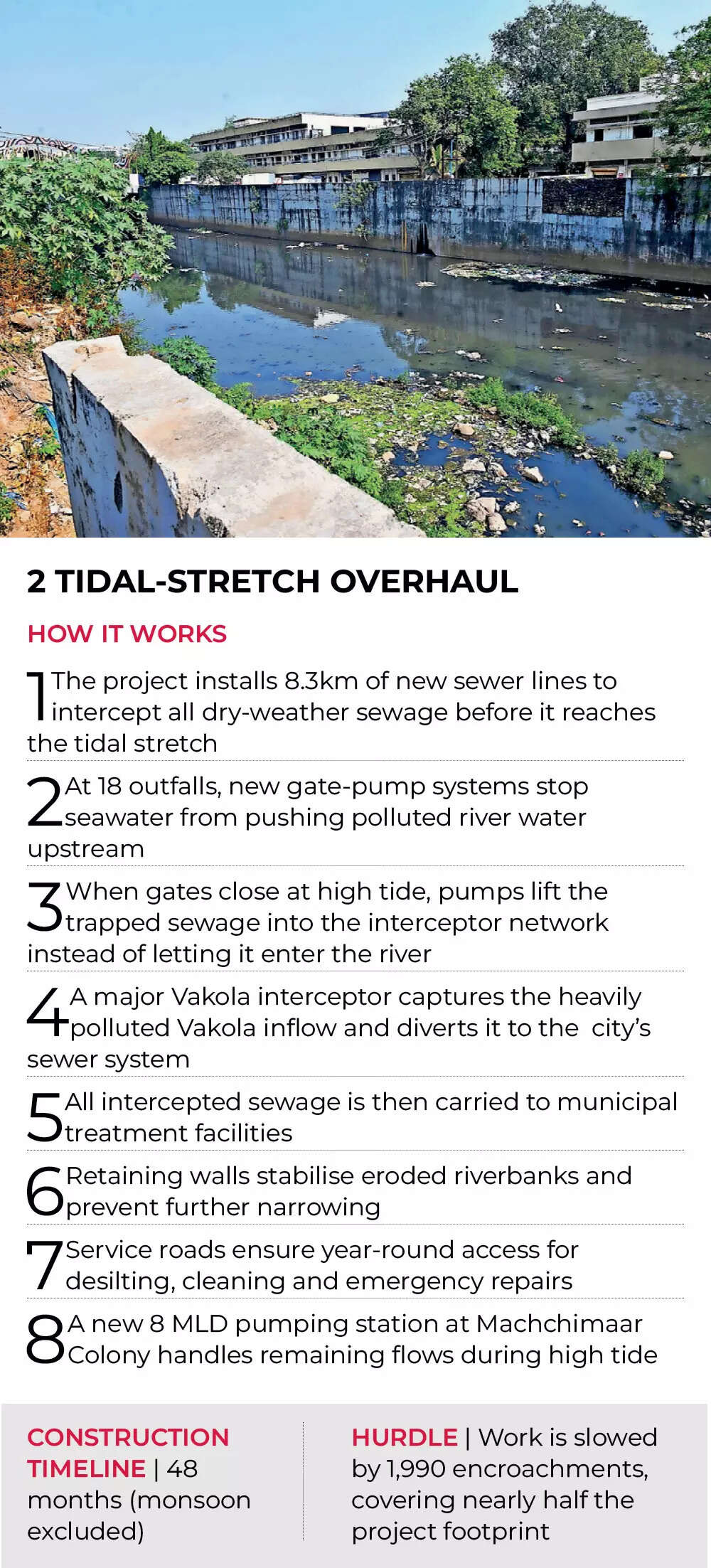
2. Tidal-stretch overhaul: Tackling the hardest sectionThe second and costlier leg of the clean-up targets the heavily encroached, tide-affected stretch from CST Bridge at Kurla to Mahim Causeway, including the Vakola river.This Rs 1,700-crore project involves installing interceptor systems at four major Vakola nullahs to capture dry-weather sewage, which will then be sent to municipal treatment plants. At 18 outfalls, new gate-and-pump systems will prevent seawater from pushing polluted river water upstream during high tide. Retaining walls will stabilise eroded banks, while service roads will allow year-round desilting and maintenance. An 8-MLD pumping station at Machchimaar Colony will manage residual flows.The construction timeline is estimated at 48 months, excluding monsoons.Encroachments: The biggest hurdleThe tidal-stretch project faces major land constraints. Nearly 1,900 encroachments — covering almost half the project footprint — have been identified across key locations, complicating wall construction, service-road formation and pipe-laying.Officials say visible improvement in water quality will depend on completing this phase and ensuring that all intercepted sewage is actually treated.

-

Two decades, Rs 2,200 crore — and countingMumbai has spent 20 years working on the Mithi through four major packages, at a cost exceeding Rs 2,200 crore. The latest round alone adds another Rs 2,000 crore to that tally.The question now is whether this push will finally deliver durable change — or repeat the cycle of heavy spending and limited results.Experts urge cautionEnvironmental experts broadly welcome the scale of sewage interception but warn against viewing mega-projects as silver bullets.They point out that pollution extends well beyond sewage to unmanaged solid waste, plastic, sludge and industrial effluents. Unless these inputs are stopped at the neighbourhood level, they argue, engineering solutions will only offer temporary relief.Others caution that large-scale interception could leave long stretches of the river dry outside the monsoon, altering its ecology unless treated water is returned in a controlled manner. Reliable, round-the-clock operation of pumps, gates and treatment plants will be critical.“The city has shown it can build complex infrastructure,” said one expert. “The real test is whether it can enforce discipline along the river’s banks and restore ecological balance — not just move pollution from one place to another.”After two decades and thousands of crores, Mumbai is once again betting big on the Mithi. Whether this time the river truly recovers will depend not just on tunnels and pumps, but on governance, enforcement and long-term ecological thinking.


Source link