Breaking News
Stock market today: Nifty50 opens in green; BSE Sensex up around 350 points


Stock market today: Nifty50 opens in green; BSE Sensex up around 350 points
Analysts suggest that the market’s short-term trend remains volatile with a weak bias. (AI image)

Stock market today: Indian equity benchmark indices, Nifty50 and BSE Sensex, opened in green on Friday on positive global cues. While Nifty50 went above 25,900, BSE Sensex was up around 350 points. At 9:16 AM, Nifty50 was trading at 25,913.10, up 98 points or 0.38%. BSE Sensex was at 84,830.34, up 349 points or 0.41%.After experiencing weakness, the Nifty index appeared to stabilize with a slight downward trend on Thursday. Analysts suggest that the market’s short-term trend remains volatile with a weak bias.Dr. VK Vijayakumar, Chief Investment Strategist, Geojit Investments Limited says, “FIIs stopping selling during the last two days, though positive from the market perspective, doesn’t indicate a directional change in the market. A lot will depend on the Bank of Japan’s rate decision today. It is almost certain that BoJ will raise rates by 25bp and, therefore, such a decision is unlikely to impact the market. What the market is looking for is commentary from the Japanese central bank regarding future rate action in the context of inflation in Japan. If the BoJ chief sends a hawkish message indicating more rate hikes, that would impact the market since the market will fear further unwinding of the yen carry trade, triggering more FII outflows from markets like India. Therefore, watch out for the BoJ commentary.” “Meanwhile, cooling inflation in the US ( November core inflation has come at 2.6%, lower than the estimate of 3%) is imparting resilience to the US economy and markets. This augurs well for global equity markets as 2025 draws to a close.”Asian stocks rose on Friday following a report of cooling US inflation, which bolstered the case for potential interest rate cuts by the US Federal Reserve. This, along with easing concerns in the tech sector, supported gains in US stocks.On Wall Street, the main indexes ended higher on Thursday. A soft inflation report fueled expectations for Federal Reserve interest rate cuts, while a strong forecast from chipmaker Micron indicated robust demand for AI technology.The Consumer Price Index showed that consumer prices rose less than anticipated over the year to November. The Labor Department’s Bureau of Labor Statistics did not release month-to-month CPI changes due to the 43-day government shutdown, which disrupted the collection of October data.On Thursday, foreign portfolio investors purchased shares worth Rs 596 crore. Domestic institutional investors were also net buyers, acquiring shares worth Rs 2,700 crore.(Disclaimer: Recommendations and views on the stock market, other asset classes or personal finance management tips given by experts are their own. These opinions do not represent the views of The Times of India)


Source link

Mumbai’s Mithi river revival: Experts warn engineering push alone won’t end decades of sewage and pollution | Mumbai News


Ecologists warn of gaps as Mithi engineering push ramps up

MUMBAI: Even as municipal authorities invest thousands of crores to revive the long-polluted Mithi river, the core question continues to be whether these projects finally stop the sewage, flooding and stink that have defined the river for decades. Experts say that while the current works are substantial, smaller localised measures, such as basic screens at outfalls, could also have delivered meaningful improvements.Rakesh Kumar, former director of NEERI and head of the Supreme Court-appointed expert committee on Mithi, welcomed the scale of the sewage-diversion push but warned that “interception, diversion and treatment” projects “are highly complex and rarely silver bullets and take long time to complete”. He said, “Capturing sewage at the source is always more effective than trying to reroute it kilometres away,” echoing IIT-B’s recommendation that treatment and reuse at source could help keep the river perennial. He noted that the 2018 committee report had also suggested multiple nature-based solutions.Kumar said pollution extends far beyond sewage. “A large share of the river’s degradation comes from unmanaged municipal solid waste, plastic, sludge, industrial effluent and debris. Unless these inputs are stopped at the neighbourhood level, engineering solutions alone will not deliver a clean river.” Large tunnelling projects, he said, carry uncertainties: “There’s no guarantee a diversion tunnel of this scale will deliver 100% results. We have seen multiple rejuvenation attempts over the past two decades — channelisation, widening, desilting, flood-mitigation works — yet the core problem persists.”AD Sawant, civil society member of the expert committee and former pro-VC of Mumbai University, said the contrast remains stark between Mumbai’s engineering feats and its inability to clean a 17km river. “We’ve built Coastal Road, an underground metro line, deep tunnels – all projects of enormous complexity. Yet Mithi remains foul. A large portion of Mithi’s pollution is human-driven. If we truly want a cleaner river, the bay must remain a strict no-development zone.Architect PK Das, who too was on the committee as a civil society member, said restoring the river’s ecology is essential. “The river has been reduced to an impervious RCC-lined channel… destroying the symbiotic relationships in nature,” he said. “Instead of attending to ecological restoration, the focus by the authorities has been only on large engineering budgets. But technology alone cannot save the river; unless we revive its ecology, nothing will change. Global best practices now favour breaking concrete embankments and creating eco-sensitive riverfronts.”Rishi Agarwal, co-founder of Mithi Sansad, warned that large-scale sewage interception could leave the river bone-dry for most of the year. “Once the dry-weather flow is trapped, vast stretches of the river will run dry outside the monsoon.” The real challenge, he said, will be reliable operations: “Unless they are run optimally, 24×7, we won’t see real change on the ground.”


Source link

‘Felt quite bad because I was doing well’: Ishan Kishan breaks silence on prolonged Team India snub | Cricket News


'Felt quite bad because I was doing well': Ishan Kishan breaks silence on prolonged Team India snub
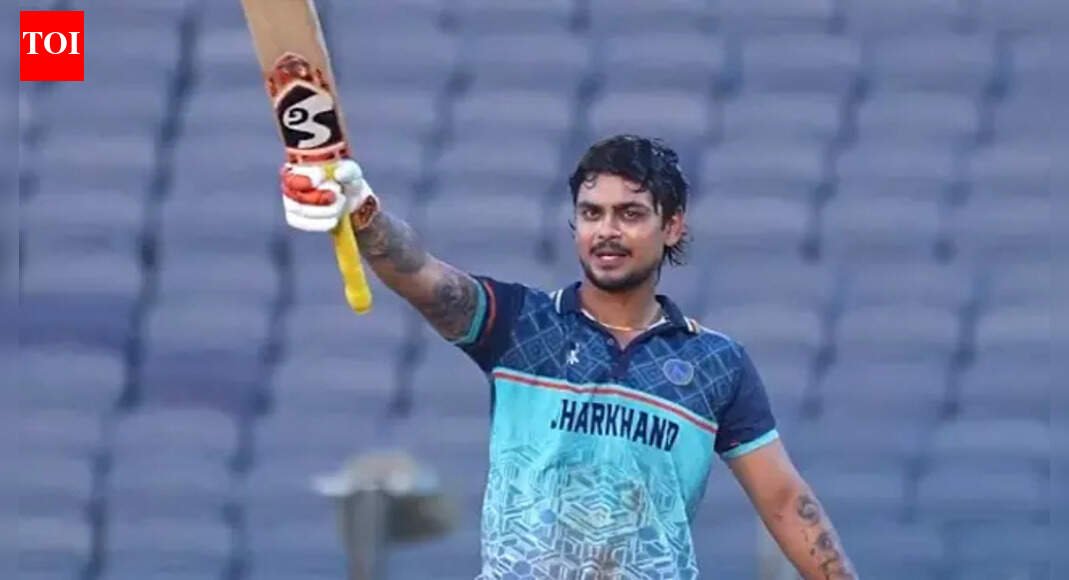
Ishan Kishan (Pic credit: BCCI)

NEW DELHI: Out-of-favour India wicketkeeper-batter Ishan Kishan delivered a statement performance in the Syed Mushtaq Ali Trophy final on Thursday, smashing a breathtaking 101 off just 49 balls to lead Jharkhand to their maiden title and finally breaking his silence on his prolonged absence from Team India.Go Beyond The Boundary with our YouTube channel. SUBSCRIBE NOW!Kishan, captaining Jharkhand, led from the front on a day to remember as his side posted a daunting 262 for 3 against Haryana before sealing a commanding 69-run victory. It marked a fitting end to a sensational tournament for the 27-year-old, who finished as the leading run-scorer with 517 runs from 10 innings at a staggering strike rate of 197.32.

Shashi Tharoor vs Rajeev Shukla breaks out on India match in Lucknow

Having been sidelined from the national team since 2023 following disciplinary issues under then head coach Rahul Dravid and chief selector Ajit Agarkar, Kishan admitted the phase had been mentally challenging.“When I was not selected in the Indian team, I felt quite bad because I was doing well,” Kishan was quoted as saying by Sportstar. “But I told myself that if I am not selected with this sort of performance, then maybe I have to do more. Maybe I have to make my team win. Maybe we have to do well as a unit.”

Poll

Do you believe Ishan Kishan should be recalled to the national team for the T20 World Cup?

The left-hander emphasised the importance of handling frustration during setbacks. “It’s important that you don’t allow the frustration to get to you. This is my message to all the youngsters — frustration is something that will take you one step down. You need to put in a lot of hard work, believe in yourself and focus on what you need to achieve,” he said.Despite his red-hot form, Kishan is unlikely to be recalled for the upcoming T20 World Cup. However, he insisted he is no longer weighed down by expectations. “I know you fancy your chances a lot of times. And when you don’t see your name, you just feel bad about it. So, I’m not in that zone anymore. I’m not expecting anything,” he said with a smile. “But my job is to just keep performing.”In the final, Kishan tore into the Haryana bowling attack, hammering 10 sixes and eight fours, and bringing up his second century of the tournament with a stylish one-handed six over extra cover. He shared a decisive 177-run second-wicket stand with Kumar Kushagra, who struck a rapid 81 off 38 balls.Jharkhand bowlers, led by Anukul Roy, then dismantled Haryana’s chase, bowling them out for 193 despite a fighting fifty from Yashvardhan Dalal.For Kishan, the title triumph stands tall among his career highlights. “It is definitely the happiest moment because we have never won a domestic tournament under my captaincy,” he said. “Now, I have more trust in myself, more belief in my batting.”


Source link

China to get Nvidia H200 chips! Trump admin begins licensing process for exports — Why are officials not happy?


China to get Nvidia H200 chips! Trump admin begins licensing process for exports — Why are officials not happy?

China could receive the first shipments of Nvidia’s second-most powerful AI chips, signalling a shift in America’s long-standing restrictions on exports to Beijing.The US government has began a formal licensing process that could pave the way for chip gaint’s Beijing entry, Reuters reported, citing five people familiar with the matter. This comes after US President Donald Trump recently committed to permit sales. Earlier this month, Trump said that his administration would allow Nvidia to sell its H200 chips to China, with the US collecting a 25% fee on the transactions. Explaining the rational behind the permission, he said that exporting American chips would help US companies retain an edge over Chinese chipmakers by reducing the appetite for dragon’s chips.However, despite the announcement, uncertainty still surrounds the pace of approvals and whether Chinese authorities would permit local firms to purchase the chips. The move has also drawn sharp criticism from China hawks across the US political spectrum, who argue that the technology could enhance Beijing’s military capabilities and weaken the US lead in artificial intelligence, Reuters reported. According to the sources, the commerce department has forwarded licence applications related to the proposed chip exports to the state, energy and defense departments as part of a mandatory inter-agency review. Under US export regulations, the departments have 30 days to submit their assessments. One administration official stressed that the process would be comprehensive, saying it was “not some perfunctory box we are checking.” However, the regulations, the final green signal still remains with the president.While the White House declined to comment directly on the review, a spokesperson said “the Trump administration is committed to ensuring the dominance of the American tech stack – without compromising on national security.” The potential policy is a transition from the approach taken under former president Joe Biden, whose administration imposed extensive restrictions on exports of advanced AI chips to China and other countries it saw as possible transit points for smuggling, citing national security concerns. It also contrasts sharply with Trump’s stance during his first term, when he moved aggressively to restrict China’s access to US technology. At the time, Trump pointed to allegations that China steals American intellectual property and uses commercially obtained technology to strengthen its military, accusations that Beijing has denied.

‘A mistake’ — Why officials are not happy?

Former national security officals have firmly opposed the move saying that large chip outflows to China would be ‘a significant strategic mistake,’” said Chris McGuire, who served on the White House National Security Council under President Joe Biden and is now a senior fellow at the Council on Foreign Relations. He told Reuters that the chips are “the one thing holding China back in AI.” “I cannot possibly fathom how the departments of Commerce, State, Energy, and Defense could certify that exporting these chips to China is in the U.S. national security interest,” he added. Officials backing the policy within the Trump administration argue the exports could have the opposite effect. Led by White House AI czar David Sacks, they say selling advanced chips to China would discourage domestic firms such as Huawei from intensifying efforts to close the gap with Nvidia and AMD’s most advanced designs. Reuters reported last week that Nvidia is considering ramping up production of the H200 chips, which sit just below its flagship Blackwell processors, after initial orders from China exceeded existing manufacturing capacity. Although the H200 is slower than the Blackwell chips across many AI applications, it remains widely used and has never previously been approved for sale in China. Trump had earlier indicated that he was open to allowing exports of a less advanced version of Nvidia’s Blackwell chips, but later reversed that position and moved instead to approve potential sales of the H200.


Source link

Bijli, paani, sadak and now a broken bridge: Parel has had enough, thinks of BMC poll boycott | Mumbai News


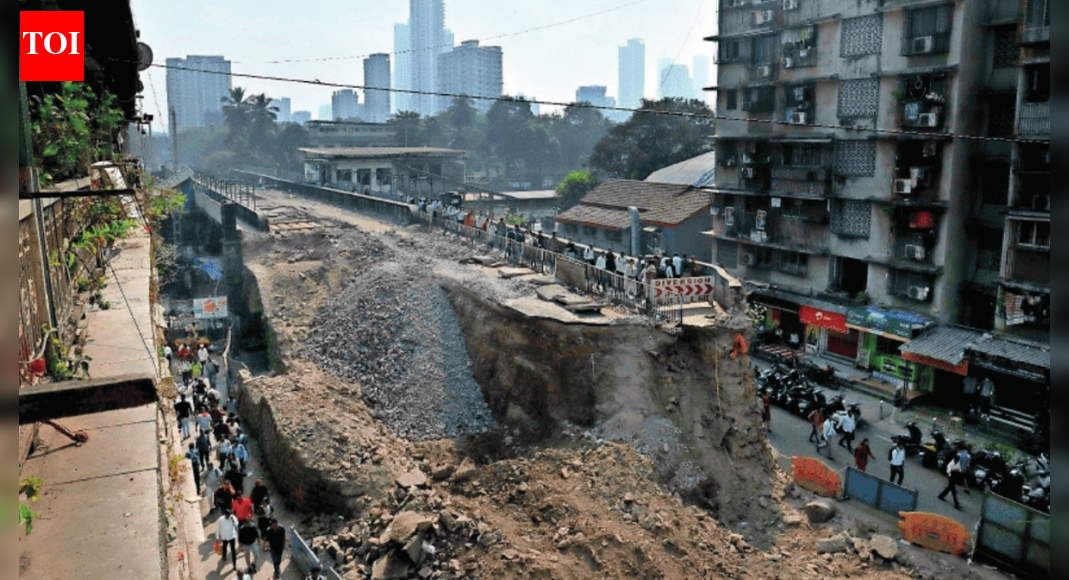
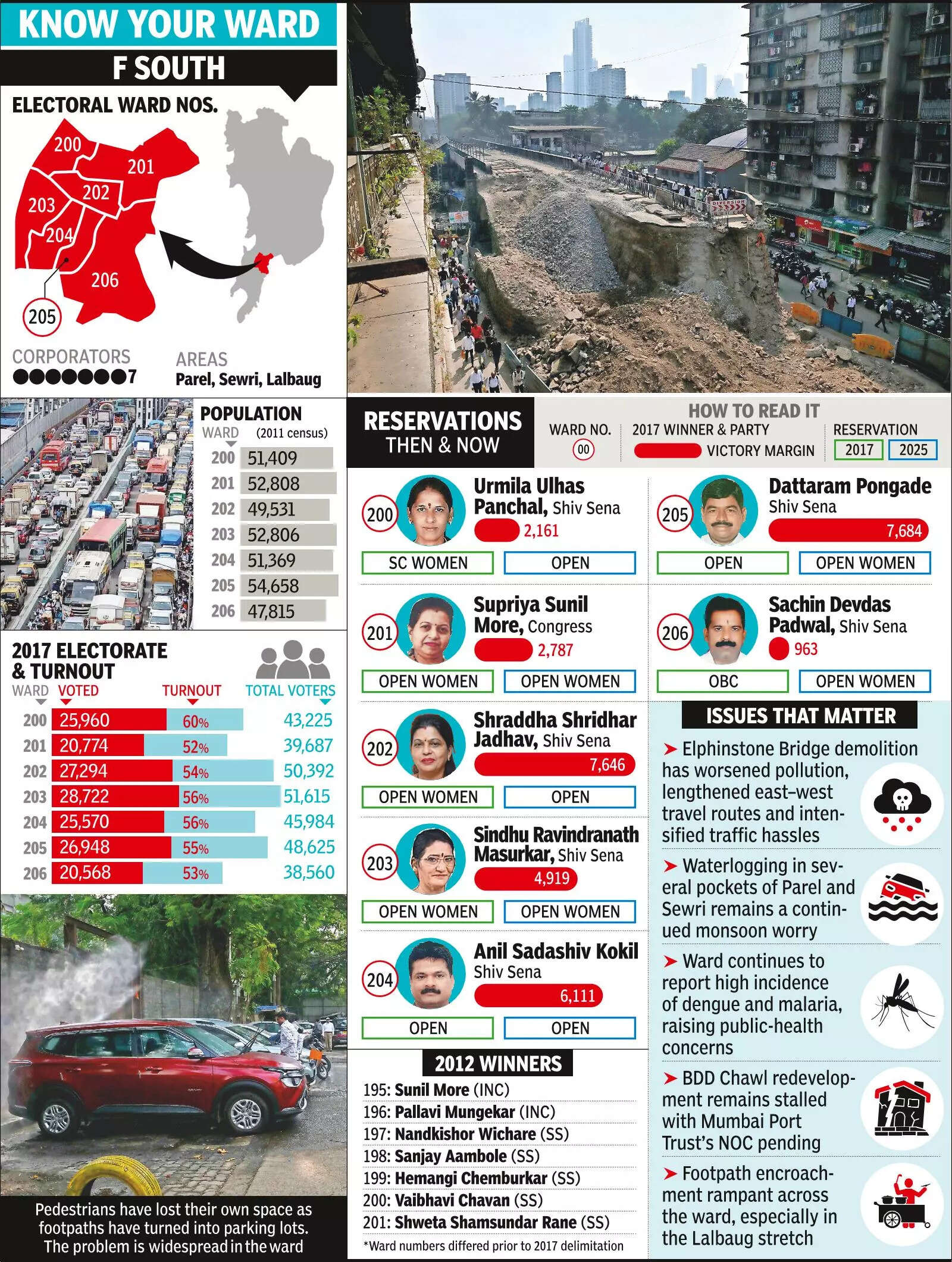
MUMBAI: Anchored by its working-class mill belt and Marathi strongholds like Parel, Lalbaug, Sewri and parts of Dadar, the F South ward now finds its long-promised redevelopment and chronic waterlogging issues colliding with the fallout of the Elphinstone Bridge demolition and a surge in construction activity that has brought fresh traffic jams and pollution.The ward has long been considered a stronghold of Shiv Sena, and six of its seven former corporators remain aligned with Shiv Sena (UBT). The sole Congress corporator from electoral ward No. 201, Supriya Sunil More, has since joined Shiv Sena (Eknath Shinde’s party). Her husband, Sunil More, is also expected to enter the race, likely contesting from No. 200, a seat that became open after being reserved for Scheduled Castewomen in the 2017 polls.This could mark the return of the bow-and-arrow symbol to the fray; it was absent in the area during the last assembly election, when Shinde’s Sena did not field a candidate and the contest became a straight fight between MNS leader Bala Nandgaonkar and UBT’s Ajay Chaudhari, who ultimately won the seat. A portion of the ward also falls under the Wadala assembly constituency, the stronghold of BJP MLA Kalidas Kolambkar.

Bijli, paani, sadak and now a broken bridge: Parel has had enough, thinks of poll boycott

Sriram Pawar, a shopkeeper and resident activist from Samarth Niwas under No. 200 — one of the 25 buildings impacted by the Elphinstone Bridge demolition — said, “We are unable to breathe properly because the demolition has led to more pollution. Our buildings are now at risk because the drilling vibrations are affecting these old structures.”He said residents of thesebuildings, some of which fall in G South ward, may boycott the BMC polls altogether. “We will start a campaign calling for a boycott. The area is under MLA Kolambkar, who has held the seat for a long time. If he is unable to help us, what will corporators do?” An unintended consequence of the bridge demolition is that traffic has eased around the F South ward office, but the brunt of this is being felt by locals toward Currey Road. “Schoolchildren and the elderly can’t even cross the road without fearing for their lives anymore because all the vehicles now use this side to move between east and west,” said Krushnakumar Nagvekar, a long-time resident of Ramdhoot Building under Mhada at Currey Road under No. 203, whose redevelopment has been stalled for the past few years. He said that a surge in new high-rises in the area has led to water shortages and placed additional strain on the electricity network, resulting in frequent power cuts. Similar issues were reported toward Sewri as well.Former corporator Anil Kokil (No. 204) said that roughly eight high-rises have been built in his locality in recent years, even as essential resources have remained unchanged. “If 100 litres of water were once shared among 100 people, that same quantity is now expected to serve 1,000,” he said.Another issue in his ward, he said, concerns Sai Baba Path municipal school, which has remained shut since 2020, when it was turned into a Covid treatment centre. It was demolished last year after an oxygen cylinder stored there exploded. “Parents of the students who studied there want the school back,” Kokil said.Prasad Pradhan, a civic activist from Ashok Garden, Sewri, said, “Many spots on GD Ambekar Road have been taken over by carwash centres and garages. Footpaths have been encroached upon and there is unauthorised parking of heavy vehicles like trucks on Jivraj Road. It could be a major issue if the fire brigade needs to enter.”


Source link

The making of Jeffrey Epstein: How a Brooklyn math teacher turned access into fortune


The making of Jeffrey Epstein: How a Brooklyn math teacher turned access into fortune
Democrats have unveiled disturbing photos from Jeffrey Epstein’s estate, intensifying calls for the Justice Department to release sealed files. The images offer a glimpse into his network and alleged crimes, including explicit tattoos and redacted IDs. This release is another attempt by Democrats to put pressure on authorities to disclose records concerning the late financier’s activities and wealth accumulation.

With just hours left before a court-mandated disclosure, Congressional Democrats on Thursday released dozens of new photographs from Jeffrey Epstein’s estate, intensifying pressure on the justice department to open its long-sealed files on the late financier and convicted sex offender.TL:DR: Driving the newsDemocrats on the House Oversight Committee have released 68 disturbing images from Jeffrey Epstein’s estate, offering a chilling window into his network and alleged crimes. The photos include:•Passages from Lolita inked across a woman’s body•Redacted IDs of women from seven countries•Late-night texts arranging girls for someone named “j” at $1,000 eachThe images are part of a 95,000-photo archive now in the committee’s hands. The US justice department faces a December 19 deadline to release its Epstein investigation records under the Epstein Files Transparency Act.“We must end this White House cover-up,” said Rep. Robert Garcia, the committee’s top Democrat. “The DOJ must release the Epstein files now.”Photos also show Epstein alongside major figures including President Donald Trump, Bill Gates, Noam Chomsky, and Steve Bannon. Only the White House has responded, dismissing the release as irrelevant: “The Trump administration has delivered on transparency,” said spokesperson Abigail Jackson.Why it mattersThe origins of Epstein’s wealth explain how he was able to operate with impunity for decades. His fortune allowed him to:* Buy access to politicians, scientists, and celebrities.* Acquire properties where abuse occurred.* Fund an international sex-trafficking ring that entrapped hundreds of girls and young women.As Senator Ron Wyden said, “Following the money is how, in our country, we’ve had a long history of catching and rooting out corrupt behavior.”The big picture: How did Jeffrey Epstein get rich in the first place?Jeffrey Epstein wasn’t born into money, didn’t finish college, and wasn’t a Wall Street prodigy – but he built a fortune that funded his access to billionaires, presidents, and underage girls. His rise was marked by brazen lies, insider connections, and a knack for manipulating powerful men who repeatedly looked the other way.A New York Times investigation paints the clearest picture yet: Epstein was less a financial genius, more a grifter in a suit – one who gamed the system, rigged deals, and monetized relationships, all while constructing a predatory sex-trafficking network that shocked the world.An invitation that changed everythingEpstein story, pieced together through years of reporting by The New York Times and others, reveals something less cinematic than espionage or secret client lists, and more unsettling: a career built on proximity, manipulation, and a near-total absence of consequences.In 1976, Epstein was a 23-year-old math teacher at the Dalton School, a prestigious private school on Manhattan’s Upper East Side. He was about to be asked to leave. His teaching was undistinguished. His credentials, as it turned out, were fictional.Then he attended an art gallery opening.A Dalton parent introduced Epstein to another parent, who in turn placed a phone call to Ace Greenberg, the legendary Bear Stearns executive. Epstein showed up to the firm’s offices wearing a turtleneck and knowing almost nothing about Wall Street.Greenberg hired him anyway.Bear Stearns prided itself on recruiting what Greenberg called “P.S.D.s” – poor, smart, and driven. Epstein fit the mold. He was soon earning a Wall Street salary and dating Greenberg’s daughter, a relationship that conferred informal protection inside the firm, according to former colleagues interviewed by The New York Times.Within months, Epstein was caught lying about having college degrees. He admitted it calmly. His supervisor confronted him. Nothing happened.It would not be the last time.Learning the rules by breaking themAt Bear Stearns, Epstein learned less about finance than about leverage.According to the Times, he abused expense accounts, charged luxury travel for girlfriends, and improperly allocated “hot” initial public offering shares to people he was sleeping with. He loaned money in ways that violated brokerage rules. He was questioned by the Securities and Exchange Commission during an insider-trading investigation.Each time, Epstein escaped serious punishment.By 1980, he was named a limited partner, pulling in the equivalent of more than $800,000 a year. Cosmopolitan magazine named him “Bachelor of the Month,” describing him as someone who “talks only to people who make over a million a year.”Bear Stearns eventually opened a formal investigation. Epstein resigned before the penalties could land.What he took with him was more valuable than a severance package: credibility.

How Epstein got rich

The freelancer years: Scams and second chancesAfter leaving Bear Stearns, Epstein styled himself as a financial fixer, adviser and, at times, what he called a “bounty hunter” – someone who recovered lost or hidden assets for wealthy families.In practice, the line between consulting and con artistry was thin.A British defense contractor, Douglas Leese, hired Epstein and later accused him of abusing expense accounts. A businessman named Michael Stroll entrusted Epstein with $450,000 – roughly ten percent of his net worth – for a supposed oil deal. Most of the money disappeared. Epstein eventually prevailed in court on technical grounds.“He’s a despicable prick,” Stroll later said in an unpublished interview cited by the Times.Again, there were no real consequences.According to reporting by The New York Times, Epstein exaggerated relationships, borrowed prestige from old employers, and continued answering his phone “Bear Stearns” long after leaving the firm. Former colleagues kept introducing him to clients. Doors stayed open.Each small deception funded the next.The real breakthroughEpstein’s first undeniable windfall came not from trading but from recovery.In the early 1980s, the brokerage firm Drysdale Securities collapsed, wiping out millions for wealthy families, including Spanish aristocrats. Epstein, through a girlfriend, was hired to help track down missing funds. Working with a former federal prosecutor, he located money hidden in offshore accounts.The reward made him a millionaire.From there, Epstein moved into larger circles, exaggerating his role with powerful figures, including David Rockefeller – an association the Times later reported Epstein inflated far beyond reality. He cultivated foundations, donated strategically, and used famous names as social currency.By the late 1980s, Epstein had found his most important patron: Leslie Wexner, the billionaire retail magnate behind Victoria’s Secret. Wexner granted Epstein sweeping control over his finances. That relationship would underwrite Epstein’s mansions, private jets, and global mobility.It would also insulate him for years.(With inputs from agencies)


Source link

Supreme Court will talk to patient’s parents before deciding on passive euthanasia | India News


Supreme Court will talk to patient’s parents before deciding on passive euthanasia

NEW DELHI: Saying that time has come for it to decide on the passive euthanasia plea regarding 31-year-old Harish Rana, who has been in a vegetative state for the last 13 years, Supreme Court on Thursday decided to talk to his parents before it moves further in the matter.

SC will talk to patient’s parents before deciding on passive euthanasia

Significantly, the secondary report filed by AIIMS medical board, as was directed by SC, is similar to the primary medical board’s report, which had said that there is negligible chance of the man’s recovery.A bench of Justices J B Pardiwala and K V Viswanathan called AIIMS Delhi’s secondary medical report a “sad” one and said it wanted to talk to the parents in person before moving ahead. It requested them to come to court on Jan 13 when it would interact with them in the chamber. The court also directed its registry to furnish the AIIMS medical report to additional SG Aishwarya Bhati.

Court asks two lawyers to meet & interact with Harish’s parents, siblings

The Supreme Court also directed its registry to furnish the AIIMS medical report additional SG and advocate Rashmi Nandakumar, who is appearing for Harish’s father. “We have reached a stage wherein we will have to take a final call. So, your thorough assistance will be required. We will ask the registry to provide you with one copy of the report. Study the report. You will have to assist us. It’s a very sad report, and it will be a big challenge for us also, but we can’t keep the boy like this for all time to come,” it told both the lawyers.The bench also asked the two lawyers to meet and interact with Harish’s parents and his siblings to discuss the issue before the next date of hearing.“In pursuance of our last order dated Dec 11, a secondary medical board was constituted by AIIMS, New Delhi. The team of doctors medically examined the patient, and a report has been forwarded. The report consists of the medical history, general examination, neurological examination and other observations made and diagnostic criteria. We direct the registry to provide each copy to Ms Rashmi and Ms Aishwarya Bhati, learned ASG. We request them to look into the report and study the same and assist us in the report. We request them to jointly speak to the parents and other family members of Harish Rana and give us a report in that regard,” the bench said.As per the procedure framed by SC on passive euthanasia, a decision to withdraw artificial life support is to be made after the primary and secondary medical boards concur. In case of contradictory reports from the two, the matter is to be decided by court, which may constitute an independent committee to depute three doctors from the fields of general medicine, cardiology, neurology, nephrology, psychiatry or oncology, with experience in critical care and with overall standing in the medical profession of at least 20 years.Harish had fallen from the fourth floor on Aug 20, 2013. He was treated at various hospitals, but his condition did not improve. His father had first moved Delhi HC, which refused his plea to refer the case to a primary medical board. Last week, the court went through the report of the primary medical board set up by Noida District Hospital and said, “The bare reading of the letter would indicate Harish is in a pathetic condition.”


Source link

More trouble for Shilpa Shetty: After Bengaluru, actor’s Mumbai food chain raided | Mumbai News


Two days ago, Bastian Pub, a popular Bengaluru nightlife spot in owned by Bollywood actress Shilpa Shetty was raided.

MUMBAI: Multiple food and beverages companies in Mumbai, including the one linked to actor Shilpa Shetty, were searched by the Income Tax Department on Thursday on charges of tax evasion, news agency PTI reported.The action came amid inputs against about 20-24 companies who are alleged to have been undertaking “out of the books” or cash transactions.

From Glamour to Legal Storm: Shilpa Shetty, Raj Kundra Booked for Cheating in ₹60 Crore Row

The sources said the searches have covered some office premises of a restaurant co-owned by Shetty and some others. They denied that her Mumbai house was being raided by the taxman.The tax officials said the I-T investigation was neither linked to a Maharashtra Police FIR against Shetty and her husband Raj Kundra (on charges of fraud) nor one registered by Bengaluru police against a local restaurant for allegedly operating post the legal working hours.The Bengaluru restaurant is stated to be co-owned by Shetty.On Wednesday, Shetty and her husband issued a statement on social media categorically denying the allegations against them and stating that they “fully cooperated” with the investigation and were sanguine.They said justice will prevail and they have complete faith in the law enforcement authorities and the judicial system of the country.(With agency inputs)


Source link

Mumbai Invests Rs 2,000 Crore for Major Mithi River Cleanup Initiative | Mumbai News


Mumbai bets on Rs 2,000 crore twin projects to clean 60% of the Mithi river

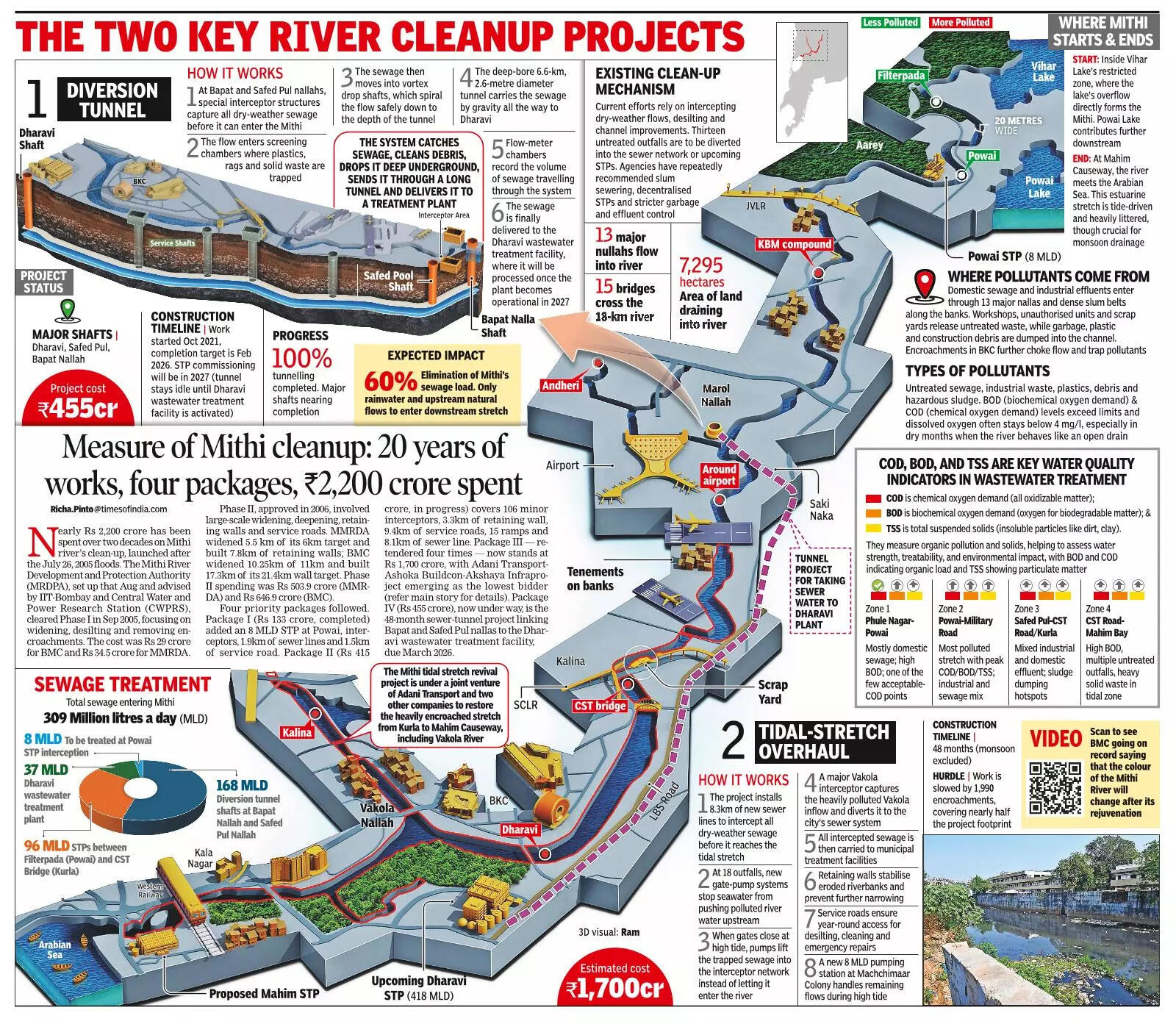
Mumbai’s latest push to clean the Mithi is the most technically advanced and expensive attempt so far, centred on a 6.6km diversion tunnel system worth over Rs 400 crore and a Rs 1,700-crore tidal-stretch overhaul. The two projects – designed to trap nearly 60% of the river’s sewage load – could, if executed well, intercept most sewage and ease chronic flooding. But success hinges on encroachment removal and the timely commissioning of the Dharavi wastewater treatment facility (WWTP), without which the tunnel cannot function. Experts warn that engineering alone cannot revive the river, and any gains will fade unless waste dumping, effluents and unregulated activity along the banks are controlled. After two decades and over Rs 2,200 crore spent, all eyes are on the latest effort costing another Rs 2,000 crore. Will it deliver durable, ground-level change, or will it be more money down the drain?

CITY BETS ON ₹2,000-CRORE TWINPROJECTS TO get 60% CLEAN MITHI

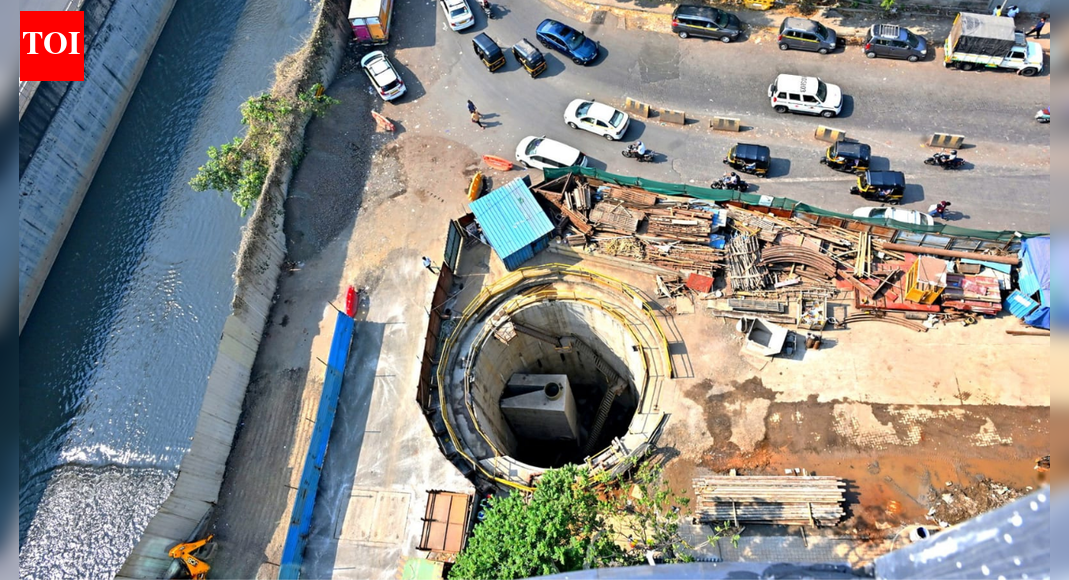
Diversion tunnel system:The construction of diversion tunnel shafts at Bapat Nalla and Safed Pul Nalla is nearing completion. The works aim to divert dry-weather sewage from both nallas to the upcoming Dharavi WWTP, stopping about 168 MLD of sewage from entering Mithi. This represents more than half of the river’s estimated 309 MLD sewage load. “The river’s black, foul water today is because untreated sewage continues to flow directly into it,” said additional municipal commissioner Abhijit Bangar, who heads the storm-water drain department. He said that that while tunnelling and shaft construction are advancing, “the full impact will be seen after the Dharavi WWTP comes online, likely by mid-2027.”

CITY BETS ON ₹2,000-CRORE TWINPROJECTS TO get 60% CLEAN MITHI

The 6.63km, 2.6-metre diameter tunnel, fully bored between Bapat Nalla near the airport and Safed Pul Nalla at Saki Naka, can carry 440 MLD of sewage to Dharavi for treatment. The J Kumar-MEPL JV is executing the package, which began in Oct 2021 and is slated for completion by Feb 2026. The main shafts at Dharavi, Safed Pul and Bapat Nalla are supported by interceptor systems, screen chambers and vortex drops. Explaining how it will operate, a site engineer said, “Incoming sewage is first passed through a screening chamber, where solid waste is filtered out. From there, it enters the 6.63km tunnel. By trapping 78 MLD from Bapat and 90 MLD from Safed Pul, we prevent nearly 60% of the river’s sewage load from flowing downstream.Tidal-stretch overhaul:The second leg is the Rs 1,700-crore package covering the heavily encroached, tidal-influenced stretch from the CST Bridge at Kurla to Mahim Causeway, including Vakola River. Adani Transport, in partnership with Ashoka Buildcon and Akshaya Infraproject, has emerged as the lowest bidder through an SPV. This package includes dry-weather flow interception, gate-pump systems at 18 outfalls, 8.3km of bored sewer lines, 4.72km of retaining walls, 6.42km of service roads, an 8 MLD pump station at Machchimaar Colony and a major interceptor at Vakola. “Because the stretch is affected by tidal ingress, the plan includes installing gates and pumps at 18 river outfalls,” Bangar said. “These will prevent high-tide water from entering the city’s drainage network and will pump out water during heavy rainfall, reducing flooding in low-lying areas.”But this phase faces the steepest land-acquisition hurdles. BMC has identified 1,990 affected structures: 900 near CST Bridge, 100 along Vakola, 319 at Machchimaar Colony and 671 near Maharashtra Nature Park. Nearly half the work footprint lies under encroachment, complicating wall construction, service-road formation and pipe installation. Bangar said Mithi improvement is tied to the project’s completion. “Once the interceptor network is fully in place and all sewage is diverted and treated, we will start seeing a noticeable change in the colour and quality of Mithi’s water.”


Source link

TikTok row: US joint venture deal signed to avert Chinese ownership ban; ByteDance’s stake capped at 19.9%


TikTok row: US joint venture deal signed to avert Chinese ownership ban; ByteDance's stake capped at 19.9%

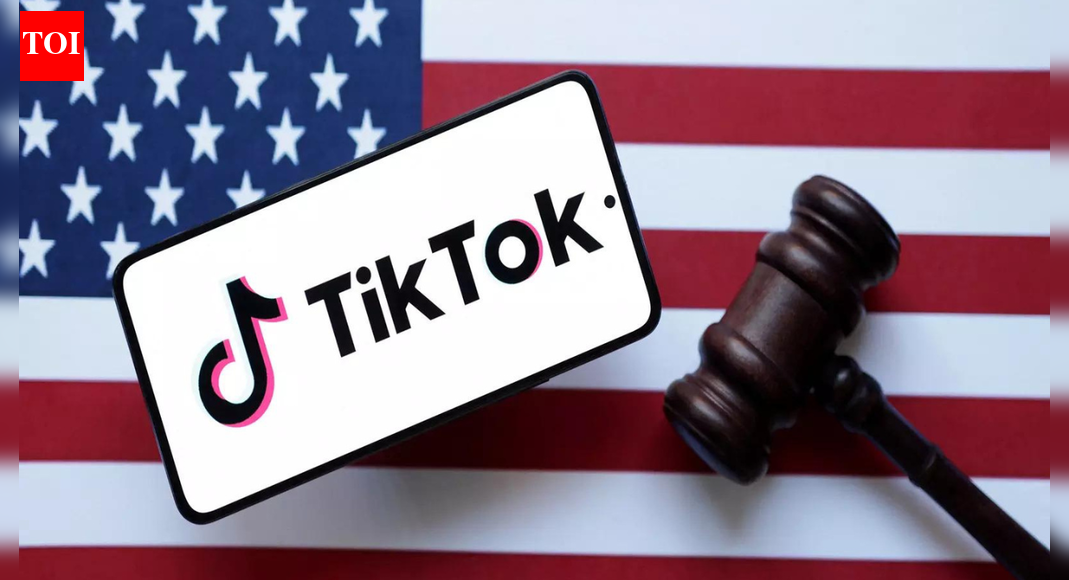
TikTok has signed a joint venture agreement with major investors to keep its platform running in the United States and avoid a potential ban linked to its Chinese ownership, according to an internal memo seen by news agency AFP.TikTok chief executive Shou Zi Chew told employees that the company and its parent ByteDance have agreed to form a new US-based entity, backed by Oracle, private equity firm Silver Lake and Abu Dhabi-based investor MGX. The deal is aimed at meeting the requirements of a 2024 US law that mandates the sale of TikTok’s American operations or a shutdown of the app.Under the arrangement, American and global investors will hold just over 80 per cent of the new joint venture, while ByteDance will retain a 19.9 per cent stake — the maximum ownership allowed for a Chinese company under the law, reported Reuters. Oracle, Silver Lake and MGX will each own 15 per cent, while affiliates of existing ByteDance investors will hold around 30 per cent.Chew said the US joint venture would operate as an independent entity with authority over “US data protection, algorithm security, content moderation and software assurance”. He added that the venture would have “the exclusive right and authority to provide assurances that content, software and data for American users is secure”, as per AFP.Oracle will serve as TikTok’s “trusted security partner”, responsible for auditing compliance and safeguarding sensitive US user data, which will be stored on Oracle’s cloud infrastructure in the United States, Reuters reported. The new entity will also oversee certain commercial operations, including advertising, marketing and e-commerce, while TikTok’s US entities will manage global product interoperability.The agreement is set to close on January 22, 2026, though Chew told staff that more work remains before completion. The memo marks the first confirmation that TikTok has formally signed on to a deal framework unveiled by the White House in September, AFP noted.The move follows years of pressure from US lawmakers, who have argued that TikTok could be used by Beijing to access Americans’ data or influence public opinion through its algorithm. US President Donald Trump, who initially pushed for a ban during his first term, repeatedly delayed enforcement of the law through executive orders since his return to the White House. He has credited TikTok, which has over 170 million US users, with helping him win re-election.Trump has publicly backed the new arrangement, previously naming Oracle founder Larry Ellison — a longtime ally — as a key figure in the deal. Ellison has recently re-emerged in the spotlight through major media and technology investments, AFP reported.The deal has drawn criticism from some US politicians. Democratic Senator Elizabeth Warren said there were still unanswered questions, accusing Trump of allowing a “billionaire takeover” of TikTok, as reported by Reuters.Despite the concerns, analysts quoted by Reuters said the agreement is likely to clear regulatory hurdles, given the level of involvement by the White House in shaping the transaction.


Source link