Breaking News
Sunrisers Eastern Cape skittle Paarl Royals for SA20’s lowest-ever total in one-sided win


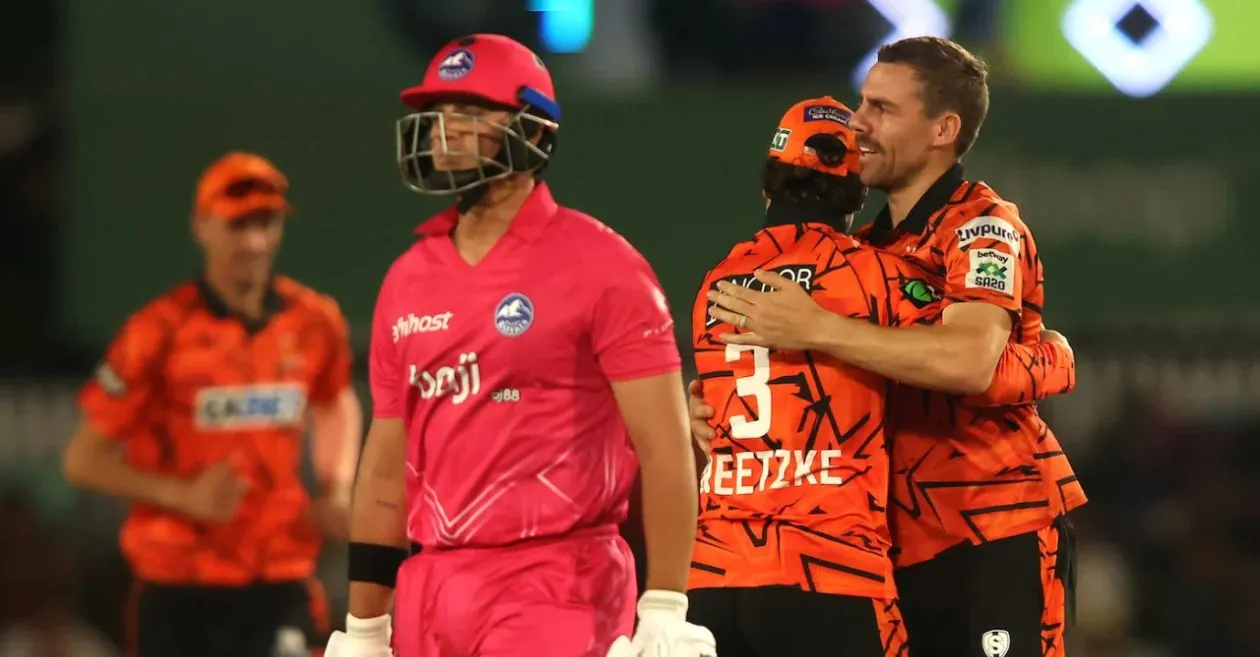
Sunrisers Eastern Cape launched their SA20 2025-26 campaign in ruthless fashion, crushing Paarl Royals by 137 runs in the third match at Boland Park, Paarl, on December 27, 2025. The defending champions produced a complete performance, setting up a massive total before dismantling the Royals for the lowest score in the tournament’s history.​

Sunrisers Eastern Cape set up a formidable total against Paarl Royals

After winning the toss, Sunrisers Eastern Cape opted to bat first on a Boland Park surface that initially looked true but always promised help for disciplined seam bowling under lights. Their top order made full use of the hard new ball as Quinton de Kock and Jonny Bairstow exploded out of the blocks, racing the score past fifty inside the first five overs and instantly putting the Paarl attack under pressure. The aggressive tempo in the powerplay forced Royals’ captain to shuffle his bowlers early, but Sunrisers’ batters continued to target the shorter side of the ground and punished anything marginally off length.​

The middle overs were controlled with notable composure, as Sunrisers shifted seamlessly from all-out attack to calculated accumulation, ensuring wickets in hand for a final surge at the death. Smart strike rotation against spin and precise boundary-hitting in the last four overs propelled them to 186 for 4, a total well above par at Boland Park and one that immediately exposed the fragility of the Royals’ batting card under scoreboard pressure.​

Also READ: SA20 2026: Complete squads of all six teams after the players’ auction

Paarl Royals crumble to record-low score in SA20 history

Chasing 187, Paarl Royals required a strong, risk-managed start, but their innings unraveled almost instantly against a ferocious new-ball burst from Anrich Nortje and Adam Milne. Both quicks hit a heavy length at high pace, extracting steep bounce and seam movement, and the top order simply could not cope as Royals slumped to 15 for 4 inside the first four overs. Edged drives, mistimed pulls and indecisive prods outside off stump became a pattern, with Sunrisers’ slip cordon and ring fielders snapping up every half-chance to deepen the crisis.​

As the collapse intensified, Royals’ hopes of respectability rested briefly on Asa Tribe and Kyle Verreynne, the only batters to reach double figures, but once that partnership was broken the tail folded rapidly. The hosts were bundled out for 49 in just 11.5 overs, undercutting Pretoria Capitals’ 52 against the same franchise in 2024 to set a new lowest total in SA20 history and handing Sunrisers a colossal 137-run victory. This statement win not only reinforced Sunrisers Eastern Cape’s reputation as the premier bowling unit of the league, but also highlighted how their pace battery can dictate entire campaigns by turning defendable scores into utterly one-sided contests.​

Top 5 lowest team totals in SA20

Team Total Opposition Date
Paarl Royals 49 Sunrisers Eastern Cape 27 Dec 2025 ​
Pretoria Capitals 52 Sunrisers Eastern Cape 22 Jan 2024 ​
Sunrisers Eastern Cape 77 MI Cape Town 9 Jan 2025 ​
Joburg Super Kings 78 Sunrisers Eastern Cape 31 Jan 2024 ​
Durban’s Super Giants 80 Pretoria Capitals 20 Jan 2023

Also READ: SA20 unveils elite match officials panel for the 2025-26 season


Source link

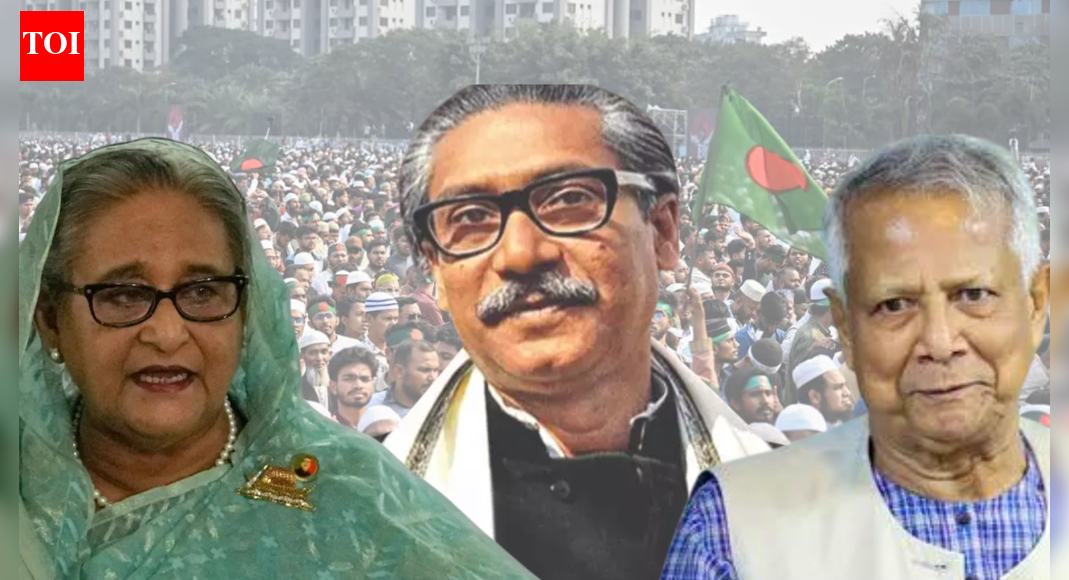
Born in protest, trapped in turmoil: A tale of two Decembers – How Bangladesh is back where it started


Born in protest, trapped in turmoil: A tale of two Decembers - How Bangladesh is back where it started

Let me make it very clear to you that the state language of Pakistan is going to be Urdu and no other language. Anyone who tries to mislead you is really the enemy of PakistanMuhammad Ali Jinnah during his first and only visit to East Pakistan (Now, Bangladesh)With Partition, Pakistan was carved out of India, but its founding father and Quaid-e-Azam Muhammad Ali Jinnah’s insistence that Urdu be the sole national language planted a deep sense of betrayal among the Bengali-speaking majority in the East. More than half the country suddenly felt pushed to the margins.Jinnah could never have foreseen that sidelining the Bengali language, culture and identity would spark a divide that would be powerful enough to undo his dreamland of Pakistan.

Muhammad Ali Jinna’s declaration of “State language of Pakistan…” in Dhaka.

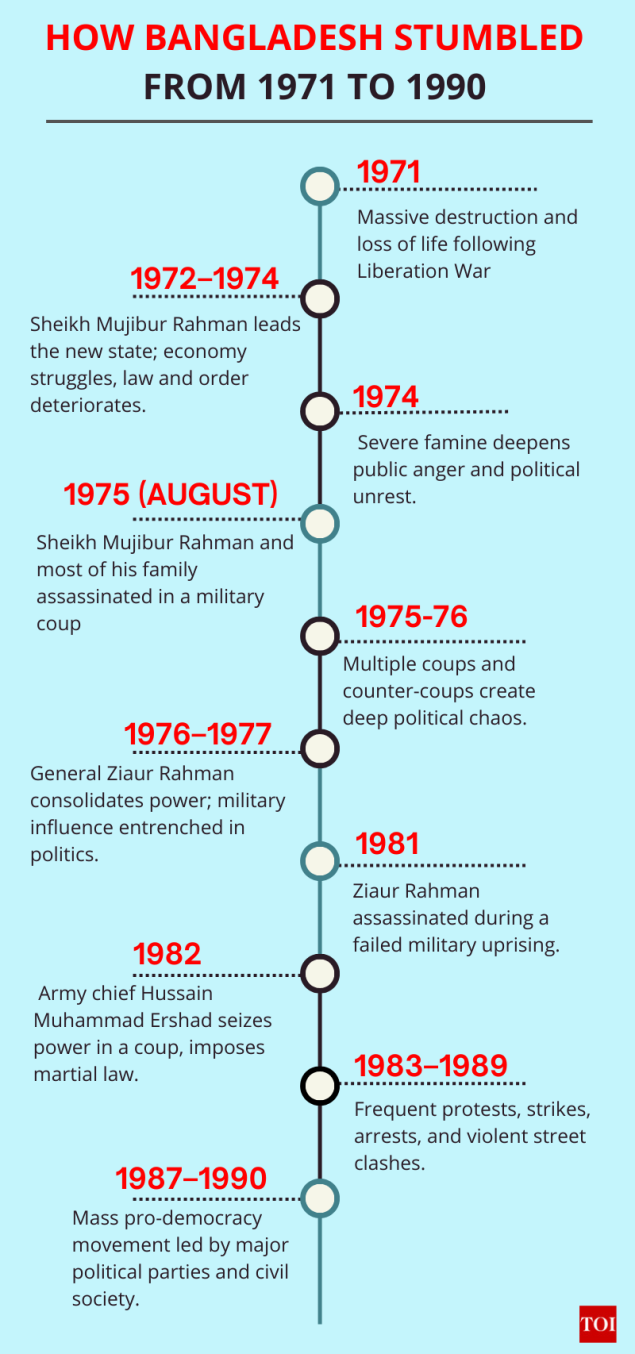
In 1952, police opened fire on student demonstrators in Dhaka, killing several: a theme that would return decades later, leading to the ouster of Sheikh Hasina, the daughter of Bangladesh’s founding father, Mujibur Rahman.By 1971, the language fault line and multiple other factors that agitated the Bengali land had split wide open, leading East Pakistan to break away and become Bangladesh, with all due prominence to language, culture, and ethnicity.But the story did not end with Bangladesh’s birth. The nation, forged through a struggle over language and dignity, has often mistaken political upheaval for genuine transformation. Again and again, the fall of a dominant order has been greeted as a historic shift, only for the country to drift back into familiar instability.

Osman Hadi’s Brother Accuses Yunus Regime Of Murder Plot To Defer Bangladesh Polls Scheduled in Feb

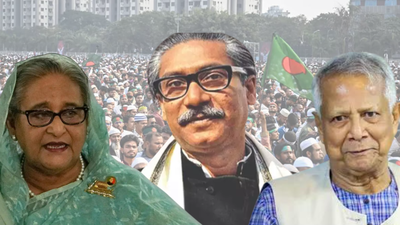
This is the paradox at the heart of modern Bangladesh. The country that emerged in December 1971 to escape repression, in December 2025, is confronting familiar dangers: political violence, weakened institutions, silenced voices and minorities being lynched, living in fear.The political landscape is further adrift with both major matriarchs almost out of the picture, Sheikh Hasina in exile and Khaleda Zia critically ill, while the BNP attempts a resurgence with Zia’s son, Tarique Rahman, returning from 17 years of exile in London.

How Bangladesh was born

After the creation of Pakistan in 1947, Muhammad Ali Jinnah’s assertion that Urdu alone would be the state language crystallised Bengali discontent. Bengali speakers, the vast majority in the east, saw this imposition as an affront to their identity. In February 1952, police killed student protesters in Dhaka demanding official status for Bengali, a moment that became a cornerstone of Bengali nationalism.

How Bangladesh was born

Beyond language, East Pakistanis felt systematically sidelined. Despite being a larger population, they were under-represented in political power and received a disproportionately smaller share of economic development. The jute-exporting east funded much of Pakistan’s earnings, yet infrastructure and industry favoured the west. By the 1960s, resentment fueled demands for autonomy. Sheikh Mujibur Rahman’s ‘Six Point Movement’ called for greater regional control and became widely popular in the east.The turning point came in the 1970 elections when Rahman’s Awami League won a clear majority. Instead of transferring power, West Pakistan’s leadership stalled and then ordered a brutal crackdown in March 1971. Resistance fighters, refugees flooding into India and India’s subsequent military intervention led to a devastating nine-month war. On December 16, 1971, Pakistani forces surrendered in Dhaka, and Bangladesh emerged as an independent nation.

Chaos, autocracy and protests

The new nation’s first few years were hopeful but turbulent. Sheikh Mujibur Rahman (“Bangabandhu” – Friend of Bengal) became the founding president and then prime minister under the 1972 constitution. Initially, he led a parliamentary democracy, but by 1974, Bangladesh faced economic crisis and social unrest (including a devastating famine). In 1975, Mujib’s government moved toward one-party socialist rule and civil liberties were curtailed. In the early hours of 15 August 1975, renegade army officers assassinated Mujib and most of his family, abruptly ending “the first spell of democracy”.

-

After Mujib’s death, Bangladesh entered decades of military-backed rule. A series of coups in the late 1970s brought General Ziaur Rahman to power (founder of the BNP party) and later, in 1982, Lt. Gen HM Ershad seized control. Both Zia and Ershad ruled as autocrats, imposing martial law and banning opposition. After the assassination in 1975, Bangladesh experienced two decades of authoritarian rule, including stints of military regimes. Public protests and political unrest were frequent during this period, but competitive elections and democracy were suspended.It was only in 1990 that Bangladesh returned to civilian rule. A mass pro-democracy uprising forced Ershad’s resignation, and elections in 1991 re-established a parliamentary system. The BNP won that election under Khaleda Zia (widow of Ziaur Rahman), pledging to restore democracy.

Deja vu for Dhaka?

This month, Sharif Osman Hadi, a youth leader who came to the forefront during the 2024 July uprising that toppled former prime minister Sheikh Hasina, was assassinated. Hadi, spokesperson for the Inqilab Mancha and an aspiring candidate for the upcoming elections, was shot in Dhaka on 12 December. He died six days later in hospital, sparking widespread protests and civil unrest across the country.

How Bangladesh Ended Up In Chaos, Again

The reaction has been explosive. Demonstrators have vandalised major newspaper offices and cultural centres, and marches toward the Indian High Commission have featured anti-India slogans and demands tied to wider political grievances. Some groups view Hadi as a martyr of the July Uprising, while others accuse rival factions and the interim government of complicity in his death and of undermining the electoral process. The interim administration under Muhammad Yunus has condemned the violence and pledged to pursue justice and maintain order. Yet the unrest has strained diplomatic relations with neighbours and revealed deep fractures within Bangladeshi society. With a national election looming, concerns are growing that the current turbulence could either reshape the country’s political landscape or plunge it into enduring instability, much as historical divisions did more than half a century ago.

A familiar sight

A grim feature of the recent unrest in Bangladesh has been the targeting of minorities. Two Hindu men were killed in incidents that sparked fear. In Mymensingh district, a 27-year-old garment worker, Dipu Chandra Das, was accused of blasphemy and beaten to death by a crowd on 17 December.Immediately after that, hundreds of Hindu organisations protested in India. Then on December 26, another Hindu man, Amrit Mondal (29), was brutally murdered in Rajbari district, reportedly during an altercation. The government’s line was that Mondal was a criminal seeking extortion, not a communal victim, but the optics were terrifying for Bangladesh’s Hindu minority.Domestically, the lynching in Mymensingh drew condemnation even from Dhaka’s government. Within days, the interim cabinet “condemned the lynching of a Hindu man…beaten and set on fire” and vowed the perpetrators would be brought to justice. But rights groups fear a broader slide towards communal violence.The independent monitoring group ‘Ain o Salish Kendra’ (AOSK) warned that the “coordinated attacks on media outlets, cultural institutions and historical sites” – including desecration of sculptures and images – signalled an alarming spread of extremist behaviour. By mid-December 2025, AOSK counted over 180 deaths in Bangladesh this year alone from mob violence (a steep rise from 51 in 2023).The Prothom Alo and Daily Star offices were torched by protesters branding them as “pro-India” or corrupt. In a shocking incident, gunmen abducted and then released a prominent left-wing journalist, apparently to intimidate the press. Chhayanaut cultural centre (a respected arts academy) was ransacked, and a portrait of a revered musicologist was slashed by rioters calling her an “atheist”.

Regime change, but democracy still distant

While Sheikh Hasina’s critics in Bangladesh accused her of ruling with an iron fist and silencing dissent, what has followed her ouster has been marked by chaos. The post-Hasina period has seen frequent violence, political unrest and reported attacks on minority communities, raising concerns about security and governance during the transition.At the same time, the interim phase has triggered intense debates over electoral reforms, including proposals to change the voting system. Critics have warned that measures such as proportional representation, if poorly managed, could deepen political fragmentation and fuel further instability rather than strengthen democracy.In short, the fall of autocracy has opened a pathway towards democratic renewal, with elections and reform plans now on the table. However, whether Bangladesh moves towards genuine democracy will depend on how free, inclusive and stable the upcoming political processes prove to be

How India is at the centre, again

India looms large in this story historically and today. In 1971, India’s decisive military and diplomatic support was pivotal to Bangladesh’s birth. Over the next five decades, New Delhi saw Dhaka as a crucial partner, investing in development and security ties. Hasina dubbed the 2010s a “golden era” of bilateral cooperation. But since her ouster, relations have soured. Bangladesh has demanded that Sheikh Hasina be handed over to Dhaka, while for India, rising violence at the border and against Hindus and other minorities has been a great concern.Tensions were explicitly mentioned during the December unrest. Reuters reports that relations “have been strained since Sheikh Hasina fled to New Delhi” after last year’s protests. Large crowds in Dhaka attacked the Indian diplomatic mission.

-

On the Indian side, outrage over violence against Hindus has triggered protests and diplomatic tussles. Hundreds of activists gathered at the Bangladesh high commission in New Delhi on December 23, angrily denouncing the lynching of a Hindu man in Mymensingh. They clashed with police and demanded justice, chanting that India should give Bangladesh a “befitting answer”. More demonstrations have erupted elsewhere in India (for example, in Kolkata) against the “atrocities being committed against minorities” in Bangladesh. New Delhi has officially described those demonstrations as peaceful but has also raised Bangladesh’s protest of Indian rallies at the Bangladeshi mission. Dhaka, for its part, summoned India’s envoy to complain about these rallies and warned against disrupting diplomatic sites.The ministry of external affairs informed that over 2,900 incidents of violence against minorities were documented in Bangladesh by independent sources during the tenure of the interim government led by Mohammad Yunus. The bilateral relationship is at a crossroads. India remains critical of any deterioration of rights in Bangladesh, but Bangladeshi leaders resent being seen as having outsourced their politics to New Delhi. With Bangladesh holding elections soon, both sides are positioning for influence: India quietly pressed for a “free, fair, inclusive” vote, while Bangladesh’s new rulers castigate “foreign hands” in local affairs.

What’s next

The “two Decembers” 1971 and 2025 bookend Bangladesh’s modern story. December 1971 marked the end of liberation: victory over autocracy and the birth of hope. December 2025 is now marked by violence and uncertainty, as Dhaka grapples with the aftermath of toppling another long-ruling leader.Understanding the path from 1971 to today is crucial. It shows that democratic gains won at great cost can be fragile. Over the past 15 months, Bangladesh has again overturned one political order, but this upheaval has not automatically delivered the peace and pluralism that many expected.


Source link

Virat Kohli’s next match for Delhi in Vijay Hazare Trophy: All you need to know | Cricket News


Virat Kohli's next match for Delhi in Vijay Hazare Trophy: All you need to know

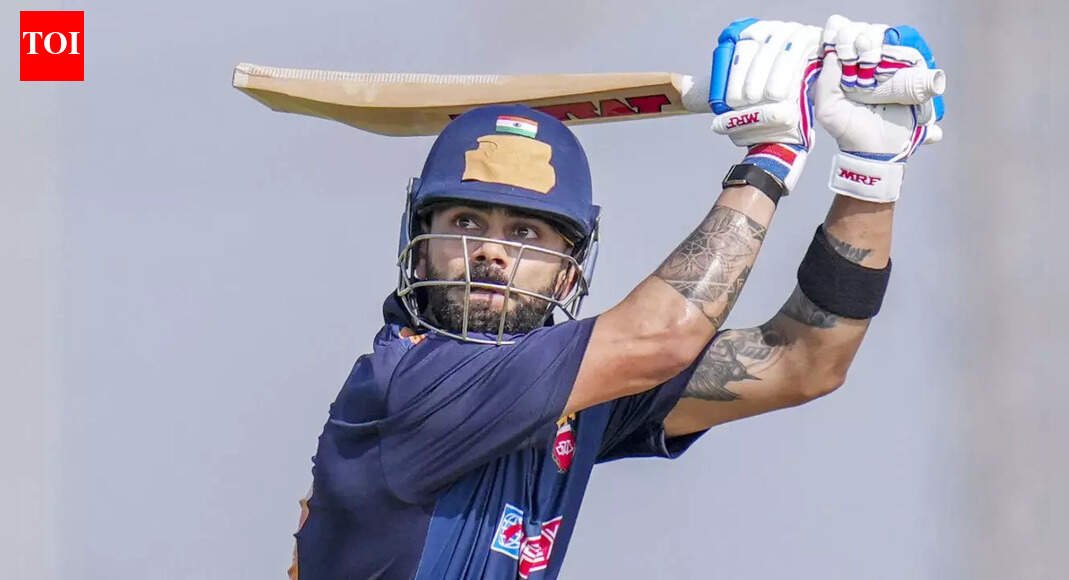
NEW DELHI: Virat Kohli marked a stunning return to domestic cricket in the Vijay Hazare Trophy 2025–26, turning out for Delhi after a prolonged absence from the List A circuit.The 37-year-old was in sublime form in his first two appearances, amassing 208 runs at a brisk strike rate to reaffirm his status as one of the finest List A batters of all time. His contributions powered Delhi to back-to-back wins and saw him script history by becoming the fastest player to reach 16,000 runs in List A cricket.

Why Mumbai’s iconic Azad Maidan is no longer safe for cricket | Bombay Sport Exchange

Kohli’s comeback began on December 24 against Andhra at the BCCI Centre of Excellence in Bengaluru. Chasing a stiff target of 299, he produced a masterclass, hammering 131 off 101 balls with a blend of classical strokeplay and controlled aggression. The innings steered Delhi to a four-wicket victory and took him past the landmark 16,000-run mark.He followed it up just two days later with another commanding display against Gujarat in an Elite Group match at the same venue. Kohli scored a fluent 77 off 61 deliveries, bringing up his half-century in just 29 balls to set the tone for Delhi’s innings. His impact extended to the field as well, where he grabbed two crucial catches to help Delhi clinch a tense seven-run win. Kohli was named Player of the Match.

When will Virat Kohli play next for Delhi?

Despite his limited availability, Kohli is likely to feature in at least one more Vijay Hazare Trophy match for Delhi. As per reports, Kohli is scheduled to play against Railways on January 6, 2026, ahead of India’s ODI series against New Zealand.He has also been in superb touch at the international level, having scored two centuries against South Africa in the recently concluded series.Overall, the Indian great has now registered six scores of fifty or more across competitions — four for India and two for Delhi in the Vijay Hazare Trophy.Virat Kohli in VHT:Delhi vs Gujarat – 77 off 61 balls (Player of the Match)Delhi vs Andhra – 131 off 101 balls


Source link

Imran Khan questions pay gap and reveals how A-listers like Ranbir Kapoor, Ranveer Singh, Shahid Kapoor are ‘not earning less than Rs 30 crore per film’: ‘It doesn’t make sense’ |


In a candid interview, Imran Khan divulged the massive pay disparity in Bollywood, claiming A-list stars like Ranbir Kapoor and Ranveer Singh now earn at least Rs. 30 crore per film. He also questioned the industry’s “mathematics,” stating such astronomical fees “don’t make sense.”

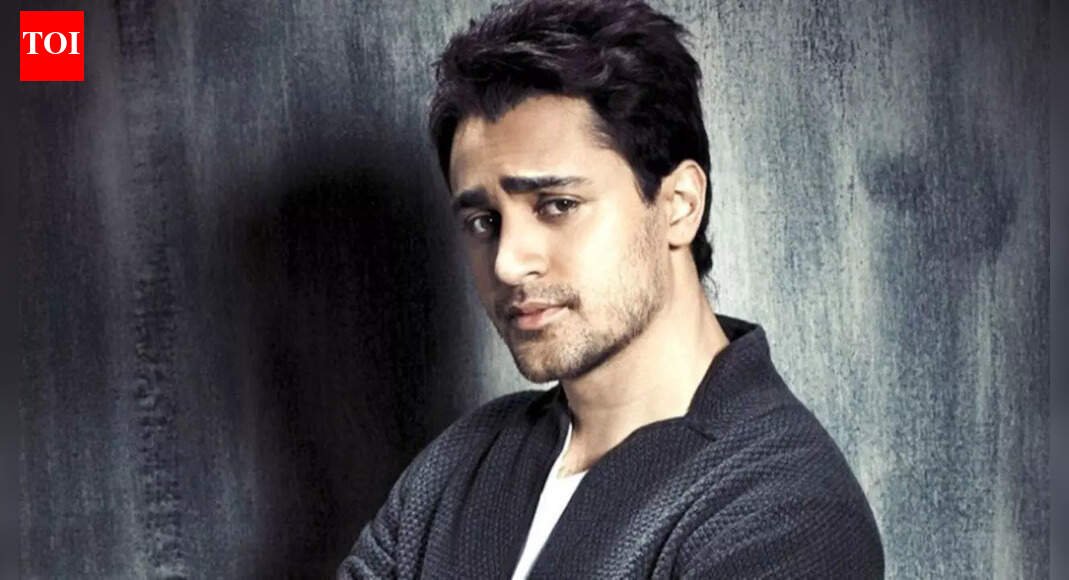
In a candid new interview, Imran Khan has revealed the staggering economics of the film industry. He also went on to divulge the massive pay checks of A-list stars like Ranbir Kapoor and Ranveer Singh. Additionally, the actor also reflected on his own financial journey during the peak of his stardom.

Imran Khan on his first film ‘Jaane Tu… Ya Jaane Na

Speaking on the Unfiltered by Samdish podcast, Imran Khan shared the experience of becoming an overnight sensation with the cult hit, ‘Jaane Tu… Ya Jaane Na’. He revealed that he was paid just Rs. 5 lakh for the Sanjay Dutt, Minisha Lamba starrer ‘Kidnap’, where the makers were initially hesitant to even cast him. However, it all changed following the massive success of ‘Jaane Tu… Ya Jaane Na’. He went on reveal how the highest paycheck that he had received for a film was Rs. 12 crore, without divulging its name.Khan said, “When my first film was released and became a hit, I went from being paid almost nothing to being paid multiple crores. At 25, suddenly you’re being paid Rs 7-10 crore. By the time Jaane Tu released, I had already done three films. I suddenly thought to myself, ‘Did my acting grow so much from my previous film?’”

Imran Khan on A-listers and their remunerations

In the same interview, Imran Khan went on to discuss the budgets of films. He noted how the industry’s A-listers are now command

Ranbir Kapoor Faces Angry Paparazzi As His Team Blocks Cameras!

ing astronomical figures that often put the rest of the production cost to shame.Khan said, “If you really consider the scale at which a leading actor earns in comparison to all other actors and all the other non-actors on set with all the recent films, there will come a moment where they will all sit and say ‘Hang on!’”Imran Khan added, “They will then analyse the whole thing, and somewhere in the mathematics and algebra, they will say, ‘This is not making sense.’ It doesn’t make sense to pay one person so much.” As for A-list actors’ fees today, Imran said, “If you’re an A-lister in theatrical films today, you’re not earning less than Rs 30 crore per film. Anyone my age—Ranbir Kapoor, Ranveer Singh, Shahid Kapoor—I would be surprised if any of them are earning less than that.

Imran Khan recalls an incident from Dubai

Imran Khan also went on to pinpoint at the exhaustion that comes with stardom as he recalled a humorous incident from a promotional trip in Dubai. His manager informed him that cutting a ribbon at a jewellery shop would earn him a gold iPhone. Tired and preparing for a flight to London, Imran declined, saying, “You keep the gold iPhone, I need a hot shower and a good night’s sleep.”

Imran Khan on filmmaker Vishal Bharadwaj

The interview also touched upon his experience with filmmaker Vishal Bhardwaj during ‘Matru Ki Bijlee Ka Mandola’. He described the casting as “dishonest,” admitting he felt lonely during the shoot and struggled to connect with the project’s vision.

About Imran Khan

On the work front, Imran Khan will be seen in ‘Happy Patel: Khatarnak Jasoos’ with Vir Das, Mithila Palkar, Aamir Khan and Sharib Hashmi. The comedy drama is slated for a release on January 16, 2026.


Source link

Osman Hadi murder: Two suspects fled to India, claim Bangladesh Police; details so far


Osman Hadi murder: Two suspects fled to India, claim Bangladesh Police; details so far

Bangladesh Police on Sunday claimed that two primary suspects in the murder of student leader Osman Hadi fled Bangladesh and entered India through Meghalaya border, news outlet the Daily Star reported.In a media briefing in Dhakha, Additional Commissioner Dhaka Metropolitan Police said that the Faisal Karim Masud and Alamgir Sheikh entered India through Haluaghat border in Mymensingh with the help of local associates.“According to our information, the suspects entered India via the Haluaghat border. After crossing, they were initially received by an individual named Purti. Later, a taxi driver named Sami transported them to Tura city in Meghalaya,” the Daily Star quoted Faisal Karim Masud.He further said that the Bangladeshi Police received informal reports suggesting that the Indian security agencies have detained the individuals who assisted the suspects.Nazrul said the Bangladesh government is actively working to bring the suspects back.“We are maintaining communication with Indian authorities through both formal and informal channels to ensure their arrest and extradition,” he said.Sharif Osman Hadi was shot dead from a close range on December 12 in Dhaka’s Bijoynagar area, triggering a widespread protests and calls for swift and exemplary punishment of those responsible.Authorities said Hadi was attacked while riding in a rickshaw near Box Culvert Road in the Motijheel area. He was shot near his left ear, lost significant blood and remained in critical condition before being airlifted abroad.Hadi emerged from the July Uprising and become the convenor and spokesperson of Inquilab Mancha — a platform opposed to all forms of political domination. Hadi he was a fierce critic not only of the Awami League but of mainstream politics as a whole and rejected established Bangladeshi political elites, positioning himself as a voice of generational rupture.Meanwhile, Inqilab Moncho, one of the prominent platforms that emerged during the July uprising, has warned that it will launch a mass movement to oust the interim government if justice is not delivered.


Source link

Stock market cues: What will guide Dalal Street this week? Macro data announcements, FII trading & more


Stock market cues: What will guide Dalal Street this week? Macro data announcements, FII trading & more

Dalal Street is headed into the final stretch of the year as investors brace for a week driven by economic data releases, global developments and the flow of foreign funds. Analysts expect trading to remain largely range-bound, with sentiment hinging on a mix of domestic indicators and overseas cues, while automobile sales numbers are also set to draw attention. With the year nearing its end and only a limited number of trading sessions remaining, equities are likely to trade within a narrow band, though experts see underlying support for the market. “This week marks the transition into calendar year 2026 and is likely to witness heightened volatility due to the December F&O expiry. Key domestic data points to track include industrial production data for November and the final HSBC manufacturing PMI (Purchasing Managers’ Index) reading,” said Ajit Mishra, SVP, research, Religare Broking Ltd. He noted that global factors would play an equally important role, as investors track signals from the United States, particularly the release of the Federal Open Market Committee (FOMC) minutes and information related to the Federal Reserve’s balance sheet. “These developments could influence near-term expectations around growth, liquidity, and global risk sentiment,” Mishra said. Last week, Indian equities ended on a cautious note in a holiday-shortened trading period, marked by thin volumes, marginal profit-taking and continued foreign fund outflows. The BSE benchmark index advanced 112.09 points, or 0.13%, during the week, while the Nifty rose by 75.9 points, or 0.29%. Ponmudi R, CEO – Enrich Money, said the market’s near-term direction will largely be guided by a heavy flow of economic data from both domestic and global fronts. “With only a handful of trading sessions left in 2025, Indian equity markets are expected to remain largely range-bound, albeit with a constructive bias. Investor sentiment this week is likely to be shaped by a busy economic data calendar, both domestically and overseas. On the home front, India’s November industrial production (IIP) data will offer fresh insights into trends across mining, manufacturing, and electricity output,” he said. According to Ponmudi, investors will also keep a close watch on November automobile sales figures to gauge the strength of demand. “Alongside IIP data, these releases will offer key insights into domestic consumption trends, particularly whether the post-GST rationalisation surge in auto demand is being sustained as India moves into 2026,” he added. On the international front, attention is expected to shift to signals from major economies. Apart from the US Federal Reserve meeting minutes, analysts said data such as US initial jobless claims and manufacturing PMI readings from the US and China could influence global market sentiment. Siddhartha Khemka, head of research, wealth management, at Motilal Oswal Financial Services Ltd, said that India’s monthly auto sales, along with these overseas indicators, will be among the key data points investors are likely to track through the week.


Source link

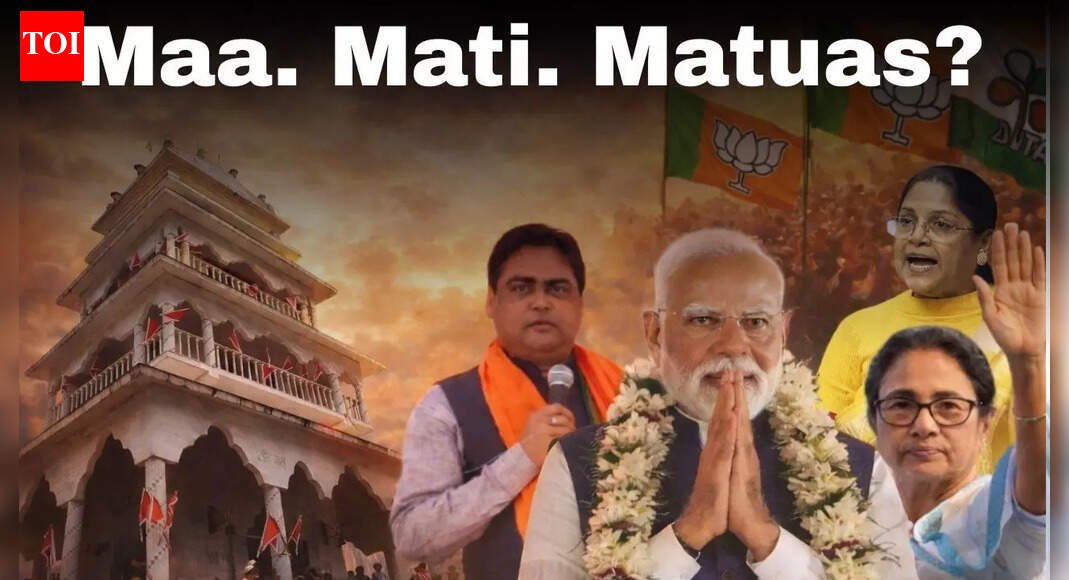
In search of Bharaitya ‘porichoy’: Will the Matua–Namasudras rewrite ‘poriborton’ in Bengal elections? | India News


In search of Bharaitya 'porichoy': Will the Matua–Namasudras rewrite 'poriborton' in Bengal elections?
Will the Matua–Namasudras rewrite ‘poriborton’ in Bengal elections?

When bad weather forced Prime Minister Narendra Modi to cancel a public meeting in West Bengal’s Ranaghat on December 20, he chose not to let the moment pass quietly. Instead, he sent out a message addressed specifically to the Matua and Namasudra community, acknowledging their decades-long plight and quest to secure a place in the country they now call home.It was a small gesture in form but a telling one in substance.Prime Ministers do not routinely issue targeted messages to caste-based religious communities. That PM Modi did so, even when prevented by the weather, points to a political truth that has been steadily taking shape over the last decade. The Matua–Namasudra community is no longer on the margins of Bengal’s politics. It sits close to the Centre.But can the community deliver what the BJP now seeks in poll-bound Bengal and revive what was once chief minister Mamata Banerjee’s clarion call? Can it set in motion another ‘Poriborton’?
SIR vs Speical Reivision (8)

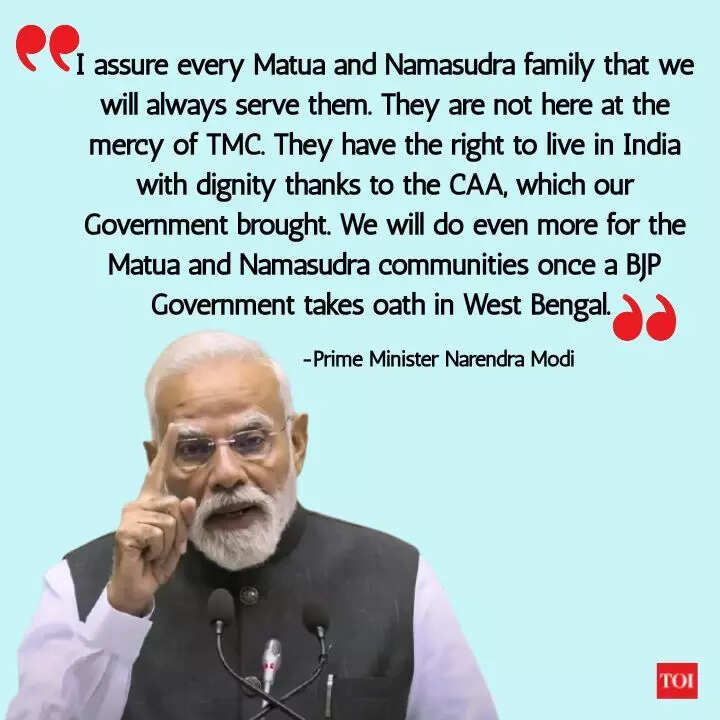
PM Modi post on X

It was a rare direct appeal, naming the community, invoking the controversial Citizenship Amendment Act (CAA), and framing dignity as a political entitlement rather than a favour. The message raised an obvious question. Why does a missed program with the Matuas merit such emphasis from the Prime Minister of India?The answer lies not in the weather, but in a long and layered history of caste oppression, religious reform, Partition-era displacement, and a steadily growing electoral clout that has turned the Matua–Namasudra community into one of the most closely watched constituents in Bengal’s politics today.“It is not as if the BJP suddenly discovered them. However, with the CAA, the history of the Matuas becomes very interesting. They are, of course, present in certain pockets of Bengal, but they are also scattered in large numbers across the state. With the CAA, the BJP felt that they could vote en masse for the idea of persecuted minorities from Bangladesh getting citizenship, ” Deep Halder, author of “Bengal 2021: An Election Diary”, who extensively covered the last West Bengal assembly polls, told TOI.Halder further said: “The BJP also studied the history of the Matuas, who were a bulwark against Islamisation of the lower castes in East Bengal. During that time, there were a lot of conversions of lower castes into the Islamic fold, and there was also caste discrimination. So they (Matuas), within the Hindu fold, found their own mythology, which gave shelter to many lower-caste Hindus and, in some way, kept them within the Hindu fold. This history also made the community very interesting to the BJP.”
Untitled design (7)

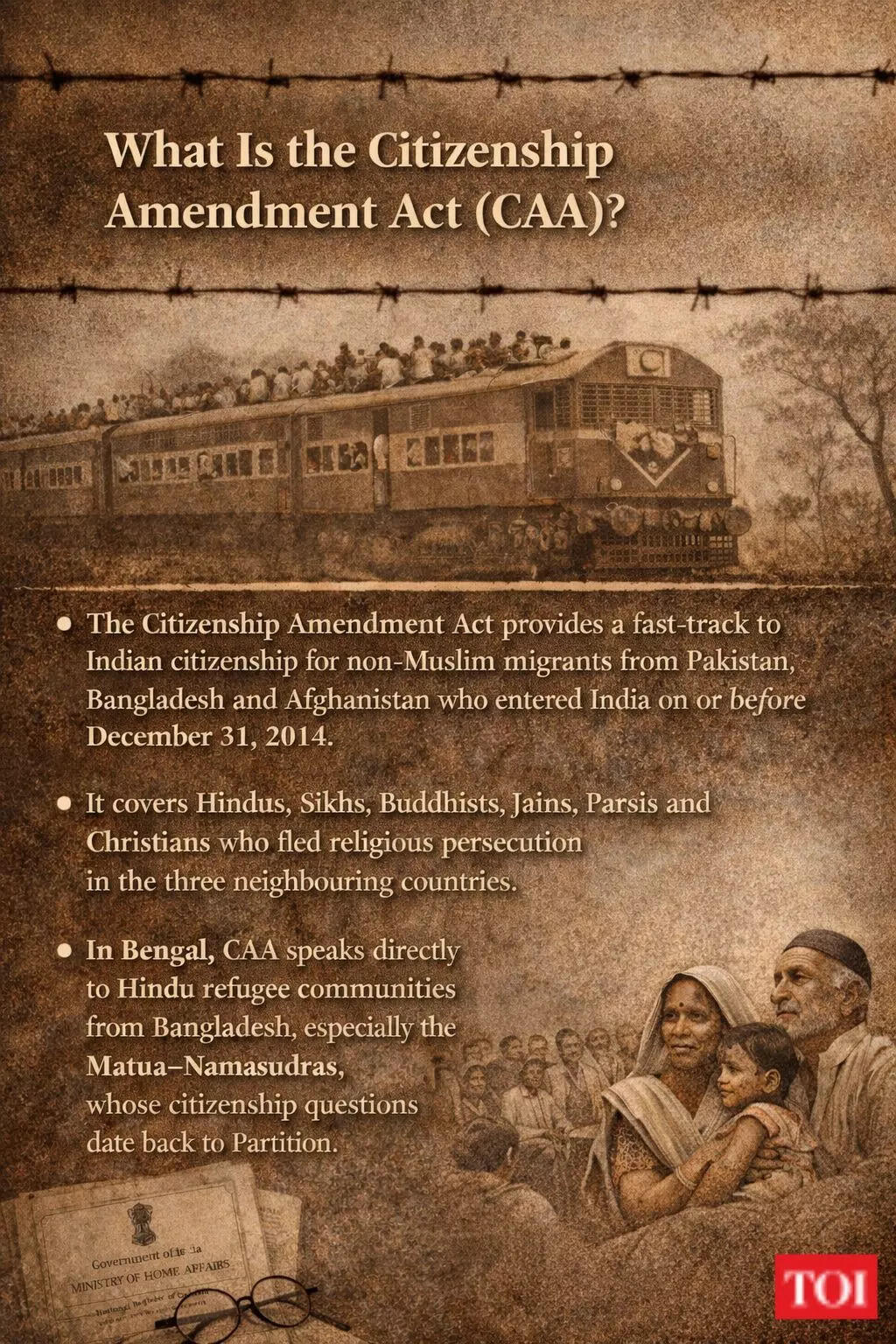
What is CAA

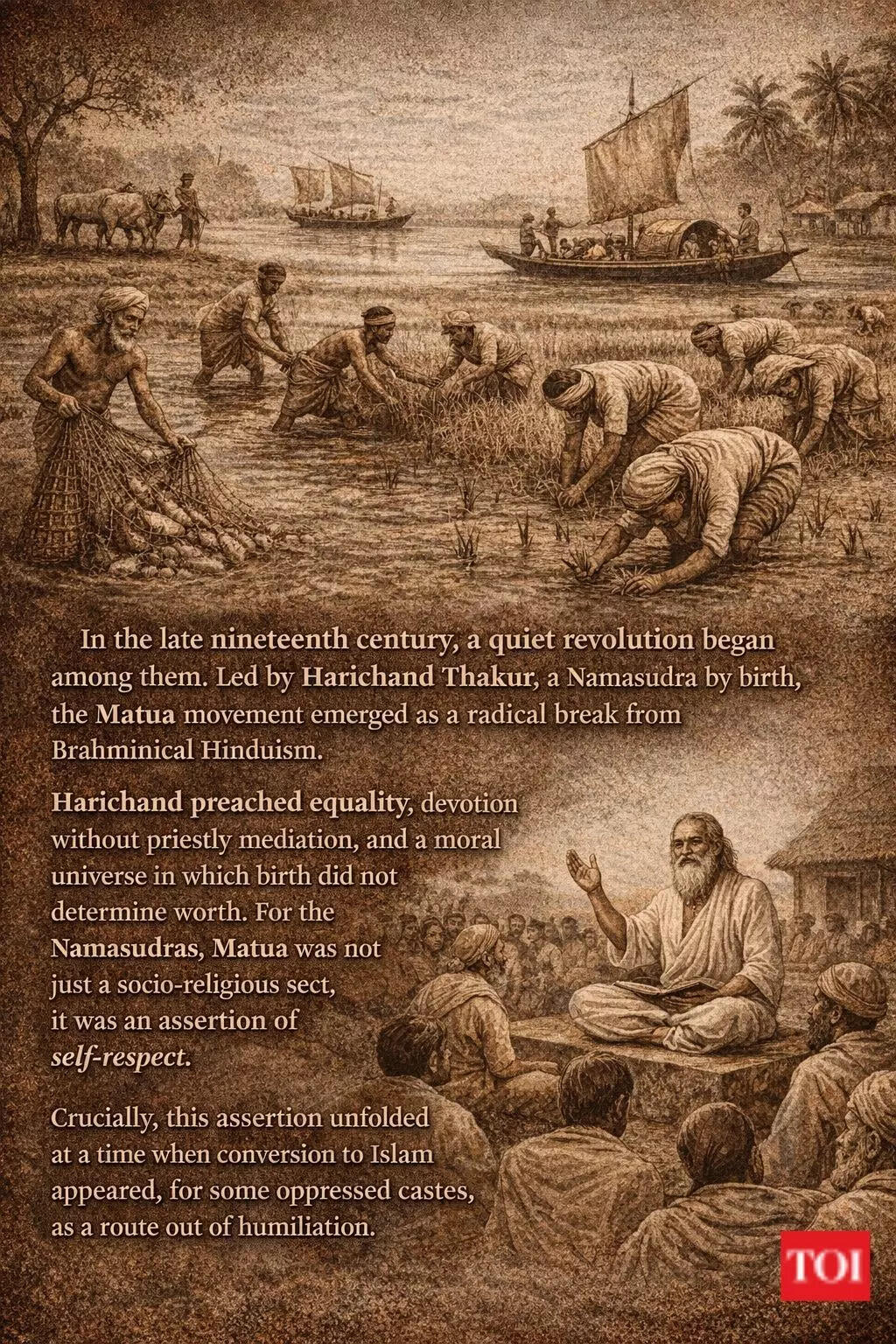
Matua–Namasudras: The question of belonging In the country’s popular discourse, opposition to the Citizenship Amendment Act (CAA) often comes wrapped in the language of constitutional morality, secularism, and “fear of exclusion”. But travel a few kilometres north of Kolkata, into the refugee settlements of North 24 Parganas, and the “popular” framing begins to look very different.For many among the Namasudras in the region, CAA is not an abstract constitutional question. It is a law that finally acknowledges a history they have lived with for generations.Why the Matua-Namasudra community views politics the way it does becomes clearer when one looks beyond electoral arithmetic, beyond BJP versus Trinamool Congress (TMC), and even before the creation of Bangladesh.The Namasudras are not migrants by origin. They are among the indigenous communities of eastern Bengal, once spread across the wetlands and riverbanks of what is now Bangladesh. For centuries, they lived at the bottom of the caste hierarchy, known by the historically stigmatising label “Chandal”. Denied dignity by the caste-driven society, they occupied the margins economically and socially, surviving as peasants, fishermen, and boatmen in Bengal’s agrarian economy.In the late nineteenth century, a quiet revolution began among them. Led by Harichand Thakur, a Namasudra by birth, the Matua movement emerged as a radical break from Brahminical Hinduism. Harichand preached equality, devotion without priestly mediation, and a moral universe in which birth did not determine worth. For the Namasudras, Matua was not just a socio-religious sect, it was an assertion of self-respect.Crucially, this assertion unfolded at a time when conversion to Islam appeared, for some oppressed castes, as a route out of humiliation. However, Harichand Thakur’s teachings offered an alternative. “Thakur was able to offer an independent and alternative space to the Namasudras, away from both Islam and Brahminical Hinduism, but closer to “Dharmic syncreticism”, an admixture of pre-Vedic Kaumadharma, Sahajiya Buddhism and Vaishnavism,” writes Avik Sarkar, an expert on Bengal’s Dalit history, in his article “Subaltern Resistance to Islam and Prospects of Dalit-Muslim Alliance in West Bengal”.
Untitled design (6)

History of Matuas

Harichand’s son, Guruchand Thakur, took this further. He institutionalised education among Namasudras, encouraged political awareness and repeatedly spoke of the community as “Bir Jaati” (Brave race).“The Guruchand Charit is replete with vivid descriptions of the two incidents of communal violence between the Namasudra-Matuas and the Muslims in Eastern Bengal. Guruchand Thakur, the second Sanghadhipati of the Matuas, often addressed Namasudras as “Bir Jaati” (brave race) and called for resisting any attempt to denigrate their collective honour”, Sarkar writes.The Matua movement, by the early twentieth century, had become as much a social force as a religious one.Prolonged plight after PartitionFor the Namasudras, 1947 was not a clean rupture but the beginning of prolonged displacement. Many stayed back in East Pakistan, hoping that a Muslim-majority state would offer them the dignity Hindus had denied. What followed was disillusionment! They found themselves squeezed between religious majoritarianism and economic vulnerability. Communal violence, political instability and the slow erosion of security pushed successive waves of Namasudras across the border.Their migration unfolded over decades, not overnight. The riots of 1950, unrest in the 1960s, and finally the Bangladesh Liberation War in 1971 forced large numbers to cross into India. They arrived in West Bengal not as migrants seeking opportunity but as refugees fleeing uncertainty. The settlement was harsh. Refugee colonies lacked infrastructure, employment was scarce, and the stigma of being “Bangal outsiders” persisted in the Ghoti-dominated society of West Bengal.Thakurnagar: The Mecca of MatuasOut of partition-led displacement emerged Thakurnagar in North 24 Parganas, which grew from a refugee settlement into the spiritual and organisational centre of the Matua movement after Partition. In the region, religion, memory, and politics are fused. The Matua identity provided continuity to people whose geography had been torn apart. Over time, this shared history translated into political consciousness. The Namasudra–Matua community in the 21st century is among the largest Scheduled Caste groups in West Bengal.
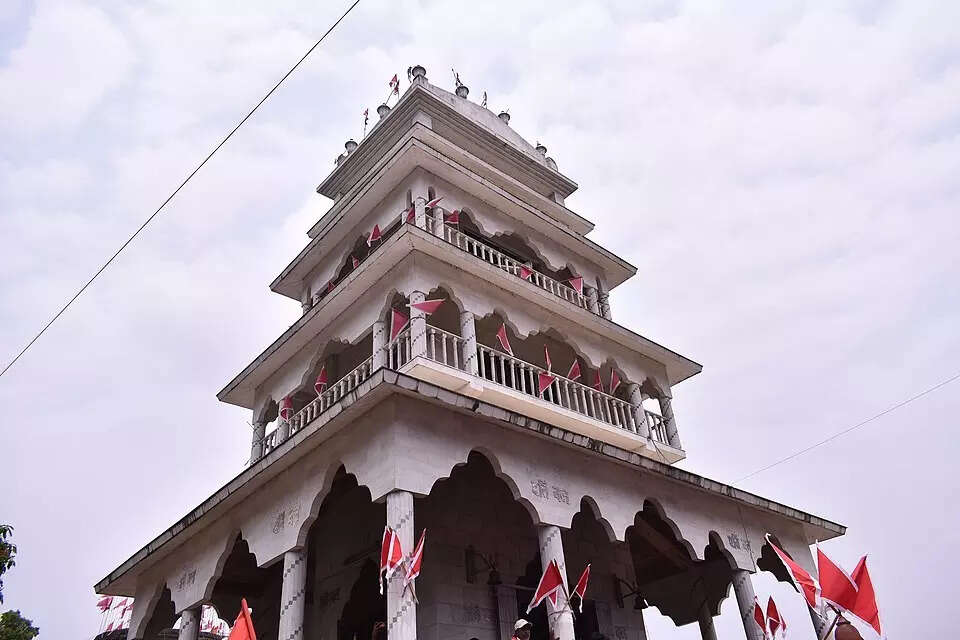
Thakurnagar

Thakurnagar Matua Mahasangha and Thakur Bari Temple: Credit: Wiki Commons

While there is no official caste-wise count, estimates suggest they form roughly 17 to 18 per cent of the state’s population. Politically, their presence stretches across North and South 24 Parganas, Nadia, Howrah, Cooch Behar, North and South Dinajpur and Malda.Electoral analysts routinely point out that Matua voters influence outcomes in as many as 60-65 assembly seats and are spread across at least six parliamentary constituencies. In a state where margins are often tight, that kind of concentration confers bargaining power.For decades, this power rested largely with the Left and later the Trinamool Congress. Welfare programs, refugee rehabilitation, and grassroots networks kept the community electorally aligned, while the BJP remained peripheral in Bengal until the mid-2010s.Boroma: Matua matriarch & her lineageThe Thakur family of Thakurnagar occupies a symbolic space that cuts across party lines. Binapani Devi, known as Boroma, carried Harichand Thakur’s teachings across India and became the Matua matriarch. After her death in 2019, the state accorded her funeral with full state honour, which reflected the recognition of Matua’s influence even among political rivals.Her grandson, Shantanu Thakur, now BJP MP from Bongaon, represents the intersection of faith and politics in contemporary Bengal. Parties court him not merely for endorsement but for access to a constituency shaped by history rather than ideology alone. At the same time, Boroma’s daughter-in-law, Mamata Bala Thakur, a former Rajya Sabha member, has been associated with the Trinamool Congress, illustrating that the family’s political affiliations cut across party lines.
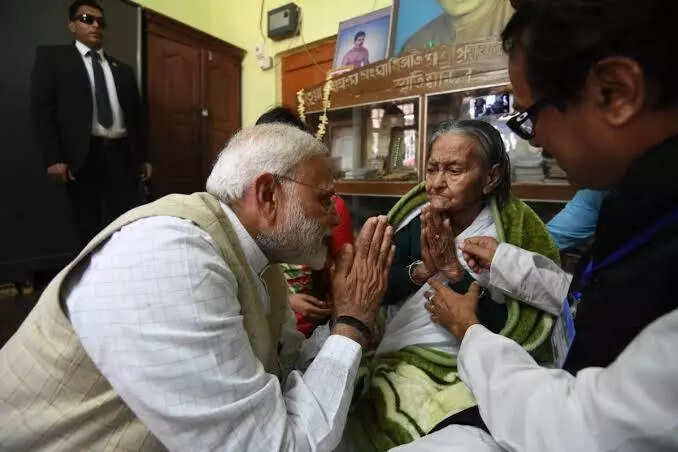
GIZKx-9WkAES6Fw

Prime Minister Narendra Modi met Matua Community’s ‘Boroma’ Binapani Devi Thakur in Thakurnagar in 2019.

On the “make or break election” potential of the community, Deep Halder says, “The family itself is very divided. There is another side of the family, which is with the Trinamool Congress (TMC). Yes, it is an important voting bloc, but make-or-break, I would not say.”To reduce the Namasudra–Matua community to a vote bank is to miss the point. Their political choices are anchored in a memory of caste humiliation, of religious assertion, of displacement and of delayed recognition. Their power lies not just in numbers but in a shared understanding of what the state has owed them and often failed to deliver. As Bengal’s politics grows more polarised, the Matua–Namasudra community remains a reminder that identity here is not manufactured overnight. It is inherited, negotiated, and, increasingly, exercised at the polling booth.2014: The year of shiftThe shift began after 2014. Identity, citizenship, and belonging entered the political mainstream in a way they had not before. In the 2014 Lok Sabha elections, the BJP won just two of Bengal’s 42 seats. Five years later, in 2019, it won 18. The jump was not accidental. Constituencies with large Matua populations, including Bongaon and Ranaghat, swung decisively.The Citizenship Amendment Act played a role in this consolidation. While the law does not name Namasudras or Matuas, it addresses precisely the condition of non-Muslim refugees from Bangladesh who entered India before 2014. For a community whose migration was born of Partition and persecution, the promise of citizenship was not symbolic. It was existential.That promise, and the delay in its implementation, shaped political expectations. In the 2021 assembly elections, the BJP fell short of forming the government, but it still emerged as the principal opposition with 77 seats, a dramatic rise from its three-seat tally in 2016. Many of these contests were fought tooth and nail in Matua-influenced belts. The 2024 Lok Sabha elections saw the BJP’s numbers in Bengal dip to 12 seats, with the Trinamool Congress winning 29. Yet even then, Matua-heavy constituencies remained competitive, asserting that the community was not locked into permanent allegiance. It votes, increasingly, with a sense of leverage.SIR and the dilemma of citizenshipMore than one lakh voters from the Matua heartland, spread across four assembly constituencies in North 24 Parganas’s Bongaon subdivision, are likely to receive notices for hearings following the publication of draft electoral rolls on December 16.A statement by junior Union minister Shantanu Thakur, hinting at one lakh Matua deletions from voter rolls following SIR, has led to fresh unease in the already anxious Matua belt in Bengal.Speaking at a public meeting at Bagdah’s Garapota, Thakur, also the sabhadhipati of the BJP-backed faction of the All India Matua Mahasangha, said: “If excluding 50 lakh infiltrators means that one lakh people from my community are temporarily deprived of voting, which option is more beneficial?”

BJP's Shantanu Thakur

BJP’s Shantanu Thakur on SIR

Hitting back, TMC called Thakur’s comment “nothing but a cynical, backstabbing betrayal”.“For years, they (BJP) dangled the mirage of citizenship in front of our Matua brothers and sisters, conning them election after election with honeyed lies, only to stab them in the back the moment the votes were pocketed,” the party said on X. “Now, with the EC reduced to their obedient B-team, BJP has rammed through their Silent Invisible Rigging (SIR) abomination in Bengal, forcing millions of Matuas into a humiliating litmus test of citizenship designed to strip them of their rights and erase their votes,” the party posted.
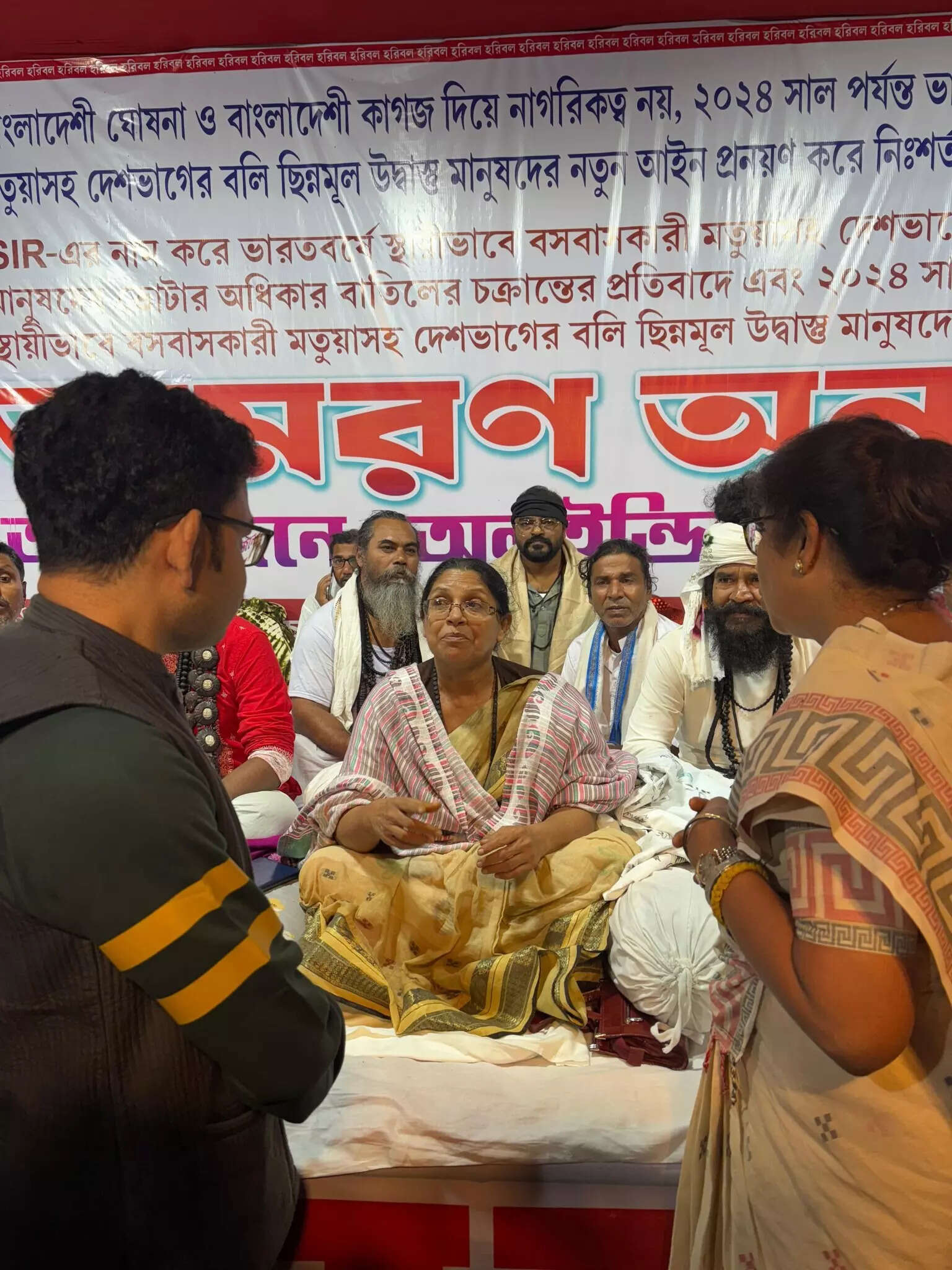
G5469nSawAATw7H

TMC MP Mamata Bala Thakur-led Matua faction during the hunger strike over SIR

In this context, PM Modi’s assurance that the Matuas “have the right to live in India with dignity thanks to the CAA” could be read as an attempt to reassure the community that the ongoing revision of electoral rolls does not dilute its place or legitimacy in the state.The message appears aimed at separating administrative action from questions of belonging, even as concerns over voter exclusions continue to fuel unease in the Matua heartland.The Bengal battle for 2026On the factors that would probably play on the Matua community’s mind in the 2026 elections, Deep Halder said that “what is happening in Bangladesh explains why they left (East Pakistan) in the first place. Political galvanisation even on this side of the border (West Bengal) would remind them of what is happening on the other side of the border (Bangladesh)”.“The public lynching and burning of a Bengali Hindu man is a very recent memory for the Matuas. There is also a large chunk of Matuas on that side of the border (Bangladesh). I visited their headquarters there, and they are very aware of the developments in Bangladesh today. This would also play on their minds when they vote for either of the political parties.”He said the community may not choose one party solely on the issue of identity, but “identity is a big issue even for Gen Z Matuas”. “They are very aware of their identity and history. Hindus of other persuasions may not be aware of many things, but the Matuas I have met are very aware of their history and the reasons why they did not convert to other faiths, mostly Islam,” Halder told TOI.
Matua

Matuas and GenZ

For the Matua–Namasudra community, politics has never been a matter of slogans alone. It has been shaped by memory, by displacement, by the struggle to hold on to dignity across generations, and by the slow negotiation of belonging in a land they have helped build but have often had to justify their place in.Their choices have been pragmatic as much as emotional, guided as much by lived experience as by ideology. That is why their political loyalties have shifted, fractured and reassembled over time, resisting any attempt to be neatly categorised or permanently claimed. As Bengal moves toward another election cycle, the Matua story offers a reminder that electoral behaviour here is rarely divorced from history. Administrative processes, citizenship debates and developments across the border are not abstract issues for this community; they touch upon inherited anxieties and hard-earned assertions.Whether the Matua–Namasudra vote consolidates, fragments or recalibrates itself in 2026 will depend less on promises made from platforms and more on whether the state can convince them that recognition, security and dignity are not provisional, but settled facts of citizenship.

Source link

Access Denied


Access Denied

You don’t have permission to access “http://www.ndtv.com/science/is-the-universes-endless-expansion-in-doubt-changing-dark-energy-sparks-fresh-cosmic-debate-10041541” on this server.

Reference #18.acf856b8.1766915040.2da2311b

https://errors.edgesuite.net/18.acf856b8.1766915040.2da2311b


Source link

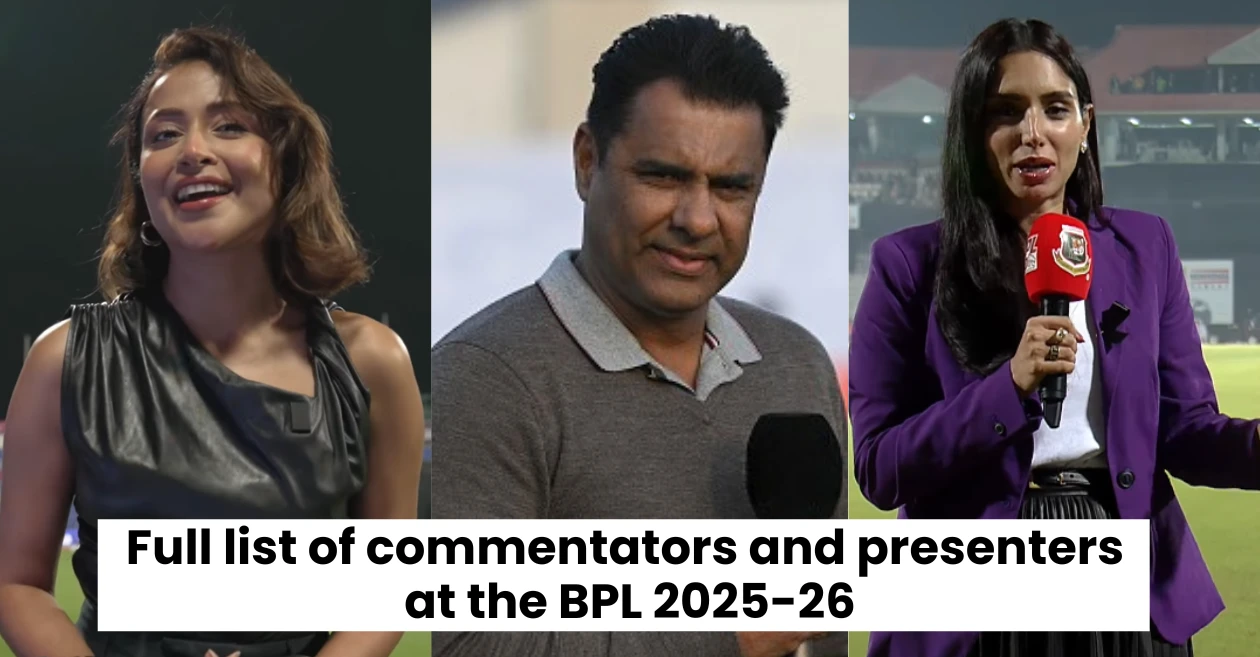
BPL T20 2025-26: Full list of commentators and presenters at the Bangladesh Premier League


The Bangladesh Premier League (BPL) 2025-26 is already underway, marking the 12th season of Bangladesh’s flagship T20 competition. As fans across the country and overseas tune in to the action, the organisers have confirmed the complete list of commentators and presenters leading broadcast coverage for the ongoing season.

With the BPL T20 now an established part of the global calendar, the 12th edition continues the league’s focus on delivering high-quality, informative and entertaining commentary by combining trusted Bangladeshi voices with renowned international experts.

The backbone of BPL commentary once again comes from respected local broadcasters who bring deep insight into Bangladesh cricket. Veteran commentator Athar Ali Khan remains a central figure, offering decades of experience and intimate knowledge of local players, conditions and domestic structures.

Athar Ali Khan (PC: X.com)

Alongside him is Shamim Chowdhury, whose calm, analytical style has made him a familiar presence for BPL viewers. Completing the local panel are Somannoy Ghosh and Mazhar Uddin Omi, both of whom add fresh perspectives and strong on-ground context.

Together, the local team ensures that the stories of emerging Bangladeshi players and domestic rivalries are told with accuracy and depth throughout the tournament.

The international commentary lineup for the BPL T20 2025-26 brings global appeal and tactical insight. New Zealand’s popular broadcaster Danny Morrison returns to inject energy and entertainment into the broadcast, a role he has become known for across T20 leagues worldwide.

West Indies spin specialist Samuel Badree provides sharp analysis of bowling match-ups and modern T20 strategies. Pakistan legends Waqar Younis and Ramiz Raja add star power, experience and high-profile insights from decades at the top level of international cricket.

Waqar Younis, Samuel Badree
Waqar Younis, Samuel Badree (PC: X.com)

Sri Lanka’s Farveez Maharoof and Jamie Cox of Australia round out the international panel, offering balanced viewpoints on batting techniques, field placements and in-game momentum shifts.

Also READ: BPL T20 2025-26 Schedule – Broadcast, Live Streaming details | When and where to watch Bangladesh Premier League in India, Pakistan, USA & other countries

Studio and on-ground coverage led by familiar sports presenters

Presentation duties during the ongoing BPL season are being handled by Zainab Abbas and Ridhima Pathak.

Zainab Abbas
Zainab Abbas (PC: X.com)

Both presenters bring extensive experience across international cricket leagues and are tasked with anchoring pre-match shows, mid-innings segments and post-match discussions.

Ridhima Pathak
Ridhima Pathak (PC: X.com)

Their role extends beyond studio work, helping connect fans to players through interviews, features and behind-the-scenes coverage as the tournament unfolds.

Also READ: SA20 2026 – Full list of commentators and presenters at South Africa’s explosive T20 cricket league


Source link

‘Opportunity aayega, mehnat kar’: Virat Kohli to Vishal Jayswal after falling to left-arm spinner | EXCLUSIVE | Cricket News


'Opportunity aayega, mehnat kar': Virat Kohli to Vishal Jayswal after falling to left-arm spinner | EXCLUSIVE
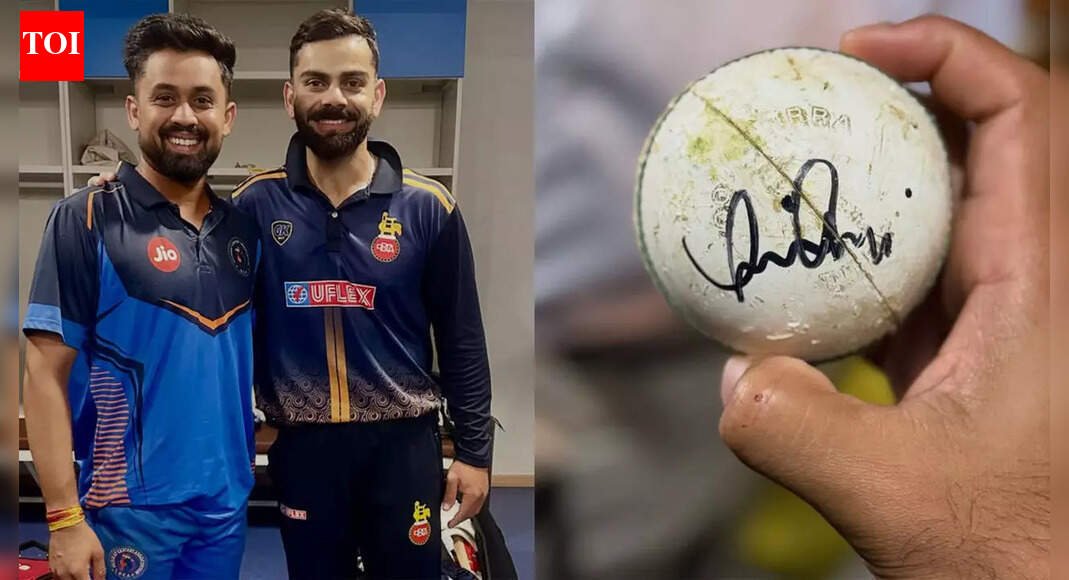
Virat Kohli and Vishal Jayswal (Image credit: Special arrangement)

NEW DELHI: Vishal Jayswal was an unknown name until he claimed the most prized wicket of his cricketing career — Virat Kohli – a dismissal that instantly etched his name into the record books.Jayswal tempted Kohli out of the crease, spinning the ball sharply past the outside edge and the wicketkeeper made no mistake and whipped off the bails to send the well-set Delhi batter back for 77.

Virat Kohli’s childhood coach makes a big statement on 2027 ODI World Cup

While Gujarat narrowly lost the thriller by seven runs, the moment belonged to the young spinner, who was embraced by teammates for his unforgettable breakthrough.As the rest of the Gujarat players headed back to the dressing room, Jayswal lingered. He requested the umpire for the match ball — the one with which he had dismissed Kohli.Ball in hand, he nervously walked towards the Delhi dressing room. Spotting Kohli, he hesitated. Kohli noticed him, smiled, and said: “Aaja, aaja” (Come in).A nervous Jayswal pulled the ball out of his pocket and said: “Bhaiya, ball pe ek autograph chahiye” (Please give me an autograph).Kohli put his kit aside, asked Jayswal to sit down, and made him comfortable before signing the ball.

.

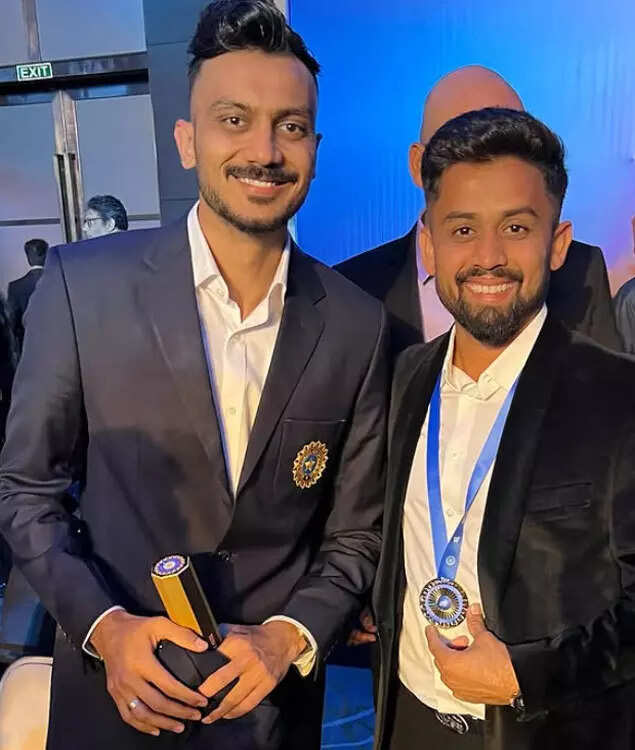
“Achha ball daalta hai. Hard work karta rah. Opportunity aayega, wait kar and mehnat kar [You bowl really well. Keep working hard. Your opportunity will come — be patient and keep putting in the effort],” Kohli told him.Jayswal admitted the pressure of bowling to a modern day great.“I didn’t have any specific plan against him. He’s a legend of the game. Just bowling to him is a huge moment, and there’s immense pressure when he’s at the crease. I spoke to him and he gave me a lot of tips, how to remain calm under pressure, fitness etc,” Jayswal said, during an exclusive chat with TimesofIndia.com.“Of course, I’m really happy to have dismissed him. Having a wicket like that next to your name is very special,” the spin allrounder said.INSPIRED BY AXAR PATELLike Axar Patel, Jayswal hails from Nadiad in Gujarat’s Kheda district and began his cricket journey at the same academy where Team India’s T20I vice-captain took his first steps.

Vishal Jayswal with Axar Patel (Image credit: Special arrangement)

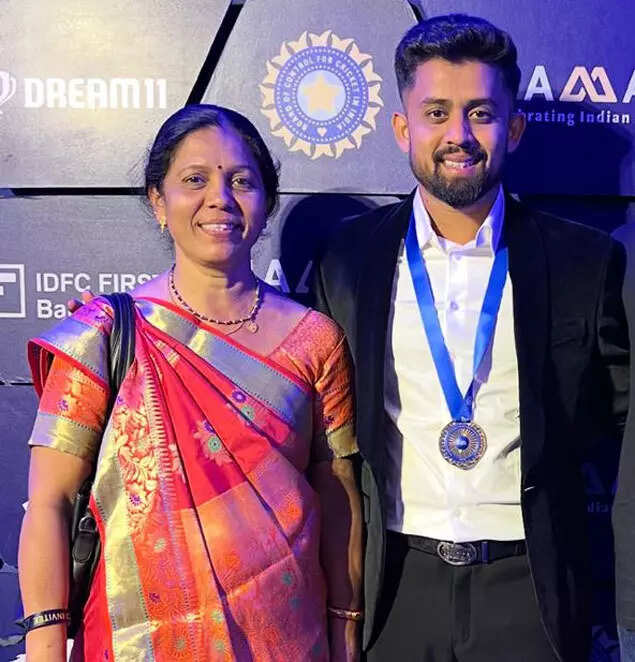
Jayswal lost his father when he was just eight months old.As he grew older, cricket became his passion, and he told his mother of his dream to become a professional cricketer. The road was far from easy, but his mother stood firmly by him.“The journey was extremely tough, but whatever I am today is because of my mother,” said Jayswal, who finished as the highest wicket-taker in the 2022–23 CK Nayudu Trophy.“Taking her to the awards function was one of the proudest moments of my life.”

Vishal Jayswal with his mother (Image credit: Special arrangement)

According to Jayswal, Axar has played a crucial role in shaping his career.“Axar bhai has helped me immensely — from my cricket kit to jerseys and bats. I look up to him as an inspiration and mentor,” he said.“I’ve always wanted to be a spin-bowling all-rounder like him. He teaches me how to be a game-changer — when to attack, how to control the run rate, and how to stay mentally strong.”Recalling Axar’s advice, Jayswal added with a smile: “He always tells me: ‘Batting mein dhyaan sirf ball pe rakho, aur bowling mein batsman ke pair aur wickets pe.’ Those tips have helped me a lot.”


Source link