Breaking News
BBL|15: Chris Green sizzles as Sydney Thunder beat Melbourne Renegades in rain-hit clash


A rain-affected encounter at the Sydney Showground Stadium saw Sydney Thunder register a crucial four-wicket win over Melbourne Renegades via the DLS method in Match 33 of the Big Bash League 2025–26 season. Chasing a revised target after interruptions, the Thunder rode on a blistering late cameo from Chris Green to seal the contest with 28 balls to spare.

Melbourne Renegades post competitive 170 despite mixed innings

Asked to bat first after Thunder skipper opted to bowl, Melbourne Renegades posted a competitive 170 for 8 in their 20 overs. The innings was built on steady starts from Josh Brown and Tim Seifert, who added vital runs at the top. Brown’s aggressive 35 off 25, featuring three fours and as many sixes, set the tempo, while Seifert chipped in with a fluent 29.

The middle order, however, struggled to convert starts into big scores. Jake Fraser-McGurk’s quick 19 off just nine balls provided momentum, but wickets at regular intervals prevented the Renegades from fully capitalising. Mohammad Rizwan anchored briefly with 26, before Hassan Khan played the defining knock of the innings. His 46 off 31 balls, laced with four towering sixes, lifted the Renegades past the 160-run mark and ensured a competitive total.

For the Thunder, Wes Agar and Ryan Hadley were the standout bowlers, picking up two wickets each. David Willey also struck twice, though he proved expensive at the death as the Renegades accelerated in the final overs.

Also READ: BBL|15 – Sam Harper’s electrifying 84 not out steers Melbourne Stars to a commanding win over Melbourne Renegades

Sydney Thunder chase disrupted by rain but Chris Green turns the tide

Sydney Thunder’s reply was frequently halted by rain, resulting in a revised target under DLS. The chase began shakily as early wickets pegged the hosts back, with Matthew Gilkes and Cameron Bancroft falling cheaply. Sam Konstas showed early intent with a brisk 18, while Sam Billings attempted to stabilise the innings with a composed 33.

The real momentum shift came through Nic Maddinson, whose attacking 30 off 17 balls reignited Thunder’s hopes. Yet, just when the game seemed evenly poised, it was Green who changed the complexion entirely. Walking in under pressure, Green unleashed a stunning 34 off just 13 deliveries, smashing three fours and three sixes to swing the DLS equation firmly in Thunder’s favour.

Despite Gurinder Sandhu’s impressive four-wicket haul for the Renegades, the damage was already done. Green’s onslaught ensured the Thunder crossed the revised target at 140 for 6 in just 15.2 overs. Green was deservingly named Player of the Match for his match-defining knock under pressure.

Also WATCH: “Like a 4-year-old…” – David Warner complains to umpire about Pakistan pacer’s bowling in BBL|15


Source link

‘ICC’s existence is unnecessary’: Ex-Pakistan cricketer’s explosive attack on BCCI dominance | Cricket News


'ICC's existence is unnecessary': Ex-Pakistan cricketer's explosive attack on BCCI dominance
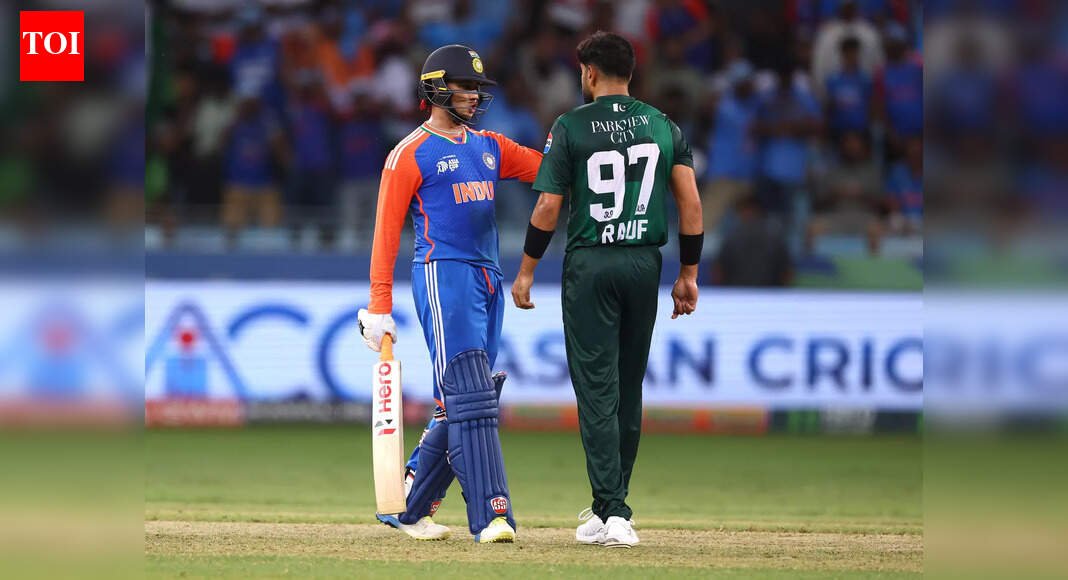
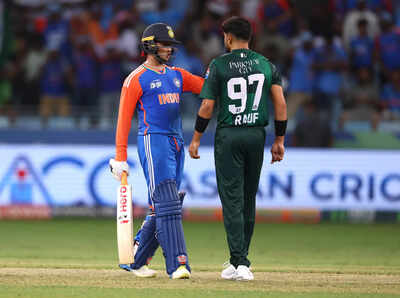
Abhishek Sharma of India speaks to Haris Rauf of Pakistan (Photo by Francois Nel/Getty Images)

Former Pakistan off-spinner Saeed Ajmal has launched a strong critique of the International Cricket Council, warning that the global governing body risks losing its relevance if it continues to function under what he described as the dominance of the Indian cricket board. Speaking to the media at a public function, Ajmal questioned the ICC’s ability to take independent and impartial decisions in the interest of world cricket. As quoted by PTI, Ajmal said the council’s existence would be pointless if it cannot assert its authority. “If the ICC can’t enforce its decisions on the Indian board then its very existence is unnecessary,” he said.

Harshit Rana press conference: ‘Team wants to groom me as an all-rounder’

Ajmal claimed that many Test-playing nations privately share this view but are reluctant to speak openly about it. He argued that the ICC’s agreement with India’s refusal to play in Pakistan, even during global tournaments, exposes the governing body’s lack of control. “There is no logical reason for India not to play in Pakistan but the ICC is helpless because it is dominated by Indians now,” Ajmal alleged. India’s refusal to tour Pakistan is based on security concerns and the Indian government’s decision not to approve bilateral sporting ties between the two countries. As a result, India-Pakistan cricket has been restricted to ICC white-ball events and has taken place only at neutral venues. Relations between the two nations deteriorated further last year following the Pahalgam terror attack, pushing bilateral cricket ties to their lowest point. Ajmal’s remarks come at a time when the ICC is headed by former BCCI secretary Jay Shah, a factor that has often been cited by critics questioning the balance of power within global cricket administration.


Source link

Bengal SIR: Supreme Court seeks EC reply on Trinamool MPs’ pleas alleging ‘arbitrariness’; next hearing on Jan 19 | India News


Bengal SIR: Supreme Court seeks EC reply on Trinamool MPs' pleas alleging 'arbitrariness'; next hearing on Jan 19

NEW DELHI: The Supreme Court on Monday granted the Election Commission of India (ECI) one week to respond to fresh interim pleas filed by two Trinamool Congress (TMC) MPs, alleging “arbitrariness and procedural lapses” in the Special Intensive Revision (SIR) of electoral rolls in the party-run West Bengal.A bench comprising Chief Justice of India (CJI) Surya Kant and Justice Joymalya Bagchi rejected ECI’s request for two weeks and directed it to file a common response to the interim pleas filed by TMC MPs Derek O’Brien and Dola Sen. The bench listed the plea for hearing on January 19.In his plea, O’Brien contended that the ECI is issuing instructions for SIR through “extra-statutory” means such as WhatsApp messages and oral directions during video conferences, instead of formal written orders. Drawing the CJI-led bench’s attention to this, his counsel, senior advocate Kapil Sibal, said such practices compel booth-level officers (BLOs) to act without lawful authorisation.Sibal added that the ECI has introduced a new category of voters termed “logical discrepancies”, under which electors may be issued notices for quasi-judicial hearings on alleged errors in voter details, without any statutory backing.“The draft electoral roll published on December 16, 2025, led to the deletion of 58,20,898 names without notice or personal hearing. Nearly 31,68,424 voters could not be mapped with the 2002 electoral roll and that notices were proposed to be issued to about 1.36 crore electors under the ‘logical discrepancies’ category,” O’Brien’s application stated.The Rajya Sabha MP has sought directions to extend the January 15 deadline for filing claims and objections, restrain the ECI from issuing instructions through informal channels, and declare such instructions illegal. The plea also flagged long queues, unclear documentation requirements, restrictions on party booth-level agents, and hardship to senior citizens, persons with disabilities and medically unwell voters.A separate plea filed by his party and Rajya Sabha colleague Dola Sen similarly challenges the SIR as arbitrary and unconstitutional, warning of wrongful deletion of genuine voters.The West Bengal assembly elections are expected to be held in April–May. The Trinamool Congress, which has been in power since 2011 under chief minister Mamata Banerjee, the party supremo, will be seeking a fourth consecutive term.(With PTI inputs)


Source link

Chinese tech leaders admit US export controls are a problem; say chances of beating OpenAI, Anthropic and other US tech giants are …


Chinese tech leaders admit US export controls are a problem; say chances of beating OpenAI, Anthropic and other US tech giants are ...

Contrary to what tech leaders like Jensen Huang and Eric Schmidt, some Chinese tech leaders are now saying China is unlikely to eclipse the US in the AI race. According to a report by Bloomberg, Justin Lin, head of Alibaba Group Holding Ltd.’s Qwen series of open-source models has said that currently there are less than 20% chances of any Chinese company surpassing US companies like OpenAI and Anthropic. Speaking at a panel at the AGI-Next summit in Beijing, lin said “A massive amount of OpenAI’s compute is dedicated to next-generation research, whereas we are stretched thin — just meeting delivery demands consumes most of our resources.” “It’s an age-old question: does innovation happen in the hands of the rich, or the poor?,” he stated.Lin’s concern was shared by leaders at Tencent Holdings Ltd. and Zhipu AI who were also present at the event. The report quotes Tang Jie, Zhipu’s founder and chief AI scientist, and Yao Shunyu, who recently joined Tencent from OpenAI to lead the AI push for China’s most valuable company. “We just released some open-source models, and some might feel excited, thinking Chinese models have surpassed the US. But the real answer is that the gap may actually be widening,” Tang said as quoted in the Bloomberg report. Core restrictionsChinese leaders cited limited resources and US export controls on chips and lithography equipment as major restrictions that could limit China’s AI growth. Tencent’s Yao Shunyu urged his industry peers to focus on the bottlenecks of next-generation models — such as long-term memory and self-learning. Yang, on the other hand, referred to artificial general intelligence (AGI) stating: “We should represent China to push AGI further for the world”, adding “Meaningless internal competition serves no purpose”. During the summit, the tech leaders also explained where they plan to focus their efforts in the coming year. Yao said he is helping Tencent use AI to create more value for its large user base, such as by connecting the company’s Yuanbao assistant with users’ WeChat chat history.Lin, on the other hand, highlighted Alibaba’s bet on multimodality and real-world agents.


Source link

BMC polls: From ‘Daddy’ to ‘Didi’, Arun Gawli legacy faces test in Dagdi chawl; Geeta seeks fourth term | Mumbai News


Backed by Daddy, Didi Geeta Gawli seeks her 4th term with focus on redevelopment (Right)

MUMBAI: Wearing her trademark oversized sunglasses, Geeta Gawli strides out of the gate of Dagdi chawl in Byculla, the once-feared lair of her father, former underworld don turned politician Arun Gawli. At the peak of his reign of terror, Arun Gawli earned the unlikely sobriquet “Daddy”, while his wife Asha was referred to as “Mummy”. Geeta, who is standing for her fourth term as corporator, is on her evening campaign rounds and asks for votes as “Didi”.Geeta is contesting from ward 112, while her younger sister Yogita will make her electoral debut from the adjoining ward. Their father, Arun Gawli, founded the Akhil Bharatiya Sena (ABS) and was an MLA from Chichpokli from 2004 to 2009. He was present when they filed their nomination forms but stays away from the daily rounds of campaigning. His photos, wearing a Gandhi topi and white kurta pyjama, are on all the campaign posters.

Mumbai Headlines Today — The Biggest Updates You Need to Know.

Geeta’s ward is in the city’s erstwhile mill precinct in Central Mumbai, where old chawls and dilapidated shops co-exist with gated high-rises. “I am focusing on redevelopment projects to ensure that they do not remain pending for years. During my tenure, I focused on CC roads and on providing drinking water,” says Geeta, who is accompanied by her mother. “Vote for the whistle,” blares a loudspeaker. That is the ABS election symbol. The ward has a mix of Muslim, Hindu and Dalit voters. Many in the ward say Geeta has been approachable and helpful. “She sent a recommendation to Nair Hospital to get my heart surgery done at a very subsidised rate two years ago,” says Abdul Majid from A N Traders. However, others from the ward, which has a sizeable Muslim population, are concerned that the ABS will back the BJP. “What is the point in voting for her then? It is a vote for the BJP,” says a Muslim vegetable vendor. Some in Dagdi chawl say there is still a sense of pressure to vote for Geeta because of her father’s image. “We fear the use of muscle power and dadagiri. Money power as well,” says a resident from the ward. Arun Gawli was once among the key figures in Mumbai’s underworld. He was convicted for the 2007 murder of Shiv Sena corporator Kamlakar Jamsandekar. Last year, he was released on bail after 18 years in prison. The appeal against his conviction is pending. The ward is reserved for women, and Geeta’s competitors include the Congress party’s Nazia Siddiqui and the Samajwadi Party’s Amrin Abrani. Geeta will have to contend with anti-incumbency, but she feels her consecutive terms here are an advantage. “It has helped me understand people’s problems and actually get things done,” she says.


Source link

New dating trend: What is ‘Sunset Clause’ and how can it save or kill your love life


Are you single and ready to find your forever love on dating apps? But are you also tired of endless swiping with no results? Welcome to 2026’s new dating trend: the “Sunset Clause” – that can save or kill your love life. According to reports, the Sunset Clause is where daters set expiration dates on matches and apps to protect their hearts (and time). According to QuackQuack’s survey (as reported by MidDay) of 7,583 singles aged 22-35 across Indian cities, 37% of people are now adopting time-bound dating. And so, “Sunset clause dating” is what a major of people are now trying, but does it fast-track love or doom relationships? Read on to know more about it:What is the Sunset Clause?Imagine this: You match with someone cute on a dating app. But, instead of talking for hours and letting the connection slowly lose its charm over the next few months, you agree to give it six months. If no real progress happens, you part ways gracefully. That’s the sunset clause – a relationship with a built-in expiry date unless both partners decide to commit to each other and take the relationship forward. Inspired by business contracts, daters too are now setting timelines (6 months, 1 year, or “until the right one” is found) to avoid dating aimlessly for years. Commenting on this dating trend, QuackQuack CEO Ravi Mittal says users want “outcome-based dating” over endless chats. Whether smart or heartless, the Sunset Clause makes people find clarity in their relationship.

Relationship Repair: Avoid These Common Communication Mistakes

Why 2026 is the Sunset Clause EraPost-2024 dating fatigue birthed this trend. Singles burned by ghosting, lukewarm texts, and 3-year “talking stages” declared war on wasted time. 37% of metro/suburban daters (Tier 1-3 cities) now time-box romance. No more background-app scrolling – dating became priority or delete. Talking about this, Mittal said, as reported by MidDay, “Young daters evolved from casual flings to calculated compatibility.People are now focusing more on career alignment over having shared hobbies, and similar lifestyles over having chemistry alone. The COVID-19 pandemic taught people that their time’s precious – And Sunset Clauses protect emotional bandwidth, ensuring apps serve a purpose, not procrastination.However, Sunset Clauses can also make relationships feel transactional for some. After all, you can’t time or force love. And, what’s meant to be, will be.What are your views on this new dating trend? Tell us in the comment section below.


Source link

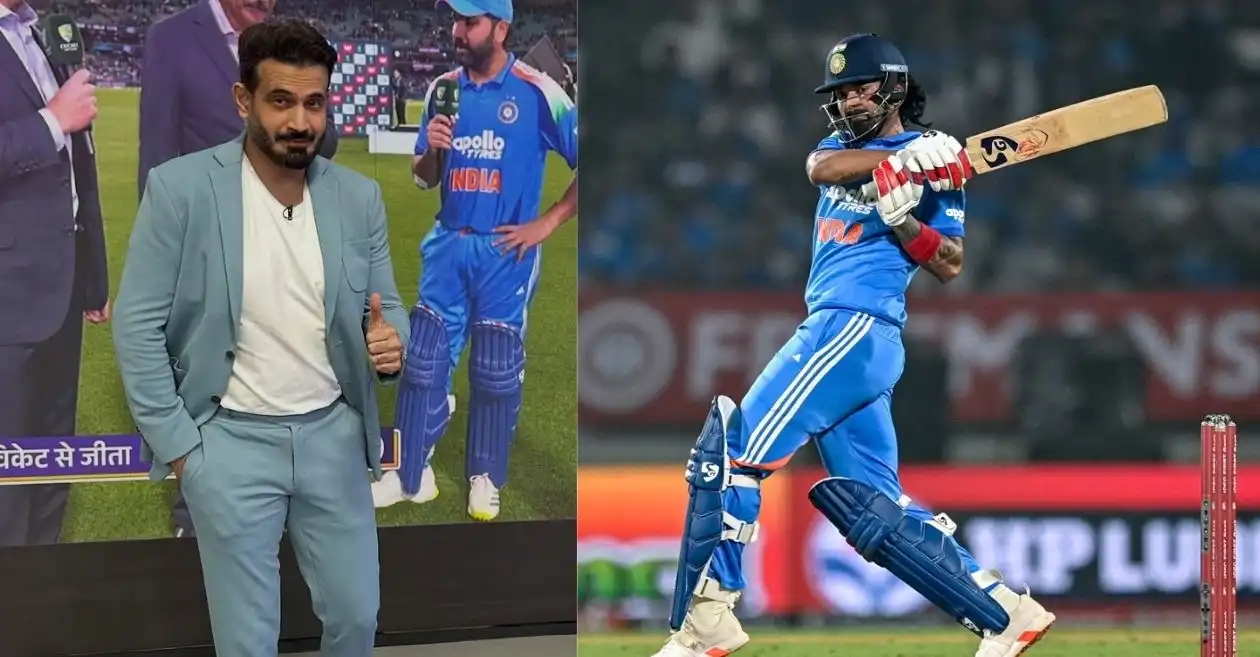
Irfan Pathan breaks down why KL Rahul at No.6 makes sense for India in ODIs


India’s victory in the opening ODI against New Zealand at Vadodara was significant not just for the result, but for the tactical conversations it triggered. One decision in particular stood out — KL Rahul being slotted at No.6. While fans debated whether a proven top-order batter was being underused, former India all-rounder Irfan Pathan has offered a detailed explanation, explaining why the move is both logical and forward-thinking in modern-day ODIs.

A tense chase sets the stage for tactical calls

Batting first, New Zealand put India under pressure with a competitive total just short of the 300-run mark. The pitch offered some grip as the innings progressed, making stroke-making less straightforward in the latter half. India’s reply was anchored by Virat Kohli, who once again showcased his ODI mastery with a fluent 93, narrowly missing out on a century. At the top, Shubman Gill provided stability, ensuring India stayed in the chase despite a few testing phases.

As wickets fell and the asking rate hovered in an uncomfortable zone, the responsibility shifted to the lower middle order to close out the game — a scenario where composure mattered more than flair.

KL Rahul’s calm presence at No.6

Walking in at No.6, Rahul immediately brought clarity to the chase. Rather than forcing boundaries, he focused on strike rotation, waited for loose deliveries, and ensured the required rate never spiralled out of control. His measured approach allowed India to cross the line with overs to spare, sealing a 1–0 lead in the three-match series.

While the innings may not have been explosive, it was precisely what the situation demanded — a controlled finish under pressure.

Also READ: Top 3 cricketers with most Player of the Match awards in ODIs ft. Virat Kohli

Irfan Pathan explains the logic behind India’s move to keep Rahul at No.6

Addressing the debate on his YouTube channel, Pathan highlighted how the evolving nature of ODIs has changed batting roles. He pointed out that with the ball now tending to reverse slightly after the 34th over — or alternatively becoming slower if reverse swing doesn’t kick in — the final phase of an innings is no longer tailor-made for pure power-hitters alone. In such conditions, technically sound batters who can manoeuvre the field and handle subtle movement become invaluable.

Pathan noted that while other batters looked slightly uncomfortable in the first ODI, Rahul appeared completely in control, underlining the value of his technique and game awareness. His ability to keep ticking the scoreboard with singles, Pathan explained, was the difference between panic and poise in a tricky chase.

“When KL Rahul bats, people often ask why he is batting so low. But we need to keep in mind that the rule has now changed because the ball reverses slightly after the 34th over. If the ball doesn’t reverse, it is slow. In those situations, a technically correct batter makes a difference. Other batters were getting slightly troubled in the first ODI, but Rahul was well in control. Rahul showed what his approach was when he kept taking singles,” said Pathan.

A role built for modern ODI cricket

Rahul’s placement at No.6 seems less like an experiment and more like a calculated strategy. With ODIs increasingly being decided in the final 15 overs, India appear keen to station their most dependable decision-makers where pressure peaks. Rather than exposing Rahul to the new ball or early aggression, the team management is backing him to finish games — a role that demands maturity, adaptability, and calm execution.

Also READ: IND vs NZ: Rib injury sidelines Washington Sundar for remainder of ODI series; replacement announced


Source link

UAE content creators can now sell globally on Amazon under new Foundry agreement


UAE content creators can now sell globally on Amazon under new Foundry agreement
Amazon launches Creators Foundry to help UAE influencers sell worldwide

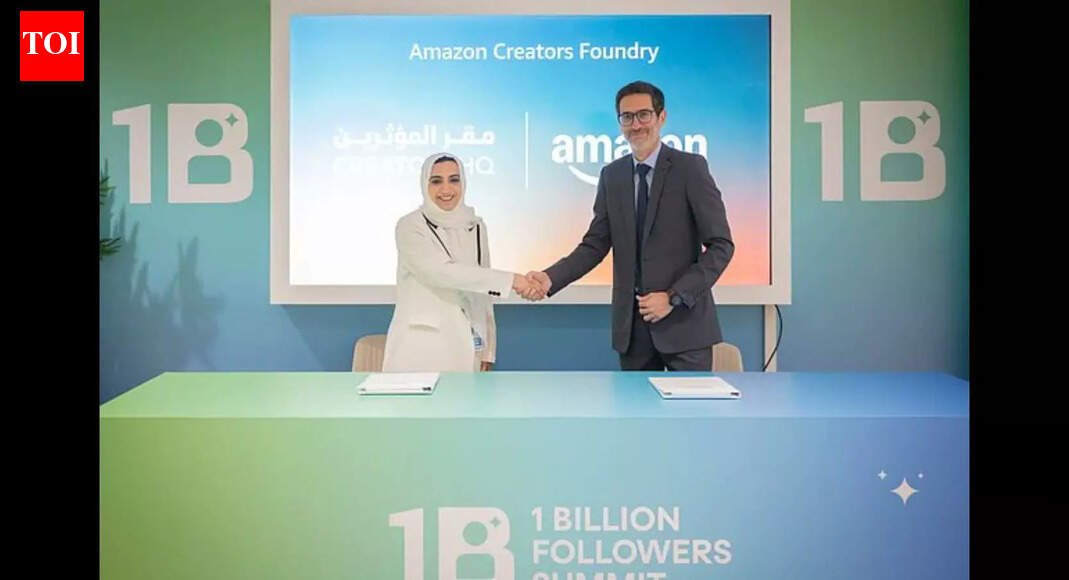
Dubai has once again positioned itself at the forefront of the global creator economy, with a major new initiative designed to help digital creators turn their influence into entrepreneurial success. On the sidelines of the fourth 1 Billion Followers Summit in Dubai, Creators HQ (the first dedicated content creators’ hub in the UAE and the Middle East) announced the launch of Amazon Creators Foundry, in partnership with Amazon Ads. It is a strategic programme aimed at enabling UAE-based content creators to build, launch and scale their own products on Amazon.ae and beyond.The Foundry announcement signals a milestone in the evolution of content creation, from traditional monetisation through ads and sponsorships to creator-led commerce, where digital personalities become product entrepreneurs and global sellers.

What is Amazon Creators Foundry?

The Amazon Creators Foundry is a comprehensive support ecosystem for creators who are already part of the Creators HQ network. It offers eligible participants:

  • End-to-end support leveraging Amazon’s marketplace infrastructure and seller tools, helping creators list, sell and scale their products on Amazon.ae.
  • Access to global selling opportunities, including the chance to list products on Amazon marketplaces worldwide through the Global Selling programme, exposing creator brands to hundreds of millions of customers.
  • Educational mentorship and training covering everything from online retail basics and product development to digital marketing, brand building, and customer acquisition strategies.
  • Dedicated storefront creation for creator brands on Amazon.ae, helping influencers establish their own retail presence.
  • Amazon Ads credits to boost visibility and reach — a crucial tool for creators transitioning from content audiences to actual paying customers.

The programme also extends into areas such as gaming and entertainment commerce, acknowledging the diverse ways creators engage their communities online.

A turning point for the creator economy

The announcement comes during the 1 Billion Followers Summit, a flagship UAE Government Media Office event that has rapidly become the world’s largest creator economy conference, attracting more than 15,000 creators and influencers with a combined audience of over 3.5 billion followers globally.This context matters as the global creator economy has matured swiftly in recent years, with influencers shifting from content monetisation models to full-fledged commerce pathways, launching products, building brands and establishing direct revenue streams tied to their personal audience influence. Amazon Creators Foundry represents a major corporate bet on this shift that essentially bridges the gap between creative influence and retail opportunity.Rayan Karaky, Managing Director of Amazon Ads for EMEA and Southeast Asia, underscored this shift, saying that the programme is designed to bridge “unique creator insights” and commercial success by leveraging Amazon’s infrastructure to help creators build scalable businesses.

Creators as entrepreneurs: A new model

What sets Amazon Creators Foundry apart is its entrepreneurial focus –

  • Product ideation and validation: Creators will be taught how to move beyond digital influence into tangible product offerings that resonate with audiences as buyers.
  • Commercialisation skills: The mentorship provided, spanning retail fundamentals to advanced digital marketing, equips creators with the tools to navigate the complexities of ecommerce, which are often challenging for individuals transitioning from purely content creation roles.
  • Global scaling opportunities: While most creator programmes remain platform-centric (tied to social media metrics and ad revenue), this programme extends creators’ reach into traditional ecommerce, potentially generating significant income beyond ad and sponsorship dollars.

This marks a key trend in the digital ecosystem: influence is no longer the end goal; it is the foundation for building commerce businesses.

Economic and strategic implications for the UAE

The collaboration also aligns with the UAE’s broader strategic vision to establish itself as a global hub for the creator economy. By facilitating creator commerce and enabling digital entrepreneurs to build retail brands that serve both the local market and international customers, the initiative supports economic diversification and digital innovation, core priorities of the UAE’s knowledge-based growth plans.Alia Al Hammadi, Vice Chairperson of the UAE Government Media Office and CEO of the 1 Billion Followers Summit, said that initiatives like Amazon Creators Foundry demonstrate how vision is translated into tangible opportunities for digital entrepreneurs. She emphasised that empowering creators to build sustainable online businesses will contribute to shaping the future of commerce while expanding the UAE’s digital economy.The programme is also expected to reinforce Dubai and the UAE’s positioning as a destination of choice for startups, tech innovators and digital talent, further enhancing the emirate’s attractiveness to global investors and young entrepreneurs alike.For UAE-based creators, the programme presents a gold-standard opportunity:

  1. Real-world monetisation: Creators get not just visibility but the tools to convert audiences into customers, a challenge that even large influencers often struggle with.
  2. Business education: The mentorship programme covering product ideation, marketing, brand building and customer acquisition is arguably more structured and business-oriented than most creator economy initiatives.
  3. E-commerce integration: By leveraging Amazon’s global infrastructure, creators can bypass many common barriers faced by independent ecommerce entrepreneurs, such as logistics, payment processing and marketplace compliance.
  4. Competitive differentiation: The backing of Amazon, one of the world’s largest retail platforms, gives early adopters a significant edge in commerce execution compared with creators who remain solely dependent on platform monetisation.

Amazon Creators Foundry arrives at a moment when content and commerce are converging rapidly. Traditional ecommerce models focus on product discovery through search and paid advertising; creator-led commerce leverages trust, community and personality-driven influence, turning fans into buyers at higher conversion rates.This fusion is already visible in trends where creator partnerships significantly elevate brand visibility and sales performance and with the Foundry, creators can own the products, not just promote them. By empowering creators as brand owners and retail operators, the initiative could serve as a template for global expansion of creator economy infrastructure, not just in the UAE but in other markets where talent and digital influence intersect with ecommerce potential.

Bottom line: A new chapter in content entrepreneurship

The launch of Amazon Creators Foundry is more than a programme. It is a symbolic shift in how modern digital economies view creators. No longer just content producers, creators are being recognised as founders, product innovators and commerce leaders.For UAE creators, this initiative offers a bridge from digital influence to business ownership with global reach. For Amazon, it represents a strategic investment in the creator economy as a next frontier of retail growth and for the broader ecosystem, it signals that the future of ecommerce lies at the intersection of creativity, community and commerce.


Source link

Project-75I: How India’s $8 billion submarine upgrade reshapes the Pakistan, China equation | India News


Project-75I: How India’s $8 billion submarine upgrade reshapes the Pakistan, China equation

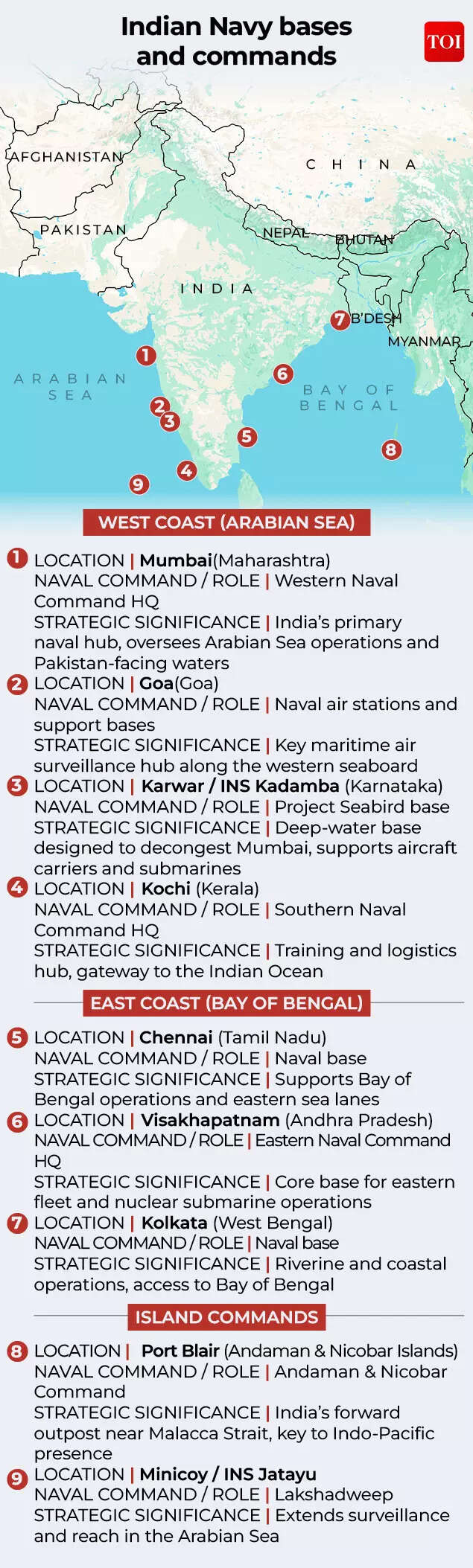
NEW DELHI: More than five decades after Indian naval strikes crippled Karachi during the 1971 war, undersea power is once again at the heart of New Delhi’s strategic thinking. As German Chancellor Friedrich Merz began his visit to India on Monday amid a more volatile regional and global security environment, discussions around Project-75I have acquired fresh urgency.The Indian Navy’s plan to induct six next-generation conventional submarines equipped with air-independent propulsion reflects a convergence of hard lessons from history, renewed friction with Pakistan following recent crises, and China’s expanding undersea presence in the Indian Ocean. Together, these factors are pushing India towards one of its most consequential naval procurement decisions in years, one that blends deterrence, indigenisation and long-term strategic signalling.

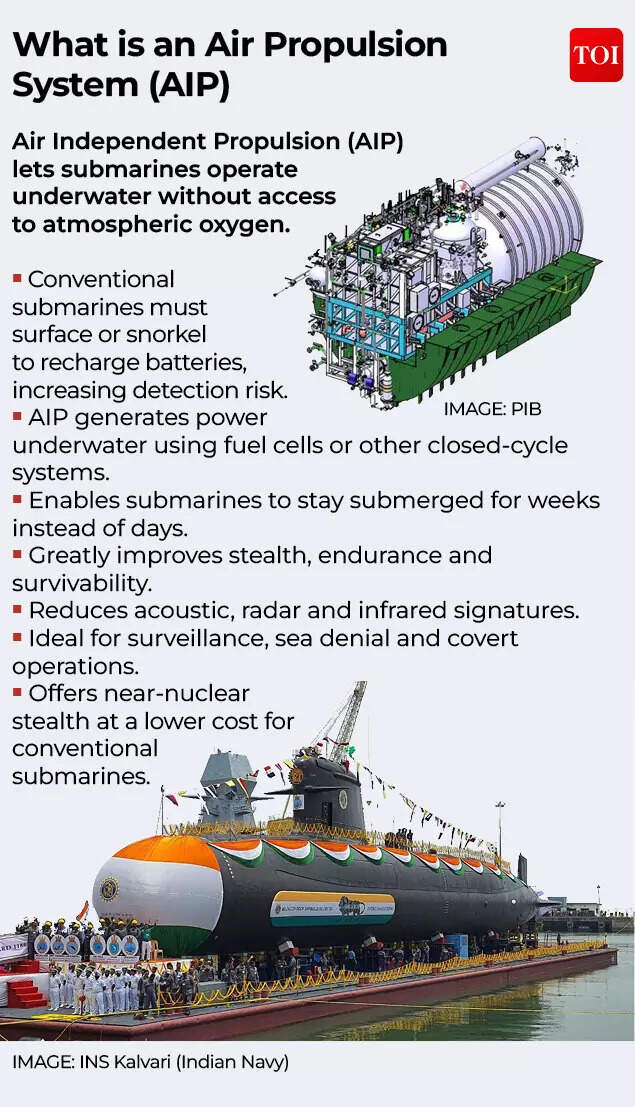
What is Air Propulsion system

What is Project-75I and why it matters

Project-75I is the Indian Navy’s flagship programme to build six modern diesel-electric submarines equipped with fuel-cell-based air-independent propulsion, advanced sensors, torpedoes and missile systems. The Ministry of Defence issued the Request for Proposal for the project in July 2021 under the Strategic Partnership Model, describing it as a key pillar of the government’s Make in India push, according to a PIB statement.

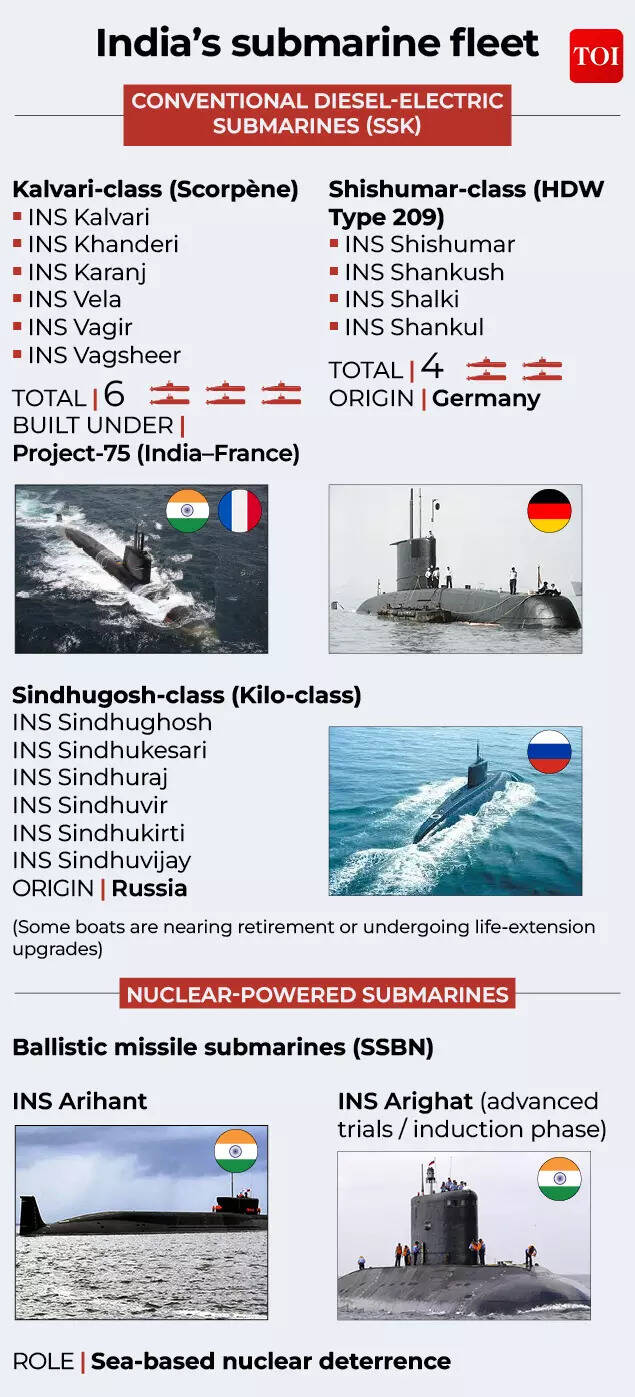
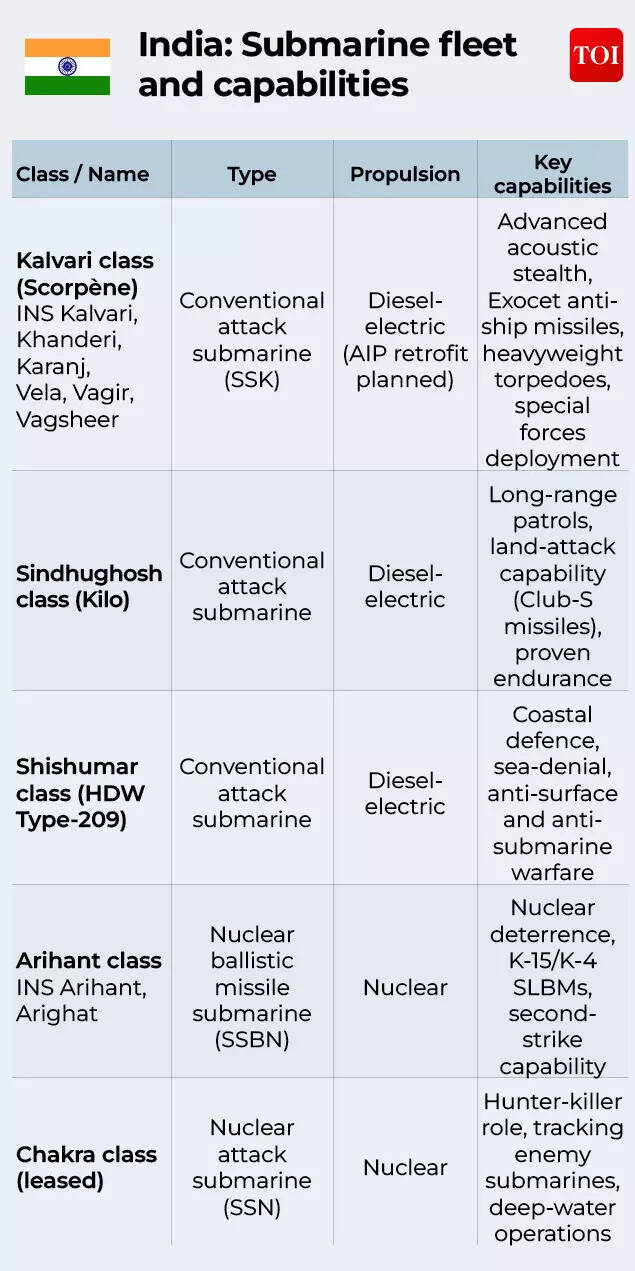
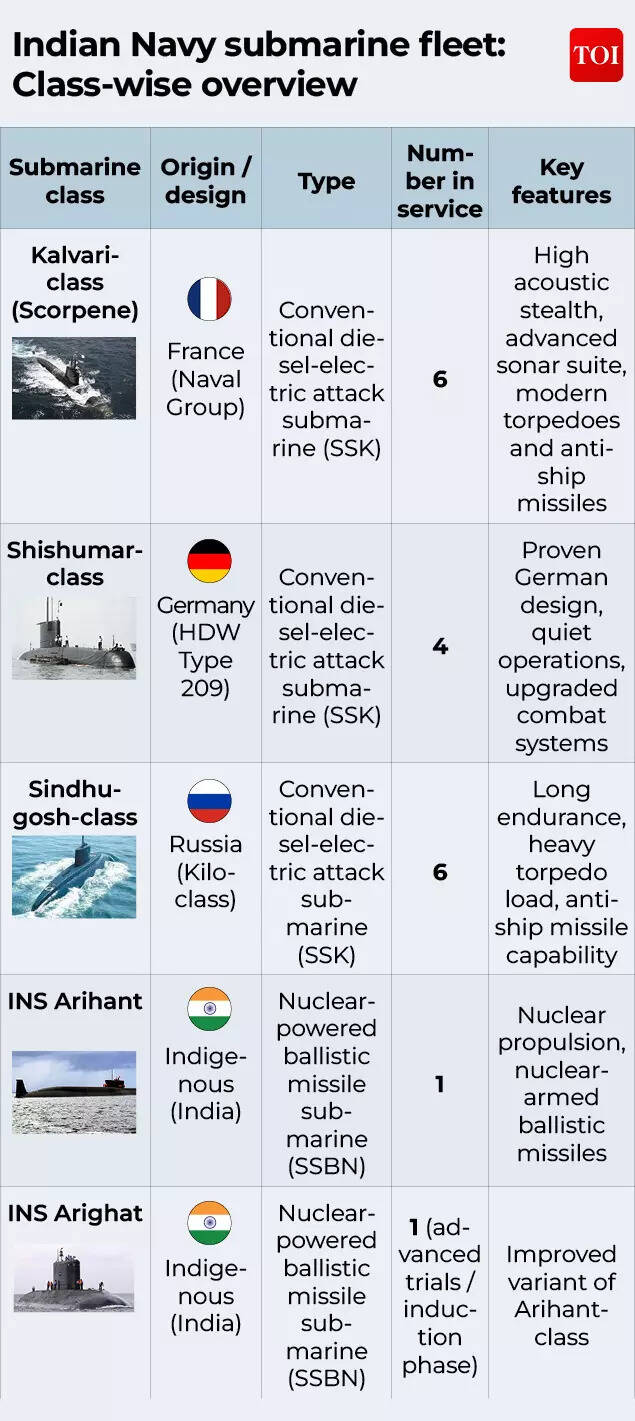
India's submarine fleet

The project envisages indigenous construction, long-term technology transfer and the creation of a domestic submarine-building ecosystem. The estimated cost was over Rs 40,000 crore at the RFP stage, with current assessments placing the final contract value closer to $8 billion, or about Rs 72,000 crore, based on configuration and lifecycle support.For the Indian Navy, the programme addresses a critical gap. Its conventional submarine fleet is ageing even as undersea activity by China and Pakistan increases in the Indian Ocean and along India’s maritime approaches.

Why the German Type-214NG was selected

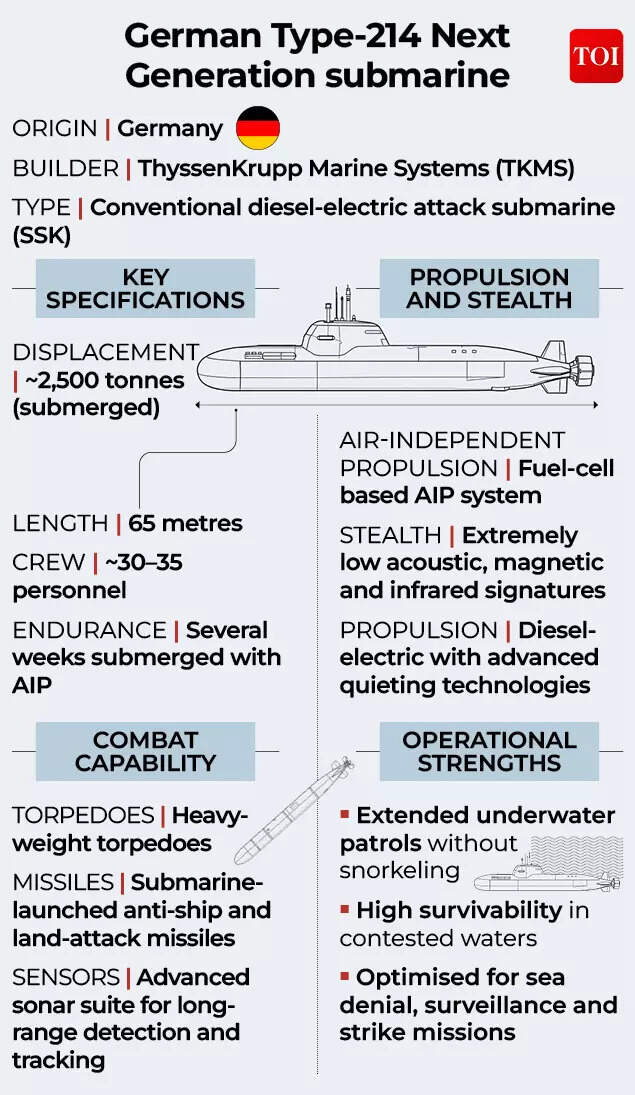
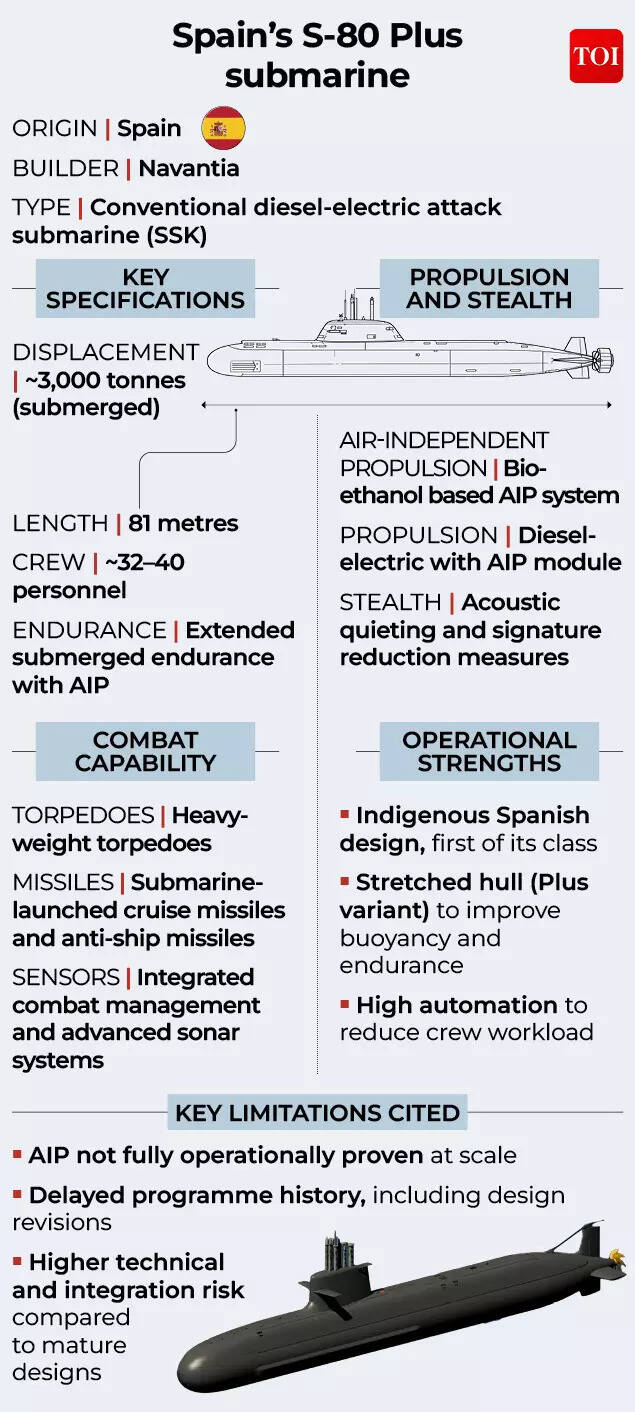
The Indian Navy has selected the German Type-214 Next Generation submarine, edging out Spain’s S-80 Plus offered by Navantia, defence sources said. The decision was driven primarily by the maturity of the German fuel-cell-based AIP system, acoustic stealth and lower lifecycle risk.

German Type-214 next gen submarine

AIP allows submarines to remain submerged for weeks without surfacing or snorkeling, reducing detection risk. In contested waters, endurance and silence are decisive. The Type-214’s AIP technology is widely regarded as operationally proven, while competing systems are still undergoing validation.In undersea warfare, reliability and survivability often outweigh novelty. That calculus appears to have guided the Navy’s choice.

Spain's S-80 plus submarine

Make in India at the core

Under the proposed framework, all six submarines will be built in India at MDL, with TKMS providing design authority, engineering expertise and technical consultancy. Indigenous content is expected to start at around 45 percent and rise to nearly 60 percent by the final boat, aligning with Atmanirbhar Bharat goals.TKMS and MDL signed a memorandum of understanding in June last year to jointly pursue the project, laying the groundwork for the partnership. MDL’s prior experience building Scorpène-class submarines under the earlier Project-75 strengthened its case as the Indian strategic partner.

.

The ministry of defence has repeatedly stressed that Project-75I is not only about acquiring platforms but about absorbing complex submarine design and construction technologies, as outlined in the 2021 PIB release.

Pakistan, Karachi and the logic of sea denial

India’s emphasis on undersea capability is rooted in history. During the 1971 war, the Indian Navy’s attacks on Karachi port crippled Pakistan’s maritime logistics and fuel supply, accelerating Islamabad’s defeat. That episode stressed how control of the seas can shape outcomes on land.The relevance of that lesson resurfaced during Operation Sindoor in May 2025, when tensions with Pakistan escalated following a major terror provocation. Between May 8 and May 11, India placed its naval forces on heightened readiness, with Karachi again emerging as Pakistan’s most critical vulnerability.

.

Karachi handles the bulk of Pakistan’s maritime trade and energy imports. India’s ability to credibly threaten that hub, even without firing a shot, highlighted the deterrent value of naval and undersea power. New submarines with extended underwater endurance would sharpen that leverage.

.

China’s expanding undersea footprint

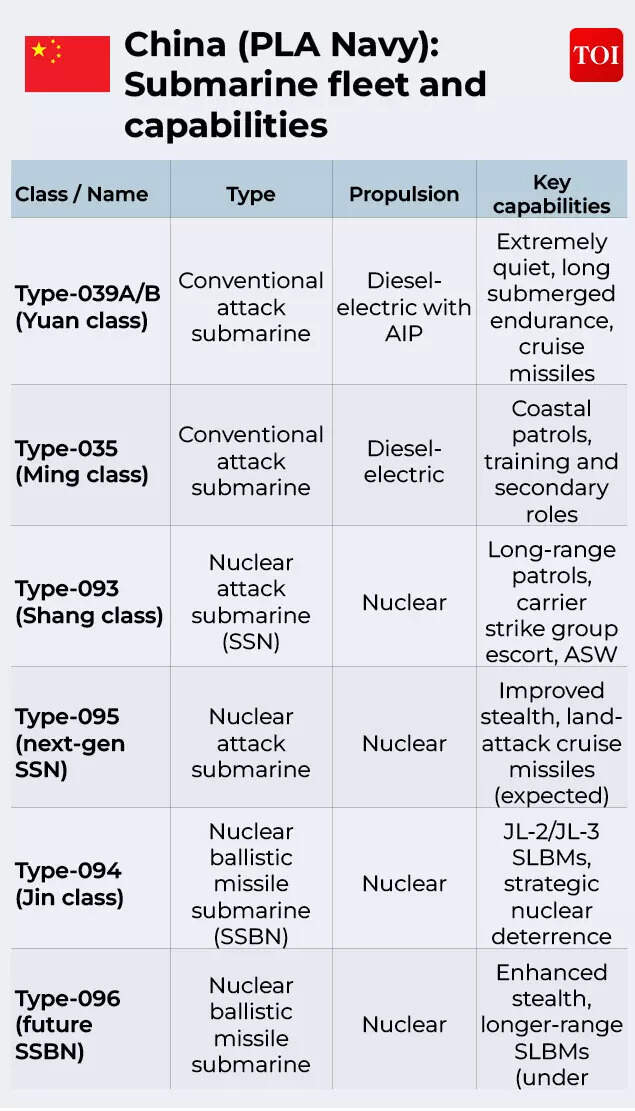
Beyond Pakistan, China looms large in India’s maritime threat assessment. The People’s Liberation Army Navy operates a rapidly expanding submarine fleet, including nuclear-powered platforms that have increasingly deployed into the Indian Ocean.

.

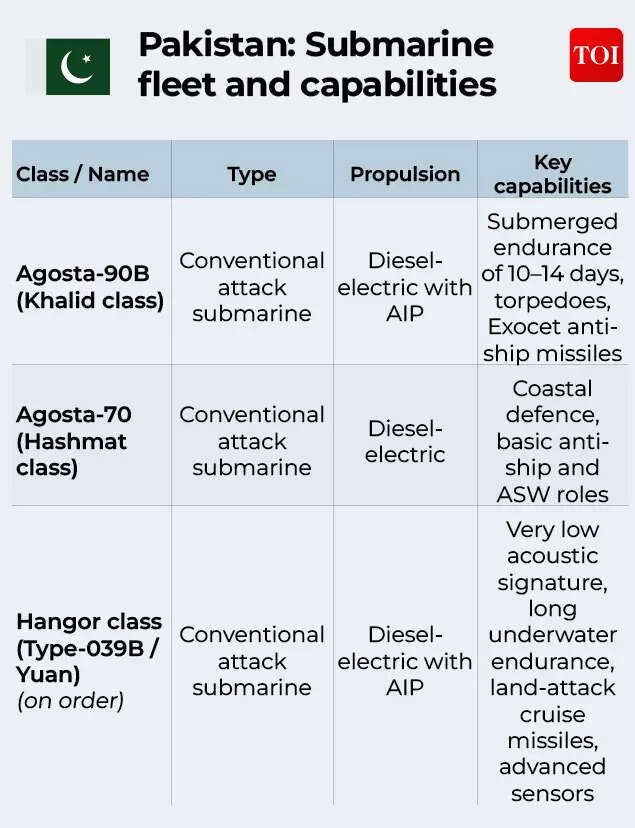
Chinese submarines have docked at regional ports and conducted patrols close to Indian waters, while Pakistan, with Chinese assistance, is also upgrading its submarine arm. For Indian planners, this twin challenge has made restoring conventional submarine strength an urgent priority.

.

Project-75I is designed to plug that gap by giving India a survivable, persistent undersea capability suited to monitoring choke points, tracking adversary submarines and conducting sea-denial operations.

Strategic timing of Merz’s visit

Chancellor Merz’s visit from January 12–13 comes amid a broader effort by Germany to expand its strategic footprint in the Indo-Pacific. Berlin and New Delhi are also working toward an EU-India free trade agreement, as noted by AFP.For India, the potential submarine deal fits into a wider diversification of defence partnerships beyond legacy suppliers such as Russia. For Germany, it represents an opportunity to anchor a long-term industrial and security relationship with the world’s largest democracy.According to informed defence sources cited by idrw.org, the final contract is not expected to be signed during Merz’s visit but could be concluded within the next three months, with the high-level engagement expected to provide political momentum.

.

French-origin Scorpene follow-on plan put on hold as Project-75I gained priority

In October 2025, India put on hold plans to build three additional French-origin Scorpene submarines at Mazagon Dock Shipbuilders Limited, even as it moved decisively to push ahead with Project-75I, which envisages the construction of six new-generation German-origin diesel-electric submarines at the same shipyard, The Times of India reported.Top government sources told TOI that the proposal for the three additional Scorpenes, estimated to cost around Rs 36,000 crore, “was not being pursued” at the time, although a formal decision to scrap it had not been recorded. While cost negotiations for the Scorpene follow-on order had concluded in the previous fiscal, final clearance from the Prime Minister-led Cabinet Committee on Security remained on hold.Officials told TOI that the German submarines under Project-75I were considered “a generation ahead” in terms of technology and capability. Concerns also existed about MDL’s ability to simultaneously execute two complex submarine construction programmes. The six original Kalvari-class submarines had already been built at MDL under the earlier Project-75 contract signed in October 2005, with the first boat INS Kalvari commissioned in December 2017 and the sixth, INS Vagsheer, inducted in January 2025.All six Kalvari-class submarines were slated to be retrofitted with the DRDO-developed air-independent propulsion system to improve underwater endurance. AIP allows a diesel-electric submarine to remain submerged for nearly two weeks, compared to boats without the system that must surface or snorkel every few days to recharge batteries.In contrast, the submarines planned under Project-75I, to be built in partnership with Germany’s ThyssenKrupp Marine Systems, were designed to incorporate AIP from the outset, along with land-attack cruise missiles and other next-generation technologies, TOI reported.Sources told TOI that the decision to proceed with final techno-commercial negotiations for the six German submarines, with an option for three more at a later stage, followed extensive deliberations involving the defence ministry, the Navy and the National Security Council Secretariat. Formal contract negotiations began in September 2025.“These new-generation boats under P-75I will come with design ToT (transfer of technology) and a greater indigenisation level of around 60%. The project will serve as a bridge to the future P-76, under which conventional submarines will be constructed based on totally indigenous design,” a source told TOI.Despite the pause on the Scorpene extension, officials indicated that France’s broader strategic partnership with India remained strong. Negotiations progressed on additional Rafale fighters for the Indian Air Force’s proposed 114 multi-role fighter aircraft programme, as well as a collaboration to co-develop a powerful jet engine with French major Safran for India’s fifth-generation Advanced Medium Combat Aircraft was nearly finalised.At the time, the Navy’s conventional submarine strength stood at six Scorpenes, six ageing Russian Kilo-class boats and four German HDW submarines, alongside two nuclear-powered ballistic missile submarines. China, by comparison, operated more than 50 diesel-electric and around 10 nuclear submarines and was in the process of supplying eight Yuan-class AIP-equipped submarines to Pakistan, a development seen as a major capability boost for Islamabad, TOI reported.

Long-term impact on India’s naval posture

Once inducted, the six Type-214NG submarines will significantly enhance the Indian Navy’s capacity for covert surveillance, sea denial and precision strike missions. Their sensors, weapons and endurance will form a key layer of India’s maritime deterrence architecture.Equally important is the industrial legacy. By absorbing advanced submarine technologies, India positions itself for future indigenous designs and follow-on projects. MDL’s role would be strengthened, and a specialised domestic supply chain would be deepened.

.

Project-75I marks one of the most consequential naval procurement decisions India has taken in years. It addresses hard lessons from 1971, recent operational realities with Pakistan, and the growing challenge posed by China’s undersea expansion.As Germany’s chancellor arrives in India, the submarine negotiations underscore how defence industrial cooperation has become central to New Delhi’s foreign policy. From Karachi’s burning docks in 1971 to the silent depths of the Indian Ocean today, India’s maritime strategy is being reshaped through capability, indigenisation and strategic foresight.


Source link

“I didn’t ditch him – he cheated me”: MC Mary Kom addresses affair rumours amid divorce from Onler Kom


“I didn’t ditch him - he cheated me”: MC Mary Kom addresses affair rumours amid divorce from Onler Kom
Photo: Mary Kom / Instagram

Legendary Indian boxer MC Mary Kom is making headlines these days, however, it is for a sad reason – her recent divorce with former husband Onler Kom after almost 20 years of marriage and having four children together! That’s a split that no one saw coming, and so the news has stunned many. In a new bombshell interview with Rajat Sharma on Aap Ki Adalat, the six-time world boxing champ and Olympic bronze medalist, Mary Kom didn’t hold back as the host grilled her about divorce drama, financial betrayal, and steamy affair allegations with business manager Hitesh Choudhary. From “he drank all day” to “my bank account was…”, Mary’s raw emotion shocked people. Here’s what she revealed while sharing her side of the story:“He never earned a penny!” – Mary Kom’s marriage shockerAfter roughly 20 years of marriage, and four kids (three sons including twins, one daughter who is the youngest), and Mary Kom said that she discovered her ex-husband, Onler Kom was living off her glory. When Sharma asked, “Is Mary Kom selfish? That’s what people are saying– that after becoming successful and rich, you ditched your husband…” To which Mary Kom replied, “I did not ditch him. He cheated and ditched me. For the last two years (since her divorce with Onler) I kept this a secret.”“My hard-earned money – he didn’t contribute ONE rupee!” she claimed. “He has no successful career. He plays street football, and so do many people; that doesn’t make you Bhaichung Bhutia or Sunil Chhetri!”The breaking point in her marriage came when she was bedridden post-injury, before the 2022 Commonwealth Games. “God gave me this injury for the better,” she said. Mary Kom further revealed that she caught her ex-husband red-handed: Onler withdrew INR 10 lakhs from her account, switched off his phone, and later lied about “just taking INR 30,000,” from a bank account which he was closing. These betrayals happened repeatedly, which took a toll on their marriage. She also spoke up about the election fiasco, wherein she shelled out INR 5-6 crores for Onler’s MLA dreams. “I don’t even like politics!” she said. Meanwhile, Onler took loans in her name, and drank daily – which slowly crumbled their marriage.

Mary Kom with her ex-husband Onler Kom in happier times

“I sacrificed my life to earn money, I sacrificed seeing my kids grow up… and he betrayed me! So, how can I be happy with such a man?,” Mary said.Revealing that her four children are with her, and she is the one taking care of them she said that her kids chose her post-divorce. “They’re with me – I handle ALL expenses,” she clarified. Onler’s “great dad” PR? “Maids cared for them – he just slept,” she said.Is Mary Kom dating again? The affair allegation that broke the internetRajat Sharma went on to ask, “There are allegations that you’re having an affair with your business manager Hitesh Choudhary (that broke your marriage)…” To which Mary replied, “He came into my life after I divorced Onler; later, this allegation of having an affair was made against me. But the truth is that for the last two years, after we got a divorced we have been living quite amicably!”But it was the church shaming that stung the deepest, Mary shared. Christian by faith, Mary’s Kumbh Mela, Shirdi trips and a visit to a sufi shrine created a lot of furore, “Even our PM Modi celebrates Christmas!” she fired back.While social media empathised with Onler, Mary said she was shown as a villain. Talking about how it impacted her, Mary said, “All I have to tell people is that– it doesn’t matter if you support me or not. You will get to know the truth one day or the other. I’m a fighter, I will fight.”Which side are you on– Team Mary or sympathising for Onler? Tell us in the comment section below.


Source link