Breaking News
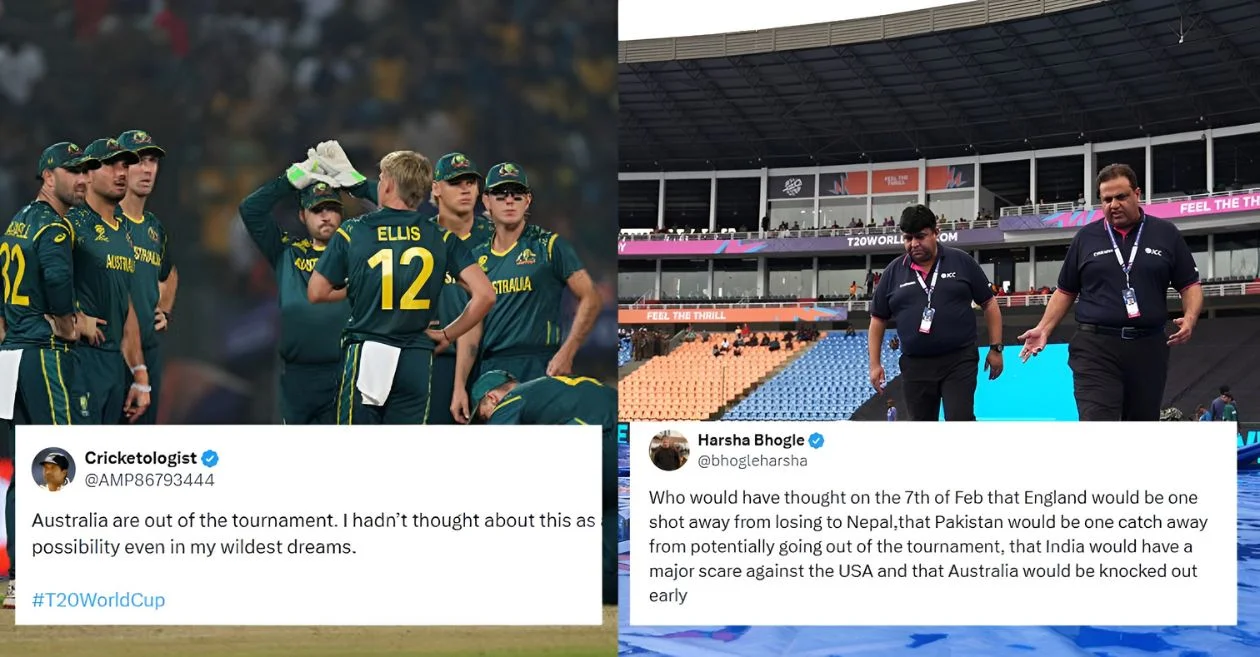
Fans react as Australia faces elimination from T20 World Cup 2026 after rain washes Ireland vs Zimbabwe clash in Pallekele


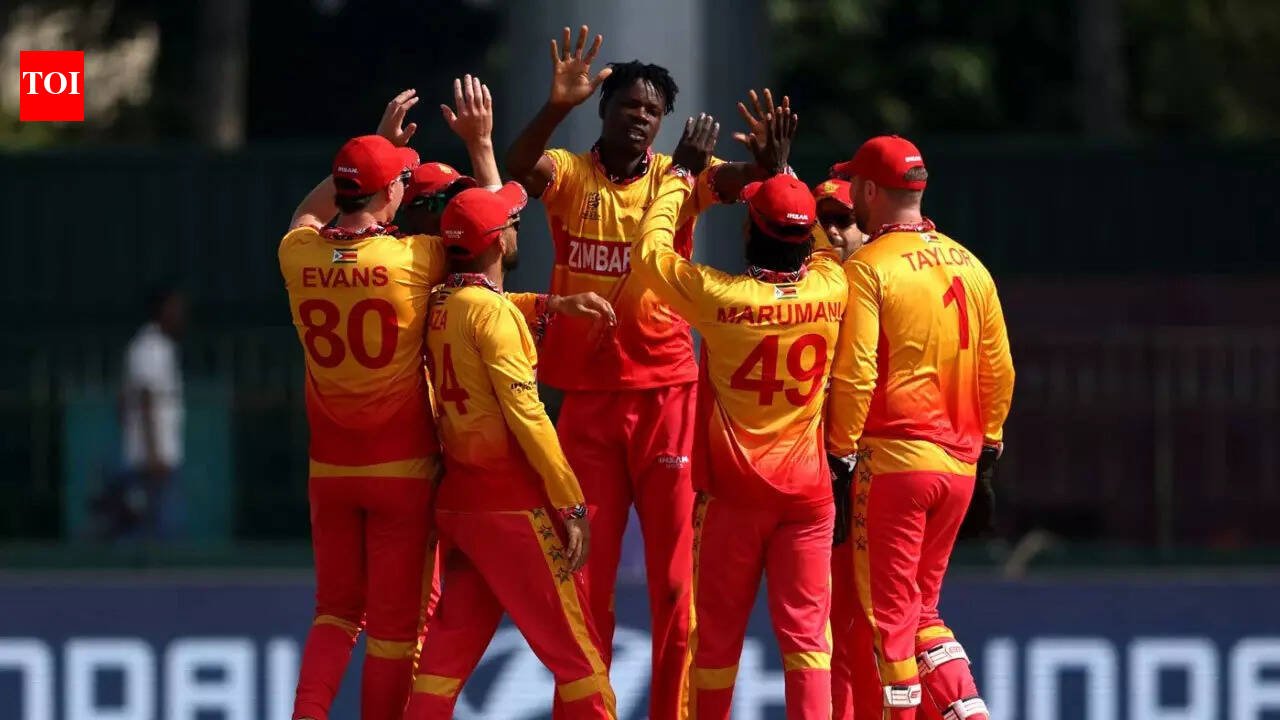
In a dramatic turn of events at the Pallekele International Cricket Stadium on February 17, 2026, rain has officially knocked Australia and Ireland out of the T20 World Cup 2026. Persistent showers throughout the day meant that the crucial Group B clash between Zimbabwe and Ireland was abandoned without a single ball being bowled.

The washout earned Zimbabwe the one point they needed to reach a total of 5 points, a tally that Australia, currently sitting on 2 points with only one game remaining, cannot possibly match. This soggy conclusion to the day’s events has finalized Group B, confirming Zimbabwe’s historic progression alongside co-hosts Sri Lanka, and leaving the 2021 champions to contemplate their earliest tournament exit in nearly two decades.

Rain-ruined hopes in Pallekele: Australia’s second-ever group stage exit in T20 World Cup history

The Australian campaign, which had already been pushed to the brink following shock back-to-back defeats against Zimbabwe and Sri Lanka, has officially met its demise in the Pallekele rain. With only one remaining fixture against Oman on February 20, Mitchell Marsh’s side can now only reach a maximum of 4 points, leaving them stranded behind Zimbabwe’s 5 and Sri Lanka’s 6.

This marks only the second time in T20 World Cup history that the Men from Down Under have failed to progress past the opening round, a feat previously seen only in 2009. The team’s failure to adapt has been compounded by a brutal ‘groin crisis’ that sidelined captain Marsh for the opening two games and a string of late injuries to their premier pace attack, including Pat Cummins and Josh Hazlewood. Even Marsh’s valiant return against Sri Lanka, where he smashed a brisk 54, was not enough to overcome a record-breaking century by Pathum Nissanka, leaving Australia dependent on an Irish miracle that never came.

Here’s how fans reacted: 

Also READ: From Kapil Dev to Clive Lloyd – Check out the full list of 14 legendary captains demanding justice for Pakistan great Imran Khan

T20 World Cup 2026 Super 8 stage roadmap: Groups and high-stakes venues confirmed

With Zimbabwe securing the seventh ticket to the Super 8s, the second phase of the tournament is now almost entirely set, featuring a division between the two host nations. Zimbabwe’s qualification places them in Group G1, where they will travel to India to compete against tournament favorites India, South Africa and the West Indies.

Matches for this group are scheduled to be held at iconic venues including the Narendra Modi Stadium in Ahmedabad and the M.A. Chidambaram Stadium in Chennai, where spin is expected to play a decisive role.

Meanwhile, Group G2 will remain centered in Sri Lanka, consisting of Sri Lanka, England, New Zealand and the winner of the final undecided spot from Group A (Pakistan or USA). These teams will battle it out at the R. Premadasa Stadium in Colombo and the Pallekele International Cricket Stadium in Kandy, as the tournament shifts from the unpredictability of the group stage to the high-stakes pressure of the Super 8 qualifiers starting February 21.

Also READ: Top 5 youngest centurions in T20 World Cup history ft. Yuvraj Samra


Source link

Pakistan’s problem isn’t about skill or temperament — it runs much deeper | Cricket News


Pakistan's problem isn't about skill or temperament — it runs much deeper
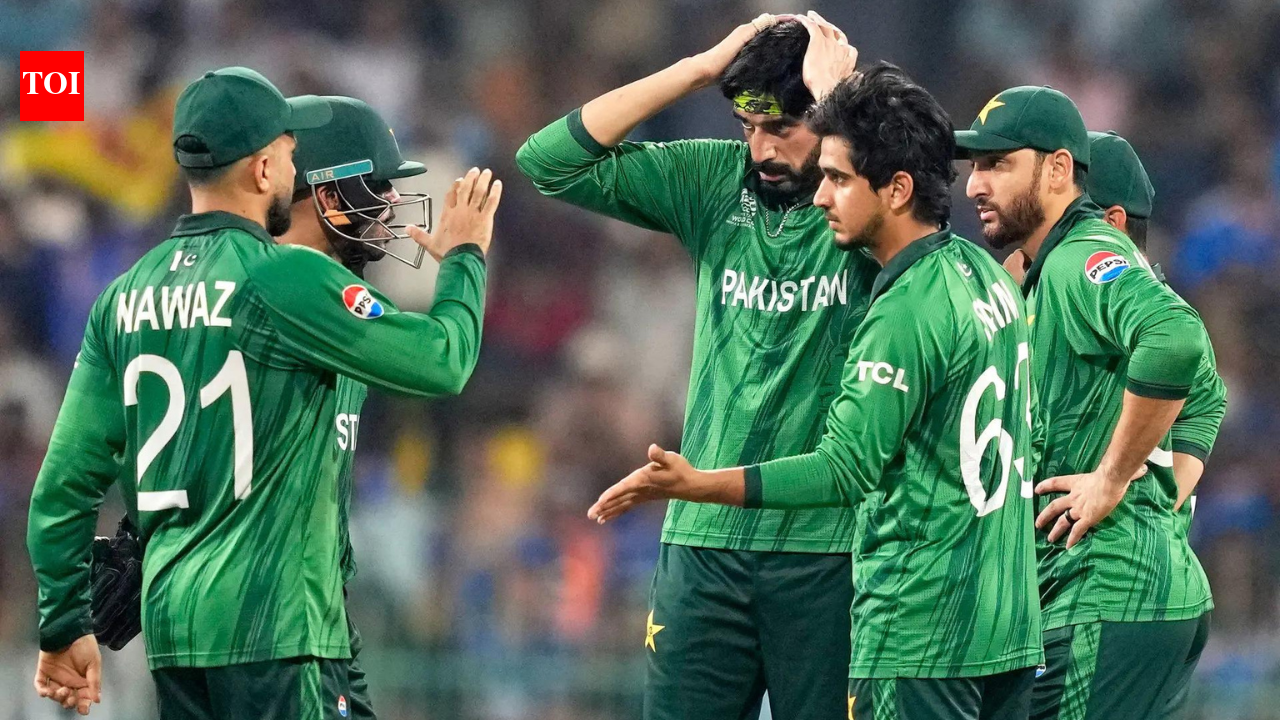
Pakistan cricket team (Agency Image)

TimesofIndia.com in Colombo: A day after their humiliating 61-run loss against India, the Pakistan cricket team looked in good spirits ahead of their clash against Namibia at the Sinhalese Sports Club (SSC) Ground in Colombo.It was a light session for the men in green after having two intense sessions before the India game.

T20 World Cup: India humiliate Pakistan again

They began training with a light football session, and the laughter, giggles and relaxed body language stood in stark contrast. During their two net sessions ahead of the India game, there were hardly any jokes. Everything was intense.The presence of Pakistan Cricket Board (PCB) chairman Mohsin Naqvi, who is also the interior minister in the Shehbaz Sharif cabinet, appeared to add to the pressure on the Salman Ali Agha-led side.It is learnt that Mohsin Naqvi hosted the team for dinner on the match eve and breakfast on match day, but left the stadium after Pakistan lost their sixth wicket. A similar episode occurred during the Asia Cup, when the board president met the players a day before the match.Pakistan coach Mike Hesson defended Mohsin Naqvi’s frequent visits before matches against India. “The chairman is a big supporter of ours and he comes along all the time and before games. I don’t think it adds extra pressure. That’s part of his role. Our guys know we are representing Pakistan,” Hesson said after the match.

Does Mohsin Naqvi’s presence add extra pressure?

It certainly does. With fewer cameras around, the players looked far more at ease at the SSC, where they will face Namibia in a must-win game. A win will take Pakistan to the Super Eight, while a loss will send them home.

Lack of clarity

Pakistan’s struggles against India are often framed as a question of temperament or selection, but the deeper issue is a chronic lack of role clarity. No team has experimented more at T20 World Cups. Pakistan have used 29 players across the last four editions, the most among Full Members.Take the example of Babar Azam. Pakistan’s loss to India was shaped by poor bowling execution and a top-order collapse, and Babar was not directly responsible. But his presence at No. 4 highlights a recurring flaw in Pakistan’s thinking, assigning roles that do not suit a player’s skill set.

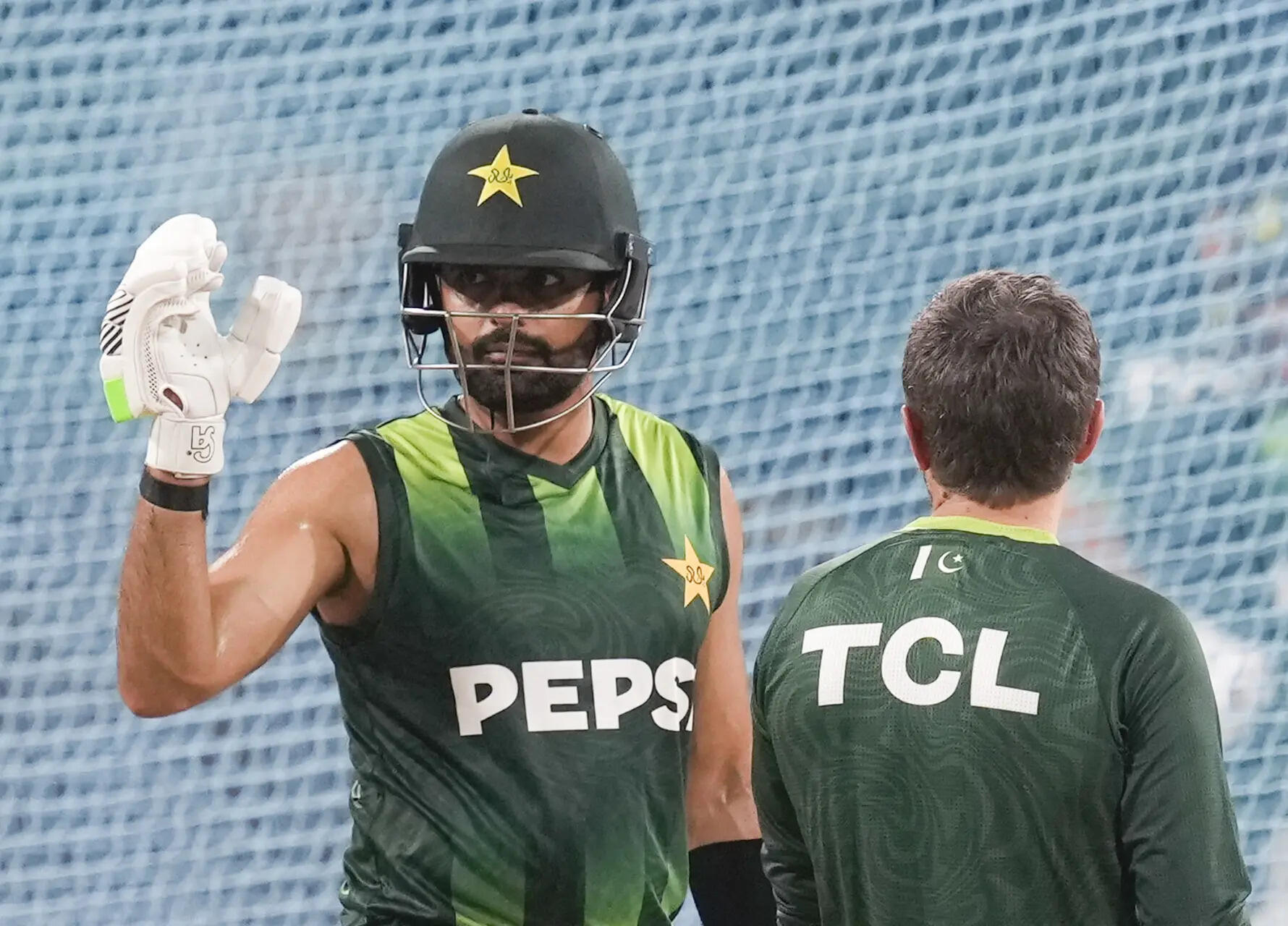
Pakistan's Babar Azam

Pakistan’s Babar Azam (PTI Photo)

Even during his peak years in T20 cricket from 2018 to 2023, Babar’s limitations were evident: a modest strike rate and difficulty accelerating against spin. There is no cricketing logic to suggest that a batter who struggles to dominate the Powerplay as an opener will suddenly flourish in the middle overs. The limited evidence supporting that idea largely comes against weakened or lower-ranked opposition.The same confusion extends to the bowling unit. Pakistan have overloaded their XI with all-rounders, seemingly to cover every scenario, but without a clear plan for when or whether they will be needed.Against India, Pakistan fielded eight bowling options, yet only three—Shaheen Afridi, Abrar Ahmed and Usman Tariq—were selected primarily for their bowling. One bowled just two overs, while another was introduced only in the 11th over, indicating a strategy heavily reliant on part-timers.Faheem Ashraf’s role sums up the muddle. He has not bowled a single over in the tournament and has delivered only four overs across his last eight T20Is. Batting at No. 8 suggests Pakistan doesn’t trust his batting either, limiting it to a brief two to three-over window.If Salman Agha was always going to open the bowling, it raises a fundamental question. Why load the XI with three additional spin-bowling all-rounders? Especially when Indian batters have consistently dominated Pakistan’s spinners, regardless of conditions.By stacking the team with spin, Pakistan put all their eggs in one basket. When Shaheen had an off day, there was no Plan B. Pakistan ended up bowling 18 overs of spin, something no other team has ever done in a T20 World Cup, and no side has ever used six spinners in a match at this level.T20 cricket has moved on. What once looked innovative, packing the XI with seven or eight bowling options, now appears counterproductive. Overloading bowlers often creates insecurity among specialists, who feel they have just an over or two to justify their place.

Clues from the nets

Watching Pakistan at the nets is fun when they are not under pressure.Naseem Shah bowled a scorching yorker to Saim Ayub, which the opener managed to squeeze out. Naseem sledged him, saying, “Match mein bhi aisa khelta” (You should have played Bumrah’s yorker like this in the match as well). Saim smiled and nodded.Shadab Khan, who conceded 17 runs in the only over he bowled, bowled mostly to Saim and kept asking questions about his lengths.Saim’s opening partner Sahibzada Farhan instructed Naseem Shah and left-arm pacer Salman Mirza to bowl back of a length. Farhan looked at ease, pulling and hooking the bowlers in the nets.Then came the skipper, not Salman Ali Agha, but Babar Azam, the former two-time captain. Shadab Khan and Abrar Ahmed kept addressing Babar as “skipper”.Captain or not, Babar remains a leader in the dressing room. He kept sharing inputs with Abrar and others. However, he looked uncomfortable when it came to power-hitting and appeared unhappy with his shot selection. Coach Mike Hesson rushed towards him, shared a few words and tried to calm him down. After a decent power-hitting session, Babar left the nets visibly upset with himself.

Pressure on Babar and Shaheen

The pressure is mounting on senior pros Babar Azam and Shaheen Shah Afridi. Babar has not hit a six against a Full Member team in T20 World Cups since the 10-wicket win over India in Dubai in 2021.The 31-year-old endured a poor Big Bash League season, scoring just 202 runs in 11 innings at a strike rate of 103.06. When Babar was dropped from Pakistan’s T20I side, Mike Hesson said he needed to perform in the BBL, where his returns were underwhelming.

Pakistan's Shaheen Afridi

Pakistan’s Shaheen Afridi (PTI Photo/Arun Sharma)

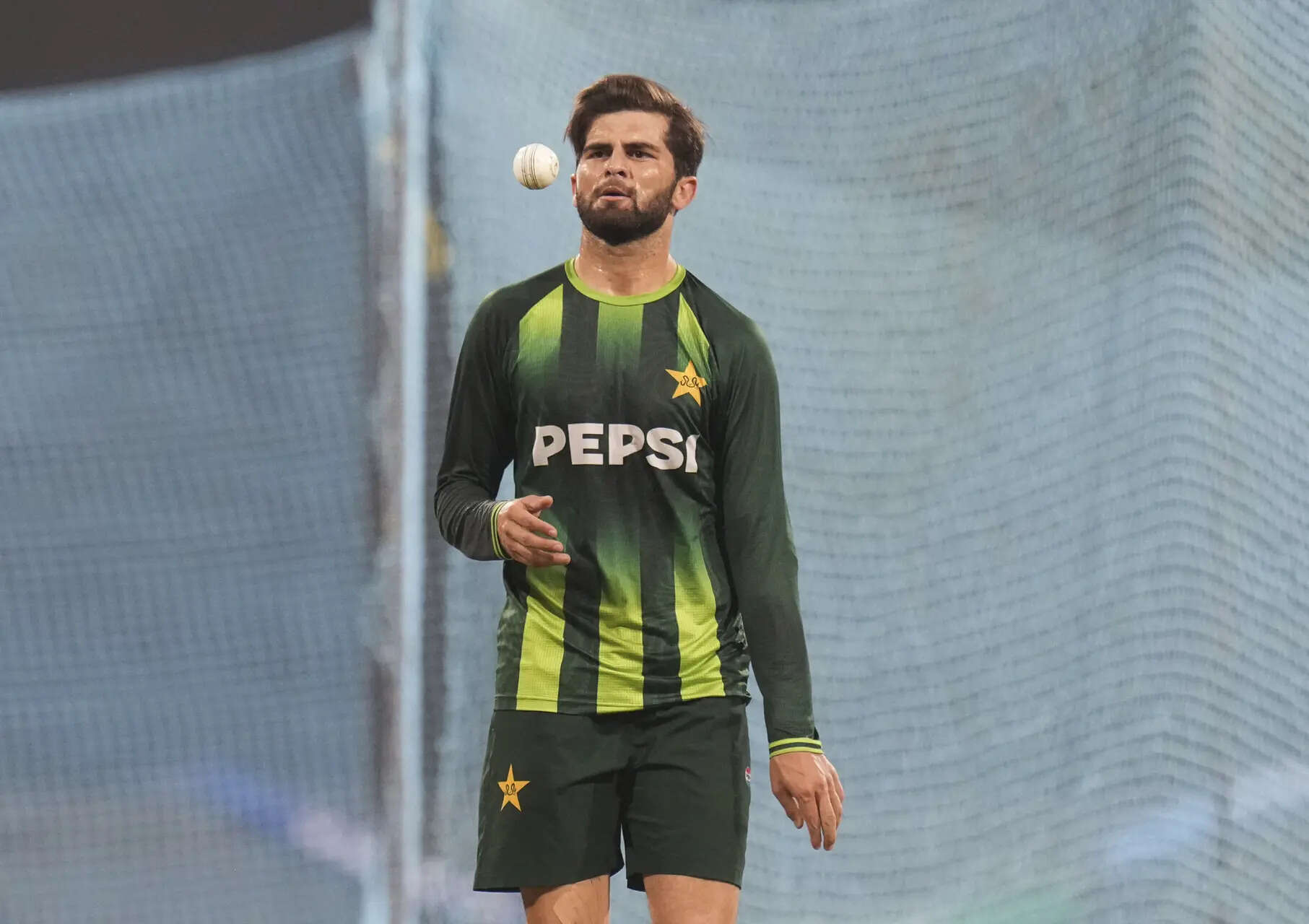
Shaheen, too, is no longer the force he once was. The left-arm seamer is becoming predictable. At the nets, it appeared unlikely he would play Wednesday’s fixture. He barely bowled, despite encouragement from the coach. Instead, he batted and rolled his arm over with left-arm wrist spin to Fakhar Zaman, who may return to the side, with Babar moving back to the top. In that scenario, Sahibzada Farhan could make way.“One game doesn’t define their capability or calibre,” Usman Tariq said in the pre-match press conference.“There’s no doubt that Shaheen and Babar have won many matches for Pakistan. If something like this happens, they know how to recover because they are senior players,” he added.Until Pakistan stop confusing flexibility with indecision, India will continue to expose the cracks. Talent has never been the problem. Clarity has. And unless roles are clearly defined and trusted, Pakistan will keep arriving at World Cups with options on paper and uncertainty on the field.


Source link

Stock market today: Here are the top gainers and losers on NSE, BSE on February 17 – check list


Stock market today: Here are the top gainers and losers on NSE, BSE on February 17 - check list

Equity benchmark indices ended higher for the second consecutive session on Tuesday, supported by gains in banking, IT and capital goods stocks.The 30-share BSE Sensex climbed 173.81 points, or 0.21 per cent, to close at 83,450.96. During the session, it touched a high of 83,598 and a low of 82,987.43.The 50-share NSE Nifty advanced 42.65 points, or 0.17 per cent, to settle at 25,725.40.

Nifty50 top gainers

Company Name Current Price (Rs) Price Change % Change
Adani Ent. 2,243 +58.30 +2.67%
ITC 325.45 +7.50 +2.36%
BEL 446.85 +8.86 +2.03%
Infosys 1,391 +25.60 +1.88%
L&T 4,280 +78.30 +1.87%
Adani Ports SEZ 1,566 +26.20 +1.71%
Asian Paints 2,437 +40.20 +1.68%
Tata Motors PV 382.85 +5.61 +1.49%
HCL Tech 1,483 +20.80 +1.43%
Bajaj Auto 9,827 +129.00 +1.34%

Nifty50 top losers

Company Name Current Price (Rs) Price Change % Change
Kwality Wall’s 27.95 -1.48 -5.00%
Hindalco 890.10 -17.36 -1.92%
Eternal 281.50 -5.11 -1.78%
Trent 4,172 -57.61 -1.37%
Tata Steel 203.08 -2.73 -1.33%
RIL 1,423 -14.10 -0.99%
Shriram Finance 1,075 -10.41 -0.96%
Cipla 1,344 -12.50 -0.93%
M&M 3,489 -20.50 -0.59%
Bharti Airtel 2,020 -9.11 -0.45%

Sensex top gainers

Company Name Current Price (Rs) Price Change % Change
ITC 325.45 +7.50 +2.36%
BEL 446.85 +8.86 +2.03%
Infosys 1,391 +25.60 +1.88%
L&T 4,280 +78.30 +1.87%
Adani Ports SEZ 1,566 +26.20 +1.71%
Asian Paints 2,437 +40.20 +1.68%
HCL Tech 1,483 +20.80 +1.43%
Titan Company 4,236 +55.30 +1.33%
Sun Pharma 1,717 +16.60 +0.98%
Maruti Suzuki 15,179 +128.00 +0.86%

Sensex top losers

Company Name Current Price (Rs) Price Change % Change
Kwality Wall’s 27.95 -1.48 -5.00%
Eternal 281.50 -5.11 -1.78%
Trent 4,172 -57.61 -1.37%
Tata Steel 203.08 -2.73 -1.33%
RIL 1,423 -14.10 -0.99%
M&M 3,489 -20.50 -0.59%
Bharti Airtel 2,020 -9.11 -0.45%
Bajaj Finserv 2,044 -6.50 -0.32%
ICICI Bank 1,408 -4.10 -0.30%
HUL 2,312 -6.70 -0.29%

IT, PSU banks among top sectoral gainers

Among Sensex constituents, gainers included ITC, Bharat Electronics Limited, Larsen & Toubro, Infosys, Asian Paints, Titan Company, Adani Ports & SEZ, HCL Technologies, Sun Pharmaceutical Industries, Maruti Suzuki India, InterGlobe Aviation, State Bank of India and Tech Mahindra.On the losing side were Eternal, Tata Steel, Trent, Reliance Industries, Mahindra & Mahindra, Bajaj Finserv, Axis Bank, Bharti Airtel, Kotak Mahindra Bank and Hindustan Unilever.Broader markets also remained firm, with the BSE Smallcap Select Index rising 0.49 per cent and the Midcap Select Index gaining 0.26 per cent.Among sectoral indices, PSU Bank surged 2.36 per cent, followed by IT (1.15 per cent), Industrials (1.13 per cent), Services (0.98 per cent), Focussed IT (0.94 per cent), FMCG (0.87 per cent), Consumer Durables (0.85 per cent) and Capital Goods (0.76 per cent). Metal, Commodities, Energy and Realty were the only laggards.A total of 2,447 stocks advanced, while 1,756 declined and 149 remained unchanged.The market capitalisation of BSE-listed firms rose by Rs 1,52,688.24 crore to Rs 4,70,11,313.57 crore (USD 5.18 trillion).

IT stocks extend recovery

Vinod Nair, head of research at Geojit Investments Limited, was quoted by news agency PTI as saying, “Domestic markets traded in a range-bound manner. The IT sector, following a sharp correction, witnessed selective bottom-fishing, aided by announcements of strategic collaborations with global AI partners.”Siddhartha Khemka, head of research, wealth management at Motilal Oswal Financial Services Ltd, said, “IT stocks extended gains for the second consecutive session after the recent sharp correction. The sentiment in the sector improved after Infosys announced a strategic partnership with Anthropic, easing concerns around AI-led disruption.”“Defence stocks gained 1.3 per cent ahead of the meeting between French President Emmanuel Macron and Prime Minister Narendra Modi, as expectations rose around potential discussions on the acquisition of additional Rafale fighter jets,” he added.On the downside, metal stocks came under pressure tracking weakness in precious metal prices, dragging the Nifty Metal index down 1 per cent. Khemka said markets are expected to remain firm with a positive bias, tracking global cues and domestic sectoral developments.According to Bajaj Broking, benchmarks extended gains for the second straight session despite subdued global cues, as investors adopted a watchful stance ahead of signals from the US Federal Reserve, key macroeconomic data releases and developments surrounding US-Iran discussions.

Global cues mixed

In Asian markets, Japan’s Nikkei 225 index closed 0.47 per cent lower, while markets in China, Hong Kong and South Korea were shut for Lunar New Year holidays.European markets were trading higher in mid-session deals. The US markets were closed on Monday for Presidents’ Day.Foreign institutional investors (FIIs) sold equities worth Rs 972.13 crore on Monday, while domestic institutional investors (DIIs) bought shares worth Rs 1,666.98 crore, according to exchange data.Brent crude fell 0.79 per cent to $68.13 per barrel.On Monday, the Sensex had jumped 650.39 points to 83,277.15, while the Nifty advanced 211.65 points to 25,682.75, setting the stage for Tuesday’s follow-up gains.


Source link

PM Modi says India-France to manufacture first helicopter flying to the heights of Mount Everest | India News


PM Modi says India-France to manufacture first helicopter flying to the heights of Mount Everest

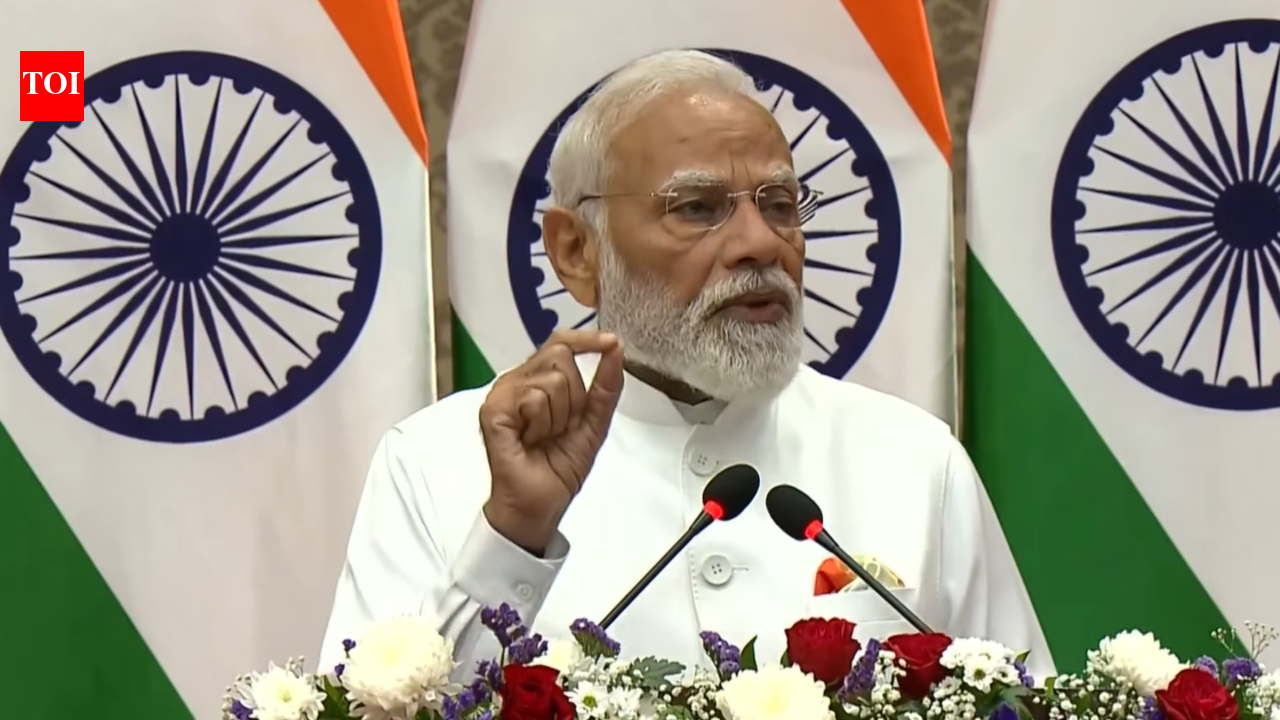
NEW DELHI: Prime Minister Narendra Modi on Tuesday said India and France would jointly manufacture the world’s first helicopter that would fly to the heights of Mount Everest.During the joint press briefing alongside French president Emmanuel Macron, PM Modi said the partnership between New Delhi and Paris “knows no boundaries” and that it “can reach from deep oceans to the tallest mountains”.PM Modi and French president Macron virtually inaugurated assembly line for production of Airbus H125 helicopters at Vemagal in Karnataka.“In India, the initiation of his helicopter assembly is another bright example of this relationship. We are proud that India and France will build a helicopter which will be able to take flight to Mount Everest. We will also export this. The India-France partnership knows no boundaries. It can reach from deep oceans to the tallest mountains,” PM Modi said in Mumbai.Before the media briefing in the coastal city, PM Modi held comprehensive talks with Macron, with both leaders focusing on strengthening cooperation in trade, defence, energy and critical technologies.Top quotes from PM Modi:

  • “I am delighted to welcome my dear friend, president Macron, to Mumbai. Last year, he invited me to the AI Action Committee Summit in France. At that time, we visited Marseille, France’s largest port and a major gateway to France and all of Europe.”
  • “Marseille is the city from where our Indian soldiers set foot in Europe during World War I. Their saga of bravery is still remembered in many parts of Europe, and it is the same city where freedom fighter Veer Savarkar jumped into the sea to escape the British. His action symbolised his unwavering resolve for India’s independence.”
  • “I had the opportunity to remember and pay my respects to him in Marseille last year. This time, when president Macron is in India for the AI Impact Summit, we are fortunate to welcome him in Mumbai, the Gateway to India.”
  • “The strategic partnership between the two countries is one of the oldest and with the help of president Macron, we have deepened the ties and given it more energy in recent times.”
  • “Based on this trust and vision, we are elevating our relation to a Special Global Strategic Partnership. This partnership is not just strategic. In this era of unpredictable global dynamics, this partnership will provide global stability and progress.”

H125 Light Utility Helicopter’s significance The H125 Light Utility Helicopter Final Assembly Line at Vemagal is expected to strengthen India’s indigenous aerospace manufacturing capabilities and further deepen India-France defence and industrial cooperation.The facility is designed to produce H125 helicopters for civil and parapublic operations, including emergency medical services, law enforcement, and passenger transport.The delivery of the first ‘Made in India’ H125 is expected in early 2027. The helicopter will also be available for export in the South Asian region.Emmanuel Macron on 3-day visitMacron arrived in Mumbai earlier in the day on a three-day visit, during which he is scheduled to attend the AI Impact Summit in New Delhi and meet Modi.The visit comes shortly after India cleared a long-pending proposal to acquire 114 Rafale fighter jets from France under a government-to-government framework, a deal described as one of the world’s largest military procurement programmes in recent years.Sources told news agency PTI that deepening defence collaboration and expanding engagement in critical and emerging technologies are among the top priorities guiding the next phase of bilateral ties.


Source link

Zimbabwe create history, storm into Super Eight; Australia eliminated from T20 World Cup | Cricket News


Zimbabwe create history, storm into Super Eight; Australia eliminated from T20 World Cup

NEW DELHI: Zimbabwe on Tuesday advanced to the Super 8 stage of the T20 World Cup after their decisive Group B clash against Ireland was abandoned due to persistent rain, a result that also knocked former champions Australia and Ireland out of the competition.With both sides sharing a point each, Zimbabwe moved to five points — enough to seal qualification. They are set to open their Super 8 campaign against India on February 26 in Chennai.

Thomas Draca exclusive: Hardik Pandya, ‘special’ pendant and T20 World Cup dream

“As much as we have achieved, it is just a tick in the box and not the whole box. There will be a small celebration, but we will then focus on the next game. It is just a small tick in what we have set out to achieve,” Zimbabwe captain Sikandar Raza said.Having missed out on the 2024 edition, Zimbabwe became the seventh team to qualify for the Super 8s, completing Group G1 alongside India, South Africa and West Indies. They will wrap up their league engagements against co-hosts Sri Lanka on February 19.Group G2 features Sri Lanka, England, New Zealand and either Pakistan or USA, with matches scheduled in Colombo and Pallekele.“Myself and the coach, we will sit down, we have the data on them (Sri Lanka) and we will try to win that game. Qualifying has not changed our ultimate goal,” Raza said.“Everyone loves an underdog story. Every condition we find ourselves in, if we get a day or two to train, we try and learn those conditions. We train, try and assess the conditions, see the previous games (at that venue), and try to put together a good game of cricket.”With Sri Lanka (6) already through to the Super 8s, the fixture carried high stakes for Zimbabwe (4) and Ireland (2). Australia, also on two points after losses to Zimbabwe and Sri Lanka, needed Zimbabwe to lose their remaining matches to stay alive, but relentless rain dashed those hopes.The toss at the Pallekele International Cricket Stadium was delayed due to drizzle, and despite brief optimism, continuous showers and a soggy outfield meant no play was possible, confirming Zimbabwe’s progress.Zimbabwe supporters, however, braved the weather to celebrate, singing and dancing in the stands.“Whichever corner they are sitting at, they will be the loudest. They keep lifting us up. But when we hear them, it gives us energy,” Raza said.“These guys have done it out of their own pockets. Hopefully, it is the start of many more fans coming in. We will try everything to raise the Zimbabwe flag high.“Hopefully, the numbers will increase and hopefully this is the start of a culture of fans going wherever the team plays,” he added.


Source link

‘We are open-minded’: Ashwini Vaishnaw apologises for inconvenience at AI Impact Summit, sets up ‘war room’ | India News


After Day 1 Glitches at AI Summit, Ashwini Vaishnaw Says Sorry, Assures Better Arrangements

Ashwini Vaishnaw

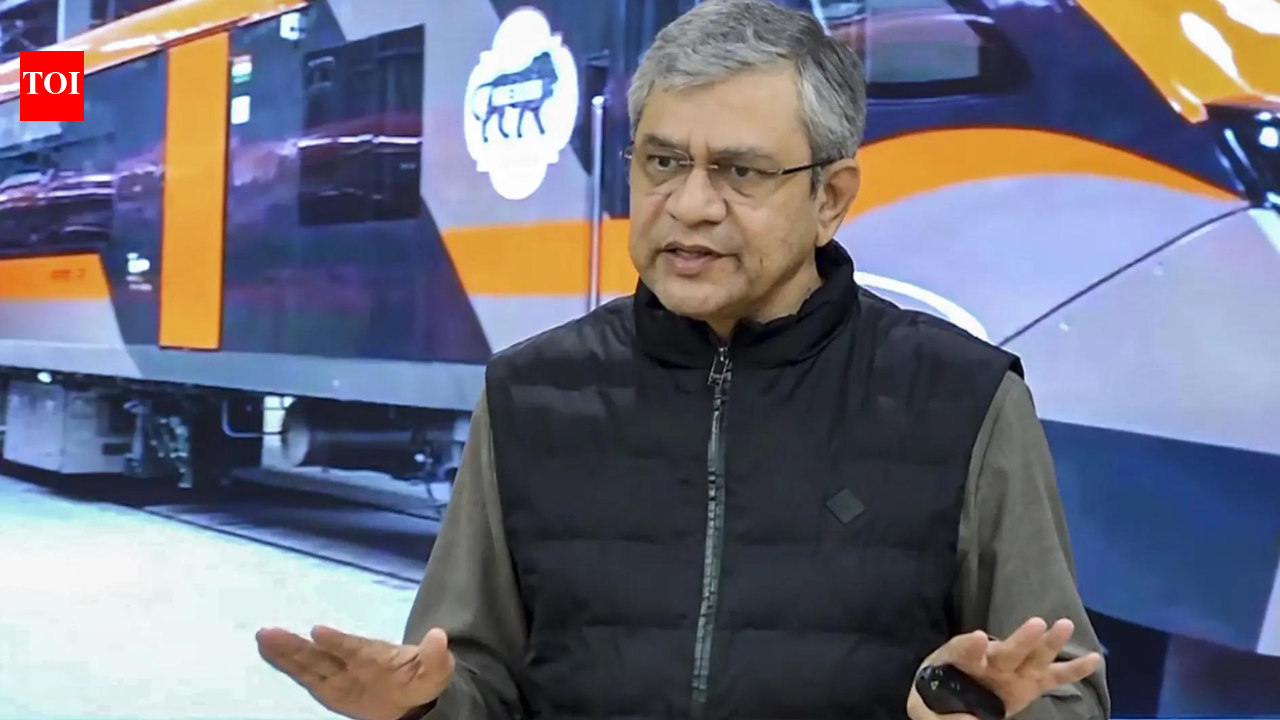
NEW DELHI: Union IT minister Ashwini Vaishnaw on Tuesday apologised for the inconvenience faced by organisers, exhibitors and visitors during the opening day of the India AI Impact Summit, assuring that all issues would be addressed and smoother arrangements ensured in the coming days.His remarks came amid reports of long queues, heavy crowds and logistical challenges at Bharat Mandapam, where the five-day summit began on Monday.

After Day 1 Glitches at AI Summit, Ashwini Vaishnaw Says Sorry, Assures Better Arrangements

Addressing a briefing, Vaishnaw said that the government was open to feedback and had set up a dedicated system to resolve complaints quickly.“Whatever feedback you have, please share with us. We are open-minded. We have a war room operating right now any issue which is there, please report to us. We definitely will take efforts to make it smoother and make it more enjoyable for all of you,” he said.The minister also issued a direct apology to those who faced difficulties on the first day. “If anybody has faced any problems yesterday, my apologies for that. We are working very hard. The entire team is working day and night to organise this world’s biggest AI Summit, and we’ll make all efforts to make sure it is enjoyable for all of you,” Vaishnaw added.In a separate statement, he said, “If any issue or inconvenience has come to exhibitors at AI Summit, we apologise for that. All issues will be addressed.”Earlier, Congress had accused the Centre of mismanagement. Party president Mallikarjun Kharge termed the situation “utter chaos” and described the government as “PR hungry”, alleging that founders, exhibitors and visitors faced distress due to lack of basic facilities.He listed complaints such as shortage of food and water, alleged theft of products, failure of Digi Yatra, restrictions on laptops and personal electronic devices, acceptance of only cash payments instead of digital modes, and high participation costs without adequate facilities.The AI Impact Summit, being described as the world’s largest artificial intelligence gathering, is being held from February 16 to 20 in New Delhi. Prime Minister Narendra Modi inaugurated the event, which has drawn thousands of participants, including policymakers, industry leaders, startup founders and global technology executives.More than 20 heads of state and government, including France’s Emmanuel Macron and Brazil’s Luiz Inácio Lula da Silva, are expected to participate. Technology leaders such as OpenAI’s Sam Altman and Google’s Sundar Pichai are also scheduled to attend.The summit aims to shape a “shared roadmap for global AI governance and collaboration” under the themes of “People, Planet and Progress”. India is positioning itself as a global hub for digital infrastructure and artificial intelligence, with a focus on expanding access to AI technologies and building consensus on responsible AI development.PTI reporters at the venue observed long queues outside session halls due to high demand and packed schedules. Organisers said registrations had exceeded expectations, reflecting strong global interest in AI infrastructure, enterprise adoption and governance.


Source link

Silicon Valley-style fallout: Uber adds fuel to fire as Türkiye’s Getir founders sue Abu Dhabi’s Mubadala for $700M betrayal


Silicon Valley-style fallout: Uber adds fuel to fire as Türkiye’s Getir founders sue Abu Dhabi’s Mubadala for $700M betrayal
Türkiye’s Getir Demands $700M From Abu Dhabi Investor Mubadala in Bitter Breakup

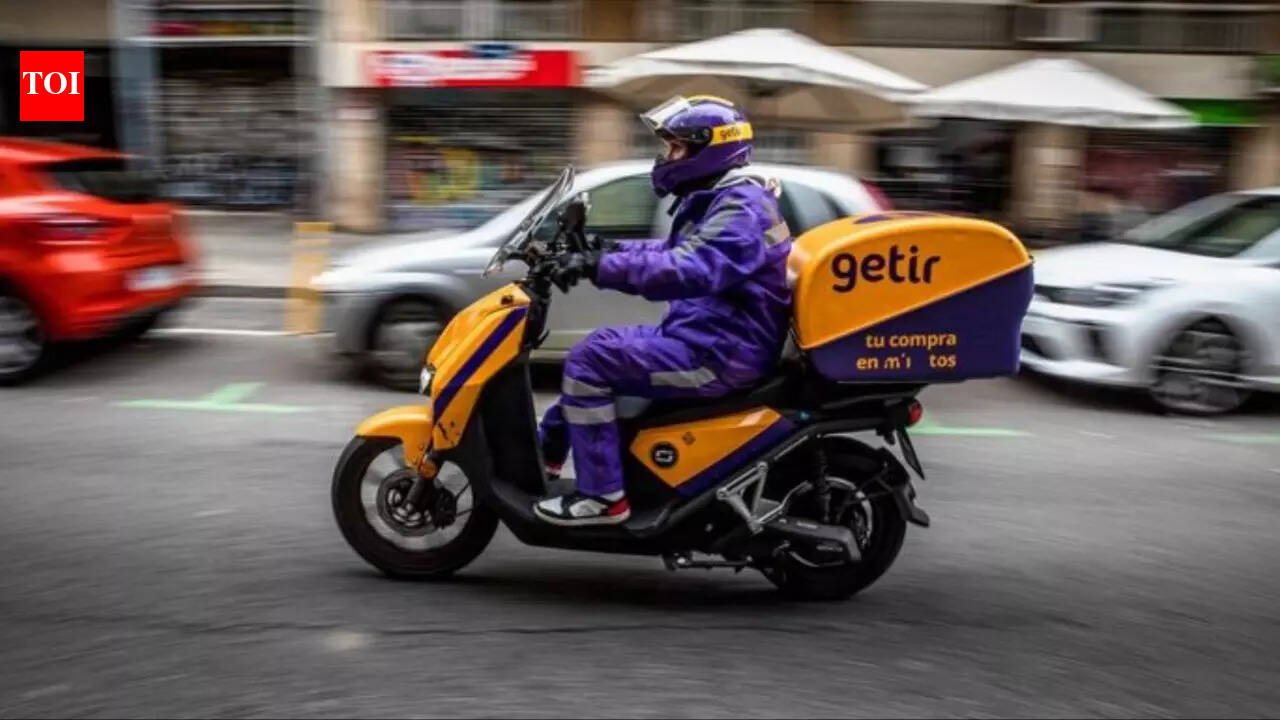
In a major escalation of the ongoing dispute between a once-high-flying delivery start-up and its largest investor, the co-founders of Turkish food and grocery delivery startup Getir, Nazım Salur and Serkan Borançılı, have filed a $700 million lawsuit against Abu Dhabi’s Mubadala Investment Company, alleging that the sovereign wealth fund breached a 2024 restructuring agreement by withholding key assets they were promised. The claim, lodged in London’s High Court, marks a dramatic escalation in what has become one of the delivery sector’s most closely watched legal disputes.This legal action comes just days after Mubadala agreed to sell Getir’s core food delivery business in Türkiye to Uber Technologies for about $335 million, underscoring how intensely the relationship has deteriorated between the Turkish firm’s founders and its Emirati backer.

What happened between the Turkish food and grocery delivery startup and the Abu Dhabi investor

The lawsuit centres on a June 2024 restructuring deal, under which Mubadala, which had taken majority control of Getir’s Turkish operations, agreed to transfer a specific bundle of assets to the founders as part of the company’s reorganisation. These included international units and, critically, Getir Finance, a technology-driven finance platform valued at around $510 million last year.However, Salur and Borançılı argue that only the least profitable elements, such as FreshDirect (a grocery delivery business based in New York) and n11 (an online commerce platform), were ever handed over to them, while valuable and strategic assets like Getir Finance were never transferred as promised. The lawsuit claims that Mubadala and its associated entities conspired to breach the terms, leaving the founders with significantly diminished control and value.Lawyers for the founders have said that the original agreement envisioned a clean separation and control over the profitable technology and international arms of Getir but that the final offer presented in December 2024 “deviated considerably” from those terms and was highly disadvantageous for Salur and Borançılı. Mubadala has not yet filed a defence in the case.

Getir, from pandemic surge to post-pandemic struggles

Understanding this legal clash requires some context about Getir’s meteoric rise and recent challenges. Founded in Istanbul in 2015, Getir became one of the earliest players in the quick commerce delivery arena, offering ultra-fast grocery and food deliveries via on-demand app order fulfilment and its valuation soared to nearly $12 billion in 2022.

Türkiye’s Getir Demands $700M From Abu Dhabi’s Mubadala as Uber Acquisition Shakes Things Up

Türkiye’s Getir Demands $700M From Abu Dhabi’s Mubadala as Uber Acquisition Shakes Things Up

However, like many pandemic-era innovators, the company faced a downturn once demand normalised and investors cooled off on high-growth tech valuations. It subsequently scaled back operations outside Türkiye and Europe and restructured with Mubadala’s backing, culminating in a major organisational split that was supposed to reset its business for long-term sustainability.In recent months, Getir has been the subject of several major investor moves, including the sale of its Turkish delivery business to Uber, a deal that further underscored Mubadala’s shift in strategy and arguably heightened the founders’ dissatisfaction with how the overall plan was unfolding.

Getir’s legal and strategic stakes: Why this matters now

The $700 million lawsuit is significant for several reasons:

  • Billion-Dollar Tech Dispute – It pits startup founders against a major sovereign wealth fund in one of the largest legal disputes involving a post-pandemic delivery platform, underlining the complex dynamics of founder-investor relationships when rapid scale meets long-term strategy disagreements.
  • Control of High-Value Assets – At the core of the legal fight is control over Getir’s technology and future revenue streams, particularly Getir Finance. If the founders succeed, it could mean reclaiming those assets or securing huge compensation, a major victory in a case where the value of what was promised dwarfs what was delivered.
  • Broader Market Implications – This lawsuit comes at a time when delivery and logistics companies globally are reassessing profitability and strategic direction post-Covid, with firms consolidating, pivoting or exiting markets altogether. A ruling in London could reverberate across venture capital, startup governance and cross-border investment norms.

Uber deal and aftermath: Adding fuel to the fire

The legal timing is crucial. Just last week, Uber confirmed a deal to acquire Getir’s food delivery operations in Türkiye from Mubadala for roughly $335 million, a move that not only consolidates Uber’s presence in a key market but also leaves open questions about how remaining parts of Getir will be managed and monetised.

Türkiye’s Getir vs Abu Dhabi’s Mubadala: $700M Fight Erupts After Uber Steps In

Türkiye’s Getir vs Abu Dhabi’s Mubadala: $700M Fight Erupts After Uber Steps In

That sale has seemingly intensified the founders’ frustration with Mubadala’s stewardship, with Salur and Borançılı arguing that the restructuring deal’s spirit was not honoured, especially as strategic parts of the business changed hands. Their decision to litigate this now signals they believe they have a strong case and significant leverage, even as their company’s valuation and operational footprint have shrunk from its pandemic highs.

What happens next?

The case, being heard in London’s High Court, will unfold over months, and possibly years, as legal teams from both sides present evidence about contractual obligations, alleged breaches and the precise nature of the asset transfers. Mubadala’s response, which has not yet been filed, will be critical in shaping the next chapter. Investors, entrepreneurs and analysts will watch closely, as the outcome could influence how future startups negotiate restructuring deals with deep-pocketed strategic investors, particularly sovereign wealth funds whose incentives sometimes diverge from founders’ visions.Founders Nazım Salur and Serkan Borançılı have sued Mubadala Investment Company for at least $700 million, claiming promised assets were withheld during a 2024 restructuring. The dispute centres on alleged breaches of a restructuring agreement involving valuable units like Getir Finance, while only less profitable entities were transferred. The lawsuit follows Uber’s acquisition of Getir’s Turkish delivery operations for about $335 million, a move that has intensified tensions. The legal battle highlights deep issues between startup founders and large strategic investors, with implications for future break-up and restructuring deals in the global tech industry.


Source link

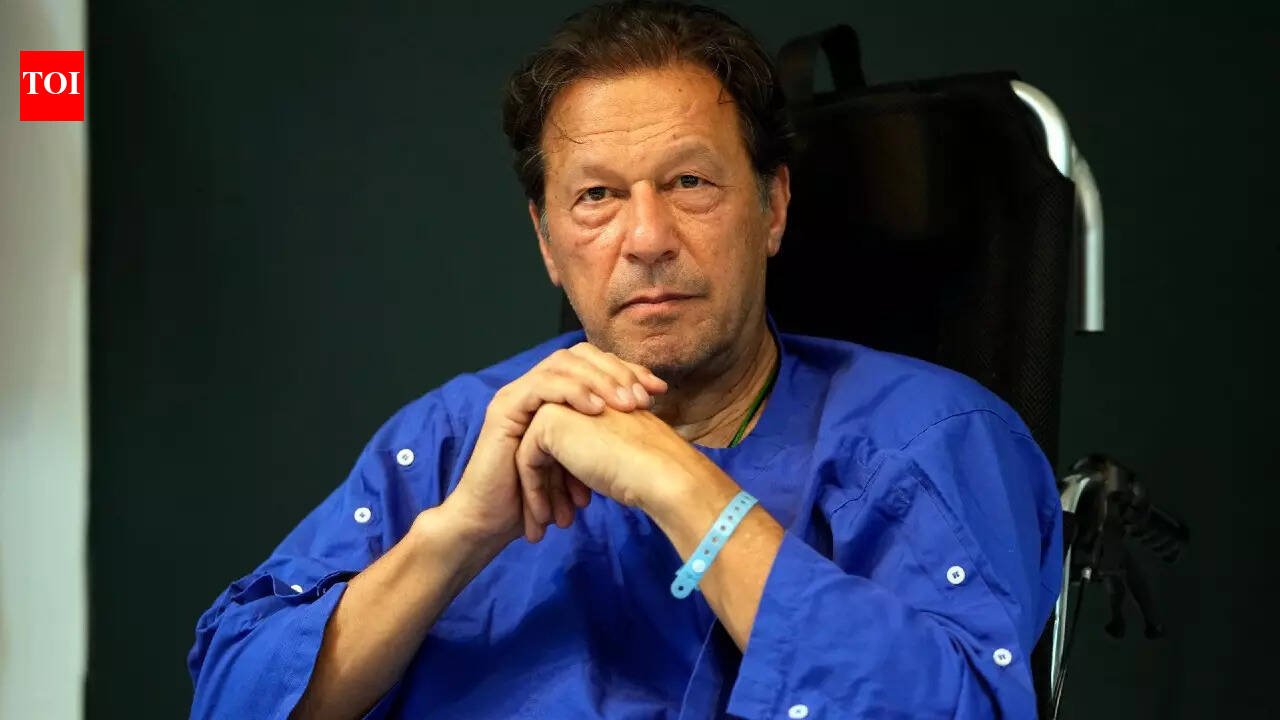
Imran Khan jail appeal: Sunil Gavaskar, Kapil Dev among 14 legendary cricket captains urging Pakistan government to treat him fairly | Cricket News


Former Pakistani PM Imran Khan (AP photo)

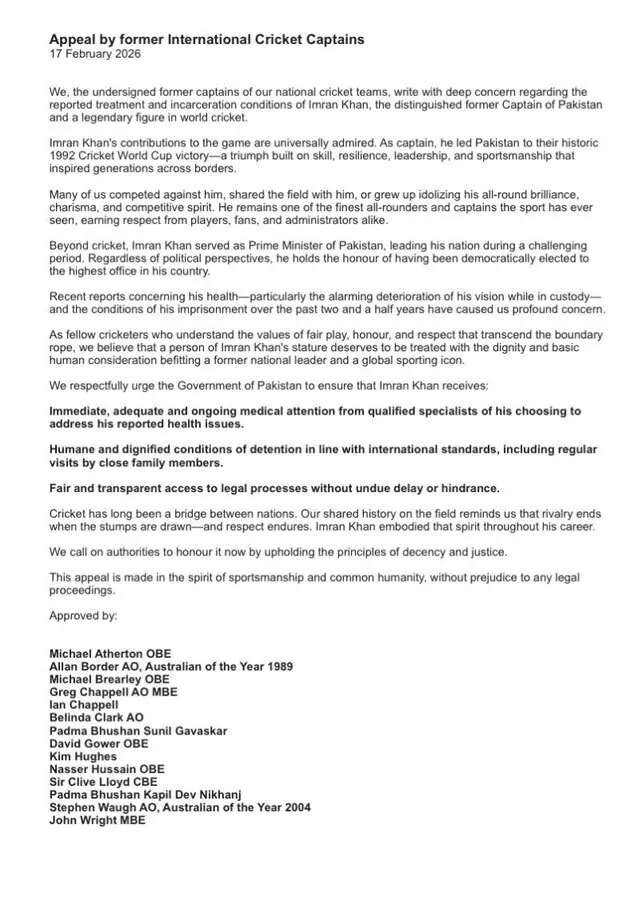
AHMEDABAD: In a massive development, 14 legendary captains from five countries -including Sunil Gavaskar and Kapil Dev and Australian great Greg Chappell, appealed to the Pakistan government on Tuesday about ensuring proper treatment for Pakistan’s 1992 World Cup-winning captain Imran Khan, who has been in jail for more than two years now.Imran Khan’s sister Aleema Khanum spoke out against Khan’s treatment in jail and his worsening health.

Treat Imran Khan Fairly: Kapil, Sunil Gavaskar Among 14 Ex- Cricketers To Send Letter To Pakistan

Khan has been in jail for over 800 days and his plight has been deteriorating, raising serious concerns about his treatment in the jail. A few days back, a court-appointed lawyer has claimed that the jailed former Prime Minister has been left with just 15 percent vision in his right eye after authorities allegedly ignored his complaints for three months, adding another layer of contention over his imprisonment. Signed by Gavaskar, Kapil, Michael Atherton, Allan Border, Michael Brearley, Greg Chappell, Ian Chappell, former Australian women’s captain Belinda Clark, David Gower, Kim Hughes, Nasser Hussain, Clive Lloyd, Steve Waugh and ex-India coach John Wright, the appeal (a copy of the appeal is with TOI) states, “We, the undersigned former captains of our national cricket teams, write with deep concern regarding the reported treatment and incarceration conditions of Imran Khan, the distinguished former Captain of Pakistan and a legendary figure in world cricket.” Reminding the Pakistan government, led by Prime Minister Shehbaz Sharif of Imran’s massive cricketing achievement, the appeal by the distinguished former international cricket captain’ states, “Imran Khan’s contributions to the game are universally admired. As captain, he led Pakistan to their historic 1992 Cricket World Cup victory—a triumph built on skill, resilience, leadership, and sportsmanship that inspired generations across borders. “Many of us competed against him, shared the field with him, or grew up idolizing his all-round brilliance, charisma, and competitive spirit. He remains one of the finest all-rounders and captains the sport has ever seen, earning respect from players, fans, and administrators alike.” Beyond cricket, Imran Khan served as Prime Minister of Pakistan, leading his nation during a challenging period. Regardless of political perspectives, he holds the honour of having been democratically elected to the highest office in his country.” Expressing deep concern over Imran’s worsening health situation in the jail, the former cricket captains have stated, “Recent reports concerning his health—particularly the alarming deterioration of his vision while in custody— and the conditions of his imprisonment over the past two and a half years have caused us profound concern. As fellow cricketers who understand the values of fair play, honour, and respect that transcend the boundary rope, we believe that a person of Imran Khan’s stature deserves to be treated with the dignity and basic human consideration befitting a former national leader and a global sporting icon.

Image credit: (X)

Requesting “immediate and adequate medical treatment to address his reported health issues, the appeal states, “We respectfully urge the Government of Pakistan to ensure that Imran Khan receives: Immediate, adequate and ongoing medical attention from qualified specialists of his choosing to address his reported health issues. Humane and dignified conditions of detention in line with international standards, including regular visits by close family members. Fair and transparent access to legal processes without undue delay or hindrance.” The letter by the 14 captains to the Pakistan government states that the appeal has been “made in the spirit of sportsmanship and common humanity, without prejudice to any legal proceedings.” “Cricket has long been a bridge between nations. Our shared history on the field reminds us that rivalry ends when the stumps are drawn—and respect endures. Imran Khan embodied that spirit throughout his career. We call on authorities to honour it now by upholding the principles of decency and justice. This appeal is made in the spirit of sportsmanship and common humanity, without prejudice to any legal proceedings.” Pakistan Tehreek-e-Insaf (PTI), the party founded by Khan, had last week expressed “profound concern” in a statement and strongly condemned the treatment meted out to him, “particularly with regard to the serious deterioration of his eyesight”.


Source link

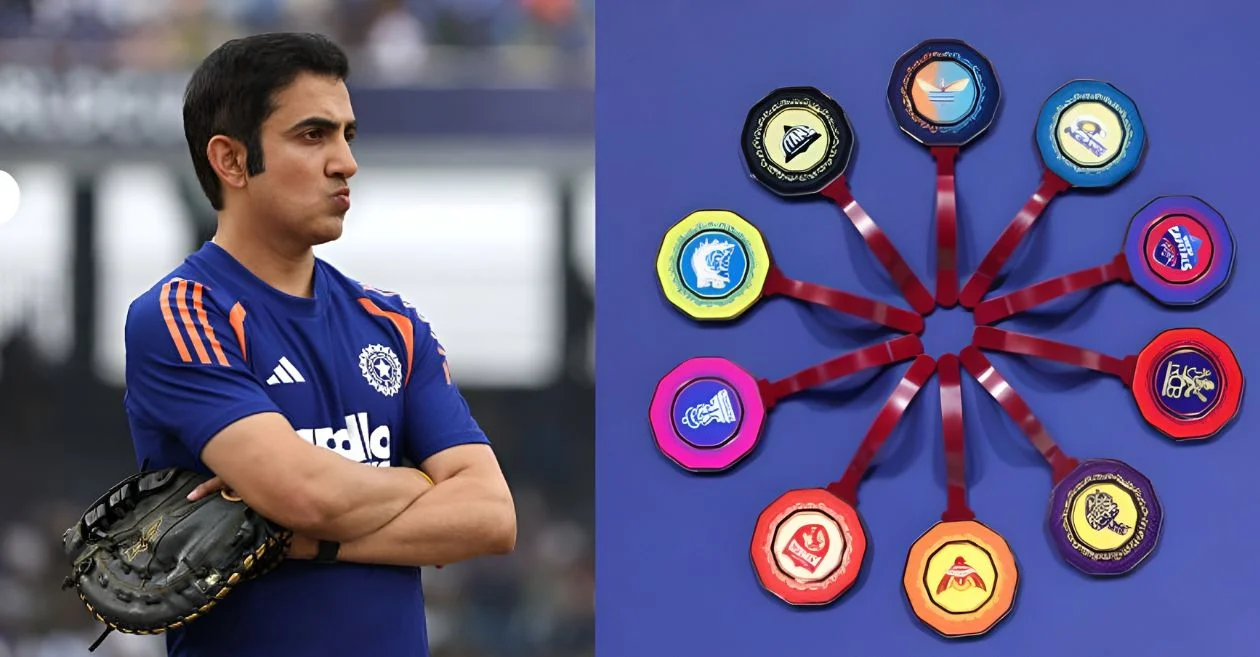
IPL 2026: India head coach Gautam Gambhir receives triple-role offer from THIS franchise – Full details inside


In a surprising turn of events amidst India‘s T20 World Cup 2026 campaign, reports have surfaced regarding a high-profile pursuit of the national team’s head coach. On February 17, 2026, news broke that a premier Indian Premier League (IPL) franchise has reached out to Gautam Gambhir with an unprecedented leadership proposal.

The offer comes as the franchise undergoes a significant ownership transition, with new stakeholders looking to secure a proven tactical mind. While the approach has created ripples in the cricketing world, the timing coincides with India’s unbeaten run in the ongoing tournament. For now, the move remains purely speculative due to rigid regulatory frameworks and existing national commitments.

IPL 2026: The triple-role proposal for Indian head coach Gautam Gambhir

According to a detailed report by Dainik Jagran, one of the three incoming stakeholders in the Rajasthan Royals (RR) has presented Gambhir with a sweeping ‘triple-role’ package. The proposal reportedly offers him the positions of CEO, Mentor and Partner, effectively giving him total operational control and a seat at the ownership table.

The deal is said to include a lucrative 2% to 3% equity stake in the franchise, which is currently valued at over $1 billion during its ongoing transfer of shares. This approach stems from Gambhir’s legendary track record as a mentor, most notably leading Kolkata Knight Riders to the 2024 IPL title just before taking over the national job. By offering him a stake in the team, the new management aims to replicate that championship-winning culture in Rajasthan, where they are currently undergoing a leadership reboot with Riyan Parag recently named as captain for the 2026 season.

“A majority of Rajasthan Royals shareholders are selling their stake to the new owners. The deal is currently in a transferable state. One of the owners in RR’s new management has offered Gambhir a two-to-three per cent stake, in addition to the roles of CEO and mentor,” the report said.

Also READ: Fans react as Riyan Parag appointed captain of Rajasthan Royals ahead of IPL 2026

Will Gautam Gambhir quit as India head coach? Here’s what we know

Despite the allure of the Royals’ offer, Gambhir is legally and professionally bound to his current post as India’s head coach. Under the Lodha Committee’s conflict-of-interest guidelines, which were upheld by the Supreme Court of India, no individual is permitted to hold a position in an IPL franchise while simultaneously serving the national team.

Accepting the ‘Partner, Mentor and CEO’ role would necessitate an immediate resignation from the BCCI. Gambhir’s contract with India runs until the ODI World Cup 2027, and with the team currently favorites to win the 2026 T20 World Cup, he remains deeply invested in his long-term roadmap. Furthermore, reports indicate Gambhir is eyeing a potential extension through the Los Angeles Olympics 2028, where he hopes to guide India to an historic gold medal. Consequently, while the Royals’ offer is historic in its scale, the ‘Gautam Gambhir era’ in Indian cricket appears set to continue uninterrupted.

Also READ: IPL: Complete list of all Rajasthan Royals (RR) captains so far ft. Riyan Parag and Sanju Samson


Source link

Draft Income Tax Rules 2026: How ITR forms are evolving – top changes explained


Draft Income Tax Rules 2026: How ITR forms are evolving - top changes explained

Draft Income Tax Rules 2026: Redesigned income tax return (ITR) forms, broader criterion for applicability of ITR forms, and more pre-filled details are some of the changes that income taxpayers can look forward to for the upcoming tax year 2026-2027 for which returns will be filed in 2027-28.The Income Tax Department has released the Draft Income Tax Rules 2026 which list out some of the changes in the tax filing process which also impact salaried and middle class taxpayers. It is important to note that the Draft Income Tax Rules 2026, once finalised, will be applicable for the next financial year 2026-27 and do not change your tax filing requirements and ITR forms for the upcoming tax filing season. While the draft income tax rules 2026 indicate the possible changes in ITR forms for tax year 2026-27, greater clarity will emerge only once the final forms are released next year.

Budget 2026: 10 Changes In Income Tax Rules That Will Reshape How Indians Save And File Returns

Draft Income Tax Rules 2026: How are ITR forms evolving?

According to Richa Sawhney, Partner Tax, Grant Thornton Bharat LLP, the eligibility parameters for selection of ITR 1 and 4 have been tweaked. “Though the forms are currently not available, it is anticipated that they will further carry forward the theme of simplification and ease of compliance. Also, as the New ITR forms would be applicable for tax year 2026 -27 they are expected to be notified later,” Richa Sawhney told TOI.The new rule 164 lays down the criteria for applicability of different ITR forms. The new forms are not yet available. The key changes are:

  • The 1962 rule regime mandated filing return in ITR 1 and 4 provided the assessee does not own more than 1 property. The new rule provides for the ownership of 2 properties to exercise return filing under ITR 1 and 4.
  • Similarly, ITR 1 and 4 were not allowed in a case where the assessee earned income u/s. 115BBE (unexplained investments or money/cash credits). Now, the negative list has been expanded to include certain other income streams e.g. transfer of carbon credits, VDA, online game etc.

Talking about the Draft Income Tax Rules 2026, she said, “In line with the New Income -Tax Act, the new rules have also been drafted to ensure they are simple to comprehend and easy to comply with, for all categories of taxpayers. The number of rules and forms has been significantly reduced, as redundant ones have been removed. The use of tables will help in better navigation. The focus on technology in ensuring the forms are pre -filled and reconciled will reduce the time spent in compliances and reduce inadvertent errors. It is important that all stakeholders evaluate these rules and forms in detail and share their inputs with the government in a timely manner, so that any teething issues in implementation are mitigated and there is a smooth transition.”Kuldip Kumar, partner at Mainstay Tax Advisors, highlighted technological progress in the ITR forms. “The redesign of forms, increased use of pre-filled information, and automated linkages will significantly simplify compliance and improve ease for taxpayers. This simplification has already been progressing gradually over the years and is further strengthened by the proposed changes and approach adopted by the government,” Kuldip Kumar told TOI.“Although the draft ITR return forms under the proposed Income-tax Rules, 2026 have not yet been issued, it is reasonable to expect that the existing structure of return forms, namely ITR-1 to ITR-7, will broadly continue. However, stricter monitoring of taxpayer eligibility for the respective forms may be introduced, supported by increased digitisation and improved data integration within the tax administration system,” he says.“Greater integration with AIS/TIS data, audit reports, and other third-party information sources is also anticipated. Additionally, there may be a rearrangement of sections and renumbering of rules and forms, as required, to align the return forms with the provisions of the Income-tax Act, 2025. Certain alignment challenges are already visible under the current framework. For example, where a taxpayer is liable to offer notional rental income in respect of more than two self-occupied house properties, such taxpayer cannot use ITR-1 or ITR-4, even if the other eligibility conditions of those forms are satisfied,” Kuldip Kumar explains.“At present, reporting of foreign assets continues to pose practical challenges. For instance, ambiguity often arises regarding whether vested but unexercised stock options are required to be disclosed in the foreign asset schedule. Clarificatory guidance on such issues would significantly assist taxpayers in ensuring accurate compliance,” he adds.

The ITR form ineligibility risk

Five main return forms: ITR-1 (Sahaj) for salaried individuals with simple income, ITR-2 for those without business income, ITR-3 for business or professional income, ITR-4 (Sugam) for presumptive taxpayers, and specialized forms for other entities.ITR-1 eligibility appears straightforward—salary, family pension, house property income (maximum two properties), income from other sources (excluding lottery and race horses), and long-term capital gains under section 198 up to Rs 1.25 lakh.

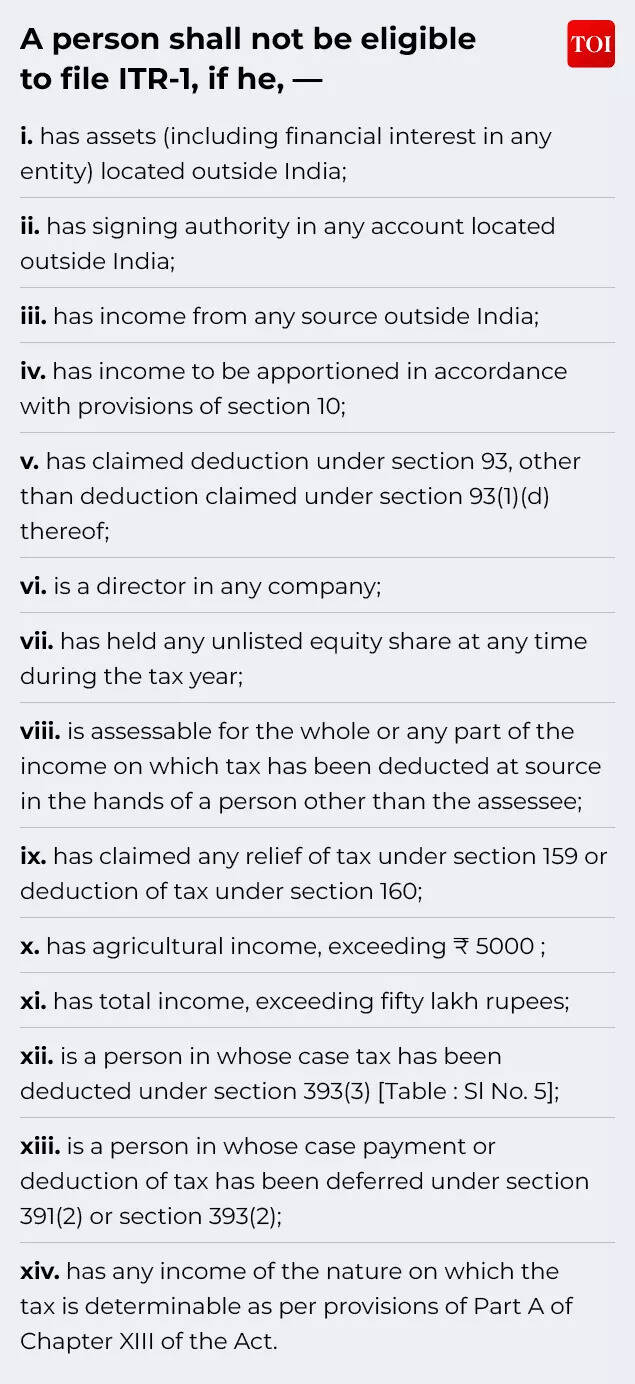
ITR-1 ineligibility

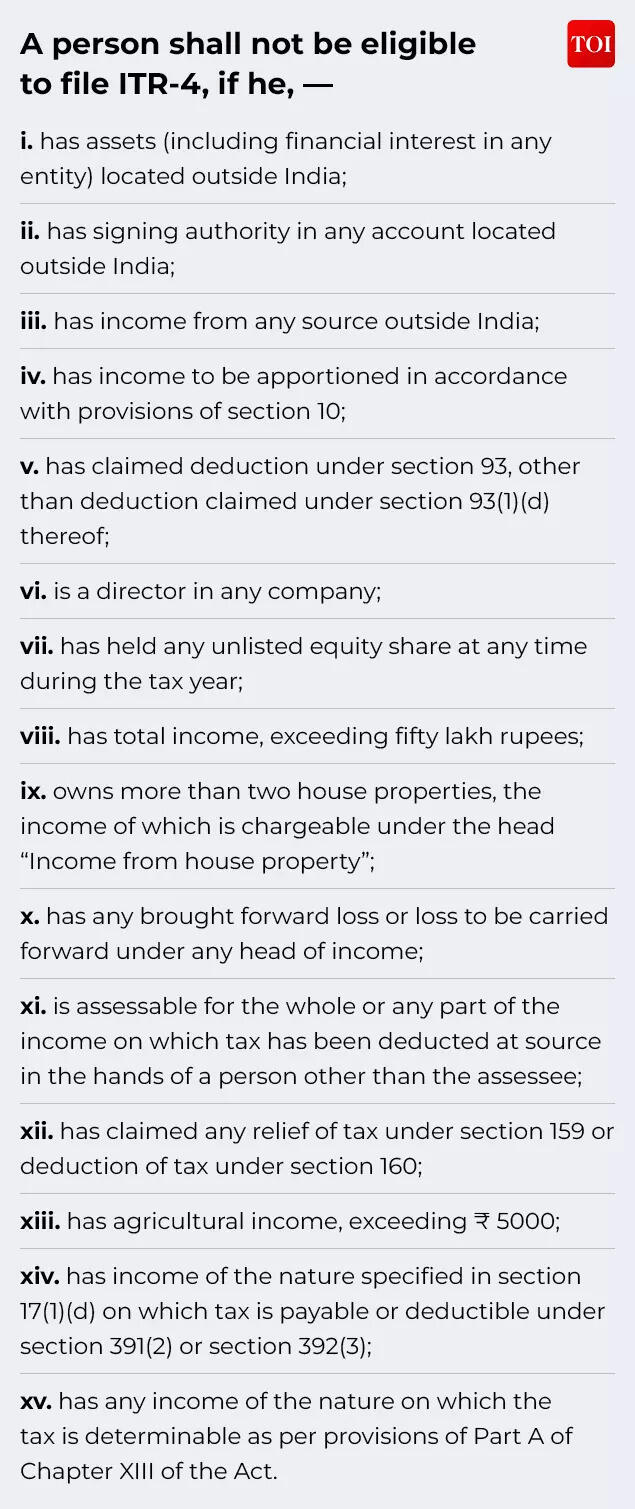
But twelve specific disqualifications exist: foreign assets or signing authority in overseas accounts, foreign-source income, director status in any company, holding unlisted equity shares, income above Rs 50 lakh, agricultural income exceeding Rs 5,000, plus six other technical triggers.ITR-4 for presumptive taxpayers has fifteen disqualifications.OP Yadav, former principal commissioner of income tax and now tax evangelist at Prosperr.io explained the continuity. The forms are prescribed each year within the broader framework—earlier under Rule 12 of the 1962 rules, from 2026-27 onwards under Draft Rule 164. “There is no fundamental shift in policy—the structure largely continues the existing approach.”

ITR-4 ineligibility

Asked by TOI whether ordinary taxpayers may unknowingly slip into ineligibility, CA Chintan Ghelani, partner for direct tax at N.A. Shah Associates LLP, said the risk is real.An otherwise ordinary taxpayer may unknowingly become ineligible if any exclusion triggers—foreign assets, unlisted shares, directorship, or crossing the Rs 50 lakh threshold. But the rules are largely consistent with the existing framework, he emphasised. The key point: careful evaluation before selecting the return form.The annual review question becomes critical.According to Ghelani, taxpayers should review eligibility every year rather than assume continuity. “Even a single change such as acquiring foreign assets, holding unlisted shares, becoming a director, or crossing the income threshold can immediately alter the applicable return form,” he said.Yadav reinforced the point. Eligibility is not static—a taxpayer eligible in the previous year may become ineligible in the current year due to changes in income composition or asset holdings, and vice versa. Therefore, annual review isn’t driven by rule changes but by evolving income profiles.He noted the compliance risk: assuming continuity merely on the basis of last year’s filing, without evaluating the changed income profile, can lead to incorrect form selection.

Capital gains complexity

The draft rules allow ITR-1 and ITR-4 where long-term capital gains under section 198 don’t exceed Rs 1.25 lakh and there are no carry-forward losses. Section 198 of the new Act corresponds to section 112A of the existing Act—the provision taxing long-term capital gains on listed equity shares.From Assessment Year 2025-26, Yadav explained, ITR-1 and ITR-4 permitted reporting of long-term capital gains from listed equity shares up to Rs 1.25 lakh under section 112A, which is otherwise exempt. The new Act continues this through section 198.For retail investors trading actively through SIPs, direct equities, and digital platforms, tracking gets challenging.Asked how difficult this becomes, Ghelani told TOI the challenge is moderate but real. Even routine SIP redemptions or equity trades can generate capital gains or losses affecting whether simplified forms remain available.While trading platforms typically provide consolidated gain/loss statements, taxpayers still need to correctly classify gains as short-term versus long-term, identify any carry-forward losses, and check prescribed thresholds. Crossing those limits automatically disqualifies the simplified return. “In practice, the difficulty is manageable with proper record-keeping and annual review, but investors who trade frequently or across multiple platforms face a higher risk of overlooking a disqualifying trigger.Can small changes like booking profits suddenly shift taxpayers into complex forms?Yes. According to Ghelani, even relatively small transactions—booking capital gains or claiming a carry-forward loss—can immediately make a taxpayer ineligible for simplified forms. Eligibility depends on the nature and classification of income rather than its size. Therefore, a seemingly routine investment activity can shift the taxpayer into a more detailed return form.Yadav clarified the mechanics. If capital gains exceed the prescribed limit but there’s no business income, ITR-2 would generally apply. If there’s business or professional income along with capital gains, ITR-3 becomes necessary.

Defective returns risk

Wrong form selection carries consequences. But what is treated as a defective return? Let’s understand that:According to Grant Thornton Bharat’s Richa Sawhney, the newly inserted conditions state that a return of income shall be treated as defective if any of following conditions fulfilled-

  • All fields, parts, schedules, statements, and columns in the return of income, have not been duly filled in
  • Audit report not furnished prior to furnishing ITR
  • Detail of payment of tax not filled in
  • MAT/ AMT credit not in accordance with last ITR

Just as under section 139(9) of the Old Act, OP Yadav explained, under Draft Rule 166 read with section 263(7) of the New Act, a return may be treated as defective if not furnished in the prescribed form applicable for the relevant year.Recent data shows active enforcement. For Assessment Year 2025-26, a considerable number of notices under section 139(9) were issued due to incorrect selection of ITR forms. This demonstrates that the tax administration actively verifies form eligibility based on disclosures available through TDS statements, AIS and other reporting mechanisms.Incorrect form selection is not merely a procedural lapse- it can trigger formal defect notices requiring timely rectification. If such a defect is not rectified within the prescribed time by filing the return in the applicable form, the return may ultimately be treated as invalid – effectively as if no return was filed – attracting all consequences of non-filing.

Electronic Filing of ITR

Draft Rule 164(12) prescribes filing methods. Companies must file electronically under digital signature. Persons whose accounts require audit under section 63 can file under digital signature or electronic verification code. Others have additional options including transmitting data electronically and submitting physical verification in Form ITR-V.Individuals aged 80 years or more filing ITR-1 or ITR-4 can file in paper form—the only remaining option for physical filing.Draft Rule 165 governs updated returns under section 263(6), requiring Form ITR-U. Draft Rule 177 addresses modified returns for business reorganizations under section 314, requiring Form ITR-A.

Person Manner of furnishing return of income
Company Electronically under digital signature
Any person whose accounts are required to be audited under section 63 of the Act (A) Electronically under digital signature; (B) Transmitting the data electronically in the return under electronic verification code.
Any person other than the person referred in Sl. No. 1 and 2 (A) Electronically under digital signature; (B) Transmitting the data electronically in the return under electronic verification code; (C) Transmitting the data in the return electronically and thereafter submitting the verification of the return in Form ITR-V.
An individual of the age of 80 years or more at any time during the tax year, who furnishes return in Form No. SAHAJ (ITR-1) or

Form No. SUGAM (ITR-4)

(A) Electronically under digital signature; (B) Transmitting the data electronically

in the return under electronic verification

code;

(C) Transmitting the data in the return

electronically and thereafter submitting the

verification of the return in Form ITR-V;

(D) Paper form.


Source link