Breaking News
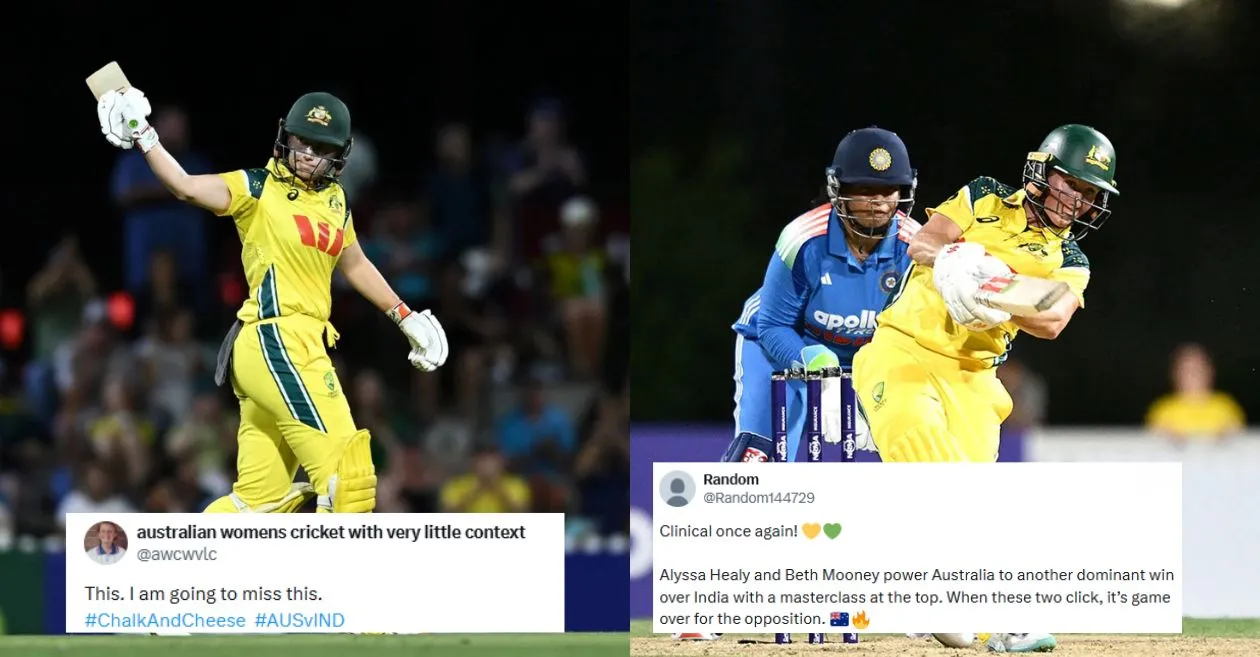
Fans erupt as Alyssa Healy and Beth Mooney steer Australia to dominant victory over India in Women’s ODI opener


The much-anticipated India Women’s tour of Australia kicked off with a display of clinical efficiency from the hosts at the Gabba on Tuesday (February 24, 2026). In what is an emotional farewell series for the legendary Alyssa Healy, the Australian captain led from the front, alongside Player of the Match Beth Mooney, to secure a commanding 6-wicket victory in the opening Day/Night ODI. Despite India entering the series with the prestige of being the reigning World Champions, the Australian “Golden Era” showed no signs of fading, chasing down a target of 215 with 70 balls to spare.

The atmosphere in Brisbane was electric as fans gathered to witness the first chapter of this high-stakes series. However, for the Indian contingent, the night proved to be a challenging outing against a disciplined Australian bowling attack that exploited the humid conditions perfectly under the lights.

Disciplined Australian attack stifles Indian batting order for a low score

The match began with a nightmare start for the World Champions. Choosing to bat first, India found themselves under immediate pressure when Megan Schutt trapped Pratika Rawal lbw for a duck in the very first over. While the seasoned Smriti Mandhana played a fluent knock of 58 off 68 balls, featuring nine boundaries, she lacked a stable partner at the other end. Australia’s bowling unit operated like a well-oiled machine, with Ashleigh Gardner (3/33) and Annabel Sutherland (3/20) dismantling the middle order.

India’s captain Harmanpreet Kaur fought a lonely battle, digging deep to score a gritty 53 off 84 deliveries. Her half-century, supported by brief cameos from Deepti Sharma (24) and Richa Ghosh (23), pushed India past the 200-mark. However, the lack of a late-inning acceleration proved costly. India was eventually bundled out for 214 in 48.3 overs. The Australian bowlers maintained a stranglehold throughout the innings, ensuring that the world-class Indian hitters were never allowed to break free, setting the stage for a straightforward chase.

Alyssa Healy and Beth Mooney take Australia to an emphatic victory in Women’s ODI opener

The chase was defined by experience and composure. Captain Healy, playing in her final international series, looked determined to leave on a high. She anchored the top order with a solid 50 off 70 balls, providing the perfect platform. Although India’s Shree Charani briefly sparked hope by removing Phoebe Litchfield and Georgia Voll in consecutive deliveries to leave Australia at 55/2, the recovery was swift and ruthless.

Beth Mooney joined her captain to put on a batting clinic. Mooney, who was later named Player of the Match, scored a brilliant 76 off 79 balls, striking five boundaries and two massive sixes. Her ability to rotate the strike kept the scoreboard ticking at over five runs per over, effectively deflating the Indian bowling spirit. By the time Mooney departed in the 37th over, the result was a foregone conclusion.

Annabel Sutherland provided the finishing touches with an unbeaten 48, as Australia reached 217/4 in just 38.2 overs. The victory levelled up Australia to a scoreline of 4-4 in the multiformat series, sending a clear message that while India may hold the World Title, the Aussies remain the team to beat on their home soil.

Also WATCH: Georgia Voll plucks a screamer to remove Richa Ghosh in 1st WODI

Here’s how fans reacted:

Also WATCH: Pratika Rawal’s return cut short by Megan Schutt’s unplayable inswinger during WODI series opener

This article was first published at WomenCricket.com, a Cricket Times company.


Source link

From sales pitch to suitability check: What RBI’s draft mis-selling rules could mean for your money


From sales pitch to suitability check: What RBI’s draft mis-selling rules could mean for your money
AI image used for representation purpose only

NEW DELHI: The Reserve Bank of India has proposed a new set of rules that could reshape how banks and financial institutions sell insurance, loans, mutual funds and other financial products to customers.Issued on February 11, 2026, the draft All India Financial Institutions — Responsible Business Conduct Amendment Directions, 2026 seek to address a long-standing concern in retail finance — mis-selling, or the sale of unsuitable, unwanted or poorly explained financial products.The proposed framework applies to All India Financial Institutions (AIFIs), including NABARD, National Housing Bank, EXIM Bank and SIDBI. The draft is open for public comments and is proposed to come into effect from July 1, 2026, if finalised.Here is what the draft proposes and how it could affect customers, banks and insurers if implemented.

What is mis-selling — and why the draft redefines it

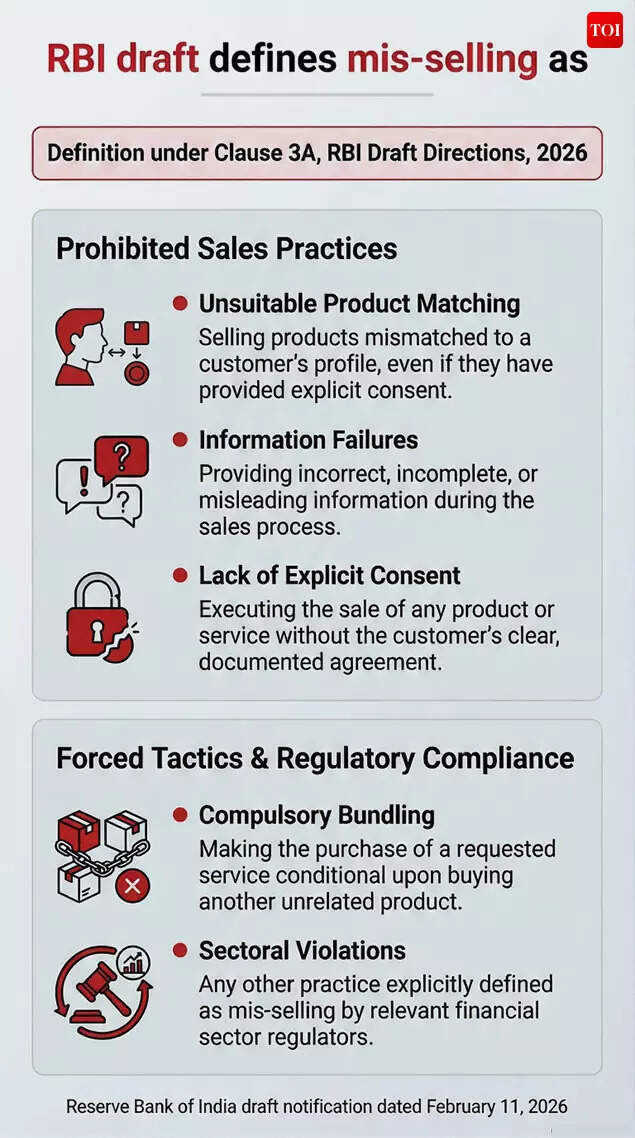
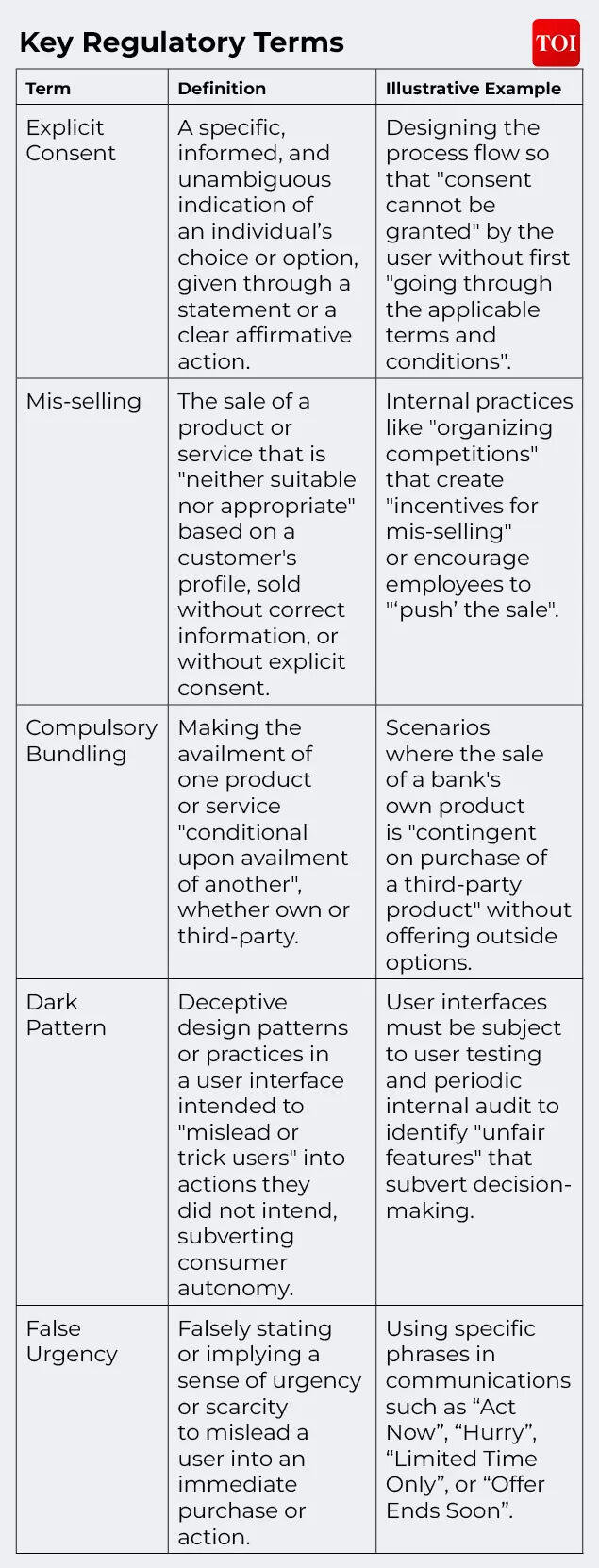
For the first time within this framework, the RBI draft sets out a detailed definition of mis-selling under Clause 3A.An institution would be considered to have mis-sold a product if it:

  • Sells a product unsuitable for a customer’s profile, even where explicit consent exists;
  • Provides incomplete or misleading information;
  • Completes a sale without explicit customer consent; or
  • Bundles an additional product with one the customer actually requested.

The most consequential element is the first. Under the proposal, customer consent alone would no longer shield an institution if the product itself was inappropriate for the customer’s age, income, financial literacy or risk tolerance.

LOGO

In effect, responsibility shifts from what customers signed to how products were sold.

How branch interactions and sales calls could change

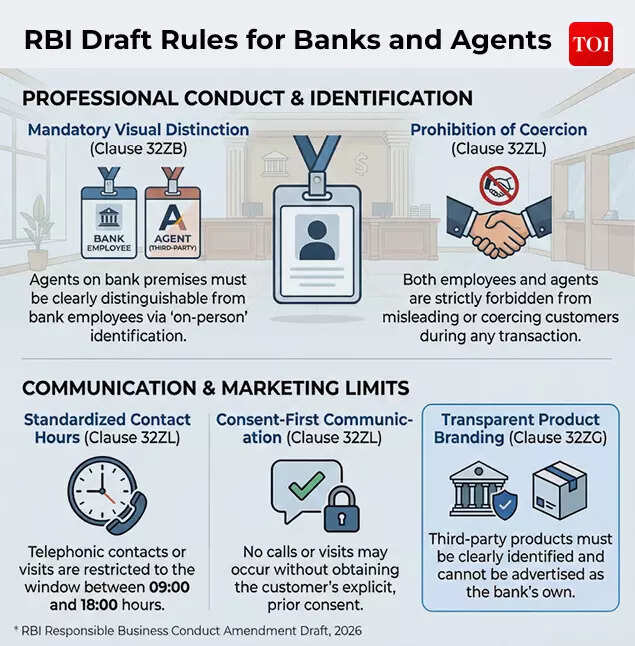
The draft places suitability assessment at the centre of product sales.Clause 32ZF proposes that institutions determine whether a product is suitable and appropriate before marketing or selling it. The assessment must compare product characteristics – including risk-return profile, complexity, fees and investment horizon – against customer attributes such as income, financial literacy and risk tolerance.If implemented, this could mean more structured conversations before recommendations are made, with profiling becoming part of the sales process rather than an afterthought.Sales outreach is also addressed. Under Clause 32ZL:

  • Agents and representatives may normally contact customers only between 9 AM and 6 PM unless expressly authorised otherwise;
  • Terms and conditions must be explained before completing a sale; and
  • Misleading or coercive conduct is prohibited.

Agents would also need to disclose upfront if purchasing through them involves different fees or charges compared with buying directly from the institution.

-

However, Rohit Shah, Financial Planner, cautioned against expecting immediate change on the ground. “I’d call most of this unethical selling rather than mere mis-selling. Given the slow nature of such changes actually transpiring on the ground, I suspect customers won’t notice a material difference immediately,” he said. Shah noted that ground-level behaviour typically lags regulation by several quarters, and that real awareness at the customer end would not build unless the RBI mandated sustained awareness campaigns – the way AMFI drove “Mutual Fund Sahi Hai” or IRDAI pushed “Insurance Liya Achha Kiya.” “Without that, these remain gazette notifications, not behavioural shifts,” he said.Shruti Ladwa, Partner and Insurance Sector Leader at EY India, offered a more structural reading of the shift. “The RBI circular represents a shift towards more transparent distribution, with a focus on strengthening customer protection,” she said. Ladwa said the most visible change for customers would be in the nature of the conversation itself. “Branch interactions and sales calls will prioritise the customer’s financial profile and need analysis, supported by suitability assessments and standardised disclosures. The recommendations will also be better explained and documented, moving the conversations towards advisory or need-based dialogue which will enhance transparency and long-term trust,” she said.

Consent rules become more explicit — especially online

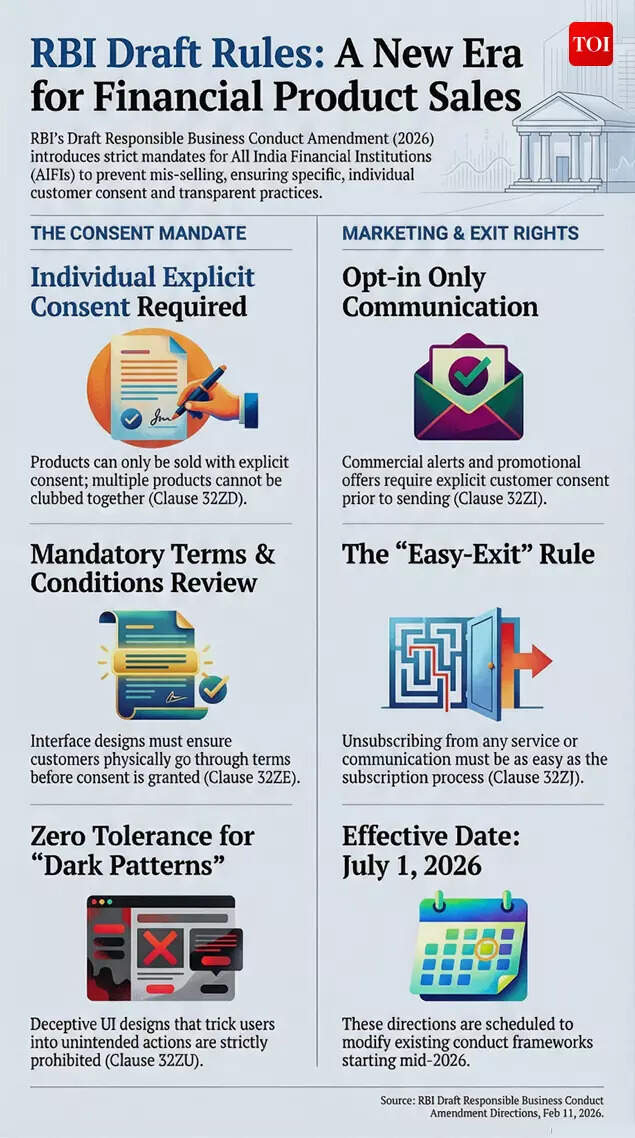
The draft introduces detailed requirements around how customer consent must be obtained.Under Clauses 32ZD and 32ZE:

  • Consent must be taken separately for each product or service;
  • Institutions cannot bundle multiple approvals into a single checkbox; and
  • Digital interfaces must ensure customers navigate applicable terms and conditions before granting consent.

Promotional communications may be sent only where explicit permission has been given, and unsubscribing must be as simple as subscribing.

-

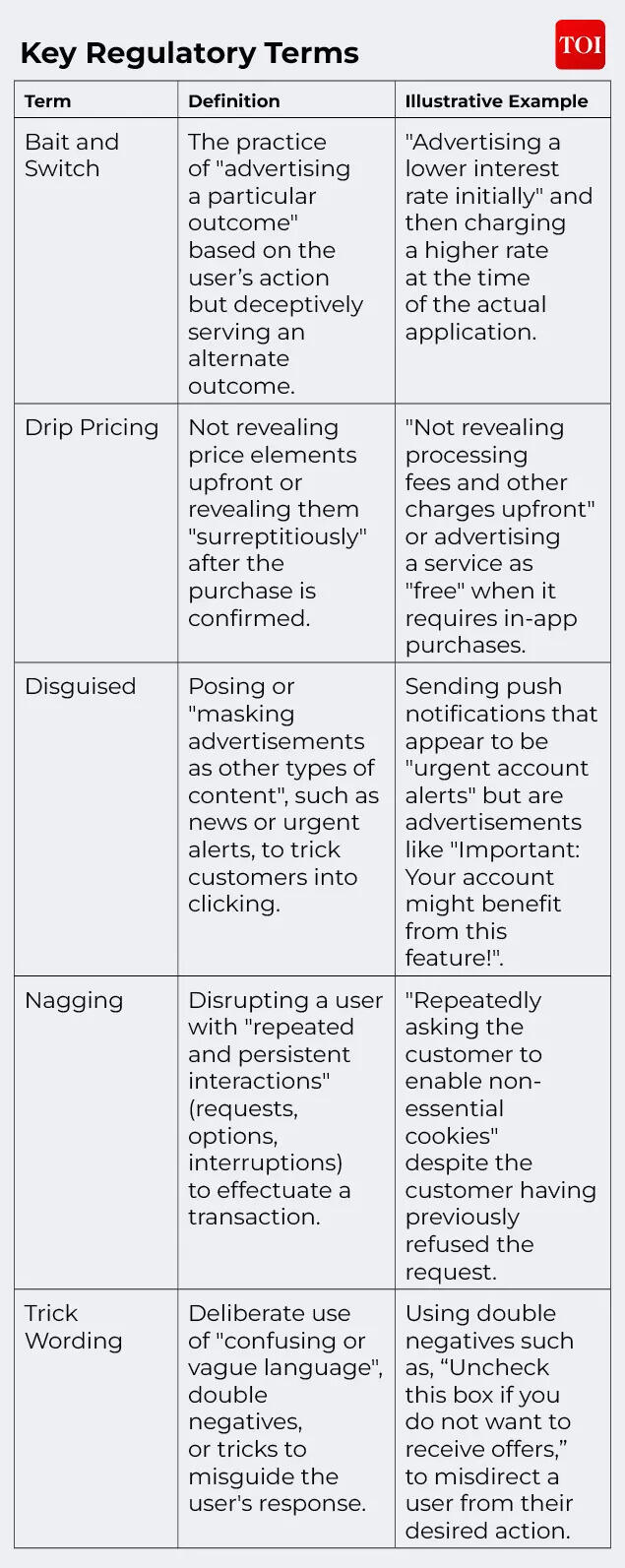
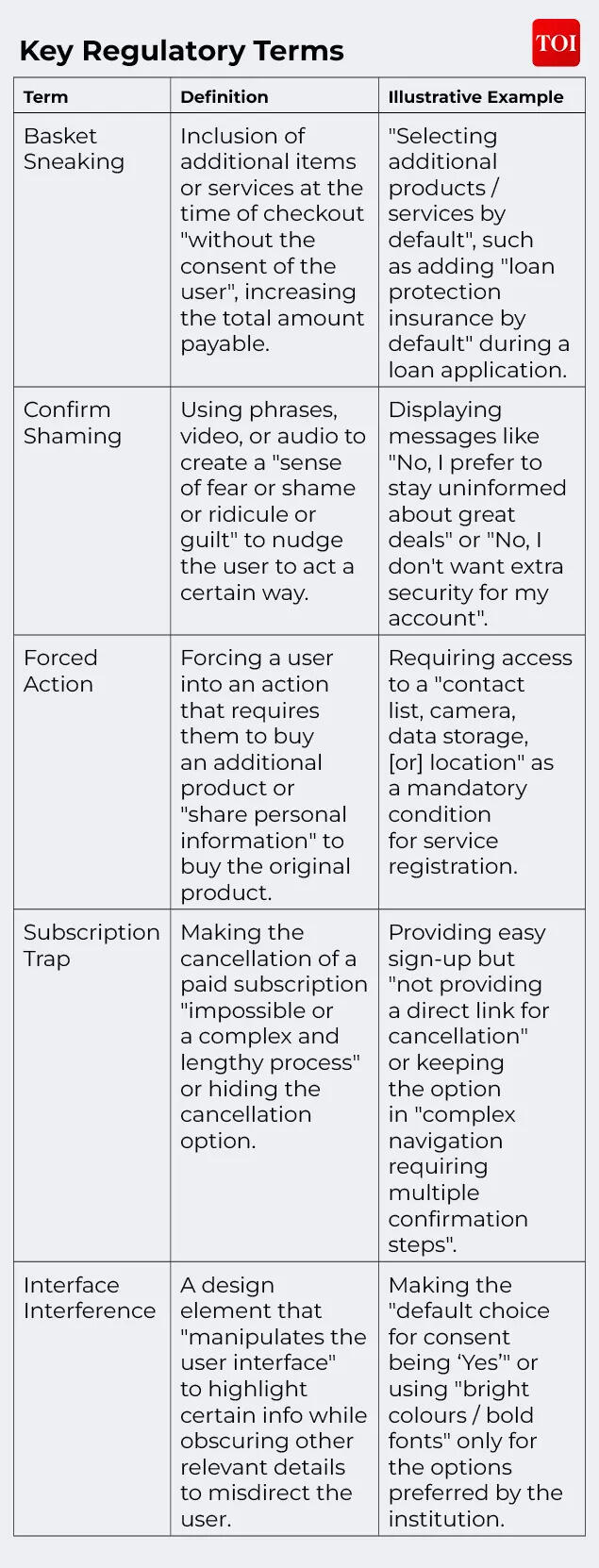
Vivek Iyer, Partner and Financial Services Risk Advisory Leader at Grant Thornton Bharat, said the opt-in requirement addresses a gap that has long worked against customers. “Currently, many customers do not even know that they have opted for being contacted and this guideline will give them the flexibility to decide,” he said. He added that the change would reduce unsolicited outreach to those who do not want it, “which is a positive from a conduct risk point of view, which is how it should have been in the first place.Iyer also said the framework would push institutions toward more sustainable communication strategies. “Financial literacy campaigns will help financial institutions inform customers about new products and services, instead of reaching out through unsolicited calls,” he said.The draft also proposes a ban on “dark patterns” – interface designs that nudge users into unintended decisions. Annex I lists practices such as false urgency messaging, default add-ons, subscription traps, disguised advertisements and hidden pricing structures as examples relevant to financial services.

What customers may need to do differently

The proposed framework also changes what happens after a sale.Clause 32ZV requires institutions to contact a sample of customers within 30 days to confirm they understood the product’s features and risks. The feedback must be collected by teams not involved in the original sale.Customers who believe a product was mis-sold may lodge complaints within timelines specified by sectoral regulators, or within 30 days of receiving signed agreements where no timeline exists (Clause 32ZW).If mis-selling is established, Clause 32ZX proposes:

  • Refund of the entire amount paid; and
  • Compensation for losses arising from the mis-sale in accordance with institutional policy.

The emphasis moves toward evaluating conduct and suitability rather than relying solely on signed documentation.Shah said customers should not wait for institutions to act first. “Caveat emptor always applies. Customers should read the product literature carefully, insist on written answers from the bank relationship manager, and do their own due diligence before trusting any recommendation,” he said. He pointed to pressure tactics that remain common: RMs seeking help in meeting sales quotas or offering quid pro quo for routine banking services such as a locker or a loan. “Customers must resist this influence, ask tough questions, and demand that their normal banking services are never held hostage to product purchases,” Shah said. On the new complaint provisions, he described the shift as decisive: “If mis-sold, the draft rules now require banks to refund the full amount paid and compensate for any loss — a decisive shift from ‘buyer beware’ to ‘seller beware’. Customers should document everything and escalate through the RBI Ombudsman if the bank fails to act.”Ladwa said informed decision-making would remain the customer’s best protection even under the new framework. “Before purchasing any financial product, customers should ensure that they clearly understand product features, costs and exclusions, among other things. They should also evaluate how the product aligns with their financial goals and risk profile,” she said. On the complaint process, Ladwa said the revised framework was designed to deliver timely resolution. “If a customer believes a product has been mis-sold, they can lodge a complaint with the bank within the timeline specified by the respective financial sector regulator. The revised emphasis on accountability is intended to ensure timely resolution and fair outcomes while strengthening customer protection,” she said.

Could tighter rules affect bank earnings?

Banks and financial institutions generate fee income by distributing third-party products such as insurance policies, mutual funds and pension schemes.

-

The draft introduces provisions that could influence how this business operates, including:

  • Mandatory suitability assessment before sale (Clause 32ZF);
  • Prohibition on incentives encouraging aggressive product pushing (Clause 32ZR); and
  • Restrictions on compulsory bundling of third-party products (Clause 32ZS).

According to Vivek Iyer, the intent is tied to broader financial stability goals. “Systemic risk stability is one of the core objectives of the Reserve Bank of India and treating customers fairly is one of the key goals to keep the financial services system stable. Mis-selling guidelines issued by RBI are issued with this intent to protect consumer interests and thereby maintain financial stability, which is a long-term positive impact for the financial services ecosystem.He added that institutions may need to embed customer protection into business strategy rather than treat the framework purely as compliance. “We expect the approach by the financial institutions to change from sellers of products or services to providers of genuine solutions for customer challenges.”Iyer noted that stronger dispute-resolution mechanisms may also become necessary as complaint processes evolve.Shah said the revenue impact should not be underestimated. “Third-party product distribution is now a critical revenue pillar – fee income constitutes roughly 25–30% of total income for top private banks,” he said.

-

But he argued that a shift in approach could offset near-term pressures. “Banks that pivot from pushing products to genuinely understanding customer needs may find that right-fit recommendations lead to higher retention, larger ticket sizes, and better margins over time — offsetting the short-term revenue hit.”Ladwa said the income pressure was real but was likely to be transitional. “In the near term, banks could see moderate pressure on fee income, alongside some increase in compliance and process-related costs. However, this impact is likely to be transitional only. As banks recalibrate distribution models and adapt to the requirements, income momentum should stabilise over the medium term,” she said. She added that larger institutions were better placed to absorb the shift. “Large private banks, in particular, are well positioned to adapt quickly given their strong digital infrastructure, integrated platforms and established capability in managing process transitions,” Ladwa said.

Implications for bancassurance and insurance distribution

Insurance distribution through bank branches – commonly known as bancassurance – is directly affected by several draft provisions.The proposals state that:

  • Customers cannot be compelled to purchase third-party products alongside another service (Clause 32ZS);
  • Institutions cannot market third-party products as their own (Clause 32ZG); and
  • Agents operating inside branches must be clearly identifiable (Clause 32ZB).

These measures could alter how insurance products are presented within banking relationships, particularly where policies have historically been linked to loans or relationship-based selling.

-

Ladwa said leading insurers had already built resilience into their distribution models. “Bancassurance has evolved over the past decade, and most bank-promoted insurers have built strong distribution, product and servicing capabilities,” she said. She acknowledged a likely near-term slowdown but said adaptation would follow quickly, driven by three levers: distribution evolution toward advisory and digitally enabled models, technology-led sales enablement including AI-driven personalised product recommendations, and product innovation with greater emphasis on need-based solutions and simpler structures. Ladwa added that diversification would cushion the impact. “Most leading bank-promoted insurers have diversified distribution, with roughly 50% of premium coming from non-bancassurance channels. This should help cushion the impact and enable faster adjustment,” she said, noting that recent GST regulatory changes could also strengthen underlying insurance demand.Iyer said stronger consumer confidence could support long-term engagement. “When customers feel protected, they are more likely to engage and buy products or services.”Shah said tighter rules would create friction in the short term but should not be read as a structural setback. “Bancassurance is now a Rs 55,800 crore market and a critical growth engine for insurers, especially in Tier 2–4 cities. Tighter norms will certainly create short-term friction,” he said. “But India’s insurance penetration remains just 3.7% of GDP – half the global average of 7.3%. The problem was never demand; it was trust.” He said insurers should use the moment to strengthen alternate channels – traditional agents and digital platforms – and shift toward products such as pure term plans, where penetration is low and genuine need is high. “Better selling practices may ultimately expand the market, not shrink it,” Shah said.

A broader conduct shift under consultation

Taken together, the draft directions introduce a conduct-focused framework covering advertising practices, consent collection, agent behaviour, digital interface design and post-sale verification.The proposals remain under consultation and may evolve following stakeholder feedback before finalisation.If implemented substantially in their current form, they would mark a shift in regulatory focus – from merely ensuring financial soundness to closely examining how financial products are presented, explained and sold to customers.



Source link

Centre boosts Powergrid equity threshold to Rs 7,500 crore per subsidiary; move to support 500 GW non-fossil target by 2030


Centre boosts Powergrid equity threshold to Rs 7,500 crore per subsidiary; move to support 500 GW non-fossil target by 2030

NEW DELHI: The government has raised Power Grid Corporation of India Ltd’s (Powergrid) equity investment ceiling in each subsidiary from Rs 5,000 crore to Rs 7,500 crore, in a move designed to bolster funding for large transmission projects and renewable energy evacuation.The cabinet committee on economic affairs (CCEA), chaired by Prime Minister Narendra Modi, approved the higher threshold under existing Maharatna delegation guidelines, while retaining the overall cap of 15 per cent of the company’s net worth. Under department of public enterprises guidelines issued on 4 February 2010, Maharatna CPSEs such as Powergrid enjoy enhanced autonomy to make large investments without case-by-case government approvals.

Impact on Powergrid’s project pipeline

The higher limit expands Powergrid’s headroom to back capital-intensive transmission schemes, particularly ultra high voltage alternating current (UHVAC) and high voltage direct current (HVDC) corridors.These assets form the backbone of long-distance bulk power transfer, allowing the utility to scale up its role in strengthening the national grid and integrating geographically remote generation centres.

Renewable push and capacity evacuation

Government officials said the additional financial flexibility will help Powergrid step up investment in transmission systems dedicated to evacuating renewable power, a critical enabler for India’s goal of 500 GW of non-fossil capacity by 2030.Powergrid already handles the majority of inter-regional transfer capacity in the national grid and has facilitated the evacuation of over 110 GW of non-fossil energy, positioning it as a key player in the next leg of green capacity build-out.With a higher equity cap per subsidiary, Powergrid can more aggressively participate in tariff based competitive bidding (TBCB) for new transmission projects, including complex, high-ticket networks.The government expects deeper participation in TBCB to broaden competition, aid sharper price discovery, and, over time, translate into more affordable and cleaner power for industrial and retail consumers.


Source link

Anil Kumble hails West Indies’ title charge, warns India after crushing reality check | Cricket News


‘They know what it takes to win’: Anil Kumble hails West Indies’ title charge, warns India after crushing reality check
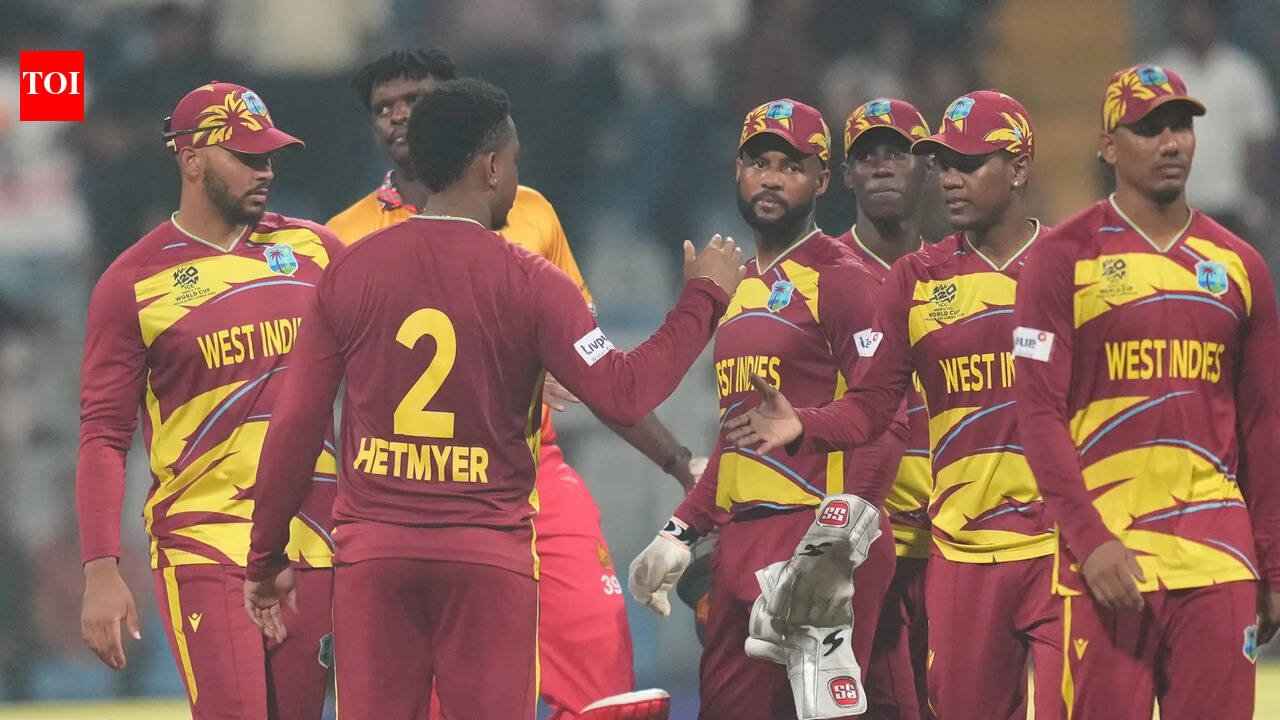
West Indies’ players after their win against Zimbabwe. (AP Photo)

NEW DELHI: Former India captain Anil Kumble believes West Indies have shown they possess the qualities needed to win the T20 World Cup at the business end, while warning that India now face a difficult road to the semi-finals after their heavy defeat to South Africa.Go Beyond The Boundary with our YouTube channel. SUBSCRIBE NOW!West Indies sent a strong message to the rest of the field with a dominant 107-run demolition of Zimbabwe, piling up a staggering 254/6 before bowling their opponents out for 147. The performance impressed Kumble, who said the Caribbean side demonstrated a clear understanding of how to succeed in knockout-style situations.

T20 World Cup: Shai Hope press conference after West Indies beat Zimbabwe

“The West Indies understand what it takes to win at this stage of the tournament. The left-arm spinners were outstanding. Gudakesh Motie bowled brilliantly. In this format, finger spinners often try to stay away from the batter’s hitting arc, but Motie and Hosein were different,” Kumble said on JioHotstar.He also singled out Shimron Hetmyer’s explosive 34-ball 85 as the turning point. “Shimron Hetmyer has long been a finisher and knows how to clear the boundaries. He has the power and the temperament. What stands out is that he doesn’t settle for quick cameos of 20 or 30. He converts them into substantial scores. Had he fallen for 30, perhaps the West Indies wouldn’t have reached 254,” Kumble explained.

Poll

Can India still reach the semi-finals after their defeat to South Africa?

Kumble added that Rovman Powell’s calculated assault made the total even more formidable. “Powell is again a proven power-hitter. He took his time initially, but once he settled, he was unstoppable.”Turning to India’s situation, Kumble admitted the margin and manner of their loss to South Africa had made things complicated. “Every game counts at this stage. India suffered a significant loss… The key question now is whether they can bounce back strongly.”He stressed that India must now win big. “India needs to win convincingly, much like the West Indies did… The primary focus should be on winning both matches.”


Source link

Iran Military Helicopter Crash: Iran: Military chopper crashes into market; 4 dead


Iran: Military chopper crashes into market; 4 dead

An Iranian military helicopter crashed into a fruit and vegetable market in central Iran on Tuesday, killing at least four people.Iranian state television reported that the crash occurred in Dorcheh, about 330 km south of Tehran, in Isfahan province, reported AP. The province houses a major Iranian air base and a nuclear site that was struck by the US during the Iran-Israel war in June.State TV said the army helicopter was on a training flight at the time of the crash. The pilot and co-pilot were killed, it added, broadcasting footage showing debris at the site and smoke rising from the market area. Iran’s semiofficial Fars News Agency reported that two people on the ground also died in the incident, taking the toll to at least four. The crash comes less than a week after an F-4 Phantom II fighter jet went down near the western city of Hamedan, killing one of its pilots.Iran has witnessed multiple fatal aviation accidents over the years. Western sanctions have restricted access to aircraft parts, leaving the country reliant on an ageing fleet of helicopters and airplanes for both military and civilian use, according to AP .


Source link

IT selloff shock: Nifty IT logs worst fall in February since 2008 global financial crisis; is this crash a buying opportunity?


IT selloff shock: Nifty IT logs worst fall in February since 2008 global financial crisis; is this crash a buying opportunity?

A sharp selloff in technology stocks has pushed the Nifty IT index into its steepest monthly decline since the 2008 global financial crisis, as fears around artificial intelligence disruption rattled investor confidence.With Tuesday’s 6% decline, the Nifty IT index has plunged over 21% in February alone, marking its worst monthly fall since the 2008 global financial crisis, according to an ET report. The trigger this time is not only macroeconomic weakness but also concerns about potential disruption to traditional IT services.Anxiety intensified after AI startup Anthropic said its Claude tool can help streamline COBOL code, raising fears over long-standing revenue streams for technology companies. The announcement sent shockwaves across global tech stocks, with IBM shares plunging 13% overnight — the company’s worst single-day selloff in about 25 years.During the latest trading session, IT stocks fell as much as 8%, with Coforge, Persistent Systems and HCLTech leading losses, declining about 7-8%. Infosys, Tech Mahindra, Mphasis and Tata Consultancy Services dropped roughly 4-6%, while the Nifty IT index tanked 6%.Following the correction, the Nifty IT index now trades at an eight-year low relative to the Nifty 500, drawing attention from contrarian investors searching for value opportunities.

Cheap valuations alone may not be enough

Market experts cautioned investors against rushing into the sector despite lower valuations.“The sector is in a flux along with heightened fear. If the growth risks do not materialise, there is scope for meaningful returns. However, clarity on long-term growth is essential before becoming decisively positive. In a sector which is facing disruption, cheap valuation alone will not suffice,” S Naren, ED and CIO at ICICI Prudential AMC told The Economic Times earlier.Alok Agarwal, Head Quant and Fund Manager at Alchemy Capital Management, said the sector’s weakness predates current AI-related concerns, noting that earnings growth over the past 3, 5 and 10 years has largely remained in single digits or barely reached double digits.He said the underperformance reflects commoditisation of services, pricing pressure and sluggish demand from key Western markets. Adding AI disruption on top of these trends could further weaken earnings visibility.High dividend yields and attractive free cash flow yields may appear supportive but remain backward-looking indicators, he added. If growth weakens further, cash generation could come under pressure, making such yields less sustainable. Until companies demonstrate clear strategies to pivot towards AI enablement or move up the value chain, the risk-reward balance may remain unfavourable even over a four- to five-year horizon.

Technical indicators point to further downside risk

Technical analysts said market signals continue to favour caution.Anand James, Chief Market Strategist at Geojit Investments, said oscillators had earlier turned oversold with signs of positive divergence, but the latest breakdown pushed the index below the February 13 reaction low of 31,422, with momentum indicators favouring further downside. He identified 29,961 as the nearest support level, followed by 28,800 and 27,200 in case of deeper declines, while 30,300 intraday and 31,300 on a closing basis remain key reversal levels and 36,200 acts as major resistance.Sachin Gupta, VP Research at Choice Broking, said the index entered a clear bearish phase after breaking down from a Head and Shoulders pattern on the weekly chart. The fall below the crucial 10-month low of 30,918 confirmed a structural trend reversal, while the breach of the 61.8% Fibonacci retracement level and a negative crossover of key moving averages — commonly referred to as a Death Cross — suggests the earlier buy-on-dips strategy has shifted to sell-on-rise.He sees further downside towards the 29,300–28,700 zone unless a strong global trigger, particularly stability in the Nasdaq, improves sentiment.Ajit Mishra, SVP at Religare Broking, said the index has formed a pattern of lower highs and lower lows, signalling weakening momentum. Immediate support is seen near 29,600, with a major support zone around 26,300. Any rebound towards 33,000–34,000 could attract fresh selling pressure, and he advised traders to avoid fresh long positions and instead look for shorting opportunities on rebounds.

More pain or opportunity ahead?

The valuation discount in IT stocks is evident, but uncertainty around AI-led disruption continues to cloud the outlook. If technological changes prove incremental, the sharp correction could eventually create long-term opportunities. However, if demand for traditional services weakens materially, the downturn may persist.For now, experts recommend a wait-and-watch strategy as investors look for clearer signs of growth stability and sector adaptation.(Disclaimer: Recommendations and views on the stock market, other asset classes or personal finance management tips given by experts are their own. These opinions do not represent the views of The Times of India)


Source link

‘Wounded yet in high spirits’: Army shares update on braveheart dog Tyson who ‘took the first bullet’ | India News


'Wounded yet in high spirits': Army shares update on braveheart dog Tyson who 'took the first bullet'

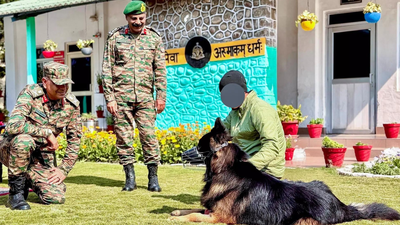
NEW DELHI: Tyson, a four-legged Army hero, was shot in the leg during Operation Trashi-I in Kishtwar, Jammu and Kashmir, and is “recovering well.” The Army on Tuesday said he is “wounded but in high spirits,” showing courage while leading the entry into a terrorist hideout.The German Shepherd, serving in the Army, demonstrated true Indian spirit by playing a key role in neutralising Pakistan-based Jaish-e-Mohammed (JeM) commander Saifullah and his two associates inside their mudhouse hideout (dhok) in the foothills of Passerkut in the Chatroo belt on Sunday.“In the recent Operation Trashi-I at Kishtwar, assault dog ‘Tyson’ displayed extraordinary courage by taking the first bullet while leading the entry into the terrorists’ hideout. Undeterred by his injuries, he pressed forward and launched a fierce assault, compelling the terrorists to open fire and thereby confirming their presence,” the Army’s White Knight Corps said in a post on X.The Army added that Tyson’s fearlessness enabled troops of the White Knight Corps, police, and CRPF to precisely engage and neutralise the three Pakistan-sponsored terrorists.“Wounded yet in high spirits, alert and recovering well, Tyson exemplifies unwavering devotion to duty — a true warrior and a soldier in every sense,” the Army said, adding, “the hunt continues – those who seek to disturb peace will find no sanctuary.”After sustaining an injury to one of his front legs, the K9 soldier was evacuated by helicopter and admitted to a veterinary hospital, officials said.General Officer Commanding of White Knight Corps, Lt Gen P K Mishra, visited Tyson at the veterinary facility and reviewed his medical condition, they added.The corps commander interacted with the attending veterinary team, directed that the best possible care be ensured, and commended the role of Army dog units in counter-terror operations.


Source link

T20 World Cup 2026 [Explained]: Reason behind David Miller–Washington Sundar spat during IND vs SA Super 8 match


In the high-stakes pressure cooker of the T20 World Cup 2026, even the most composed cricketers can find their temperament tested. During the marquee Super 8 clash between India and South Africa at the Narendra Modi Stadium on February 22, 2026, fans witnessed a rare flashpoint between two of the game’s coolest heads: Washington Sundar and David Miller. While the match itself was a masterclass in Proteas dominance, the mid-pitch altercation became the defining viral moment of the evening, sparking a massive debate on social media about the spirit of the game and tactical gamesmanship.

What sparked the David Miller–Washington Sundar altercation in the IND vs SA Super 8 clash?

The friction ignited in the 14th over of the South African innings, a period where the Proteas were shifting gears to post a formidable total. With Tristan Stubbs on strike and Miller at the non-striker’s end, Sundar abruptly halted his delivery stride. The Indian off-spinner was visibly incensed by Miller’s positioning, gesturing sharply toward the non-striker’s crease.

The crux of the dispute lay in Miller’s backing up technique. Visuals suggested that the veteran left-hander was leaving his crease early and positioning himself remarkably close to the stumps—not necessarily to steal a run, but potentially to navigate the wet outfield grass by staying on the firmer edge of the pitch. Sundar, viewing this as an unfair advantage, raised a formal concern with on-field umpire Chris Gaffaney.

The disagreement didn’t end with the umpire; it quickly escalated into a heated face-to-face shouting match. Miller, known for his “Killer Miller” persona but rarely for on-field vitriol, approached Sundar with a defiant stance. The exchange was so animated that Ishan Kishan and the umpires had to physically intervene to separate the duo. Even as the teams headed for a drinks break, South African skipper Aiden Markram had to step in to mediate and restore calm. While the specific words exchanged remain a mystery, the tension was palpable, marking a rare breach of professional composure for both players.

Also READ: India’s T20 World Cup 2026 semi-final qualification scenario after West Indies’ dominant win over Zimbabwe

South Africa bulldozes India in one-sided Super 8 encounter

Despite the early drama, South Africa refused to let the distraction break their rhythm. After a shaky start that saw them reeling at 20/3, the Proteas mounted a spectacular recovery. Miller channelled his on-field aggression into a match-winning performance, smashing a blistering 63 off just 35 balls. Alongside young Dewald Brevis (45) and a late flourish from Stubbs (44*), South Africa catapulted to a commanding total of 187/7.

India’s response was, by contrast, a catastrophic collapse. Chasing 188, the defending champions looked out of depth on a slightly sluggish Ahmedabad surface. South Africa’s pace spearhead Marco Jansen dismantled the top order with figures of 4/22, while the spin duo of Keshav Maharaj and Markram squeezed the middle order.

The Indian batting lineup, missing the steady hand of Axar Patel, whose exclusion for Sundar sparked significant post-match scrutiny, crumbled for a meager 111. Only Shivam Dube (42) offered any meaningful resistance. This 76-run drubbing not only ended India’s 12-game unbeaten streak in T20 World Cups but also severely dented their Net Run Rate, leaving them in a must-win territory for their upcoming fixtures against Zimbabwe and the West Indies.

Also READ: 2007 reloaded? Here’s how Team India’s T20 World Cup 2026 campaign mirrors a legendary comeback


Source link

Hpv Vaccination Campaign India: ‘Swastha Nari’ mission: Centre to launch nationwide HPV vaccination drive in war against cervical cancer | India News


'Swastha Nari' mission: Centre to launch nationwide HPV vaccination drive in war against cervical cancer

NEW DELHI: The government is set to roll out a nationwide Human Papillomavirus (HPV) vaccination campaign for girls aged 14 and above, offering the Gardasil jab free of cost as part of a major push to curb cervical cancer, according to official sources cited by PTI.The voluntary programme, to be implemented across the country in the coming weeks, aims to expand equitable access to life-saving immunisation and strengthen India’s fight against one of the most common cancers affecting women.Officials said the quadrivalent HPV vaccine to be administered under the programme protects against HPV types 16 and 18 — responsible for the majority of cervical cancer cases — as well as types 6 and 11.Emphasising the scientific backing for the initiative, an official source said, “Strong global and Indian scientific evidence confirms that a single dose provides robust and durable protection when administered to girls in the recommended age group.”Citing strong global and Indian scientific evidence, a senior source noted that a single dose administered within the recommended age group provides “robust and durable protection”.“Vaccination under the national programme will be voluntary and free of cost, ensuring equitable access across socio-economic groups,” the PTI reported, citing sources.

What is ‘Swasth Nari Sashakt Parivar’ drive?

The ‘Swasth Nari Sashakt Parivar Abhiyaan’ is described as the largest-ever health outreach initiative for women and children in India. Jointly spearheaded by the Ministry of health & family welfare (MoHFW) and the Ministry of women & child development (MoWCD), the nationwide campaign saw lakhs of health camps organised between 17 September and 2 October at Ayushman Arogya Mandirs, Community Health Centres (CHCs), district hospitals and other government health facilities.The initiative focused on delivering women-centric preventive, promotive and curative healthcare services at the community level. It strengthened screening, early detection and treatment linkages for non-communicable diseases, anaemia, tuberculosis and sickle cell disease.Simultaneously, it promoted maternal, child and adolescent health through antenatal care, immunisation, nutrition support, menstrual hygiene awareness, and lifestyle and mental health interventions.The campaign also sought to mobilise communities towards healthier living, placing particular emphasis on obesity prevention, improved nutrition and voluntary blood donation, reinforcing the broader goal of building healthier families through empowered women.


Source link

12-team blockbuster unveiled! ICC Women’s T20 World Cup 2026 schedule out; India vs Pakistan clash set for June 14 | Cricket News


12-team blockbuster unveiled! ICC Women's T20 World Cup 2026 schedule out; India vs Pakistan clash set for June 14
Women’s T20 World Cup (Pic Credit – X)

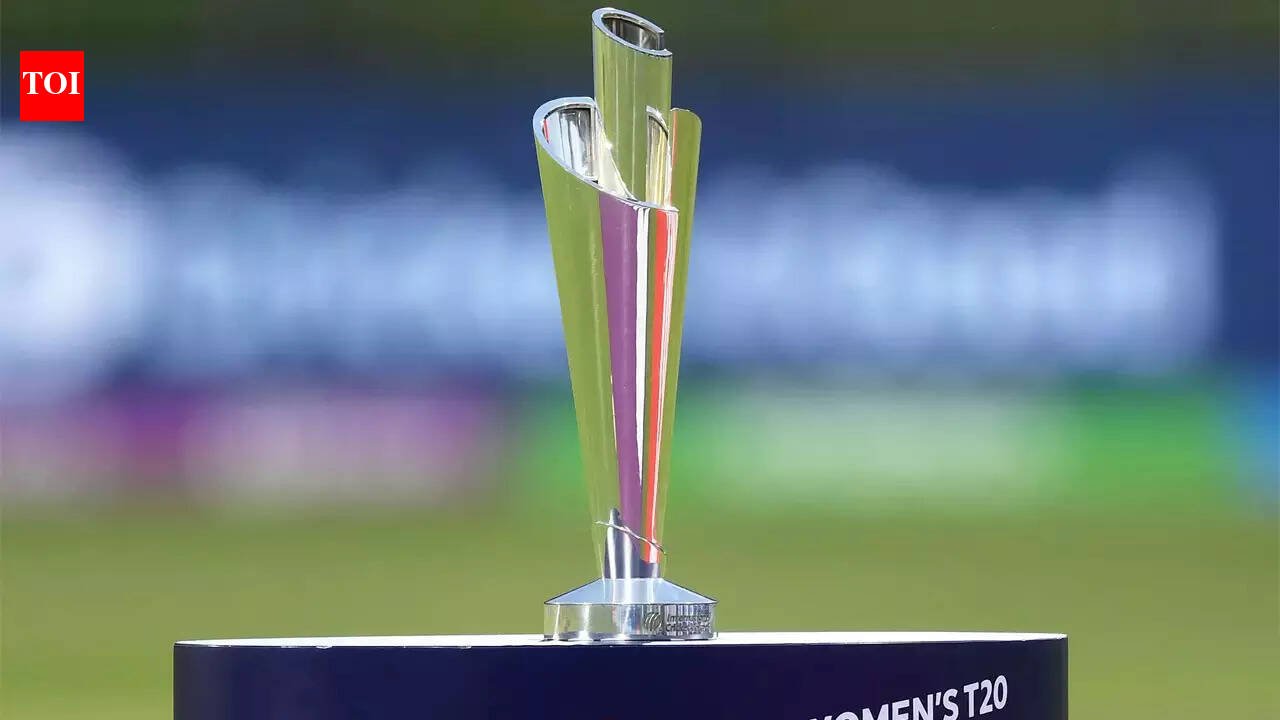
NEW DELHI: The International Cricket Council on Tuesday announced the full schedule for the ICC Women’s T20 World Cup 2026, setting the stage for the biggest edition in the tournament’s history, with 12 teams competing for the coveted title from June 12 to July 5 in England.Go Beyond The Boundary with our YouTube channel. SUBSCRIBE NOW!Hosts England will launch the tournament against Sri Lanka on June 12, marking the beginning of a nearly month-long spectacle that will culminate in the final at the iconic Lord’s Cricket Ground on July 5. India will open their campaign against Pakistan at Edgbaston on June 14.

Gautam Gambhir’s animated chat with Abhishek Sharma goes viral; Team India lands in Chennai

This edition will feature the largest field ever assembled in the competition. Bangladesh, Ireland, Scotland and the Netherlands secured the final four spots through the qualifying tournament in Nepal, joining defending champions New Zealand, six-time winners Australia, 2016 champions West Indies, hosts England, ODI world champions India, Pakistan, South Africa and Sri Lanka.The group stage promises several high-profile clashes.

  • Group A includes heavyweights Australia, India, Pakistan, South Africa, Bangladesh and tournament debutants Netherlands.
  • Group B features England, New Zealand, West Indies, Sri Lanka, Ireland and Scotland.

ICC CEO Sanjog Gupta described the schedule release as a significant moment for the global game.“The release of the schedule is an important milestone in the run-up to the global, premier sporting event,” Gupta said, emphasising the governing body’s continued investment in women’s cricket through expanded participation, improved pathways, enhanced production standards and increased commercial opportunities.He added that recent global events had helped elevate the women’s game and expressed confidence that the upcoming tournament would further strengthen its popularity and global reach.“The ICC Women’s Cricket World Cup in India served as a force multiplier for the sport – breaking records, capturing imaginations and inspiring communities – and our ambition is to carry the momentum into the event in June-July,” he added.

Full Schedule of ICC Women’s T20 World Cup 2026

  • Friday June 12: England v Sri Lanka, Edgbaston 18:30 BST
  • Saturday June 13: Scotland v Ireland, Old Trafford Cricket Ground 10:30 BST
  • Saturday June 13: Australia v South Africa, Old Trafford Cricket Ground 14:30 BST
  • Saturday June 13: West Indies v New Zealand, Hampshire Bowl 18:30 BST
  • Sunday June 14: Bangladesh v Netherlands, Edgbaston 10:30 BST
  • Sunday June 14: India v Pakistan, Edgbaston 14:30 BST
  • Tuesday June 16: New Zealand v Sri Lanka, Hampshire Bowl 14:30 BST
  • Tuesday June 16: England v Ireland, Hampshire Bowl 18:30 BST
  • Wednesday June 17: Australia v Bangladesh, Headingley 10:30 BST
  • Wednesday June 17: India v Netherlands, Headingley 14:30 BST
  • Wednesday June 17: South Africa v Pakistan, Edgbaston 18:30 BST
  • Thursday June 18: West Indies v Scotland, Headingley 18:30 BST
  • Friday June 19: New Zealand v Ireland, Hampshire Bowl 18:30 BST
  • Saturday June 20: Australia v Netherlands, Hampshire Bowl 10:30 BST
  • Saturday June 20: Pakistan v Bangladesh, Hampshire Bowl 14:30 BST
  • Saturday June 20: England v Scotland, Headingley 18:30 BST
  • Sunday June 21: West Indies v Sri Lanka, Bristol County Ground 10:30 BST
  • Sunday June 21: South Africa v India, Old Trafford Cricket Ground 14:30 BST
  • Tuesday June 23: New Zealand v Scotland, Bristol County Ground 10:30 BST
  • Tuesday June 23: Sri Lanka v Ireland, Bristol County Ground 14:30 BST
  • Tuesday June 23: Australia v Pakistan, Headingley 18:30 BST
  • Wednesday June 24: England v West Indies, Lord’s Cricket Ground 18:30 BST
  • Thursday June 25: India v Bangladesh, Old Trafford Cricket Ground 14:30 BST
  • Thursday June 25: South Africa v Netherlands, Bristol County Ground 18:30 BST
  • Friday June 26: Sri Lanka v Scotland, Old Trafford Cricket Ground 18:30 BST
  • Saturday June 27: Pakistan v Netherlands, Bristol County Ground 10:30 BST
  • Saturday June 27: West Indies v Ireland, Bristol County Ground 14:30 BST
  • Saturday June 27: England v New Zealand, The Oval 18:30 BST
  • Sunday June 28: South Africa v Bangladesh, Lord’s Cricket Ground 10:30 BST
  • Sunday June 28: Australia v India, Lord’s Cricket Ground 14:30 BST
  • Tuesday June 30: TBC v TBC (Semi Final 1), The Oval 14:30 BST
  • Thursday July 2: TBC v TBC (Semi Final 2), The Oval 18:30 BST
  • Sunday July 5: TBC v TBC (The Final), Lord’s Cricket Ground 14:30 BST


Source link