Breaking News
‘Keralamite, Keralamian’? Shashi Tharoor quips after Centre renames Kerala as Keralam | India News


‘Keralamite, Keralamian’? Shashi Tharoor quips after Centre renames Kerala as Keralam

NEW DELHI: Senior Congress leader Shashi Tharoor on Tuesday reacted with wordplay after the Union Cabinet is understood to have approved the proposal to change the name of Kerala to ‘Keralam’, asking what Anglophones would now call residents of the state.The Thiruvananthapuram MP asked how people from the state now would be referred to, and what happens to terms like “Keralite and Keralan”. “All to the good, no doubt, but a small linguistic question for the Anglophones among us: what happens now to the terms ‘Keralite’ and ‘Keralan’ for the denizens of the new ‘Keralam’? ‘Keralamite’ sounds like a microbe and ‘Keralamian’ like a rare earth mineral…! @CMOKerala might want to launch a competition for new terms resulting from this electoral zeal,” Tharoor said in a post on X.Sources cited by PTI said the Union Cabinet, at a meeting held on Tuesday, approved the Kerala government’s proposal to rename the state. The meeting was the first to be held at Seva Teerth, the newly inaugurated Prime Minister’s Office and Cabinet Secretariat complex.The move follows a unanimous resolution passed by the Kerala Assembly on June 24, 2024, urging the Centre to amend the First Schedule of the Constitution to reflect the name ‘Keralam’. The Assembly had earlier passed a similar resolution in August 2023, but the ministry of home affairs suggested technical changes, prompting the state to adopt it again.Chief minister Pinarayi Vijayan, who moved the resolution, had said the state is referred to as ‘Keralam’ in Malayalam and that the demand for a unified Kerala for Malayalam-speaking people dates back to the national freedom struggle. “The name of our state is written as Kerala in the First Schedule of the Constitution. This assembly requests the Centre to take immediate steps to amend it as ‘Keralam’ under Article 3 of the Constitution and have it renamed as ‘Keralam’ in all the languages mentioned in the Eighth Schedule of the Constitution,” Vijayan had said.The resolution sought changes in the First Schedule under Article 3. Upon review, it was indicated that the amendment would be required in the First Schedule of the Constitution.Assembly elections in the state are expected in April-May.


Source link

Tirupati row: Andhra CM Chandrababu Naidu flags ‘conspiracy angle’, claims ’20 crore laddus’ made with adulterated ghee | India News


Tirupati row: Andhra CM Chandrababu Naidu flags 'conspiracy angle', claims '20 crore laddus' made with adulterated ghee

NEW DELHI: Andhra Pradesh chief minister N Chandrababu Naidu on Tuesday attacked the previous YSRCP government under Y S Jagan Mohan Reddy alleging that nearly 60 lakh kg of “adulterated ghee” was used between 2019 and 2024 to prepare more than 20 crore consecrated Tirupati laddus.Naidu made the remarks during a special discussion in the Andhra Pradesh assembly on the alleged adulteration of ghee used in preparing the sacred laddu prasadam of Lord Venkateswara Swamy at Tirumala.Participating in the debate on the alleged “sacrilege of the holy laddu prasadam of Lord Venkateswara Swamy,” Naidu claimed that the supply of adulterated ghee was part of an organised conspiracy.“There was a conspiracy angle in the adulterated ghee supply issue. They (perpetrators) became a syndicate. All these are proved in the forensic evidence,” he said in the House.“As much as 59.71 lakh kg of ghee supplied to TTD was adulterated. Between 2019 and 2024, over 20 crore laddus were made using adulterated ghee,” he added.He noted that the Tirumala Tirupati Devasthanams (TTD), which manages the renowned hill shrine, spent about Rs 234.51 crore to procure the ghee in question.“They (the previous regime) committed sacrilege by adulterating the laddu (sacred sweet) in an organised crime,” Naidu alleged.Naidu further claimed that several attacks on temples occurred during Reddy’s tenure between 2019 and 2024. He said his remarks on the adulterated ghee were based on findings in an earlier NDDB report.Endowments minister A Ramnarayan Reddy initiated the discussion in the Assembly, expressing concern over the controversy surrounding the temple offering.Addressing the House, he said, “It is sad that a situation arose to explain the purity of the sacred temple prasadam (offering).” He added that the alleged adulteration of the laddu prasadam had caused distress among devotees.


Source link

Gold price today: How much 18K, 22K and 24K gold costs in your city; check rates for Delhi, Mumbai & more


Gold price today: How much 18K, 22K and 24K gold costs in your city; check rates for Delhi, Mumbai & more

Gold edged eased on Tuesday, with April futures slipping 0.31% to Rs 1,61,102 per 10 grams amid ongoing global uncertainty over US tariffs. On the Multi Commodity Exchange, the yellow metal fell by Rs 496 in a turnover of 7,587 lots. In the international market, Comex gold futures for April fell $28.16, or 0.54%, to $5,197.44 an ounce.The decline comes as the Trump administration looks to restart its global tariff agenda, following a Supreme Court decision last week that blocked several levies imposed last year. Here’s how much gold costs in your city today:

Gold price in Ahmedabad today

In Ahmedabad, 24K gold is trading at Rs 16,183 per gram. The rate for 22K gold stands at Rs 14,835 per gram, while 18K gold is available for Rs 12,139 per gram.

Gold price in Bangalore today

Bangalore sees 24K gold priced at Rs 16,178 per gram. Buyers can get 22K gold for Rs 14,830 per gram, and 18K gold is sold at Rs 12,134 per gram.

Gold price in Bhubaneswar today

The current gold rates in Bhubaneswar are Rs 16,178 per gram for 24K, Rs 14,830 per gram for 22K, and Rs 12,134 per gram for 18K gold.

Gold price in Chennai today

In Chennai, 24K gold costs Rs 16,244 per gram. Meanwhile, 22K gold is priced at Rs 14,890 per gram and 18K gold at Rs 12,730 per gram.

Gold price in Delhi today

Delhi’s gold market lists 24K gold at Rs 16,193 per gram. The 22K variant is Rs 14,845 per gram, while 18K is Rs 12,149 per gram.

Gold price in Hyderabad today

Hyderabad residents can buy 24K gold at Rs 16,178 per gram. The price for 22K gold is Rs 14,830 per gram, and 18K is Rs 12,134 per gram.

Gold price in Kanpur today

In Kanpur, the rates are Rs 16,193 per gram for 24K, Rs 14,845 per gram for 22K, and Rs 12,149 per gram for 18K gold.

Gold price in Kolkata today

Kolkata’s gold prices today are Rs 16,178 per gram for 24K, Rs 14,830 per gram for 22K, and Rs 12,134 per gram for 18K.

Gold price in Mumbai today

The gold rates in Mumbai show 24K at Rs 16,178 per gram, 22K at Rs 14,830 per gram, and 18K at Rs 12,134 per gram.

Gold price in Jaipur today

Jaipur reports 24K gold priced at Rs 16,193 per gram. The 22K variety is Rs 14,845 per gram, and 18K is Rs 12,149 per gram.


Source link

India’s T20 World Cup 2026 semi-final qualification scenario after West Indies’ dominant win over Zimbabwe


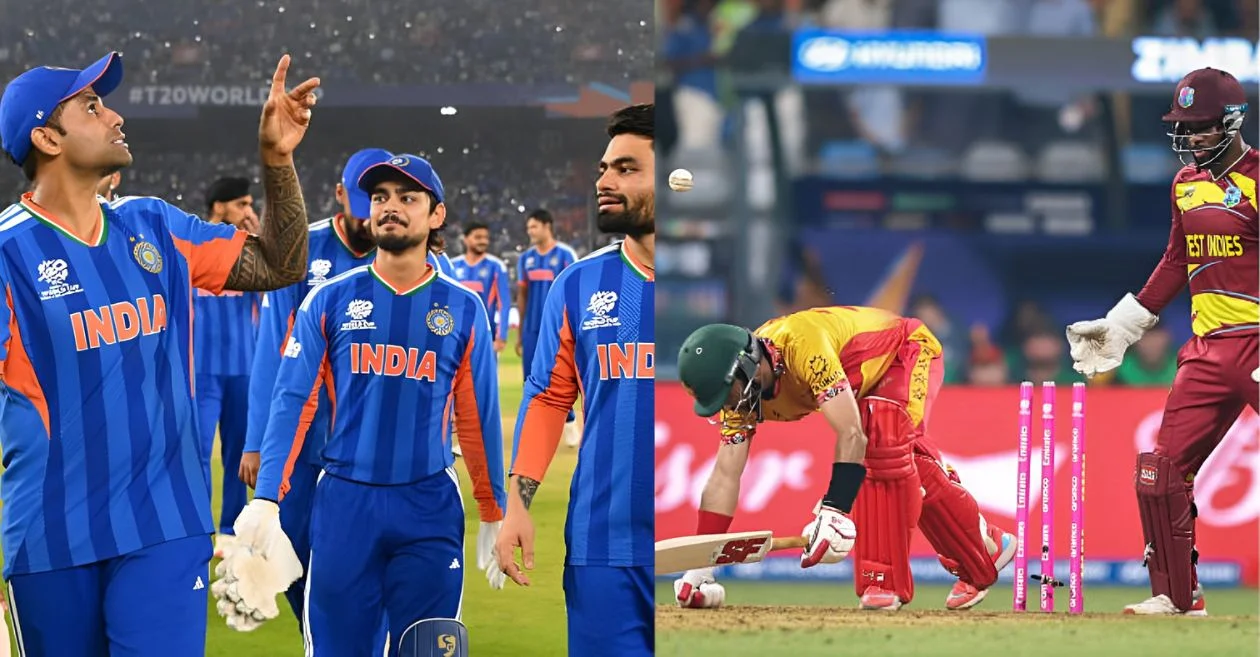
The West Indies’ record-breaking 107-run victory over Zimbabwe in Super 8 stage of T20 World Cup 2026 has essentially turned Group 1 into a statistical minefield for the Indian cricket team. After suffering a heavy 76-run defeat to South Africa, India finds themselves at the bottom of the table with a daunting -3.800 Net Run Rate (NRR), while the Windies have surged to the top with a massive +5.350. For the defending champions, the room for error has completely vanished; they now face two mandatory wins in Chennai and Kolkata to keep their title defense alive.

The Super 8 standings: T20 World Cup 2026

The current Group 1 table reflects a massive divide that India must bridge in just two matches. Because the West Indies and South Africa both secured “blowout” victories in their opening games, they have created a massive NRR buffer that acts as an extra point in their favor. India, sitting at 0 points, is not just trailing in the win column but is effectively 9.15 runs per over behind the West Indies.

This means that simply winning their remaining fixtures may not be enough if the points are tied; the Men in Blue must approach their next two games against Zimbabwe and the West Indies with an ultra-aggressive mindset to systematically dismantle these surpluses and move their own NRR back into the positive territory.

Group Points Table

Position Team Points Net Run Rate (NRR)
1 West Indies 2 +5.350
2 South Africa 2 +3.800
3 India 0 -3.800
4 Zimbabwe 0 -5.350

Also READ: T20 World Cup 2026: Fans react as West Indies hand Zimbabwe 107-run hammering in Super 8 game at Wankhede

What India need to qualify for T20 World Cup 2026 semi-finals after West Indies thrash Zimbabwe?

Scenario 1: The clean sweep and South African assistance

The most straightforward and mathematically safe path for Suryakumar Yadav‘s India is to win both of their remaining matches while hoping South Africa wins their remaining two games as well. If the Proteas defeat the West Indies on February 26 and then beat Zimbabwe on March 1, they would finish as the undisputed group leaders with 6 points. Under these conditions, if India successfully defeats Zimbabwe and the West Indies, they would finish on 4 points, while the Windies and Zimbabwe would be capped at 2 points each. This scenario is the “Gold Standard” for India because it allows them to qualify in the second spot based on points alone, completely removing the hazardous Net Run Rate tie-breaker from the equation.

Scenario 2: The three-way tie and NRR calculations

A much more volatile situation arises if the West Indies defeat South Africa in their upcoming clash. If that result occurs and India goes on to win their next two matches, India, South Africa, and the West Indies would all be tied on 4 points (each with 2 wins and 1 loss). In this deadlock, the semi-finalists would be determined solely by Net Run Rate. To survive this, India would need to win their matches by colossal margins, potentially winning by a combined total of 100+ runs across both games, to leapfrog the NRR of at least one of their rivals. This would require India to not just win, but to effectively “demolish” Zimbabwe in Chennai to set up a final-day shootout in Kolkata.

Scenario 3: The strategic last-mover advantage

India possesses a vital tactical advantage due to the tournament’s scheduling. Their final match against the West Indies at Eden Gardens (March 1) takes place after the South Africa vs. Zimbabwe game has concluded. This sequence provides the Indian team with absolute ‘mathematical clarity’ before they even step onto the field. They will know the exact result needed, down to the specific over or run, to overtake their rivals on the points table or the NRR column. This allows the coaching staff to tailor their strategy, whether it requires a steady chase for a simple win or an all-out blitz to reach a target within a specific timeframe to satisfy NRR requirements.

Also READ: T20 World Cup 2026: Sunil Gavaskar slams star India batter following humiliating defeat against South Africa


Source link

Access Denied


Access Denied

You don’t have permission to access “http://www.ndtv.com/education/cbse-board-exams-2026-no-entry-after-10-am-check-full-exam-day-schedule-here-11006669” on this server.

Reference #18.c7f5d217.1771924080.e545fc5

https://errors.edgesuite.net/18.c7f5d217.1771924080.e545fc5


Source link

Access Denied


Access Denied

You don’t have permission to access “http://www.ndtv.com/world-news/why-trumps-new-15-tariffs-can-again-land-in-legal-trouble-11128913” on this server.

Reference #18.f5493417.1771925730.1c867226

https://errors.edgesuite.net/18.f5493417.1771925730.1c867226


Source link

Chilling murder captured on CCTV: Noida youth ambushed, shot dead at his doorstep over old enmity | Noida News


Chilling murder captured on CCTV: Noida youth ambushed, shot dead at his doorstep over old enmity
CCTV Visual of horrific murder in Noida

NOIDA: A man was shot dead in Uttar Pradesh’s Greater Noida on Tuesday, police said. The incident took place within the jurisdiction of the Ecotech-I police station. According to police, Nitin, a resident of Luksar village and son of Phire, was allegedly shot dead by Sachin and his associates due to an old rivalry. CCTV footage shared by the police purportedly shows several men dragging the victim to the ground and shooting him multiple times. The footage also shows a woman stepping out of a house, while one of the accused is seen threatening the victim with a gun. Nitin sustained grievous injuries in the attack and was taken to a nearby hospital, where doctors declared him dead. Senior police officials, along with additional personnel, reached the spot. Police said the law and order situation is under control and further legal action is being taken. An investigation has been launched to identify and trace all those involved in the killing.

Banner Insert


Source link

R Ashwin’s explosive warning before England clash: ‘If Pakistan are serious about their campaign’ | Cricket News


‘If Pakistan are serious about their campaign’: Ashwin’s explosive warning before England clash
Pakistan players (PTI Photo)

NEW DELHI: Veteran off-spinner Ravichandran Ashwin has stirred debate at the ICC T20 World Cup 2026 after urging Pakistan to make a bold selection call ahead of their must-win Super 8 clash against England in Pallekele on Tuesday. Taking to social media, Ashwin advised Pakistan to promote Fakhar Zaman to the middle order if they are serious about staying alive in the tournament.Go Beyond The Boundary with our YouTube channel. SUBSCRIBE NOW!“If Pakistan are serious about this World Cup campaign, they need to think about giving Fakhar Zaman a go in the middle order,” Ashwin wrote on X. He emphasised Fakhar’s ability to counter England’s spin threat, particularly leg-spinner Adil Rashid and left-arm spinner Liam Dawson.

T20 World Cup: Sahibzada Farman press conference ahead of Pakistan vs England

“He can sweep and use his feet against Rashid and Dawson to inflict some serious damage through the middle overs. This was Nepal’s success formulae against Rashid and there are some key learning’s that the other teams can try to imbibe. Access the square boundaries to earn balls in the step hit zone,” Ashwin added.Ashwin pointed to Nepal’s success against Rashid, even sharing a wagon wheel graphic to illustrate how accessing square boundaries and using footwork disrupted England’s control in the middle overs.The suggestion comes as spin is expected to dominate at the Pallekele International Cricket Stadium, where slowing surfaces have already influenced results. England’s spinners, supported by pacer Jofra Archer, played a decisive role in their commanding win over Sri Lanka, while their batting has found unlikely heroes.Despite inconsistent performances from senior players like Jos Buttler, England have continued to win, with captain Harry Brook backing his experienced core to deliver soon. Opener Phil Salt has also rediscovered form at a crucial time.Pakistan, led by Salman Ali Agha, face a far more precarious situation. Their opening Super 8 match against New Zealand was washed out, leaving them with little margin for error. While their spin attack offers variety, their batting has struggled for consistency beyond leading scorer Sahibzada Farhan.


Source link

IBM stock suffers worst single-day drop in 25 years over Anthropic’s COBOL tool: What it is and why it wiped billions of dollar for IBM


IBM stock suffers worst single-day drop in 25 years over Anthropic’s COBOL tool: What it is and why it wiped billions of dollar for IBM

IBM shares suffered their worst single-day drop in over 25 years on Monday, February 23 after AI startup Anthropic announced that its Claude Code tool can automate the modernisation of COBOL—the decades-old programming language that sits at the heart of IBM’s mainframe business. The stock fell 13.2% to close at $223.35, wiping roughly $40 billion off IBM’s market value and dragging it down more than 24% year to date.The selloff was triggered by a blog post from Anthropic claiming that Claude Code could handle the exploration and analysis work that makes COBOL modernisation so expensive and time-consuming for enterprises. The company argued that AI tools can now compress what used to be multi-year, consultant-heavy migration projects into a matter of quarters.For IBM, which earns recurring revenue from mainframe hardware refresh cycles, software licences and COBOL-related services, the implication was hard to ignore: if AI can do what armies of consultants once did, a significant chunk of the company’s business model faces disruption.

What exactly is COBOL, and why does it still matter?

COBOL stands for Common Business-Oriented Language. It was created in 1959—the same year Alaska became a US state—partly drawing on work by computing pioneer Grace Hopper. The language was built for one job: processing business data. Payroll, transactions, administrative records.Sixty-six years later, it still does that job. Every day. An estimated 95% of ATM transactions in the US still rely on COBOL. It supports 80% of in-person credit card swipes. Hundreds of billions of lines of the language are in active production every day, powering critical systems at banks, airlines and government agencies worldwide.The COBOL Working Group of the Open Mainframe Project estimated in 2021 that roughly 250 billion lines of COBOL are still in use at businesses globally. And most of this code runs on IBM mainframes—the massive, customer-owned servers optimised for large-scale transaction processing.

The problem: Fewer people speak COBOL every year

The catch with COBOL is not that it doesn’t work—it works extremely well for what it was built to do. The problem is that the pool of developers who understand it has been shrinking for years. Most computer science graduates today are trained on Python, Java and cloud-native architectures. Taking a job maintaining COBOL systems is widely seen as career-limiting rather than career-building.This has created an expensive talent bottleneck. Organisations are competing for a shrinking number of specialists who can keep these systems running, while struggling to attract younger developers. During the COVID-19 pandemic, several US states found themselves scrambling for COBOL programmers when unemployment systems—many still running on legacy code—buckled under sudden demand.Banks have tried multi-year migration projects to move off COBOL, and some of these efforts have ended with widespread service disruptions and regulatory fines. The IRS only recently announced a transition from COBOL to Java. For most organisations, understanding the legacy code has historically cost more than rewriting it—which is precisely why so much of it is still around.

What Anthropic actually said—and why markets panicked

In its blog post on Monday, Anthropic framed the announcement as a direct solution to this bottleneck. The company said Claude Code can map dependencies across thousands of lines of COBOL, document workflows and flag risks that would take human analysts months to surface. It also released what it calls “The Code Modernisation Playbook,” laying out a phased approach where AI agents read through COBOL programs and JCL scripts, extract business logic, generate code translations to Java or Python and create test suites—all within weeks rather than years.Anthropic’s broader pitch is that legacy code modernisation stalled because comprehension was the real expense, not the rewriting itself. AI, the company argues, flips that equation by making the analysis cheap and fast.Markets took the message seriously. IBM’s 13.2% drop was its steepest daily decline since October 2000. According to Bloomberg data, the stock is now down 26% in February alone—putting it on track for its worst monthly decline since at least 1968. The selloff also dragged down cybersecurity stocks after Anthropic unveiled a separate security scanning capability built into Claude Code on Friday.

IBM’s mainframe business is the real target

IBM isn’t just any company that happens to use COBOL. It owns the mainframe platform the language runs on. The company earns revenue from hardware, software licences and performance upgrades tied to COBOL workloads. Its modernisation strategy has been to connect COBOL to modern tech—exposing COBOL programs as APIs, integrating them with cloud apps and running them alongside Java and AI workloads—rather than to eliminate the language entirely.If an external AI tool can handle the heavy lifting of understanding, documenting and migrating COBOL systems, it threatens a core part of what IBM sells. It’s not that COBOL will disappear overnight. But the consulting-heavy, multi-year modernisation model that has sustained IBM and a roster of large IT services firms—including companies like Infosys, TCS and Wipro—could shrink significantly.Indian IT benchmarks felt the ripple too. The Nifty IT index dropped nearly 4% on Tuesday, February 24 as fears of AI-driven disruption to legacy IT services spread.

IBM isn’t alone—AI disruption fears are wrecking havoc on the entire software industry

IBM’s Monday crash is part of a much wider rout. On Friday, cybersecurity heavyweights like CrowdStrike and Datadog slumped after Anthropic unveiled a separate security scanning feature in Claude Code. A major software ETF has now shed 27% this year—its steepest quarterly decline since the 2008 financial crisis. The pattern is becoming predictable: an AI company drops a new capability, and investors dump the legacy names that capability threatens.The fear driving all of this has a name—”vibe coding.” The idea that AI can now write functional software from plain-English prompts has led investors to question the long-term pricing power of companies selling tools and services that developers might soon replace themselves. It’s not just IBM. Consulting firms, IT services giants and enterprise software vendors are all being repriced on the assumption that AI shrinks the addressable market for their products.Whether Anthropic’s COBOL claims hold up at enterprise scale—where decades of undocumented business logic, regulatory requirements and organisational inertia complicate every migration—remains an open question. But Wall Street isn’t waiting to find out. The market has decided that the era of expensive, multi-year legacy modernisation projects is ending. The only debate left is how fast.


Source link

New data series: Real GDP growth data calculation methodology overhauled to improve accuracy – here’s what changes


New data series: Real GDP growth data calculation methodology overhauled to improve accuracy - here’s what changes

Real GDP in India is calculated by adjusting nominal growth figures for inflation through the use of price indices. (AI image)

India is set to release its first set of GDP or Gross Domestic Product data on the basis of a new series that may also address recent criticism from economists. The government is revamping the methodology used to estimate real GDP growth under a new national accounts series scheduled to be released this week. The revised framework will incorporate more detailed price deflation techniques to respond to concerns raised by economists.Real GDP in India is calculated by adjusting nominal growth figures for inflation through the use of price indices. Critics have argued that the existing approach is outdated because it depends largely on the wholesale price index rather than the more widely followed consumer price index.In November, the International Monetary Fund highlighted shortcomings in India’s national accounts system. It pointed to the continued use of the 2011–12 base year, heavy dependence on wholesale price data and extensive reliance on single-deflation techniques. The IMF assigned the methodology a “C” rating.

New GDP data series: What changes

“We will now use about 500–600 items from the new CPI and the old WPI series, compared with about 180 earlier, to deflate the output and improve accuracy of the data,” Saurabh Garg, secretary in the Ministry of Statistics and Programme Implementation, said in an interview according to a Reuters report.He noted that this approach will remain in place until a revised WPI series is introduced, which is expected in the near term.Under the earlier system, periods marked by subdued nominal GDP expansion and low wholesale inflation often resulted in inconsistencies, as they tended to produce comparatively higher real growth estimates.As per the current data series, India’s economy, which is one of the fastest-expanding among major global economies, is projected to grow by 7.4% in 2025–26. This is compared with an estimated 6.5% growth in 2024–25.Nominal GDP, which measures economic output at prevailing market prices, is expected to increase by 8.0% during the current financial year.A revised GDP series with 2022–23 as the base year will be released on February 27, along with updated historical data covering the previous four years.These modifications form part of a wider overhaul of India’s statistical framework, following the introduction of a new retail inflation series earlier this month. Updates to the wholesale price index and industrial production data are also in progress.A key element of the revised framework is the adoption of double deflation, which adjusts both output prices and input costs separately to derive real value added.Garg said the changes are expected to enhance data precision, especially in the manufacturing sector, where differences between input and output price movements had previously raised concerns about distortions under the single-deflation approach.


Source link