Breaking News
T20 World Cup 2026: Rashid Khan pays heartfelt tribute to outgoing coach Jonathan Trott


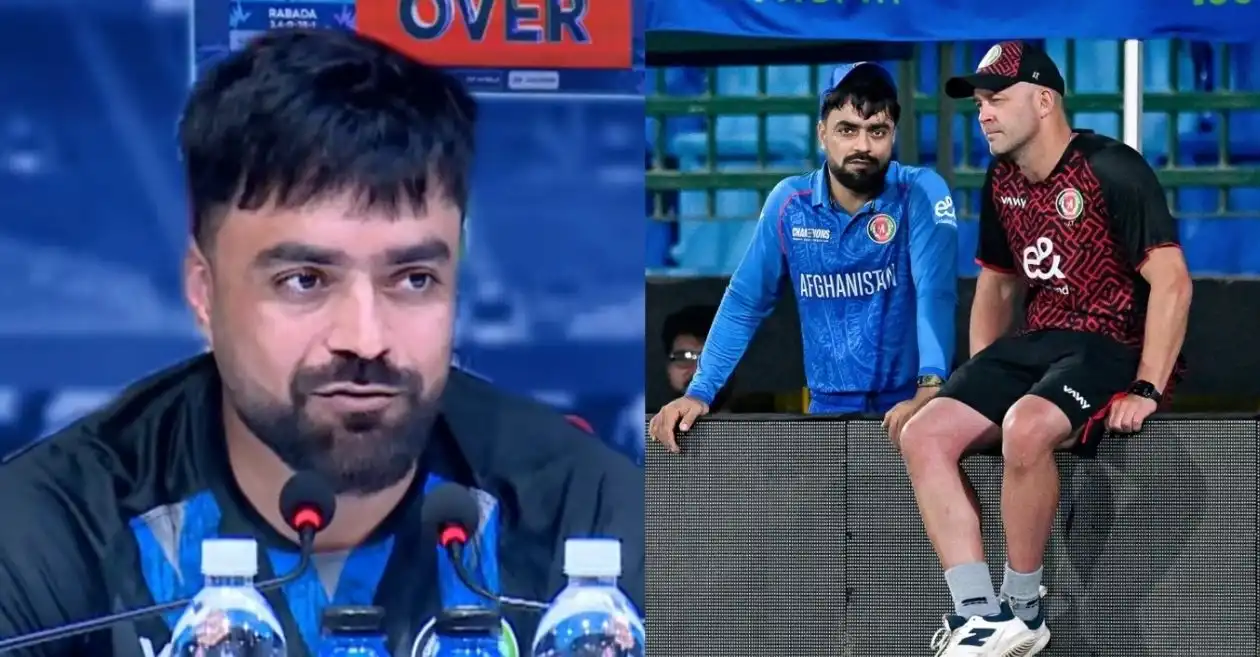
As Afghanistan gear up for their final group-stage fixture of the ICC Men’s T20 World Cup 2026, skipper Rashid Khan has paid a glowing tribute to outgoing head coach Jonathan Trott, crediting him for transforming the team’s mindset and elevating the standards of Afghan cricket.

Afghanistan will take on Canada in what will also mark Trott’s last game in charge of the national side. The former England batter, who took over at a crucial stage in Afghanistan’s cricketing journey, leaves behind a squad that now commands respect across formats.

Speaking on the eve of the clash, Rashid acknowledged Trott’s immense contribution, describing his tenure as a defining chapter in Afghanistan’s cricketing rise.

Rashid Khan pays rich tribute to Jonathan Trott

Rashid did not hold back in his praise for the outgoing coach. Reflecting on their journey together, he said Trott had been instrumental in guiding the team in the right direction and building a strong foundation for the future.

“We have a series against Sri Lanka straight after the World Cup and then the IPL. Tomorrow is Jonathan Trott’s last game with us. We’ve had some unbelievable games and tours with him. He has been someone who has taken Afghanistan cricket to where it is now,” Rashid said in the pre-match presser.

The Afghan captain emphasized that Trott’s influence extended beyond tactics and match-day strategies. According to Rashid, the Englishman worked tirelessly with every player in the squad, helping them grow both individually and collectively.

“I think he has worked so hard with every single one. Definitely everyone around us will miss him so much. He played a main role in taking this team on the right way, right path,” he added.

Also READ: Explained: Which teams will Pakistan face in Super 8 of T20 World Cup 2026?

Rashid on the transformation of Afghanistan team under Trott’s leadership

Under Trott’s leadership, Afghanistan have evolved into a disciplined and fearless unit capable of challenging established cricketing nations. Their performances in recent global tournaments have showcased a team that not only competes but believes it belongs at the highest level.

Rashid highlighted that this transformation did not happen overnight. It was the result of sustained effort, clear communication, and a shared vision between players and coaching staff.

Notably, Afghanistan’s growth under Trott has been marked by improved consistency, sharper game awareness, and better adaptability in pressure situations. The team’s ability to execute plans against stronger opposition has particularly stood out during his tenure. While paying tribute to his departing coach, Rashid also acknowledged that the challenges will only grow from here. With Afghanistan now seen as a serious contender, rival teams are devising specific strategies to counter their strengths.

“Now nothing is easy for us. Teams will come against us with different plans. It’s about how we manage ourselves, upgrade our skills and stay one step ahead of the opposition. That depends on individuals and how we prepare ourselves,” Rashid added further.

Also READ: Sunil Gavaskar reveals how Abhishek Sharma can rediscover his lost mojo in T20 World Cup 2026
Source link

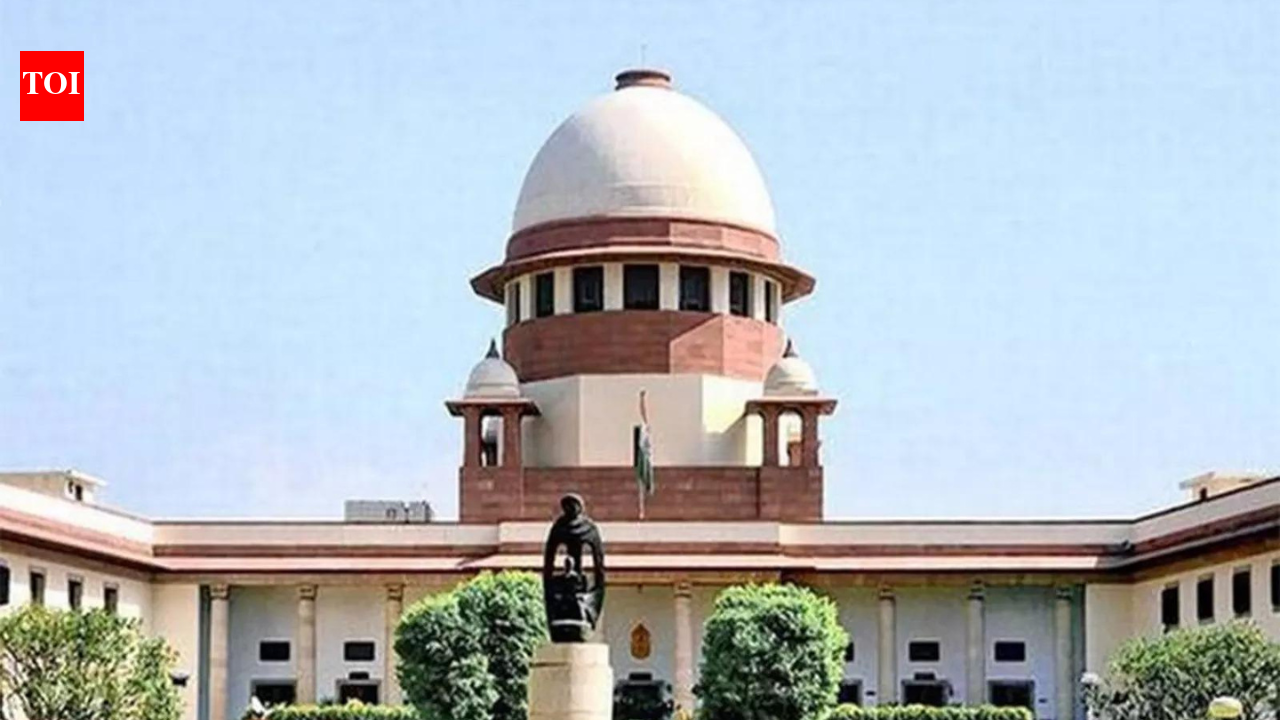
‘Who will pay for it?’: SC raps Tamil Nadu govt for promising free electricity; flags ‘freebie’ politics | India News


'Who will pay for it?': SC raps Tamil Nadu govt for promising free electricity; flags 'freebie' politics

NEW DELHI: The Supreme Court on Thursday pulled up Tamil Nadu electricity board for promising free electricity to consumers irrespective of their financial status.The apex court issued notice to the Centre and others on plea of DMK government which proposes to provide free electricity. A bench led by Chief Justice of India Surya Kant slammed freebies culture adopted by states and political parties, saying that it hampers economic development.The apex court added that most states in the country are revenue deficit but offering such freebies while overlooking development.“The economic development of the nation will be hampered with this kind of largesse distribution Yes, it is the State’s duty to provide. But the ones who are enjoying freebies.. is it not something that should be looked at?” Chief Justice of India Surya Kant verbally observed.“We know states where there is free electricity even if you are big landlord.. you keep lights on..machines on etc. If you want to have a facility you pay for it. But this money which state says will pay now… Who will pay for it? This is the tax money,” he said.The court said that it is aware of what happened in some states in the recent elections, where welfare schemes were suddenly announced just ahead of the elections.The Court clarified that the issue was not confined to any one State but all States in the country.“We are not on Tamil Nadu context only. We are on the fact that why are schemes being announced just before elections. All political parties, sociologists need to revisit ideology. How long will this continue?” CJI said.“It’s not one State we are talking about, it’s about all States. It is planned expenditure. Why don’t you make Budget proposals and give justification that this is my outlay on unemployment of people,” Justice Joymalya Bagchi added.


Source link

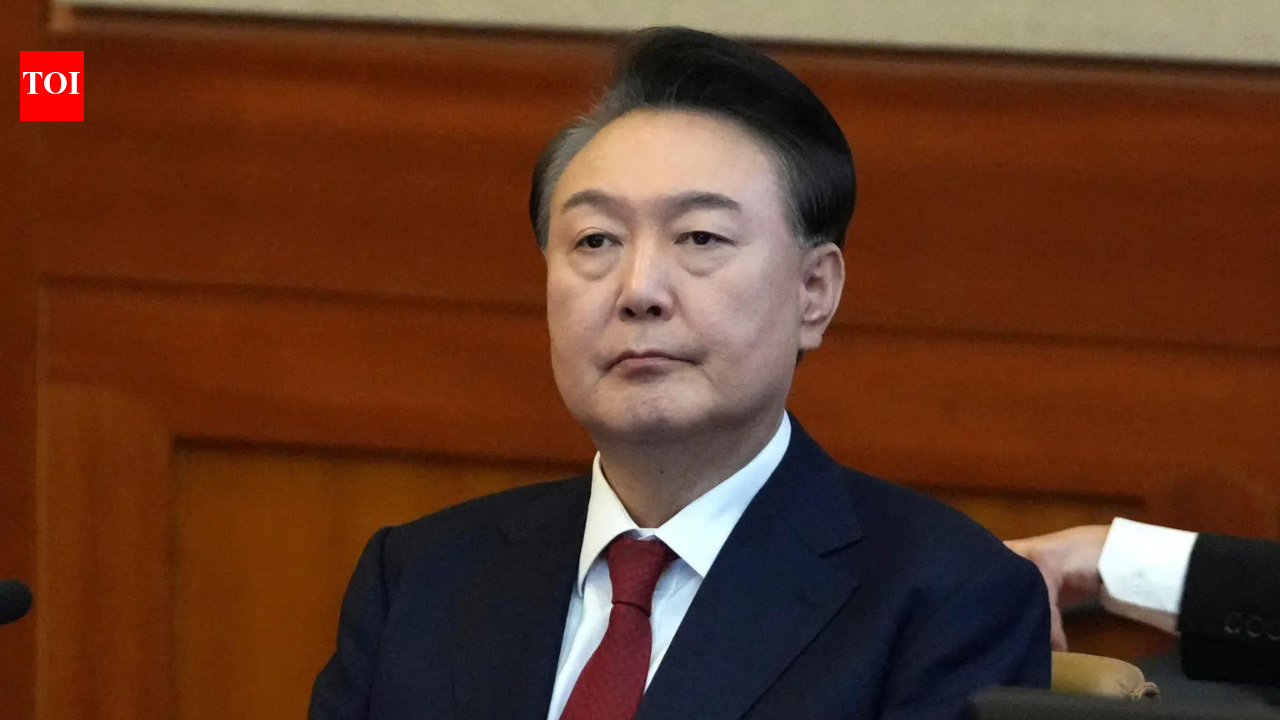
Former South Korea president Yoon Suk Yeol sentenced to life imprisonment for ‘insurrection’


Former South Korea president Yoon Suk Yeol sentenced to life imprisonment for 'insurrection'
South Korea’s impeached President Yoon Suk Yeol (file pic)

Former South Korea president Yoon Suk Yeol has been found guilty of “insurrection”, and has been sentenced to life in prison by the Seoul central district court. The verdict is linked to his martial law declaration in December 2024 , which the court called a deliberate plot to “paralyse” the National Assembly.“As to defendant Yoon Suk Yeol, the crime of insurrection leadership is established,” presiding judge Ji Gwi-yeon told Seoul Central District Court, as quoted by AFP.“The declaration of martial law resulted in enormous social costs, and it is difficult to find any indication that the defendant has expressed remorse for that,” added the judge to the ruling while announcing the ‘life imprison’ ruling.A special prosecutor has demanded the death penalty for Yoon, arguing that his actions posed a serious threat to the country’s democracy and warranted the harshest punishment. However, most analysts expected a life sentence, noting that Yoon’s poorly planned power grab did not result in any casualties. South Korea has not executed a death row inmate since 1997, effectively maintaining a moratorium amid ongoing calls for abolition.As Yoon arrived at the Seoul court, hundreds of police officers monitored the scene while supporters rallied outside the judicial complex. Nearby, critics demanded the death penalty, their protests intensifying as the prison bus transporting Yoon passed by.The court will also hear cases against seven former military and police officials accused of enforcing Yoon’s martial law decree. Yoon, a staunch conservative, defended the six-hour decree as necessary to prevent “anti-state” liberal forces from obstructing his agenda. The measure was lifted after lawmakers broke through a military blockade and unanimously voted to nullify it.Yoon was suspended from office on December 14, 2024, following impeachment by the National Assembly, and formally removed by the Constitutional Court in April 2025. He has been in custody since July 2025, facing multiple criminal trials, with the rebellion charge carrying the most severe punishment. Last month, he was sentenced to five years in prison for resisting arrest, fabricating the martial law proclamation, and bypassing a legally required full Cabinet meeting before declaring the measure.The Seoul Central Court has also convicted two of Yoon’s Cabinet members in related cases. Prime Minister Han Duck-soo was sentenced to 23 years for attempting to legitimise the decree through a Cabinet Council meeting, falsifying records, and lying under oath. Han has appealed the verdict.


Source link

‘Cultural insensitivity’: Mamata slams PM Modi over ‘Swami’ prefix to Ramakrishna’s name | India News


‘Cultural insensitivity’: Mamata slams PM Modi over ‘Swami’ prefix to Ramakrishna’s name

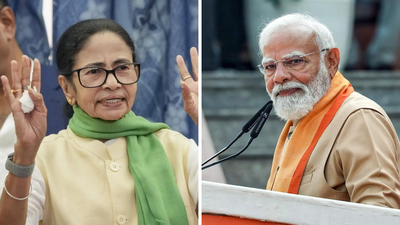
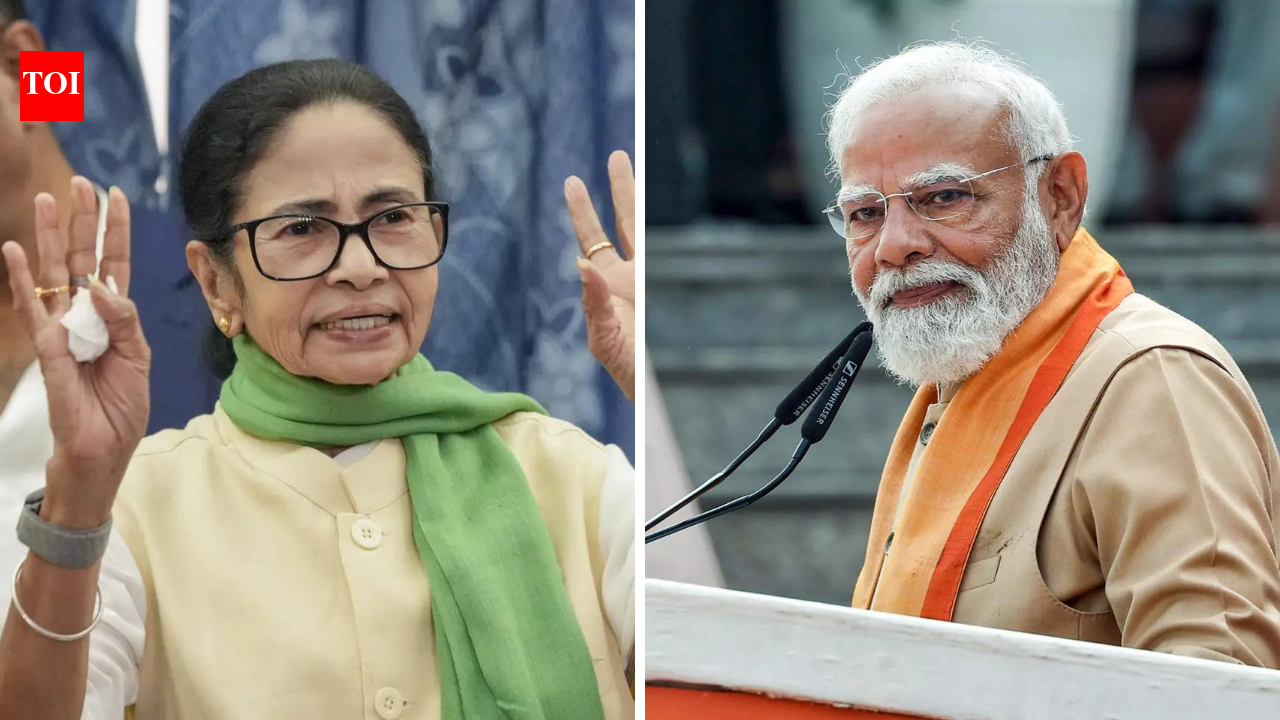
NEW DELHI: West Bengal chief minister Mamata Banerjee on Thursday launched a scathing attack against Prime Minister Narendra Modi for adding an “unprecedented and improper prefix” to Sri Sri Ramakrishna Paramahamsadeva’s name while paying tributes on his birth anniversary.Mamata accused the Prime Minister of “aggressively displaying his cultural insensitivity to great figures of Bengal.”

‘Targeting People Like Terrorists’: Mamata Banerjee Attacks EC Over SIR, Cites Bangladesh Polls

“Yet again, our Prime Minister aggressively displays his cultural insensitivity to great figures of Bengal. Today is the janmatithi of Yugavatara (God’s incarnation in our age) Sri Sri Ramakrishna Paramahamsadeva. While trying to hail the great saint on this occasion, our PM added an unprecedented and improper prefix to the great saint’s name, ‘Swami’!” Mamata said in a social media post on X.“As is well known, Sri Ramakrishna was widely revered as Thakur (literally, God). While his ascetic disciples constituted the Ramakrishna Math and the Ramakrishna Mission after their Master’s demise, and those monks were then called ‘Swami’ as per Indian traditions, the Master, the Acharya, himself continued to be referred to as Thakur. The prefix ‘Swami’ was meant for his disciples in the Ramakrishna Order; but the holy trinity of the Order remained Thakur–Ma–Swamiji. Thakur is Sri Sri Ramakrishna Paramahamsadeva, Ma is Ma Sarada, and Swamiji is Swami Vivekananda,” she added.Earlier in the day, PM Modi paid tributes to Swami Ramakrishna Paramahansa on his birth anniversary and said his noble thoughts will forever remain a source of inspiration.“Humble tributes to Swami Ramakrishna Paramahansa on his birth anniversary. The way he established spirituality and meditation as a vital life force will continue to benefit humanity in every era. His noble thoughts and messages will forever remain a source of inspiration,” Modi said in a post on X in Hindi.Ramakrishna Paramahansa was born on this day in 1836.Ramakrishna Paramahansa, who served as a priest at Kolkata’s Dakshineswar Kali Temple, is known for his teachings on the harmony of religions.The Ramakrishna Math and Ramakrishna Mission were brought into existence by Sri Ramakrishna and his chief disciple, Swami Vivekananda.The Ramakrishna Math and Ramakrishna Mission are worldwide, non-political, non-sectarian spiritual organisations that have been engaged in various forms of humanitarian and social service activities for more than a century.


Source link

Ranji Trophy: Jammu and Kashmir dare to dream under pressure – A big leap long in the making | Cricket News


Ranji Trophy: Jammu and Kashmir dare to dream under pressure – A big leap long in the making
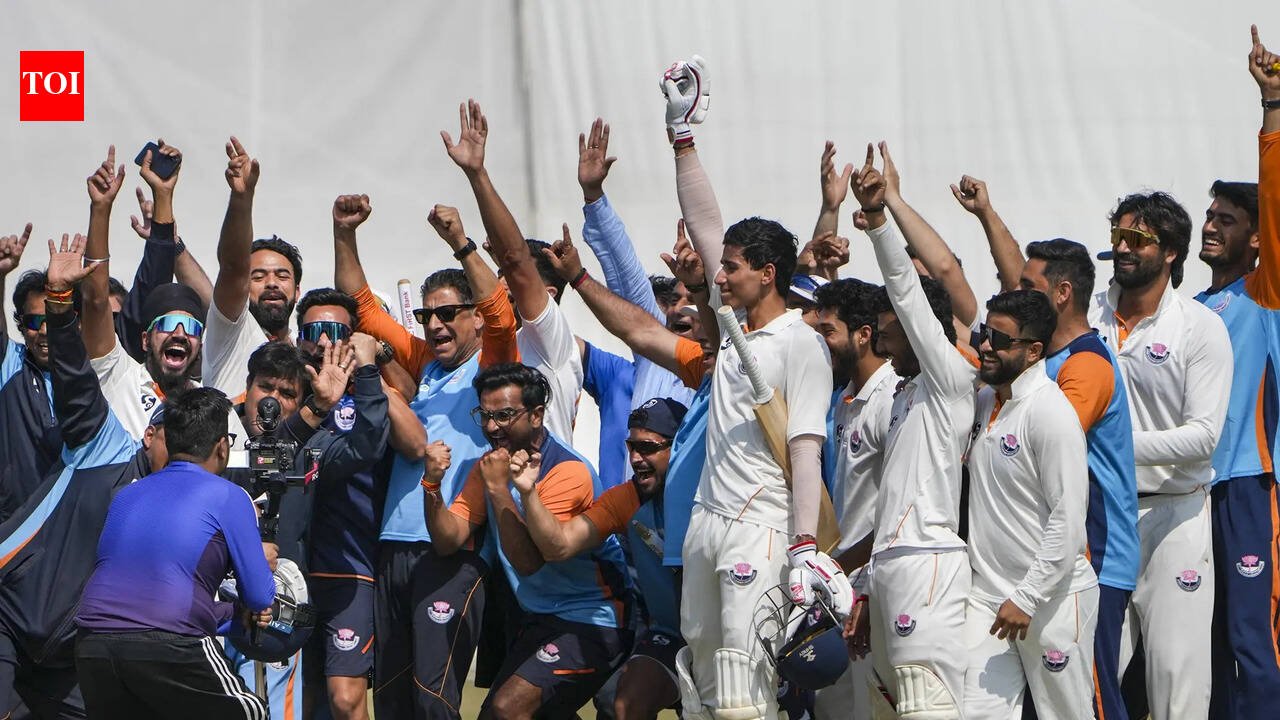
Jammu and Kashmir’s players celebrate after the team’s victory in Ranji Trophy semifinal against Bengal. (PTI Photo)

KALYANI: History had barely settled in when the phone rang. A familiar face flashed up on a video call. Minutes after Jammu and Kashmir sealed a spot in the Ranji Trophy final, the team heard from BCCI president Mithun Manhas, a former head of the J&K cricket’s ad-hoc committee. It was fitting. J&K first entered the Ranji Trophy in the 1959-60 season. For decades they were treated as plucky participants, rarely as genuine threats. The transformation into a side that now talks — and plays — like title contenders has had Manhas’ imprint on it.Go Beyond The Boundary with our YouTube channel. SUBSCRIBE NOW!“We have done it, Mithun,” J&K coach Ajay Sharma shouted out on the phone, “Mithun and I go back a long way. He made his debut for Delhi under me. I know how hard he had worked for this.”There is a fairy-tale quality to J&K’s rise as a cricketing power: overcoming odds, brushing aside doubts, and learning the most important skill of all — self-belief. But this isn’t a story built on romance alone. It has also been shaped by method, patience and the hard labour of building a culture.

Why Pakistan don’t trust Babar Azam any more | T20 World Cup 2026

Former Delhi player Sharma himself admits he struggled to get a grip when he first took charge before the 2022-23 season. “When I joined for the first time, I was handling 38 boys. I was alone then,” Sharma said.The set-up looks very different now. J&K have a bowling coach in P Krishnakumar and Dishant Yagnik as their fielding coach. These are small additions on paper, significant ones in a dressing room trying to grow into a winning unit.“Initially it was challenging because it was a very different culture in J&K. It took me around two years to understand these kids. It took time to bond with them,” he said. “I was hard on them initially. But today they see me as an elder brother.”The first shift, Sharma believes, had to happen in the mind. “These boys only think about white-ball cricket and the IPL. We have players from the state in the IPL. But Mithun, as J&K cricket administrator, had a vision and that is to win the Ranji trophy. Ranji trophy still remains the country’s premier tournament. If you do well here your name goes ahead,” Sharma said.From there, the work became more deliberate: identify a core and keep backing it. A group of 24-25 boys began to take shape — some, like left-arm pacer Sunil Kumar, emerging through talent-hunt competitions. “It’s the same bunch which has developed as we kept giving them confidence,” Sharma stated.Alongside confidence came ambition — not the loud, throwaway kind, but some-thing planted carefully and watered over seasons. “I slowly made them understand that you are all talented guys and you are all around 19-20 years of age. You have the game in you so if you apply a little, you can play for India,” he said.Infrastructure, too, mattered. J&K’s push included pitch preparation, with Sharma noting the state now has both black and red soil pitches, a rare advantage for a side looking to be versatile at home and resilient away.Preparation became a season-defining theme. “Pre-season is very important and we started playing the Buchi Babu (in Chennai) for the last two-three years,” Sharma pointed out. Facing bigger sides there, and surviving those examinations, helped the group believe it could beat anyone.“J&K has become a team to reckon with. Everybody is scared of playing J&K now,” Sharma thundered. “We have all bases covered having both quality fast bowlers and spinners. We have won both the knockout matches away from home.”


Source link

Identical twins, identical scores (285) in JEE Main | India News


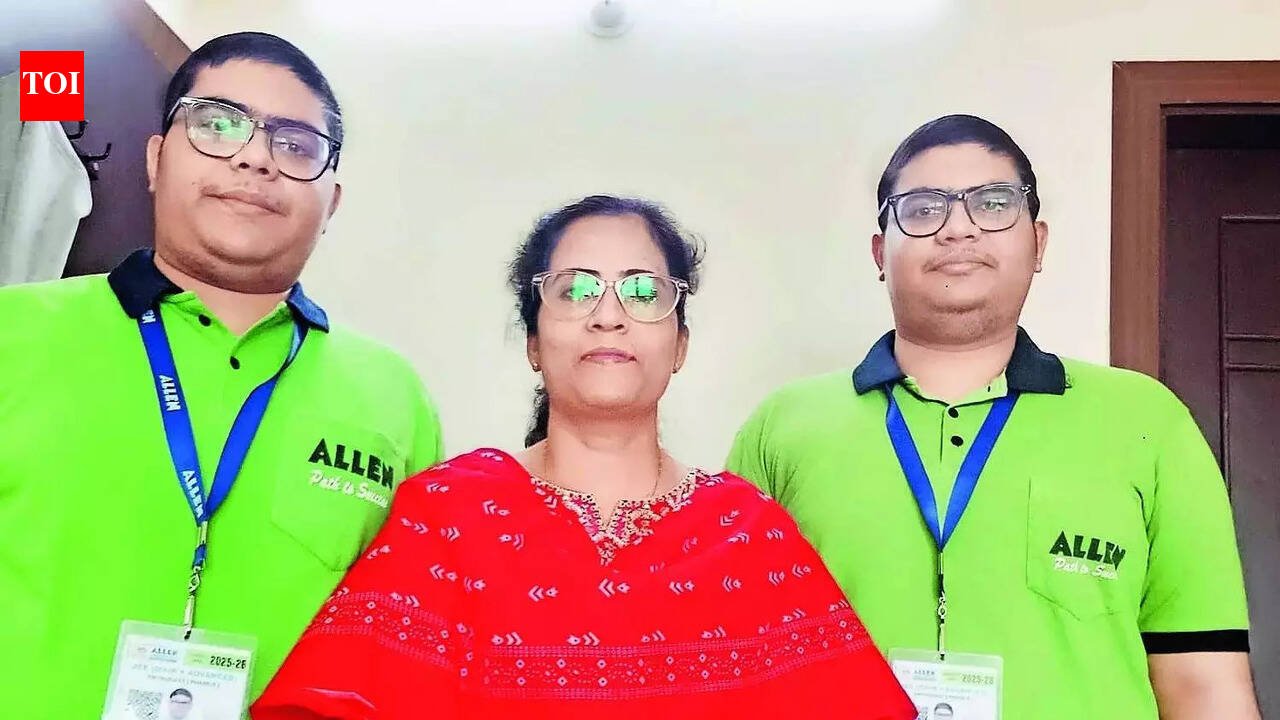
The twins with their mother

MUMBAI/JAIPUR: In a city crowded with toppers and tight schedules, brothers Mahroof Ahmed Khan and Masroor Ahmed Khan in Kota stand out for an almost uncanny symmetry. The twins, who share the same shoe size and eyeglass power, studied together, tested together, sat the same JEE Main (Session-I) 2026 shift, and walked away with identical marks till the last digit – 285 out of 300; an NTA score of 99.998.Under NTA rules, candidates must declare if they are twins while filling out forms for the same competitive exam. Such candidates are made to take the exam in the same shift to ensure the integrity of exams like JEE and NEET. Their story began in Bhubaneswar, Odisha, and moved, like so many other JEE journeys, to Kota in 2023.At Kota academy, twins turned every test into a private contestKnown for cracking Olympiad exams, the twin brothers hoped the city’s coaching ecosystem would sharpen them for bigger tests ahead, and turned friendly rivalry into a full-time study tool.“The twins came here sharing not just classrooms and notes, but an entire rhythm of preparation. Born on May 7, 2008, they have moved in parallel lines for as long as they can remember – same school, same coaching, same ambition,” said Prof Amit Ahuja, career counsellor at Allen Career Institute. Behind this effort was a decision that reshaped the family’s life.Their mother, Dr Zeenat Begum, a gynaecologist who had been working for Odisha govt since the 1990s, put her career on hold to move to Kota with her sons. For three years, she managed their routines, meals, health, and morale, becoming the quiet constant in a high-pressure environment.Zeenat said the move to Kota was initially meant to be temporary. “Both of them got selected for the International Science Olympiad in 2023, and we came to Kota in March that year, thinking we would stay for a few months till they prepared for the Olympiad exam. But after a few weeks, both said that they liked the environment and the study approach here and decided to pursue coaching for JEE,” she said. “When they decided to pursue a career in engineering and prepare in Kota for JEE, I left my job as I thought that if their career was made, I too could restart mine. But supporting them is important in this phase,” Zeenat said.At the academy, the twins found their competitive edge not in outpacing others, but in pushing each other. If one slipped, the other stepped in – dissecting mistakes, revising concepts, and resetting goals.At home, the competition stayed strictly in-house. Their mother said the twins competed only as a preparation strategy, calling each other their “friend” and “mirror”. “They would study and give exams together and compare their scores with each other and with their previous attempts. It helped them identify their weaknesses, and they worked to improve them. This mutual competition is their greatest strength,” said Zeenat.


Source link

Shivam Dube reveals how MS Dhoni helped him tackle short balls


In the high-stakes cauldron of the ICC Men’s T20 World Cup 2026, Shivam Dube has emerged as one of India’s most dependable match-winners. But behind the explosive 31-ball 66 that powered India to victory against the Netherlands on Wednesday (February 18) lies a story of mentorship, mindset shift, and three simple words from the man who has defined cricketing wisdom for a generation: MS Dhoni .

The Indian all-rounder, who was named Player of the Match for his game-changing performance at the Narendra Modi Stadium, revealed in a post-match conversation that Dhoni’s advice fundamentally altered his approach to facing short-pitched deliveries – a vulnerability that once threatened to derail his international career.

MS Dhoni’s mantra that helped Shivam Dube conquer short balls

Speaking to host broadcasters after India’s 17-run victory against the Netherlands, Dube opened up about the crucial conversation that transformed his batting philosophy. When struggling against short balls early in his IPL career, Dhoni offered characteristically simple yet profound counsel .

“Mahi bhai had told me that it isn’t necessary that you have to hit a six on that ball, you can hit a boundary or take a single, so that thing was always in my mind that when I come in at the start,” Dube revealed.

This advice – essentially “don’t attack the short ball” – ran counter to the natural instincts of a power-hitter. Dube admitted that batters struggling against a particular delivery often believe the only way to overcome it is by smashing it for a six .

Dube’s technical journey: From vulnerability to strength

Dube’s struggles against short-pitched deliveries were well-documented early in his career. Despite possessing immense power and being one of the tallest cricketers in the Indian setup, the left-hander often looked uncomfortable against quality fast bowling exceeding 140 km/h.

“There was a time when I came to IPL, I was struggling a bit against short balls, at that time I wasn’t able to hit them so cleanly,” Dube recalled. “But then I realised that if I have to dominate at this level and I have that power, then why should I lag because of one thing, so I worked a lot on that thing during the off season.” 

The transformation involved extensive practice with sidearms, but Dube emphasized that the mindset shift proved more crucial than technical adjustments . The results have been dramatic – his average against short balls improved from 23.5 during the 2021-22 period to 84 in 2023 .

The Dhoni-CSK connection: A partnership that transformed Dube’s cricketing career

Dube has been part of the Chennai Super Kings setup since IPL 2022, forging a bond with Dhoni that remains strong to this day. While Dhoni’s illustrious playing career may be nearing its final chapter, his mentorship continues to yield dividends for Indian cricket .

“This credit goes to Chennai Super Kings and Mahi bhai because I always had this game in me,” Dube had earlier said during the Afghanistan series in 2024. “They have brought out the best in me. They have always encouraged me and said that they believe in me. Stephen Fleming and Mike Hussey have shown faith in me.” 

The CSK think-tank’s willingness to promote Dube in the batting order and back him despite initial struggles created an environment where he could implement Dhoni’s advice without fear of failure.

Also READ: Sunil Gavaskar reveals how Abhishek Sharma can rediscover his lost mojo in T20 World Cup 2026
Dube delivers a match-winning performance against Netherlands at T20 World Cup 2026

The wisdom of Dhoni’s counsel was on full display during India’s final group-stage match against the Netherlands. Coming in with India struggling at 74 for 3 after 10 overs, Dube started slowly, scoring just six runs off his first 11 deliveries and even surviving a close lbw call.

Instead of panicking or attempting to dominate immediately, he remained patient, rotated strike, and waited for scoring opportunities – exactly as Dhoni had advised. The approach paid spectacular dividends as he then targeted the spinners and capitalized on predictable changes of pace.

Dube’s half-century came off just 25 balls, featuring four boundaries and six sixes. Alongside Hardik Pandya, he stitched a crucial 119-run stand in the final 10 overs, with India scoring 75 runs in the last five overs alone. He eventually fell in the 19th over for 66 off 31 balls, but the damage had been done.

To complete a memorable all-round performance, Dube also contributed figures of 2 for 35 with the ball, further denting the Netherlands’ chase.

Also READ: Fans react as India complete flawless T20 World Cup 2026 group stage run after Shivam Dube stars vs Netherlands


Source link

Income Tax notice alert! Senior executives with over Rs 50 lakh salaries under radar for ‘underreporting income’, misusing exemptions


Income Tax notice alert! Senior executives with over Rs 50 lakh salaries under radar for ‘underreporting income’, misusing exemptions
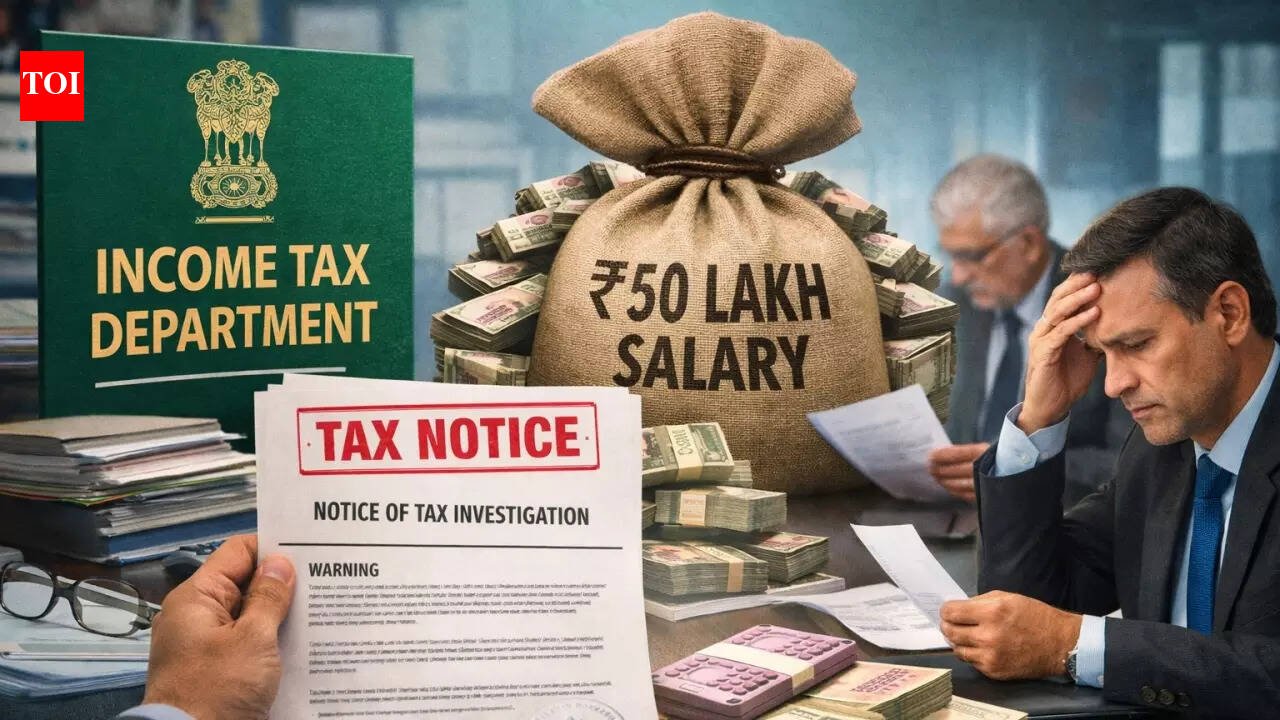
The Income Tax Department has flagged cases involving non-disclosure of overseas assets and foreign income. (AI image)

Income Tax Notice alert! The Income Tax Department is cracking down on alleged misreporting of income by senior executives across multinational companies and startups. Several such executives earning over Rs 50 lakh have received tax notices from the I-T Department.The tax department has alleged that in all these cases the income has either been underreported, misreported, or false exemptions have been claimed to reduce tax outgo.

Why Income Tax Notices Are Being Sent

The Income Tax Department has flagged cases involving non-disclosure of overseas assets and foreign income, understatement of stock-based compensation, and inflated claims of benefits such as accommodation and travel allowances aimed at lowering taxable income.According to officials quoted in an ET report, the Income Tax Department authorities have issued notices to these individuals — including chief executives and managing directors at multinational corporations — asking them to correct discrepancies in their filings before any action is taken.

Tax notices

Tax notices

Executives from industries including, information technology, fast-moving consumer goods, hospitality, engineering and construction, and automobiles have received such notices. Officials cited in the report said that several founders and senior leaders from startups have also attracted the tax department’s scrutiny.In many instances, the taxpayers are alleged to have sought tax relief by reporting bogus donations to religious bodies, charitable organisations, or educational institutions.We are examining more than two dozen cases involving investments in high-value properties, over 50 instances where substantial secondary income was received from foreign clients in cryptocurrencies, and cases featuring significant contributions to political parties that are neither officially recognised nor participating in elections, a senior official was quoted as saying.These irregularities came to light following closer scrutiny of income tax returns filed by high earners during the ongoing assessment period. Under its ‘Non-intrusive Usage of Data to Guide and Enable (Nudge)’ initiative, the department has prompted several executives to submit revised returns to address inconsistencies.An official noted that some taxpayers assumed overseas acquisitions and holdings would escape detection. However, with the government getting important financial information through automated data-sharing arrangements and monitoring linked to the Permanent Account Number (PAN), concealing such foreign dealings has become far more challenging.Among the undeclared assets that have been identified are properties registered in the names of spouses and minor children, foreign equity investments, cryptocurrency-based income, and funds maintained in overseas bank accounts.The review also revealed a striking trend: many taxpayers represented by the same chartered accountants were contributing to identical institutions. The official added that separate proceedings are being initiated against those chartered accountants.This enforcement drive is part of the government’s wider effort to strengthen compliance through data-centric oversight. In recent years, authorities have increasingly relied on artificial intelligence-powered analytics to detect mismatches between reported income, tax deducted at source records, and information obtained from third-party financial sources.So far in the current financial year, over 2.1 million taxpayers have revised their returns for assessment years 2021-22 through 2024-25, resulting in additional tax payments exceeding Rs 2,500 crore. Additionally, more than 1.5 million returns have already been updated for the ongoing assessment year.In the 2026-27 Budget, the Centre introduced a one-time six-month compliance window allowing individuals to disclose foreign assets. The measure is intended to offer relief to taxpayers, including professionals with unreported employee stock option holdings and students who continued to hold funds in overseas accounts.


Source link

“Social media is junk food…”: Tech entrepreneur Bryan Johnson shares his experience after a 40-hour social fast |


“Social media is junk food...”: Tech entrepreneur Bryan Johnson shares his experience after a 40-hour social fast
Bryan Johnson (Image source: Wikipedia)

Social media is a big part of our daily lives now. Smartphones keep getting notifications, timelines never stop refreshing, and short videos are always trying to get your attention. Even though these platforms are supposed to connect people, researchers and technologists are starting to wonder how being on them all the time affects the brain, attention span, and long-term mental health. Over the past few years, the idea of a “digital detox” has gone from being talked about on wellness blogs to being seriously discussed in the fields of technology and neuroscience.Tech entrepreneur Bryan Johnson is one of the most recent people to bring this topic back into the spotlight. Known for his work in technology and longevity research, Johnson shared a detailed post on X (formerly Twitter) describing his experience after stepping away from social media.The post attracted attention because it framed social media use not as a moral issue, but as a technical and biological one. Johnson explained how modern platforms are built to keep people interested by using reward loops, notifications, and personalised feeds. According to him, these systems interact directly with human neurochemistry, shaping behaviour in subtle but powerful ways.Johnson’s message was more about personal awareness and choice than about asking for rules or bans. He said that taking a break from social media is like resetting your brain, just like cutting back on sugar resets your taste buds. His story adds to the growing conversation about how digital tools affect the brain and why taking a break, even for a short time, can help you focus in a world where you are always connected.

Bryan Johnson completed a 40-hour social media fast

In his post published on X, Bryan Johnson explained that after removing social media from his daily routine, he noticed clear changes in how his mind worked. He stated that his thinking became calmer, his ability to focus improved, and his emotional reactions felt less intense over time.Johnson pointed out that social media platforms are built using advanced technology designed to capture attention. These systems use algorithms, notifications, and endless scrolling to keep users engaged for as long as possible. He said that taking a break from these systems helped his brain recover from being constantly stimulated.

The technology behind social media addiction

Machine learning algorithms that look at how people use social media in real time are used by most modern sites. Every like, pause, share, or scroll feeds data back into the system. This data is then used to refine what content appears next.Technology researchers have long noted that these platforms operate on variable reward systems, similar to those used in gaming. Users do not know which post will be interesting or rewarding, so they keep scrolling. Over time, this can teach the brain to always look for new things to do.Instead of blaming users, Johnson’s post focuses on this technical design. He says that being around these kinds of systems for a long time can make it harder to control your attention and make it hard to do quiet, focused work.

What a social media detox means in a tech context

A social media detox doesn’t mean you have to stop using all technology. Instead, it means taking away or limiting access to platforms that depend on loops of continuous engagement.From a technical point of view, this lowers the risk of:

  • Ranking content with algorithms
  • Notifications that pop up
  • Interfaces with infinite scrolling
  • Feedback systems that use dopamine

By lowering these inputs, the brain gets fewer quick signals, which lets natural attention rhythms come back.

Why Johnson links detox to brain performance

Johnson said that taking a break from social media helped him get back to what he called “baseline mental clarity.” Tasks required less effort, and emotional responses became more stable when there were no constant interruptions.His observations are in line with other research in cognitive science that shows that switching tasks often and getting notifications can make working memory worse. Johnson’s post is personal, but it agrees with what digital behaviour studies have found about how technology affects thinking.


Source link

‘You immigrant of Korean descent’: US professor defends Indian-American visibility, shuts down content creator’s Texas becoming ‘New Delhi’ rant in viral tweet


'You immigrant of Korean descent': US professor defends Indian-American visibility, shuts down content creator's Texas becoming 'New Delhi' rant in viral tweet
Is Texas Becoming ‘New Delhi’? Social Media Fight Erupts Over Indian Presence

A seemingly off-hand social media exchange this week has drawn attention and criticism for highlighting deep tensions around immigration, demographic change and cultural identity in the United States. Academic and commentator Wilfred Reilly retweeted a post asserting “Texas is 1% Indian,” responding to Korean content creator Kangmin Lee, who had observed that many passengers on his flight to Dallas and numerous people at the airport appeared to be of Indian origin. That reply tapped into fast-moving online debates about ethnic presence, belonging and who gets to define an “authentic America.”

What really happened?

Taking to his social media handle on X (formerly Twitter), Kangmin Lee posted early Thursday morning, “Just flew into Dallas, over half of my flight was Indian and every other person at the airport is Indian. Am I in Texas or New Delhi? What is going in Dallas? (sic).” Retweeting the unnecessary hate, Wilfred Reilly defended, “Texas is 1% Indian and you yourself seem to be a legal immigrant of Korean descent (sic)” to which Kangmin replied, “And? Is it wrong to not want parts of America to look like entire foreign countries? (sic).What followed was a heated exchange in the comments section with some amplifying the hate against Indians while some defending it but the context for this exchange is a much larger viral conversation about Indian-American visibility in parts of Texas, especially in the Dallas–Fort Worth (DFW) metro area, where Indians form one of the fastest-growing immigrant communities. According to demographic data, the DFW area is home to more than 235,000 Indian Americans, roughly 3 percent of the total population, with concentrations in suburbs like Plano, Frisco and Lewisville where Indian-run businesses, cultural centers and communities have flourished over recent decades. What began as light-hearted footage in some viral videos showing Indian grocery stores and eateries has repeatedly been reframed by some commentators as evidence that the cultural landscape in parts of Texas is changing “too fast.” In one notable case last year, a viral clip of Ganesh Chaturthi celebrations outside a Dallas area Indian bazaar was repurposed by critics to support claims that Indian customs and immigration were overwhelming local culture — even though many viewed the celebration as a typical cultural festival among diaspora communities.

Social media reaction to the Korean content creator’s tweet, stereotypes against Indians and the US politics of belonging

Online reactions to these tweets and videos have split sharply. Some users greeted Kangmin Lee’s remark with amusement or identification, noting that ethnic diversity is increasingly visible in American cities, especially in tech and university-linked communities. Others, including some fringe commentators and MAGA-aligned activists, seized on the topic to amplify a narrative of “invasion” or cultural takeover.Recently, a Texas-based conservative commentator blasted a 90-foot Hanuman statue at a Hindu temple as evidence of a supposed “invasion” by “third world aliens,” echoing similar rhetoric about Indians “taking over” Texas towns.

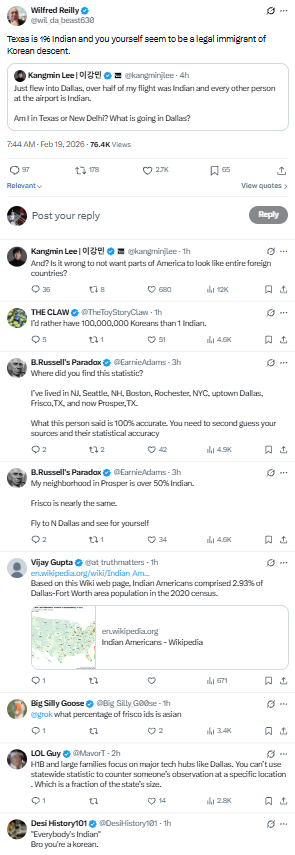
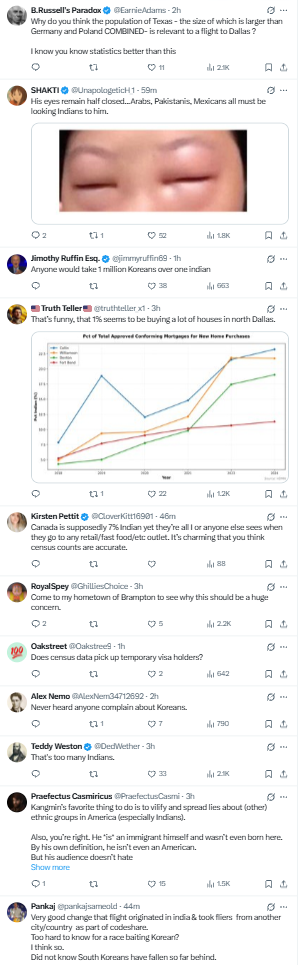
X (formerly Twitter) users react to Korean content creator's dig at Indians in the US.

X (formerly Twitter) users react to Korean content creator’s dig at Indians in the US.

Critics of this framing argue it feeds into xenophobia and anti-immigrant sentiment, pointing out that demographic change and multiculturalism are longstanding features of American society. Indeed, debates about H-1B visas, a work-related immigration category under fire in US politics, often surface in these discussions, with some voices blaming foreign professionals for perceived economic strain on local workers even as economists stress that tech and skilled sectors sorely rely on global talent.Experts and diaspora commentators warn that what might start as commentary on community growth can quickly morph into divisive rhetoric if stripped of context. A recent interview with Sree Sreenivasan, a senior Indian-American digital strategist, cautioned that “anti-Indian hate going on right now in the US” is an example of how broader anxieties about economics and security can play out as targeting of immigrants on social media.

Texas in US as a microcosm of broader identity debates

Texas, with its rich history of immigration and cultural blending, once part of Mexico and now a mosaic of Latin, Asian, African and European heritages, has often been at the center of broader national debates over identity and demographic shifts are real. Many Indian Americans in the DFW area work in sectors like information technology, engineering and medicine, forming vibrant, tightly knit communities with their own cultural, commercial and civic institutions.

​X (formerly Twitter) users react to Korean content creator's dig at Indians in the US.

X (formerly Twitter) users react to Korean content creator’s dig at Indians in the US.

However, social media commentary such as Lee’s tweet and Reilly’s reply show how sensitive such topics can be, especially when wrapped in provocative language or broad generalisations. Some argue that pointing out a community’s visibility is simply observation; others see such statements as feeding into fear-based identity politics that can escalate into xenophobia or stigma. Analysts note that while discussions about immigration are legitimate in democratic discourse, they must be handled with nuance and awareness of how marginalized groups can be affected by sweeping generalizations.

Bottom line

An exchange between Wilfred Reilly and Kangmin Lee on X sparked debate about Indian visibility in Texas, touching on sensitive topics of immigration and cultural change. The Dallas–Fort Worth area has a substantial Indian-American population, contributing to its multicultural character and economic growth. Some social media users and commentators have framed such demographic presence in alarmist terms, linking it to debates over H-1B visas and cultural identity. Analysts warn that online discussions can amplify divisive narratives and promoting context, empathy and accurate data is key to constructive discourse about immigration and community dynamics.


Source link