Breaking News
Air India fuel surcharge: Airline to levy Rs 399 charge on domestic tickets from March 12


Air India fuel surcharge: Airline to levy Rs 399 charge on domestic tickets from March 12

Air India and Air India Express will start levying a fuel surcharge of Rs 399 on each domestic flight ticket from March 12, as airlines face rising operating costs following a sharp increase in aviation turbine fuel (ATF) prices amid tensions in Middle East, reported PTI.The airline group said the surcharge will be implemented in phases across domestic and international routes due to the steep rise in jet fuel prices linked to the geopolitical situation in the Gulf region.In the first phase, a fuel surcharge of Rs 399 per domestic ticket will be imposed from March 12. The same surcharge will also apply to flights to SAARC destinations, the airline said in a statement on Tuesday.For West Asia routes, the surcharge will be USD 10 per ticket, while the charge for Africa flights will increase by USD 30 to USD 90. The surcharge for Southeast Asia services will rise by USD 20 to USD 60.The airline also said the surcharge will now apply to flights to and from Singapore, where no such charge was levied earlier.“Air India group today announced a phased expansion of a fuel surcharge on its domestic and international routes, necessitated by the steep rise in jet fuel prices arising from the geopolitical situation in the Gulf region,” the statement said.


Source link

RBI dividend norms: Banks can pay up to 75% of profits as payout from FY27


RBI dividend norms: Banks can pay up to 75% of profits as payout from FY27

The Reserve Bank of India has capped the maximum dividend payout by banks at 75% of profit after tax (PAT), with the new prudential norms set to take effect from the financial year 2026-27.The central bank on Tuesday issued the Reserve Bank of India (Commercial Banks – Prudential Norms on Declaration of Dividend and Remittances of Profits) Directions, 2026, after consultations with stakeholders.Under the new framework, banks will be allowed to declare dividends “up to the limits prescribed… but in aggregate not exceeding 75 per cent of the PAT for the period for which the dividend is being proposed,” the RBI said.The regulator has also stipulated that a bank’s regulatory capital must not fall below the applicable regulatory capital requirement even after payment of dividends.For foreign banks operating in India through the branch mode, the RBI said they must report positive profit after tax for the relevant period before remitting profits to their head offices.The directions also lay down prudential norms governing dividend declaration by small finance banks, local area banks, payments banks and regional rural banks, PTI reported.The revised guidelines will come into force from FY2026-27, forming part of the central bank’s efforts to strengthen capital buffers while allowing banks to distribute profits to shareholders.


Source link

India considering naval escort for ships in Strait of Hormuz amid Iran war: Report | India News


India considering naval escort for ships in Strait of Hormuz amid Iran war: Report

NEW DELHI: India is considering sending naval ships to escort its vessels through the Strait of Hormuz amid the ongoing Middle East tensions, according to a report by The New York Times.The report said the move is being examined following requests from Indian shipowners seeking protection for commercial vessels navigating the strategic waterway.

Iran’s Huge Offer To U.S. Allies In Mideast Over Strait Of Hormuz Passage | ‘Dump Israel, And…’

“India was also considering sending its warships in response to requests from Indian shipowners for naval escorts,” the newspaper reported, quoting Capt. P.C. Meena, a senior official at India’s main maritime authority.The Strait of Hormuz has become a high-risk zone for shipping after tensions escalated in the Middle East following attacks involving Iran, the United States and Israel. The conflict, now in its second week, has disrupted maritime traffic and raised concerns about energy supplies.The Middle East supplies about 55 per cent of India’s crude oil, according to brokerage firm Jefferies. Around 35 per cent of India’s oil imports pass through the Strait of Hormuz.India also depends heavily on liquefied petroleum gas imports from Gulf countries such as the UAE, Qatar, Saudi Arabia and Kuwait. Nearly 80 per cent of the country’s LPG imports transit through the strategic waterway.Reports suggest that several Indian vessels are currently unable to cross the Strait of Hormuz due to security risks linked to the conflict.Around 38 Indian-flagged commercial ships carrying more than 1,100 sailors are stranded in the Persian Gulf and the Gulf of Oman, according to a report earlier this month.Union Shipping Minister Sarbananda Sonowal has directed officials, including the Directorate General of Shipping, to take steps to ensure the safety of Indian seafarers and maritime assets.Meanwhile, Pakistan has deployed naval escorts for its commercial vessels operating in the region. The Pakistani navy said its warships would accompany merchant ships in the Middle East “to ensure the uninterrupted flow of national energy supplies.”Images released by the navy showed a warship escorting a crude oil tanker belonging to Pakistan’s national shipping company.Pakistan imports most of its natural gas from Qatar and crude oil from Saudi Arabia and the United Arab Emirates. Shipping companies have reportedly slowed or halted energy shipments through the Strait of Hormuz due to rising security concerns.(With inputs from The New York Times)


Source link

Donald Trump Ufo Files Release: Obama thinks they are real, Donald Trump has ‘UFO speech ready’: Are we close to finding aliens?


Obama thinks they are real, Donald Trump has 'UFO speech ready': Are we close to finding aliens?

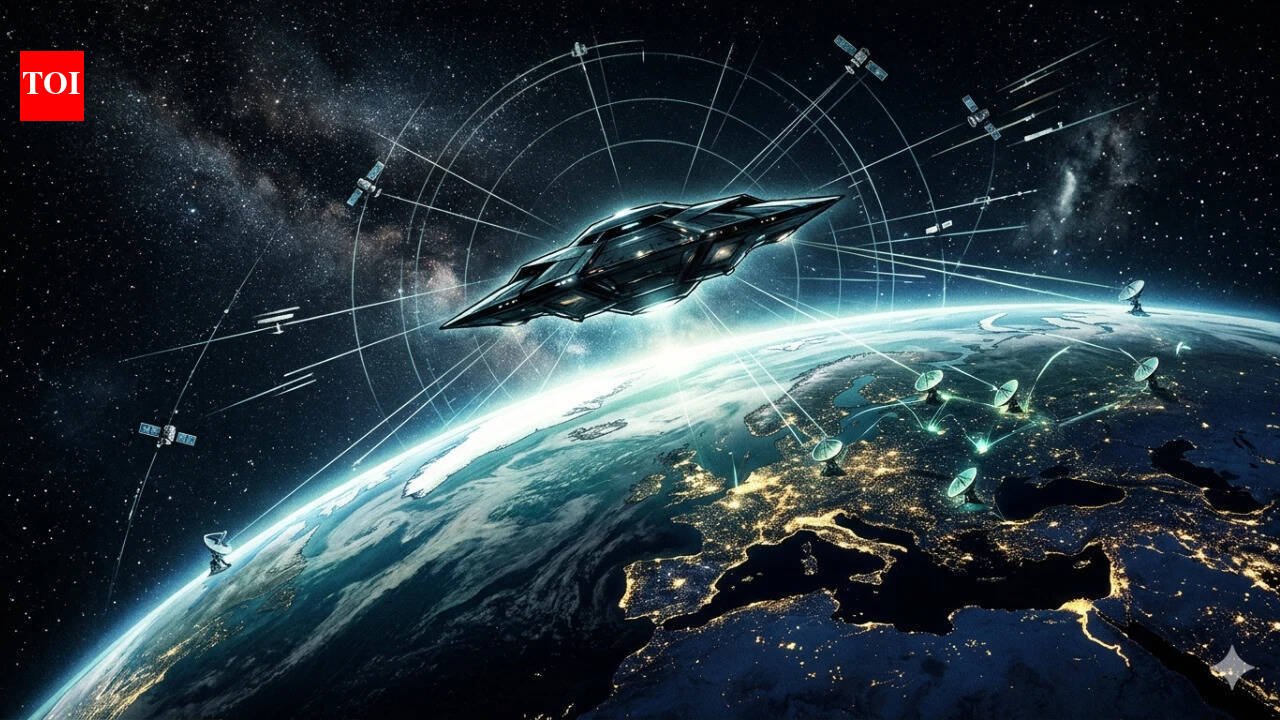
AI image (Picture credit: Google Gemini)

For decades, the idea of alien life has lived somewhere between science and science fiction. From Hollywood & Bollywood films to grainy UFO footage on the internet, the possibility that humanity is not alone in the universe has fascinated people across the world. But in recent years, the conversation has moved increasingly from speculation to scientific inquiry.Renewed interest has been triggered by reports that the United States government may release additional classified records related to unidentified aerial phenomena (UAPs), the modern term for UFOs. The push gained momentum after US President Donald Trump said his administration would direct the Pentagon and other federal agencies to identify and release such records. In a social media post, he cited the “tremendous interest” in extraterrestrial matters following comments by former US president Barack Obama, saying the public deserved greater transparency.These files, expected to come from agencies such as the Pentagon and US intelligence departments, are believed to contain observations of aerial objects that remain unexplained. While scientists caution that such documents are unlikely to confirm alien spacecraft, they have reignited a broader question: are we any closer to discovering life beyond Earth?The answer is complicated: both yes and no. Humanity has learned more about the universe in the last three decades than in the previous three centuries. Thousands of planets have been discovered beyond our solar system.

How big is the universe?

Telescopes can now analyse the atmospheres of distant worlds. Space missions continue to search for microbial life on Mars and icy moons.Yet despite these advances, one puzzling question remains unresolved: if the universe is so vast and old, why have we not found clear evidence of alien civilisations?The fascination with extraterrestrial life is not limited to scientists. At times, it has also reached the highest levels of political power in the United States.

From Carter to Trump: The alien question in American politics

Curiosity about aliens and UFOs has long extended into the highest levels of American politics. For decades, several US presidents have publicly spoken about extraterrestrial life, sometimes seriously, sometimes jokingly, reflecting how deeply the topic has entered public imagination.The debate gained fresh attention recently after former US president Barack Obama said in a podcast interview that aliens are “real,” though he clarified he had seen no evidence of extraterrestrial contact during his presidency. Obama later explained that statistically the universe is so vast that the odds of life existing somewhere else are high, even if visits to Earth are unlikely.Earlier American leaders also showed fascination with the idea. Jimmy Carter once reported witnessing what he believed was a UFO in Georgia in 1969, an experience he later documented with the International UFO Bureau. As president, Carter even placed a message from Earth aboard the Voyager Golden Record, launched on the Voyager 1 and Voyager 2 spacecraft in 1977, intended for any extraterrestrial civilisation that might encounter them.During the Cold War, Ronald Reagan famously used the idea of an alien threat to highlight humanity’s shared destiny. Speaking at the United Nations in 1987, Reagan remarked that global divisions might disappear quickly if humanity faced “an alien threat from outside this world.”Former president Bill Clinton also expressed interest in the mystery. In a 2014 television interview, he said he had asked aides to investigate Area 51, the secretive US Air Force testing facility long associated with UFO speculation, to ensure there was no hidden alien activity there.More recently, the topic resurfaced during the presidency of Donald Trump. Trump previously said he had received briefings about UFOs during his first term but remained sceptical about extraterrestrial visitors.
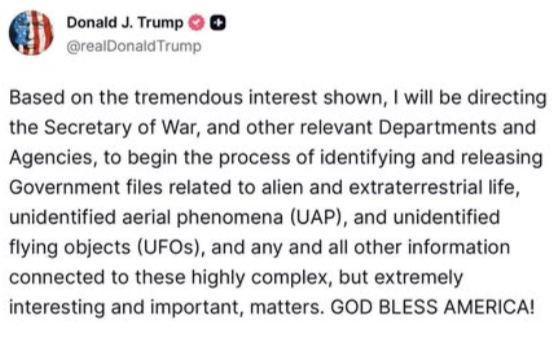
Trump UFO files release announcement

Trump UFO files release announcement (Image Source – Truth/Donald Trump)

However, his daughter-in-law Lara Trump recently suggested in a podcast interview that Trump may have “a speech ready” about extraterrestrial life that could be delivered at the right time.Together, these comments illustrate how the possibility of alien life, once confined largely to science fiction, has occasionally surfaced even in presidential conversations, reflecting both scientific curiosity and the enduring mystery surrounding the universe.This puzzle lies at the heart of one of science’s most famous ideas — the Fermi Paradox.

The great cosmic puzzle

The paradox is named after Italian-American physicist Enrico Fermi, who raised a simple but profound question during a conversation with colleagues in 1950. Looking at the immense scale of the universe, Fermi reportedly asked, “Where is everybody?”

The Fermi Paradox explained

The logic behind the question is straightforward. The Milky Way Galaxy alone contains hundreds of billions of stars. Many of those stars likely host planets. Over billions of years, some of those planets could have developed intelligent life. Given enough time, such civilisations might develop advanced technology and explore space.In theory, even a single technologically advanced civilisation could spread across the galaxy in a few million years — a short period on cosmic timescales. If that is possible, then traces of alien technology, signals or visits should already be visible.Yet humanity has found none.This contradiction between high probability and zero evidence is what scientists call the Fermi Paradox.Over the decades, scientists, philosophers and futurists have proposed many explanations. Some suggest alien life is extremely rare. Others argue that intelligent species often destroy themselves before exploring the stars. A few theories even suggest that aliens may already be aware of humanity but deliberately avoid contact.Here are some of the most intriguing explanations that attempt to solve the mystery.

10 ways scientists explain the Alien silence

The rare Earth hypothesis

One possibility is that intelligent life is extraordinarily rare.The Rare Earth Hypothesis suggests that while microbial life might be common, the conditions required for complex organisms — and eventually intelligent species — are incredibly unlikely.Earth’s history offers several examples of unlikely events that made complex life possible. These include the presence of a large stabilising moon, plate tectonics that regulate climate, a protective magnetic field and a relatively stable star. Even small changes in these conditions could have prevented the emergence of complex life.Under this theory, Earth may simply be one of the very few places where all the necessary factors came together.

The great filter

Another influential idea is known as the Great Filter hypothesis.This theory proposes that somewhere between the formation of planets and the rise of interstellar civilisations lies a difficult barrier, a “filter” that most life forms fail to pass.The filter could occur at many stages. Perhaps life rarely begins in the first place. Maybe complex organisms almost never evolve. Or perhaps intelligent species tend to destroy themselves through nuclear war, environmental collapse or uncontrolled technology.If the Great Filter lies ahead of humanity, it would imply that technological civilisations often collapse before achieving long-term survival.

The distance problem

Even if intelligent life exists elsewhere, the sheer size of space may make contact extremely difficult.The nearest star system, Proxima Centauri, is more than four light-years away. Current spacecraft would take tens of thousands of years to reach it.Human radio signals have travelled only about a hundred light-years into space since the first broadcasts in the early twentieth century. That is a tiny fraction of our galaxy.Civilisations might exist thousands or millions of light-years away, separated by distances too vast for practical communication.

The zoo hypothesis

Some researchers have proposed a more unusual idea: that aliens deliberately avoid contacting humanity.Known as the Zoo Hypothesis, the theory suggests advanced civilisations may observe Earth without interfering, much like humans watch animals in a wildlife reserve.Under this scenario, extraterrestrial societies might follow ethical rules that prevent them from influencing developing worlds until those worlds reach a certain level of technological maturity.While there is no evidence for this idea, it remains a popular concept in discussions about extraterrestrial intelligence.

The dark forest theory

A darker explanation is known as the Dark Forest Hypothesis.According to this theory, the universe may be filled with intelligent civilisations, but they remain silent out of fear. In a galaxy where resources are limited and survival is uncertain, revealing one’s location could invite attack from a hostile civilisation.As a result, every advanced society might hide quietly, avoiding communication with others.This concept has gained popularity in recent years through science fiction but also raises serious philosophical questions about cosmic survival.

The simulation hypothesis

Another controversial idea suggests humanity might not be living in a natural universe at all.The Simulation Hypothesis proposes that reality could be an advanced computer simulation created by a highly advanced civilisation.If that were the case, alien life might not appear simply because the simulation’s creators chose not to include it.While the theory remains speculative, it has been discussed by physicists and philosophers exploring the limits of technological possibilities.

The self-destruction theory

Some scientists believe intelligent civilisations often eliminate themselves through technological risks.Once a species develops advanced technology, it gains the power to alter or destroy its environment. Nuclear weapons, artificial intelligence, bioengineering or environmental collapse could threaten long-term survival.If most civilisations collapse shortly after reaching technological maturity, the window for detecting them may be extremely small.Humanity itself is only about a century into the age of modern technology — a blink of time on cosmic scales.

The ocean worlds hypothesis

Another possibility is that alien life may exist in places that are difficult for humans to observe.Several moons in our solar system, such as Europa and Enceladus, are believed to contain vast oceans beneath thick layers of ice.If microbial life exists in these oceans, it might thrive in darkness far below the surface. Detecting such organisms from Earth would be extremely challenging.Life could therefore be widespread but hidden in environments humans have barely explored.

The technological mismatch

Another theory suggests alien civilisations may communicate using technologies humans cannot detect.The SETI Institute, which leads the Search for Extraterrestrial Intelligence, has traditionally searched for radio signals from space. But advanced societies might use entirely different methods, such as laser communications or technologies not yet understood by human science.If alien signals exist in forms beyond our detection capabilities, humanity might simply be listening to the wrong channels.

The “They Are Already Here” idea

Perhaps the most controversial explanation is that extraterrestrials have already visited Earth.Supporters of this idea often point to mysterious sightings of objects in the sky — commonly known as UFOs.In recent years, governments have begun referring to these sightings as Unidentified Aerial Phenomena, a broader term that includes any unexplained objects observed in the atmosphere.However, scientists stress that unexplained does not necessarily mean extraterrestrial.

The UFO sightings that captured public imagination

Several high-profile incidents have fuelled speculation about alien visitors.One of the most famous is the Roswell Incident in 1947, when debris recovered in New Mexico was initially described by local authorities as a “flying disc”. The US military later said the material came from a secret surveillance balloon.Another widely discussed case involved US Navy pilots encountering an unidentified object during exercises near the Pacific Ocean in 2004. The incident, often called the USS Nimitz UFO encounter, involved radar detections and infrared footage of a fast-moving object that appeared to defy conventional aircraft behaviour.In 2017, several such videos were released publicly by the United States Department of Defence, drawing renewed attention to unexplained aerial sightings.Despite the mystery surrounding some cases, many UFO sightings eventually turn out to be misidentified aircraft, weather balloons, satellites or natural atmospheric phenomena.

UFO reports beyond the West

Unidentified objects in the sky are not limited to the United States.In India, reports of strange lights have occasionally emerged from remote regions. In 2012, residents and military personnel in the Himalayan region of Ladakh reported seeing glowing objects moving across the night sky near the India-China border.Investigations suggested the lights were likely Chinese lanterns or astronomical phenomena, but the sightings attracted widespread media attention.One of the most famous modern cases occurred in November 2023 at Imphal Airport. A bright, white, ball-like object hovered directly over the airfield in broad daylight. The Indian Air Force (IAF) didn’t take it lightly; they scrambled two Rafale fighter jets to intercept it. The pilots saw the object on their sensors, but as they closed in, it simply vanished. The airport was shut down for over three hours, and to this day, no official explanation has been given.Further north, in the Kongka La Pass of the Himalayas, locals have reported “silent, triangular craft” for years. This area is a “no-man’s land” between India and China, making it one of the most remote places on Earth. In 2024 and 2025, reports of glowing orbs emerging from the mountains became so frequent that local Indian Army units reportedly logged them as “unidentified technical observations.” These aren’t just stories; these reports were logged in official military records, though no conclusive explanation has been provided..Similar stories have appeared around the world for decades. Most remain unexplained, though few provide evidence of extraterrestrial technology.

The scientific search for life

While UFO sightings capture public imagination, the real scientific search for alien life focuses on astronomy and planetary science.One of the most promising areas of research involves exoplanets — planets that orbit stars outside our solar system.Since the 1990s, astronomers have discovered thousands of such worlds using telescopes like the Kepler Space Telescope and the James Webb Space Telescope.Some of these planets lie within the “habitable zone” of their stars, where temperatures might allow liquid water to exist.

Where scientists are looking for life

Scientists are now beginning to analyse the atmospheres of distant planets, searching for gases such as oxygen or methane that could indicate biological activity.Meanwhile, robotic missions continue exploring our own solar system.Rovers on Mars are searching for signs that microbial life may once have existed there. Future missions may attempt to drill into the icy crusts of moons like Europa to search for organisms in subsurface oceans.Even microbial life beyond Earth would represent one of the most important discoveries in human history.

What scientists really think

Despite growing public interest in UFOs, most scientists remain cautious.There is currently no verified evidence that extraterrestrial spacecraft have visited Earth. At the same time, many astronomers believe the universe is so vast that it would be surprising if life existed only on our planet.The real challenge lies in detecting that life across immense cosmic distances.Astronomers often compare humanity’s search for alien signals to scooping a glass of water from the ocean and concluding that whales do not exist because none appeared in the sample.Humanity has only just begun to explore the cosmos.

A question that defines our era

The search for alien life is not just about curiosity. It touches on some of the deepest questions humanity can ask.

Three questions scientists still cannot answer

Are we unique in the universe? Is intelligent life a common outcome of evolution? Or is Earth an extraordinarily rare exception?New telescopes, space missions and scientific techniques may begin to answer these questions in the coming decades.For now, the universe remains silent.But as astronomers continue to scan the skies and explore distant worlds, the possibility remains that one day humanity may detect a signal, faint, distant and unmistakably artificial.If that moment comes, it would transform humanity’s understanding of its place in the cosmos.Until then, the mystery remains unresolved.And the question that Enrico Fermi asked more than seventy years ago continues to echo across modern science:“Where is everybody?”



Source link

Ishan Kishan gets annoyed after winning T20 World Cup 2026 title: ‘Ispe mein kya bolun?’ | Cricket News


Ishan Kishan (Screengrab)

NEW DELHI: India’s T20 World Cup 2026 win sparked both celebration and controversy. Wicketkeeper-batter Ishan Kishan was visibly annoyed when reporters asked him about comments made by former cricketer Kirti Azad regarding the team taking the trophy to a Hindu temple in Ahmedabad. Kishan dismissed the question and said, “Kitna accha World Cup jitte hai, kitna accha sawal aaplog kijiyega, yeh Kirti Azad ne kya bola ispe mein kya bolun? Kuch accha sawal kijiye na ki mazza aya (Winning the World Cup is such a great thing. You people should ask good questions. What can I say about what Kirti Azad said? Please ask some good questions so that it’s enjoyable).”

Sanju Samson opens up on T20 World Cup journey, and title win

Azad had criticised the move on social media, questioning why the trophy was taken only to a temple. He wrote, “Why NOT a Mosque? Why NOT a Church? Why NOT a Gurudwara?… The Trophy Belongs to 1.4 BILLION Indians of EVERY Faith — NOT ONE RELIGION’S VICTORY LAP!” He added that India’s 1983 World Cup team represented many religions and said, “When we won the World Cup under Kapil Dev in 1983, we had Hindu Muslim Sikh and Christian in the team.

Poll

Which aspect of India’s T20 World Cup win impresses you the most?

Azad also stressed that the team represents the whole country, writing, “This Team Represents INDIA — not Surya Kumar Yadav’s or Jay Shah’s Family,” and pointed out that players like Siraj or Sanju Samson never took the trophy to their own places of worship.Watch Ishan Kishan speaking to journalists:After winning the T20 World Cup, Kishan spoke about his personal journey. After being dropped earlier, he worked his way back through domestic cricket and described the experience as a “rollercoaster.” In this tournament, the left-handed batter scored 317 runs at a strike rate above 190, including three half-centuries.On Sunday, India sealed the title with a dominant performance in the final against New Zealand. After losing the toss, India piled up a record 255/5 thanks to quick fifties from Abhishek Sharma, Sanju Samson and Kishan. New Zealand never recovered in the chase and were bowled out for 159.The victory made India the first team to win three T20 World Cups and the first to claim back-to-back titles while also winning the tournament on home soil.


Source link

Sanjay Bangar names his playing XI of Punjab Kings for IPL 2026


Punjab Kings (PBKS) are gearing up for another strong campaign in the Indian Premier League (IPL) 2026, and former India cricketer Sanjay Bangar has already shared his vision for the team’s ideal playing XI. The former batting coach of the Indian team believes PBKS possess a balanced squad capable of competing for the playoffs this season, even if they begin matches with only three overseas players in the starting lineup.

PBKS finished as runners-up in IPL 2025 after falling short in the final against Royal Challengers Bengaluru (RCB). Despite the heartbreak, the franchise has retained the core of its squad and made a few strategic additions at the IPL 2026 auction to strengthen the team further.

Punjab Kings retain core and add reinforcements at the auction

Ahead of the IPL 2026 season, Punjab Kings retained as many as 21 players, signaling their confidence in the squad that performed impressively last year. During the auction, they added Cooper Connolly, Ben Dwarshuis, Pravin Dubey and Vishal Nishad to enhance their bench strength.

Bangar feels the team’s stability and depth give them flexibility when it comes to team combinations. According to him, the presence of quality Indian players allows PBKS to rely less heavily on overseas cricketers while still maintaining a strong lineup.

Speaking during a discussion on Star Sports, Bangar expressed confidence in the squad’s overall balance and ability to perform consistently throughout the season.

“I have full belief that they are a very strong contender to reach the playoffs. This squad has so much ability that they can enter the ground with three overseas as a playing XI,” Bangar said.

Also READ: Gujarat Titans appoint new batting coach ahead of IPL 2026

Sanjay Bangar’s preferred lineup for PBKS

Bangar outlined a batting order that blends aggressive young talent with experienced campaigners. He suggested that Prabhsimran Singh and Priyansh Arya should open the innings, providing an attacking start at the top of the order.

Shreyas Iyer, who is expected to lead the side, slots in at number three to anchor the innings. Nehal Wadhera follows at number four, while Australian all-rounder Marcus Stoinis provides power in the middle order at number five. Shashank Singh, who impressed with his finishing abilities last season, takes the number six spot in Bangar’s lineup.

“If I talk about the batting order, Prabhsimran Singh and Priyansh Arya, Shreyas Iyer at No. 3, Nehal Wadhera at No. 4, Marcus Stoinis at No. 5, and then Shashank Singh at No. 6,” Bangar explained.

Bangar also emphasized the strength of Punjab Kings’ bowling department. He placed South African all-rounder Marco Jansen wwat number seven, followed by spin-bowling all-rounder Harpreet Brar.

Veteran leg-spinner Yuzvendra Chahal leads the spin attack, while Lockie Ferguson adds pace and aggression with the new ball and at the death. Left-arm pacer Arshdeep Singh completes the bowling unit, bringing experience and consistency.

Bangar also pointed out that the team can strengthen its bowling further by including an additional overseas fast bowler depending on conditions. Alternatively, Afghan all-rounder Azmatullah Omarzai could be introduced to add balance to the side.

Sanjay Bangar’s PBKS playing XI for IPL 2026: Prabhsimran Singh, Priyansh Arya, Shreyas Iyer, Nehal Wadhera, Marcus Stoinis, Shashank Singh, Marco Jansen, Harpreet Brar, Yuzvendra Chahal, Lockie Ferguson, Arshdeep Singh

Also READ: Yellove reloaded: CSK unveil striking new jersey for IPL 2026 in grand style


Source link

Freight pricing scrutiny: Govt asks shipping lines to avoid ‘predatory’ charges amid Middle East crisis


Freight pricing scrutiny: Govt asks shipping lines to avoid ‘predatory’ charges amid Middle East crisis

The government has asked shipping companies, vessel operators and their agents to refrain from “predatory, non-transparent and opportunistic pricing” practices as freight costs rise sharply amid disruptions caused by the ongoing conflict in West Asia, PTI reported citing sources.The advisory was issued by the Directorate General of Shipping (DGS) on Monday after the regulator received representations from stakeholders in the EXIM trade regarding the levy of multiple ancillary charges by shipping lines and their agents.

Crude Oil Rally Near 120 Dollars, Raises Big Question If India Can Survive Crisis With Russian Oil

These charges, the regulator said, are widely perceived as “non-transparent and opportunistic in nature”, leading to higher transaction costs across the logistics chain.“In the interest of promoting transparency, fairness and predictability in the EXIM logistics ecosystem, all shipping lines, carriers and their agents are hereby advised to refrain from predatory, non-transparent and opportunistic pricing practices, including levy of exorbitant charges thereby taking undue advantage of prevailing geo-political issue,” the advisory stated.The DGS also asked operators to clearly communicate all applicable charges upfront to exporters, importers and other stakeholders to avoid disputes within the trade ecosystem.“They must should adhere to fair trade practices and avoid the levy of charges that may give rise to disputes within the EXIM trade and ensure that all applicable charges are communicated clearly and upfront to exporters, importers and other stakeholders,” the advisory added.Freight rates have risen sharply in recent days as military tensions in the Middle East escalate, with Iran, the United States and Israel attacking one another, disrupting shipping routes and increasing uncertainty in global logistics.An executive at a global shipping company said the conflict is forcing vessels to take longer routes around Africa, leading to higher fuel consumption and increased operational costs for cargo ships.Meanwhile, an analyst at BigMint Research said crude oil prices, which averaged around $70 per barrel before the conflict, are now hovering around $90 per barrel, further adding to shipping and logistics costs.


Source link

India crash out of AFC Women’s Asian Cup without a single point after 1-3 loss to Chinese Taipei | Football News


India crash out of AFC Women’s Asian Cup without a single point after 1-3 loss to Chinese Taipei
India vs Chinese Taipei (Photo from @IndianFootball on X)

NEW DELHI: India crashed out of the AFC Women’s Asian Cup after losing 1-3 to Chinese Taipei in a crucial group-stage match on Tuesday. The result ended India’s campaign despite the team dominating large portions of the game and creating several chances but failing to convert them.India needed to win by at least two goals to keep their hopes alive, especially after earlier defeats to Japan and Vietnam. Although Japan beat Vietnam 4-0 in the other match, India could not produce the required result.Chinese Taipei took the lead early in the 12th minute after a defensive error. A poor back pass from Sanju left goalkeeper Elangbam Panthoi Chanu out of position, allowing Y H Su to score into an empty net. India responded with attacking intent and eventually equalised in the 39th minute, when Manisha Kalyan unleashed a powerful long-range strike to score India’s only goal.However, just before half-time, Chinese Taipei regained the lead in dramatic fashion. After Pyari Xaxa handled the ball in the box, a penalty was awarded. Although Y Y Hsu struck the post, the rebound deflected off Panthoi and rolled into the net, putting India behind again.India pushed hard in the second half and created several opportunities but failed to finish them. Their attacking efforts left gaps at the back, which Chinese Taipei exploited in the 77th minute when Yu-Chin Chen ran through the defence and scored the third goal after rounding the goalkeeper.India had a few late chances through Sanfida and Manisha, but the Chinese Taipei goalkeeper made crucial saves to keep them out. The defeat meant India exited the tournament despite qualifying for the competition on merit for the first time and putting up a spirited performance.


Source link

First-person account: How Dubai keeps its tempo under missile alerts


First-person account: How Dubai keeps its tempo under missile alerts
Light traffic moves along a main road in Dubai, United Arab Emirates, Tuesday, March 3, 2026. (AP photo)

Yalla Habibi, Let’s GoThe National Emergency Crisis and Disaster Management Authority of the UAE had an important announcement to make on 9th March. They were going to change the alert tone between 10.30 pm and 9 am to a regular chime. Residents complained that the original alarm, a shrill siren, was causing anxiety. The government agreed.As a resident, I can attest to that. The alarm was triggering at bedtime. From the kids because of the noise. From me because I was afraid of how long sleep time would take.I don’t know many places where civil defence adjusts the sound design of a national warning system based on public feedback. Did someone at civil defence say, “Can we please make the safety alert slightly less stressful?” or, like distractors will say, it’s a sign of a country living in a bubble – that Habibi, is up for debate.Since February 28th, I have noticed three different types of narratives coming from people who don’t live here.First, there’s the gleeful commentary from part of the US, UK, India, and elsewhere, usually about Dubai, the UAE and the people who moved here to save tax. Particularly when amplifying rumours about Burj Khalifa being attacked. It wasn’t. It responded the next day by lighting its façade in the colours of the UAE flag.Second, there’s television news coverage, looping dramatic footage of interceptions and debris. This often comes 13 hours after an incident has been announced and contained.Third, there are parents and friends, who are panic-struck. They can’t reconcile what they see on television with what residents are saying.“How are you going to the mall?” they ask.As a couple with young children, we have our ready-to-go bag packed, the car tank full, and cash withdrawn for an emergency. And that’s about it. People are out for walks, they’re going to the gym, and as I write this, I see a gentleman, sunning himself on a rooftop pool.In Dubai, it’s been business as usual. Stand outside, stare at the sky for 10 mins and you will see at least 2 commercial aircraft either descending or taking off. EACH and every delivery service is working; there was an outage with Amazon initially, but local delivery service Noon is still delivering water and chocolates in under 15 mins. Everything from Dubai Chocolate to Sushi are being delivered, and there have been no reports of people hoarding essentials or supermarkets running out of supplies.Anywhere else in the world – Mumbai, New York, London, you’d hear sonnets about the ‘spirit of the city’. But when Dubai keeps functioning, somehow the narrative becomes, ‘they are living in a bubble’. The irony is hard to miss.It’s a city that also never stops moving; everyone is out drinking coffee, working, or on a date. Everyone is going somewhere, doing something. Not sitting at home, reading the news, and hyperventilating.Supermarkets are open. So are organic farmers’ markets. McDonald’s is open, so are craft coffee shops, offices are open, so are beach clubs. Roof-top pools are open, and so are outdoor cafes (despite it being Ramadan).Once, or sometimes twice a day, the Ministry of Defence issues a statement and an infographic; it’s coherent, well-designed, and echoes a city confident in its skin.The day after the first missile was launched, schools were closed until March 4. Then extended to the 6th. Then the spring break, originally scheduled for later in the month was simply brought forward. It happened quietly, without confusion or panic. Schools were closed. But kids’ activities, parkour classes, sports continued. Playgrounds never shut.A couple of days ago, debris hit a building in an upmarket part of Dubai called Dubai Marina, causing a small fire. Earlier in the conflict, something similar happened on the facade of the Burj Al Arab. But Dubai went to sleep, woke up, and Habibis and Habibtis went to work.Did people carry on because that’s the spirit of the city? Or because it’s an expensive city and people still have jobs to get to? Probably both. The same argument could be made for London, New York or Mumbai.I do think one thing is different in the UAE: there have been a slew of small, absurd-sounding, almost inconsequential measures in isolation. But oddly effective. For instance, a couple of days ago, at the peak of the crisis, an announcement was made – some banks would be open till midnight, and they were also waiving ATM withdrawal charges. A princely sum of 2.1 AED (About 50 rupees). It sounds trivial but it’s the kind of detail that tells you, someone is thinking about the small inconveniences too.Have my wife and I both acquired super hearing? Yes. Do we confuse trucks for Missiles and motorcycle exhaust for interceptions – sometimes. That’ll take some time to go away, but we’ll take it.The country’s attention to detail has been astounding. When the first missiles were launched, Abu Dhabi’s Department of Culture and Tourism issued a now viral directive to hotels – “extend the stay of travelers, send us the bill.”True, small measures don’t get a city back up on its feet; it needs to do that itself. But a slightly less shrill alert, regular, specific information helps. It’s the hand that dusts off your trousers. And let’s face it, we can always use a hand there, whether we trip or are targeted by 253 ballistic missiles, 1440 drones and 8 cruise missiles (as of March 9th 2026).Until then, the city continues. Everyone is on the streets telling everyone else, Yalla Habibi! (the only translation that comes close to this is Let’s Go, Let’s go!).


Source link

193 e-challan cyber fraud cases registered in ’25: CM Fadnavis | Mumbai News


Mumbai: Chief minister Devendra Fadnavis on Tuesday told the Legislative Assembly that 193 cases of cyber fraud involving fake links or APK files in the name of e-challans were registered in 2025, and 36 accused were arrested. CM Fadnavis said 120 cases were registered in 2024 and 2025 for illegal online gaming, and 68 accused were arrested. CM Fadnavis was replying to a query raised by MLAs Prashant Thakur, Sameer Kunawar and Atul Bhatkhalkar, among others.“The state govt implemented the Maharashtra Cyber Security Project, which includes measures equipped with cutting-edge technology, skilled manpower and resources, focusing on citizens who are victims of cyber fraud, especially women, children and senior citizens. To control cyber crimes across the state, the Cyber Security Project Headquarters and Nodal Cyber Police Station function at Mahape in Navi Mumbai, through which 50 District Cyber Labs/Police Stations in the state work to investigate technically complex cyber crimes. The Maharashtra Cyber Office, with the help of 26 expert consultants, provided online training on forensic tools to 1,000 police officers and employees in the state,” said the CM in his written reply.“To prevent all types of cyber crimes, awareness was created among the general public about the website and the cyber helpline number through Maharashtra Cyber’s social media accounts, Twitter, Instagram, Facebook and YouTube. Also, public awareness about cybercrime is being effectively created through Maharail LED/LCD screens at 34 railway stations in the state,” CM Fadnavis said.“The state govt, via its letter dated July 2, 2025, requested the Union Minister of Home Affairs to enact a law to regulate online lotteries and online games. Accordingly, the Centre promulgated the ‘Promotion and Regulation of Online Gaming Act, 20250′, dated August 22, 2025, in the Gazette of India,” said CM Fadnavis in his written reply.


Source link