Breaking News
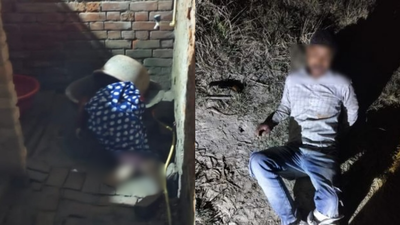
Lucknow double murder: Man rapes, kills woman, strangles partially blind son who tried to save her | Lucknow News


Accused Kishan Rawat, arrested after a police encounter in Lucknow, is linked to the March 9 double murder of a woman and her partially blind son in Sisendi village.

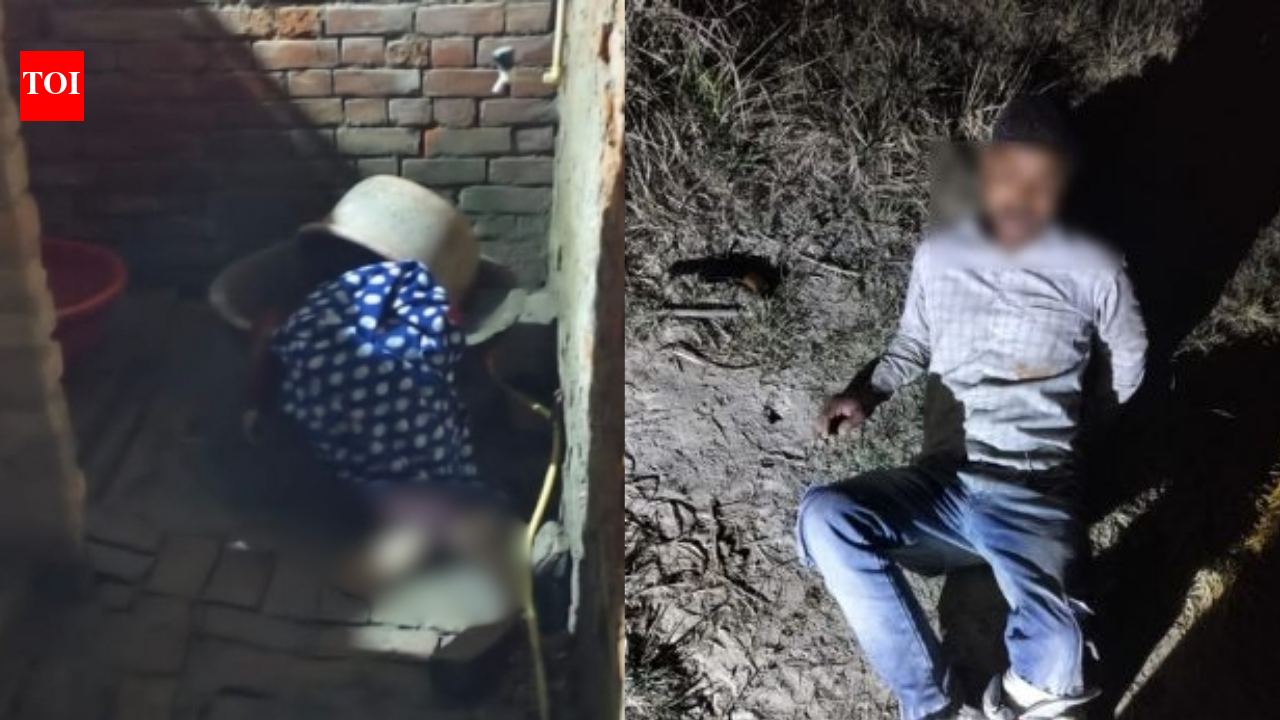
LUCKNOW: The accused in the sensational double murder case in Sisendi village of Mohanalalganj on March 9 was arrested after an encounter late Wednesday night.A policeman was also injured in the exchange of fire.The accused, Kishan Rawat (35) of Sisendi, had allegedly raped the woman and later killed her and her son, who was partially blind.According to DCP, south, Nipun Agarwal, a team led by the station house officer of Mohanlalganj, along with surveillance and field units, intercepted him.As the police closed in, Rawat allegedly opened fire in a bid to escape. A police constable suffered injury in firing.“Police retaliated in self-defence during which the accused suffered a bullet injury on his leg and was overpowered. He was taken into custody and taken to a hospital for treatment,” he added.

Poll

Do you believe the police acted appropriately during the encounter with the accused?

Senior officers, including additional DCP Rallapalli Vasanth Kumar, and ACP Vikas Pandey, reached the spot and supervised the operation.Police said preliminary investigation revealed that there was a financial dispute between the accused and the woman. Rawat had allegedly lent her some money and had been repeatedly asking her to return it.Police said that suspicion of rape came to light when the post-mortem report revealed injuries on the private parts of the woman. Later, CCTV footage confirmed that Rawat had visited the woman a few hours before the murder. During the attack, the woman’s visually impaired son tried to save her, but the accused allegedly strangled him to death.


Source link

Pitch Tampering? BCCI BANS shared nets for IPL franchises


BCCI (Board of Control for Cricket in India) has issued a fresh bunch of guidelines ahead of the IPL 2026 season. The main purpose of the board’s guidelines is to protect the main pitch as much as possible before the main match. To keep the tracks in pristine conditions, the Indian cricket governing body has issued some advisories for every participating team in the league.

In a five-page communique, the board has issued guidelines for the practice sessions as well. In the official announcement, it is clearly mentioned that teams will have to arrange separate nets for their training if one team comes for practice after another.

The same nets will not be allowed for back-to-back practice sessions of different teams

“Fresh nets should be provided to each team for their allocated practice session. In any event of simultaneous practice sessions or when one team practises after the other, the first team shall not be permitted to use the other team’s nets (including for throw downs). If one team finishes practice early, the other team is not permitted to use their range-hitting wicket”, the part of the guidelines reads.

Your daily dose of cricket!

next

To keep the players prepared for an upcoming match, teams often arrange practice matches. Now, the franchises will have to arrange practice matches according to the BCCI’s latest notification.

Practice matches will not be allowed inside the main square of the ground: BCCI guidelines

The board has mentioned that teams are allowed to arrange practice matches only on one of the side wickets of the main square, after taking permission from the authority. A team will be allowed to arrange up to two practice matches. And, if any team wants to play their practice games under the lights, then they will have to complete it within three and a half hours.

“To prepare the pitch for the season, no practice sessions or practice matches may be played on the main square in the four days leading up to the relevant franchise’s first home match of the season”, the BCCI notice mentioned.

“During this period, if requested by the home franchise, the State Association should make an alternative practice ground available to the franchise at no cost to the franchise”, it also added.

The home team will have an advantage over the away team before a match

The board also mentioned that the home will have some advantages over the visiting teams. Though, the visiting sides’ requests will be taken seriously.

“Though the home team should get the first choice of a preferred session, the away team’s request will be taken into account, particularly if it has played a match on the previous day, and taking into consideration the travel arrangements of the away team”, BCCI states.

“If the home and away teams wish to practice at the same time, BCCI will ask the two team managers to try and resolve the double booking – either by one of the teams taking another session or by the two teams sharing the session”, according to the guidelines.

Read More: Not Virat Kohli and Chris Gayle! Ex-India wicket-keeper picks Rohit Sharma as best T20 batter of all time


Source link

The birder who refuses to let a hill disappear in Pune: How a quiet community of birdwatchers continue to save Pune’s highest hill |


The birder who refuses to let a hill disappear in Pune: How a quiet community of birdwatchers continue to save Pune's highest hill
Vetal Tekdi in Pune, Maharashtra (PC: Ranjeet Rane)

Cities often lose their natural spaces gradually. A road appears where a trail once existed, a construction site replaces a grove of trees, and over time a landscape that people once knew simply fades away. In rapidly expanding urban centres, such changes are often accepted as inevitable. Yet sometimes a place survives because people begin to see it differently. The story was the same for Vetal Tekdi, Pune’s highest hill.But we are talking about Vetal Tekdi because a change in perception came for the gentle, quiet hill, not through aggressive protests and morchas, but through binoculars, bird calls, and the persistence of a small group of nature lovers. At the centre of this story is Pune-based avid birder Ranjeet Rane, a public policy professional, and a birder and nature lover by choice. His curiosity about the hill gradually evolved into a community-driven effort that highlighted the ecological value of the landscape.

Leading the trail: Ranjeet Rane

Leading the trail: Ranjeet Rane

The backdrop of an unusual ‘public movement’

Ranjeet’s involvement with Vetal Tekdi began after he moved back to Pune from the Delhi–NCR region. Returning to the city meant reconnecting with familiar places, and like many Punekars, he felt a strong connection to the city’s hills. Vetal Tekdi was one of those landscapes that had always been part of the city’s identity. Sometimes ignored, misused, but always present. Then came the day Ranjeet observed something unusual on the way to Vetal Tekdi. The road leading to the tekdi had been blocked with construction barricades. Access to the hill was restricted. Period.Curious and concerned, Ranjeet began asking questions. Through platforms like X he reached out to members of the Vetal Tekdi Bachav Kruti Samiti (VTBKS), a loosely bound group of citizen volunteers engaged in conservation of the tekdi. The explanations he heard were troubling: three infrastructure projects cutting across the tekdi would spell doom for the rich biodiversity of this hill complex.

Nature at its best at Vetal Tekdi

Nature at its best at Vetal Tekdi (PC: Ranjeet Rane)

For Ranjeet, the moment was unsettling. A place that had been freely accessible since his childhood was suddenly off limits. The hill that had always been part of Pune’s open landscape was now under restriction. Instead of accepting the situation and walking away, he decided to understand the hill more deeply. And there was only one way to do that. Walk the landscape.

Looking at the hill through a birder’s eyes

Ranjeet had long been an avid birdwatcher. For him, exploring a landscape meant observing it carefully, listening to bird calls, scanning the skyline for raptors, and paying attention to the subtle movements of wildlife. As he began spending more time on Vetal Tekdi, he started noticing something remarkable. The old hill was full of birds, not at all your run-of-the-mill hill. The hill had character.

Oriental honey buzzard

Oriental honey buzzard (PC: Ranjeet Rane)

His silent walks around the tekdi made one thing clear to him – Vetal Tekdi was not simply open land, it was a functioning ecosystem. Raptors circled above the ridges, smaller birds moved through the scrub forests and grasslands, migratory species appeared during the winter months…Soon he realised that sharing the experience could help others appreciate the hill in a new way.He began inviting a few people along on informal birding walks. In the early days, participation was modest, sometimes just two or three curious individuals who joined him on weekend mornings. Ranjeet started spreading the word about these bird walks through social media, using platforms like @IndiAves on X, and through WhatsApp groups and Facebook communities. He began announcing small birdwatching outings scheduled for weekends and public holidays.

Ranjeet leading a group of birders at Vetal Tekdi

Ranjeet leading a group of birders at Vetal Tekdi

The idea was simple: gather a few people, walk the hill slowly, and observe the birds.At first, the walks remained small and informal. But something interesting happened as word spread. Participants who joined the walks began discovering birds they had never noticed before in their own city. To others, suddenly, the hill began to look different. He won’t admit it now, but it sure started to look like the growth of a quiet movement, and in a good way. More people began joining the bird walks—students, photographers, families, curious residents who wanted to learn more about the wildlife around them, and sometimes, an odd one or two who just wanted to see what the fuss was all about.

Spotted owlet

Spotted owlet (PC: Ranjeet Rane)

Over time, birdwatchers would document more than 160 bird species in the broader hill complex, an impressive number for a landscape located inside a major Indian city. The European honey buzzard sighted at this location is the only record of this species in the state of Maharashtra. The increase in data also helped establish Vetal Tekdi as an important birding site in Pune. Bird walks that earlier had only two or three participants at Vetal Tekdi now have large numbers. Today, there are bird walks that have as many as 50 participants, from diverse age groups. And to manage these increased numbers, there is now a dedicated team of about 10 volunteers who help manage these bird walks and guide participants on the trails.

Birders at Vetal Tekdi, Pune

Birders at Vetal Tekdi, Pune

What had once been a solitary birder exploring a hill had gradually grown into a community of observers.

Vetal Tekdi and the Great Backyard Bird Count

The annual Great Backyard Bird Count is a global citizen science initiative organised by institutions such as the Cornell Lab of Ornithology and the National Audubon Society. Birders from across the world record birds they observe over a four-day period and then upload the data online on platforms like eBird. The results help scientists monitor bird populations and migration trends globally.

Pied kingfisher

Pied kingfisher (PC: Ranjeet Rane)

In Pune, birdwatchers, including Ranjeet and his fellow volunteers, organised observation sessions across the city during the count. Vetal Tekdi quickly emerged as one of the most productive birding hotspots during these events. During the 2026 Great Backyard Bird Count, the city of Pune recorded 248 species of birds. Under this umbrella figure, Vetal Tekdi recorded 132 species of birds. Such as the Eurasian hobby, Indian Thick-knee, white-eyed buzzard, rock-bush quail to name a few.Participants who once visited the hill simply for exercise began noticing wildlife they had previously overlooked. But perhaps the hill’s greatest success lies in how people have come to see it. Thanks to the quiet persistence of birdwatchers, and the efforts of people like Ranjeet, Vetal Tekdi is no longer seen as something that is also there today but more of something that needs to be there tomorrow.


Source link

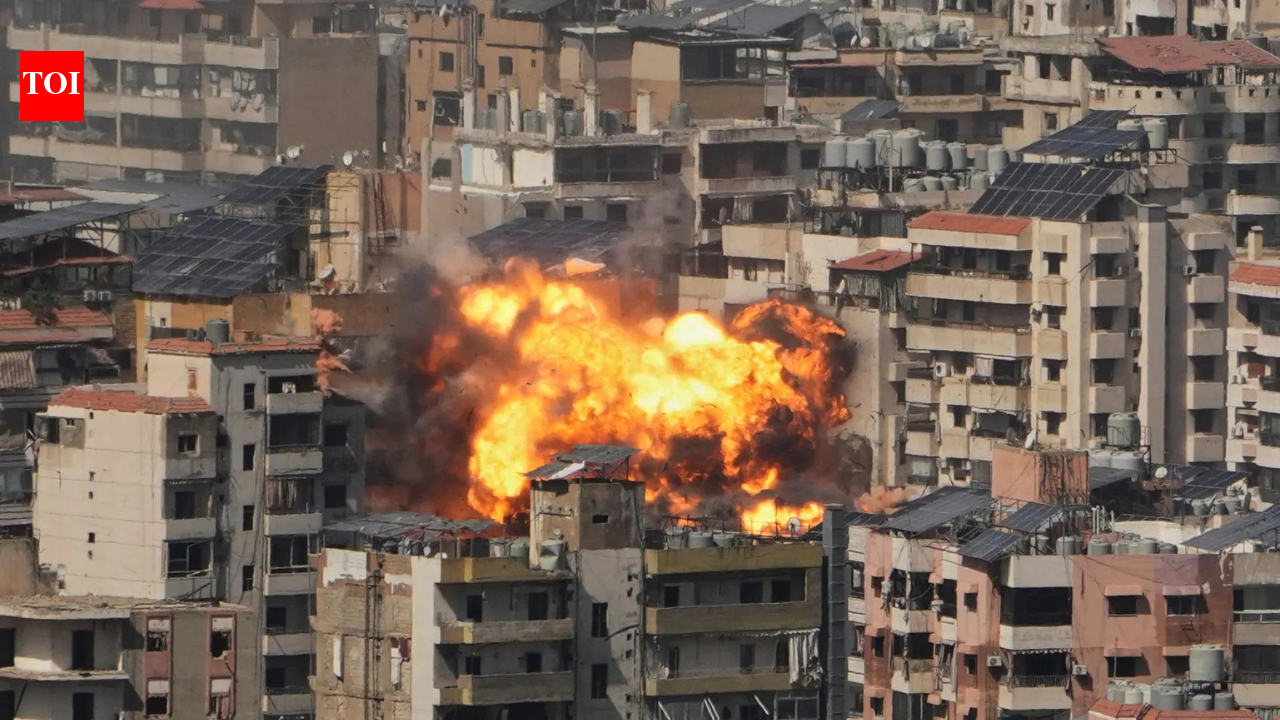
Bahrain news: Drone strike sparks fire at airport fuel tanks during Iran vs US–Israel war


Iran Unleashes Fury: Dubai Tower, Bahrain High-Rise On Fire; Saudi Diplomatic Area Attacked | WATCH

Airport Fuel Tanks in Bahrain Hit by Drone as Iran vs US-Israel War Spreads Across The Gulf

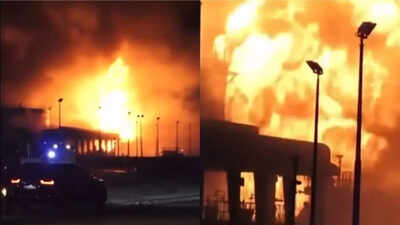
A dramatic escalation in the widening Iran vs US–Israel conflict has reached the island kingdom of Bahrain, after an Iranian drone reportedly struck fuel storage facilities near Bahrain International Airport on Muharraq Island, triggering a massive blaze and raising fears that critical civilian infrastructure across the Gulf is increasingly becoming a target in the regional war. The attack reportedly occurred late at night in Muharraq Governorate, where Bahrain’s main international airport and several energy storage facilities are located.According to Bahraini authorities, the drone strike hit fuel tanks in the area, igniting a large fire that sent thick plumes of smoke into the sky and prompted emergency warnings to nearby residents. Officials urged people living in surrounding neighbourhoods to remain indoors and close windows to avoid inhaling smoke from the burning fuel.

Iran Unleashes Fury: Dubai Tower, Bahrain High-Rise On Fire; Saudi Diplomatic Area Attacked | WATCH

Emergency services and firefighters were deployed quickly to contain the flames, while security forces secured the site to prevent further damage. Videos circulating online showed towering flames and heavy smoke rising from the fuel storage facility as firefighters battled the blaze through the night.

Strategic Iran vs US-Israel target near Bahrain International Airport

The strike’s location raised alarm across the Gulf because the targeted fuel facility sits close to Bahrain International Airport, one of the country’s most critical transport hubs. The storage tanks in the Muharraq area are used for aviation fuel and other petroleum products that support airport operations and the broader energy infrastructure of the island nation.Authorities confirmed that the attack occurred amid an expanding regional conflict involving Iran, the United States and Israel, which has already triggered missile and drone strikes across several Middle Eastern countries. While officials did not immediately report casualties from the Muharraq incident, the attack underscores growing concerns about the vulnerability of civilian infrastructure, especially airports, ports, and energy facilities, in the increasingly volatile Gulf region.

Bahrain Already on the Frontlines amid Iran vs US-Israel war

The drone strike near Bahrain’s airport is not an isolated incident but part of a broader pattern of attacks linked to the ongoing regional war. Since late February 2026, Iran has reportedly launched multiple missile and drone strikes across the Gulf targeting military bases, ports, oil infrastructure and transport hubs. Bahrain, which hosts the United States Navy’s Fifth Fleet, has been a particularly sensitive target due to its strategic military role and proximity to Iran across the Persian Gulf.In recent weeks, Bahraini air defences have intercepted dozens of drones and missiles aimed at the country. Officials say that since the start of the conflict, Bahrain has shot down more than 100 missiles and over 180 drones, reflecting the scale of the aerial threat facing the kingdom. Despite these interceptions, several attacks have still caused damage to infrastructure and civilian areas.

Gulf region facing expanding drone warfare amid Iran vs US-Israel war

The Bahrain incident comes as drone warfare becomes one of the defining features of the ongoing conflict. Across the Middle East, unmanned aerial vehicles have been used to target energy facilities, shipping routes, and strategic infrastructure. Recent weeks have seen similar attacks in Oman, where drones struck fuel storage tanks at the Port of Salalah, as well as incidents in the United Arab Emirates, where intercepted missiles and drones caused debris to fall on buildings in Dubai.Analysts say these strikes appear designed to disrupt the Gulf’s economic lifelines—particularly oil infrastructure and shipping routes. The Gulf region handles a large portion of the world’s energy exports, with tankers passing through the Strait of Hormuz, one of the most critical chokepoints for global oil supply. Any sustained attacks on ports, airports, or fuel facilities could have major implications for global energy markets and international trade.

Regional tensions continue to escalate amid Iran vs US-Israel war

The drone strike on Muharraq comes amid one of the most serious Middle East conflicts in recent years. Fighting began after the United States and Israel launched coordinated strikes against Iranian military and nuclear targets earlier this year. Iran responded with a series of retaliatory attacks across the region, targeting what it describes as military and strategic sites linked to its adversaries.However, Gulf governments have condemned the strikes on their territory as violations of sovereignty and threats to civilian safety. Bahrain’s government has repeatedly warned that attacks on its infrastructure risk dragging the wider region deeper into conflict.

Security concerns grow in Gulf capitals amid Iran vs US-Israel war

The latest incident has heightened anxiety across Gulf capitals as residents watch the conflict spread beyond traditional battle zones. Airports, energy facilities, and shipping hubs are all considered high-value targets in modern warfare, especially during conflicts where drones and long-range missiles can travel hundreds or even thousands of kilometres. The growing frequency of such attacks has forced Gulf states to strengthen air defence systems and increase coordination with regional allies.For Bahrain, the drone strike near its main airport is a stark reminder that the widening Iran vs US–Israel conflict is no longer confined to distant battlefields. Instead, the war is increasingly being fought through long-range missiles, drones, and cyber operations capable of reaching deep into the Gulf. Although the fire at the Muharraq fuel facility has reportedly been brought under control, the attack underscores the fragility of regional security as tensions continue to escalate.With drone and missile strikes already reported in multiple countries across the Middle East, analysts warn that further attacks on critical infrastructure could follow—raising the risk that the conflict could disrupt energy markets, aviation routes and global trade. For now, Gulf governments remain on high alert, hoping to prevent the war from spiralling further while preparing for the possibility that the region’s strategic infrastructure may continue to face new threats.


Source link

More items off menu; hotels rely on coal, induction stove | Mumbai News


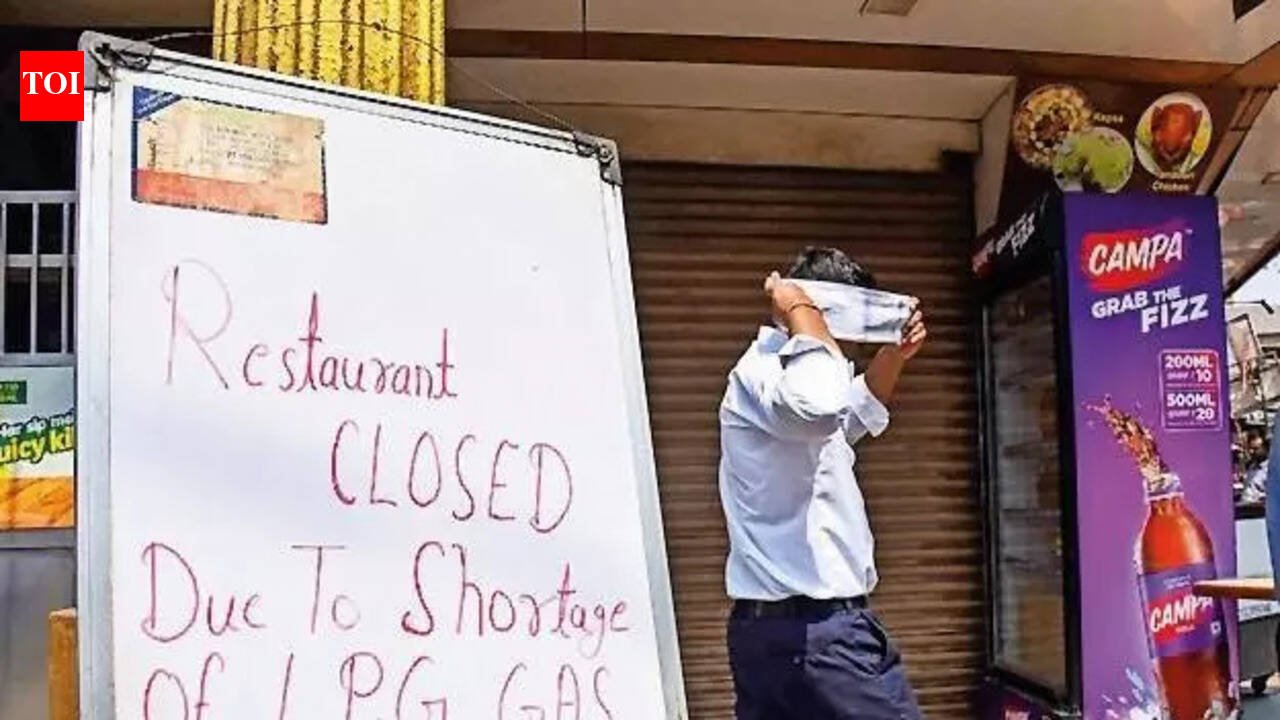
Mumbai: The situation for restaurant owners is getting tougher by the day with the majority—around 60%—all set to pull down shutters till their daily commercial LPG supply is restored. The others will remain operational but with their menu curtailed and a majority of items unavailable.Sandeep Sharma of Pancham Puriwala at Borabazar opposite the CST terminus said they have already scaled their menu down by 70% and curtailed the timings. He said the hotel plans to get an induction stove to continue to serve customers on a limited basis.Krishna Purohit of ShreeThaker Bhojanalay in Kalbadevi said the hotel has already stopped serving dishes such as halwa, daal baati, undhiyu and puris as they consumed a large proportion of gas. “Our situation is like every other restaurant in the city,” he added. However, Nissar Sardar of Sardaar Pav Bhaaji in Tardeo said since their hotel still had coal supply and coal-based chulhas, they have faced no issues so far.Kaustubh Tambe of the popular Aaram Vadapav at CST carried around 50 kg of potatoes home on Wednesday night to get them boiled and will take another 100 kg today night to get them ready for Friday morning. “Today we could not serve upavas misal, pulav, upma, poha, khichadi but we will try serve all our items tomorrow with the help of an induction stove in the absence of cylinders. We plan to ensure that we at least serve fried items such as batata vada, sabudana vada, bhaji, thalipeeth, etc without disruption. We are trying everything to keep the show going,” he said.Vijay Shetty, president of the Indian Hotel and Restaurant Association (AHAR), an apex body of over 15,000 restaurant owners across the Mumbai Metropolitan Region, said several hotel members including him have been unable to get coal and kerosene stocks to feed their chulhas amidst the crisis. “A large number of Mumbaikars who are dependent on restaurant food due to their busy schedules are getting deprived of their breakfasts and dinners,” he added.Congress legislature party leader Vijay Wadettiwar has alleged in the assembly that domestic cylinder prices have risen by Rs 60 since the crisis began and refills now take 25 days instead of 15. About 30% of hotels in cities like Mumbai and Nagpur have shut due to supply disruptions, he added. Wadettiwar warned of black-marketing risks, citing a Rs 18-lakh cylinder truck theft, and demanded the govt clarify stock levels and restore supply.


Source link

Access Denied


Access Denied

You don’t have permission to access “http://www.ndtv.com/india-news/supreme-court-grants-bail-to-separatist-shabir-shah-in-terror-funding-case-11208221” on this server.

Reference #18.34a21ab8.1773362002.9763393

https://errors.edgesuite.net/18.34a21ab8.1773362002.9763393


Source link

Maharashtra forest minister says action being taken against mangrove destruction in Borivli | Mumbai News


Mumbai: State forest minister Ganesh Naik told the assembly on Thursday that the state is taking strong action, including against private companies responsible for destroying mangroves in the Borivali area. He also said that it would work on restoring mangrove cover.The issue was raised by BJP MLA Sanjay Upadhyay who complained about the rampant destruction of mangroves in the Borivali area. “There is rampant corruption among officials and government land is being swallowed with the destruction of mangrove cover,” said Upadhyay.He said that there had been three types of violations: within areas under the mangrove department, cases in privately owned mangrove areas and cases within the 50-metre buffer zone near mangrove areas.Naik said that cases had been registered and encroachments were being removed. In privately owned mangrove areas for instance, permanent houses, mangrove sheds and godowns were found. Cases had been registered under the Environment Protection Act. Encroachments were found in areas under the Mangrove department and within the buffer zone, said Naik. Cases of land filling and dumping of iron materials, cement and sheet godowns were also found, he said.“We are taking strong action in these cases. Even private parties involved in this will not be spared,” said Naik.


Source link

Michael Vaughan jaw-dropping comparison for Jasprit Bumrah: ‘He’s like Messi or Ronaldo | Cricket News


'He's like Messi or Ronaldo': Former England captain's jaw-dropping comparison for Jasprit Bumrah

Former England skipper Michael Vaughan was full of admiration for Jasprit Bumrah following the Indian pacer’s sensational performance in the final of the 2026 ICC Men’s T20 World Cup against New Zealand national cricket team in Ahmedabad last Sunday.Bumrah delivered a historic spell, returning figures of 4 for 15 in the title clash. In doing so, he became the first fast bowler to claim a four-wicket haul in a knockout match in the tournament’s history. The performance also took his tally to 40 wickets across all his T20 World Cup appearances, the most by a pace bowler, achieved while maintaining an impressive economy rate of just 5.66.

Gautam Gambhir reflects on India’s World Cup win and backing Sanju Samson in the tournament

During a discussion on the Stick to Cricket podcast, Vaughan made a bold claim, saying Bumrah is the finest bowler he has seen in all the years he has followed the game. The former England captain went as far as comparing the Indian speedster to global football superstars Lionel Messi and Cristiano Ronaldo, highlighting the kind of impact he can have on a team.“Put Jasprit Bumrah in England’s team and they win it,” he said.Former England batter Mark Butcher quickly agreed with the assessment.“I reckon if you put him in anybody’s team, they’ll win it.”“Exactly,” Vaughan added. “He’s probably like Lionel Messi or Cristiano Ronaldo — those kinds of players.”However, the conversation took an interesting turn when former England cricketer David Lloyd reminded Vaughan of his earlier statement.“Didn’t you say he is the best bowler you have ever seen?” Lloyd asked.Vaughan stood firm on his opinion.“Yes, he is. You’ve got to remember that I started watching or studying cricket in 1985, and he’s the best I’ve seen.”Another former England captain, Alastair Cook, offered a slightly more measured perspective. While he acknowledged Bumrah as the leading multi-format bowler in world cricket today, Cook wondered whether the Indian pacer had produced a truly iconic match-winning spell in Test cricket.“Is he the best in terms of match-winning spells in Test cricket? Without a shadow of a doubt, he is the best all-format bowler around, I think. I mean, you can safely say that. But has he, like, in a Test match bowled a spell like an 8/15, or is he not that kind of bowler?” he asked.Vaughan, however, quickly defended Bumrah’s record.“I’ve seen him a bit in Australia. Some of the spells have been different — that too on flat decks.”Interestingly, statistics suggest Bumrah has indeed delivered several outstanding performances in the longest format. The Indian pacer has recorded eight or more wickets in a Test match on eight occasions, with six of those efforts coming on challenging overseas tours in England, South Africa and Australia. On three of those occasions, his performances also earned him the Player of the Match award.

Banner Insert


Source link

Middle East tensions: Firms return to WFH, travel curbs as Iran targets UAE


Middle East tensions: Firms return to WFH, travel curbs as Iran targets UAE

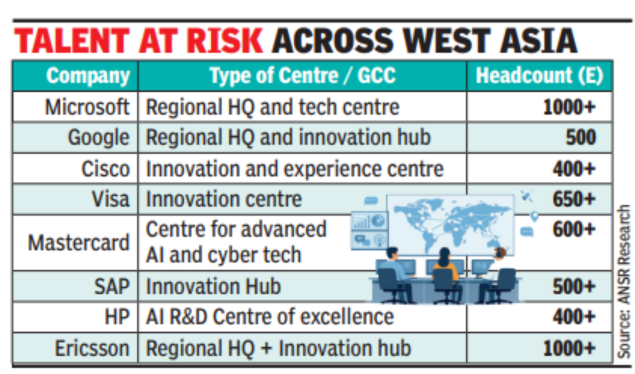
BENGALURU: With the West Asia crisis escalating and recent Iranian strikes targeting the UAE, several IT companies and global capability centres (GCCs) have activated their business continuity plans (BCPs), introducing measures such as work-from-home, travel advisories and temporary office closures.Amid rising geopolitical uncertainty, many tech firms and GCCs are increasingly relying on India as a stable hub for global operations. Many are running mirror command centres from India to ensure operational continuity during disruptions.TCS, which has over 9,000 employees across the Middle East and Africa (MEA) region, has asked its staffers to work remotely. The company has activated a call tree, with associates in impacted and neighbouring regions being contacted on priority. A call tree is a structured chain-based communication method used to quickly relay alerts or critical updates to teams. “We are also coordinating closely with local authorities and the Indian embassies to track developments and will continue to provide timely updates as the situation evolves,” the company told TOI.Infosys has introducing tighter travel restrictions The company said only critical travel will be permitted for now, with group meetings, events, offsites and conferences currently restricted. Wipro, JPMorgan, Goldman Sachs and Standard Chartered have asked their employees to work from home, among others.

-

Vikram Ahuja, co-founder of ANSR, said organisations that were in the middle of setting up or expanding GCCs in the region have paused non-essential travel and executive visits as a precaution. “If the situation persists, we could actually see an acceleration of GCC ramp-ups in India as a stable anchor,” he said. Cognizant advises BYOF After Infosys, Cognizant has encouraged employees to adopt BYOF (Bring Your Own Food) wherever feasible, to reduce reliance on office cafeterias while it monitors the evolving situation linked to the West Asia crisis. Cognizant has pre-identified alternate food vendors that do not rely on commercial LPG. The company said the current situation does not indicate an immediate disruption but could evolve into a prolonged period of operational pressure. Transport services are another area being closely monitored. Email to employees noted a “moderate risk of service strain” in commute operations due to fuel cost escalation impacting cab and shuttle vendors.


Source link

US launches trade inquiries on India, 14 other countries


US launches trade inquiries on India, 14 other countries

NEW DELHI: As part of its tariff pressure, the US Trade Representative has launched a section 301 investigation against 15 countries, including India, to ascertain if there is structural excess capacity and production in manufacturing sectors.Based on the outcome of the probe – which follows US Supreme Court’s rejection of Donald Trump’s reciprocal tariff using emergency powers – the USTR can impose penalties on the countries whose policies are seen to be hurting American interests.While identifying solar modules, petrochemicals and steel among areas where India has “created significant excess capacity”, USTR Jamieson Greer said that the country’s trade surplus sectors include textiles, health, construction goods, and automotive goods.Probe aimed at reshoring critical supply chains: GreerGreer said, “The US will no longer sacrifice its industrial base to other countries that may be exporting their problems with excess capacity and production to us. Today’s investigations underscore President Trump’s commitment to reshore critical supply chains and create good-paying jobs for American workers across our manufacturing sectors.”“The Trump Administration’s reindustrialisation efforts continue to face significant challenges due to foreign economies’ structural excess capacity and production in manufacturing sectors. Across numerous sectors, many US trading partners are producing more goods than they can consume domestically. This overproduction displaces existing US domestic production or prevents investment and expansion in US manufacturing production that otherwise would have been brought online. In many sectors, the US has lost substantial domestic production capacity or has fallen worryingly behind foreign competitors,” he said.Apart from India, the probe covers China, the European Union, Singapore, Switzerland, Norway, Indonesia, Malaysia, Cambodia, Thailand, Korea, Vietnam, Taiwan, Bangladesh, Mexico and Japan.


Source link