Breaking News
Jones Act: White House mulls suspending ‘Jones Act’ to curb soaring oil prices amid Iran conflict – key maritime law explained


White House mulls suspending 'Jones Act' to curb soaring oil prices amid Iran conflict - key maritime law explained

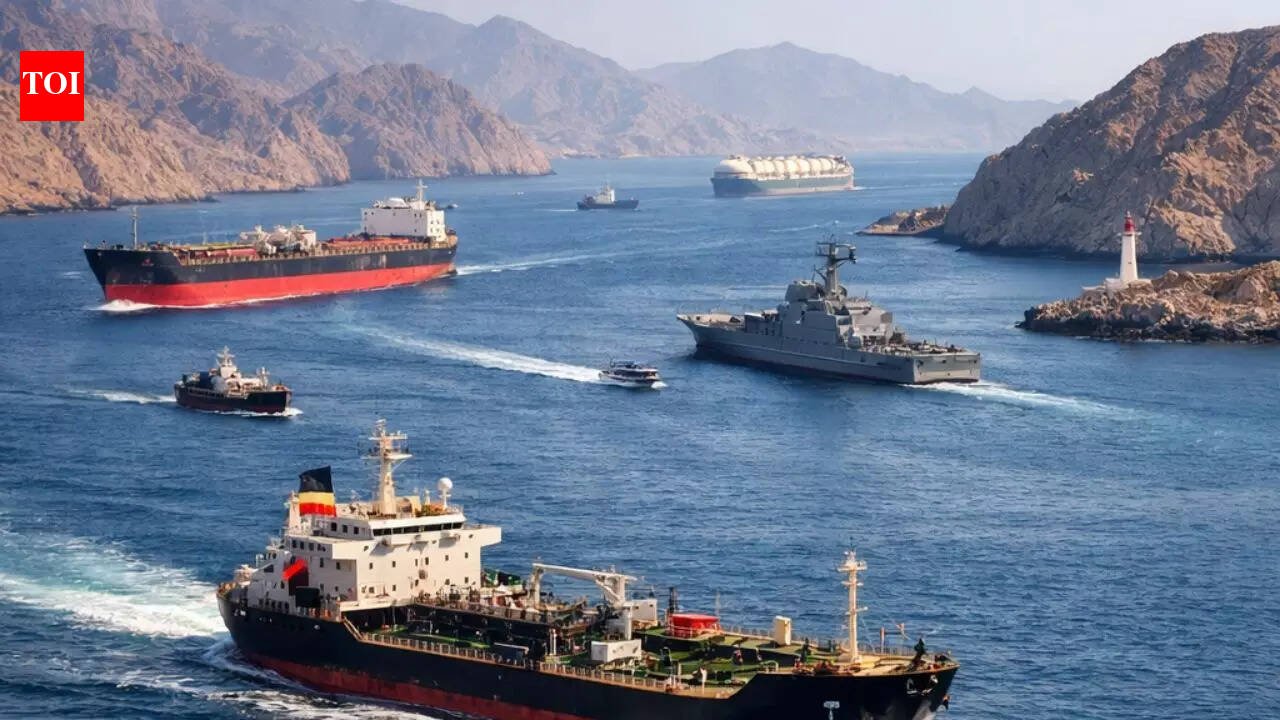
Amid the rising oil prices as the Iran conflict continues to escalate, the Trump administration is considering the idea of suspending a key maritime law that requires American ships be used to transport between US ports.“In the interest of national defense, the White House is considering waiving the Jones Act for a limited period of time to ensure vital energy products and agricultural necessities are flowing freely to US ports,” White House Press Secretary Karoline Leavitt said in a statement, as quoted by Bloomberg, but clarifying that, “This action has not been finalised.”

Iran’s New Supreme Leader Takes Chilling Hormuz Pledge, Warns Trump As Gulf War Escalates

The proposal comes as Donald Trump weighs several measures to address the sharp surge in crude oil and gasoline prices following the ongoing conflict with Iran.In the latest on oil prices, crude jumped sharply on Thursday after Iran’s Supreme Leader Mojtaba Khamenei pledged “revenge” following strikes by the United States and Israel, while the Islamic Revolutionary Guard Corps (IRGC) warned that the strategic Strait of Hormuz would remain closed.At around 1450 GMT, international benchmark Brent crude rose 9.46 per cent to $100.68 per barrel, after briefly crossing the $100 level earlier in the trading session.On Wednesday, the administration said it would release 172 million barrels of crude oil from the Strategic Petroleum Reserve to help ease supply pressures. The move is part of a broader coordinated effort in which multiple countries plan to release around 400 million barrels of oil from their reserves under International Energy Agency (IEA).Also read: ‘We make lot of money’ – Trump on rising oil prices amid US-Iran war

What is the Jones Act

The Merchant Marine Act of 1920 (Jones Act), commonly known as the Jones Act, is a US federal law that regulates domestic shipping and maritime commerce. It requires that vessels transporting goods between US ports be built, owned and registered in the United States, and operated by crews who are US citizens or permanent residents.The law was introduced to protect and maintain a strong US maritime industry and shipping fleet. In the current situation, the White House is considering temporarily waiving the Jones Act to help address surging oil and fuel prices. A suspension would allow foreign-flagged ships to transport oil between US ports, potentially increasing supply flexibility and easing fuel shortages.The government, in the past, has temporarily waived US shipping requirementsto address fuel shortages following major storms, but such a step is often politically sensitive. The Jones Act is strongly supported by some of the country’s largest shipbuilders and vessel operators, along with their allies in Congress. On Thursday, a White House official said the Trump administration can ensure that the move would not affect the US shipbuilding industry.The US last granted a waiver under the Act in October 2022, allowing a tanker to transport supplies to Puerto Rico after Hurricane Fiona.The Biden administration had also temporarily approved an exemption for Valero Energy following a cyberattack on a major fuel pipeline along the US East Coast in 2021.


Source link

‘Some people trying to create panic’: PM Modi plays down LPG crisis; targets opposition | India News


'Some people trying to create panic': PM Modi plays down LPG crisis; targets opposition

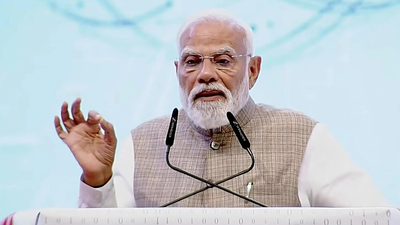
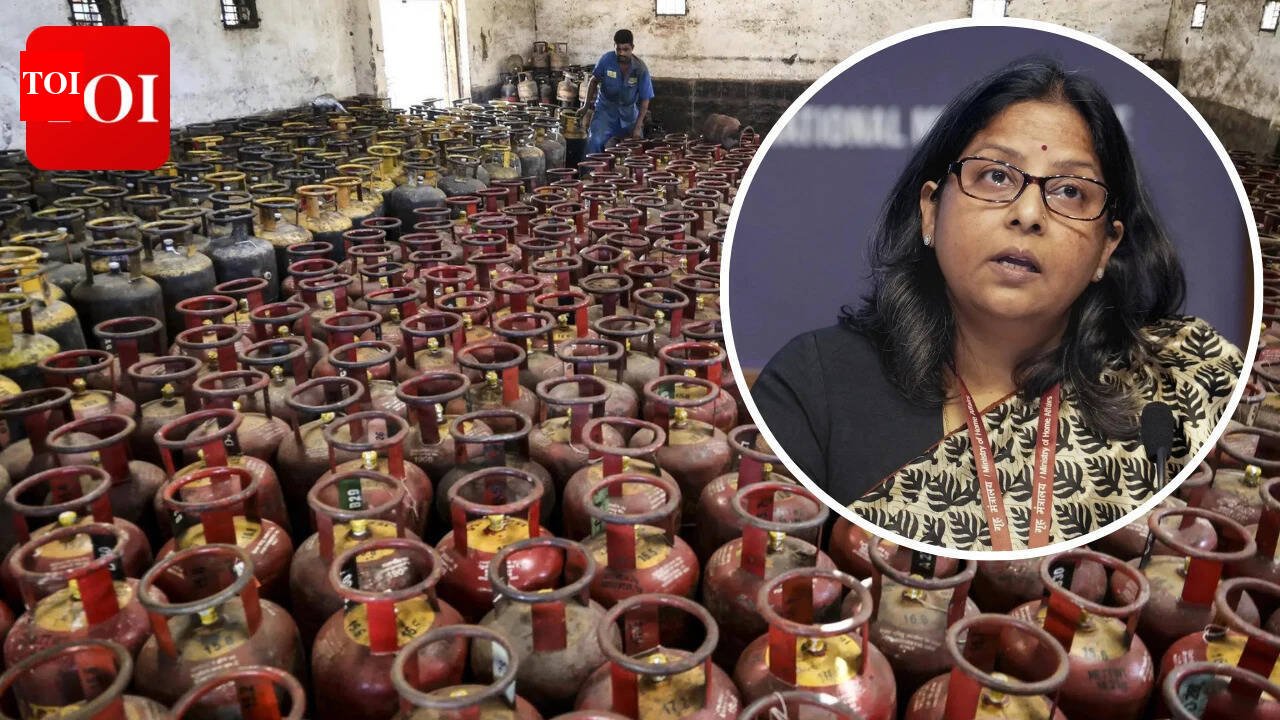
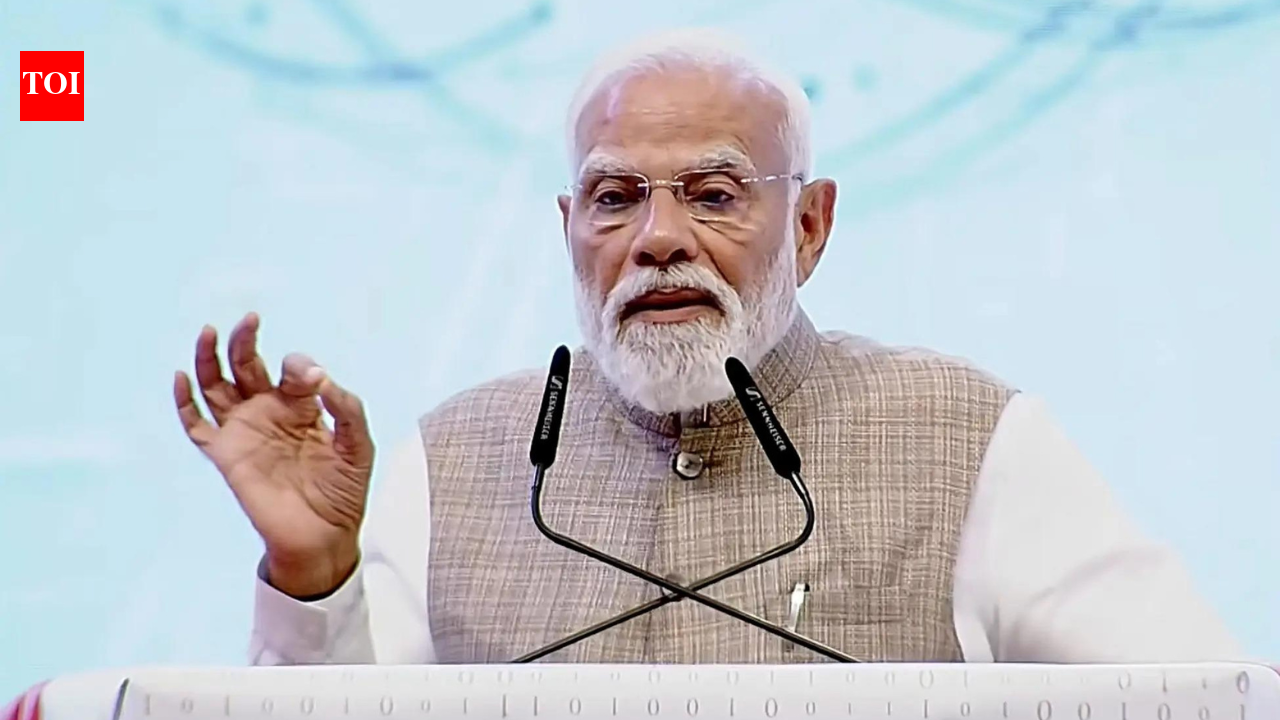
NEW DELHI: Prime Minister Narendra Modi on Thursday played down the energy crisis in the country triggered by the ongoing conflict between thejoint forces of United States and Israel with Iran. While addressing the NXT Summit, the Prime Minister indirectly targeted those who are “trying to create panic” and claimed that, by doing so, they are exposing themselves in front of the public.“We will have to make collective efforts, keeping the national interest supreme and fulfilling our duties. Nowadays, there is a lot of discussion about LPG. There are some people who are trying to create panic. They want to push their own agenda,” PM Modi said. “At this time, I do not wish to make political comments on them. But I will certainly say that by doing so, they are not only exposing themselves in front of the public but also causing great harm to the country,” he added.The Prime Minister said that the government has prioritised self-reliance in the energy sector to ensure that the country doesn’t have to rely solely on foreign sources for energy.“To ensure we don’t have to rely solely on foreign sources for energy, emphasis was placed on self-reliance in the energy sector. Until 2014, there were only 14 crore LPG connections in the country. Today, there are more than double that—33 crore household LPG connections. In 2014, there were only 4 LNG terminals in the country,” PM Modi said.“Today, their number has also doubled. Today, no country is untouched by the impact of this global crisis that has arrived. In lesser or greater measure, everyone is a victim of this crisis. India too is leaving no stone unturned to deal with this crisis,” he added.The Prime Minister also said the government is making every possible effort to ensure that the burden of situations arising from war does not fall on the citizens of India.“The Government of India has always made every possible effort to ensure that the burden of situations arising from war does not fall on the citizens of India,” he said.“This time too, we will make every possible effort to ensure that the war has the least possible impact on the lives of the country’s farmers and the citizens of the country,” he added.Fears of LPG shortage began spreading across the country as the escalating conflict in the Middle East disrupts global energy supply chains.The closure of the Strait of Hormuz following Iranian retaliation against US–Israel strikes has triggered panic buying, long queues at LPG agencies and petrol pumps, and forced restaurants and small businesses to switch to alternative cooking methods.With certain measures helping raise domestic LPG production by 28 per cent and some alternative sources being tapped overseas, the government has decided to allow some sale of commercial LPG to meet a fifth of the demand, Sujata Sharma, Joint Secretary in the Oil Ministry, said.“The state governments will have to identify the beneficiaries,” she said.As panic buying escalates, the government has extended the LPG refill ordering window for rural users to 45 days, up from 25 days set last week for all users, which itself had replaced the previous 21-day limit. The move aims to manage demand and ensure equitable distribution amid the ongoing energy supply disruptions caused by the West Asia crisis, she said.The increase in the monthly quota of kerosene released to states is the first in more than a decade and temporarily reverses the government’s stated objective of phasing out the fuel, which, besides being heavily subsidised, was also used for adulteration in petrol.


Source link

Cong MP Varsha Gaikwad requests defence minister Rajnath Singh to issue NOC for redevelopment of Bandra East slums | Mumbai News


Mumbai: Congress city chief and MP Varsha Gaikwad requested the union minister of defence Rajnath Singh to issue a no-objection certificate (NOC) for the redevelopment of slums in Bandra East.She said a survey of slums pockets at Dawari Nagar, Hanuman Tekdi, Maratha Colony and Hussain Tekdi area, showed around 9,500 slum dwellings. She said redevelopment of these areas remained stuck for long because the land fell under the jurisdiction of the defence, which needed to issue an NOC for redevelopment under the SRA scheme.Gaiwad urged the minister’s intervention to expedite the process of issuing the necessary NOC. The MP said thousands of families continued to live in extremely difficult conditions, facing a lack of basic amenities and unsafe housing. Bandra East had several slum pockets, with many adjoining the railway station, and that the area was part of Gaikwad’s parliamentary constituency.Meanwhile, Congress decided to organise protests across Mumbai against the BJP-led govt over a shortage of LPG gas that forced many hotels and eateries to shut down. Mumbai Congress spokesperson Sureshchandra Rajhans said, “A major shortage of gas cylinders is now being felt in Mumbai. While the govt claims that there is no shortage, this claim is not true. We will protest against the govt inaction to address the issue.


Source link

Hari Murali Death News: Actor Hari Murali passes away at 27; Child artist from ‘Rasikan’ and ‘Annan Thambi’ found dead at his residence |


The passing of 27-year-old Hari Murali has cast a shadow over the Malayalam cinema community. Discovered in his Payyannur residence, Murali, who first captured hearts as a child actor, is remembered not only for his film successes but also for his pursuit of graphic design after stepping away from the spotlight.

TRIGGER WARNING: This article contains mention of death.Malayalam actor Hari Murali, who began his career as a child artist in films and television, has passed away. He was 27 years old. Reports from Manorama Online says that the young actor was found dead at his residence in Annoor, Payyannur.Reports also say that his body was later shifted to a private hospital in Payyannur and further details surrounding the circumstances of his death have not yet been publicly confirmed.

Son of veteran theatre artist

Hari Murali came from a family with a strong background in theatre and cinema as he was the son of theatre and film actor K. U. Murali, popularly known as Payyannur Murali.See More: ‘Why did you do this?’ Actor Seema G. Nair mourns Hari Murali’s demise with an emotional tribute

Actor Ganapathi’s relative

His father has been active in the theatre field for nearly three decades. Hari’s mother is Prasanna, and he is survived by his brother Sreemurali. ‘Manjummel Boys’ actor Ganapathi is reportedly a relative of Hari Murali.Additionally, actor Babu Annoor—who portrayed the father of Fahadh Faasil in the film ‘Oru Indian Pranayakatha’—is the brother of Hari’s father.

Poll

How do you remember Hari Murali’s contribution to cinema?

Hari Murali first entered the world of acting through television serials. Director A. M. Naseer reportedly gave him a small role in a serial when he was just four and a half years old.Hari’s first movie appearance was in Dileep’s ‘Rasikan’ which received good reviews from the audiences even though it flopped.After his debut in Rasikan, Hari Murali went on to appear in several popular Malayalam movies such as Annan Thambi, directed by Anwar Rasheed, as well as Madampi, Don, Pattanathil Bhootham and Ulakham Chuttum Valiban.In total, he appeared in around 10 to 15 films during his childhood years.After spending several years in front of the camera, Hari gradually stepped away from acting to focus on his education.Hari completed a BSc in Visual Effects and Animation from Bengaluru and after finishing his studies, he began working in Ernakulam as a graphic designer.His last outing as an actor was ‘Amar Akbar Anthony’.


Source link

‘Difficult situation’: Government briefs on LPG supply, urges citizens to avoid panic booking | India News


'Difficult situation': Government briefs on LPG supply, urges citizens to avoid panic booking

NEW DELHI: Public concern over a possible shortage of LPG and other fuels is mounting, but the Centre assures that there is no reason to panic. The closure of the Strait of Hormuz has led to disruptions in oil supply amid the ongoing US-Israel-Iran war. The government said that the citizens should avoid panic booking and conserve fuel during these uncertain times.Sujata Sharma, joint secretary at the ministry of petroleum and natural gas, during a press briefing said, “There is a manifold increase in the bookings because of the panic. We urge the citizens to avoid panic booking and all efforts have to be made to conserve the fuel wherever possible during this period of global uncertainty.” Sharma also said that the retail network across the country is functioning smoothly, with nearly 100,000 fuel outlets operating without any dry-outs. She added that around 25,000 LPG distributors are supplying roughly 50 lakh cylinders daily, ensuring uninterrupted household access.Commercial LPG supplies are being prioritised for hospitals and educational institutions, with a three-member committee of executive directors from oil marketing companies overseeing allocations to prevent hoarding or black marketing.Sharma also added that India’s refineries are working at maximum capacity to boost LPG output.“Yesterday I told you 25%. Now it is 28% of our domestic production. So that is the increase,” she said, referring to the government’s March 9 order under the Essential Commodities Act directing refineries to maximise LPG production.She noted that India, the world’s fourth-largest refiner, processes nearly 55 million barrels of oil per day, providing a significant buffer against global shocks.Despite the closure of the Strait of Hormuz — a vital shipping lane for global energy transport — Sharma said the government’s intervention has ensured continued imports through alternate routes.“So today is the 13th day of the war, and the Hormuz for the commercial shipping is closed. This is very important in the context that we do take lot of import from the Strait of Hormuz. Although after the intervention of the government, as on today, more than 70% of our import is coming through routes other than the Strait of Hormuz,” she said.To ease pressure on LPG and natural gas channels, the government has also stepped up supplies of alternative fuels.Kerosene allocations to states are being raised, and coal distribution for small and medium consumers is being scaled up. The Environment Ministry has advised state pollution boards to temporarily allow restaurants and hotels to use biomass, RDF pellets, kerosene or coal for a month.Daily coordination between oil marketing companies and state governments continues to ensure a steady supply, monitor demand patterns and enforce regulations. District-level committees have been tasked with preventing diversion, hoarding and misuse of fuel stocks.


Source link

Suresh Raina picks the batting position of LSG captain Rishabh Pant for IPL 2026


The anticipation surrounding the Indian Premier League (IPL) continues to grow as the 2026 season approaches, with fans eagerly waiting for another thrilling edition of the world’s most popular T20 franchise tournament. The new season is scheduled to begin on March 28, bringing together top international stars and emerging Indian talents in what promises to be a fiercely competitive campaign.

Every IPL season carries enormous expectations, not just for teams but also for star players who shoulder leadership responsibilities. With franchises assembling powerful squads and fine-tuning their strategies, discussions around team combinations and batting orders have already started gaining momentum. Former India batter Suresh Raina recently shared his thoughts on how the Lucknow Super Giants (LSG) should structure their batting lineup, particularly regarding the role of their captain Rishabh Pant.

Suresh Raina picks the batting order for Rishabh Pant in LSG lineup

During a discussion on Star Sports, Raina suggested that Lucknow should consider promoting Pant up the batting order to maximize his impact. According to the former Chennai Super Kings star, Pant could be more effective batting at No. 3 rather than lower down the order.

Raina explained that LSG’s middle order might struggle if early wickets fall, especially in high-scoring chases. To avoid a collapse and maintain momentum, he proposed a slightly reshuffled batting order.

“If four batters get out, there is a sort of commotion down the order. Abdul Samad has come after winning the Ranji Trophy, but when you chase 210 or 220, I feel they will have to tweak a little there. Get Rishabh Pant at No. 3 and play Nicholas Pooran at No. 4. Abdul Samad is at No. 5, and you will have to fit Ayush Badoni in between. You have a left-arm spinner in Shahbaz Ahmed, who also bats very well,” Raina said.

Raina further highlighted that Pant and Nicholas Pooran would have a crucial role if the openers fail to provide a solid start. He also expressed confidence that the LSG captain could adopt a more aggressive approach this season.

“They don’t have a heavy-hitter from No. 5 to No. 8. I feel that even if two players get out from the top, Rishabh Pant and Nicholas Pooran have a very important role. He will have to justify his captaincy this time. I feel Rishabh will do slightly differently this season and will be more fearless this year,” Raina added.

Also READ: Faf du Plessis picks a player who will be ‘under most pressure’ in IPL 2026

Star-studded side ready for the big challenge

LSG enter IPL 2026 with a powerful squad and renewed ambitions after a disappointing campaign last season. The franchise finished seventh in IPL 2025 and missed out on the playoffs, prompting them to reshape their squad for the upcoming tournament.

Pant will lead the side as captain after being retained for ₹27 crore, making him one of the most valuable players in the league. The team is also supported by strategic advisor Kane Williamson, whose experience is expected to help shape the team’s tactical approach.

LSG’s biggest strength lies in its pace attack, which could arguably be one of the fastest bowling units in IPL history. The lineup features the exciting pace of Mayank Yadav along with international stars Anrich Nortje and Mohammed Shami.

Their batting unit is equally formidable, boasting big hitters like Aiden Markram and Mitchell Marsh alongside Pooran. Meanwhile, Wanindu Hasaranga adds quality spin and valuable lower-order batting.

Despite the star power, questions remain about the injury history of some key fast bowlers and the lack of experienced finishers in the lower middle order. Lucknow will begin their IPL 2026 campaign against Delhi Capitals on April 1, hoping their high-risk, high-reward strategy can finally deliver their maiden IPL title.

Also READ: IPL 2026: BCCI announces schedule for the first phase; RCB to take on SRH in the opening contest


Source link

Hundred Auction 2026: Indian-owned SunRisers Leeds buy Pakistan player, Usman Tariq also picked | Cricket News


Hundred Auction 2026: Indian-owned SunRisers Leeds buy Pakistan player, Usman Tariq also picked
Kavya Maran, co-owner and head of SunRisers Leeds (Photo by Pankaj Nangia/Getty Images)

NEW DELHI: Pakistan spinner Abrar Ahmed was bought by SunRisers Leeds for £190,000 at the Hundred Player Auction 2026 on Thursday, putting an end to speculation that teams linked to the Indian Premier League (IPL) might avoid signing Pakistani players. The franchise, co-owned by Kavya Maran, competed strongly in the bidding and beat Trent Rockets to secure the mystery spinner.Earlier in the auction, Usman Tariq became the first Pakistani player to be picked when Birmingham Phoenix signed him for £140,000.

EXCLUSIVE: Rahul Dravid on iconic Eden Gardens win against Australia in 2001

However, several other Pakistan stars did not find buyers. Fast bowler Haris Rauf and all-rounders Shadab Khan and Saim Ayub remained unsold at the time of writing.Meanwhile, Pakistan ODI captain Shaheen Shah Afridi had already withdrawn from the auction before bidding began. The ECB confirmed that Quinton de Kock, Sunil Narine, AM Ghazanfar, and Peter Siddle also pulled out. The likely reason was scheduling clashes with the Caribbean Premier League (CPL) and other international commitments.Afridi’s withdrawal still left 13 Pakistani players available in the men’s auction pool. The situation had drawn attention after speculation that franchises with IPL links might avoid picking Pakistani players.Responding to the debate, the ECB and the eight franchises issued a joint clarification, saying selections would be based on “performance, availability, and the needs of each team.”Pakistan also had a disappointing outcome in the women’s auction held a day earlier. None of the Pakistani women players were selected. Muneeba Ali, Diana Baig, Sadia Iqbal, and captain Fatima Sana had all entered the auction with a base price of £15,000, but they did not receive any bids.

Banner Insert


Source link

US-Iran war: How Strait of Hormuz closure impacts global oil supply – explained in 5 charts


US-Iran war: How Strait of Hormuz closure impacts global oil supply - explained in 5 charts
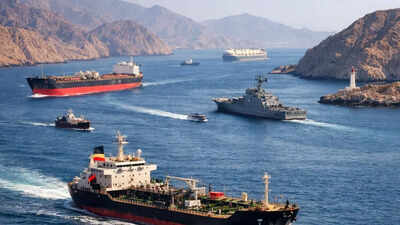
Representative AI image (Credit: Chatgpt)

The narrow waters of the Strait of Hormuz, a vital artery of the global energy system have become the epicentre of the latest shock to oil markets as the US-Israeli war on Iran escalates. Tankers are anchored, refineries are struggling to ship fuel, and some of the world’s biggest oil producers are cutting output as storage tanks fill up.The conflict has effectively blocked the strategic shipping route. With vessels avoiding the corridor due to security risks and energy infrastructure under attack, with several reports warning that the disruption could become one of the most serious supply shocks in decades.

‘Well, What Can I…’: Trump’s Startling Statement After Two Ships ‘Hit’ In Hormuz By Iran

As the crisis ripples through global markets, governments and energy agencies are scrambling to contain the fallout from releasing emergency oil reserves to imposing price caps and restricting exports, while businesses and consumers brace for rising energy costs.

The Strait of Hormuz

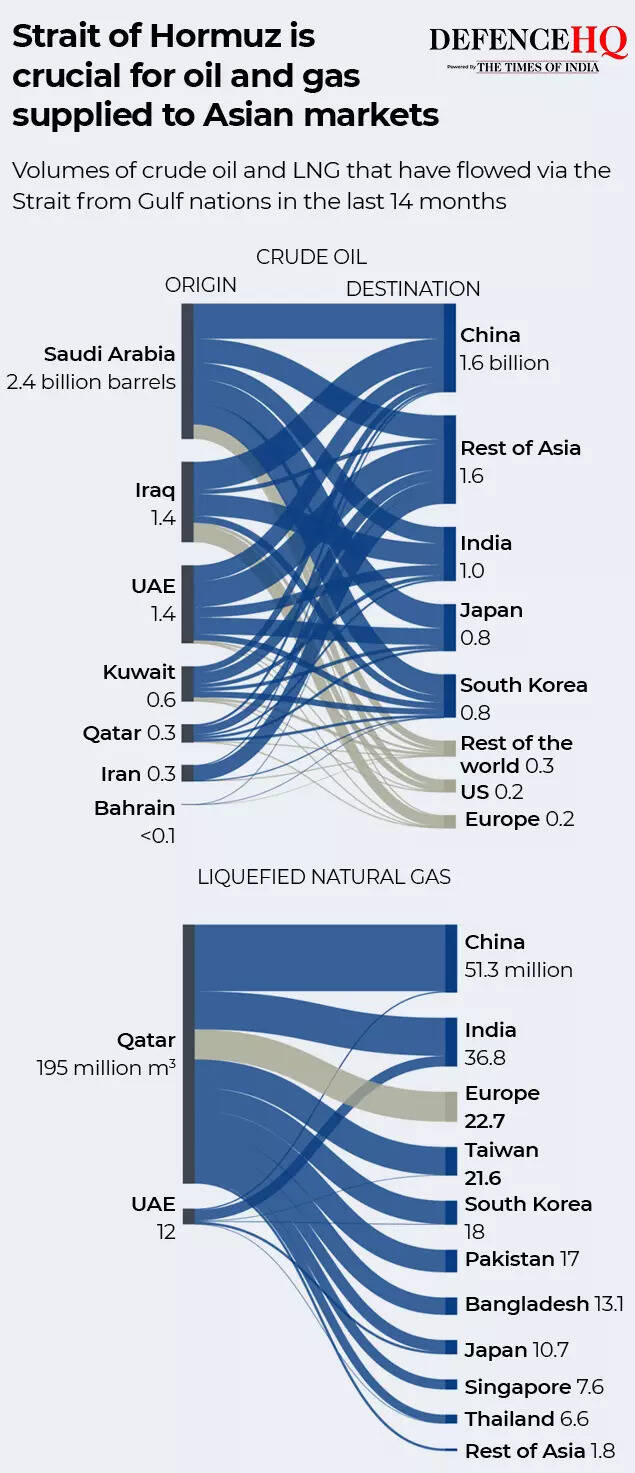
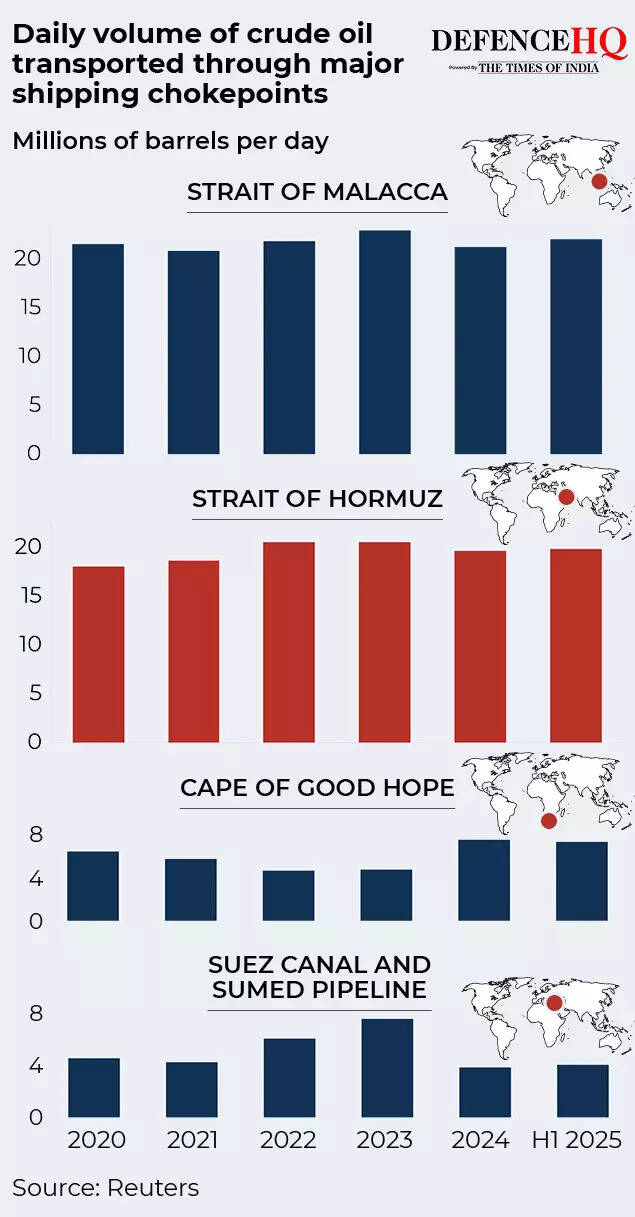
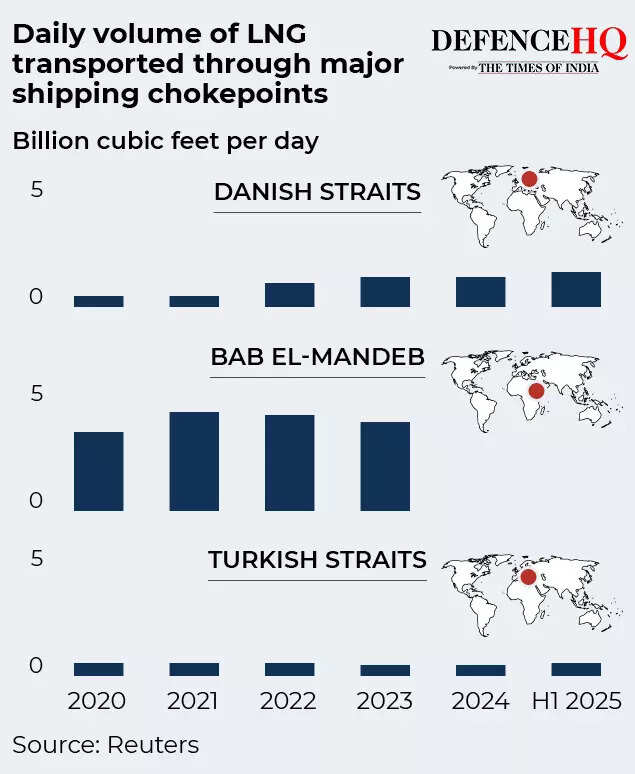
The Strait of Hormuz, located between Iran and Oman, is one of the most strategically important waterways in the world.The narrow shipping corridor normally carries about one-fifth of global oil and liquefied natural gas shipments. Tankers transport crude from major Gulf producers to markets across Asia, Europe and North America.But the escalation of the US–Iran conflict 2026 has effectively shut the route. Since the war began on February 28 with joint strikes by the United States and Israel on Iranian targets, tanker movement through the strait has slowed dramatically. Many vessels are avoiding the corridor entirely due to security risks, with several tankers already attacked since the conflict began. Hundreds of ships are currently anchored on both sides of the waterway as shipping companies and oil traders wait for signs that navigation through the strait may resume safely.
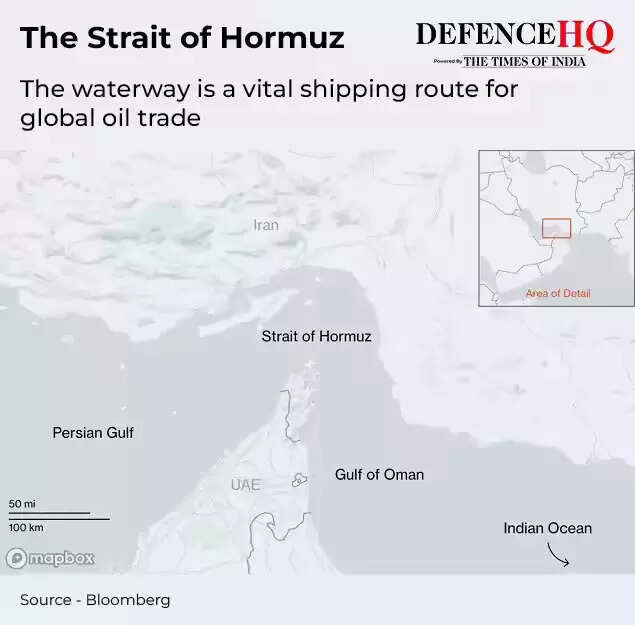
Strait of Hormuz

Strait of Hormuz

Oil producers forced to cut output

The disruption has quickly affected production across the Gulf.Top Middle East producers, including Saudi Arabia, Iraq and Kuwait have begun reducing output at their oilfields.With tankers unable to load crude for export, companies have been forced to divert oil into storage. However, storage facilities across the region are nearing capacity after nearly 10 days of shipping disruptions.Once storage tanks fill up, producers have little choice but to slow or halt production. This scenario threatens to tighten global oil supply sharply if exports do not resume soon.

,

Oil infrastructure and refineries under attack

The war has also damaged key energy infrastructure across the Gulf region. Some refineries have been directly hit during the conflict.The 380,000-barrel-per-day Sitra refinery operated by Bapco Energies in Bahrain was struck and declared force majeure earlier this week.Meanwhile, Saudi Aramco had shut its largest refinery at Ras Tanura which also hosts the kingdom’s biggest marine export terminal after a drone strike from Tehran.These disruptions have further limited the region’s ability to process and export fuel products.Kuwait’s massive Al Zour Refinery, which processes about 615,000 barrels per day and supplies jet fuel to Europe and Africa, has also been affected as shipping routes remain blocked. Even if hostilities ease soon, repairing damaged infrastructure and restarting production could take weeks.Tanker traffic through the strait has stopped, insurance costs have gone up, and big shipping companies have stopped crossing. Over 400 oil and product tankers are sitting still in the Gulf, and some vessel tracking shows that flows through Hormuz are much lower than usual.

,

Emergency oil reserves considered

With global supplies tightening rapidly, the International Energy Agency is preparing an emergency response.The agency is expected to recommend releasing around 400 million barrels of oil from strategic reserves, the largest such move in its history. Emergency stockpiles are designed to cushion the global economy from sudden supply shocks.However, the spare production capacity may not be enough to fully offset the disruption if the Strait of Hormuz remains closed.Until shipping resumes, refineries around the world will likely rely on existing inventories to continue producing fuel for transport, industry and power generation.

,

Oil and gas prices surge

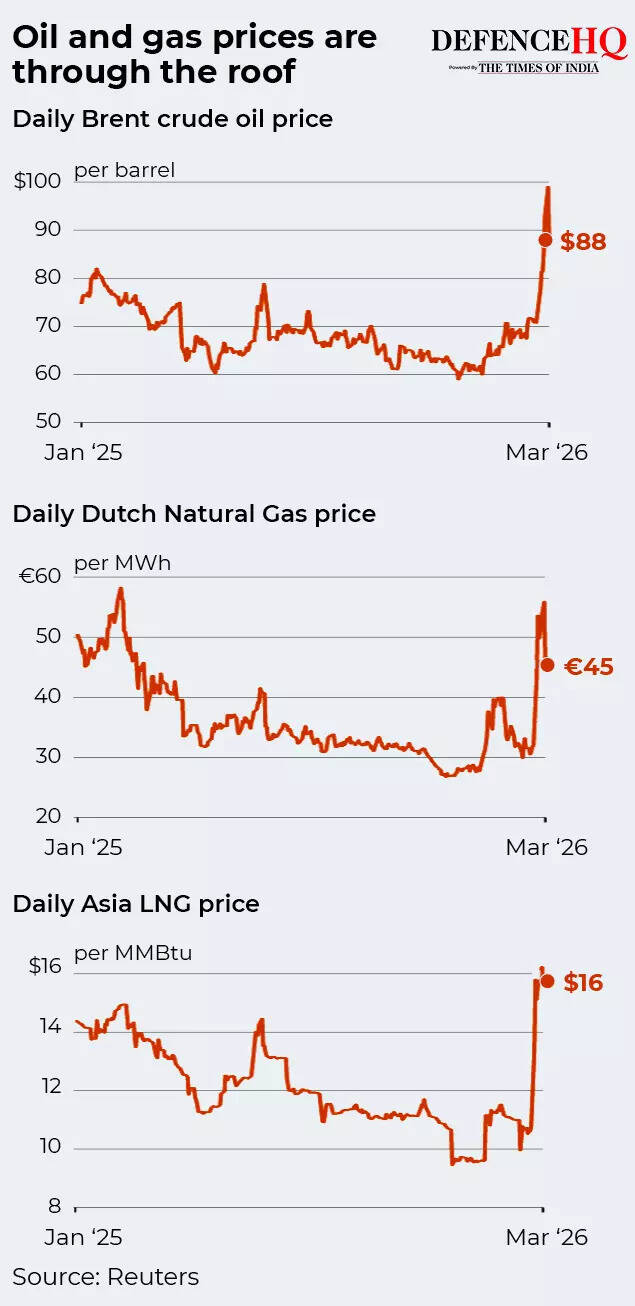
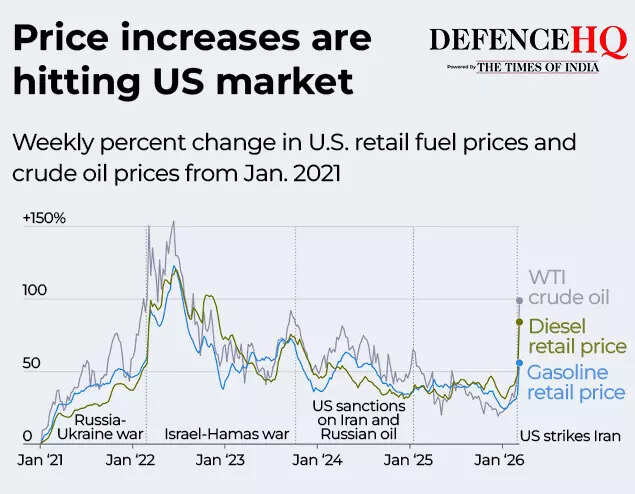
Energy prices have already surged sharply since the conflict began. Oil briefly climbed to about $119 a barrel earlier this week the highest level since 2022, as traders reacted to the supply disruption. Although prices later eased slightly, analysts warn that prolonged disruption could drive crude significantly higher.If supply losses persist, prices may rise until higher energy costs reduce demand, a process economists often describe as “demand destruction.” The impact is not limited to crude oil. Prices for gasoline, diesel, jet fuel, natural gas, petrochemicals, fertilisers and electricity have all risen sharply since the war began, according to Reuters reports.Shipping costs have also surged as insurers and freight operators price in the risk of attacks on vessels passing through the Gulf.

,

Asia faces the biggest risk

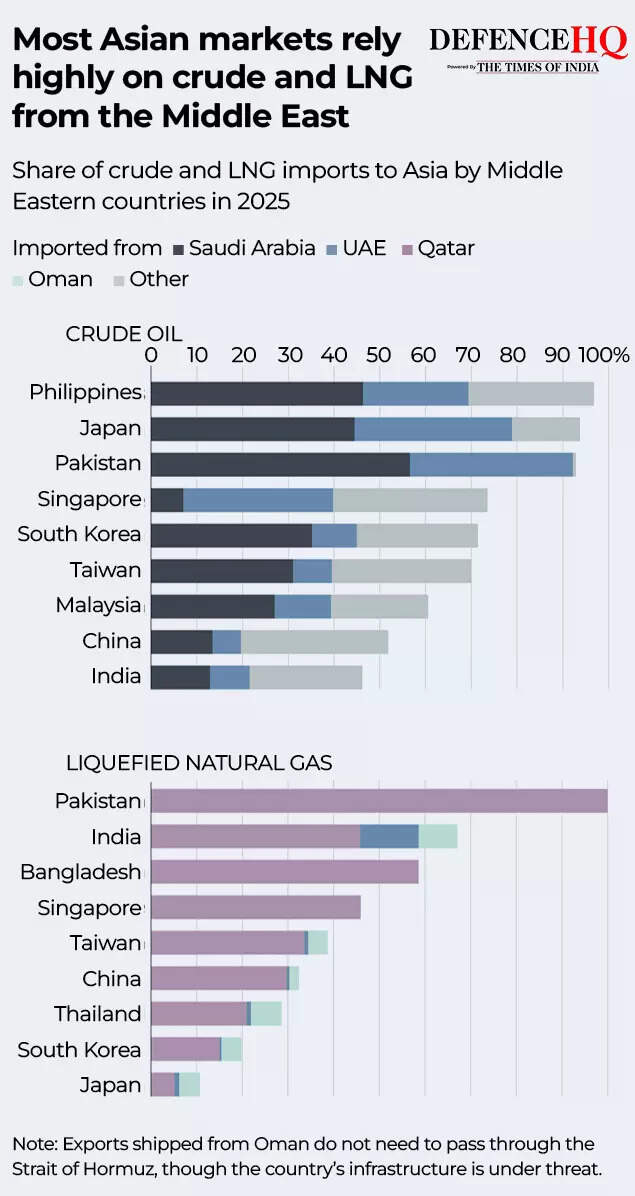
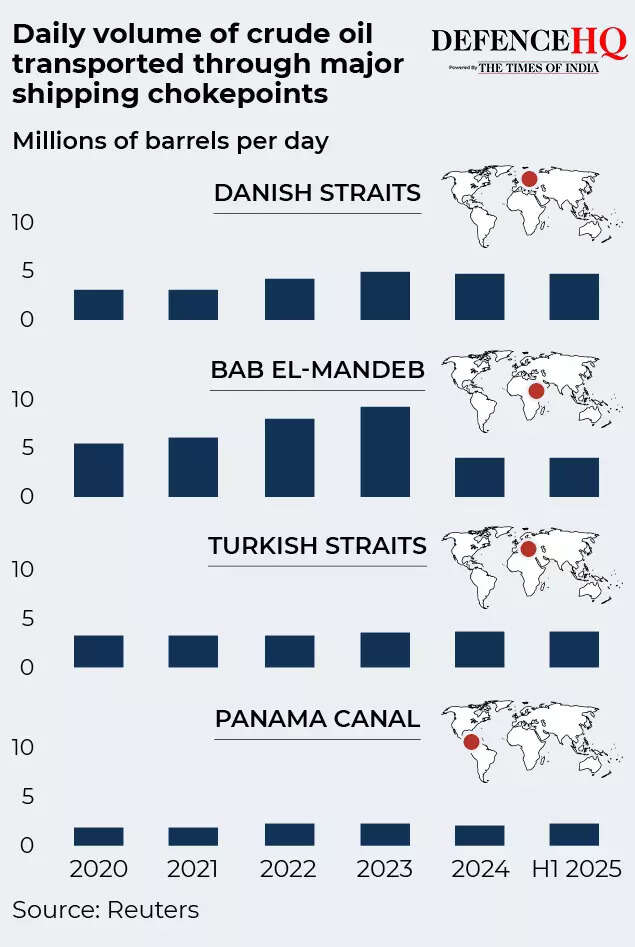
Asian economies are considered the most vulnerable to supply disruptions from the Strait of Hormuz. Many countries across the region rely heavily on imports of crude oil, liquefied natural gas and refined fuel from the Middle East.Only the Strait of Malacca, between Malaysia and Indonesia, sees more tanker traffic than Hormuz. With the Gulf corridor disrupted, governments across Asia are scrambling to manage the impact.

,

China has asked refiners to halt fuel exports to secure domestic supply. South Korea has imposed price caps on fuel for the first time in three decades.Meanwhile, Bangladesh has shut universities temporarily in an effort to conserve electricity and fuel.

Limited alternatives to bypass Hormuz

Some Gulf producers have limited options to bypass the strait using pipelines.Saudi Arabia has been pumping crude through its East-West pipeline to the Red Sea port of Yanbu. The pipeline can transport up to 5 million barrels per day.However, Yanbu has rarely loaded more than 2.5 million barrels per day, limiting its ability to fully replace exports through Hormuz.

,

The United Arab Emirates also operates the Abu Dhabi Crude Oil Pipeline known as the “Habshan-Fujairah pipeline” which can carry about 1.5 million barrels per day from inland oilfields to the port of Fujairah on the Gulf of Oman.While these pipelines provide partial alternatives, they cannot fully replace the massive volumes that normally pass through the strait.Another sign of how messed up the market has become is that buyers are paying more for barrels that can load outside of Hormuz. The Wall Street Journal said that crude oil from Oman has gone up a lot compared to Dubai grades that are stuck on the wrong side of the chokepoint. Tankers are going to Yanbu and Fujairah instead. Petrobras says that Saudi Arabia is still keeping its promises by shipping through the Red Sea route, even though shipping costs have gone up a lot.

,

Rising costs for businesses and consumers

And as experts told Middle East Eye, the real squeeze may be more on refined products than on crude oil. Policymakers can point to crude oil still moving. But the economy as a whole depends on more than just oil prices. It also depends on several other factors.Higher fuel costs are pushing up inflation and increasing the cost of producing and transporting goods. Food prices are also rising as fertiliser and transportation costs climb.Farmers across the Northern Hemisphere, currently preparing for planting season, are facing higher input costs due to the spike in energy prices.Businesses across sectors from aviation to manufacturing are also seeing operating costs rise.

India among the vulnerable economies?

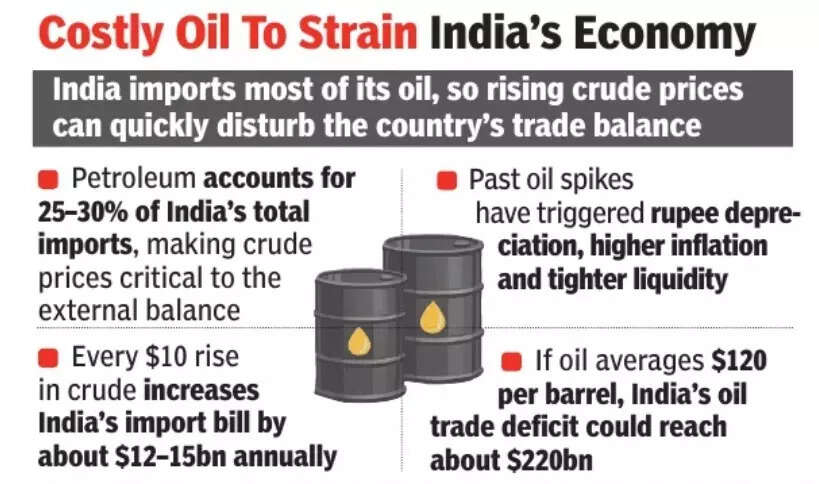
Among major economies, India is considered particularly vulnerable to an oil shock. The country imports nearly 90% of its crude oil and about half of its natural gas needs.More than 40% of India’s crude imports come from the Middle East, the region currently at the centre of the conflict.India’s oil reserves are estimated to cover only about 20 to 25 days of consumption. If high oil prices persist the country could face significant economic pressure. And a prolonged spike in oil prices could affect India’s growth, inflation and government finances.According to Reuters, economists said that an average crude price of $100 per barrel could widen India’s current account deficit to between 1.9% and 2.2% of GDP in the 2026-27 financial year.If oil prices rise to around $120 per barrel, the current account deficit could expand to roughly 3.1% of GDP.

,

Higher import costs have already pushed the rupee to record lows, forcing the central bank to sell dollars from its reserves to stabilise the currency.High oil prices could also increase government spending significantly. According to estimates by Mumbai-based Elara Securities, federal expenditure could rise by around 3.6 trillion rupees ($39 billion) next year if oil prices average $100 per barrel.India is targeting a fiscal deficit of 4.3% of GDP for the 2026-27 financial year. Maintaining that target while absorbing higher energy costs could force the government to cut spending in other areas such as infrastructure investment.

,

India’s economy is expected to grow more than 7% in the coming financial year. However, if oil prices remain close to $100 per barrel throughout the year, growth could slow to about 6.6% while inflation could rise to around 4.1% , according to a report by State Bank of India.

Energy supply chains under strain

Even if the conflict ends soon, restoring normal operations across the region’s energy infrastructure will take time. Damaged refineries will need repairs before they can resume full output, while other facilities may take weeks to restart.For instance, QatarEnergy’s LNG facilities could take several weeks to ramp up after a complete shutdown. Oilfields that have scaled back production will also require time to stabilise, and in some cases a loss of reservoir pressure could lead to a lasting drop in output.For now, global markets remain on edge as shipping firms, oil producers and governments closely monitor the situation for any signs that traffic through the strategic corridor could resume. Until then, the disruption risks keeping energy prices high and adding further strain to economies worldwide.



Source link

Big shift in India’s job market! Why fixed term employment is the new normal and what it means for employees


Big shift in India’s job market! Why fixed term employment is the new normal and what it means for employees
Fixed term employment is steadily emerging as a mainstream form of hiring. (AI image)

India’s world of work is changing. Businesses today operate in an environment marked by rapid technological shifts, evolving geopolitical dynamics, seasonal demand cycles, project‑based work and intense global competition. Geopolitical realignments, supply‑chain reconfiguration and cross‑border regulatory developments are influencing how organisations plan operations and deploy talent. At the same time, employees are increasingly open to diverse career paths that may include short‑term assignments, project roles or specialised engagements.Against this backdrop, fixed term employment (FTE) is steadily emerging as a mainstream form of hiring. Far from being an exception, it is now formally recognised and regulated under India’s new labour codes, particularly the Industrial Relations Code, 2020 and the Code on Social Security, 2020. Rather than creating a new concept, the labour codes acknowledge a reality that already exists in many sectors — and bring it within a clearer, more transparent legal framework.

What is fixed term employment?

In simple terms, fixed term employment means hiring an employee directly on the employer’s payroll for a clearly defined period, backed by a written contract. The contract specifies the start date and the end date, and the employment comes to an end automatically once the term expires.For example, a company may hire a software tester for a 12-month product implementation project, or a manufacturing unit may recruit additional technicians for a six-month peak production cycle. Once the period ends, the contract concludes by design.The labour codes formally define and recognise such arrangements, removing ambiguity around their legality.

Why fixed term employment matters in today’s economy?

India’s economy increasingly relies on time-bound projects and specialised skills. Infrastructure projects, digital transformation initiatives, expansion into new markets, compliance-led programmes and seasonal business spikes all require manpower for defined durations.Earlier, organisations often relied on contractor arrangements to meet these needs. The labour codes take a different approach – they encourage direct employment, even if the engagement is for a limited period.This shift supports a more formal labour market while allowing businesses to remain agile.

Understanding Fixed Term Employment

Equal treatment under the labour codes

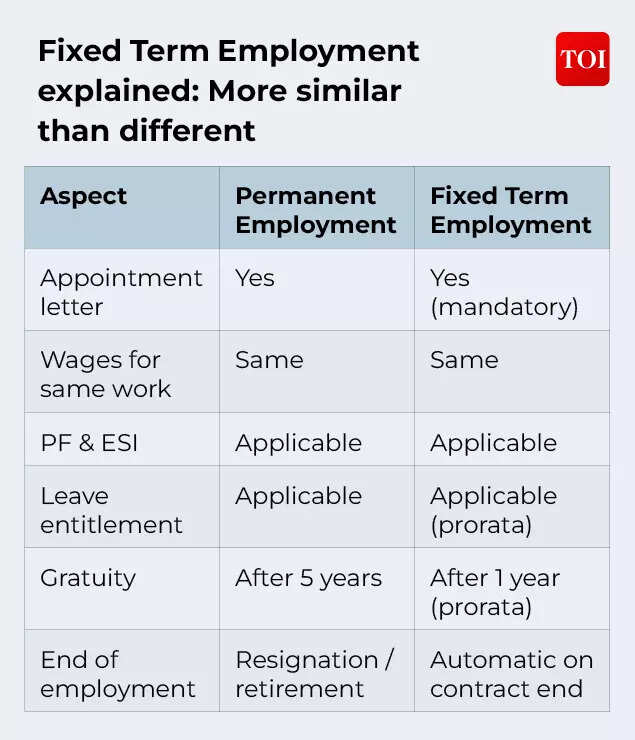
One of the most important features of fixed term employment under the labour codes is parity of treatment. A fixed term employee is entitled to the same wages, working hours, allowances and statutory benefits as a permanent employee performing similar work. The only difference lies in the duration of the employment, not in the quality of protection.This means that a fixed term employee cannot be paid less simply because the contract is time-bound. Provident fund, ESI (where applicable), leave entitlements and other statutory benefits apply in the same manner, calculated proportionately. Consider a technology services company undertaking a time‑bound enterprise system migration for a large client, such as moving legacy applications to a cloud‑based platform. To support this programme, the company hires experienced project managers and solution leads on a nine‑month fixed‑term basis. These professionals are issued formal appointment letters clearly setting out the fixed duration of employment. During the contract period, they are paid wages and benefits comparable to permanent employees performing similar roles and are covered under applicable social security provisions, including provident fund. Once the migration project is completed and the systems are stabilised, the employment comes to an end automatically in line with the contract terms. This arrangement allows the organisation to access specialised capabilities for a defined period while providing employees with clarity, parity and statutory protection.

Gratuity and social security: A notable change

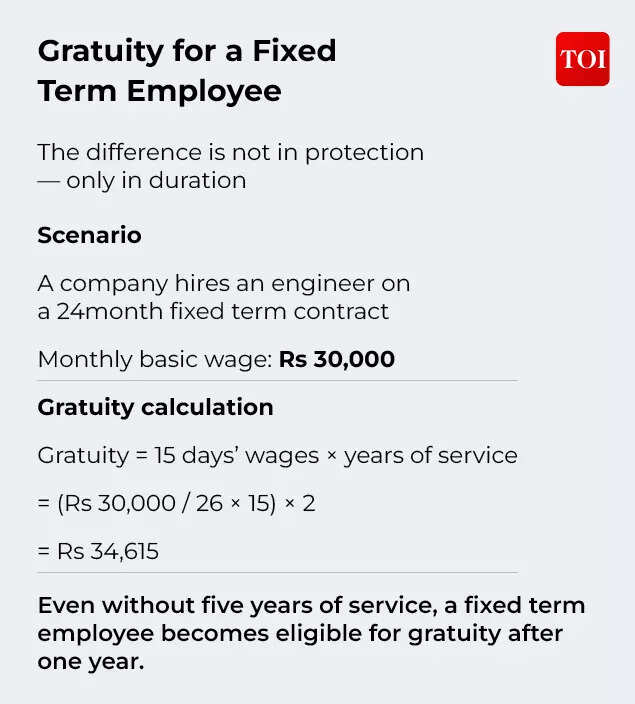
A significant reform under the Code on Social Security, 2020 relates to gratuity eligibility for fixed term employees.Traditionally, gratuity required five years of continuous service. Under the labour codes, fixed term employees become eligible for gratuity on a pro-rata basis after completing one year of service.This is particularly relevant for project-based roles that may last one to three years and were earlier outside the gratuity framework.For instance, an engineer hired on a two-year fixed term contract for a renewable energy project would now be eligible for gratuity at the end of the contract, proportionate to the period worked.

Gratuity for a Fixed Term Employee

Predictability for employers, transparency for employees

Fixed term employment introduces predictability into workforce planning. Employers know the duration of engagement upfront, while employees have clarity on tenure, compensation and benefits from day one.Importantly, the end of a fixed term contract does not amount to retrenchment under the Industrial Relations Code, as the employment ends by the “efflux of time” specified in the contract.This legal clarity reduces disputes and allows organisations to plan staffing needs more efficiently, especially in sectors affected by demand cycles.

Where fixed term employment is commonly used

Fixed‑term employment is prevalent across a wide range of sectors in India, including information technology and digital services, manufacturing and engineering, e‑commerce and logistics, infrastructure and construction, hospitality and tourism, as well as research, consulting and project‑based roles. These arrangements are commonly used to meet time‑bound business requirements, manage demand variability, or access specialised skills for defined periods. Importantly, the labour codes do not restrict fixed‑term employment to specific industries, allowing organisations across the economy to use this model as a flexible and compliant workforce option.Fixed term employment is not contract labour – It is important to distinguish fixed term employment from contract labour.A fixed term employee is directly employed by the organisation and works under its supervision and control. This is different from contract labour, where workers are engaged through a contractor.By encouraging fixed term hiring on the principal employer’s rolls, the labour codes promote greater accountability and reduce dependence on multi-layered contracting structures.

What it means for employees and employers

For employees, fixed‑term employment provides access to formal employment arrangements with full statutory benefits, along with opportunities to work on high‑impact assignments and well‑defined projects. It enables greater mobility across roles, organisations and industries, while offering clarity through transparent contractual terms and a clearly defined tenure. Many professionals today increasingly view fixed‑term roles as a practical way to build specialised skills, gain exposure to different sectors, or contribute to large and meaningful projects, without necessarily committing to long‑term employment.For employers, it enables workforce flexibility that can be aligned closely with business cycles, project timelines and evolving operational needs. It provides a compliance‑backed framework for short‑term hiring, allowing organisations to plan manpower requirements with greater certainty and discipline, rather than relying on informal or ad‑hoc arrangements. Fixed‑term roles also support better cost planning while reducing legal ambiguity around tenure‑based positions, as the duration and terms of employment are contractually defined from the outset. As organisations revisit compensation structures and workforce strategies in the context of the labour codes, fixed‑term employment is increasingly being viewed as a legitimate and deliberate workforce design choice, rather than an exception to standard employment models.

A gradual but steady shift

The labour codes do not mandate the use of fixed term employment. Instead, they create an enabling framework where such arrangements can be used responsibly and transparently.Over time, as state rules are finalised and organisations align their HR practices, fixed term employment is likely to coexist alongside permanent roles, each serving different business needs.Rather than replacing permanent employment, fixed term roles complement it — particularly in a fast-changing economy where not all work fits a one-size-fits-all model.Fixed term employment reflects a broader shift in India’s labour landscape: from informality to formalisation, from ambiguity to clarity, and from rigid structures to balanced flexibility.By recognising and regulating fixed term employment, the labour codes acknowledge modern work realities while ensuring statutory protections remain intact. As businesses and professionals adapt to this framework, fixed term employment is steadily becoming part of the new normal — structured, transparent and aligned with India’s evolving economy.(Puneet Gupta is Partner, People Advisory Services Tax at EY India)


Source link

US stocks tumble at open as oil prices touched $100 per barrel amid Iran conflict


US stocks tumble at open as oil prices touched $100 per barrel amid Iran conflict

US stock markets opened sharply lower on Thursday as surging oil prices and uncertainty stemming from the ongoing conflict involving the US, Israel and Iran weighed on investor sentiment.Shortly after opening bell, the Dow Jones Industrial Average fell 1.1 per cent to 46,879.09. The broader S&P 500 declined 1.0 per cent to 6,706.10, while the tech-heavy Nasdaq Composite dropped 1.3 per cent to 22,426.80.Energy markets remained volatile as crude prices surged amid fears of supply disruptions in the Middle East. Oil briefly crossed the $100 per barrel mark earlier in the day before retreating slightly by the time US trading began.International benchmark Brent crude rose 7.9 per cent to $99.23 per barrel, while West Texas Intermediate (WTI) gained 8.1 per cent to $94.33 per barrel.Market analysts said investors were increasingly worried about the economic implications of the escalating conflict.“Oil prices and also the uncertainty with respect to when the war will end” is weighing on markets, Adam Sarhan of 50 Park Investments told AFP.“The reality is that right now based on the facts that we know so far, there’s no end in sight and that’s the problem for investors,” he added.Energy markets have been under pressure since the US and Israel launched military operations against Iran on February 28.The crisis intensified after shipping through the Strait of Hormuz, a critical route that carries roughly one-fifth of the world’s energy supplies, face blockages, with the passage reportedly close to being blocked. Iran has also warned ships attempting to pass through the waterway.The conflict has intensified risks to energy infrastructure across the region. Iran has targeted oil facilities in key Middle Eastern producing countries, while US and Israeli strikes have focused on Iranian energy installations, heightening fears of prolonged disruptions to global oil supplies.


Source link