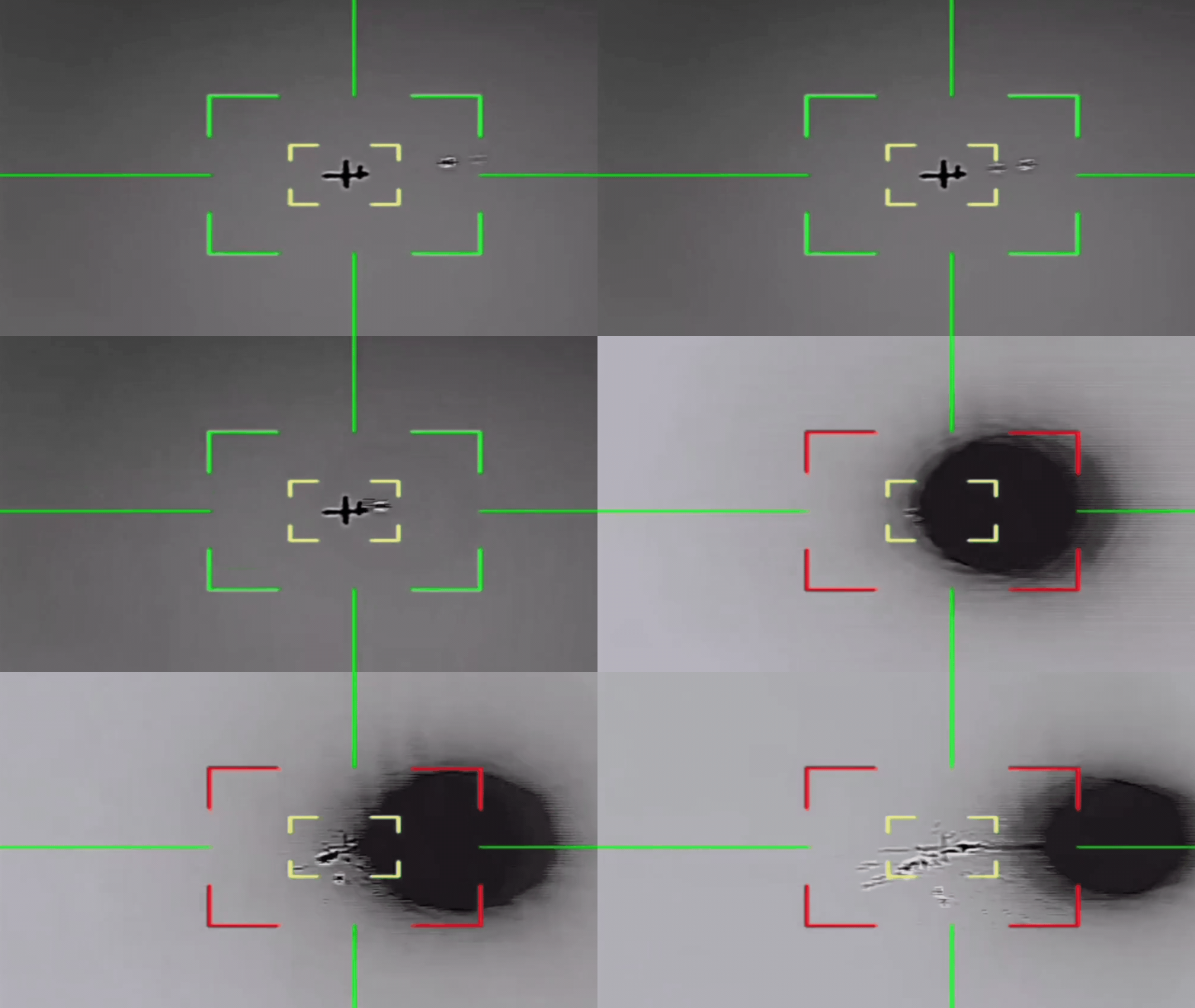
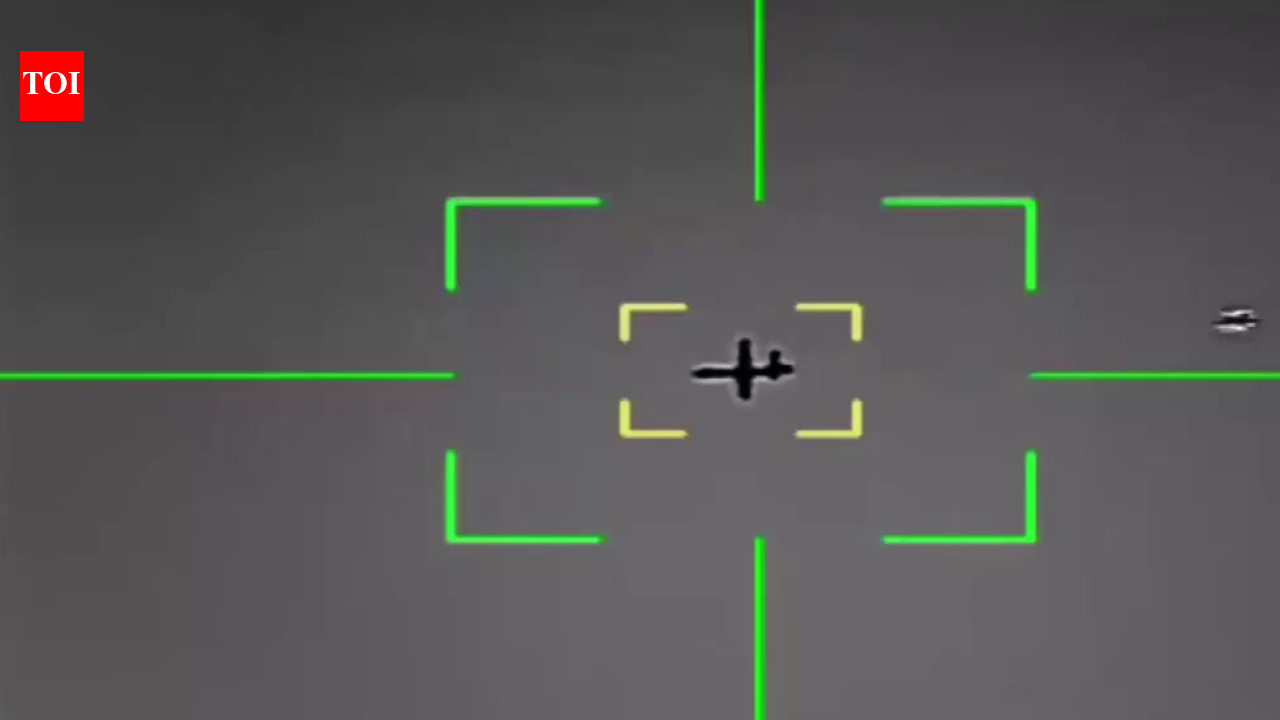
Iran claims it shot down two US MQ-9 drones – shares video
Here are top 5 stories of the day
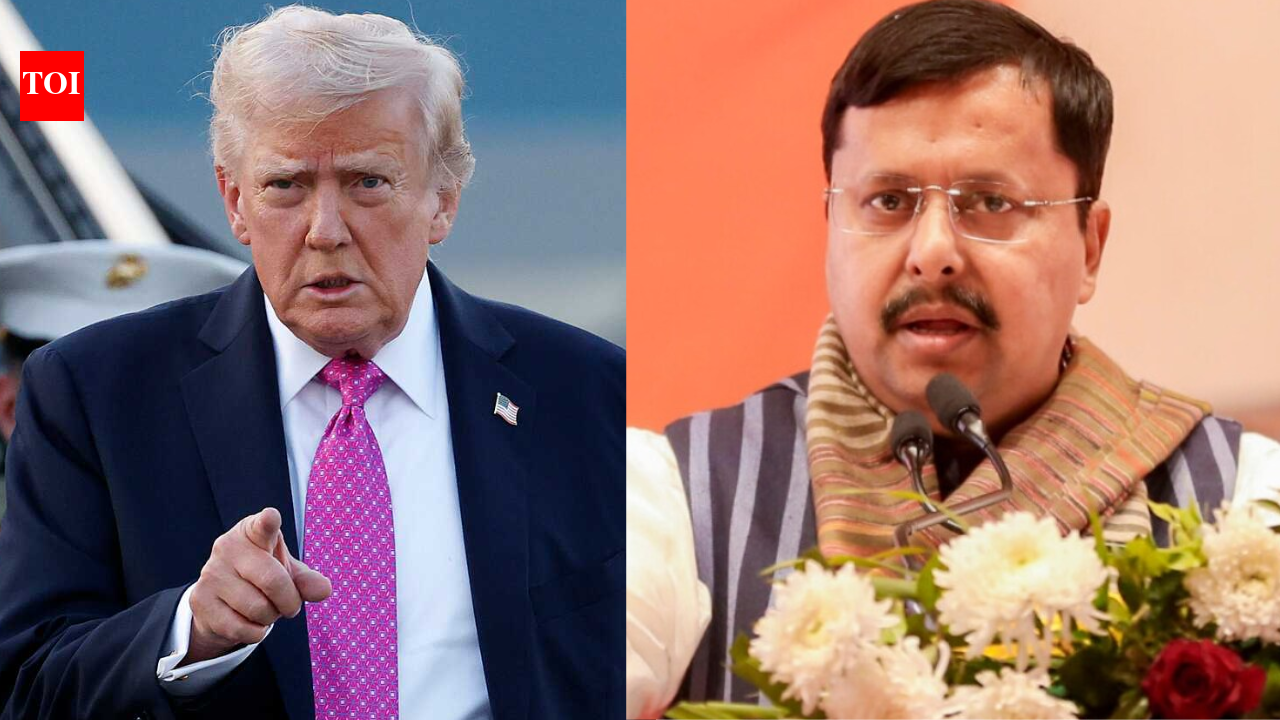
Donald Trump said countries facing jet fuel shortages because of disruptions near the Strait of Hormuz should buy fuel from the US and do more to secure their own energy supplies. In a Truth Social post, he criticized allies such as the UK for not supporting military action against Iran and said they should no longer rely on the US for protection. Read full story
The BJP released its manifesto for the Kerala Assembly elections, promising a mix of welfare schemes, infrastructure development and temple-focused measures. The manifesto included a Rs 3,000 monthly pension for needy women, widows and senior citizens above 70, along with 20,000 litres of free water per month for every household in Kerala. Read full story
IndiGo announced the appointment of former British Airways chief Willie Walsh as its new chief executive officer, following the resignation of Pieter Elbers earlier this month. The move comes months after the airline grappled with a significant operational crisis in December. Read full story
Pakistan’s opening stalwart Fakhar Zaman has been suspended for two matches over the PSL ‘ball-tampering’ controversy, following an incident during a tense finish between Karachi Kings and Lahore Qalandars. The controversy erupted at the end of the 19th over in the second innings, with Karachi requiring 14 runs from the last over before sealing victory with three balls remaining. Read full story
A techie couple from Telangana died within minutes of each other at an apartment complex in Bengaluru. Bhanu Chander Reddy Kunta was found dead inside a locked room in the couple’s flat after his wife, Shaziya, raised an alarm when he did not respond. Minutes later, Shaziya allegedly jumped from the 17th floor of the building. Read full story
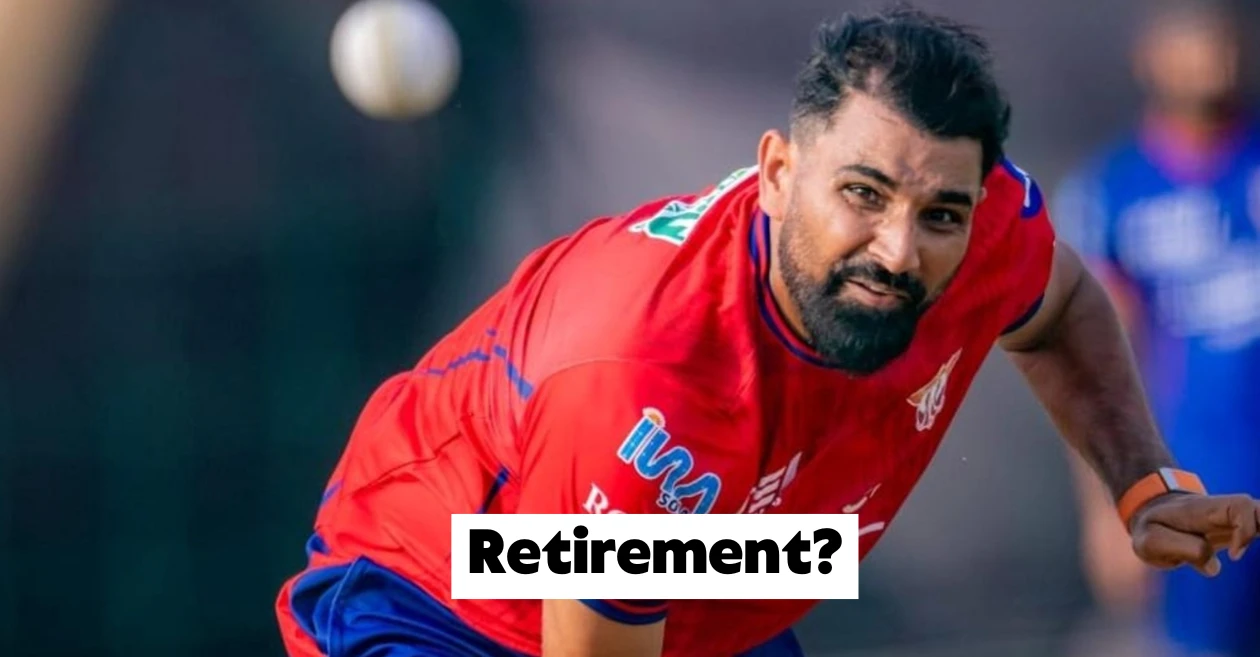
Veteran Indian fast bowler Mohammad Shami has firmly dismissed growing retirement rumours, stating he remains motivated and far from calling time on his career. Speaking ahead of his new franchise’s first match in the Indian Premier League (IPL) 2026, Shami emphasized that thoughts of retirement have not crossed his mind.
Interacting with Shubhankar Mishra on his Youtube channel, Shami said that retirement is something he associates with boredom or fatigue – neither of which he currently feels. According to him, as long as he enjoys the game and delivers results, stepping away is not an option. His remarks come amid increasing speculation due to his absence from the national team since March 2025.
Shami last represented India during the final of the ICC Champions Trophy 2025. Since then, despite consistent domestic performances, he has remained out of the selectors’ plans, sparking debates among fans and experts.
“When I get tired, I will call it a day. But I am not even thinking of retirement right now because such thoughts pull you down. If this thought crosses your mind, it means you’re already tired. And if you’re tired, it means you’re bored. And I have said this earlier, too. I’ll leave cricket the day I wake up and decide to get bored. So yeah, the day I feel lazy or get bored, I’ll leave. But neither am I bored nor am I lazy. I am enjoying. Results are good and positive,” Shami said on The Shubhankar Mishra Show.
The continued exclusion of Shami from the Indian squad has raised eyebrows, especially considering his stellar domestic record. During the 2025-26 season, the experienced pacer picked up an impressive 67 wickets across formats, reinforcing his reputation as one of India’s most reliable seamers.
However, the Board of Control for Cricket in India (BCCI) selectors appear to be focusing on grooming younger fast bowlers. This shift has led to a perception that the management is gradually moving on from senior players like Shami.
Shami himself has expressed disappointment over the lack of communication from selectors. He revealed that clarity regarding his position in the team has been missing, leaving him uncertain despite maintaining strong form.
Adding to the complexity, Shami had opted out of major tours, including the Australia and England series, citing incomplete recovery from a foot injury. While these decisions were made to ensure long-term fitness, they may have inadvertently impacted his selection chances.
In IPL 2026, Shami is all set to represent Lucknow Super Giants (LSG), hoping to turn a new page in his T20 career. After an ordinary stint with Sunrisers Hyderabad (SRH) in IPL 2025 – where he managed just six wickets in nine matches – the right-arm pacer is eager to prove his worth once again.
Shami acknowledged that while luck plays a role in cricket, his primary focus remains on effort, discipline, and attitude. He stressed that he is committed to giving his best for Lucknow and meeting the expectations placed on him by the franchise.
Also READ: IPL 2026 – Ravindra Jadeja reveals why he hasn’t spoken to MS Dhoni since leaving CSK
The move to LSG offers him a renewed platform to showcase his abilities in a high-pressure environment. With IPL being a crucial stage for players eyeing a national comeback, a strong performance could potentially reignite his international career.
Despite uncertainties surrounding his international future, Shami remains grounded and focused on his game. He highlighted that personal satisfaction and maintaining rhythm are more important than dwelling on past achievements or selection setbacks.
Rather than counting the number of matches played in domestic cricket, Shami emphasized the importance of staying in rhythm and maintaining peak performance levels. According to him, once that rhythm is achieved, thoughts about the future naturally follow.
“As a bowler, I will give my 100 per cent. I’ll perform my responsibilities and try to meet the expectations set for me. Rest, I can’t change my luck. All I can contribute is with my attitude and determination. If Lucknow has trusted me, I will give my all. Still, whenever you’re playing, the main element is satisfaction. Will I get the returns based on all the preparations that I have gone through? I did not focus on how much domestic I’ve played, but on the fact that my rhythm is alright. If that’s the point, I start thinking about the future,” added Shami.
Also READ: IPL 2026 – Ravindra Jadeja gets emotional against his former franchise CSK; video goes viral
Asia is likely to face the worst impact of the ongoing Iran war and the resulting energy disruptions, with supply gaps emerging across key economies, global maritime analytics firm Kpler has warned, as reported AFP.“We think Asia will, for now, be the ones suffering the most,” Kpler president Jean Maynier told AFP in an interview at the company’s Singapore office.
He said the region lacks sufficient domestic energy resources to offset supply disruptions caused by restricted flows through the Strait of Hormuz.“It will not be enough in China, it will not be enough to cover in big countries like the Philippines or Indonesia. So it’s a real energy crisis,” Maynier said.The disruption has already begun to show visible effects. Maynier pointed to the Philippines, where authorities have declared a national energy emergency amid tightening supplies.“It’s really bad for Asia and we are not optimistic if the event continues,” he said, adding, “We hope at some point that politicians will find a solution.”Kpler, a Brussels-based firm founded in 2014 that owns the MarineTraffic platform, tracks global commodity flows and shipping activity.Data from the firm shows a sharp decline in vessel movement through the Strait of Hormuz since the conflict escalated following US-Israel strikes on Iran on February 28.While 17 commodities vessels crossed the strait over the weekend — including 12 on Saturday — overall traffic remains significantly lower. As of 1700 GMT on Monday, only 196 commodities vessels had crossed the route this month, far below pre-war levels.Of these, 120 were oil tankers and gas carriers, with most shipments moving eastward out of the strait.The Strait of Hormuz is a critical artery for global energy trade, and continued disruption is expected to intensify supply constraints and price pressures, particularly for energy-import dependent Asian economies.
NEW DELHI: The Board of Control for Cricket in India (BCCI) on Tuesday issued a statement after the death of British broadcast engineer Ian Williams Langford, who was working on IPL 2026 matches in Mumbai.Langford, 76, was found unconscious in his hotel room in south Mumbai on Monday morning and was taken to Bombay Hospital, where he was declared dead. Police said no suspicious findings were reported in the postmortem, and a case of unnatural death has been registered.Responding to the incident, the BCCI said: “The IPL Governing Council and all stakeholders involved express their deepest condolences on the untimely demise of Ian Williams Langford, a dedicated broadcast engineer, who was an integral part of our broadcast operations. Our thoughts and prayers are with his family and friends back home.”The board also said it would extend support to his family. “The IPL is committed to providing all necessary support and assistance to Langford’s family during this incredibly difficult time.”It added that safety remains a priority. “The health, safety and overall security of every member involved in the smooth functioning of the IPL continues to remain of utmost importance.”Further enquiries into the case are ongoing.Langford was on a work assignment as a broadcast engineer for BCCI/IPL matches.
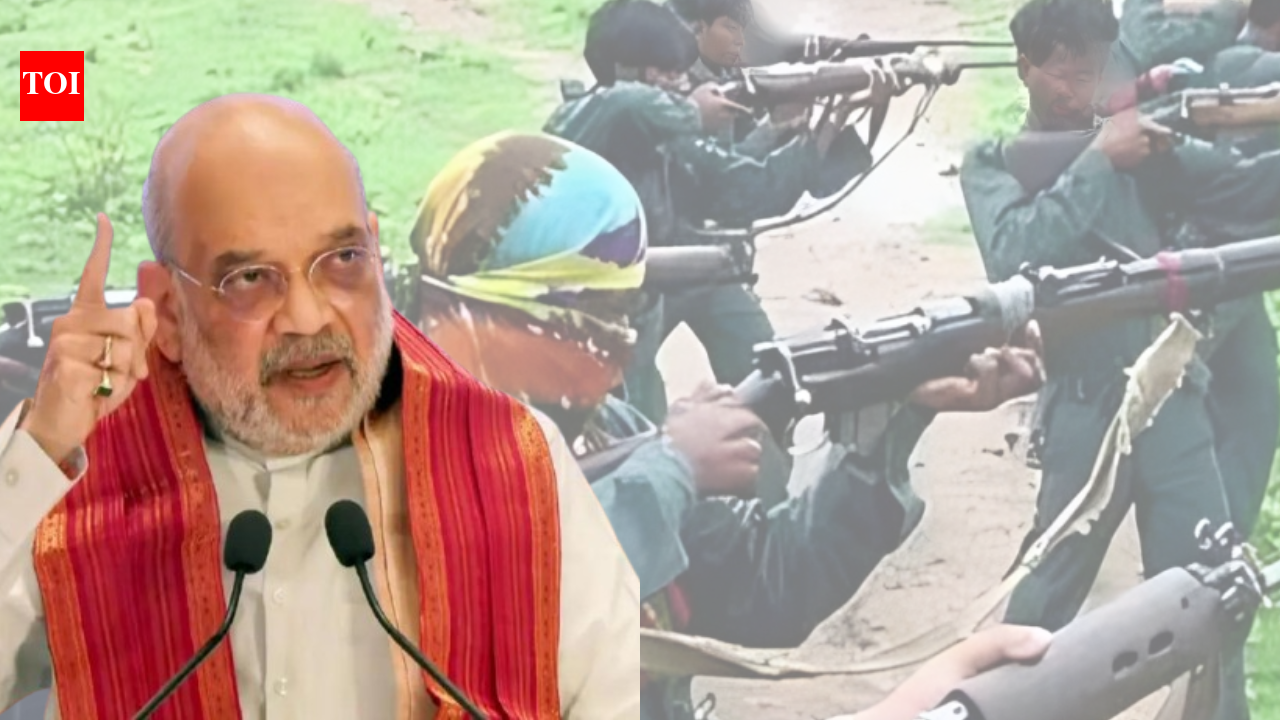
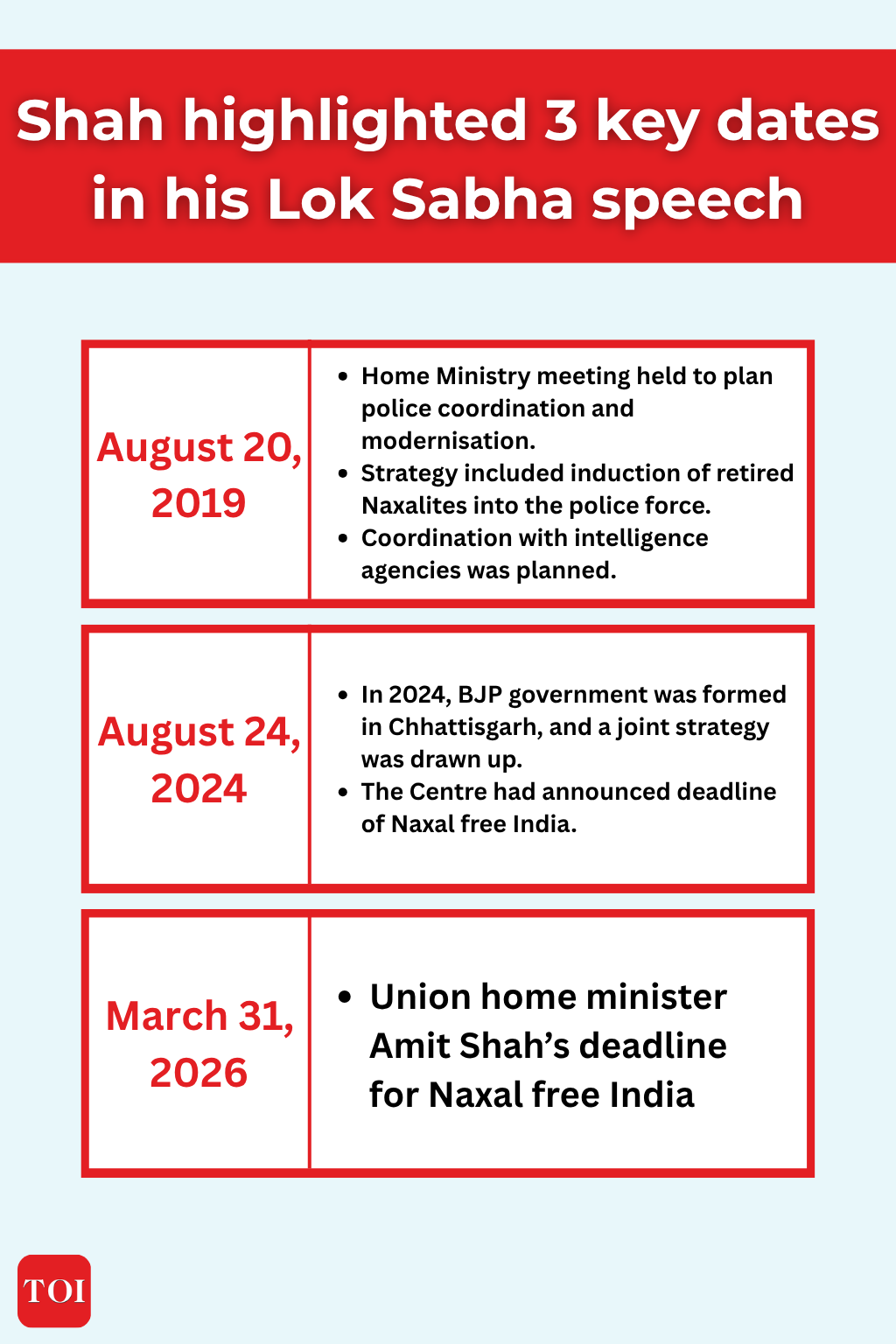
As the sun sets over the dense canopies of Chhattisgarh’s forests today, it marks more than just the end of a day, it signals the final countdown to a historic deadline. Union home minister Amit Shah’s March 31, 2026 target was never just a date on paper, rather it was a security benchmark, and a message both to Naxalites and the nation. That deadline ends today, and with it comes the question ringing louder than ever: is India now closer than at any point in decades to ending Naxalism?Shah’s deadline is not just about counting encounters rather a signal that the endgame may finally be near.Speaking in the Lok Sabha on Monday, the home minister said India’s anti-Naxal campaign had entered its final phase, claiming Naxalism had been almost wiped out in Bastar, the region once seen as the heartland of “Red Terror”. He said that the area is now seeing roads, schools, ration shops, health centres and welfare delivery. The claim marks a dramatic shift for a region that once symbolised the peak of Naxalist influence. But how did Bastar, and much of central India, become part of the Red Corridor in the first place?
.
The Red Corridor did not appear on India’s map overnight. Its story began in 1967, in Naxalbari, West Bengal, where a peasant uprising gave birth to what India would later know as Naxalism.However, what started as a local rebellion did not stay local for long.Slowly, the movement spread into some of India’s most remote, underdeveloped and tribal-dominated regions. Over the years, it stretched across parts of Chhattisgarh, Jharkhand, Odisha, Maharashtra, Madhya Pradesh, Andhra Pradesh, Telangana, and pockets of Kerala and Karnataka. Piece by piece, this expanding belt of unrest came to be known as the “Red Corridor.”But this was never just a movement of slogans and rebellion. It soon turned into a violent armed challenge to the Indian state. Naxalist groups built parallel systems of control in remote areas, attacked security forces, blew up roads and public infrastructure, extorted money, and in many cases forced civilians, even children, into their network.Reference link: https://www.pib.gov.in/PressReleasePage.aspx?PRID=2120771®=3&lang=2At its peak, Naxalist violence affected 126 districts and reached deep forest regions where the state’s presence was weak.However, that is no longer the case.
.
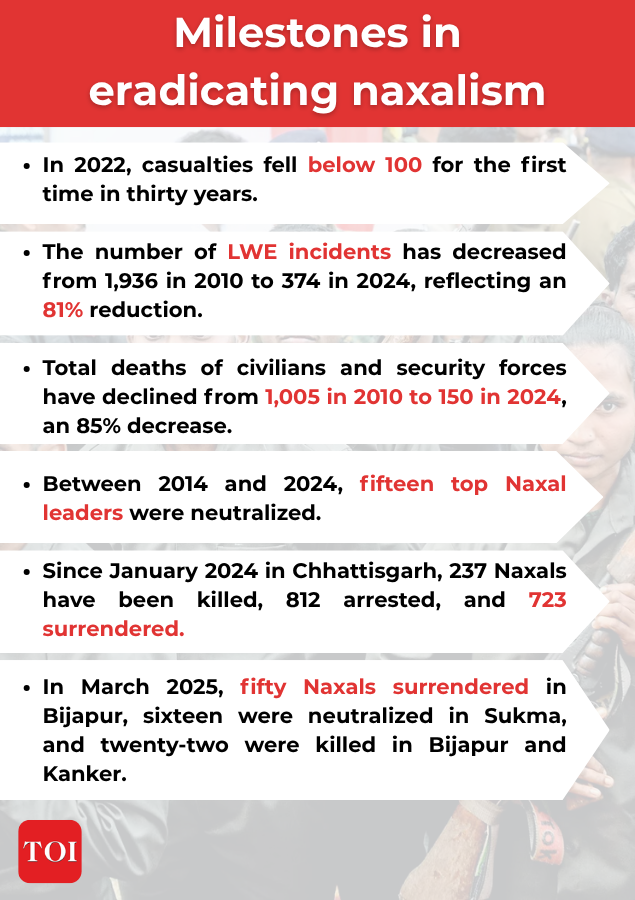
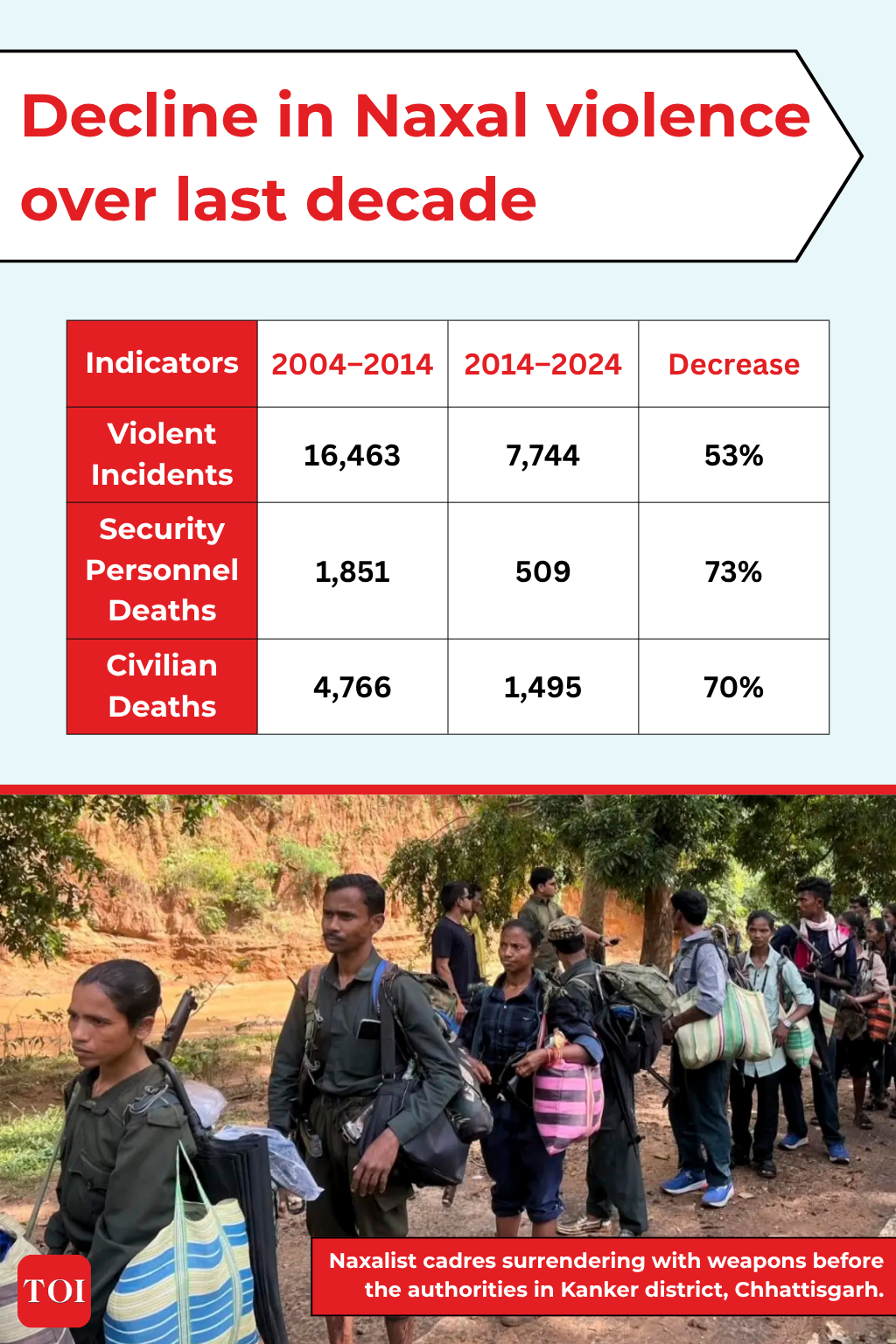
More districts leave the corridor The naxalite moment that once stretched through states, is now looking far smaller. According to government data, the number of LWE-affected districts has steadily fallen from 126 to 90 in April 2018, then to 70 in July 2021, and further to just 38 by April 2024. Furthermore, even within those 38 districts, the number of worst-hit districts has been cut from 12 to 6, now limited to Bijapur, Kanker, Narayanpur and Sukma in Chhattisgarh, West Singhbhum in Jharkhand, and Gadchiroli in Maharashtra. The message is hard to miss: the once-sprawling Red Corridor is no longer quite the corridor it used to be.Look a little closer and the picture gets even sharper. Among the 38 affected districts, the number of “districts of concern,” areas that still need intensive resources beyond the worst-hit zones, has also come down from 9 to 6. These are Alluri Sitarama Raju in Andhra Pradesh, Balaghat in Madhya Pradesh, Kalahandi, Kandhamal and Malkangiri in Odisha, and Bhadradri-Kothagudem in Telangana. The category of other LWE-affected districts has thinned out too, falling from 17 to 6. These include Dantewada, Gariaband and Mohla-Manpur-Ambagarh Chowki in Chhattisgarh, Latehar in Jharkhand, Nuapada in Odisha, and Mulugu in Telangana. In short, the insurgency has not just been reduced in scale, it has been pushed into a narrower, more fragmented geography. MHA data puts this more clearly: Naxal active territory has shrunk from over 18,000 sq km in 2014 to around 4,200 sq km by 2024, and by 2025 it was reduced further to just a few hundred square kilometres. What was once a wide corridor is now down to a few dense forest holdouts.The insurgency is not just losing ground but also people The numbers inside the movement tell just as striking a story. Government data shows that over the past decade, as security operations were backed by roads, welfare and a stronger state presence, the insurgency has steadily weakened. Between 2004–2014 and 2014–2024, violent incidents nearly halved from 16,463 to 7,744. Over the same period, deaths of security personnel fell from 1,851 to 509, while civilian deaths dropped from 4,766 to 1,495.
.
And the trend continued in 2025, when security forces killed 270 Naxals, arrested 680, and saw 1,225 cadres surrender. Add to that major operations like Operation Black Forest, along with mass surrenders in Bijapur, Chhattisgarh and Maharashtra, and the pattern becomes clear: the Maoist movement is not just losing territory, it is also losing fighters. In fact, more than 8,000 Naxalites have abandoned violence in the last 10 years, reinforcing the government’s claim that the insurgency is no longer spreading outward, but steadily being squeezed into its final pockets.Reference link: https://www.pib.gov.in/PressReleasePage.aspx?PRID=2182437®=3&lang=2https://www.pib.gov.in/PressReleasePage.aspx?PRID=2120771®=3&lang=2
The March 31 deadline is the government’s attempt to draw a final line under one of India’s longest-running internal security threats. Because Naxalism was never just about gunfights in the jungle. Over the years, Maoist groups targeted security forces, roads, telecom towers, public infrastructure and democratic institutions. They used violence, extortion, coercion and recruitment in tribal belts, turning many remote regions into places where the state itself struggled to function.And that is the key point.In areas like Bastar, the fight was not only over territory, it was over whether roads could be built, schools could open, health services could reach, and banking and communication could work. In Parliament, Shah argued, “Red terror was not there because there was no development; rather, development could not happen there because of red terror.” Stressing his point, the minister compared Naxalbari, Bastar, Saharsa and Ballia. All four, he said, had similarly low literacy and income levels in earlier decades. Yet Naxalism took root only in Naxalbari and Bastar, not in Saharsa or Ballia. His message? “Red Terror was not there because there was no development; rather, development could not happen there because of Red Terror.”And the damage, he said, was brutal. Shah pointed to Naxalites hanging innocent villagers after branding them “enemy informers”, staging sham “People’s Courts” with no judge, no lawyer, no due process, and trying to replace the Constitution and justice system with fear and parallel rule. So, in simple terms, March 31 matters because it is more than a security deadline but a point where India ends not just the armed rebellion, but the decades-long Naxal grip over neglected tribal regions, and takes a step towards replacing it with governance, law and development.
As India marks a crucial milestone in its battle against Left Wing Extremism, years of planning, operations, and development are beginning to show results. Once stretching across 12 states and parts of Uttar Pradesh, the “Red Corridor” has shrunk dramatically. The government’s zero-tolerance approach against Naxalism combines security operations, welfare schemes, and community engagement to restore lives and livelihoods in affected areas. In Parliament, Shah highlighted a strategy of dialogue with those willing to negotiate, while taking firm action against those attacking civilians and security forces. Alongside, advanced technology, including drones, satellites, AI analysis, and social media monitoring, has strengthened coordination and helped reclaim territories long under fear.
The government has adopted a firm zero-tolerance stance against Naxalism, combining security operations with development initiatives to reclaim affected areas. The strategy focuses on two key objectives: restoring the rule of law and rapidly compensating for decades of developmental neglect. Full implementation of welfare schemes ensures that benefits reach regions long deprived due to insurgency.
The National Policy and Action Plan on LWE, approved in 2015, outlines a multi-layered approach that combines security measures, development interventions, and protection of local rights. Central authorities support states with armed police forces, India Reserve battalions, intelligence sharing, counter-insurgency training, and inter-state coordination, delivering a unified response to the LWE threat.
Security infrastructure has been drastically improved. 612 fortified police stations have been built, up from 66 in 2014, alongside 302 new security camps, 68 night landing helipads, 15 Joint Task Forces, and six CRPF battalions to support state police. The National Investigation Agency and Enforcement Directorate have targeted Naxal finances, seizing crores of rupees and prosecuting funders. Long-duration operations and targeted strikes have led to thousands of arrests, surrenders, and neutralisations of top cadres.
.
Development has become a key weapon against extremism. Schemes such as Special Central Assistance, Special Infrastructure Scheme, and the Dharti Aaba Janjatiya Gram Utkarsh Abhiyan focus on roads, mobile connectivity, financial inclusion, and public infrastructure. Over 17,500 km of roads have been sanctioned, 10,505 mobile towers planned, and more than 1,000 bank branches, 937 ATMs, and 5,700 post offices set up. Skill development initiatives, including ITIs, Skill Development Centres, and 178 Eklavya Model Residential Schools, empower youth and provide alternatives to insurgency.
The government has strengthened trust with communities through Civic Action Programmes and media campaigns countering Naxalist agenda. Tribal youth exchanges, radio jingles, documentaries, and pamphlets ensure awareness, engagement, and support for democratic governance.
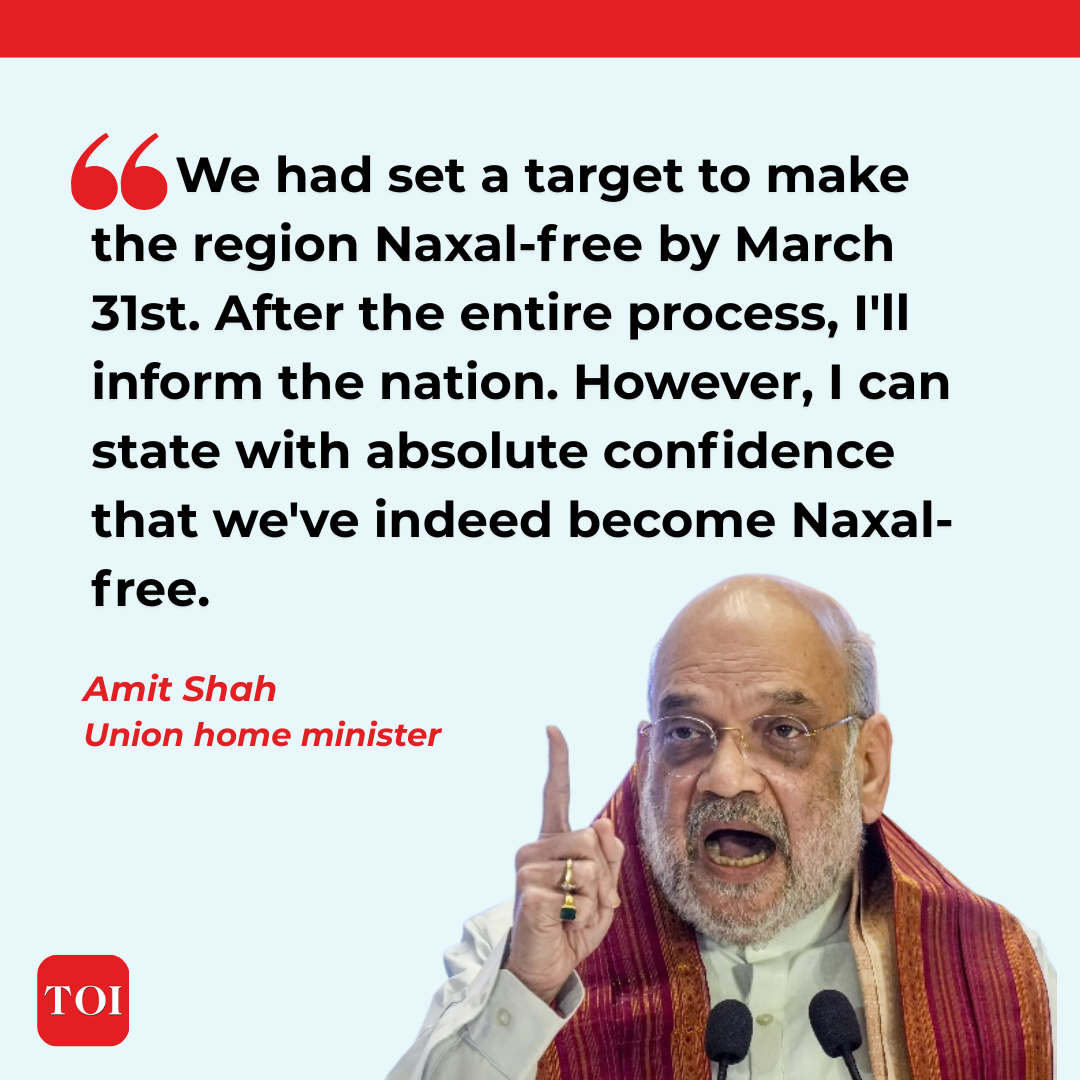
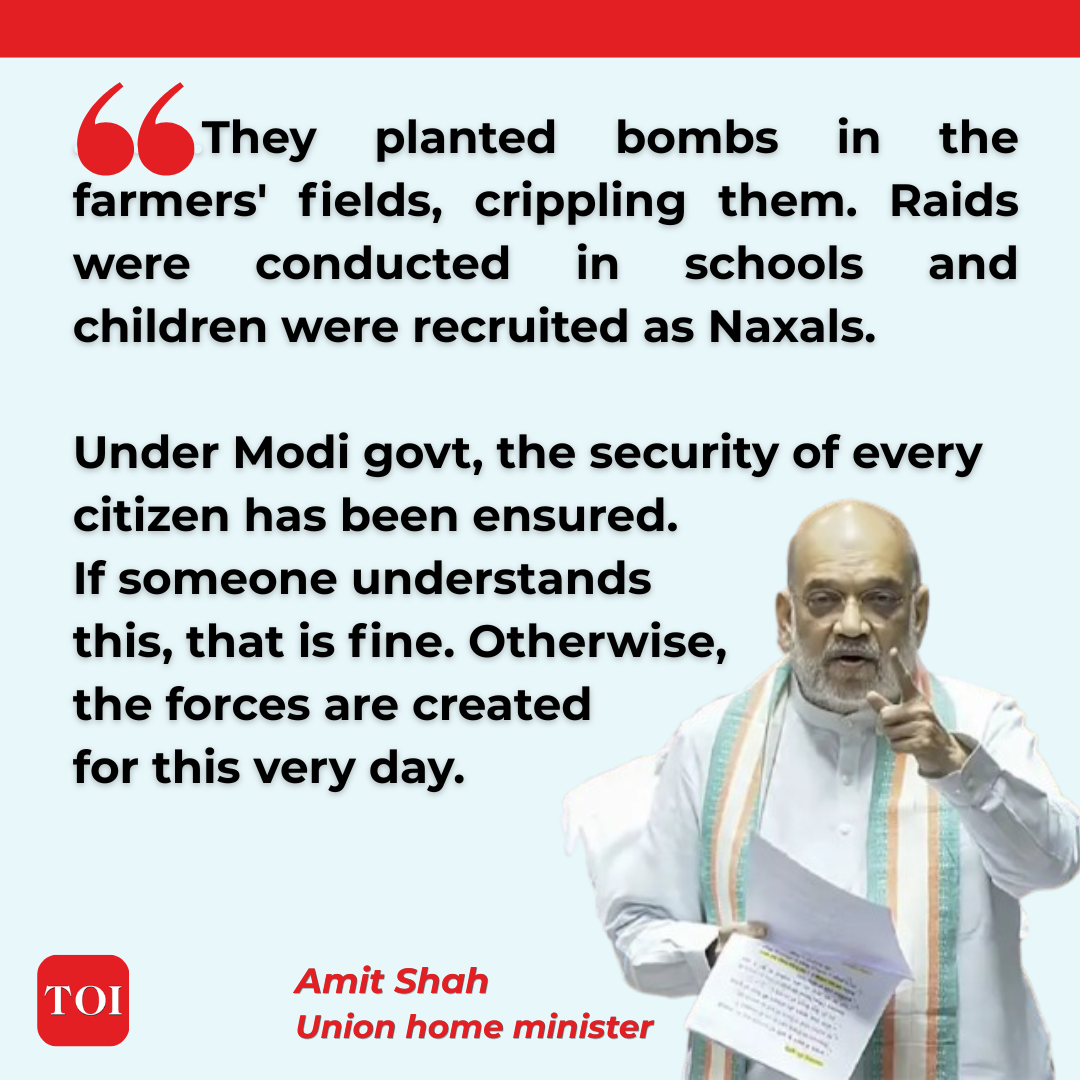
The short answer is: India appears very close to ending large-scale organised Naxal violence and according to Amit Shah, it may already have effectively crossed that threshold.Speaking in Parliament, the Union home minister declared that the Naxal leadership had been almost wiped out. “Their Politburo and central structure have been almost completely dismantled. Our goal was a Naxal-free India by March 31. The country will be informed once the entire process is formally completed, but I can say that we have become Naxal-free,” Shah said on the floor of the House.
.
He also made it clear that the Centre would continue to act firmly against armed extremism. Calling a “Naxal-free India” one of the government’s biggest achievements, Shah said those who take up arms would have to face the consequences. “The solution for addressing injustice is prescribed in the Constitution. Taking up arms is not the answer,” he said.Still, there is an important caveat. Even if the main Maoist structure has been dismantled, smaller underground cells, splinter groups, extortion networks or isolated local violence could continue for some time. And if governance weakens in tribal areas, the deeper issues that once fed the insurgency, land insecurity, displacement, poor administration and mistrust of the state, could remain.That is why the next phase matters. The shift is now from counter-insurgency to consolidation. In simple terms, the battlefield may have been won, but the peace still has to be secured.So yes, India is closer than ever, and by Shah’s own claim, effectively there.
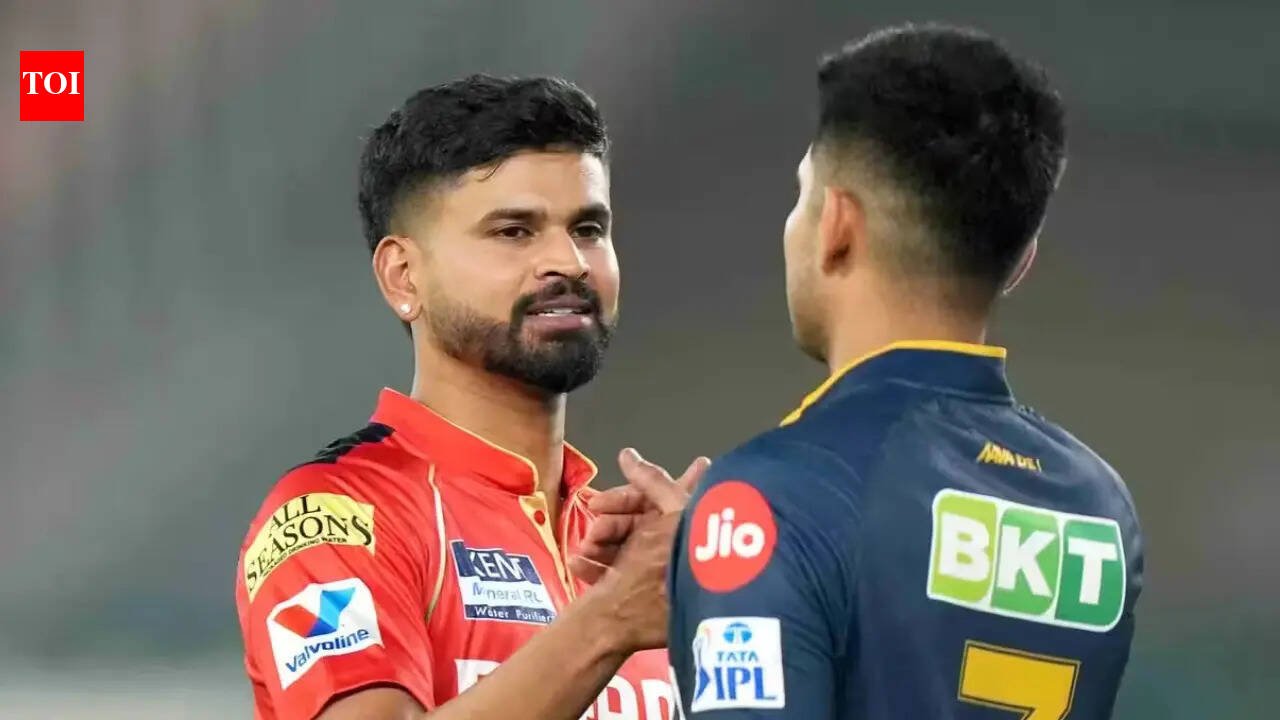
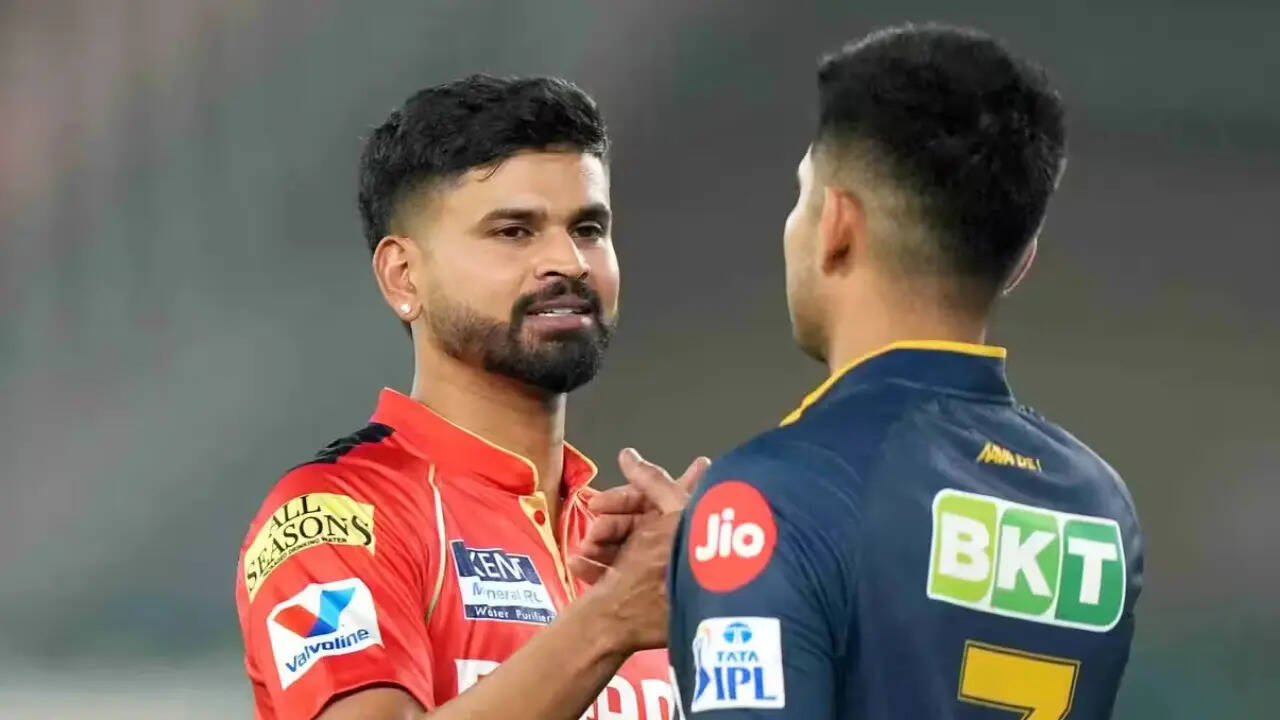
Punjab Kings: Shreyas Iyer (c), Priyansh Arya, Prabhsimran Singh (wicketkeeper), Nehal Wadhera, Shashank Singh, Marcus Stoinis, Azmatullah Omarzai, Vijaykumar Vyshak, Arshdeep Singh, Yuzvendra Chahal, Harpreet Brar, Suryansh Shedge, Vishnu Vinod (wicketkeeper), Xavier Bartlett, Yash Thakur, Mitchell Owen, Harnoor Singh, Musheer Khan, Pyla Avinash, Marco Jansen, Lockie Ferguson, Cooper Connolly, Ben Dwarshuis, Pravin Dubey, Vishal Nishad
Gujarat Titans: Shubman Gill (c), Jos Buttler (wicketkeeper), Kumar Kushagra, Glenn Phillips, Rashid Khan, Manav Suthar, Nishant Sindhu, Washington Sundar, Mohammed Siraj, Prasidh Krishna, Kagiso Rabada, Ravisrinivasan Sai Kishore, Jayant Yadav, Ishant Sharma, Ashok Sharma, Jason Holder, Tom Banton, Luke Wood, Sai Sudharsan, Rahul Tewatia, Arshad Khan, Anuj Rawat, Kulwant Khejroliya, Gurnoor Brar, M Shahrukh Khan
Predicted Playing XI with Impact subs
Punjab Kings: Prabhsimran Singh (wk), Priyansh Arya, Cooper Connolly, Shreyas Iyer (c), Marcus Stoinis, Shashank Singh, Azmatullah Omarzai, Harpreet Brar, Marco Jansen, Arshdeep Singh, Yuzvendra Chahal. Impact Player: Nehal Wadhera
Gujarat Titans: Shubman Gill (c), Sai Sudharsan, Jos Buttler (wk), Glenn Phillips, Washington Sundar, Rahul Tewatia, Rashid Khan, R Sai Kishore, Jason Holder, Mohammed Siraj, Prasidh Krishna. Impact Player: Kagiso Rabada
The government has notified the Finance Act 2026, bringing into force the tax changes approved under the Union Budget for 2026-27, according to a gazette notification issued by the Ministry of Law and Justice.“The following Act of Parliament received the assent of the President on March 30, 2026 and is hereby published for general information,” the notification said.The Act gives legal effect to the Centre’s financial proposals for the upcoming fiscal year beginning April 1.Parliament had cleared the Finance Bill 2026 last week, with the Rajya Sabha returning it to the Lok Sabha by a voice vote after a brief discussion. The Lok Sabha had earlier passed the bill on March 25 along with 32 amendments, with Finance Minister Nirmala Sitharaman responding to members’ queries.Also Read: Your income tax changes from April 1, 2026! Top 10 things salaried taxpayers should know about new rules & tax regime choiceUnder the Budget 2026-27, total expenditure is pegged at Rs 53.47 lakh crore, marking a 7.7 per cent increase over the current fiscal ending March 31. Capital expenditure has been set at Rs 12.2 lakh crore.The government has projected gross tax revenues at Rs 44.04 lakh crore and gross borrowing at Rs 17.2 lakh crore, with the fiscal deficit estimated at 4.3 per cent of GDP for FY27, lower than 4.4 per cent in the current fiscal.Also Read: ITR filing AY 2026-27: Income Tax Return forms ITR-1 to ITR-7 notified; key changes, eligibility explainedAmong key tax changes, the Act introduces a flat 12 per cent surcharge on capital gains earned by individual and corporate shareholders from company share buybacks, effective April 1.The move is expected to increase the effective tax burden on such gains, replacing the earlier slab-based surcharge structure. At present, no surcharge is levied on taxable income up to Rs 50 lakh, while income between Rs 50 lakh and Rs 1 crore attracts a 10 per cent surcharge on capital gains from buybacks
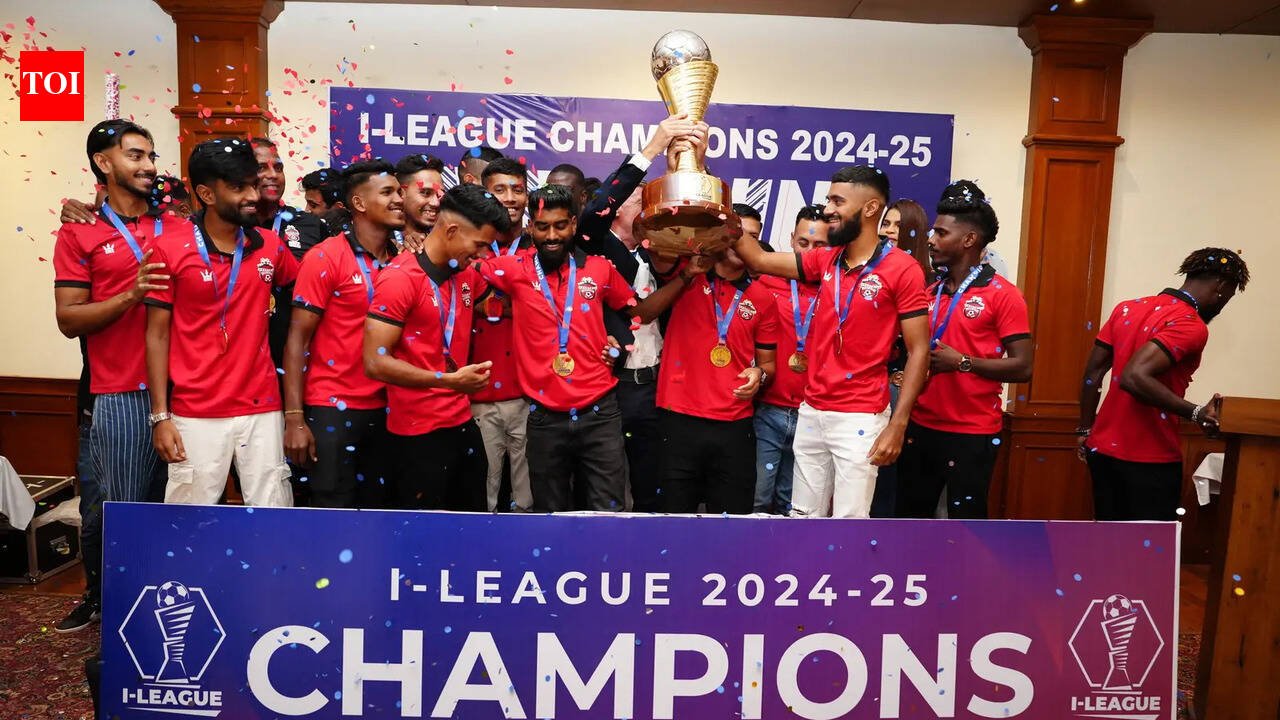
Panaji: The All India Football Federation (AIFF) has accused its executive committee member and Churchill Brothers CEO Valanka Alemao of exerting “sustained pressure” on the federation to facilitate the inclusion of the Goan team in the top-tier Indian Super League (ISL).“Between January 8 and February 15, Ms. Alemao and members of her family exerted sustained pressure on the AIFF to facilitate the inclusion of Churchill Brothers FC Goa in the ISL through exceptional means,” AIFF said in a statement on Monday. “However, the federation was unable to accommodate this request due to existing rules, regulations, and commitments made to stakeholders.”The statement came on the day Valanka accused AIFF president Kalyan Chaubey, vice president NA Haris and deputy secretary general M Satyanarayan of intimidation and harassment during the executive committee meeting on Sunday.Churchill Bros, who are not part of either the ISl or second tier Indian Football League (IFL) this season, have been up in arms against the AIFF due to last season’s I-League title race, where they were first declared champions. However, the title was later awarded to Inter Kashi, who won two appeals in the Court of Arbitration for sport (CAS).“In order to remain compliant with the applicable regulations and legal obligations, AIFF could not include Churchill Brothers in the ISL. Following this, several legal petitions were filed by members of Ms. Alemao’s family. Despite being an executive committee member of AIFF, she repeatedly attempted to influence proceedings during official meetings with the objective of securing the inclusion of her club in the ISL,” said AIFF.According to the statement, Valanka “strongly pressed” for the convening of an emergency executive committee meeting, which could not proceed on Feb 9 due to lack of quorum. Another meeting was called three days later where the proposal to include Churchill in ISL was rejected.“On Feb 14, the opening day of the ISL season, further requests were made by her family for AIFF to convene a third emergency executive committee meeting on the same matter. Given that the issue had already been deliberated upon and decided by the executive committee, AIFF did not consider it appropriate to reconvene the body.“Subsequently, legal petitions were filed before the Delhi High Court. The AIFF reiterates that all meetings and decisions of the federation are conducted strictly in accordance with its Articles of Association and established procedures,” said AIFF.
The Indian Premier League (IPL) 2026 season has kicked off with a thunderous roar, and the third match of the tournament at the Barsapara Cricket Stadium in Guwahati lived up to the hype. On Monday, the Rajasthan Royals (RR) squared off against the Chennai Super Kings (CSK) in a high-stakes encounter that showcased the shifting tides of Indian cricket. While the scoreboard reflected a dominant win for the Royals, the narrative following the match has been centered on the evolution of a modern-day batting maestro.
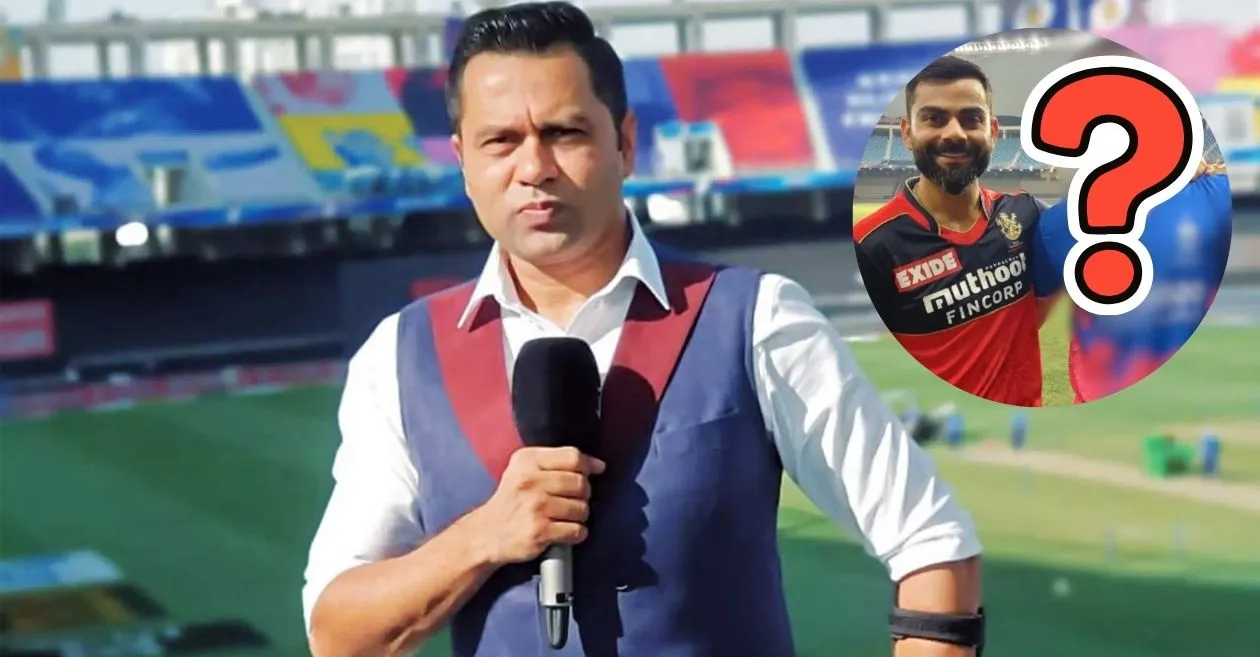
While teenage sensation Vaibhav Suryavanshi stole the headlines with a rapid-fire half-century, former Indian opener and renowned commentator Aakash Chopra chose to highlight the unseen brilliance of Yashasvi Jaiswal. In a detailed analysis on his YouTube channel, Chopra drew profound parallels between Jaiswal and the legendary Virat Kohli, focusing specifically on the youngster’s burgeoning maturity and tactical ego-management.
Chopra noted that Jaiswal’s unbeaten 38 off 36 balls was a masterclass in situational awareness. In a format often obsessed with strike rates, Jaiswal recognized that Suryavanshi was striking the ball with transcendental ease at the other end. Instead of trying to outshine his partner, Jaiswal anchored the innings, ensuring the chase never faltered.
“We saw glimpses of Virat Kohli in him today. The ability to look at the larger picture, keep the ego aside, and not compete with the batter at the other end is what defines greatness. Jaiswal understood that the team needed to win, and he prioritized staying until the end,” Chopra remarked.
Chopra emphasized the importance of the red-inker, the asterisk denoting an unbeaten status, stating that those who consistently finish games in run chases eventually transition from stars to superstars. By mirroring Kohli’s finisher DNA, Jaiswal has signalled that he is no longer just a flamboyant opener but a calculated match-winner.
The match itself was a statement of intent from the Rajasthan Royals. Chasing a modest target set by the Super Kings, the Royals looked in total control from the first ball. The victory was secured with a staggering 47 balls to spare, resulting in an eight-wicket win that significantly boosted their Net Run Rate.
The primary catalyst for this demolition was Suryavanshi, whose 52 off just 17 balls left the CSK bowling attack shell-shocked. However, the synergy between Suryavanshi’s aggression and Jaiswal’s composure provided a glimpse of RR’s balanced tactical approach for the 2026 season. CSK, usually known for their disciplined bowling, struggled to find answers as the Royals’ batters manipulated the field with ease under the Guwahati lights.
With this dream start, RR have firmly established themselves as the team to beat. As they prepare to face Gujarat Titans on April 4, the focus remains on whether Jaiswal can continue this Kohli-esque trajectory. For now, the Royals sit comfortably at the top of the table, backed by a blend of youthful exuberance and seasoned maturity.
Also READ: IPL 2026: Fans go berserk as clinical Rajasthan Royals thump Chennai Super Kings in Guwahati