Breaking News
Veteran journalist S Thyagarajan dies | India News


Veteran journalist S Thyagarajan dies

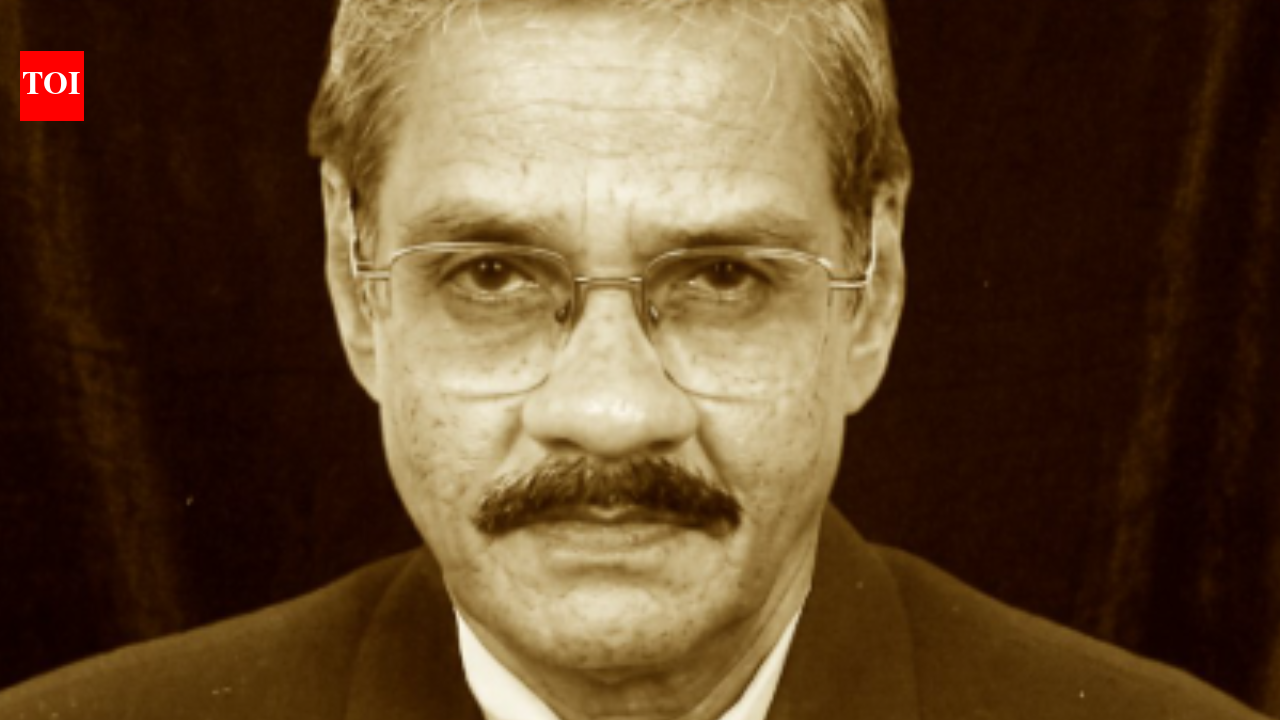
Chennai, Veteran Indian sports journalist S Thyagarajan, who carved a niche for himself with his extensive coverage of hockey, died here on Monday after battling age-related ailments. He was 85. He is survived by his wife and two daughters. His cremation took place in Chennai on Monday. Thyagarajan, who covered six Olympics and nine Asian Games, served ‘The Hindu’ newspaper from 1962 to 2013 before his retirement. He started his career with ‘The Indian Express’ in 1961. “S. Thyagarajan, veteran sports correspondent and doyen of hockey writing, who worked with The Hindu for many decades, passed away,” ‘the Hindu’s sports editor K C Vijaya Kumar posted on ‘X’. Thyagarajan also served on the media and communications-related committees of the International Hockey Federation (FIH) and the Asian Hockey Federation (AHF) during his journalistic career. He was a former president of both the Sports Journalist Federation of India and the Tamil Nadu Sports Journalists Association. Former India captain-cum-coach and 1980 Olympic gold medallist Vasudevan Baskaran was heartbroken as Tyagarajan, commonly known as “Thyagu” covered his entire career and supported him throughout. “When I started hockey in 1969 he was covering the sport and used to cover collegiate hockey for the Hindu. That’s basically how he came into prominence. His dedication, love and knowledge of the sport was impeccable,” Baskaran told PTI. “It’s a very sad for Indian sports as he was a great athletics correspondent as well besides hockey. His contribution to Indian hockey was immense,” he added. Senior journalist and hockey historian K Arumugam was at loss of words for Thayagarajan’s demise. “I knew him for more than 30 years. He was rare, an all-rounder journalist. He was master of all aspects not just hockey. He was a story teller,” Arumugam said. “He was globally very well respected, his knowledge was very well recognised,” he said. Senior Indian sports journalist S Sabanayakan, a former president of the Sports Journalist Federation of India (SJFI) who has worked with prominent newspapers like The Hindu and The Telegraph, termed Thyagarajan’s death as an “irreparable loss” for the fraternity. “The passing of S Thyagarajan is an irreparable loss to sports journalism. An expert in field hockey, Thyagu as he is well known, groomed a lot of youngsters in the profession. A fluent writer, his writing style was racy and unique,” he said. “He was the president of Sports Journalists’ Federation of India for one term of two years in 1996. He also headed the Tamil Nadu Sports Journalists’ Association for many years. He was also the Chairman of the Field Hockey Commission of AIPS from 1998 to 2006. “He covered 6 Olympics, nine Asian Games, nine hockey World Cups and 20 hockey nationals in his illustrious career. In October 2024, he was felicitated by SJFI for his contribution to sports journalism,” he added The Sports Journalists Federation of India condoled the demise of Thyagarajan. President Saraju Chakraborty said the passing away of the doyen of sports journalism was an irreparable loss to the fraternity.


Source link

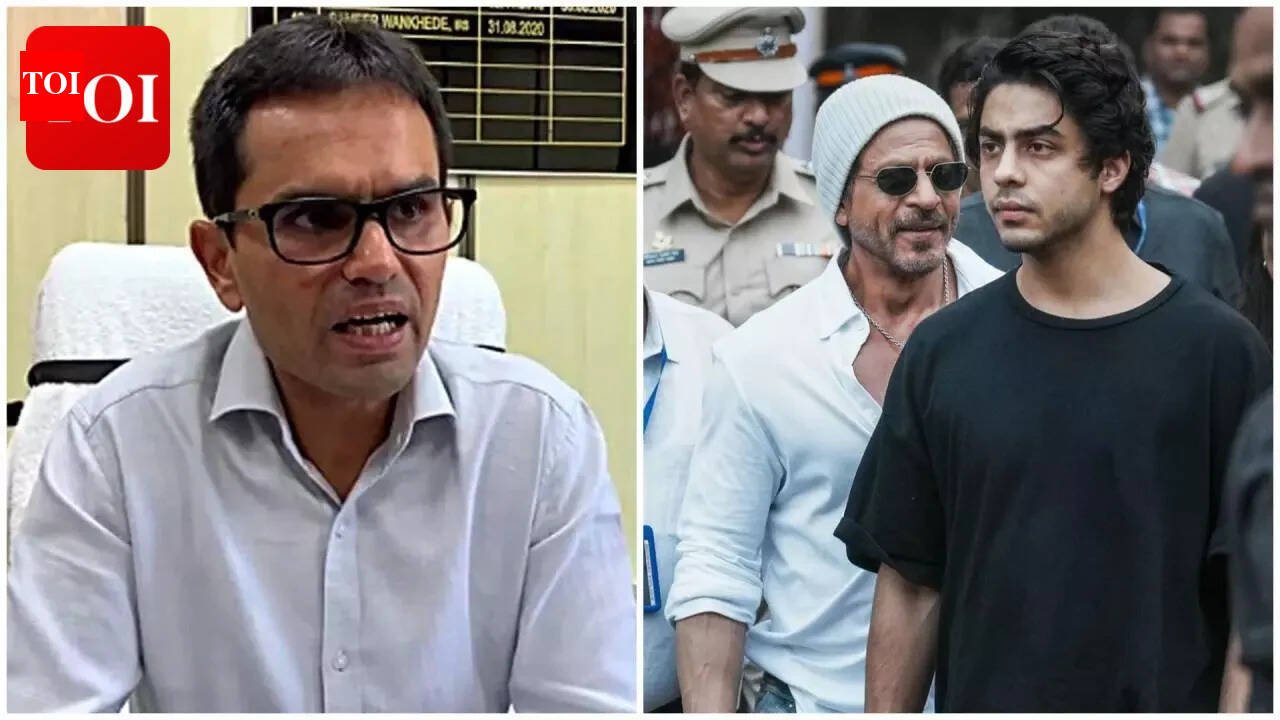
Sameer Wankhede tells Bombay HC he never sought Rs 25 crore bribe from Shah Rukh Khan in Aryan Khan case |


Sameer Wankhede tells Bombay HC he never sought Rs 25 crore bribe from Shah Rukh Khan in Aryan Khan case
The legal battle surrounding the high-profile cruise drugs case took a fresh turn on Monday, with former Sameer Wankhede telling the Bombay High Court that he neither demanded nor accepted any bribe from Bollywood superstar Shah Rukh Khan to spare his son Aryan Khan.

The legal battle surrounding the high-profile cruise drugs case took a fresh turn on Monday, with former Sameer Wankhede telling the Bombay High Court that he neither demanded nor accepted any bribe from Bollywood superstar Shah Rukh Khan to spare his son Aryan Khan.

‘No demand, no bribe’: Wankhede’s stand in court

As per PTI, appearing before a bench led by Chief Justice Shree Chandrashekhar and Justice Suman Shyam, Wankhede’s counsel Aabad Ponda asserted that the allegations made by the Central Bureau of Investigation are baseless.Ponda argued that there is “no evidence” to suggest that Wankhede demanded or received a Rs 25 crore bribe from Shah Rukh Khan during the 2021 cruise drugs case involving Aryan Khan. The plea pertains to Wankhede’s petition seeking to quash the FIR registered against him by the CBI in May 2023 on charges of corruption and bribery.

What the CBI FIR alleges

According to the FIR filed on May 11, 2023, Wankhede, along with former NCB SP Vishwa Vijay Singh, intelligence officer Ashish Ranjan, and private individuals Kiran Gosavi and Sanville D’Souza, allegedly demanded Rs 25 crore from Shah Rukh Khan in exchange for not implicating Aryan Khan in the case.The alleged demand was later negotiated down to Rs 18 crore, as per the agency.

Defence cites ‘lawful raid’ and lack of proof

Wankhede’s counsel maintained that the raid on the Cordelia cruise ship was conducted based on a tip-off received by the Narcotics Control Bureau and followed due legal procedure. He added that several individuals, including Aryan Khan, were arrested in accordance with the law.

Watch

Sameer Wankhede Sues Shah Rukh Khan’s Production Over Netflix Series | Rs 2 Crore Defamation Case

Aryan Khan’s arrest and later clean chit

Aryan Khan was arrested on October 3, 2021, a day after the controversial raid off the Mumbai coast. However, a Special Investigation Team (SIT) of the NCB later gave him a clean chit on May 27, 2022, stating there was no evidence linking him to a larger drug trafficking conspiracy.An internal probe by the NCB also flagged procedural lapses, noting that Aryan Khan and Arbaaz Merchant were added to the agency’s “information note” at the last moment. It further highlighted irregularities in documentation, including seizure records and statement recordings by Wankhede’s team. The matter continues to be heard by the court.


Source link

Tabu gifts a kurta to Irrfan Khan’s son Babil Khan on Eid – see photo | Hindi Movie News


On Eid, Babil shared Tabu’s heartfelt kurta gift online, honoring late Irrfan Khan’s close co-star. Their Maqbool, Haider chemistry was iconic; Tabu credits him for career transformation. Irrfan’s 2020 passing left a global void. Familial bonds endure.

On Eid, Babil Khan shared a touching personal moment with fans on social media, revealing a special gift from Tabu, a kurta he proudly wore. Tabu, one of the closest collaborators of his late father Irrfan Khan, made the gesture even more heartfelt.

Tabu’s familial bond

Tabu and Irrfan Khan’s iconic on-screen partnership, built on long-standing association and mutual respect, has naturally evolved into a warm, familial bond with Babil over the years.

Tabu and Irrfan Khan iconic chemistry

The on-screen chemistry between Tabu and Irrfan Khan was distinctive, blending effortless simplicity with profound depth. Films such as ‘Maqbool’, ‘The Namesake’, and ‘Haider’ showcased their genuine, subtle portrayals. Be it as romantic leads or intricate roles, they infused raw honesty into every performance, cementing their duo as a standout in Indian cinema.

Watch

Babil Khan Opens Up About Irrfan’s Legacy: ‘It Would Be Destroyed If…’ | ‘Logout’ EXCLUSIVE

Tabu shared partnering with Irrfan Khan

Tabu, in her 2022 Film Companion interview, revealed that partnering with Irrfan Khan transformed her approach to acting and her entire career. “I changed a lot after working with him,” she said, adding, “I learnt to be completely true to my characters and myself, and bring that to my work. I can say what I shared with Irrfan on screen, I don’t know if I can and if I have shared that with anybody.”

Irrfan Khan legacy

Irrfan Khan passed away on April 29, 2020, following a battle with a rare illness, leaving an immense void in Indian cinema. Renowned for his quiet intensity and effortless acting, his death was mourned not only in India but worldwide. From Bollywood to Hollywood, he had earned acclaim for his delicate, powerful performances, making his loss deeply personal for fans who grew up watching him.


Source link

Fragile footing: How India, China face sizeable economic damage prospects from US-Iran war; outlook has grown more daunting


Fragile footing: How India, China face sizeable economic damage prospects from US-Iran war; outlook has grown more daunting
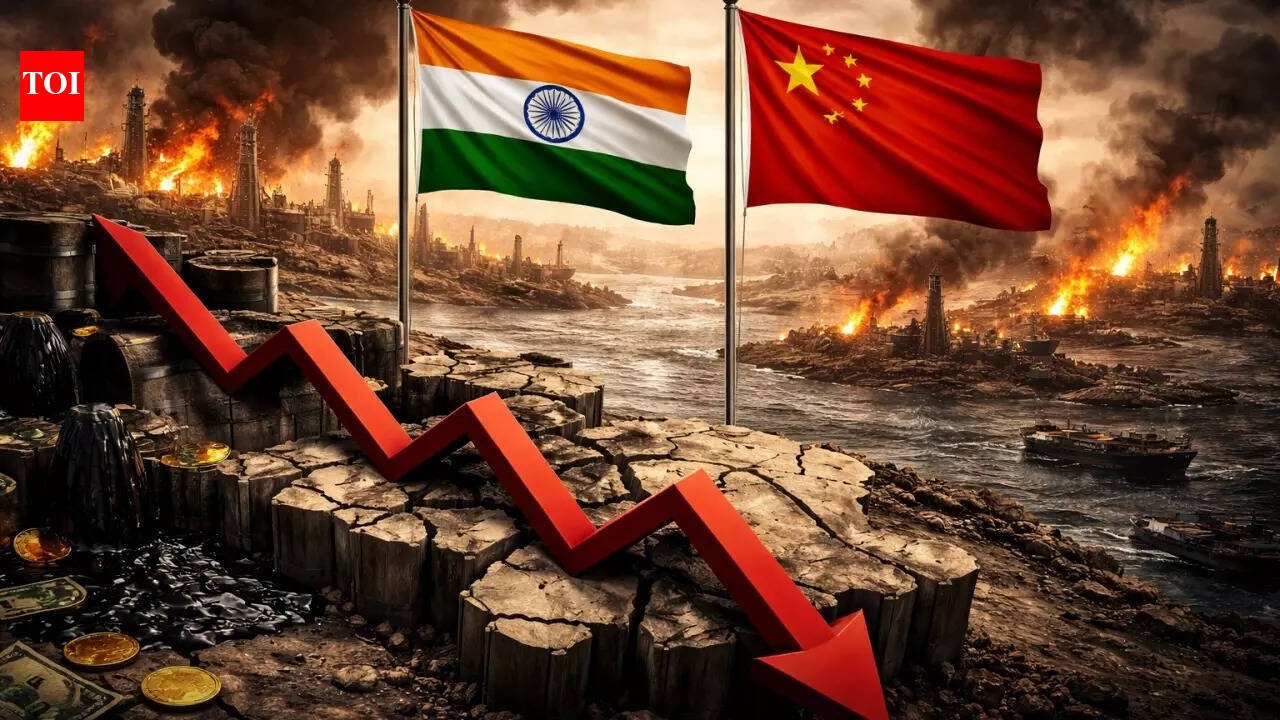
Asia-Pacific economies entered 2026 on a fragile footing. (AI image)

Asia-Pacific economies have entered 2026 on a fragile footing, and the US-Israel-Iran war has exacerbated the risks to GDP growth for economies like China, India, and other major countries in the region, says Moody’s Analytics in its latest report.The global economy has been undergoing a period of turmoil since the start of this decade – first it was the Covid pandemic, then the Russia-Ukraine war, then the Donald Trump administration’s tariff policies, and finally 2026 has added the Middle East conflict to the growing list.What does this latest disruption mean for the growth prospects of Asian economies that are in large part dependent on oil and energy imports. Since the start of the Middle East conflict, passage of ships through the Strait of Hormuz has been curtailed, major energy infrastructure across the Gulf has been hit, and oil prices have risen past $100 per barrel, stoking inflation fears.

Fragile Economic Scenario

According to Moody’s Analytics, 2026 was always going to be a tough year for Asia-Pacific countries. Now the uncertainty of the Middle East conflict has added another spanner in the growth wheel of major economies like China, India, Japan, and South Korea.
Growth Across Asia-Pacific Will Slow in 2026

Growth Across Asia-Pacific Will Slow in 2026

As Moody’s says: Asia-Pacific economies entered 2026 on a fragile footing. Domestic demand was weak, and export growth looked set to slow.“Growth was set to slow after export front-loading ahead of US tariff hikes flattered the numbers last year. And the artificial intelligence boom looked ripe for a pause. Still, cooling inflation allowed some central banks to ease policy, providing reason for cautious optimism. Added to that, the US Supreme Court’s decision in February to strike down country-specific tariffs brought some relief to some of the region’s exporters,” Moody’s Analytics says in its latest report titled ‘Asia-Pacific Outlook: Buckling Up’. But now, recent events have complicated the growth outlook considerably.The report notes the following for major Asian economies:

  • External and domestic shocks have scrambled economic fortunes across the region over the past 18 months. Looking at exports, economies seem surprisingly strong, it says, adding that US tariff related uncertainties led to front loading of shipments last year.
  • Shipments of semiconductors, storage and memory related products have grown massively due to the artificial intelligence (AI) -led boom globally. The biggest beneficiary from this has been Taiwan, which has seen a big GDP growth jump of 8.7% in 2025.
  • However, according to Moody’s domestic demand has been weak in key economies. “While exports have done well, domestic demand has not. Across much of the region, homegrown demand sits below pre-pandemic trends and global averages, dragging on prices,” it says.
  • Consumer price inflation is also averaging below central banks’ target levels. China is actually working to fight off deflation. In India too the CPI is averaging around 3%, below RBI’s 4% target level.
  • However, risks to inflation are growing with commodity prices rapidly climbing after the Middle East conflict broke out. “The Middle East conflict is pushing commodity prices higher, raising the possibility that inflation will reaccelerate. It’s also causing shortages of chemicals and fertilisers,” says Moody’s.

“All of this creates an uncomfortable echo of the inflation and supply shocks that followed the COVID-19 pandemic and Russia’s invasion of Ukraine,” it warns.

Three Risks For Asia-Pacific Economies – Where Does India Fit In?

Moody’s has a big warning for Asia-Pacific economies: They are faced with a ‘troublesome mix of external threats’!Threat 1: Middle East ConflictThe report says that the Middle East conflict sits at the top of the list. This is because of the region’s heavy dependence on imported commodities. This is especially true since the source of energy needs is the very set of countries that are currently involved in the conflict.

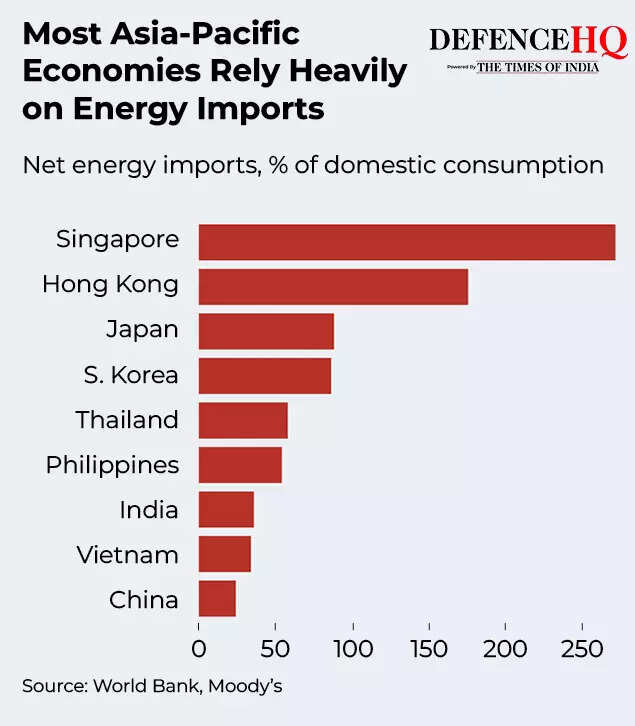
Most Asia-Pacific Economies Rely Heavily on Energy Imports

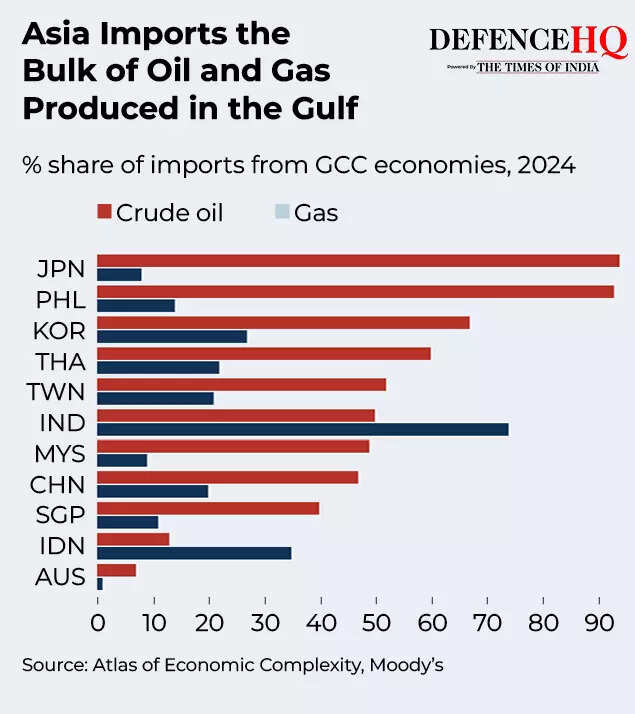
While India imports a big percentage of its crude oil requirements, Moody’s Analytics is of the view that compared to other countries in the region its dependency is somewhat less.Northeast Asia’s high-income economies such as Japan, South Korea and Taiwan are particularly dependent on imported fossil fuels. However it notes that these countries maintain sizeable strategic oil reserves. The typically limited pass-through from short-lived price spikes to domestic consumer prices provides a meaningful buffer, it says. China, which is one of the largest buyers of Iranian discounted crude, similarly maintains huge reserves.

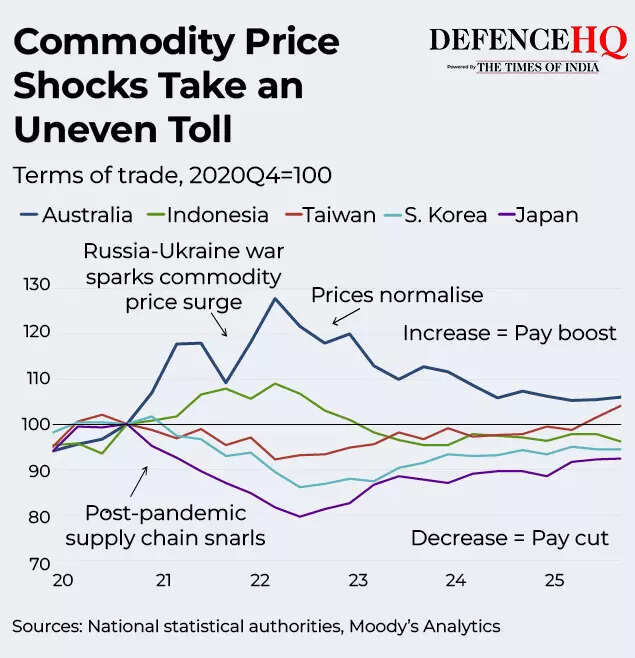
Commodity Price Shocks Take an Uneven Toll

“India and Southeast Asian economies are somewhat less import-dependent but hold far smaller reserves; their governments instead lean on direct or indirect price caps and fuel subsidy schemes to shield consumers from volatility,” Moody’s Analytics says its report.In a scenario where the US-Iran war does not persist for a longer duration, the inflation shock to South Asian economies would be contained, but a longer breakout of conflict has meaningful implications that cannot be ignored.“A prolonged conflict or a further sustained rise in energy prices would materially alter the assessment of limited impact. In addition to energy prices, food inflation is another concern given its large weight in regional consumption baskets,” the report says.

Asia Imports the Bulk of Oil and Gas Produced in the Gulf

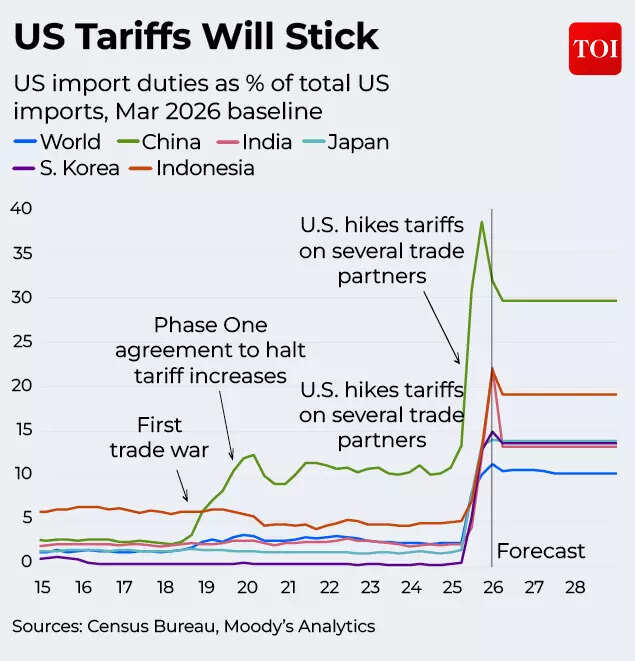
Threat 2: Trump Tariff RisksMiddle East conflict is not the only risk that threatens the growth story of Asian economies this year. Uncertainty related to tariffs is a big concern.“The Asia-Pacific region has always grown through exports, and that dependence has only deepened since the pandemic. With access to the US market becoming more difficult, the imbalance leaves the region exposed,” says the Moody’s report.The report acknowledges that the US Supreme Court has struck down the Donald Trump administration’s reciprocal tariffs, but quickly points to the 10% global tariff that was announced, with the prospect of it being raised to 15%.

US Tariffs Will Stick

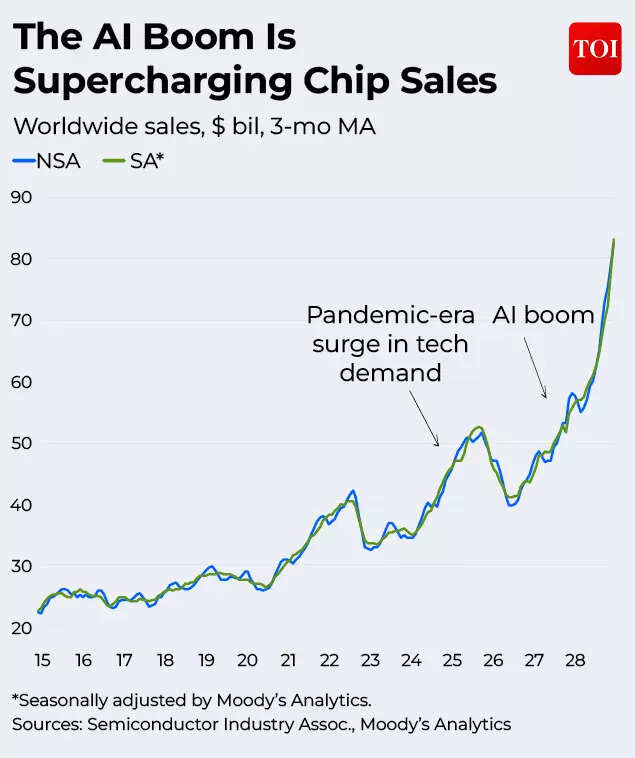
“Trump’s subsequent announcement of a flat global 15% tariff rate means the average effective US import tariff would be broadly unchanged – and considerably higher than this time last year,” it says.The Moody’s report also cautions that the new investigations under Section 301 of the Trade Act signal that the Trump administration is looking to rebuild the tariff regime that existed before the apex court’s decision. Moody’s baseline assumption is that US import tariffs will stay at current levels through 2028.Threat 2: End of the AI Boom?AI has been driving the news for months now – disruptive models are taking the world by a storm, but is the rally set for a pause According to the Moody’s report, a key source of uncertainty around its forecast is the AI boom.“Asia produces most of the world’s electronics, so the surge in AI-related demand has been a powerful tailwind – first in Taiwan, which produces most of the world’s bleeding-edge semiconductors, and since late 2025, in memory chips, storage and related products,” the report notes.

The AI Boom Is Supercharging Chip Sales

What this has meant is a rise in electronics exports across the region, and an increase in prices and some isolated shortages as well. “Data centre investment has been an added benefit, complementing the export-led growth boost. But this also means the region is heavily exposed should AI momentum falter,” Moody’s says. Exports and investments are at the risk of being hit in case the AI-led boom were to either end or worst still see a big downturn.“Financial markets would react sharply. Nowhere is this dynamic more visible than in South Korea, whose equity market nearly tripled over 18 months before selling off sharply when the Middle East conflict exposed macro vulnerabilities that worsened the risk-off move,” Moody’s explains.

China’s New Economic Normal

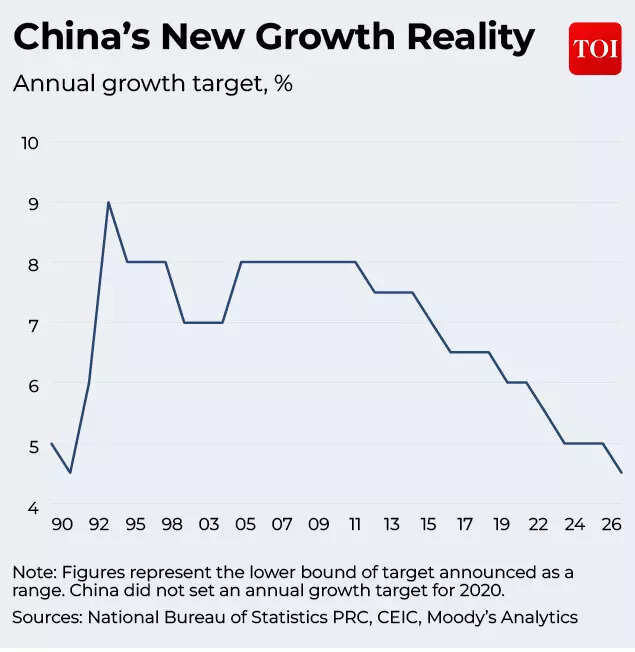
China has been flooding markets with exports, a policy which is driven by its own weak domestic demand. Earlier this month, China projected a GDP growth rate of 4.5% to 5% for 2026 – which is the first time in over three decades that officials in Beijing have projected a sub 5% growth number.Domestic weakness and industrial overcapacity received rhetorical acknowledgement, but the policy focus remains firmly on industrial upgrading and technological self-sufficiency, says Moody’s.

China’s New Growth Reality

At home, policy efforts to address involution, the excess competition that compresses returns and drives prices ever lower, may be bearing some fruit. But we wouldn’t be surprised if fresh investment into strategic sectors will see involution and deflation return before long, the report says.

South Asia Growth Projections For 2026

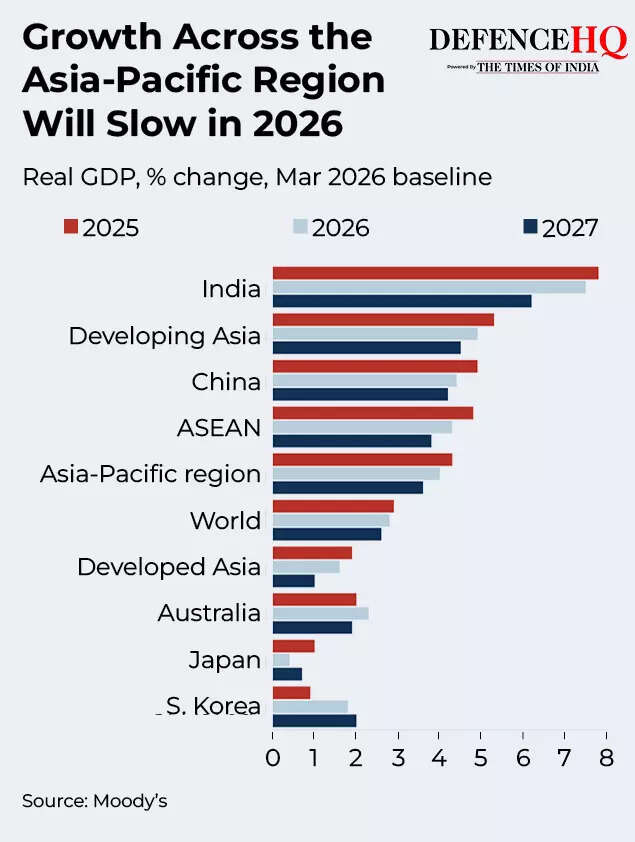
With this situation in mind, Moody’s Analytics projects that the growth across the Asia-Pacific region will slow down from 4.3% in 2025 to just 4$ in 2026. The number will come down further to 3.6% in 2027, it estimates.Individual economy wise projections are:

  • India: 7.8% in 2025, 7.5% in 2026, 6.2% in 2027, and 6% in 2028
  • China: 5% in 2025, 4.4% in 2026, 4.3% in 2027, and 4% in 2028
  • Japan: 1.1% in 2025, 0.5% in 2026, 0.7% in 2027, and 0.9% in 2028
  • Singapore: 5% in 2025, 3.8% in 2026
  • South Korea: 0.9% in 2025, 1.9% in 2026
  • Taiwan: 8.7% in 2025, 6.6% in 2026

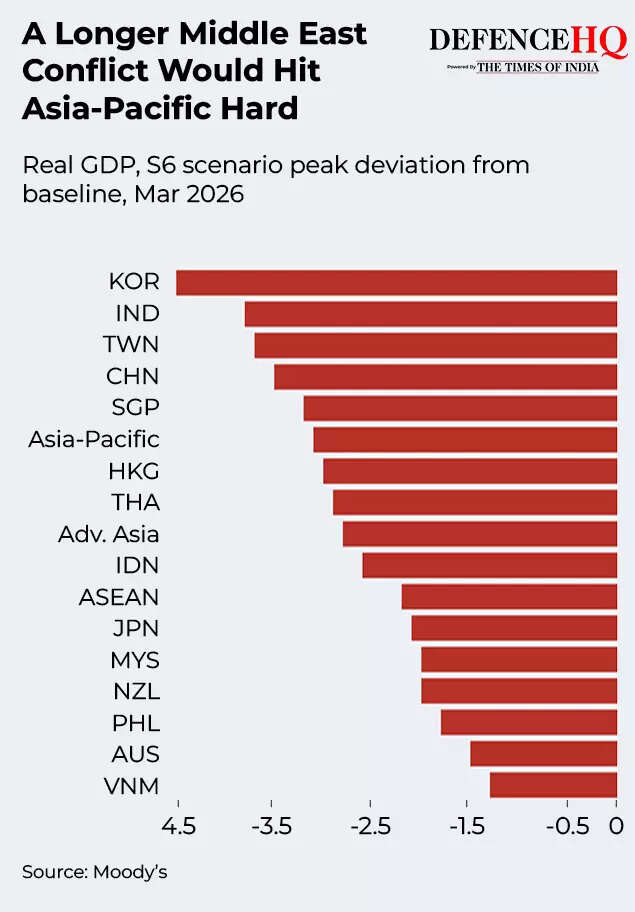
In its report Moody’s Analytics simulates a more ‘severe and protracted’ conflict which sees Brent crude rising substantially.“Results show GDP losses across the APAC region peaking at 3%, a larger hit than either Europe or the US would absorb, reflecting the region’s heavy dependence on Middle Eastern commodities,” it says.

A Longer Middle East Conflict Would Hit Asia-Pacific Hard

“Developed Asia sustains a particularly large blow; its pronounced exposure to commodity price spikes weakens trade balances and currencies, pushing up inflation. India and China face sizeable damage given their dependence on oil and gas imports from Gulf economies caught up in the conflict,” it adds.As Moody’s Analytics concludes: This year is shaping up to be an even more difficult year for the Asia Pacific region than originally envisaged.“A more severe and prolonged conflict in the Middle East would compound existing tariff pain. And while the AI boom is powering ahead, stretched equity valuations, alongside price spikes and isolated hardware shortages, suggest it is increasingly ripe for a pause. With limited support from fiscal and monetary policymakers, growth will slow,” it says.

Source link

“My wife played a huge role in calming me down”: Varun Chakravarthy on panic attacks and his rise with KKR


In a heartfelt and candid interaction with actress-cum-sports presenter Sahiba Bali, Varun Chakravarthy peeled back the layers of his cricketing journey – one that wasn’t all glamour, fame, or instant success.

Today, a key player for Kolkata Knight Riders (KKR), Varun is widely known as a mystery spinner. But behind the calm demeanour on the field lies a story filled with anxiety, late starts, and emotional battles that nearly overwhelmed him.

Unlike many cricketers who begin their IPL careers in their early 20s, Varun entered the league at 28 years old – an age when most players are already established. This late entry created immense pressure, self-doubt, and fear about his future.

Varun Chakravarthy opens up on panic Attacks, sleepless nights and mental health struggles

When asked directly about panic attacks, Varun didn’t hesitate:

“Yes… during my first two IPL seasons, I used to get panic attacks every night.”

This wasn’t just occasional stress  – it was a recurring mental health struggle. He revealed that he would often:

  • Wake up completely drenched in sweat
  • Feel constant anxiety and restlessness
  • Struggle to sleep without medication
  • Experience overwhelming uncertainty about life

At that time, life felt directionless. Before cricket, Varun had even tried his luck in the film industry – but that path didn’t work out. Financial instability added another layer of stress. He had no steady income, no job security, and even personal milestones like marriage felt uncertain.

This combination of career pressure + personal instability created a perfect storm for anxiety.

The role of Varun’s wife: A pillar of strength

Amid all this chaos, one constant source of strength stood by him – his wife.

Varun openly acknowledged: “My wife played a huge role in calming me down.”

Varun’s wife’s (Neha Khedekar) emotional support helped him navigate those dark nights when panic attacks felt unbearable. In high-pressure careers like cricket, where performance defines survival, personal support systems often become the difference between breaking down and bouncing back.

The reality behind a cricketer’s life

Varun also shattered a common myth:

“People think a cricketer’s life is easy and glamorous… but that’s only true for 5%. The remaining 95% struggle their entire lives.

This statement resonates deeply.

While fans see packed stadiums, big contracts, and fame, the unseen reality includes:

  • Years of uncertainty and rejection
  • Constant performance pressure
  • Fear of being replaced or dropped
  • Financial instability, especially early on

For Varun, entering late meant he was always “playing catch-up.” He had to prove himself faster, work harder, and deal with comparisons against younger, more experienced players.

Also WATCH: Varun Chakravarthy, Washington Sundar fulfil 14 km Girivalam vow in Tiruvannamalai following T20 World Cup 2026 victory

From struggle to stability: Varun’s rise in KKR

Despite the hardships, Varun transformed his struggles into strength.

Today, he is a vital part of KKR’s bowling unit, known for his variations and control. But the journey to stability wasn’t overnight – it took years of persistence, mental resilience, and self-belief.

He now views his early struggles not as setbacks but as building blocks that shaped his mindset and performance.

KKR, the three-time IPL champions, kick off their IPL 2026 campaign with a challenging clash against Mumbai Indians on Sunday, March 29, at the iconic Wankhede Stadium. It’s a high-pressure start that promises plenty of excitement. Soon after, KKR return home to Kolkata, where they’ll face Sunrisers Hyderabad (SRH) on Thursday, April 2. That match marks the beginning of their home leg at Eden Gardens, where passionate fans are expected to turn up in huge numbers to cheer their team and create an electric atmosphere.

Also READ: 5 sixes, 9 fours! KKR young gun unleashes carnage with blistering ton ahead of IPL 2026


Source link

IBM Consulting VP Mohamad Ali: Biggest question in corporate strategy right now is how do you prepare for an AI world where …


IBM Consulting VP Mohamad Ali: Biggest question in corporate strategy right now is how do you prepare for an AI world where …

IBM Consulting senior VP Mohamad Ali has revealed how the company’s employees are working in tandem with artificial intelligence (AI) agents. The company executive has recently demonstrated that the company has moved beyond theorising about AI and is now running a live model in which humans monitor AI agents handling real client work in real time, a shift he describes as the new template for consulting. Ali also noted that the biggest question in corporate strategy is how to prepare for a world in which humans can work alongside AI agents.In an interview with Business Insider, Ali explained that IBM Consulting’s internal platform, Consulting Advantage,” was unveiled in 2024 to help its consultants build and manage teams of AI agents. “We don’t do, like, what markets you should be in. We do strategy around ‘how do you take your corporate strategy and implement it?'” he said. “Every hour I can see what’s going on with all the humans associated with digital workers,” and vice versa, he said. “That is the new consulting model going forward,” Ali added.In January, the company released a client-facing version called Enterprise Advantage,” which allows organisations to build and manage AI agents at scale.

IBM Consulting VP explains how the AI agent monitoring tool works

Ali offered an example of how the model works in practice. In a typical security operations centre, a human investigator would normally spend about 45 minutes reviewing logs after an alert to determine what went wrong and what action to take. At IBM, that process is now handled largely by AI. Digital workers first generate an investigation plan, then execute it in real time, with multiple agents working on different parts of the problem simultaneously and passing tasks back and forth. They then run a risk analysis and produce a report, a process that now takes a couple of minutes. The findings are passed to humans, with key actions highlighted, for verification. In January, IBM used this approach to complete 52,000 investigations, Ali noted. The company currently has digital workers operating alongside humans on more than 150 client engagements.IBM’s consulting arm, which acquired PwC’s consulting business in 2002, has operated for decades, employs around 150,000 people, and positions itself as a competitor to both the Big Four accounting firms and technology-focused consultancies like Accenture.The broader IBM business has seen its generative AI division valued at $12.5 billion, as reported during its fourth-quarter earnings call. IBM Consulting’s revenue for 2025 came in at over $21 billion, up from approximately $20.7 billion in 2024, driven in part by rising client demand for generative AI implementation services.


Source link

Stock market today: Which are top gainers and losers on NSE & BSE on March 23? Check list


Stock market today: Which are top gainers and losers on NSE & BSE on March 23? Check list

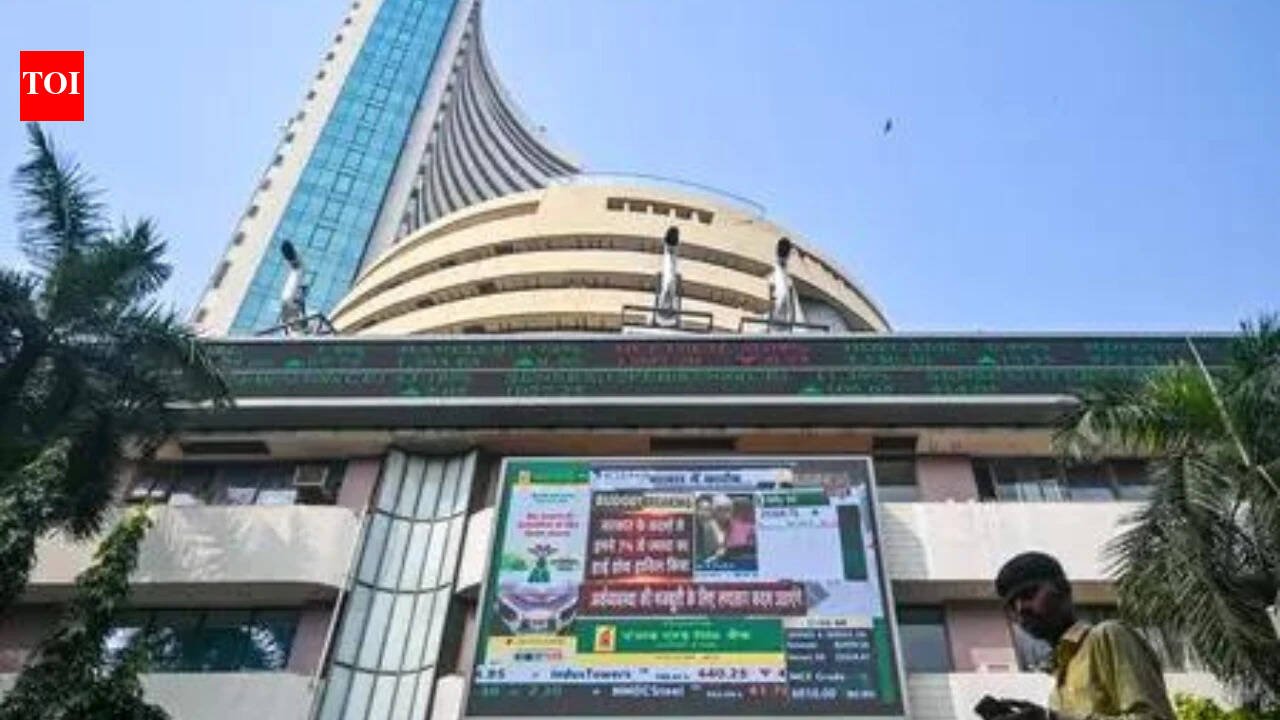
Benchmark equity indices Sensex and Nifty plunged sharply on Monday, tracking a brutal global sell-off as the Middle East war deepened into its fourth week, with rising crude prices, persistent foreign fund outflows and a record-low rupee worsening investor nerves.The 30-share BSE Sensex slumped 1,836.57 points, or 2.46 per cent, to close at 72,696.39, after falling as much as 1,974.52 points intraday to 72,558.44. The NSE Nifty dropped 601.85 points, or 2.60 per cent, to settle at 22,512.65.

Nifty50 top gainers

Company Name Current Price (Rs) Price Change % Change
HCL Tech 1,359 24.90 ↑ 1.87% ↑
Power Grid 302.10 4.50 ↑ 1.52% ↑
Infosys 1,257 0.90 ↑ 0.08% ↑
ONGC 265.45 0.06 ↑ 0.02% ↑

Sensex top gainers

Company Name Current Price (Rs) Price Change % Change
HCL Tech 1,359 24.90 ↑ 1.87% ↑
Power Grid 302.10 4.50 ↑ 1.52% ↑
Infosys 1,257 0.90 ↑ 0.08% ↑

Nifty50 top losers

Company Name Current Price (Rs) Price Change % Change
Shriram Finance 877.70 -60.90 ↓ -6.49% ↓
Titan Company 3,853 -254.00 ↓ -6.18% ↓
Trent 3,357 -203.00 ↓ -5.71% ↓
Jio Financial Ser… 226.10 -13.21 ↓ -5.52% ↓
UltraTech Cem. 10,362 -572.00 ↓ -5.24% ↓
JSW Steel 1,110 -60.00 ↓ -5.13% ↓
HDFC Life 592.10 -31.55 ↓ -5.06% ↓
InterGlobe 3,945 -204.00 ↓ -4.92% ↓
Adani Ent. 1,833 -94.10 ↓ -4.89% ↓
Tata Steel 187.17 -9.61 ↓ -4.88% ↓

Sensex top losers

Company Name Current Price (Rs) Price Change % Change
Titan Company 3,853 -254.00 ↓ -6.18% ↓
Trent 3,357 -203.00 ↓ -5.71% ↓
UltraTech Cem. 10,362 -572.00 ↓ -5.24% ↓
InterGlobe 3,945 -204.00 ↓ -4.92% ↓
Tata Steel 187.17 -9.61 ↓ -4.88% ↓
BEL 405.50 -20.61 ↓ -4.84% ↓
HDFC Bank 744.15 -36.31 ↓ -4.66% ↓
Adani Ports SEZ 1,304 -61.81 ↓ -4.53% ↓
M&M 2,956 -110.00 ↓ -3.60% ↓
Asian Paints 2,121 -74.10 ↓ -3.38% ↓

War, oil and rupee pressure trigger broad sell-off

Monday’s fall came in line with a steep decline across global markets as fears mounted over prolonged geopolitical disruption and the risk of deeper energy supply shocks.Brent crude — the global oil benchmark — rose 0.97 per cent to $113.3 per barrel, adding to concerns for an oil-importing economy like India.“Markets witnessed a sharp sell-off on Monday, continuing the prevailing downtrend amid weak global cues and escalating geopolitical tensions. Investor sentiment remained extremely fragile amid escalating geopolitical tensions in West Asia, which have once again pushed crude oil prices sharply higher,” Ajit Mishra, SVP, research at Religare Broking Ltd, said, according to news agency PTI.He added that the rise in oil prices, along with continued foreign institutional investor outflows and weakness in the rupee, significantly hit risk appetite.Vinod Nair, head of research at Geojit Investments Ltd, was quoted by PTI as saying that domestic markets mirrored weakness across Asia as investors worried about potential disruptions to global energy supplies.“Domestic markets witnessed a sharp decline, mirroring weakness across Asian markets amid escalating tensions in the Middle East and concerns over potential disruptions to global energy supplies. Investor sentiment turned cautious following Trump’s 48-hour ultimatum to Iran on the Strait of Hormuz,” Nair said.He added that rising global bond yields, signalling inflation and fiscal worries, along with the rupee falling to a record low, further pressured equities and triggered more FII selling.

Titan, Trent among major losers; IT stocks buck trend

The sell-off was broad-based, with heavy damage across consumption, metals, real estate and banking names.Titan was the biggest loser among Sensex stocks, tumbling 6.24 per cent. Trent, UltraTech Cement, Bharat Electronics, InterGlobe Aviation, Tata Steel and HDFC Bank were also among the major laggards.A handful of IT and utility counters offered limited resistance, with HCL Tech, Power Grid and Infosys ending in the green.

Midcaps, smallcaps and sectoral indices sink

The pain was even sharper outside the frontline indices, pointing to a wider risk-off mood in the market.The BSE MidCap Select index tanked 3.82 per cent, while the SmallCap Select index plunged 3.66 per cent.All sectoral indices ended lower. Consumer durables fell the most, dropping 4.91 per cent, followed by metal (4.76 per cent), realty (4.75 per cent), services (4.70 per cent), BSE PSU Bank (4.39 per cent), MidSmall Private Banks Quality Tilt (4.37 per cent), commodities (4.35 per cent), industrials (4.05 per cent) and capital goods (3.99 per cent).Market breadth remained extremely weak, with 3,798 stocks declining, compared with just 635 advancing, while 123 remained unchanged on the BSE.

Foreign investors continue heavy exit

Foreign capital flight remained a major overhang.Foreign Institutional Investors (FIIs) sold equities worth Rs 5,518.39 crore on Friday. In contrast, Domestic Institutional Investors (DIIs) bought shares worth Rs 5,706.23 crore, partially cushioning the fall.Still, the broader trend remains negative: PTI said foreign investors have pulled out Rs 88,180 crore — about $9.6 billion — from Indian equities so far this month.That persistent outflow, combined with currency weakness and expensive oil, is reinforcing fears that the market may remain vulnerable even on rebound days.

Global markets deep in the red

The weakness was not limited to India.Major Asian markets ended sharply lower, including South Korea’s Kospi, Japan’s Nikkei 225, Shanghai’s SSE Composite and Hong Kong’s Hang Seng. The Kospi saw the steepest fall, plunging 6.49 per cent.Markets in Europe were also trading with deep losses, while the US market had ended significantly lower on Friday, adding to the negative global backdrop.

Sensex, Nifty down over 10% since war began

Monday’s slump adds to the deep losses already seen since the conflict began on February 28.Since the war started, the Sensex has fallen 8,590.8 points, or 10.56 per cent, while the Nifty has shed 2,666 points, or 10.58 per cent.That means Indian equities have now erased a substantial chunk of gains in less than a month, with the market increasingly pricing in a prolonged conflict, sustained energy stress and a tighter macro environment.


Source link

PSL’s loss, RR’s gain! Sangakkara hails Shanaka as ‘ideal replacement’ for Sam Curran | Cricket News


PSL's loss, RR's gain! Sangakkara hails Shanaka as 'ideal replacement' for Sam Curran
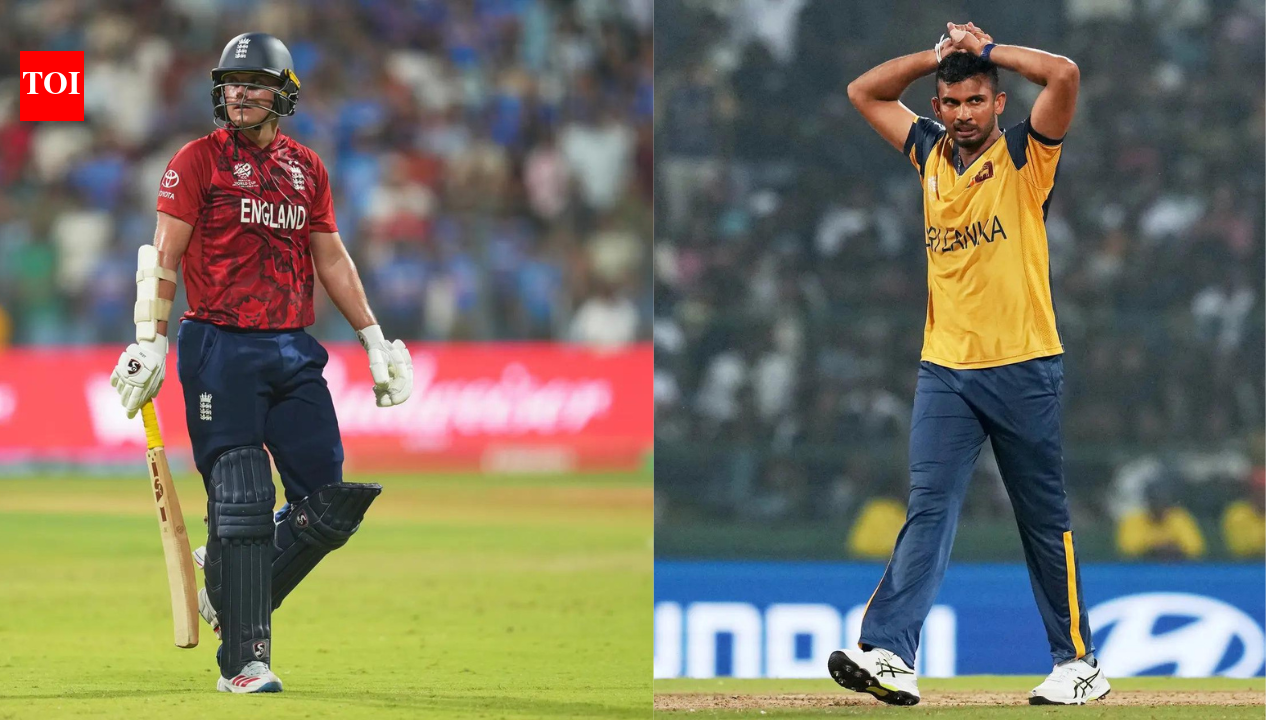
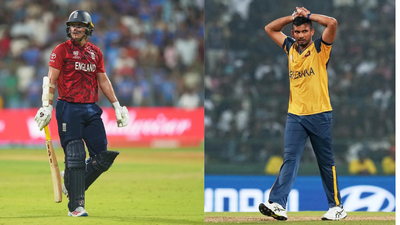
Sam Curran and Dasun Shanaka (Agency Image)

Rajasthan Royals head coach Kumar Sangakkara has expressed disappointment over the absence of Sam Curran from the IPL 2026 season, calling it a significant setback for the franchise. The England all-rounder has been ruled out due to a groin injury just days before the tournament begins.In response, the Royals have moved swiftly to bring in Dasun Shanaka as Curran’s replacement, with the Sri Lankan T20I captain confirmed in an official announcement on Monday.Curran had arrived at Rajasthan Royals as part of a blockbuster pre-auction trade involving Chennai Super Kings. The deal saw CSK secure Sanju Samson, while the Royals acquired Curran alongside Ravindra Jadeja. However, his injury has now forced an early exit before he could make an impact this season.“We are disappointed to lose a player of Sam’s calibre so close to the start of the season,” said Sangakkara, who serves as Director of Cricket and Head Coach at Rajasthan Royals.“Sam brings immense value with both bat and ball. However, we are pleased to have found an ideal replacement in Dasun Shanaka, a finisher with the bat and a quality all-rounder who helps maintain the balance of our side,” he added.Shanaka arrives with considerable T20 experience and is expected to slot into the lower middle order, offering both finishing ability and all-round depth. He previously featured in the IPL during the 2023 season for Gujarat Titans, where he played three matches.Shanaka’s move to RR makes him the second international player after Zimbabwe’s Blessing Muzarabani to leave the Pakistan Super League for a stint in the Indian Premier League.Rajasthan Royals will open their IPL 2026 campaign against Chennai Super Kings on March 30 at the Barsapara Cricket Stadium. Following that clash, they are scheduled to face Gujarat Titans on April 4, Mumbai Indians on April 7, and Royal Challengers Bengaluru on April 10.

Banner Insert


Source link

Oil price dips! Brent slips below $100 as Trump delays strike on Iranian power plants


Oil price dips! Brent slips below $100 as Trump delays strike on Iranian power plants

Oil prices tumbled sharply on Monday after US President Donald Trump ordered a five-day halt to planned military strikes on Iranian power plants and energy infrastructure, easing fears of escalation in the Middle East conflict.Brent crude fell more than 13% during the session, dropping to a low of $96 per barrel after trading above $104 earlier in the day. US benchmark West Texas Intermediate (WTI) also slid sharply, falling to a session low of $85.28.By 1130 GMT, Brent was down 7.2% at around $104.1 per barrel, while WTI was down 7.8% at $90.55. Both benchmarks had earlier recorded steeper intraday losses of up to 15% and 13.5%, respectively.On India’s Multi Commodity Exchange, crude oil for April delivery initially rose Rs 362, or 4%, to an intraday high of Rs 9,620 per barrel. However, prices later reversed sharply, plunging Rs 827, or 9%, to Rs 8,431 per barrel, hitting the lower circuit limit, PTI reported.The surge came as the Middle East conflict pushed oil prices above $100 per barrel after Iran’s attacks on vessels disrupted traffic through the Strait of Hormuz, a key global oil transit route.Earlier in a post on Truth Social, Trump said he has “instructed the Department of War to postpone all military strikes against Iranian power plants and energy infrastructure for a five-day period.”He added that the pause was subject to the “success” of ongoing “meetings and discussions”.“Over the last two days, Washington and Tehran have had very good and productive conversations regarding a complete and total resolution of our hostilities in the Middle East,” Trump said.Earlier, Trump had warned Iran to reopen the Strait of Hormuz within 48 hours or face military action targeting key energy facilities. Tehran had responded by threatening to “irreversibly destroy” critical infrastructure across the region including water systems, and to target power plants supplying electricity to US bases.The temporary de-escalation has eased concerns over supply disruptions, triggering a sharp fall in oil prices after last week’s rally.However, the broader outlook remains uncertain. The International Energy Agency (IEA) had earlier warned that the ongoing conflict has triggered a global energy crisis.Speaking at the National Press Club in Australia, IEA chief Fatih Birol said, “This crisis as things stand is now two oil crises and one gas crash put all together.” He cautioned that the global economy faces serious risks, adding, “The global economy is facing a major, major threat today, and I very much hope that this issue will be resolved as soon as possible.” Birol further warned that “no country will be immune to the effects of this crisis if it continues to go in this direction,” stressing the need for coordinated global action.


Source link

Sathankulam custodial deaths: 9 cops convicted 5 years after father, son killed in Tamil Nadu | India News


Sathankulam custodial deaths: 9 cops convicted 5 years after father, son killed in Tamil Nadu

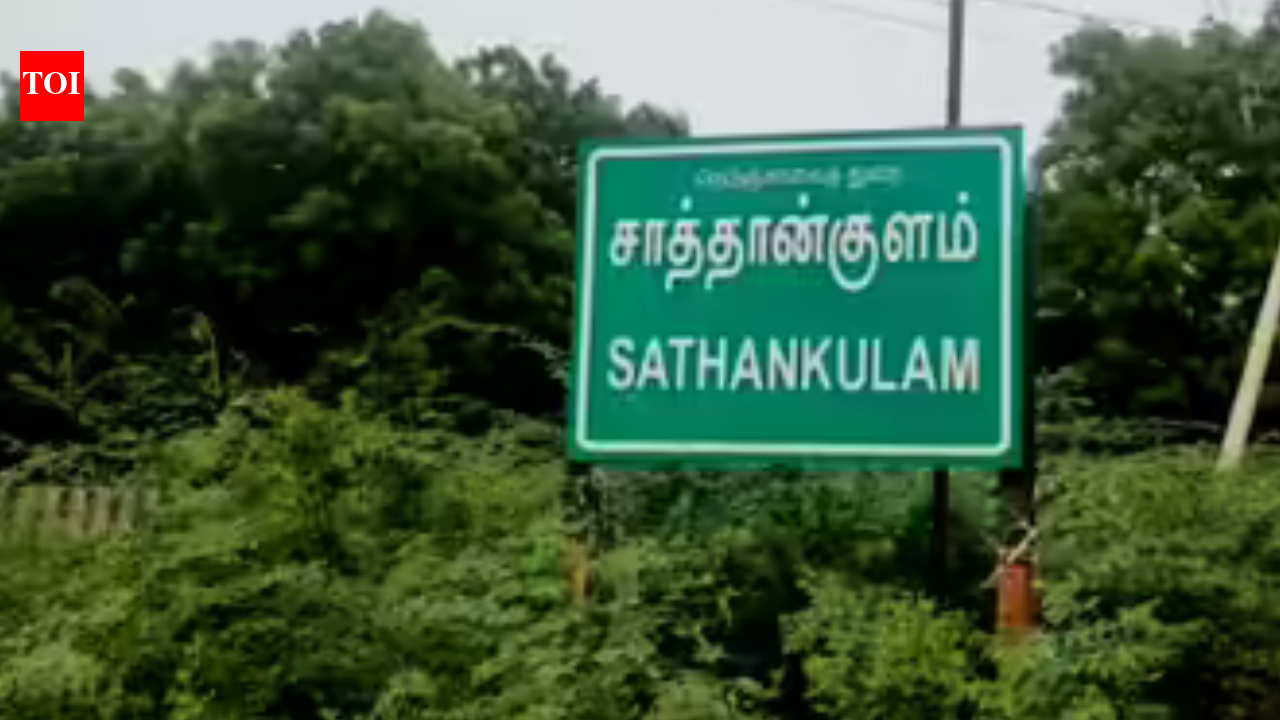
A court in Tamil Nadu on Monday found all nine accused policemen guilty in the 2020 custodial torture and deaths of a father and son in Sathankulam.The First Additional District and Sessions Court in Madurai delivered its judgment in the case related to the deaths of P Jeyaraj and his son J Beniks, who died after alleged custodial torture in Sathankulam in Thoothukudi district in June 2020.Ten policemen, who were subsequently placed under suspension, were arrested in connection with the case. The accused included inspector Sridhar; sub-inspectors Balakrishnan and Raghu Ganesh; head constables Murugan and A Samadurai; and constables M. Muthuraja, S Chelladurai, X Thomas Francis and S Vailmuthu, along with special sub-inspector Paldurai. They were lodged in Madurai Central Prison following their arrest.Paldurai later died of Covid-19.The Central Bureau of Investigation (CBI), which took over the probe, filed its chargesheet against the remaining nine policemen on September 25, 2020. A supplementary chargesheet was submitted on August 12, 2022 after further investigation.The CBI said that Beniks had gone to the Sathankulam police station after his father, Jeyaraj, was detained there, seeking an explanation for the detention. According to the agency, a scuffle broke out between Beniks and the policemen, following which inspector Sridhar allegedly intervened and directed the officers to teach him a lesson on “how to behave with police.”The CBI alleged that both Jeyaraj and Beniks were then subjected to repeated rounds of custodial torture, during which their clothes were removed, further intensifying the brutality.The investigation also found that the following morning, Sridhar allegedly instructed a sweeper to clean the floor of the main hall and other areas of the police station in an attempt to destroy evidence. The agency said the victims’ blood-stained clothes were changed twice before they were taken to the hospital, and again at the hospital before they were produced for remand. The discarded clothes were allegedly thrown into a hospital dustbin to eliminate evidence.The probe further revealed that Jeyaraj and Beniks had not violated Covid-19 lockdown norms and that no altercation had taken place between them and the police on Kamarajar Salai in Sathankulam on the evening of June 19. According to the CBI, a false case had been registered against the two men.A total of 105 witnesses were examined in the case, including Selvarani, the wife of Jeyaraj, and R Revathi, who was then serving as a woman head constable at the Sathankulam police station, as cited by PTI.The court also examined 116 documents as evidence, including the judicial inquiry reports related to the deaths of Jeyaraj and Beniks.


Source link