Breaking News
New Zealand’s top wicket-taker Rachin Ravindra makes heads turn — now with his bowling | Cricket News


New Zealand's top wicket-taker Rachin Ravindra makes heads turn — now with his bowling
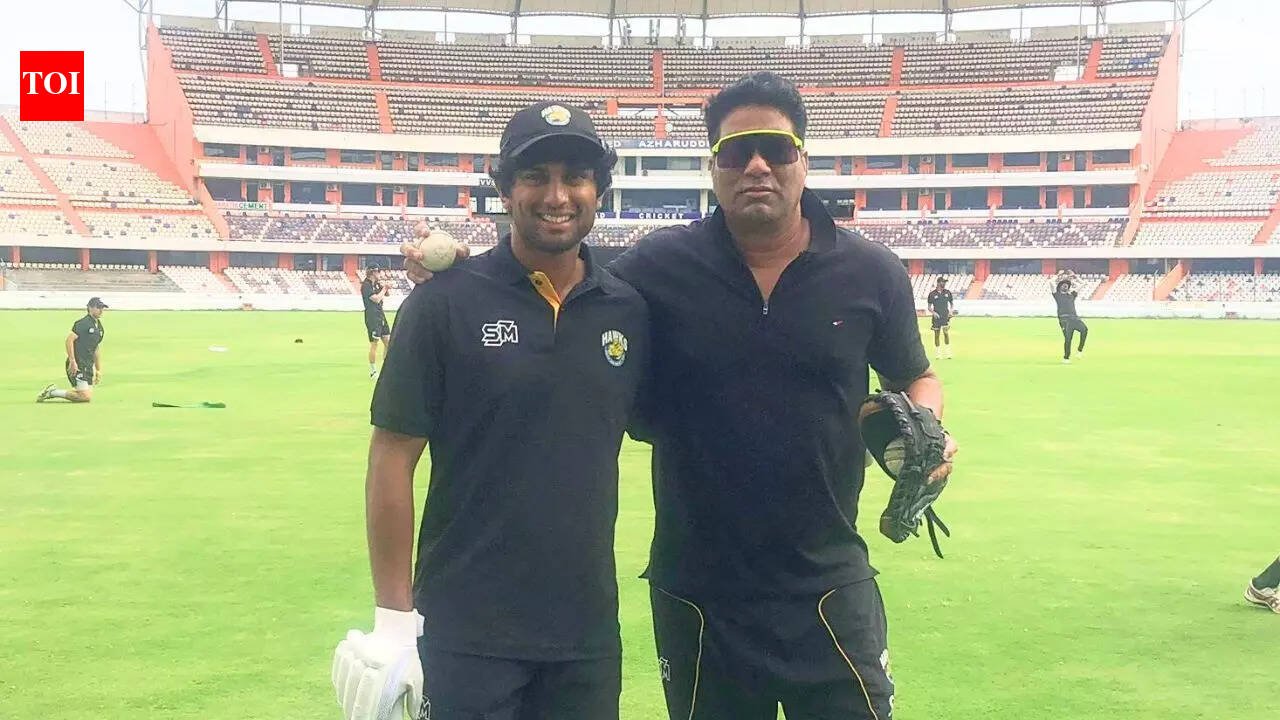
Syed Shahabuddin with Rachin Ravindra (Special Arrangements)

NEW DELHI: Do you still remember what happened to New Zealand all-rounder Rachin Ravindra in IPL 2024? Spin chewed his batting up and spat it out. And the situation became so severe that Chennai Super Kings (CSK) were forced to drop him mid-way through the season. As they say, time is the best healer. And for Ravindra, it has surely become one. Spin, once Ravindra’s archnemesis, has inflicted the same pain on batters who have padded up to face the Kiwi during this T20 World Cup, with his fingers doing all the talking with the ball.

Can India erase bad memories in Ahmedabad with T20 World Cup title? Pressure will be key!

Emerging as his team’s top-wicket taker (11) in this edition, Ravindra is now seeing things differently. While his batting pedigree initially dominated the limelight, two more dismissals in the final against India will be enough to make him New Zealand’s joint highest wicket-taker in an edition of the tournament. A single dismissal will result in Ravindra surpassing Daniel Vettori as the Black Caps’ most successful spinner in a T20 World Cup campaign. If we broaden the scale a bit, the left-arm finger spinner has accounted for 11 dismissals in 8 matches at an economy rate of 6.88, trailing the edition’s most successful spinners Varun Chakaravarthy and Adil Rashid by just two wickets.

‘Impact, role similar to Yuvraj Singh in WC 2011’

While Ravindra’s heroics may have caught the opposition and fans by surprise, Sriram Krishnamurthy, the global head coach of CSK academy, certainly isn’t one of them. Krishnamurthy, who has worked extensively with the 26-year-old cricketer, highlighted his bowling as one of the standout aspects from the beginning, terming it as something which came very naturally.
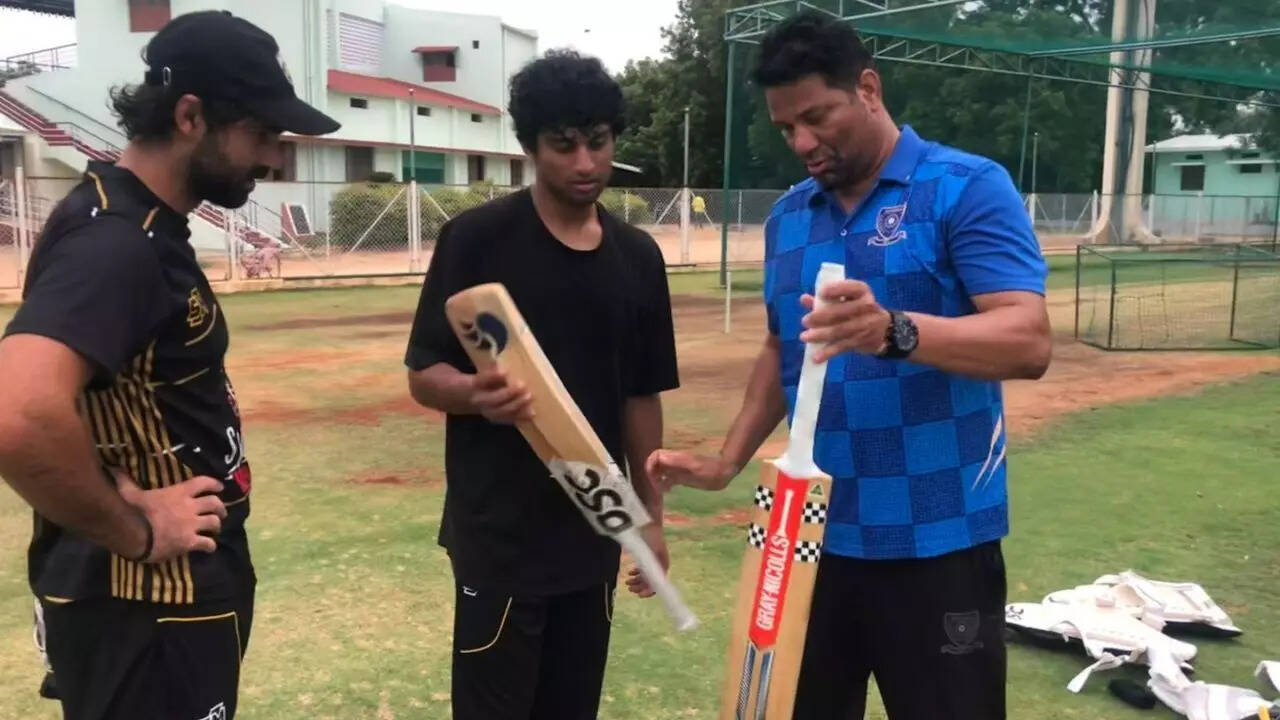
Syed Shahabuddin during a training session with Rachin Ravindra

Syed Shahabuddin during a training session with Rachin Ravindra (Special Arrangements)

“Rachin is very good at reading the game. He’s not someone who bowls a lot during practice sessions. Yet, when he takes the ball, you know he’ll be able to do some special things. Rachin has excelled with the ball in the MLC and the Hundred, which makes his current performances no surprise. New Zealand captain Mitchell Santner has used him very well,” said Sriram during an exclusive interaction with TimesofIndia.com.“Every spell of Rachin has left an impact. One of the most noteworthy aspects has been the manner in which he has struck against left-handed batters, being a lefty spinner in an unfavourable match-up, which especially stood out in the semi-final against South Africa with David Miller’s dismissal. I don’t think many people would disagree that his impact and role has been similar to that of Yuvraj Singh in the 2011 World Cup,” he added.Ravindra has provided an edge to the New Zealand bowling attack, with his shrewd gameplay and quality preparation, which first reflected in the opener against Afghanistan in Chennai. The 26-year-old all-rounder was handed the ball in the 18th over, which could have backfired massively. However, Rachin kept the ball well out of the batters’ reach from the onset, and was duly rewarded with the dismissal of dangerman Gulbadin Naib off his second delivery. The New Zealand cricketer has observed Ravindra Jadeja closely at CSK, resulting in valuable inputs.

‘Hard grind in Hyderabad before T20 WC 2026’

Another significant factor behind Rachin’s current success is an intense one-month camp in Hyderabad before the T20 World Cup, where the all-rounder worked extensively on hitting the right areas and variations. The New Zealand cricketer trained under ex-Andhra Pradesh captain Syed Shahabuddin, who urged him to bowl stump-to-stump and as per the field placements.“Ravindra can be lethal with assistance from the wicket, considering his consistency. I had encouraged the CSK team management to give him more opportunities with the ball but he hardly got one to two overs. Santner and the New Zealand think-tank is showing great belief in Ravindra’s bowling, which has proved to be a game-changer,” shared Shahabuddin.
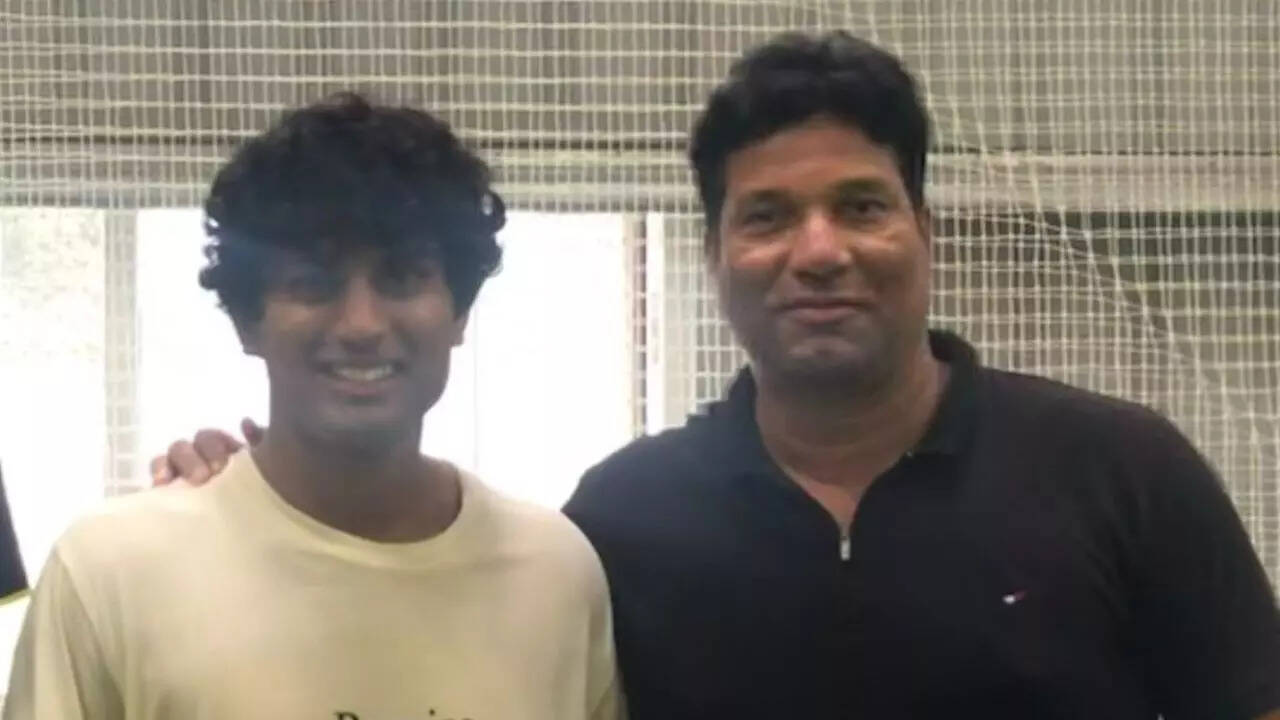
Syed Shahabuddin with Rachin Ravindra

Syed Shahabuddin with Rachin Ravindra (Special Arrangements)

While the fingerspinner has impressed with his high-impact gameplay, he once lacked agility and speed which hampered effectiveness. Former New Zealand coach Glenn Pocknall played a key role in enabling Ravindra to bowl at a quicker pace and deliver longer spells by developing his strength. The all-rounder showcased great dedication, training for six hours a day.“I first saw Rachin bowl at 15 and was deeply impressed by his unbelievable control and aura. It is very challenging to face him on flat wickets as well as turning tracks because he can spin the ball hard and into the wicket. Ex-New Zealand spinner Jeetan Patel has guided him extensively and I fully expect Rachin to pose a threat against India,” shared Pocknall.

‘Varun Chakaravarthy would’ve picked 15 wickets playing in Sri Lanka’

Chakaravarthy’s personal coach AC Prathiban praised Ravindra’s tactical astuteness, highlighting the lack of room for batters as well as the crafty use of angles to exploit the longer ends of the ground. However, Prathiban also directed focus towards New Zealand playing a lot of matches in Sri Lanka, where the advantage of bigger boundaries comes into play.
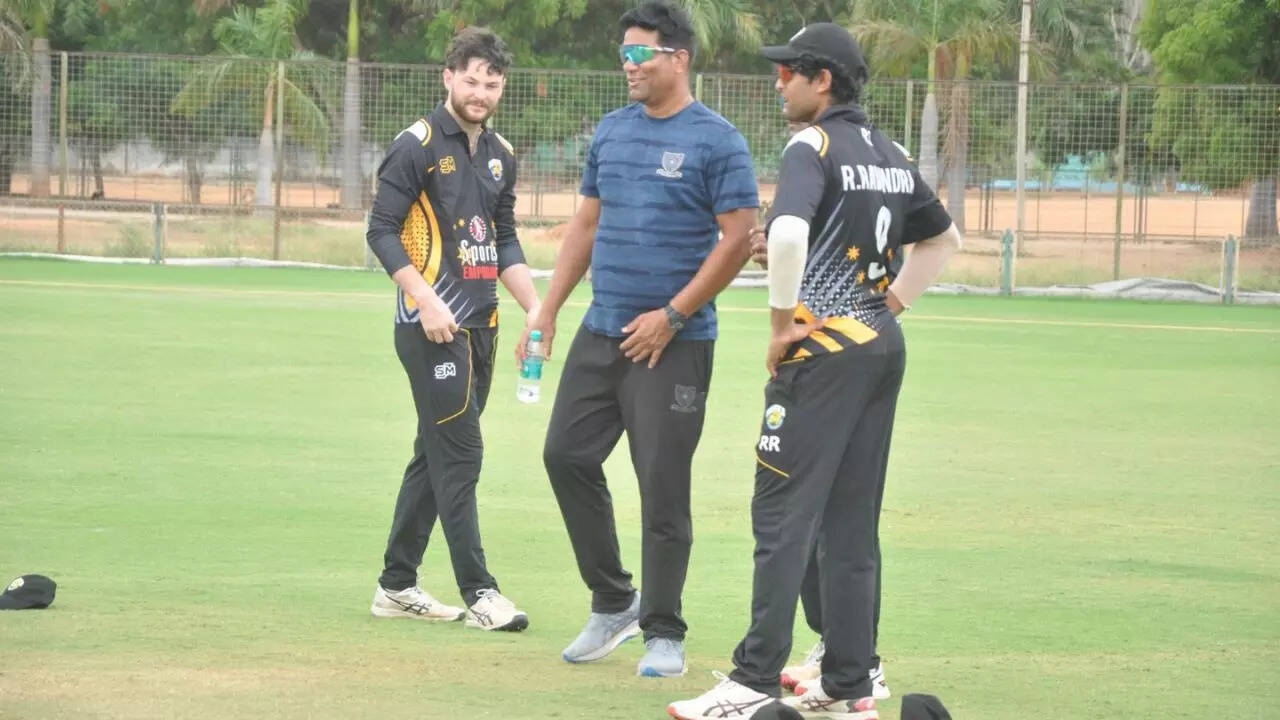
Syed Shahabuddin during a training session with Rachin Ravindra

Syed Shahabuddin during a training session with Rachin Ravindra

“Jasprit Bumrah and Varun would have picked 15 wickets at least if the Indian team had bowled as much in those conditions. Mishits were going for sixes during the semi-final at the Wankhede. However, credit to Rachin for doing his homework,” stated Prathiban.Ravindra revealed a desire to make a batter’s life as hard as possible during an interaction after New Zealand secured a spot in the final, which the Indian juggernaut will be well wary of.




Source link

Lpg Cylinder Price Hike: ‘We are poor, Rs 60 hike a lot’: Public raises concerns over LPG cylinder price increase; check city-wise rates | Delhi News


NEW DELHI: An increase in domestic LPG cylinder prices by Rs 60 on Saturday has sparked concerns among the public, with many expressing concerns about the difficulty of managing household budgets. Domestic LPG cylinder prices have been increased with effect from Saturday, March 7, with the cost of a 14.2-kg household cooking gas cylinder rising by Rs 60 across the country. The price of a 19-kg commercial LPG cylinder has also been raised by Rs 115.

LPG Cylinder Price Rise Heats Up Inflation Debate As Opposition Targets Modi Government

A resident of Delhi, Anita, spoke to about how the increase makes it difficult to live in the national capital. “Our cylinder does not last for a month. Poor people have to face a lot of problems. We use up two cylinders in a month,” she said.Another resident voiced concern over the rising costs, suggesting that the hike in LPG prices could be a precursor to increases in petrol and diesel prices.“Today, the prices of the LPG cylinder have increased; soon, the prices of petrol and diesel will also rise. It will affect the common man,” she said. Salma, who is also a resident of Delhi, spoke about how the Rs 60 is a significant amount for lower-income families. “We are poor. Rs 60 is a lot for us. We earn all day long to eat at night,” she stated. In the Moradabad area of Uttar Pradesh, a local raised concerns about the price increase, stating that this can cause a lot of problems. “Rs 60 have increased in the price of the cylinder. There are a lot of problems,” she said. “I went to get the cylinder. Rs 60 have increased… The expenses will be more than the income if there is inflation,” another resident said. According to sources, the price of a 14.2-kg domestic LPG cylinder in Delhi has been increased from Rs 853 to Rs 913. In Mumbai, the price has risen from Rs 852.50 to Rs 912.50. In Kolkata, the rate has gone up from Rs 879 to Rs 939, while in Chennai it has increased from Rs 868.50 to Rs 928.50. The revised prices came into effect immediately on Saturday.The hike also applies to commercial LPG cylinders used by businesses. In Delhi, the price of a 19-kg commercial cylinder has risen from Rs 1,768.50 to Rs 1,883. In Mumbai, the rate has increased from Rs 1,720.50 to Rs 1,835. Similarly, in Kolkata, the price has gone up from Rs 1,875.50 to Rs 1,990, while in Chennai it has climbed from Rs 1,929 to Rs 2,043.50.Earlier, the price of a domestic LPG cylinder had remained unchanged since April 2025, when the non-subsidised rate in Delhi stood at Rs 853. The latest revision marks a significant increase for both household consumers and commercial users who rely on LPG for daily operations.(With agency inputs)


Source link

David Miller questions ICC after England receive early charter flight following T20 World Cup 2026 exit


South Africa’s experienced batter David Miller has stirred controversy after publicly questioning the International Cricket Council (ICC) over what he believes to be unequal treatment regarding charter flight arrangements following teams’ exits from the T20 World Cup 2026. Miller’s comments came on social media after reports suggested that England were provided a charter flight earlier than both South Africa and the West Indies, despite being eliminated from the tournament later than the two teams.

The situation has gained attention within the cricketing community, especially as global travel schedules have been disrupted due to the ongoing USA-Israel vs Iran conflict, prompting the ICC to arrange special charter flights to help teams return home safely after their campaigns.

David Miller questions timing of England’s departure

The debate began after a report from ESPNcricinfo revealed that England were scheduled to depart via charter flight on Saturday, while South Africa and the West Indies were expected to leave a day later. The arrangement surprised many fans and players because both the Proteas and the Caribbean side had already been eliminated earlier in the tournament.

Reacting to the report on Instagram, Miller openly questioned the ICC’s decision.

He wrote that it was ‘funny’ England could leave immediately despite being knocked out after South Africa and the West Indies. According to Miller, both teams had been waiting for clarity about their travel plans while England’s departure appeared to be arranged quickly.

His comment quickly attracted attention from fans and members of the cricket fraternity, with many debating whether the scheduling decision was simply logistical or indicative of preferential treatment.

Daren Sammy backs Miller’s frustration

West Indies head coach Daren Sammy soon joined the discussion, backing Miller’s concerns in the comment section of the same post. Sammy responded humorously but pointedly, asking Miller to repeat the issue ‘a little louder for those in the back.’

Miller continued the conversation by suggesting that England’s charter flight appeared to be organised swiftly while other teams were still waiting.

He claimed the West Indies had already been waiting around seven days for a confirmed charter flight, while South Africa had been waiting for several days as well. His comments hinted at frustration among teams whose travel arrangements were yet to be finalised.

Also READ: Ahmedabad braces for India vs New Zealand T20 World Cup 2026 final as police announce special traffic plan

Timeline of eliminations adds to controversy

The timeline of eliminations has further fueled the debate. The West Indies were knocked out of the tournament on March 1, ending their campaign earlier than several other teams. South Africa exited three days later, following their defeat in the semi-finals.

England, meanwhile, were eliminated shortly afterward when India defeated them in a dramatic second semi-final to secure their place in the final.

Because England were technically eliminated later, Miller’s remarks questioned why they were able to depart earlier while the teams knocked out beforehand were still awaiting travel confirmation.

Also READ: T20 World Cup 2026 Final: Broadcast, Live Streaming details: When and where to watch in India, Pakistan, USA, UK & other countries


Source link

Market recap: Mcap of 8 of top-10 most valued firms wipes out Rs 2.81 lakh cr; State Bank biggest laggard


Market recap: Mcap of 8 of top-10 most valued firms wipes out Rs 2.81 lakh cr; State Bank biggest laggard

Dalal Street ended last week in red with eight of India’s ten most valuable companies together losing Rs 2,81,581.53 crore in market value. State Bank of India emerged as the biggest laggard during the period. The broader market also saw heavy selling pressure. The BSE benchmark index dropped 2,368.29 points, or 2.91%, over the week. “Markets ended the holiday-shortened week with steep losses as escalating geopolitical tensions in West Asia and a sharp spike in crude oil prices weighed heavily on investor sentiment,” Ajit Mishra, SVP, Research, Religare Broking Ltd, said. Among the top-10 firms by market capitalisation, only two, Reliance Industries and Infosys, managed to register gains. The remaining eight companies saw their valuations shrink. State Bank of India recorded the sharpest decline, with its market capitalisation falling by Rs 53,952.96 crore to Rs 10,55,567.27 crore. Private sector lenders also faced sizeable losses. ICICI Bank’s valuation fell by Rs 46,936.82 crore to Rs 9,40,049.82 crore, while HDFC Bank’s market capitalisation declined by Rs 46,552.3 crore to Rs 13,19,107.08 crore. Larsen & Toubro also witnessed a notable fall in value, with its market capitalisation sliding by Rs 45,629.03 crore to Rs 5,43,208.36 crore. Financial services firm Bajaj Finance saw its valuation contract by Rs 28,934.56 crore to Rs 5,91,136.03 crore. Meanwhile, Tata Consultancy Services (TCS) lost Rs 28,492.44 crore in market value, taking its total market capitalisation to Rs 9,25,380.15 crore. Consumer goods major Hindustan Unilever registered a decline of Rs 26,350.67 crore, bringing its market capitalisation down to Rs 5,23,042.51 crore. Telecom operator Bharti Airtel also posted a marginal drop of Rs 4,732.75 crore to Rs 10,67,120.50 crore. In contrast, Reliance Industries added Rs 14,750.39 crore to its market value, pushing its valuation to Rs 19,01,583.05 crore. Infosys too ended the week in positive territory, with its market capitalisation rising by Rs 3,459.99 crore to Rs 5,30,546.54 crore. Reliance Industries retained its position as India’s most valued company, followed by HDFC Bank, Bharti Airtel, State Bank of India, ICICI Bank, TCS, Bajaj Finance, Larsen & Toubro, Infosys and Hindustan Unilever.


Source link

No block on Western Railway suburban today | Mumbai News


Image used for representational purpose only

MUMBAI : There will be rail block during daytime today over Western Railway suburban section and this will be relief to commuters travelling by local trains.Earlier, between 1 am and 4.30 am on Sunday, the WR operated a block on the Up and Down slow lines between Mahim and Santacruz stations for maintenance of track, signalling systems and overhead equipment.An official said that during the block period all Down slow line trains were operated on the Down fast line between Mumbai Central and Santacruz stations. Due to inadequate platform length, these trains will halt twice at Lower Parel, Mahim and Khar Road stations and will not halt at Mahalaxmi, Prabhadevi and Matunga Road stations for want of platform. Also, some suburban services will remain cancelled during the block period.


Source link

Brace for megablocks on Central Railway Main, Harbour lines today | Mumbai News


MUMBAI : Central Railway, Mumbai division will operate megablock on its suburban sections to carry out various engineering and maintenance works today.On Main line, the block is on Matunga-Mulund Up and Down fast lines from 11.20 am to 3.45 pm.The Up fast line services leaving Thane from 11.03 am to 3.38 pm will be diverted on Up slow line at Mulund station halting as per their respective schedule halts between Mulund and Matunga stations, will be re-diverted on Up fast line at Matunga station and will arrive destination 15 minutes behind schedule.On Harbour Line, the block will be undertaken between Kurla and Vashi stations from 11.10 am to 4.10 pm. Special suburban trains will run on CSMT Mumbai – Kurla & Panvel – Vashi sections during the block period. Harbour line passengers are permitted to travel via Thane-Vashi/Nerul route till 6 pm.


Source link

FPIs turn sellers: Foreign portfolio investors withdraw Rs 21,000 crore amid Middle East tensions


FPIs turn sellers: Foreign portfolio investors withdraw Rs 21,000 crore amid Middle East tensions

Foreign portfolio investors (FPIs) turned heavy sellers in Indian equities during the first week of March, pulling out nearly Rs 21,000 crore (about $2.3 billion) over four trading sessions as global risk appetite weakened amid escalating tensions in the Middle East The withdrawals came between March 2 and March 6 in the cash market. Trading activity during the period was limited to four sessions as March 3 remained closed for the Holi holiday. The fresh round of selling follows a strong February when overseas investors had infused Rs 22,615 crore into Indian stocks, the highest monthly inflow in 17 months. Prior to that rebound, however, FPIs had remained net sellers for three consecutive months. They withdrew Rs 35,962 crore in January, Rs 22,611 crore in December and Rs 3,765 crore in November, according to data from depositories. Analysts said the latest outflows were largely driven by rising geopolitical tensions in Middle East after the United States and Israel launched a major attack on Iran on February 28 which killed Iran’s Supreme Leader Ayatollah Ali Khamenei, triggering conflict in the region. Vaqarjaved Khan, Senior Fundamental Analyst at Angel One, said fears over possible disruptions in the Strait of Hormuz pushed Brent crude prices above $90 per barrel, triggering a global risk-off sentiment. Khan also highlighted several additional pressures influencing foreign investors. These include the depreciation of the rupee beyond the 92-per-dollar mark, rising US Treasury yields that are drawing capital back to safe-haven assets, and an uncertain early outlook for corporate earnings in the fourth quarter of FY26, particularly due to margin pressures in the IT and consumption sectors. VK Vijayakumar, Chief Investment Strategist at Geojit Investments, said, “uncertainty surrounding the Middle East conflict, the recent market correction, the Indian economy’s vulnerability to a sharp rise in crude prices, and the depreciation of the rupee have all contributed to sustained FPI selling in the cash market”. Himanshu Srivastava, Principal Manager Research at Morningstar Investment Research India, said that elevated crude oil prices raise concerns over inflation, the current account deficit and currency stability, factors that typically weaken foreign investor sentiment towards emerging markets. He also noted that global investors have been increasingly shifting funds into safer assets such as the US dollar amid growing uncertainty. The recent rise in US Treasury yields during the week further accelerated capital outflows from emerging markets. Looking ahead, Vijayakumar said overseas investors may remain cautious until the geopolitical situation becomes clearer and crude prices ease. “Brent crude trading above $90 per barrel is negative for the Indian economy and equity markets,” he said. Despite persistent selling by foreign investors, Indian markets have continued to find support from domestic institutional investors (DIIs), along with steady inflows through mutual fund systematic investment plans (SIPs).


Source link

Interstellar, Einstein and the strange elasticity of time | Mumbai News


Interstellar, Einstein and the strange elasticity of time

In Christopher Nolan’s Interstellar, astronauts land on a planet orbiting close to a black hole. They spend a few hours on its surface. When they return to their spacecraft, they discover that 23 years have passed on Earth. Children have grown up. A lifetime has slipped away.It feels like science fiction, but it’s not fantasy. Einstein’s theory of relativity showed that time is not absolute. It slows down when you move close to the speed of light. It also slows down in strong gravitational fields. The closer you are to a massive object, like a black hole, the more spacetime curves, and the slower time passes for you compared to someone farther away.Atomic clocks on fast-moving aircraft tick slightly slower than identical clocks on the ground. GPS satellites must constantly adjust for relativistic effects. Without those corrections, our navigation systems would drift by kilometres each day.Gravity bends time. The universe does not run on a single master clock. And yet, concepts like the “fourth dimension” or “time relativity” are often dismissed as abstract science fiction ideas.But a generational shift is quietly taking place. We’re moving from merely thinking about these ideas, to feeling their reality, to living in them. “Tesseract” is inspired by my 12-year-old grandson, whom we watched become completely absorbed in Interstellar. Hans Zimmer’s haunting organ theme became his favourite piece to play on the piano, and again and again, he returned to it.

(AI image)

The music itself feels like time unfolding. Slow, expansive, layered, almost architectural. It rises and circles back, like something moving through dimensions we cannot see.One evening, our conversation drifted to the film’s most mind-bending idea: the tesseract – a four-dimensional hypercube. In the movie, time is represented as a physical dimension, something you can move through, like space.To explain it, he reached for paper. Through simple folds of origami, he showed how a two-dimensional square can be unfolded into a three-dimensional cube. Then he asked: if a cube can unfold into something beyond itself, why not imagine a four-dimensional version, a hypercube, unfolding in ways our eyes cannot fully perceive?It was curiosity in motion, a physics lecture from my grandson, who teaches me something new every time I meet him, without fail. For many adults, such ideas still feel abstract. But younger generations are growing up immersed in them, through films, games, simulations, science channels and digital visualisations. They are comfortable imagining spacetime as fabric, dimensions beyond the visible, universes bending under gravity. And perhaps more importantly, they intuitively grasp something about relativity long before they encounter equations.Tell ten children to meditate for five minutes and ask them to open their eyes when they think the time is up. None will stop together, because five minutes on a clock is fixed, but five minutes in the mind is elastic.When bored, time drags. When immersed, in music, in coding, in conversation…it vanishes. Psychologists call this “flow,” a state where attention is so complete that awareness of time dissolves.There are, in fact, multiple layers of relativity in our lives. There’s physical relativity, the Einsteinian bending of spacetime through gravity and velocity. Then there’s psychological relativity, the stretching and compressing of time through emotion, mental state, and attention. And perhaps there’s generational relativity: the way each generation inhabits these ideas differently.For those raised before the digital age, the fourth dimension may feel theoretical. For those raised within immersive storytelling and interactive media, it feels experiential. They don’t merely read about warped spacetime; they visualise it, feel it hear it, model it, and in some sense, live inside it.Many of us assume that children must be taught these concepts from scratch. But often, they are already thinking about them, just in different language. They may not speak of “spacetime curvature,” but they understand that time feels different in different situations. They may not derive equations, but they can imagine moving through dimensions.They will speak about it, but only if they sense genuine curiosity. If we approach children not as teachers, but as their students; if we ask how they imagine the fourth dimension; if we ask what the music makes them feel; if we are willing to truly learn from them.Science fiction once felt like speculation about distant futures. Increasingly, it is becoming a shared cultural vocabulary for thinking about reality itself.Einstein bent time with mathematics. Filmmakers visualised it. Musicians gave it sound. And children are quietly absorbing it, not as fantasy, but as possibility. Perhaps the elasticity of time is not only a feature of black holes, but also a feature of imagination, stretching across generations, waiting to be unfolded. And sometimes, the doorway into the fourth dimension begins not with equations, but with curiosity – and a simple sheet of paper folded into something more than it first appeared.Experience “Tesseract: The Geometry of Truth”, running from 16 to 22 March 2026 at NCPA Mumbai. Book here


Source link

Nitish Kumar’s son Nishant enters politics, joins JD(U) | India News


Nitish Kumar's Son Nishant To Enter Politics, Will Join JD(U) Soon In Signal Of Big Power Shift

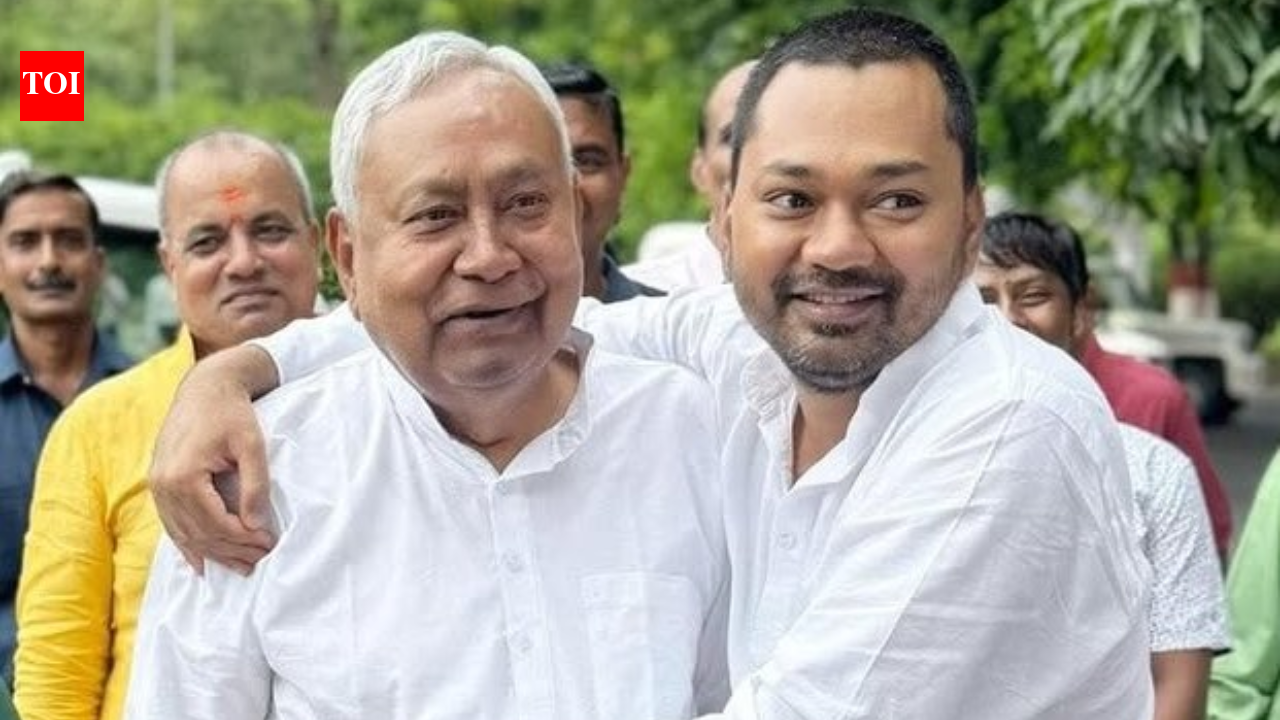
Nitish Kumar and son Nishant Kumar (Picture from X)

NEW DELHI: Bihar chief minister Nitish Kumar’s son Nishant Kumar on Sunday formally joined the JD(U), days after the party chief filed his nomination for a Rajya Sabha seat in the presence of Union home minister Amit Shah.On the rare occasions he has appeared in public, Nishant, an engineering student in his 40s, has earned goodwill for his humility. During brief interactions with the media, he has also shown that he closely follows the work carried out by his father.

Nitish Kumar’s Son Nishant To Enter Politics, Will Join JD(U) Soon In Signal Of Big Power Shift

Meanwhile, speculation is growing that Nishant could be made deputy chief minister in the new government.A close aide of Nitish Kumar claimed on Saturday that a “unanimous” decision had been taken to appoint Nishant as deputy chief minister in the government to be formed after his father’s resignation.As the longest-serving chief minister of Bihar, Nitish Kumar’s decision to step down from the top post has triggered speculation over his successor within the JD(U) and in state politics. Nishant Kumar has largely stayed away from active politics despite being the son of one of the most influential political figures in modern Bihar. Nitish Kumar’s decision to vacate the chief minister’s chair marks a key moment in the state’s political trajectory, potentially paving the way for new leadership in Bihar and possibly its first BJP chief minister. The shift could also signal the end of the long-running Lalu–Nitish era, with both leaders, political disciples of socialist veteran Jayaprakash Narayan, dominating the state’s politics for over three decades.“I seek to become a member of the Rajya Sabha in the elections being held this time. I want to assure you with complete honesty that my relationship with you will continue in the future as well, and my resolve to work together with you to build a developed Bihar will remain steadfast. The new government that will be formed will have my full cooperation and guidance,” the 75-year-old politician announced on X.Although many had anticipated the move amid speculation about his declining health, Nitish Kumar’s sudden announcement still surprised many who expected a smoother transition plan. In the coming days, he is expected to be elected unopposed to the Rajya Sabha, following which he will step down as chief minister.The Janata Dal (United) chief’s decision not only brings to a close the political lineage of leaders such as Jayaprakash Narayan, Ram Manohar Lohia and Karpoori Thakur in Bihar, but also pushes the party into uncharted territory, with no clear roadmap for the future.


Source link

South Africa players slam ICC after England fly home while SA, WI remain stranded in India | Cricket News


'Strange': South Africa players slam ICC after England fly home while SA, WI remain stranded in India
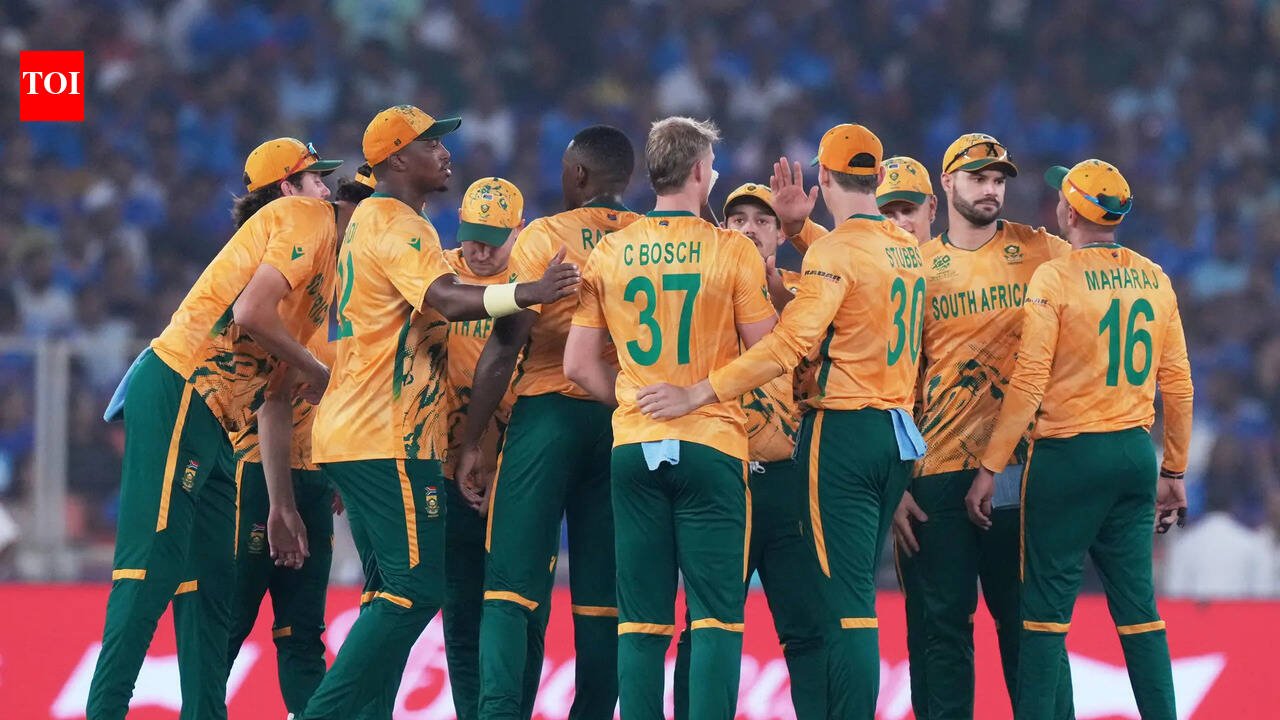
South Africa’s players (AP Photo/Ajit Solanki)

Players from South Africa and West Indies have questioned the travel arrangements after their exit from the ICC Men’s T20 World Cup 2026, claiming some teams were given priority flights home. While England national cricket team left Mumbai on a charter flight to London on Saturday after their semifinal loss, the South Africa national cricket team and West Indies national cricket team are still waiting in India due to flight disruptions linked to tensions involving the United States, Israel and Iran.

T20 World Cup: Suryakumar Yadav press conference before IND vs NZ

South Africa were knocked out after losing to New Zealand national cricket team in the first semifinal in Kolkata, while West Indies exited following a five-wicket defeat to India national cricket team at Eden Gardens. Both teams are expected to travel together on a charter flight from Kolkata, although the exact departure time is still unclear.South Africa wicketkeeper Quinton de Kock publicly criticised the situation on social media. He wrote, “Funny @icc, we have heard nothing! Meanwhile, England are leaving before us somehow? @westindies and @proteasmencsa are just in the dark! Strange how different teams have more pull than others.”His teammate David Miller echoed the frustration, commenting, “Funny that England gets eliminated after WI & SA and gets on a charter back home tonight. While WI & SA still wait for answers in Kolkata.”West Indies head coach Daren Sammy supported the criticism, replying, “@davidmillersa12 a lil louder for those in the back to hear please sir.”Former England captain Michael Vaughan also questioned the situation, writing, “So England got knocked out on Thurs, get a charter home today .. West Indies go out last Sunday and are still in Kolkata .. SA in the same position .. That’s where the power is all wrong ..”He added, “All teams in this situation should be treated the same .. just because you are more powerful at the ICC table shouldn’t count .. #JustSaying.”The South Africa and West Indies squads are expected to fly to Johannesburg first, with the Caribbean team then continuing to Antigua. Meanwhile, the tournament final between India and New Zealand is set to take place at Narendra Modi Stadium.


Source link