Breaking News
IND vs NZ: ICC names the umpires and match referee for T20 World Cup 2026 final


The International Cricket Council (ICC) has revealed the official match officials for the highly anticipated ICC Men’s T20 World Cup 2026 final between India and New Zealand. The championship clash will take place on Sunday, March 8, at the iconic Narendra Modi Stadium in Ahmedabad.

Richard Illingworth set for second consecutive T20 World Cup final

Veteran English umpire Richard Illingworth will officiate his second consecutive Men’s T20 World Cup final, further strengthening his reputation as one of cricket’s most trusted officials.

Illingworth previously stood in the 2024 T20 World Cup final, where India defeated South Africa at Kensington Oval in Bridgetown, Barbados. His appointment in this year’s title clash highlights the ICC’s continued confidence in his experience and decision-making in high-pressure matches.

The 62-year-old has been involved in several major ICC tournament finals in recent years. His resume includes the 2023 ICC Cricket World Cup final, also played at the Narendra Modi Stadium in Ahmedabad, and the 2025 ICC Champions Trophy final.

Having officiated previously at the same venue during the 2023 ODI World Cup final, Illingworth brings valuable familiarity with the stadium and its playing conditions. His presence is expected to add stability and credibility to the crucial encounter between India and New Zealand.

Alex Wharf to officiate first senior World Cup final

Joining Illingworth in the middle will be fellow English umpire Alex Wharf, who will officiate in his first senior ICC World Cup final.

The 50-year-old former cricketer represented Yorkshire and Glamorgan during his playing career before transitioning into umpiring. Over the years, Wharf has steadily built a strong reputation through consistent performances in international cricket.

He has previously officiated in several major tournaments, including the 2022 ICC Women’s Cricket World Cup and the 2023 ICC Men’s Cricket World Cup.

Wharf was promoted to the Emirates ICC Elite Panel of Umpires in 2025, a recognition of his growing stature among international officials. Earlier in the tournament, Wharf and Illingworth also worked together during New Zealand’s dominant semi-final victory over South Africa at Eden Gardens in Kolkata.

Their experience as a pair could help ensure smooth officiating in what promises to be a high-intensity final.

South Africa’s Allahuddien Paleker will serve as the TV umpire for the final. Paleker was elevated to the ICC Elite Panel of Umpires in March 2025 and has officiated in six matches during this year’s tournament.

Another South African official, Adrian Holdstock, will perform the duties of fourth umpire. Meanwhile, Zimbabwe’s Andy Pycroft, a member of the ICC Elite Panel of Match Referees, will oversee the match as referee and ensure all regulations are followed during the final.

Also READ: India or New Zealand? Brad Haddin picks the winner of T20 World Cup 2026

Narendra Modi Stadium ready for the grand finale

The India vs New Zealand T20 World Cup 2026 final will be staged at the Narendra Modi Stadium in Ahmedabad, widely recognized as the world’s largest cricket stadium.

With a seating capacity of more than 130,000 spectators, the venue is expected to host a packed crowd for the grand finale. Interestingly, this will be the second consecutive ICC event final contested between India and New Zealand, following their meeting in the 2025 ICC World Test Championship final.

With two strong teams ready to battle for the trophy and an experienced panel of match officials in charge, the stage is perfectly set for a thrilling conclusion to the T20 World Cup 2026. Cricket fans across the globe are eagerly awaiting what promises to be a memorable championship clash.


Also READ: Brendon McCullum reveals ‘defining factor’ behind England’s narrow defeat to India in T20 World Cup 2026 semi-final


Source link

Plumes of smoke, planes ablaze: Iran’s Mehrabad airport on fire as Israel launches airstrike – watch


Plumes of smoke, planes ablaze: Iran's Mehrabad airport on fire as Israel launches airstrike - watch

Israeli strikes hit Tehran on Saturday as the conflict between Iran, Israel and the United States intensified, with explosions reported at the capital’s Mehrabad International Airport and other parts of the city.Footage posted on social media showed strikes and large fires at Tehran’s Mehrabad International Airport, with eyewitnesses reporting burning planes on the tarmac after explosions rocked one of the Iranian capital’s main commercial airports.Israel said it had launched “broad-scale” strikes on targets in Tehran, while Iranian state media reported an explosion in the western part of the city. “The IDF (Israel Defense Forces) has begun a broad-scale wave of strikes” on government targets in the Iranian capital, an Israeli military statement said.

‘HELLFIRE OVER ISRAEL’: Iran Hits Ben Gurion Airport; Fires Fattah, Khorramshahr-4 Missiles | Watch

Follow US-Israel-Iran War Live UpdatesWitnesses described the Israeli airstrikes as particularly intense, saying the blasts shook homes and sent columns of smoke rising. Others reported explosions around the Iranian city of Kermanshah, an area home to several missile bases. The witnesses spoke anonymously for fear of retribution, as reported by AP.The Israeli military earlier said it had detected another round of Iranian missile fire headed toward Israel. A series of explosions was later heard in Tel Aviv following the launches.Israel’s emergency services, the Magen David Adom, said it received no reports of casualties after the barrage. The military later issued a statement saying people were free to leave their shelters “in all areas of the country.”As Israeli warplanes bombed Tehran and Beirut, Iran launched more retaliatory strikes against Israel and Gulf countries on the seventh day of the war. Many thunder-like booms were heard over Jerusalem shortly after midnight local time as Israel said it was working to intercept missiles launched from Iran.US Treasury Secretary Scott Bessent said in a television interview that the “biggest bombing campaign” of the war was still to come.The United States and Israel have carried out repeated strikes on Iran targeting its military capabilities, leadership and nuclear programme, as the goals and timelines of the war have continued to shift.The latest developments come after tensions in West Asia escalated following a joint US-Israel military strike on February 28 on Iranian territory that killed its Supreme Leader Ayatollah Ali Khamenei, along with other senior figures.In retaliation, Iran launched waves of drone and missile attacks across multiple Arab countries.


Source link

‘Indians been good actors’: Why US ‘agreed to let’ India resume buying Russian oil temporarily


'Indians been good actors': Why US 'agreed to let' India resume buying Russian oil temporarily

The United States has given “permission” to India to buy Russian oil already stranded at sea issuing a temporary waiver aimed at stabilising global oil supplies amid disruptions caused by the escalating conflict in West Asia.US President Donald Trump’s aide Scott Bessent referred to India as a “very good actor” for previously complying with Washington’s request to halt purchases of sanctioned Russian oil and said the temporary measure would help ease supply pressures in the global market.

US Allows India To Buy Russian Oil As Allies Offer Gas Supplies Amid Iran War And Hormuz Tensions

The move comes a day after Washington issued a 30-day waiver permitting the sale of Russian crude currently stranded at sea to continue to India.

US cites temporary supply concerns

Speaking to Fox Business, US treasury secretary Bessent said the decision was intended to ease short-term supply constraints during the ongoing crisis.“The world is very well supplied in oil. The Treasury (Department) agreed to let our allies in India start buying Russian oil that was already on the water,” Bessent said.“The Indians had been very good actors. We had asked them to stop buying sanctioned Russian oil this fall. They did. They were going to substitute it with US oil,” he said.“But to ease the temporary gap of oil around the world, we have given them permission to accept the Russian oil. We may unsanction other Russian oil,” he added.Bessent also noted that a large volume of sanctioned crude remains stranded at sea stating that, “There are hundreds of millions of sanctioned barrels of sanctioned crude on the water,” he said, adding that “by unsanctioning them, Treasury can create supply.”“And we are looking at that. We are going to keep a cadence of announcing measures to bring relief to the market during this conflict,” he added.

,

‘Short term measures to help keep oil prices down’

Other officials in the Trump administration have also confirmed that Washington has “permitted” India to buy Russian crude that is already loaded on ships.Earlier, US energy secretary Chris Wright said the step was intended to quickly move existing oil supplies into the market.“We have implemented short term measures to help keep oil prices down. We are allowing our friends in India to take oil that is already on ships, refine it, and move those barrels into the market quickly. A practical way to get supply flowing and ease pressure,” Wright said in a post on X.In an interview with ABC News Live, Wright emphasised that the measure was temporary.“But as oil gets bid up a little bit because of those constraints coming out of the Strait of Hormuz, we’re taking a short-term action to say all this floating Russian oil storage that’s around Southern Asia, it’s China just backed up, China does not treat their suppliers well, so there’s a bunch of floating barrels just sitting there,” he said.“We’ve reached out to our friends in India and said, ‘Buy that oil. Bring it into your refineries’. That pulls stored oil immediately into Indian refineries and releases the pressure on other refineries around the world to buy oil that they’re no longer competing with the Indians for in that marketplace,” Wright added.“So we have a number of measures like that that are short-term and temporary. This is no change in policy towards Russia. This is a very brief change in policy just to keep oil prices down a little bit better than we could otherwise,” he further noted.

Waiver amid Strait of Hormuz tensions

The US Treasury earlier issued an order granting a 30-day licence allowing delivery and sale of Russian crude and petroleum products to India. The decision comes as shipping routes through the strategically important Strait of Hormuz face disruptions due to the ongoing conflict in the region.“President Trump’s energy agenda has resulted in oil and gas production reaching the highest levels ever recorded. To enable oil to keep flowing into the global market, the Treasury Department is issuing a temporary 30-day waiver to allow Indian refiners to purchase Russian oil,” Bessent said earlier.He stressed that the step was a limited measure and would not significantly benefit Moscow.“This deliberately short-term measure will not provide significant financial benefit to the Russian government, as it only authorises transactions involving oil already stranded at sea,” he said.“India is an essential partner of the United States, and we fully anticipate that New Delhi will ramp up purchases of US oil. This stop-gap measure will alleviate pressure caused by Iran’s attempt to take global energy hostage,” he added.

India’s oil supply position

The move comes months after the Trump administration imposed 25% punitive tariffs on India over its purchases of Russian oil, arguing that such imports were helping finance Moscow’s war against Ukraine.However, the tariffs were later lifted after the two countries agreed on a framework for an interim trade agreement and India committed to reducing imports from Russia while increasing purchases of American energy.India currently imports nearly 5.5–5.6 million barrels of crude oil per day, accounting for about 90% of its domestic consumption. Officials say the country’s energy position remains comfortable despite the regional tensions.Around 15 million barrels of crude are currently on tankers in the Arabian Sea and the Bay of Bengal, while vessels carrying another seven million barrels are waiting near Singapore. Additional tankers in the Mediterranean and the Suez Canal are also heading towards Indian ports and could arrive within a week.According to data from Kpler, India imported slightly over 1 million barrels per day of Russian crude in February, compared with 1.1 million bpd in January and 1.2 million bpd in December.Before the Ukraine war in 2022, Russian crude accounted for just 0.2% of India’s imports, but purchases increased sharply after Moscow began offering deep discounts.


Source link

Infosys makes four days a week compulsory for more employees, HR says in email: It is imperative for us to lead by …


Infosys makes four days a week compulsory for more employees, HR says in email: It is imperative for us to lead by …

Infosys has reportedly asked more employees to work at least four days every week from the office. In an email to employees, the company noted that “it is imperative for us to lead by example” and that it would extend its existing four-day office mandate to employees at job level 6A and above in specific units. The policy previously applied to employees at job level 7 and above, including delivery managers, senior managers, and programme directors. The recent HR communication broadens that requirement to a lower job band, pointing to a phased rollout of stricter in-office expectations across the organisation.In the letter (seen by the Economic Times), Infosys wrote, Please note, as per our unit guidelines, JL6+ have to be in office four days a week,” adding that some employees had fallen short of the mandatory 10-day-a-month office attendance requirement. “We continue to follow a hybrid model of work that enables self-development, collaboration, innovation, and business deliverables, and as managers, it is imperative for us to lead by example and ensure our teams adhere to the hybrid working guidelines,” the email added. The email also noted that HR managers would be reviewing monthly return-to-office data for employees.]

How Infosys has been changing its hybrid work policies

The email follows a series of steps Infosys has taken to increase employee presence in the office. In January, the company added new conditions for employees seeking extra work-from-home days.At Infosys, each job level has two sublevels: B and A, with employees in band A moving to the next level upon promotion. A senior employee, who asked not to be named, told ET that while staff could previously choose any 10 days in a month to visit the office, recent emails have directed them to spread those visits across all four weeks.A second employee told ET “We haven’t been told to come to the office four days a week yet, but we are being asked to tell junior employees that they must come to the office regularly.”“My bosses come in only once a week, and it’s hard for me to convince my reportees to come in,” a third employee added.During the January earnings call, Infosys CEO Salil Parekh said there was no change to the company’s approach to the hybrid work model.

What Infosys rivals are handling hybrid working and what experts said

Like its competitors, Infosys has now done the same. In 2026, Wipro implemented a new policy requiring workers to report to work three days a week and spend at least 6 hours there. In a similar vein, TCS implemented a new policy at the start of the year mandating that its workers report to work five days a week, with their variable pay based on attendance.According to Anil Ethanur, co-founder of specialist staffing firm Xphen, “Productivity did improve for organisations that started allowing flexible working. However, the challenge for organisations is to maintain that over the long term.”“As market conditions tighten and margins come under pressure, organisations are focusing more on operational efficiency and output. Enterprises are integrating AI and automation into their processes, which requires tighter coordination and quicker iteration between teams… particularly for senior and critical talent, to maintain productivity and drive high-value outcomes,” Ethanur told ET.


Source link

‘Landed on US soil hoping to kill Trump’: IRGC operative convicted in US over murder-for-hire plot


'Landed on US soil hoping to kill Trump': IRGC operative convicted in US over murder-for-hire plot

An Iranian intelligence operative has been convicted by a US federal jury for terrorism and murder-for-hire offences linked to a foiled plot to assassinate American political figures, including President Donald Trump. Prosecutors said the man was sent to the United States by Iran’s powerful Islamic Revolutionary Guard Corps (IRGC) to organise political killings and other covert operations on American soil.The US Department of Justice said Asif Merchant, also known as Asif Raza Merchant, was found guilty of attempting to commit an act of terrorism transcending national boundaries and arranging murder for hire. Merchant faces up to life in prison. Authorities said he travelled to the United States in April 2024 with orders from the IRGC to recruit operatives and prepare an assassination plot targeting US politicians and government officials.Attorney General Pamela Bondi said Merchant had arrived in the country intending to assassinate Trump but was stopped before any attack could take place. “This man landed on American soil hoping to kill President Trump — instead, he was met with the might of American law enforcement,” she said, adding that the Justice Department would remain vigilant in preventing terrorist attacks.According to prosecutors, Merchant had been working with the IRGC since late 2022 or early 2023 after receiving training in tradecraft and counter-surveillance techniques in Pakistan. He travelled repeatedly to Iran to meet with his handler before being tasked in 2024 with recruiting individuals in the United States to steal documents, organise protests and assassinate a senior political figure.Investigators said Merchant contacted an acquaintance in New York, Nadeem Ali, seeking help to recruit “mafia” members to carry out the plot. Instead, Ali alerted authorities and became a confidential source for law enforcement. During meetings in early June, Merchant allegedly described the assassination plan, making a finger-gun gesture to signal the killing he wanted arranged.Ali later introduced Merchant to individuals he believed were hired hitmen but who were actually undercover law enforcement officers. In meetings in New York, Merchant requested three services: stealing sensitive documents from a target’s home, staging protests at political rallies and killing a “political person.” He also conducted online searches for the locations of political rallies and sent reports on security arrangements to his IRGC handler.On June 21, 2024, Merchant paid the undercover officers $5,000 in cash as an advance for the planned assassination. He planned to leave the United States shortly afterwards and communicate with the conspirators from overseas using coded messages. Authorities arrested him on July 12, 2024, before he could depart the country.FBI Director Kash Patel said the case showed Iran’s continued efforts to target Americans. “Merchant tried to hire someone to kill a politician or a US government official, but the FBI and our partners stopped that deadly plot,” he said, adding that previous attempts by Tehran to harm US citizens on American soil had also failed.The conviction comes amid escalating tensions between Washington, Israel and Tehran during the ongoing Middle East war. Israel has carried out broad strikes on targets in Tehran while Iran has fired missiles towards Israeli territory. The conflict has widened across the region, with rockets targeting bases hosting US forces in Iraq and drone attacks reported in the Gulf. President Trump has demanded Iran’s “unconditional surrender”, even as oil prices surge and global shipping through the Strait of Hormuz slows dramatically, raising fears that the conflict could further destabilise the region.


Source link

Inside Jasprit Bumrah’s constant evolution: An insatiable appetite for success and hours of tireless training sessions | Cricket News


Inside Jasprit Bumrah’s constant evolution: An insatiable appetite for success and hours of tireless training sessions
India’s Jasprit Bumrah (ANI Photo)

Two evenings before the Super-8 match against South Africa in Ahmedabad a fortnight ago, Jasprit Bumrah opted to bowl in an empty net, with two boots placed on either side of the batting crease. He kept hurling yorkers for a good 45 minutes. It was a drill he had started in Dharamshala during the T20I series against South Africa last December.Mohammed Siraj arrived at the practice area to bat in the adjacent nets, walked up to Bumrah and said, “ Aapko kya zarurat hain yorker practice karne ka? Aap toh beech raat ko neend se uthke bhi yorker maar sakte ho (Why do you need to practice bowling yorkers? You can get up from sleep in the middle of the night and land those yorkers)!” Bumrah smiled, nailed another perfect yorker which displaced one of the boots, and said, “ Bahut zarurat hain bhai (it’s very important).”

Suryakumar Yadav’s childhood friend backs him to win World Cup for India

At 32, after multiple injuries and many match-winning performances across formats for over a decade, Bumrah still puts himself through drills that a 16-year-old would do at academy level. It just speaks of his constant hunger to be the best and remain at the top.Bumrah has been bowling up to the stumps and the boots in the nets throughout this World Cup campaign. One of his yorkers even landed on the left toe of Ishan Kishan ahead of the match against Namibia last month in Delhi.

Screenshot (773)

Match by match

On Thursday night, in a tense semifinal against England in Mumbai, every yorker sent down by Bumrah was on point, helping to choke England’s chase.Finding another gear in tense situations, on the biggest stage, is nothing new for Bumrah. His spell of 2/20 in the last T20 World Cup final against South Africa was T20 bowling perfection. In this edition, he has shown he can improve on it.Thursday’s spell of 1/33 in a match that saw a match aggregate of 499 runs, and that too with a lot of dew present at the Wankhede Stadium, was the performance of a bowler in supreme control of his craft. That captain Suryakumar Yadav chose to bowl Bumrah out in the 18th over, when Jacob Bethell was on a rampage, proved he is still the No. 1 option when the Indian team is under pressure.

Screenshot (772)

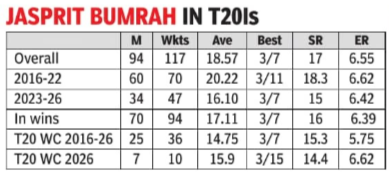
Bumrah in T20Is

Bumrah usually wears a coy smile after the perfect execution of his deliveries, be it the dipping slower balls, the zippy bouncers or the toe-crushing yorkers. He has also mastered the art of mentally distancing himself from ‘outside’ chatter and remains detached from any possible criticism. He has looked cold-blooded in the way he has gone about his job in this World Cup.India came into the tournament flaunting Varun Chakravarthy’s mystery spin as the trump card, but it is Bumrah who has covered up for him and risen to the occasion. It didn’t come as a surprise when England captain Harry Brook said, “Bumrah is a very good bowler, arguably the best of all time at the minute. He’s been a very good bowler for a long time.”Bumrah knows he is the most complete pacer going around. He also knows that to maintain that, he has to train like a rookie every day.


Source link

Access Denied


Access Denied

You don’t have permission to access “http://www.ndtv.com/india-news/deadly-uttarkashi-flood-in-2025-wasnt-caused-by-cloudburst-isro-reveals-cause-dharali-flood-ice-sheet-collapse-11180280” on this server.

Reference #18.c7f5d217.1772855912.7aa45ba6

https://errors.edgesuite.net/18.c7f5d217.1772855912.7aa45ba6


Source link

Sion railway overbridge in Mumbai will open by August 15, BMC tells civic standing panel | Mumbai News


Mumbai: The BMC’s standing committee on Friday reviewed a slew of infrastructure proposals — from the delayed Sion east–west railway overbridge to a key flyover linking Eastern Express Highway with Airoli, which is a part of Goregaon–Mulund Link Road (GMLR) project — and stalled a proposal to construct a town hall-cum-gymkhana in Fort amid concerns over planning priorities in south Mumbai.During the meeting, around 59 proposals were tabled before the committee.Civic authorities informed the committee that the Sion railway overbridge (ROB) will be completed and opened for traffic by August 15. The century-old bridge located outside Sion station has remained closed since August 2024, affecting connectivity between south Mumbai and the eastern suburbs. The cost of constructing the bridge has increased from Rs 42.8 crore to nearly Rs 50 crore due to the addition of steel girders and the development of approach roads. The proposal seeking approval for this cost escalation was placed before the standing committee.Members raised concerns over delays in the project and the inconvenience caused to citizens. Rajshree Shirwadkar, chairperson of the education committee and a member of the standing committee, said hawkers have occupied the area around the construction site, making it difficult for pedestrians — especially schoolchildren — to navigate the narrow lanes. Congress corporator Ajanta Yadav pointed out that the area houses several schools and hospitals. “The delay in completing the bridge has worsened traffic and caused inconvenience to pedestrians. When will the bridge be completed to provide relief to citizens?” she asked.Responding to the concerns, additional municipal commissioner Vipin Sharma said the bridge would be opened for traffic by August 15.The committee stalled BMC’s proposal to construct a town hall-cum-gymkhana in Fort, citing planning concerns. Members across party lines said that instead of developing a recreational facility that may cater only to a limited section of citizens, the BMC should utilise the space to strengthen parking infrastructure in south Mumbai.Among the 59 proposals tabled before the committee was a plan to construct a 1.3-km flyover connecting Eastern Express Highway with Airoli as part of the GMLR project. The contract for this flyover has been awarded at Rs 1,389 crore, which is 6.8% higher than the estimated cost. According to BMC records, the overall project cost has risen to Rs 2,495 crore. The civic body has stated in its tender document that the bridge is expected to be completed within 36 months, excluding the monsoon period.


Source link

Top football clubs at loggerheads with AIFF over long-term league future | Goa News


The clubs said the long-term future of the ISL cannot be determined without the clubs being taken into confidence

Panaji: The trust deficit between India’s top-tier football clubs and the All India Football Federation (AIFF) is wider than ever before, after the governing body unilaterally invited bids for commercial rights of its properties, including the Indian Super League, where clubs fund 60% of the costs.For the first time, AIFF has not publicly provided details about the Request For Quotation (RFQ) that was floated on March 2. However, deputy secretary general M Satyanarayan is on record that the crucial tender is for “15+5 years” without any base price. Interested parties can get the document for Rs 2.5 lakh and then bid for 30% commercial rights.The clubs, who are now majority partners in organising the top tier league, said they were in the dark about the 44-page tender document, with none of them informed in advance about its publication or a draft circulated for review.“To proceed with such a foundational document without even circulating it to clubs, who are funding 60% of the league’s costs, demonstrates a complete disconnect between financial contribution and decision-making authority,” 12 of the 14 ISL clubs wrote to AIFF deputy secretary general M Satyanarayan on Friday. “It is untenable for AIFF to assume that clubs will continue to bear 60% of operational costs while having no visibility or say in the league’s long-term commercial and governance future.”The clubs said the long-term future of the ISL cannot be determined without the clubs being taken into confidence.“If AIFF views the ISL as a purely AIFF league, then AIFF must bear the corresponding financial burden. If AIFF views it as a partnership, then partnership must exist in both economics and decision-making. The present posture satisfies neither standard.“If clubs are bearing 100% of operational exposure and 60% of economic risk, then governance cannot remain 100% unilateral. The financial contribution was accepted as a burden-sharing mechanism for the survival of the league, not as a surrender of governance rights,” said the clubs.According to sources, NorthEast United and Jamshedpur FC did not sign the letter.The clubs are also understood to have had a meeting with senior AIFF officials later in the day but were told that the RFQ document will not be shared with them for fear of getting leaked. Instead, there were suggestions that the clubs can together pool the money and pick up the document.Meanwhile, the clubs have also raised concerns over the financial model and wondered how the federation earns a surplus of Rs 3.4 crore, even after publicly stating before the sports minister that it would not “make a rupee” out of the ISL this year.“It is unacceptable that, in a force majeure–like interim season not attributable to any fault of the clubs, the federation extracts profit while clubs absorb unprecedented financial strain,” said the clubs.


Source link

Iran delays naming supreme leader out of security concerns: Officials


Iran delays naming supreme leader out of security concerns: Officials

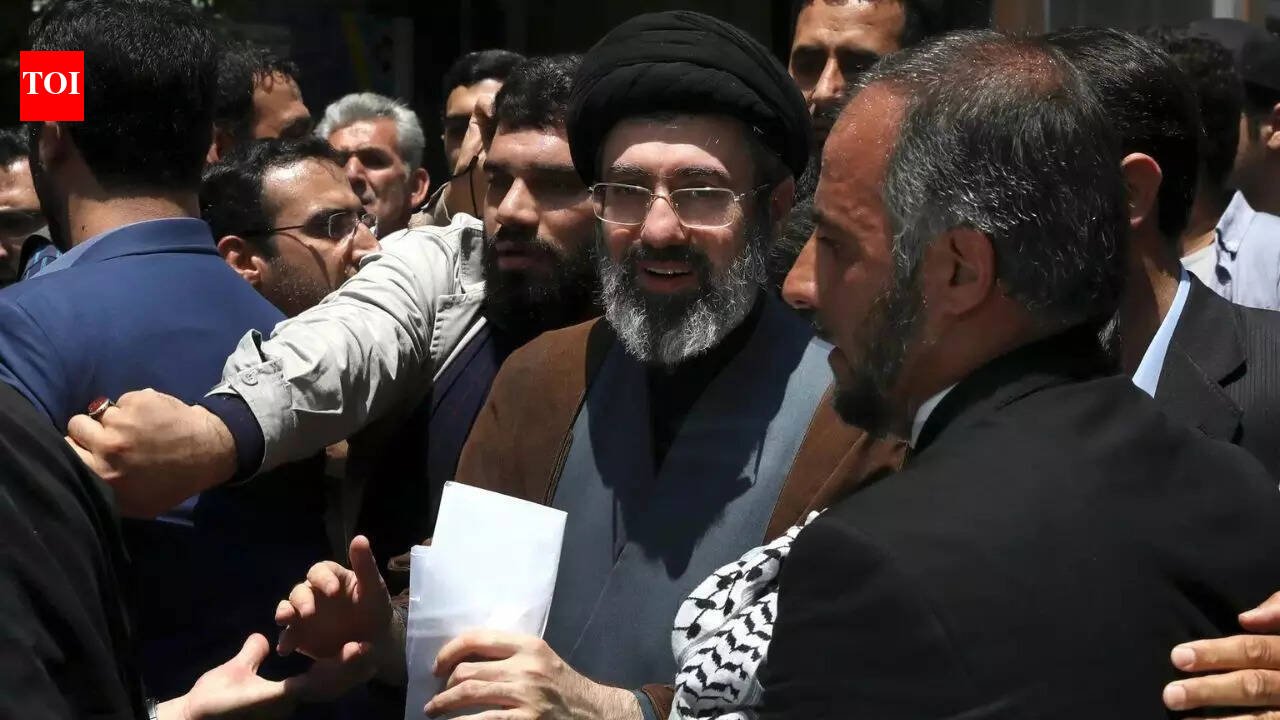
Iran has delayed the naming of a successor to its slain supreme leader, Ayatollah Ali Khamenei, out of security concerns following American and Israeli comments that the new leader could also be targeted, according to two Iranian officials.Ayatollah Khamenei’s son, Mojtaba Khamenei, 56, has emerged as a top contender for the post, but concerns over his security mounted following reports in the media that he may be the new face of Iran, said the two officials, who asked not to be named to discuss sensitive issues. Once Khamenei’s name began to circulate as the favoured candidate to succeed his father, the US said he would not be acceptable and could be eliminated. “They are wasting their time,” President Trump told Axios on Thursday, adding that the former supreme leader’s son is “a lightweight” and an “unacceptable” choice. Israel’s defence minister, Israel Katz, said in a social media post on Wednesday that any leader appointed by Iran to succeed Khamenei would be “an unequivocal target for elimination.” American and Israeli strikes have so far killed Ayatollah Khamenei, and top military commanders and figures involved in defence – but not clerics. The leaders of Iran’s three branches of govt – the presidency, judiciary and parliament – are alive.If Khamenei is appointed as the top religious, political and military figure in Iran, it signals the continuity of hard-line conservative rule. Khamenei, a mysterious but influential figure who has operated in the shadows of power, has close ties to the powerful IRGC.


Source link