Breaking News
US will ‘not make same mistake’ of giving India ‘China-like concessions’, says official


US will ‘not make same mistake’ of giving India 'China-like concessions', says official

The United States will not extend to India the kind of sweeping economic concessions it once granted China, said Deputy Secretary of State Christopher Landau on Thursday, claiming that those incentives allowed China to emerge as a rival.Speaking at the Raisina Dialogue, India’s flagship conference on geopolitics and geoeconomics, Landau made it clear that while the US sees vast potential in India, it is approaching trade negotiations with greater caution than it did two decades ago with China. “While the US wants to work with India to unlock its ‘limitless potential,’ India should understand that ‘we are not going to make the same mistakes with India that we made with China 20 years ago,’” Landau said.His remarks come as the two sides work to finalise a trade agreement under negotiation since US President Donald Trump took office. Washington last month reduced tariffs on Indian goods to 18 per cent from 50 per cent after several rounds of talks.Like several other countries, New Delhi is navigating a global environment in which the US has increasingly deployed tariffs as leverage in broader geopolitical negotiations.At the same time, India is seeking to diversify its trade partnerships to reduce overdependence on any single market. It recently signed a trade deal with the European Union and has pursued agreements with other nations as part of efforts to expand market access and strengthen supply-chain resilience.Emphasising the scope for cooperation, Landau said, “It is in our interest and we think it is also in India’s interest to be partners. We have many many win-win situations with India.”Landau also offered US support in addressing India’s short- and long-term energy needs, particularly as supply disruptions linked to the Middle East crisis threaten fuel flows. He said Washington is prepared to work with New Delhi to mitigate risks arising from the evolving regional situation.India has so far avoided taking sides in the widening conflict even as it balances trade negotiations with strategic autonomy.


Source link

Smriti Mandhana honoured with one-of-a-kind Barbie doll ahead of International Women’s Day | Cricket News


Smriti Mandhana honoured with one-of-a-kind Barbie doll ahead of International Women’s Day

Indian cricketer Smriti Mandhana has been named in Barbie’s first-ever Dream Team, becoming the first cricketer in the world to receive a one-of-a-kind Barbie doll inspired by her journey. The announcement was made on Thursday, March 5.Toy manufacturer Mattel aligned the recognition with International Women’s Day, which is observed every year on March 8. According to the company, the initiative aims to honour women who have broken barriers in their respective fields. The doll created in Mandhana’s likeness has been specially designed to celebrate her achievements and will not be available for retail sale.Mandhana features in the Dream Team alongside several prominent global personalities. The list includes tennis great Serena Williams, astronaut Kellie Gerardi, racing driver Regina Sirvent Alvarado, England footballer Chloe Kelly, singer Helene Fischer, climber Zoja Skubis and surfer Stephanie Gilmore.“The dream is real and we have the team to prove it,” Mattel said in a statement while unveiling the initiative. “Ahead of International Women’s Day, Barbie is proud to announce our first-ever Barbie Dream Team, honouring eight women from across the globe who have led the way for future generations of girls by accomplishing breakthrough firsts in their chosen paths.”Mandhana later shared pictures of her personalised Barbie doll on Instagram, admitting that the moment still feels surreal.“Still processing this moment… Seeing a one-of-a-kind @Barbie doll inspired by my journey is something I never imagined growing up. Cricket has given me so much, and if my story helps even one girl believe she belongs on the field, that means everything. Honored to be part of Barbie’s Dream Team alongside incredible women from around the world who are breaking barriers in their own fields. When girls see what’s possible, they dream bigger,” Mandhana said.Mandhana currently serves as India’s vice-captain across formats and is widely regarded as one of the side’s most dependable batters. She recently climbed back to the No. 1 position in the ICC ODI batting rankings. Earlier this year, she also captained Royal Challengers Bengaluru to their second title in the Women’s Premier League. At the peak of her career, Mandhana continues to shine both on and off the field.


Source link

DA hike: These state employees to get 58% dearness allowance from April 2026


DA hike: These state employees to get 58% dearness allowance from April 2026

In a move that will benefit thousands of state employees, the Madhya Pradesh government has decided to increase the dearness allowance (DA) to 58%, aligning it with the rate currently given to central government employees.The revised allowance will be applicable from April 2026 and will be paid with the May salary. The decision also covers pending dues from July 2025 to March 2026, which will be cleared in instalments, according to an announcement made by Chief Minister Mohan Yadav.“The arrears amount from July 2025 to March 2026 will be paid in 6 equal instalments starting from May 2026. Pensioners will also receive a 58% dearness relief in their pension from January to February 2026,” Yadav said.Dearness allowance plays a key role in government salary structures as it helps offset the impact of inflation and supports employees in maintaining their purchasing power as the cost of living rises.

Kerala government also raised DA recently

Last month, the Kerala government approved a 10% increase in DA and dearness relief (DR) for employees and pensioners respectively, raising both from 25% to 35%.The decision was notified through an official government order on February 20, 2026, providing financial relief to government employees and pensioners.

FNPO seeks DA merger with basic pay before 8th Pay Commission

Meanwhile, the Federation of National Postal Organisations (FNPO) has urged the 8th Pay Commission to consider merging 50% DA with basic pay and granting interim relief to central government employees and pensioners from January 1, 2026.In a letter dated February 27, 2026 to the 8th Pay Commission chairperson Justice Ranjana Prakash Desai, FNPO secretary general Sivaji Vasireddy said:“In the light of the prevailing inflationary conditions and the erosion of real wages, my federation earnestly request the Hon’ble commission to recommend to the government the merger of 50% dearness allowance with basic pay/pension with effect from January 1, 2026, as a measure of interim relief. This measure would provide immediate financial relief, restore partial purchasing power and ensure economic dignity to lakhs of employees and pensioners across the country.

What is dearness allowance?

Dearness allowance (DA) is a cost-of-living adjustment provided to government employees and pensioners. It is designed to offset the impact of inflation on salaries.The government typically revises DA twice every year — in January and July. The allowance is calculated as a percentage of an employee’s basic pay and is based on the 12-month average of the All India Consumer Price Index for Industrial Workers (AICPI-IW).

How a 3% DA hike can affect salaries

If an employee’s basic salary is Rs 40,000, a 3% increase in DA would result in an additional Rs 1,200 per month.This calculation applies only to the basic pay component of the salary and does not include other allowances such as house rent allowance (HRA) or travel allowance (TA).Similarly, the impact of a 3% DA hike on different salary levels would be as follows:

Basic Pay (Rs) DA Hike (3%) Monthly Increase (Rs) Annual Increase (Rs)
18,000 18,000 × 3% 540 6,480
25,500 25,500 × 3% 765 9,180
35,400 35,400 × 3% 1,062 12,744
44,900 44,900 × 3% 1,347 16,164
56,100 56,100 × 3% 1,683 20,196
1,00,000 1,00,000 × 3% 3,000 36,000


Source link

Access Denied


Access Denied

You don’t have permission to access “http://www.ndtv.com/india-news/bengal-governor-cv-ananda-bose-resigns-weeks-before-polls-sources-11173333” on this server.

Reference #18.c4f5d217.1772728405.a171e7c

https://errors.edgesuite.net/18.c4f5d217.1772728405.a171e7c


Source link

End of Lalu-Nitish era in Bihar: BJP all set to conquer final frontier of Hindi heartland | India News


End of Lalu-Nitish era in Bihar: BJP all set to conquer final frontier of Hindi heartland

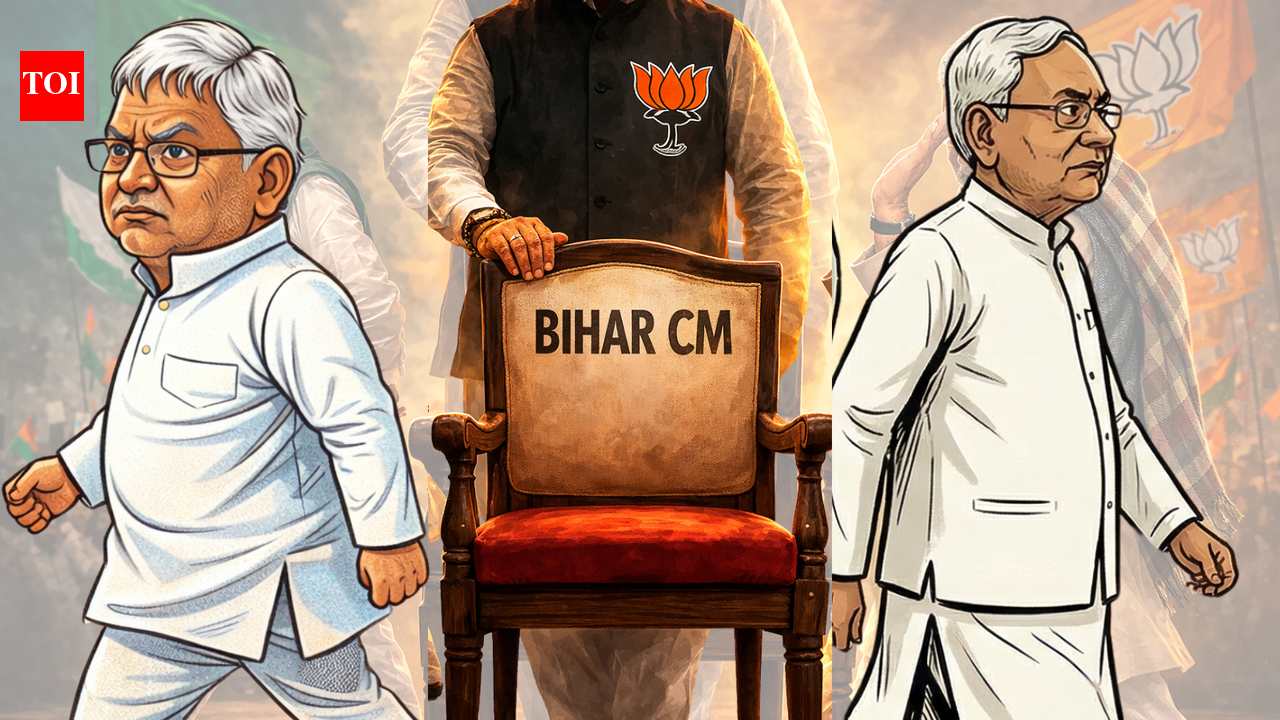
NEW DELHI: The BJP is on the threshold of a historic first in Bihar. After a long wait – spanning first the Lalu era and then the Nitish era in Bihar – the saffron party is all set to get its first chief minister in the state. This follows JD(U) chief Nitish Kumar’s “voluntary decision” to return to national politics, marking the biggest political transition in the state in recent times. Chief minister Nitish Kumar, who led the NDA alliance to a thumping victory in the assembly elections just four months ago, today filed his nomination papers for Rajya Sabha paving the way for a change of guard in the state.Announcing his decision, Nitish Kumar said in a post on X: “For more than two decades, you have consistently placed your trust and support in me, and it is on the strength of that trust that we have served Bihar and all of you with complete dedication. It was the power of your trust and support that has enabled Bihar today to present a new dimension of development and dignity. In keeping with this aspiration, I seek to become a member of the Rajya Sabha in the elections being held this time.Nitish Kumar’s move marks the end of an era in Bihar politics. But does it come as a surprise? The answer is “no”. The transition was widely anticipated especially after the BJP edged past the JD(U) as the largest party in the ruling coalition for the second time in a row. In the 2025 assembly elections, the BJP emerged as the single largest party winning 89 seats with a vote share of 20.45% while the JD(U)’s score was 85 with 19.61% votes. However, the BJP did not stake claim to the top post and Nitish Kumar took oath as chief minister for the record 10th time. But the dominance of BJP in decision-making became evident as the saffron party got a lion’s share in the new council of ministers and for the first time Nitish Kumar had to let go of the all-important home portfolio. The swearing-in ceremony of Nitish Kumar was more of a BJP show of strength. It was attended by Prime Minister Narendra Modi, Union home minister Amit Shah and a number of their cabinet colleagues, besides CMs of several states ruled by the BJP.In fact, the BJP could have claimed the top post in Bihar six years back in 2020. The BJP had then won 74 seats with a vote share of 19.46%. This was almost double of what Nitish Kumar’s party had won: 43 assembly seats with a vote share of 15.39%. However, the BJP decided to honour its pre-poll commitment of making Nitish Kumar the chief minister if the alliance won the elections. The BJP perhaps did not have an option then as Lalu Prasad’s RJD had won 75 seats and would have readily supported Nitish Kumar to keep the BJP out. So, Nitish Kumar continued as chief minister. However, the power dynamics within the Bihar NDA had changed as the BJP for the first time became the senior ally in the coalition. It has been a long wait for the BJP to have its first chief minister in Bihar. It is the only Hindi heartland state where the party has not held the top office so far. The BJP and the JD(U) came together in the state for the first time in 2005. From 2005 to 2015, the JD(U), guided by Nitish Kumar’s towering presence, was the dominant partner in the coalition. Even number wise, the JD(U) was always ahead of the BJP – forcing the saffron party to play second fiddle in the state coalition. Such was the dominance of Nitish Kumar in state politics, that the BJP was forced to welcome him back with open arms twice after the JD(U) left the NDA and joined hands with the rival Mahagathbandhan. It is in this context that the turn of events in Bihar is significant for the BJP. Its rivals have been quick to draw parallels from Maharashtra to attack the saffron party for coercing Nitish Kumar into submission. RJD leader Tejashwi Yadav, leader of the opposition in the state assembly, alleged that the BJP had always been opposed to Dalits and OBCs, and with Kumar leaving the CM’s post the party would attempt to implement its agenda in the socialist stronghold.“The BJP has done a Maharashtra in Bihar. We have been saying from the very beginning that the BJP will not let Nitish Kumar remain the chief minister after the elections. This is exactly what has happened. This development is against the mandate of the people and amounts to a betrayal of it,” he said.Congress general secretary in-charge communications Jairam Ramesh said, “What the Indian National Congress had been saying often during the Bihar election campaign has now come to pass.”“A leadership coup and regime change orchestrated by G2 has taken place. It is, in many ways, a huge betrayal of the mandate of the people,” Ramesh said on X.For the BJP, the next big challenge would be to keep the caste considerations in mind in deciding the next chief minister of the state. The names of some big contenders – Samrat Choudhary who is the deputy chief minister, Nityanand Rai, who is a Union minister are already doing the rounds. But these big names will be keeping their fingers crossed given the BJP track record. It has rarely chosen prominent faces to lead the government and has instead always surprised by picking up unknown leaders for the post of chief minister.


Source link

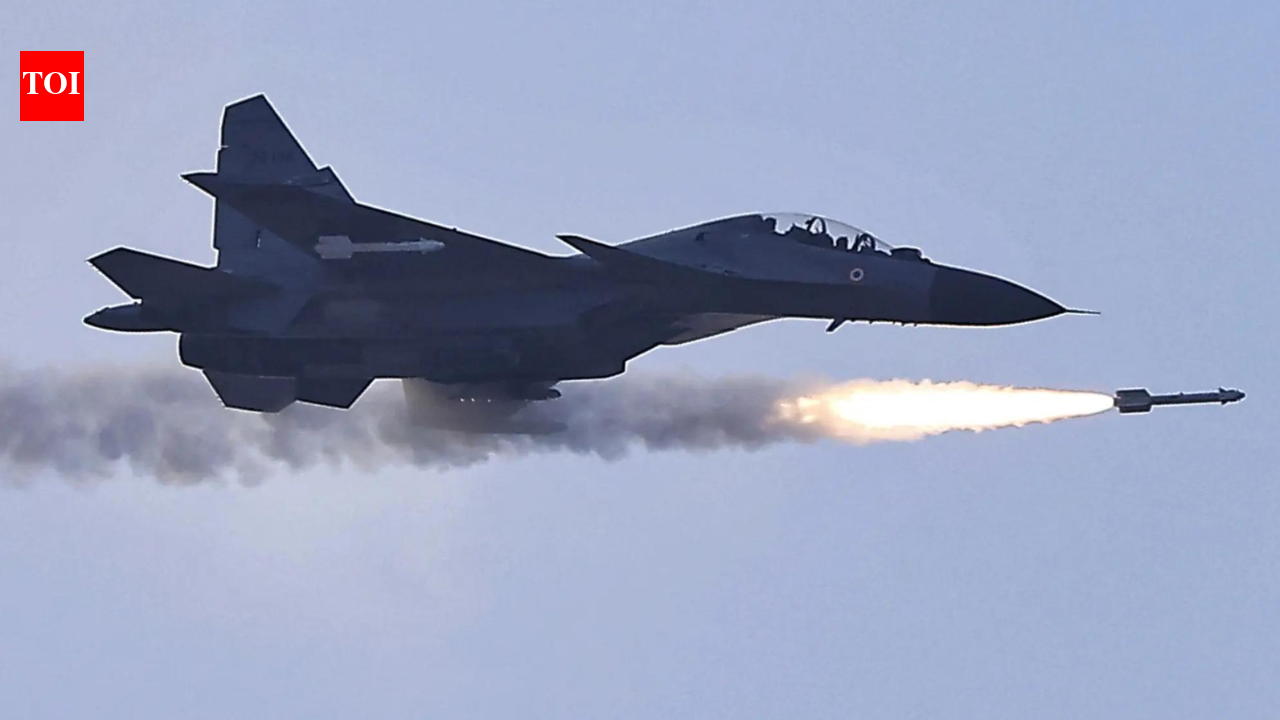
Su-30 MKI fighter jet missing: Aircraft loses radar contact in Assam, IAF deploys team | India News


Su-30 MKI fighter jet missing: Aircraft loses radar contact in Assam, IAF deploys team
IAF Su-30 MKI (File photo)

NEW DELHI: A Sukhoi Su-30 MKI fighter aircraft of the Indian Air Force (IAF) has lost radar contact in Assam, officials said on Thursday, adding that an IAF team has been dispatched to determine the circumstances.“An IAF Su-30 MKI is reported overdue. The aircraft had taken off from Jorhat, Assam and was last in contact at 7:42 pm. Further details are being ascertained. Search and Rescue mission has been initiated,” the IAF posted on X, confirming the incident.(Developing story)


Source link

Maharashtra remains India’s largest economy but posts slowest growth among top four states


Maharashtra remains India’s largest economy but posts slowest growth among top four states

Maharashtra continues to remain India’s largest state economy in absolute terms, but its economic growth has been the slowest among the country’s four biggest state economies over the past four years, according to official data.The state’s Gross State Domestic Product (GSDP) is projected at Rs 42,67,771 crore in 2024-25, the highest among all states, reported PTI. However, its growth rate since the post-COVID period has lagged behind Karnataka, Gujarat and Tamil Nadu.Between 2021-22 and 2024-25, Maharashtra’s GSDP grew by nearly 43 per cent. This places it behind Karnataka, which recorded the fastest expansion among the four major state economies.Karnataka’s GSDP rose from Rs 17,02,227 crore in 2021-22 to a projected Rs 28,09,063 crore in 2024-25, reflecting nearly 65 per cent growth. The state’s strong technology and services sector, centred around Bengaluru, has been a major driver of this expansion.Gujarat posted the second-fastest growth among the four states, with GSDP rising nearly 48 per cent from Rs 18,79,826 crore in 2021-22 to Rs 27,90,000 crore in 2024-25. The growth has been supported by the state’s robust industrial and manufacturing base.Tamil Nadu recorded around 47 per cent growth over the same period. Its GSDP increased from Rs 21,36,351 crore in 2021-22 to Rs 31,55,096 crore in 2024-25, making it the closest competitor to Maharashtra in terms of total economic size.Maharashtra’s GSDP expanded from Rs 29,81,024 crore in 2021-22 to Rs 42,67,771 crore in 2024-25. While this represents an addition of roughly Rs 12.86 lakh crore — the largest absolute increase among the four states — its percentage growth remains the lowest.Despite the slower growth rate, Maharashtra retains a substantial lead in overall economic size. Its projected GSDP for 2024-25 is over Rs 11 lakh crore higher than Tamil Nadu, more than Rs 14 lakh crore ahead of Gujarat and over Rs 15 lakh crore above Karnataka.The four states — Maharashtra, Tamil Nadu, Karnataka and Gujarat — are widely regarded as the principal engines of India’s economic growth.“These three states (Karnataka, Gujarat and Tamil Nadu) have received massive investments, while their homegrown businesses such as startups have also contributed to their GSDP. As these companies continue to grow, they will further boost the states’ economies,” an expert said.However, he noted that in Maharashtra’s case, the investments the state has attracted during the same period are yet to fully translate into measurable gains in GSDP.


Source link

Beyond oil: How US-Iran war & Middle East crisis may hit India’s economy – sector-wise impact explained


Beyond oil: How US-Iran war & Middle East crisis may hit India’s economy - sector-wise impact explained
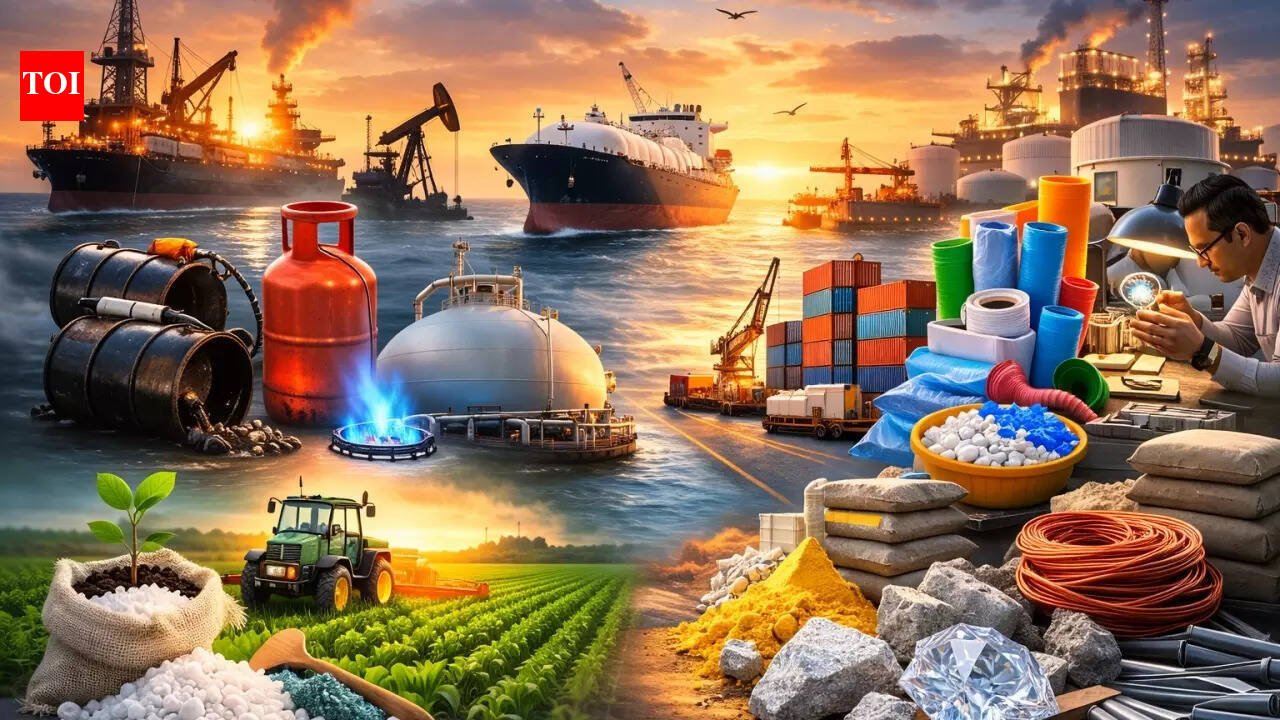
Petroleum is the most immediate area of exposure. In 2025, India sourced roughly $70 billion crude oil and petroleum products from West Asia. (AI image)

Beyond oil, the Middle East crisis has other implications for the Indian economy, especially if the US-Israel-Iran war continues for a long duration leading to major supply disruptions. In recent days, a series of missile and drone attacks have struck multiple energy and logistics installations across the Gulf region. These incidents have heightened concerns that shipments of oil and gas moving through the Strait of Hormuz – a vital artery for global energy trade – could face disruption.Between March 1 and March 3, important facilities in Saudi Arabia, Qatar, the United Arab Emirates and Oman came under attack. The situation has fueled concerns that the conflict could trigger a wider shock to global energy supplies.

Iran Conflict Presents ‘Huge Opportunity’ For India To Become Clean Energy Exporter: Amitabh Kant

But beyond oil, it’s important to note that West Asia plays an important role in supplying India with essential commodities. In 2025, India’s imports from the region of approximately $98.7 billion included critical resources such as energy, fertilisers and industrial inputs.

1. Oil: Immediate risk

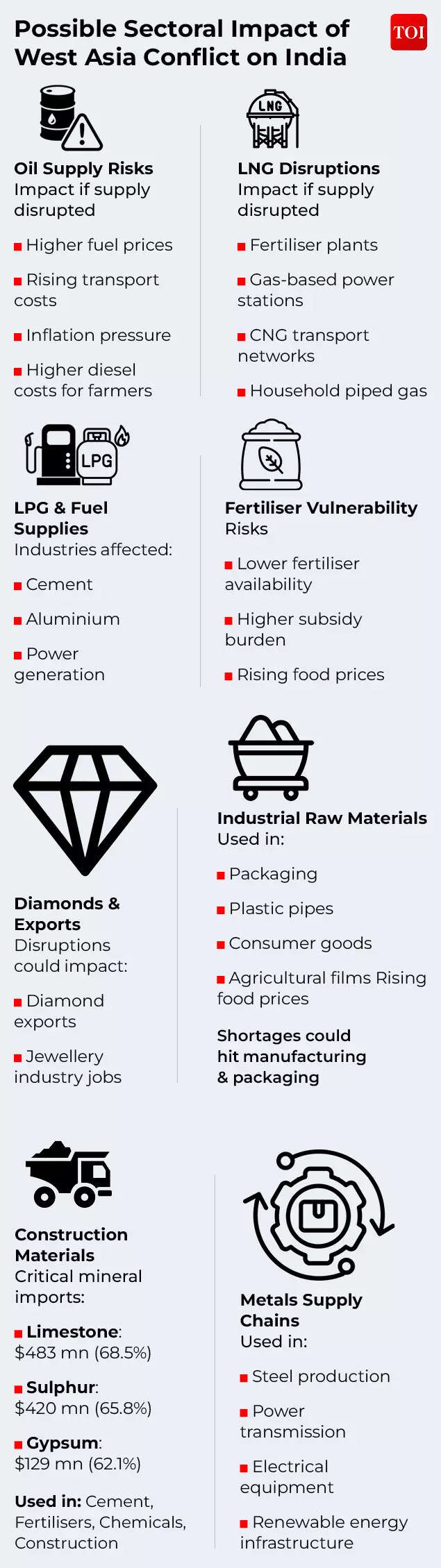
Petroleum is the most immediate area of exposure. In 2025, India sourced roughly $70 billion crude oil and petroleum products from West Asia.“Crude oil feeds India’s refineries, which produce petrol, diesel, aviation fuel and petrochemical feedstocks used across the economy. India has about 30 days of stocks, any prolonged disruption in shipments could quickly push up fuel prices, raising transport and logistics costs and feeding into inflation. Farmers would also feel the pressure through higher diesel prices for irrigation pumps and tractors,” says Ajay Srivastava, founder of Global Trade Research Initiative (GTRI).Also Read | Russian crude to rescue! Ships carrying Russia’s oil head to India amid Middle East supply shock: Report

2. LNG Supplies

Supplies of natural gas are also exposed to potential disruptions. In 2025, India sourced liquefied natural gas or LNG worth $9.2 billion from West Asia, which is around 68.4% of its total LNG imports. LNG is also a key input for fertilizer manufacturing units, gas-fired power plants and city gas distribution systems that provide compressed natural gas (CNG) for vehicles and piped gas for household cooking.Signs of this vulnerability have already emerged. Qatar’s Petronet LNG halted LNG deliveries to GAIL starting March 4, 2026 due to restrictions affecting vessel movement.

Possible Sectoral Impact of West Asia Conflict on India

3. Risks to LPG

Liquefied petroleum gas (LPG) imports from West Asia were $13.9 billion in 2025, making up 46.9 % of India’s total LPG purchases. LPG continues to serve as the main cooking fuel for millions of households. With reserves covering only about two weeks of consumption, any interruption in supply could quickly impact the availability of cooking fuel.

4. Exposure in Fertiliser Supplies

India’s agricultural sector could also feel the impact through fertiliser imports, says GTRI in its report. In 2025, fertiliser purchases from West Asia stood at $3.7 billion. Any disruption in supplies during the crop cycle could lead to reduced fertilizer availability, increase the government’s subsidy burden and eventually push up food prices.Also Read | India’s energy security exposure to Middle East: How much oil, LPG, LNG reserves do we have?

5. Diamond Trade and Exports

India’s diamond export sector is also closely tied to supplies from the Gulf. Diamonds of around $6.8 billion were imported from the Middle East in 2025, which is 40.6% of its total imports of these stones. Rough diamonds are in turn processed in India’s cutting and polishing centres, especially in Gujarat’s Surat, before being exported to international markets as polished gems. Any interruption in the flow of raw diamonds could slow manufacturing activity and have an impact on employment within the jewellery industry.

6. Industrial Raw Material Supplies

A number of industrial inputs sourced from the Gulf are also crucial for India’s manufacturing sector. India bought polyethylene polymers of around $1.2 billion from West Asia in 2025. Polyethylene is widely used in products such as packaging materials, plastic piping, storage containers, consumer goods and agricultural films used in irrigation systems.

7. Construction-Related Materials

India’s construction industry also relies heavily on mineral imports from the region. In 2025, the country imported limestone worth $483 million from West Asia. Limestone is a key ingredient in cement production, and hence any shortage could raise the cost of cement, thereby possibly slowing infrastructure development.

8. Metals Supply Chains

Supply links with West Asia also extend to the metals sector. India imported direct reduced iron of around $190 million from the Middle East region in 2025. Additionally, the country sourced copper wire worth $869 million from West Asia. Copper wire is widely used in power transmission networks, electrical machinery and renewable energy infrastructure.As GTRI notes: Together, these figures highlight how closely India’s economy is tied to West Asian supply chains. “If disruptions to shipping through the Strait of Hormuz continue beyond a week, the effects could quickly spread from energy markets to fertiliser supplies, manufacturing inputs, construction materials and export industries such as diamonds. What begins as a regional conflict could rapidly evolve into a broader supply shock for the Indian economy,” the GTRI report concludes.


Source link

Chhattisgarh Forest Guard Assault: Chhattisgarh forest guard seen with woman companion thrashed, made to dance by mob; video sparks outrage | Raipur News


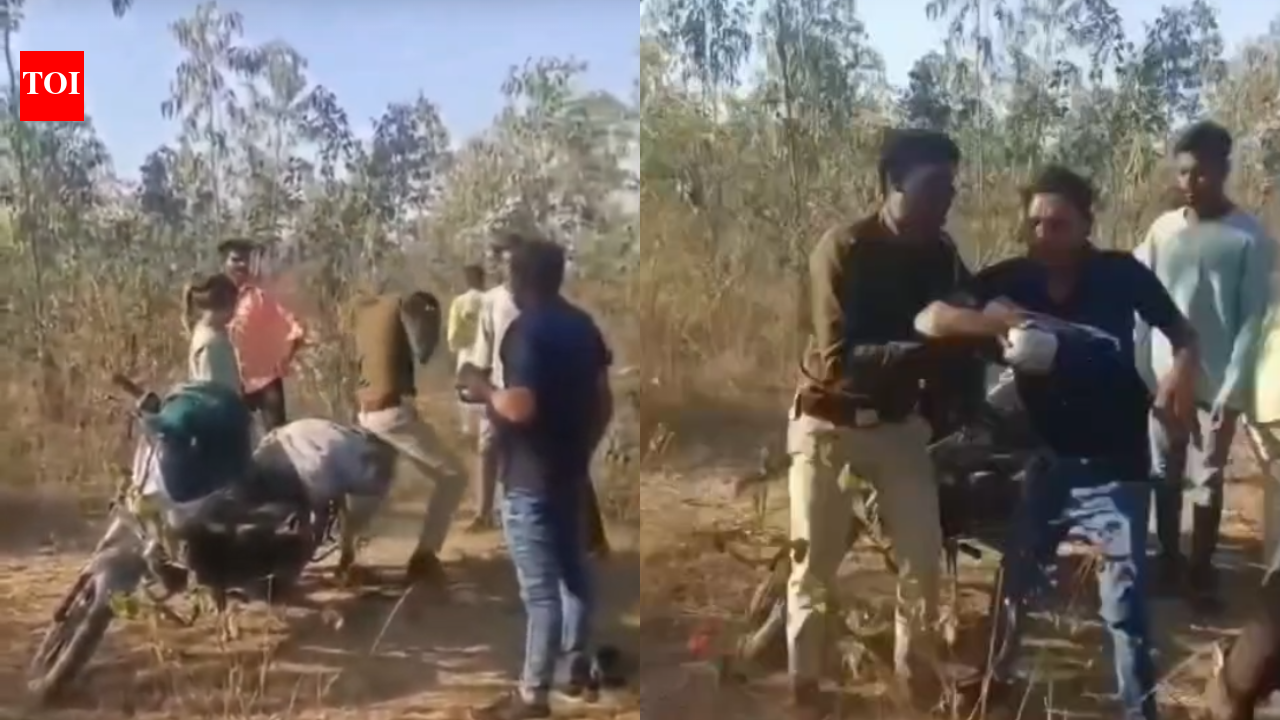
RAIPUR: A forest guard attached to the Devnagar beat of Surajpur forest division was allegedly manhandled and forced to dance by a group of local youths. The incident, which came to light after video clips surfaced on social media, has raised concerns over rising vigilantism in the region. The footage shows the group forcing the guard to play music and dance before assaulting him with sticks and belts. The attackers reportedly targeted the guard because he was accompanied by a woman friend.Surajpur Divisional Forest Officer (DFO) D P Sahu said the incident occurred about a week ago. “I have issued a show-cause notice to the forest guard and sought his reply to initiate a police case. The guard has expressed reluctance to take legal action and claimed the incident stemmed from an old rivalry,” Sahu said. The department is awaiting a formal response from the guard before proceeding with further legal steps.


Source link

India seeks US-backed insurance cover for oil tankers as Middle East tensions threaten energy supplies


India seeks US-backed insurance cover for oil tankers as Middle East tensions threaten energy supplies

India is seeking support from the United States to secure marine insurance cover for vessels transporting oil from the Middle East, as the government looks to ensure continuity of energy supplies amid disruptions in the Strait of Hormuz, a senior oil ministry official told PTI.The move comes as the widening conflict in West Asia has affected tanker movement through the strategic sea route, which carries about one-fifth of the world’s oil and large volumes of liquefied natural gas (LNG).

India Confident To Evade Fuel Crisis Amid War As Russia Offers Energy Support Despite Trump Threats

According to the official, India currently has crude oil stocks in tanks, pipelines and shipments in transit sufficient to meet about 25 days of demand. The country also holds a similar level of reserves of refined fuels such as petrol and diesel.India imports around 88 per cent of its crude oil and roughly half of its LNG needs. Of this, about 40–50 per cent of crude oil shipments and 50–60 per cent of LNG imports pass through the Strait of Hormuz.The strait, about 21 nautical miles wide at its narrowest point, has even narrower shipping lanes comprising two channels of around two miles each separated by a two-mile buffer.“We are in a comfortable position right now,” the official said, noting that oil supplies not routed through the strait continue to reach India. He added that the country is sourcing additional supplies from West Africa, Latin America and the United States to compensate for potential disruptions.The oil ministry is also in talks with major producers and global trading firms to secure additional supplies of crude oil, liquefied petroleum gas (LPG) and LNG.“We are in touch with US authorities for getting a cover from the International Development Finance Corporation for vessels to transit the Strait of Hormuz,” the official said, news agency PTI quoted.US President Donald Trump has directed the multilateral financial institution to provide political risk insurance and financial guarantees for maritime trade in the region.However, before the International Development Finance Corporation can extend such coverage, a fund worth hundreds of millions of dollars must be established, the official said, adding that insurance premiums would be borne by the cargo contracting parties.India is also exploring crude purchases from a wide range of suppliers, including Russia, to rebuild its stockpile.The government is holding discussions with suppliers such as Sonatrach and Abu Dhabi National Oil Company, along with global trading houses including TotalEnergies, Vitol and Trafigura, to secure additional oil and gas supplies.The official added that imports of crude oil and cooking gas LPG from the United States have also increased.While India’s oil inventory remains comfortable, LNG supplies have been affected by the disruption in shipping through the Strait of Hormuz. This has led to reduced gas availability for industrial consumers.To manage the situation, the government may reprioritise gas allocations to ensure critical sectors receive the fuel they require.India currently meets about half of its natural gas demand — estimated at around 195 million standard cubic metres per day (mmscmd) — through imports.Disruption of shipping through the strait and force majeure declared by India’s largest LNG supplier QatarEnergy have cut off about 60 mmscmd of gas supplies.The official added that Oil Minister Hardeep Singh Puri has also discussed the evolving situation in global oil markets with the International Energy Agency (IEA) and the Organization of the Petroleum Exporting Countries (OPEC).


Source link