Breaking News
Arjun Tendulkar-Saaniya Chandhok Pre-Wedding: Yuvraj Singh, Irfan Pathan And Others Attend Glittering Mehendi-Sangeet Ceremony


The pre-wedding celebrations for Arjun Tendulkar, son of cricket legend Sachin Tendulkar, and his fiancée Saaniya Chandhok kicked off in grand style in Mumbai on Tuesday night, with a galaxy of cricket stars including Yuvraj Singh, Irfan Pathan, Harbhajan Singh and Zaheer Khan attending the combined mehendi and sangeet ceremony . The star-studded evening, hosted by Sachin and Anjali Tendulkar at a venue in South Mumbai, saw the who’s who of Indian cricket come together to bless the couple ahead of their wedding scheduled for March 5 .

Tendulkar family dazzles in traditional ensembles

The Tendulkar family stole the spotlight as they arrived in stunning traditional outfits for the occasion. The Master Blaster himself chose a bright green kurta-pyjama set, which he paired with a printed jacket, looking every bit the gracious host. His wife Anjali Tendulkar glittered in a gorgeous deep blue ensemble accessorised with elaborate jewellery, completing the regal family portrait.

Daughter Sara Tendulkar looked radiant in a beautiful pink lehenga, adding to the family’s festive charm.

The soon-to-be groom, Arjun Tendulkar, opted for a sophisticated beige bandhgala set befitting the joyous occasion, while his bride-to-be Saaniya Chandhok stunned in a pastel gota-patti lehenga with soft pink accents, complemented by heavy jewellery and traditional kaleeras.

The couple, who got engaged in August 2025, was seen holding hands in videos that have since gone viral on social media, their chemistry evident as they mingled with guests.

Cricket’s who’s who grace the occasion

The guest list read like a who’s who of Indian cricket, with former stars arriving with their families to shower blessings on the couple. Yuvraj Singh, the hero of India’s 2011 World Cup triumph, arrived with his wife, actress-model Hazel Keech, adding glamour to the proceedings.

The Pathan brothers – Irfan and Yusuf – were also in attendance with their wives Safa Baig and Afreen respectively, bringing their trademark warmth to the celebrations.

Harbhajan Singh, ever the life of any party, was spotted with his wife, former actress Geeta Basra, while Zaheer Khan arrived with his wife, actress Sagarika Ghatge, the couple posing happily for the cameras.

Ravi Shastri, former India head coach and cricket commentator, was also seen at the venue, adding to the cricketing royalty present.

Ajit Agarkar, the current BCCI chairman of selectors, made time to attend the celebrations despite his busy schedule with the ongoing T20 World Cup. The presence of these cricket icons underscored the deep respect and affection the cricketing fraternity holds for the Tendulkar family.

Viral moments from the celebrations

Social media has been abuzz with videos and pictures from the mehendi-sangeet ceremony. One particularly touching moment captured Sachin Tendulkar posing proudly with his son Arjun, the emotion evident on the cricket legend’s face. Another video showed the entire Tendulkar and Chandhok families coming together for a group photograph, encapsulating the joy of the occasion.

Also WATCH: Sachin Tendulkar turns emotional for son Arjun at pre-wedding bash with Saaniya Chandhok in Jamnagar

Wedding set for March 5

With the mehendi and sangeet ceremony successfully concluded, both families now prepare for the main wedding ceremony on Thursday, March 5. The wedding is expected to be an intimate affair held at a high-security venue in South Mumbai, followed by a dinner reception.

Sachin Tendulkar has personally extended invitations to top dignitaries including President Droupadi Murmu, Prime Minister Narendra Modi, Union Home Minister Amit Shah, and Leader of Opposition Rahul Gandhi. The presence of these national leaders alongside cricket royalty will make the wedding one of the most high-profile social events of the year.

For Arjun, who was traded from Mumbai Indians (MI) to Lucknow Super Giants (LSG) for IPL 2026, this week marks the beginning of an exciting new chapter both personally and professionally. As the Tendulkar family celebrates, the cricketing world joins in wishing the couple a lifetime of happiness.

Also READ: Mohammad Amir makes a bold prediction ahead of India’s T20 World Cup 2026 semi-final clash with England


Source link

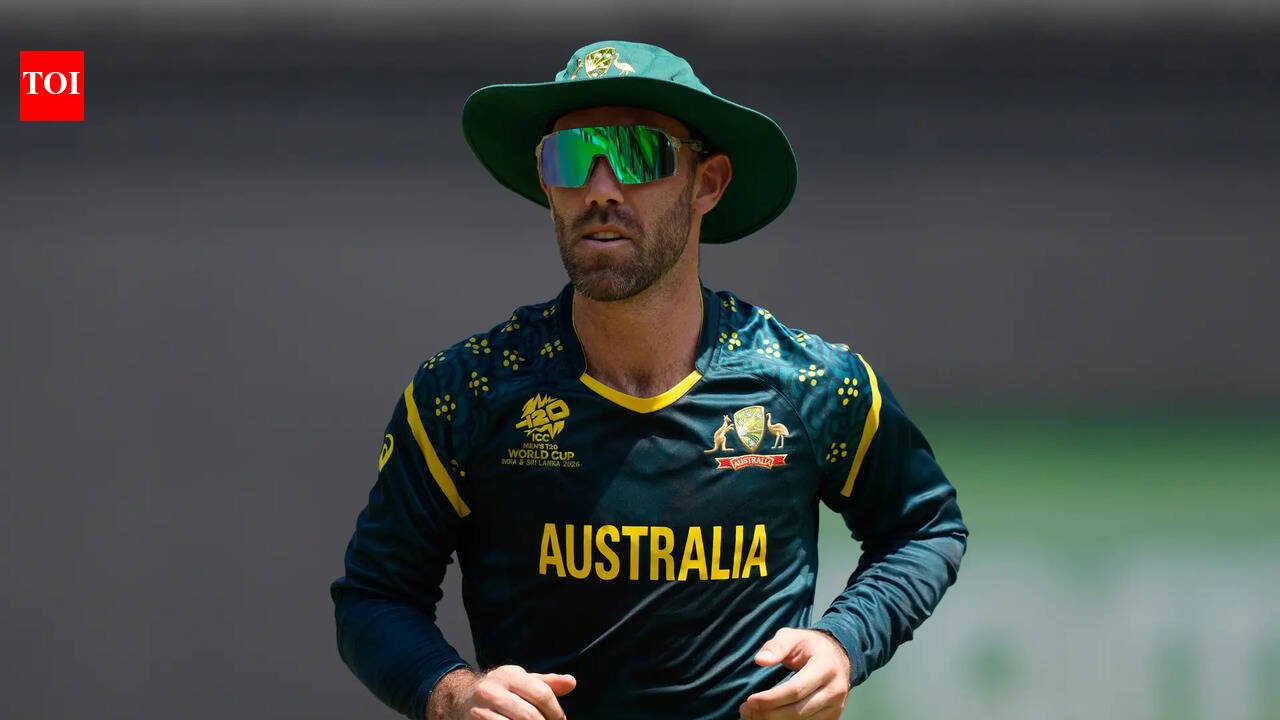
Glenn Maxwell breaks silence on retirement after Australia’s T20 World Cup disaster | Cricket News


Glenn Maxwell breaks silence on retirement after Australia’s T20 World Cup disaster
Australia’s Glenn Maxwell (AP Photo/Eranga Jayawardena)

Veteran Australia all-rounder Glenn Maxwell has underlined that he has no immediate plans to step away from T20 internationals, with both the 2028 T20 World Cup and the Los Angeles Olympics firmly on his radar.Now 37, Maxwell would be 40 by the time Australia hosts the 2028 T20 World Cup, an event slated to take place only months after cricket features at the 2028 Summer Olympics in Los Angeles. Speculation around his future intensified following Australia’s early exit at the recent T20 World Cup and a lean patch with the bat, but the explosive all-rounder insists he is not rushing into any retirement decision.“I think not making a decision around my future was probably based more on what’s to come over the next 12 months. There’s not a whole lot of T20 cricket planned, so there’s probably no need to make any sort of formal announcements and just see how my body’s going and see how I’m travelling, and if there’s an opportunity to play in the future, hopefully I’m fit and firing,” Maxwell told reporters in Melbourne on Wednesday.Australia’s T20I calendar remains light until August 2027, with only eight bilateral fixtures currently scheduled. Maxwell has already called time on his ODI career, yet he remains open to prolonging his stint in the shortest international format.When quizzed about the prospect of featuring at both the 2028 Olympics and the home T20 World Cup, Maxwell struck a hopeful yet measured tone.“Fit and firing? Hopefully. But yeah, not setting any dates. I felt like I got better and better throughout the World Cup. I probably more judge it on how I’m running around the field and how I’m feeling, probably more so than any statistics regarding wickets and runs. And I just felt like I was able to get through games a lot easier. Felt like I was playing my role as well as I could, and felt like I still had plenty to offer,” he said.Although his recent returns in T20Is and the Big Bash League have been modest, Maxwell believes his value to the side extends beyond the numbers alone.Australia’s next T20I assignment is a three-match series against Bangladesh in June, part of a wider tour that also includes ODIs in Bangladesh and Pakistan. Maxwell confirmed that discussions with selectors are ongoing regarding those plans.“We’ve had some discussions about what the next little bit looks like, and we’ll continue to have really open and fluid discussions going forward. As I said, if I’m fit and firing and available, I’ll be ready,” he said.Away from the international arena, Maxwell is set to remain busy on the franchise circuit. He has agreed to a two-year extension with the Melbourne Stars in the Big Bash League and will also feature in the Pakistan Super League, Major League Cricket and a new Europe-based T20 competition later this year. He is due to represent the Hyderabad Kingsmen in the PSL, marking his debut in the tournament.“Looked at the window that I had in between the World Cup and MLC, and with us not going as far into the tournament as I probably previously planned, found myself with a bit more time in between tournaments, and just felt like I would have been going in cold into the next one,” Maxwell said.“So probably bridges a timing gap beautifully. And getting the opportunity to get to a new team and start at the start with someone – I really like those opportunities. I think to start with a team from the very start is nice to be able to be a part and build a brand,” he mentioned.


Source link

Kuwaiti jets suspected of taking down three US F-15s in ‘friendly fire’: All you need to know about the F/A-18 Hornet


Kuwaiti jets suspected of taking down three US F-15s in 'friendly fire': All you need to know about the F/A-18 Hornet
F/A-18 Super Hornet (Image credit: Boeing website)

Three US F-15E Strike Eagle fighter jets went down over Kuwait on Sunday in what American officials have described as an “apparent friendly-fire incident,” amid escalating hostilities linked to the Iran conflict.According to reporting by The Wall Street Journal, citing people familiar with preliminary findings, a Kuwaiti F/A-18 Hornet is suspected of having mistakenly launched missiles that struck the US aircraft during joint operations.A US official quoted in the report said three missiles were fired toward the American jets, which subsequently went down over Kuwaiti territory. All six crew members ejected safely and were later recovered. They are reported to be in stable condition.The United States Central Command initially described the episode as an “apparent friendly-fire incident,” saying the aircraft were mistakenly shot down by Kuwaiti air defences during active combat conditions that included incoming Iranian drones and missiles. Investigations are ongoing.

What Is the F/A-18 Hornet?

The F/A-18 Hornet is a US-made, twin-engine, supersonic multirole combat aircraft designed to carry out both air-to-air and air-to-ground missions. The “F/A” designation signifies its dual fighter and attack role. The aircraft was developed by McDonnell Douglas in partnership with Northrop and entered service with the United States Navy in 1983. It was built for aircraft carrier operations and later exported to several US allies, including Kuwait. Boeing, which acquired McDonnell Douglas in 1997, now manufactures the newer F/A-18 Super Hornet variant. Boeing says the F/A-18 Super Hornet is the “backbone of carrier air wings”.Key features of the legacy F/A-18 Hornet include:

  • Twin turbofan engines
  • Maximum speed of around Mach 1.7
  • Carrier-capable design
  • Nine external weapons stations
  • Ability to carry radar-guided and infrared air-to-air missiles
  • An internal 20mm cannon

Kuwait ordered its fleet in 1988, with deliveries taking place between October 1991 and August 1993. US and Australia also use these jets. In one interesting fact, the F/A-18 jets, which were featured in Tom Cruise-starrer “Top Gun: Maverick”


Source link

32 injured as submarine attack sinks Iranian ship off Sri Lanka coast


32 injured as submarine attack sinks Iranian ship off Sri Lanka coast

The Sri Lankan Navy on Wednesday said 32 injured crew members were rescued and hospitalised after a submarine attack on an Iranian vessel, retracting the earlier statement given to news agency Reuters that at least 101 were missing, and 78 were injured after the attack that sank the Iranian ship.A Sri Lankan Navy spokesperson said that search and rescue operations are ongoing. “The numbers are still being verified, and operations are ongoing,” the Navy said, adding that divers and patrol vessels remain deployed in the area to locate survivors and debris from the sunken ship.The source of the underwater attack, which caused the Iranian ship to sink on early mornings of Wednesday near Galle, has not yet been identified. The maritime security agencies from Sri Lanka and neighbouring countries are monitoring the situation amid concerns about the attack’s origin.Sri Lanka’s foreign minister Vijitha Herath told parliament that a distress call was received around 6am local time, prompting the immediate launch of navy search and rescue operations. He confirmed that over 30 people had been rescued and had been taken to the hospital for treatment.However, he did not provide further details, stating that further details shall be shared as the probe progresses.Separately, a navy official who requested anonymity said that 79 people were initially rescued and taken to the hospital, one of whom later died. “About 101 people are still believed to be missing,” the source added.Local media reported that the injured were admitted to a hospital in Galle, where emergency teams are treating survivors for burns and trauma sustained during the explosion. Authorities have yet to determine whether the attack was the result of military engagement, piracy, or an accident at sea.


Source link

‘Committed war crimes’: BLA says it executed 7 Pak soldiers captured during Operation Herof II


'Committed war crimes': BLA says it executed 7 Pak soldiers captured during Operation Herof II

The Baloch Liberation Army (BLA) claimed it has executed seven Pakistani military personnel who were taken captive during “Operation Herof II” last month, ANI reported, citing The Balochistan Post (TBP).The BLA, an insurgent group that frequently attacks the Pakistani military to push for Balochistan’s independence from Pakistan, had captured 17 soldiers on February 14, releasing 10 of them because they were ethnic Baloch.The group had suggested a prisoner swap with Islamabad in exchange for the remaining captives. The deadline was later extended to 14 days on “humanitarian grounds.”Also Read | ‘How can army ignore us?’: BLA releases video of captured Pakistan soldiers pleading for helpIn a statement on Tuesday, the BLA said the seven individuals were members of regular Pakistani armed forces units and had been sentenced by the “Baloch National Court” for involvement in enforced disappearances, civilian abuses, and other war crimes.The statement added that during the extended captivity, the group determined Pakistani military authorities were “not serious” about negotiating their release. The BLA alleged that initial talks of a potential exchange were a “cunning manoeuvre” designed to buy time for military operations, while Pakistani forces continued using gunship helicopters, drones, and large troop deployments.According to the group, its Senior Command Council concluded that the humanitarian extension had been “misused” to escalate hostilities and target Baloch fighters. It further claimed that Islamabad’s approach showed it “only understands the language of strength and action.”The BLA stated that, following the final ruling of the “Baloch National Court,” the sentences against all seven detainees were carried out on Tuesday.The group held Pakistan’s military high command responsible for the deaths, accusing it of putting “ego, military misadventures, and cunning culture” above the lives of its personnel.Pakistani military authorities have not issued any official response to the claims.


Source link

US-Iran war sends shockwaves! Most crude via Strait of Hormuz heads to China, India – how vulnerable are they after closure?


US-Iran war sends shockwaves! Most crude via Strait of Hormuz heads to China, India - how vulnerable are they after closure?
Any interruption to navigation in the Strait of Hormuz poses a serious threat to international oil trade flows.

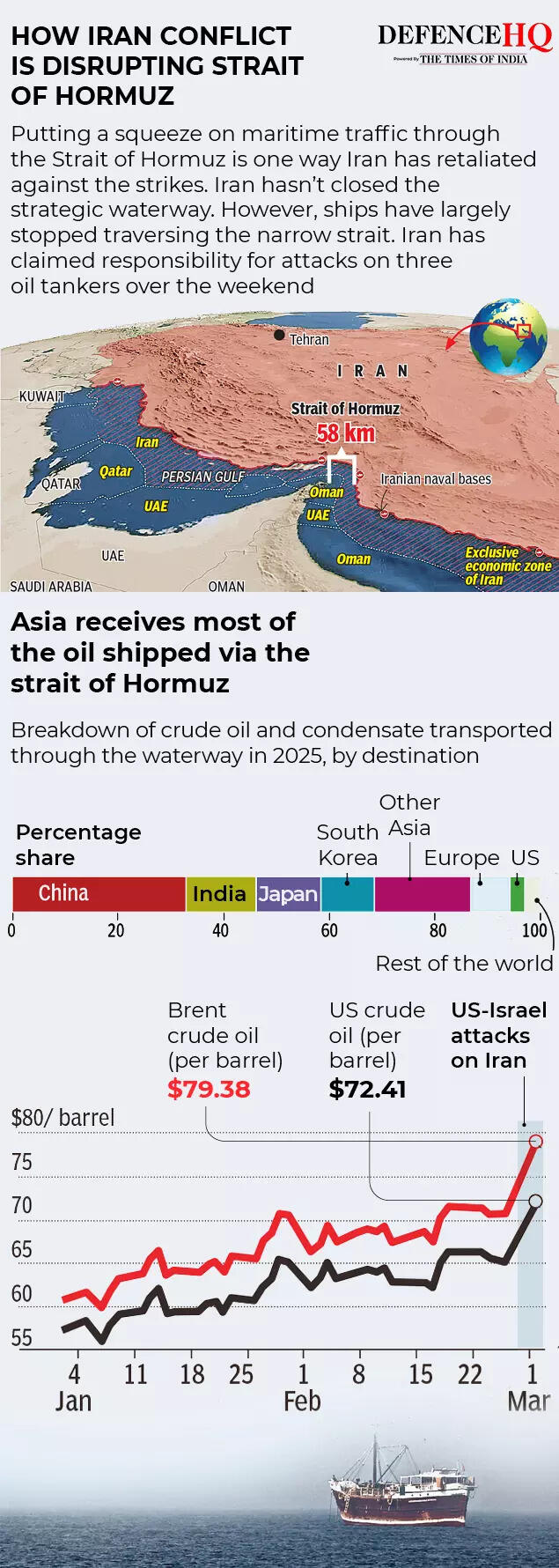
Strait of Hormuz closure has sent shockwaves in global markets and with no signs of the US-Israel-Iran war de-escalating, oil prices have been climbing up. The expanding conflict in Iran has brought tanker movement through the Strait of Hormuz to a standstill, sending oil prices sharply higher and underscoring the strategic significance of the vital maritime corridor to global energy markets.The Strait of Hormuz forms the narrow entrance to the Persian Gulf and handles roughly 20% of the world’s oil shipments. Vessels passing through the channel, which has Iran along its northern edge, transport crude and gas from Saudi Arabia, Kuwait, Iraq, Qatar, Bahrain, the United Arab Emirates and Iran. A large share of these exports is destined for Asian economies – and India is particularly seen as vulnerable. Hence, any interruption to navigation in the Strait of Hormuz poses a serious threat to international oil trade flows.

Importance of Strait of Hormuz for global shipping

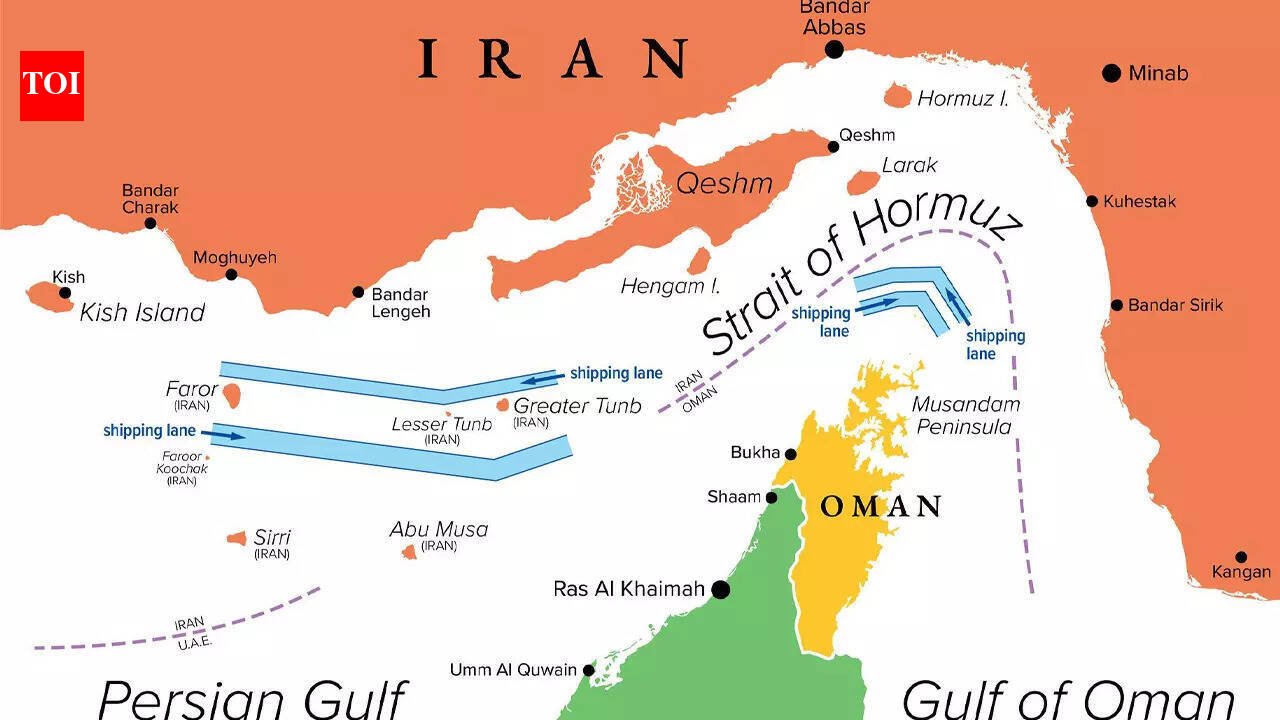
The Strait of Hormuz is a curved channel that narrows to roughly 33 kilometers, or 21 miles, at its tightest stretch. It serves as the link between the Persian Gulf and the Gulf of Oman, providing ships access onward to global sea routes.Also Read | India’s energy security exposure to Middle East: How much oil, LPG, LNG reserves do we have? Although portions of the strait fall within the territorial waters of Iran and Oman, it is regarded as an international passage open to vessels from all nations. The United Arab Emirates, which includes the skyline-dominated city of Dubai, lies close to this strategic corridor.

How Iran conflict is disrupting Strait of Hormuz

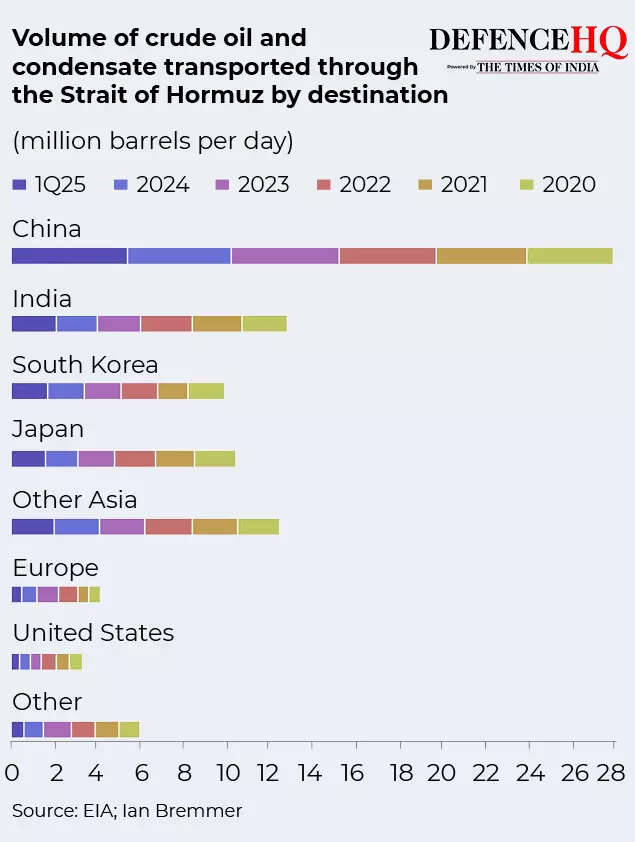
For centuries, the Strait of Hormuz has played a central role in commerce, with goods such as ceramics, ivory, silk and textiles traveling from China through the region. In contemporary times, it functions as a key transit point for massive tankers transporting oil and gas from Saudi Arabia, Kuwait, Iraq, Qatar, Bahrain, the UAE and Iran. Most of these energy supplies are shipped to Asian destinations, including China, which remains Iran’s only significant oil buyer.“The scale of what is at stake cannot be overstated,” Hakan Kaya, senior portfolio manager at investment management firm Neuberger Berman told AP. He noted that a limited disruption lasting one or two weeks could likely be managed by energy companies. However, a complete or near-complete shutdown extending for a month or longer would drive crude prices, “well into triple digits” and push European natural gas rates “toward or above the crisis levels seen in 2022.”Although Saudi Arabia and the UAE operate pipelines that can bypass the strait, the US Energy Information Administration notes that “most volumes that transit the strait have no alternative means of exiting the region.”Also Read | 1970s-style oil shock loading? Crude may hit $100 if Strait of Hormuz shuts amid Middle East tensions – what it meansIran has already targeted multiple vessels in the Strait of Hormuz and warned ships against attempting to cross, effectively bringing traffic through the waterway to a halt.“The Strait of Hormuz is closed,” declared Iranian Brig. Gen. Ebrahim Jabbari, an adviser to the paramilitary Revolutionary Guard, warned that any vessel attempting to transit the passage would be set ablaze.

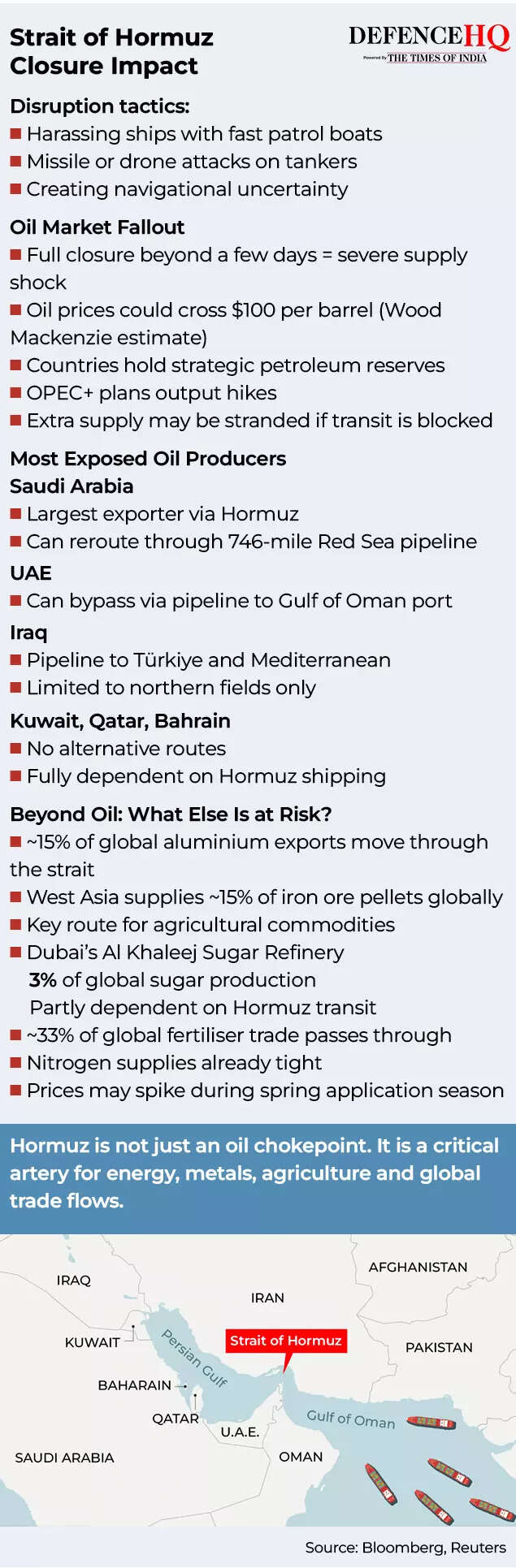
Strait of Hormuz Closure Impact

Major global shipping lines have released advisories confirming the suspension of operations in the region. Danish shipping giant Maersk, the world’s largest container carrier, announced on Sunday that it would pause all vessel transits through the Strait of Hormuz until further notice. Other major operators, including Hapag-Lloyd, CMA-CGM and MSC, issued similar statements.Data from Clarksons Research, a firm that monitors global shipping activity, indicate that roughly 3,200 vessels, which is about 4% of worldwide shipping tonnage, are currently idle within the Persian Gulf.

Volume of crude oil and condensate transported via Hormuz by destination

Trump Reaction & Insurance

US President Donald Trump on Tuesday said on social media that he has directed the United States’ development finance agency to offer political risk insurance for vessels transporting oil and other cargo through the Persian Gulf, describing the coverage as being available “at a very reasonable price.”Political risk insurance is designed to shield companies from financial setbacks arising from political instability, government interventions or acts of violence.Also Read | US-Israel-Iran war hits oil supplies: How India is preparing for the economic falloutHe added that the US Navy would provide escorts for oil tankers navigating the Strait of Hormuz if required. The Navy currently maintains a presence in the region that includes at least eight destroyers and three littoral combat ships. These vessels have previously been deployed to accompany commercial shipping in both the Persian Gulf and the Red Sea.

India and China dependence

On the oil, LPG, LNG and trade front, India is vulnerable to the impact of Strait of Hormuz closure. A big chunk of the oil that flows through the Strait of Hormuz every day is headed to China and India. However, the vulnerabilities to the closure of the Strait of Hormuz differ significantly between India and China.

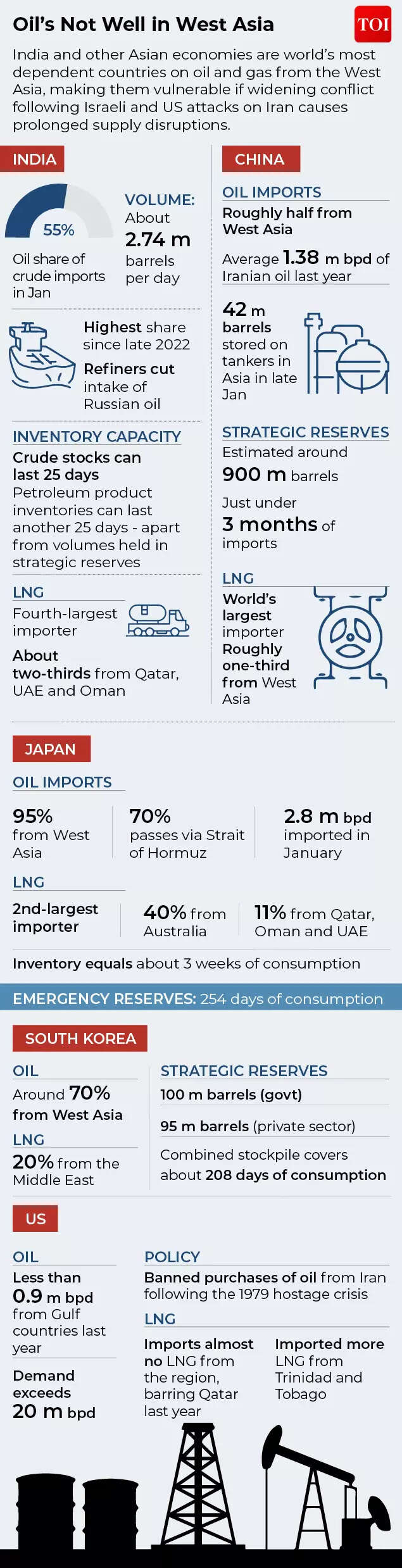
Oil’s Not Well in West Asia

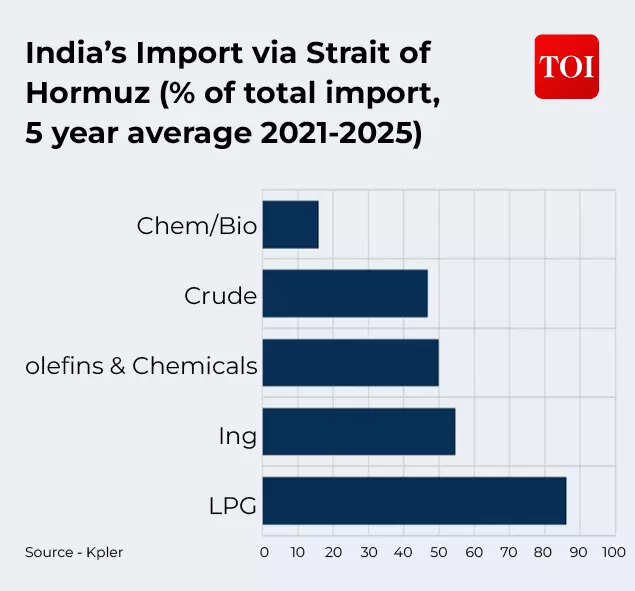
According to global real-time data and analytics provider Kpler, approximately 2.5 to 2.7 million barrels per day of India’s crude imports move through the Strait of Hormuz, primarily sourced from Iraq, Saudi Arabia, the UAE and Kuwait. Incidentally, in recent months, refiners have reduced part of their Russian intake, leading to a higher share of Middle Eastern barrels in the overall import mix. This shift has increased India’s short-term vulnerability to any disruption affecting transit through Hormuz.Shipping data from Kpler shows that Russian crude cargoes remain present in the Indian Ocean and Arabian Sea, including supplies held in floating storage. If inflows from the Gulf were to tighten, Indian refiners would likely be able to redirect purchases toward Russian grades with relative speed. Russia has already said that it is ready to help meet India’s energy needs.Although India has broadened its oil procurement basket, Gulf-origin crude oil continues to offer a logistical edge since voyage time is roughly 5 to 7 days compared with 25 to 45 days for shipments arriving from the Atlantic basin.India also relies on imports for about 80 to 85% of its LPG consumption, with most of these supplies coming from Gulf producers and passing almost entirely through the Strait of Hormuz. In contrast to crude oil, India does not hold strategic LPG reserves on a comparable scale, leaving LPG supply chains more vulnerable from a logistics standpoint if disruptions occur.For now, the government has said that India is in a ‘comfortable position’ with regards to its energy security with supplies of petrol, diesel and strategic reserves available to meet needs.

India's import via Strait of Hormuz

China is the largest energy-importing country globally, which might suggest it would be especially exposed to rising crude oil and natural gas prices triggered by the conflict involving Israel, the United States and Iran.However, according to a Reuters column by Clyde Russell, the situation is likely to play out differently. China’s extensive crude reserves provide a substantial buffer against sudden price increases, reducing the risk that energy-driven inflation affecting other economies would significantly impact it.In the event of an extended disruption to Middle Eastern oil supplies, Chinese refiners could potentially benefit by increasing exports of refined fuels. Should export-focused refineries in parts of Asia, including India and Singapore, face constraints due to limited crude availability, China would be positioned to process oil from its stockpiles and ship out products such as diesel and gasoline, capitalising on elevated fuel prices, the analysis says.China also holds additional strategic advantages. It continues to be the main buyer of discounted Russian crude that is under sanctions and remains the likely destination for Iranian oil shipments that managed to leave the Strait of Hormuz before the recent Israeli and US strikes.


Source link

Double Murder In Tirunelveli: Double murder rocks Tirunelveli: 2 hacked to death outside tea shop in Tamil Nadu; 5 injured, heavy police deployed | Madurai News


TIRUNELVELI: Two, including a guest worker, were hacked to death and five others sustained injuries in Perumpathu village, located on the Kalakkadu-Ervadi road near Nanguneri in Tirunelveli district, during the late hours of Monday.According to police sources, a gang entered Perumpathu village and hacked seven people who were standing outside a tea shop. As a result, the severely injured Trinath Kata of Odisha, currently residing in Nanguneri, and John Mark of Perumpathu village died on the spot.Ganesan of Veerankulam, Saskiumar of Puliyankulam, and Nelson, Prabhakaran, and Ramasamy of Perumpathu sustained hack injuries and were admitted to Tirunelveli Medical College Hospital for further treatment.Soon after the incident, people of the village staged a road roko, demanding that the police arrest the assailants.Nanguneri police registered a case and secured six persons in connection with the incident. Further investigation is underway.A tense situation prevailed in the village, and heavy police deployments were made to curtail further escalation.Additional director general of police (ADGP) Law and Order Maheshwar Dayal, South Zone IG Vijayendra S Bidari, DIG Tirunelveli Range G Saravanan, and district superintendent of police V Prassanna Kumar reached the spot and held talks about the incident.


Source link

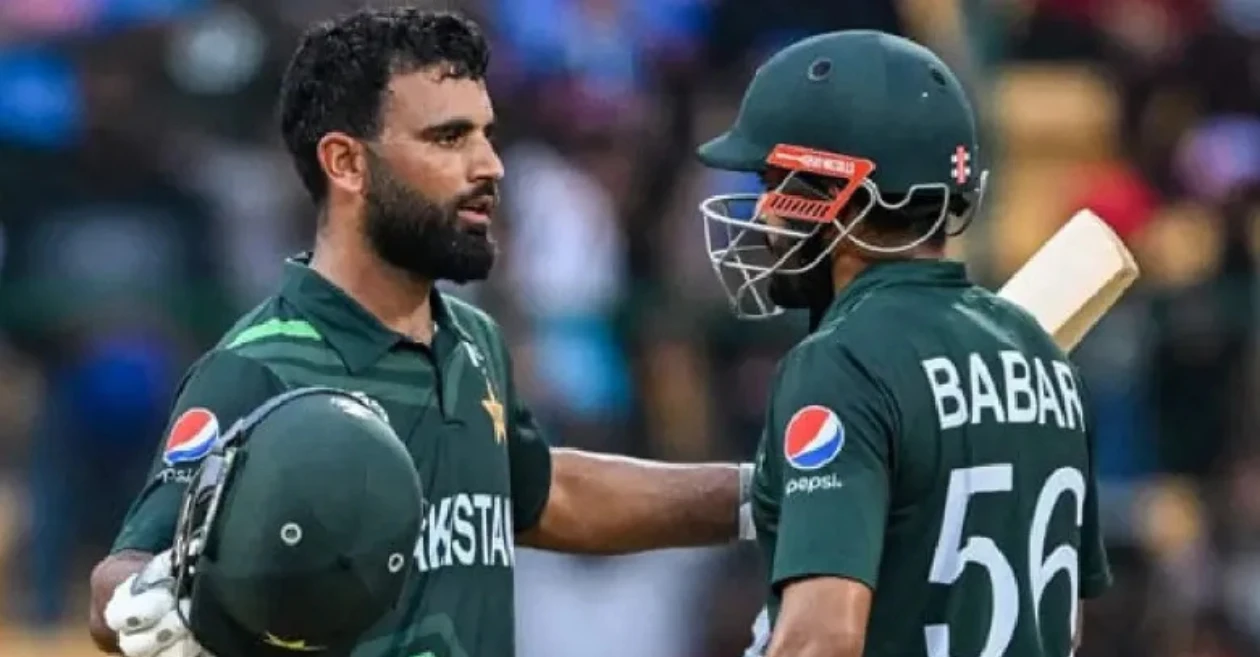
Fakhar Zaman to miss Pakistan’s ODI tour of Bangladesh – here’s the reason


Pakistan’s preparations for the upcoming Bangladesh tour have suffered a major blow as experienced batter Fakhar Zaman has been ruled out of the three-match ODI series. The setback comes at a time when Pakistan are already trying to regroup following their disappointing exit from the ICC Men’s T20 World Cup 2026.

Why Fakhar Zaman will not tour Bangladesh?

The 35-year-old picked up the injury during Pakistan’s final Super 8 match of the T20 World Cup 2026 and will now undergo rehabilitation at the National Cricket Academy (NCA) in Lahore as he works toward regaining full fitness.

Fakhar sustained the injury while playing a remarkable innings against Sri Lanka on February 28 at the Pallekele International Stadium. In what turned out to be a high-pressure encounter, the aggressive opener delivered a sensational knock of 84 runs off just 42 balls. Batting with trademark flair, he smashed nine boundaries and four towering sixes, giving Pakistan a strong platform. Although Pakistan managed to win the match, the victory came too late to keep their World Cup campaign alive. Despite the disappointment of the early exit, Fakhar’s fearless innings stood out as one of the highlights of Pakistan’s final outing in the tournament.

Interestingly, Fakhar had a limited role throughout the competition. He featured in only two matches during the World Cup campaign, missing the group-stage games against the Netherlands, USA, India, and Namibia. He returned to the playing XI during the Super Eight stage, scoring 25 runs against England before producing his explosive half-century against Sri Lanka. Unfortunately, his injury during that innings has now forced him to miss the Bangladesh series.

Fakhar’s absence will undoubtedly leave a gap in Pakistan’s top order. Over the years, the left-hander has established himself as one of the team’s most dependable ODI batters. In 92 ODIs, he has scored 3,861 runs at an impressive average of 45.42 and a strike rate of over 93. His record includes 11 centuries, with his most memorable knock being the unbeaten 210 against Zimbabwe in 2018. Fakhar is also fondly remembered for his match-winning century in the 2017 Champions Trophy final against India, which remains one of the defining moments of Pakistan’s white-ball cricket history.

Also READ: Will PCB sack him? Pakistan captain Salman Ali Agha responds after T20 World Cup debacle

Who will replace Fakhar Zaman in Pakistan’s ODI squad?

Meanwhile, the Pakistan squad is scheduled to depart for Dhaka on March 9. The team will have a practice session on March 10 before the series begins. All three matches are set to take place at the Sher-e-Bangla National Stadium in Dhaka on March 11, 13, and 15.

With Fakhar unavailable, the Pakistan Cricket Board (PCB) is expected to name a replacement soon. One of the leading contenders is Sahibzada Farhan, who recently enjoyed a remarkable T20 World Cup campaign. The talented opener finished as the tournament’s highest run-scorer, breaking Virat Kohli’s long-standing record with 383 runs in six innings at an impressive average of 76.60 and a strike rate exceeding 160. His performances have put him firmly in contention for a place in the ODI side as well.

Farhan’s domestic record also strengthens his case. In 72 List-A matches, he has scored 2,926 runs at an average of 41.80, showing the consistency needed for the 50-over format. If selected, he could get a valuable opportunity to cement his place in Pakistan’s ODI setup.

Also READ: Shahid Afridi blasts next potential captain of Pakistan after T20 World Cup 2026 exit amid leadership crisis debate


Source link

6 Vastu tips to keep in mind while designing a 3-BHK apartment


6 Vastu tips to keep in mind while designing a 3-BHK apartment

Designing a 3 BHK apartment is less about space and more about the life that space will facilitate. A home shapes the way a family sleeps, earns, speaks, and grows. It shapes the emotional cycles, the patterns of decision-making, and even the financial stability of a family, all without their conscious awareness. While most people design homes for looks and functionality, very few people think about the impact of space on inner stability and future momentum. A 3 BHK home is often a symbol of a phase of expansion, where one’s career, identity, and responsibilities are all expanding. At this point, Vastu is no longer just a tradition or a superstition; it is a way of creating a space that facilitates steadiness, clarity, and emotional balance. From a trauma-informed design perspective, spaces that feel in harmony help the nervous system unwind, and an unwound mind makes better long-term decisions. Sometimes the friction we attribute to personality is actually inherited emotional residue. The way a home is structured can quietly amplify it or soften it. Here are six Vastu tips that go beyond the superficial. Nehaa Goyal, DNA astrologer, Tarot and numerology Reader & Trauma-Informed Empowerment Coach shares her views.1. A clear and welcoming entranceThe entrance of a home sets the emotional tone of the home. A home entrance that is well-lit and clutter-free, as per Vastu tips, facilitates the natural flow of positive energy into the space. From a psychological perspective, the first few steps that one takes into a home determine whether one’s body feels like relaxing or whether it feels like being on guard. A dark and cluttered entrance can create a subtle sense of tension, while a clean and open entrance can facilitate ease and openness. When people feel psychologically open, they feel more clear-headed and more confident in their responses to opportunities. A home should feel welcoming the moment one steps inside.

Your Home’s Energy Is At Risk | Shubham Sharma Shows Vastu Mistakes Destroying Your Prosperity

2. A steady primary bedroomThe primary bedroom, which should be in the southwest corner of the house as per Vastu, should be a steady and organized room. The primary bedroom is generally the domain of the primary decision-makers of the house. If the primary bedroom is unorganized and stimulating, it causes irregular sleep patterns. Irregular sleep patterns cloud one’s judgment, and judgment is what leads to financial and life decisions. A steady and organized primary bedroom translates to clarity, emotional stability, and planning for the future. Financial security is not just about money; it is about making balanced decisions.3. A balanced, efficient kitchenThe kitchen, representing health and vitality in Vastu, should be located in the southeast corner. However, the kitchen not only represents health and vitality but also affects the daily patterns of energy. A cluttered or inefficient kitchen often results in irregular eating patterns, which can, in turn, affect health and productivity. In many Indian households, food is often an emotional aspect, and the kitchen reflects the patterns of care in the household. When food is not chaotic but organized, life becomes more organized, and discussions remain calm. Steady energy leads to steady progress.

Image: Canva

4. Children’s rooms that promote growthChildren absorb the meaning of what’s around them well before they understand the power of ambition. Their rooms should be designed to feel spacious, well-lit, and treated with dignity. Vastu recommends that children’s rooms be located in directions that are conducive to learning, such as west or northwest. Study areas should be bathed in plenty of sunlight and remain clutter-free. When a child’s environment is both defined and expansive, it subtly translates to confidence. Over time, this psychological feeling of expansion translates to independence and self-confidence. The impact of a physical space on growth is more profound than most families understand.5. Shared spaces that encourage connectionThe living room is the pulse of every home, where family energy converges and radiates. By being designed in a manner that is spacious and balanced, this area influences the way families communicate, make decisions, and connect. By arranging furniture in a manner that encourages easy eye contact, families can engage in meaningful conversations, while a congested space or too much screen time in the living room usually translates to a lack of communication and patience. Effective communication affects all aspects of family life, from resolving conflicts to managing finances. Families who feel comfortable sharing space usually make more informed and thoughtful decisions.6. Clutter-free zones for forward motionThe power of a clutter-freezone is often overlooked in Vastu. A cluttered corner and an overflowing storage bin create a subtle stagnation. Psychologically, clutter represents postponed decisions and muddled thoughts. A cluttered environment translates to a cluttered mind, and a cluttered mind translates to a stalled life.The physical world can be cleansed to cleanse the mind, and a clear mind translates to forward motion.A 3-BHK apartment is a significant milestone. It should represent success and, more importantly, sustain it.

  • Better sleep translates to better judgment.
  • Better nourishment translates to better health.
  • When children feel expansive, ambition follows suit.
  • Sharper communication translates to sharper decision-making.
  • Less clutter means more momentum.

Space is not passive. It is a subtle catalyst for progress or a hindrance to it.Informed design transforms a house into a home, a launching pad for stability, progress, and purposeful living.


Source link

Senior Journalist and Padma Bhushan awardee HK Dua passes away at 88 | India News


Senior Journalist and Padma Bhushan awardee HK Dua passes away at 88

Senior journalist and Padma Bhushan awardee HK Dua passed away in New Delhi on Wednesday at the age of 88, his family said, according to The Tribune. He had been admitted to a private hospital three weeks ago and had been unwell. His cremation will be held at 12 noon on March 5 at the Lodhi Road Crematorium.Dua was the former Editor-in-Chief of The Tribune and served as media adviser to former Prime Ministers HD Deve Gowda and Atal Bihari Vajpayee. He also represented India as Ambassador to Denmark.He led The Tribune from 2003 to 2009 and was credited with enhancing the newspaper’s national standing and editorial credibility. Over a distinguished career spanning several decades, Dua held senior editorial positions at The Indian Express, The Times of India and Hindustan Times.In 2009, he was nominated to the Rajya Sabha, where he participated in debates on media freedom and public policy. He was conferred the Padma Bhushan in 2008 in recognition of his contributions to journalism.Congress MP Manish Tewari expressed grief over Dua’s demise, recalling him as “an editor when being an editor still mattered.”In a post on X, Tewari said Dua stood by his convictions, refused to compromise editorial independence, and never sought favour from political leaders or media proprietors. He described him as a warm and unpretentious individual who spoke his mind with clarity and integrity. “Sad to learn about the passing away of Sh HK Dua. He was an editor when being an editor still mattered. Editor in Chief of Times of India, Hindustan Times, Indian Express & The Tribune he chose to live by his convictions rather than become a lackey of the owners and kowtow to Politician’s for advertisement’s. Media Adviser to Prime Minister Late Sh. Atal Behari Vajpayee, Indian Ambassador to Denmark & nominated to the Rajya Sabha by Prime Minister Late Dr. Manmohan Singh. A very warm human being and totally unpretentious he knew how to call a spade a spade,” Tewari wrote on ‘X’.


Source link