Breaking News
‘1L workers with Gulf job permits grounded by war’ | Mumbai News


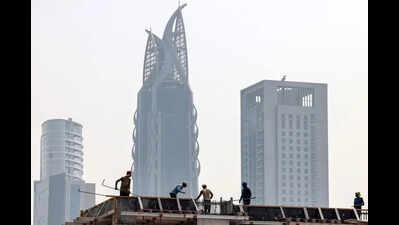
Mumbai: Khizar Farooqui, a truck driver from Jaunpur in Uttar Pradesh, has secured a work visa from a Saudi Arabian company through a travel agency in Mumbai. Grounded by the West Asia war, which has stretched beyond a month now, he is worried that long-term unemployment will push his family into acute poverty.“I have been in Mumbai for over 20 days. Despite the risks and friends’ advice against travelling to Saudi in these conditions, I want to go, as I desperately need to work. But the air ticket prices have almost doubled from what they were a month ago. I don’t know what to do,” he said. Around 1 lakh-odd unskilled, semi-skilled and skilled Indian workers with secured job permits in the Gulf countries whose plans —and hopes—have been derailed by the war, according to Abdul Karim, president of Indian Personnel Exports Promotion Council, an association of registered recruitment agencies. “The war has virtually brought the process of recruitment to a standstill. Workers with visas are apprehensive and under pressure from families against flying out of the country. The situation will worsen if the war persists for a few more weeks,” he warned. Karim said around 95 lakh Indian expatriates live and work in the six Gulf Cooperation Council countries (Saudi Arabia, UAE, Bahrain, Oman, Qatar and Kuwait). These expatriates working in sectors like construction, engineering, healthcare and hospitality collectively contribute around Rs 33 billion of the Rs 83-billion annual foreign remittances to India. “If these workers further pause their travel, it will aggravate the unemployment scenario in the country. These drivers, plumbers, pipe fitters and masons, who get between Rs 25,000 and Rs and Rs 30,000 monthly in the Gulf countries, will not find jobs for even Rs 10,000 monthly here. The war must end immediately,” said businessman-educationist Nasir Jamal, who originally hails from UP, which sends out a large workforce (3-4 lakh) annually to West Asia. Ashhad Anwar Siddiqui of BKC-based Ashhad Travel Agency said there are 150 persons who have secured visas through his company but have postponed their travel, both because of pressure from the family and the hike in airfares. “The situation has been made more complicated by the requirement of a skill test, in addition to an interview by a delegation of the employers,” he said.Wasib Peshimam of Al Samit International, a recruitment agency in Mahim, is saddled with a list of 150 workers who have secured visas. “We are hurtling towards a situation like the Covid-induced crisis. There has been no announcement of any compensation for this sector.”


Source link

US-Iran war bleeds Sensex! Rs 51 lakh crore gone, record $12 billion FII wipeout, stock market down over 11% – is there an end in sight to selloff?


US-Iran war bleeds Sensex! Rs 51 lakh crore gone, record $12 billion FII wipeout, stock market down over 11% - is there an end in sight to selloff?
In a span of just a month, BSE Sensex is down over 9,300 points or 11.48%! (AI image)

Blood bath on Dalal Street, foreign investors’ exodus, mass selloff, several lakh crore of investors’ wealth wiped out – these are the headlines that have dominated financial news this month. The US-Israel-Iran war has dealt a massive blow to the Indian stock market indices BSE Sensex and Nifty50 which were already struggling for the last few months after Donald Trump announced tariffs.With global crude oil prices rising to levels not seen in several years, the inflationary impact globally and its resultant blow to GDP growth has kept investors on tenterhooks forcing them to flee riskier assets like equities.The selloff by foreign institutional investors (FIIs) has been particularly pronounced. Rupee has seen its worst financial year in over 14 years, breaching the 95 per dollar mark in trade on the last trading day (March 30) of the fiscal year.At the start of the new financial year 2026-27, what’s the outlook for BSE Sensex and Nifty50? When will foreign investors become net investors?

Sensex & Nifty Round-Up – Facts & Figures: A Telling Picture

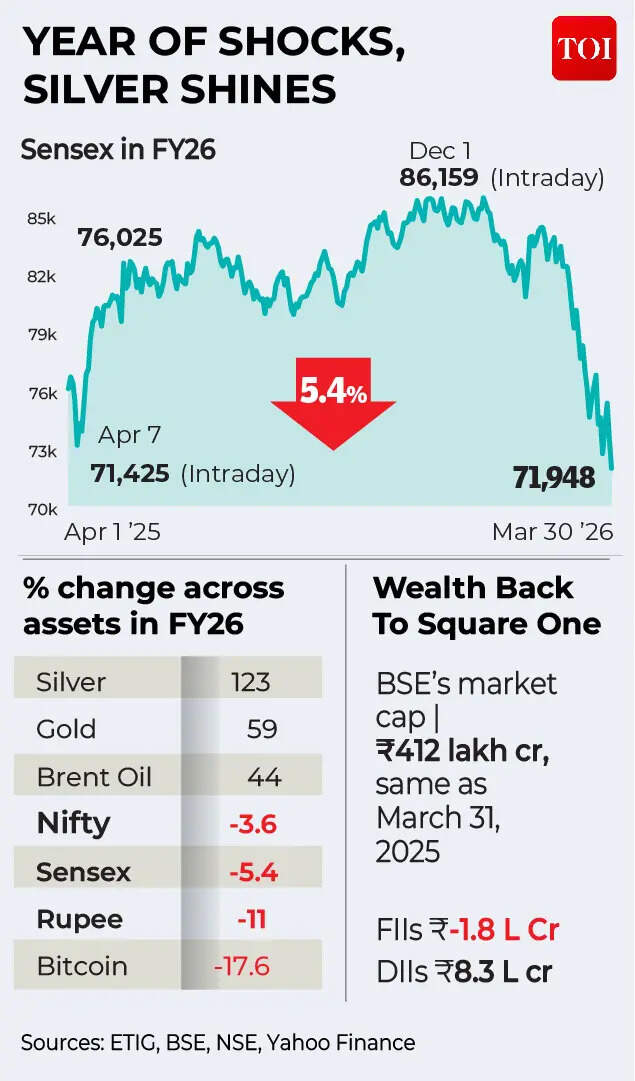
  • From the start of the Middle East conflict on February 28 (Saturday), investors have lost Rs 51.7 lakh crore so far! The market capitalisation of BSE-listed companies has come down to Rs 4,12,41,172.45 crore (March 30 closing) from Rs 46,325,200.41 crore (February 27 closing). The current market cap stands at $4.3 trillion.

  • In a span of just a month, BSE Sensex is down over 9,300 points or 11.48%! Sensex is actually down almost 16.5% from its all-time high level of 86,159.02.

  • It’s been a bad month for foreign investors’ exodus, with over Rs 1 lakh crore (around $12 billion) withdrawn from domestic equity markets in March. This is the worst monthly outlook in Indian stocks.
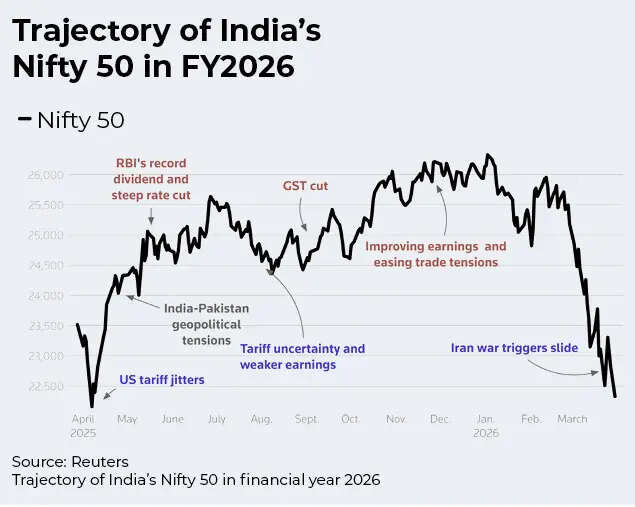
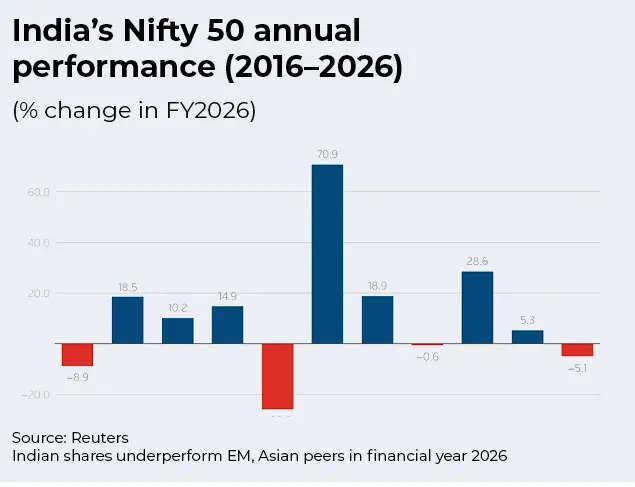
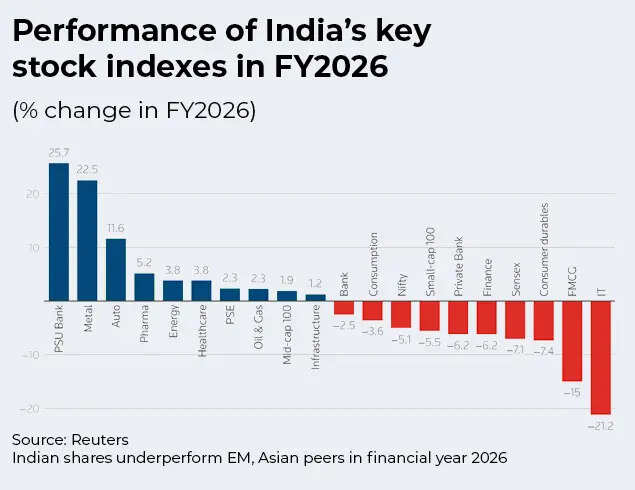
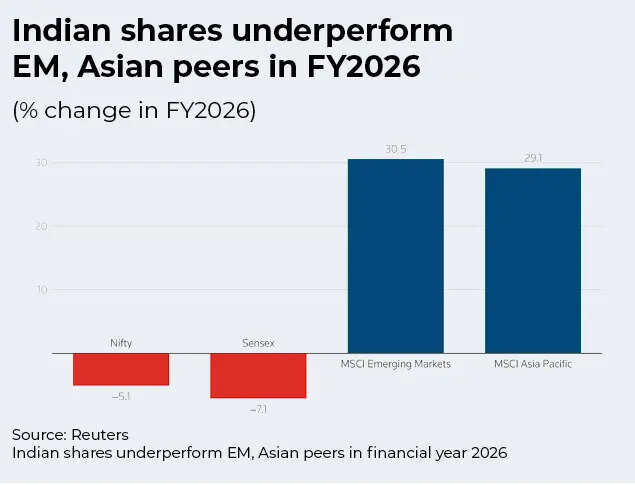
  • In the financial year 2025-26, Sensex dropped 7%, ending on a bearish note with no clear horizon on when an uptrend will begin. Nifty50 has dropped 5% in the same fiscal year.

Trajectory of Nifty in FY26

  • In fact, the market cap of BSE-listed firms has not budged in the last year. According to a TOI analysis, BSE’s market capitalization at Rs 412 lakh crore is exactly the same as it was on March 31, 2025!
  • Not only that, the March 2026 closing is even below the closing for March 2024! On March 28, 2024, Sensex closed at 73,651.35. At present, Sensex is at 71,947.55, down 1,700 points from two years ago!
  • In FY26, foreign funds took money out of Indian stocks at a record pace. The total net outflow stands at Rs 1.8 lakh crore, which is the biggest annual outflow.
  • Domestic players continue to cushion the stock market fall. In FY26, domestic institutional investors bought stocks of around Rs 8.3 lakh crore.

Analysts are of the view that the risk aversion seen in stock markets in March is one of the worst since the Covid pandemic back in 2020.

Why are foreign institutional investors rushing out of India?

Experts say the factors driving the current selloff is a mix of factors: attractive valuations in developed markets, rupee depreciation, recent US-Iran war which has driven up global crude oil prices.Pabitro Mukherjee, Associate Vice President – Technical Research Bajaj Broking blames external factors for this month’s exodus.“The current wave of FPI outflows has been primarily driven by escalating geopolitical tensions in West Asia, which have triggered a global “risk-off” sentiment. This has been further compounded by macroeconomic pressures, including a weakening Indian Rupee breaching ₹95/USD, and a sharp rise in crude oil prices, which has heightened inflation concerns and widened the current account deficit,” he told TOI.

Nifty50 Annual Performance in last 10 years

“These factors appear largely external and cyclical in nature, linked to global uncertainty and risk aversion rather than domestic structural weaknesses,” he believes.Tanvi Kanchan, Associate Director at Anand Rathi Share and Stock Brokers Limited explains that with Brent crude prices above $100, a classic risk-off move has been fuelled. This has been compounded by the rupee hovering near ₹92-95 against the dollar, elevated US bond yields, and a mixed Q4 earnings outlook.Rising US bond yields and tightening global liquidity have improved the relative attractiveness of developed market fixed income, prompting reallocation away from emerging markets including India, she tells TOI.She is also of the view that most of these drivers are cyclical, not structural – the West Asia conflict, crude spike, and dollar strength are external shocks. “India’s domestic fundamentals, 7%+ GDP growth, fiscal consolidation, and a robust DII ecosystem, remain intact. The one structurally evolving factor is FPI reassessment of IT earnings amid AI disruption, which will take 12-18 months to play out,” she opines.What’s spooking investors is the possible economic fallout of the persistent Middle East crisis.“Approximately 70-80% of the selling is externally driven on the backs of weakness in global equity markets following the West Asia war, steady rupee depreciation, fears of declining Gulf remittances, and the impact of high crude on India’s growth and corporate earnings are all contributing to sustained FPI selling. FPIs were also sellers in other emerging markets like Taiwan and South Korea, confirming this is a global risk-off move, not an India-specific rejection,” says Tanvi Kanchan.

Performance of India's Key Stock Indexes

Also, domestically, Indian valuations continue to remain relatively elevated compared to several emerging market peers, which may still be prompting selective profit-booking and reallocation, but this is a secondary factor, not the primary driver, she adds.One pointer of structural strength is the continued faith that domestic investors are showing. “While domestic institutional investors have shown strong participation, with record buying of ₹1.28 lakh crore, their support has only partially offset the scale of FPI selling, indicating that global developments are the dominant influence in the current phase,” says Pabitro Mukherjee.For Tanvi Kanchan, the silver lining is DIIs, whose monthly SIP inflows of Rs 30,000 crore and deployable mutual fund cash of around $6 billion provide a strong floor, preventing a disorderly market collapse.

FY26 a year of shocks

What’s The Road Ahead?

Experts are of the view that the FII selling may continue through the first half of financial year 2026-27, with a clearer trend reversal possibly emerging only in the second half. However, market analysts believe in the fundamental strength of India’s economic growth story and believe that the market remains structurally sound, with possible signs of optimism emerging once the immediate war settles down and crude oil prices come below $100 per below.“FII inflows are expected to be majorly skewed towards H2FY27 because H1 earnings will be impacted by the war scenario. Key reversal signals to watch would be crude oil dropping sustainably below $90/barrel; the rupee stabilising below ₹91-92; a ceasefire or de-escalation in West Asia; Q4FY26 earnings reaffirming growth visibility for FY27; and the US Federal Reserve resuming rate cuts,” Tanvi Kanchan says.

Indian shares underperform EM, Asian peers

The persistence of foreign selling is closely tied to the continuation of global risk-off sentiment and geopolitical uncertainty. As long as these conditions remain elevated, FPI outflows are likely to continue.A reversal would likely be indicated by easing geopolitical tensions, stabilisation in crude oil prices, and improvement in currency stability, which would collectively help restore investor confidence, says Pabitro Mukherjee.So when will FIIs be back on D-Street? According to Tanvi Kanchan, going forward, the key conditions are:

  • Rupee stabilisation;
  • Q4 earnings delivery reaffirming stable FY27 EPS growth;
  • US Fed resuming rate cuts, which would ease global liquidity and improve the relative attractiveness of emerging markets like India; and regulatory moves,
  • RBI’s easing of certain FPI limits and SEBI’s expanded participation framework for IFSC-based FPIs are steps in the right direction.
  • A formal US-India trade agreement, if concluded, would be the single biggest FPI re-rating catalyst in FY27.

She explains that a combination of external easing and domestic policy action is needed. “On the external side we see crude oil cooling, US yield moderation, and West Asia de-escalation. On the domestic side, February 2026 showed what works, the combination of an interim India-US trade framework reducing tariff uncertainty, the Union Budget retaining fiscal credibility with a 4.3% deficit target, and valuation comfort after earlier corrections brought Rs 22,615 crore back in a single month,” the Anand Rathi Share and Stock Brokers expert says.(Disclaimer: Recommendations and views on the stock market, other asset classes or personal finance management tips given by experts are their own. These opinions do not represent the views of The Times of India)


Source link

Jammu and Kashmir: Gunshots reported during search operation in Ganderbal | India News


The TOI News Desk comprises a dedicated and tireless team of journalists who operate around the clock to deliver the most current and comprehensive news and updates to the readers of The Times of India worldwide. With an unwavering commitment to excellence in journalism, our team is at the forefront of gathering, verifying, and presenting breaking news, in-depth analysis, and insightful reports on a wide range of topics. The TOI News Desk is your trusted source for staying informed and connected to the ever-evolving global landscape, ensuring that our readers are equipped with the latest developments that matter most.”


Source link

Trans person lodges FIR against brother over ‘doctored’ video | Mumbai News


Mumbai: Almost a week after a video involving NCP neta and FDA minister Narhari Zirwal and a transgender person went viral, the trans person lodged an FIR with the police against her brother, accusing him of doctoring the old video to threaten her.Zirwal found himself at the centre of a controversy last week after a video showing him with the transgender person in a bedroom at his official residence went viral. The trans person approached the Marine Drive police station and gave her statement. The FIR was registered, and the case was transferred to the Cuffe Parade police station as the official residence of Zirwal is located in its jurisdiction. Zirwal is a four-time MLA from the Dindori Assembly constituency.The complainant told police that her brother had doctored old videos using AI. The accused had allegedly been asking her to help him get a job in the FDA department, which comes under Zirwal. He allegedly threatened them to make the doctored video viral if he was not given a job or paid money.A police officer said, “We are probing the case.” tnn


Source link

Iran oil returns: India set to receive first cargo in 5 years, tanker heads to Gujarat


Iran oil returns: India set to receive first cargo in 5 years, tanker heads to Gujarat

India is set to receive its first shipment of Iranian crude oil since 2019, with a tanker carrying 600,000 barrels of oil en route to Gujarat following a temporary sanctions waiver by the US, according to PTI.Ship-tracking data indicates that the vessel Ping Shun is headed towards Vadinar port, marking a potential revival of Indo-Iran oil trade after nearly five years.“The Indo-Iranian oil trade has flickered back to life. Following the US administration’s decision to grant a 30-day window for Iranian oil “on the water” due to regional conflict, the vessel Ping Shun is now en route to Vadinar (in Gujarat) with 600,000 barrels of crude. This is the first such delivery since May 2019 and comes at a critical time for Indian refiners facing tightening inventories,” said Sumit Ritolia, Lead Research Analyst, Refining and Modelling at Kpler.The development follows Washington’s decision earlier this month to allow a 30-day window for the purchase of Iranian oil already at sea, aimed at easing global oil prices amid the ongoing US-Israel conflict with Iran. The window is set to expire on April 19.While the buyer of the cargo remains unidentified, Vadinar houses a 20 million tonnes per annum refinery operated by Rosneft-backed Nayara Energy and also serves as a landing point for crude supplies to inland refineries such as BPCL’s Bina unit.India’s oil ministry has so far maintained that any decision to resume imports from Iran will depend on techno-commercial viability.Before sanctions were tightened in 2018, India was among the largest buyers of Iranian crude, importing both Iran Light and Iran Heavy grades due to refinery compatibility and favourable pricing terms.Imports ceased in May 2019 after US sanctions were reimposed, with India shifting to alternative suppliers including the Middle East and the US. At its peak, Iranian crude accounted for 11.5 per cent of India’s total imports.India had imported about 518,000 barrels per day (bpd) of Iranian oil in 2018, which declined to 268,000 bpd between January and May 2019 during a sanctions waiver period before dropping to zero thereafter.“The Aframax Ping Shun (IMO 9231901) loaded with Iranian crude oil from Kharg Island in early March has emerged as the first vessel observed signalling a destination of Vadinar, India since May 2019, following sanction reimposition on Iranian oil by the first Trump administration,” Ritolia said.The tanker is estimated to have loaded around 600,000 barrels from Kharg Island around March 4 and is expected to reach Vadinar on April 4.An estimated 95 million barrels of Iranian oil are currently stored on vessels at sea, of which around 51 million barrels could be supplied to India, while the rest may be directed to China and Southeast Asian markets.However, payment mechanisms remain uncertain as Iran continues to be excluded from the SWIFT global banking system, complicating international transactions.Earlier, payments were routed in euros through Turkish banks, but that channel is no longer available following renewed sanctions restrictions.Iran was first disconnected from SWIFT in 2012 due to EU sanctions over its nuclear programme, with further disruptions in 2018 after the US reimposed sanctions, limiting its ability to receive payments and access foreign currency reserves.


Source link

PSL ball tampering row escalates: Fakhar Zaman charged with Level 3 offence | Cricket News


The ball tampering incident in the Pakistan Super League (PSL) has taken Pakistan cricket by storm as the Lahore Qalandars player Fakhar Zaman has been charged with a Level 3 offence under Article 2.14 of the Code of Conduct for Players and Player Support Personnel for allegedly breaching Article 41.3 of the playing conditions, which prohibits any action that alters the condition of the ball.Zaman denied the allegation during a disciplinary hearing held by match referee Roshan Mahanama. Another hearing is scheduled within the next 48 hours, after which the referee will announce a decision.

Watch

Inside Pakistan’s camp What is the Naqvi problem

The incident occurred during the second innings of the match on Sunday.The charge relates to an incident just before the final over of the Karachi Kings’ innings, when they needed 14 runs to win.Zaman was seen in discussion with Haris Rauf and Lahore Qalandars captain Shaheen Shah Afridi before the over. Shortly thereafter, umpire Faisal Afridi requested the ball and, after inspecting it with his colleague, determined that its condition had been altered.The penalty reduced the target to nine runs off the final over instead of 14, shifting the momentum in favour of the Kings. Abbas Afridi capitalised on the situation by striking consecutive boundaries on the second and third deliveries, guiding the 2020 champions to a thrilling four-wicket victory.Qalandars captain Shaheen Shah Afridi expressed disappointment over the decision but admitted he was unaware of the specific allegation at the time.

Poll

Should penalty rules in cricket be more stringent against ball tampering?

“I don’t know about this [ball tampering], and we’ll discuss. Five runs penalty…but we can’t say anything. We will see,” said Shaheen at the post-match presentation.If the charge is upheld, Zaman and possibly the Lahore Qalandars could face further action.Also See: CSK vs RR Live Score


Source link

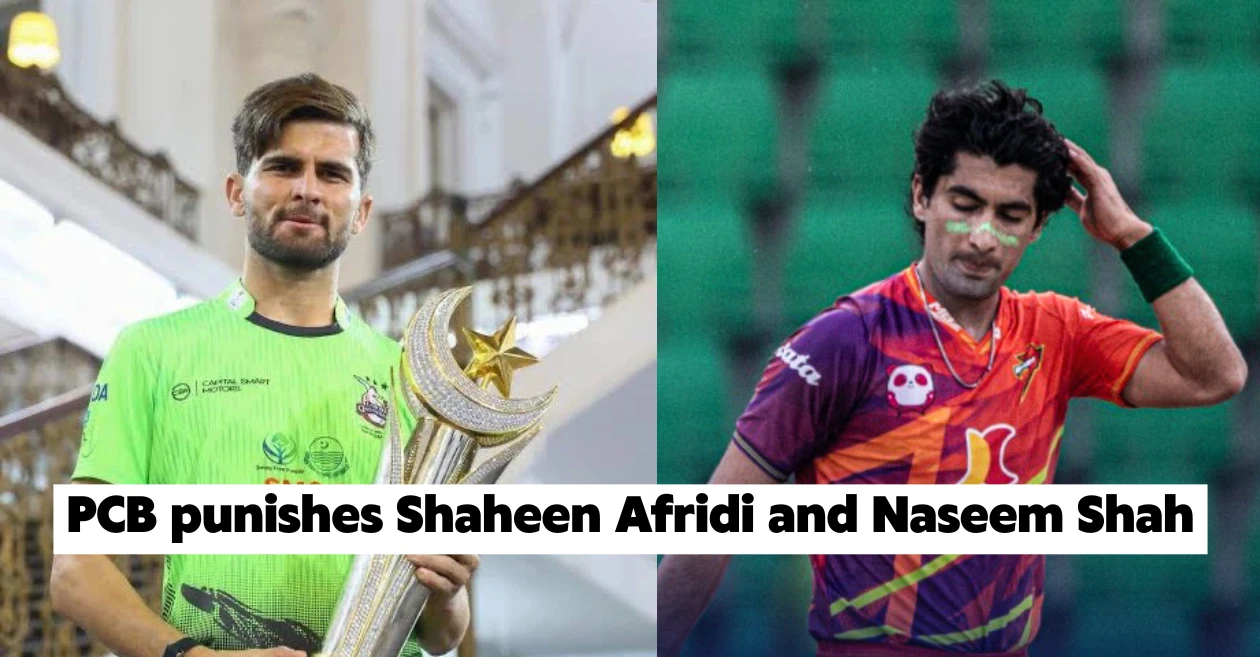
PCB penalizes Shaheen Afridi and Naseem Shah for breaching security protocol and posting offensive tweet during PSL 2026


The Pakistan Super League (PSL) 2026 season has barely gotten underway, but it has already been overshadowed by controversy. In a strong message to players, the Pakistan Cricket Board (PCB) and franchise authorities have taken strict disciplinary action against two of the country’s top fast bowlers – Shaheen Afridi and Naseem Shah – for separate off-field incidents.

With the tournament already under intense scrutiny due to security concerns and logistical challenges, these incidents have further highlighted the PCB’s zero-tolerance approach towards breaches of discipline. The board appears determined to ensure that players maintain professionalism, both on and off the field, especially during such a sensitive edition of the league.

Shaheen Afridi penalized for security breach

Lahore Qalandars captain Shaheen has been fined PKR 1 million (approximately USD 3,600) after being found guilty of violating security protocols at the team hotel. The incident reportedly took place on March 28, when Afridi, along with teammate Sikandar Raza, escorted four unauthorized individuals into a player’s room.

What raised serious concerns was the fact that the visitors were allowed to stay inside for nearly three hours – despite repeated objections from security personnel. According to reports, the request to allow the visitors was rejected multiple times, first by the team’s liaison officer, then by PCB security officials, and finally by PSL CEO Salman Naseer, even after team owner Sameen Rana personally intervened.

In response, Lahore Qalandars issued a statement confirming the penalty while also attempting to downplay the seriousness of the situation.

“In the interest of maintaining discipline and demonstrating accountability, the franchise has taken a voluntary and proactive step by imposing a fine of PKR 1 million on Shaheen Shah Afridi for his involvement.”

The franchise described the entire episode as a “misunderstanding” rather than an intentional violation. Interestingly, no action was taken against Sikandar Raza, who took responsibility for the incident during a press conference, which may have influenced the final decision.

In a much more severe case, Naseem Shah was hit with a massive PKR 20 million (USD 72,000) fine for a controversial social media post that quickly went viral before being deleted. The young fast bowler had posted on his X (formerly Twitter) account during the PSL 2026 opener in Lahore:

“Why is she being treated like the Queen at Lords?”

The remark, widely interpreted as a sarcastic comment on Punjab Chief Minister Maryam Nawaz’s presence at the match, triggered immediate backlash. The timing of the tweet added fuel to the fire, as it came shortly after the PCB had announced that matches would be held behind closed doors due to a fuel crisis linked to ongoing tensions in West Asia.

Naseem later deleted the tweet and claimed that his account had been hacked. He also issued an unconditional apology. However, the PCB’s three-member disciplinary committee was not convinced and found him guilty of breaching multiple clauses of his central contract and social media guidelines.

The board confirmed its decision in a firm statement:

“While noting the unconditional apology tendered, Naseem is found to have breached various clauses of his Central Contract and a fine of PKR 2 crores has been imposed. The PCB remains committed to upholding professional standards, contractual obligations and the integrity of the game.”

The fine is significant, reportedly equivalent to around eight months of Naseem’s central contract earnings. In addition, the PCB has taken further action by terminating and blacklisting his social media adviser, preventing them from working with any PCB-contracted player in the future.

Also READ: Ball-tampering in PSL 2026 – Haris Rauf, Shaheen Afridi, Fakhar Zaman under fire after viral clip

PSL 2026 faces early challenges amid strict oversight

These incidents are just part of a growing list of disciplinary concerns in PSL 2026. Lahore Qalandars opener Fakhar Zaman is currently under investigation for an alleged ball-tampering offense, while Karachi Kings pacer Hasan Ali has already been fined for inappropriate on-field behaviour.

The tournament itself is being played under unusual conditions, including closed-door matches, limited venues, and enhanced AI-powered surveillance systems due to ongoing regional security concerns.

All of this has prompted the PCB to adopt a stricter stance than ever before. By imposing heavy penalties and taking swift action, the board is sending a clear message – discipline and professionalism are non-negotiable, regardless of a player’s stature.

Also READ: From Carlos Brathwaite to Wasim Akram – Star-studded commentary panel announced for PSL 2026


Source link

Mumbai sessions court nixes order in 1.4cr cheating case over date change sans notice | Mumbai News


Mumbai: A sessions court has set aside a magistrate’s order that had dismissed a decade-old cheating complaint involving an alleged fraud of over Rs 1.46 crore. The applicant, Vishalaskhi Shetty, pointed to a discrepancy in court records where a scheduled date in Jan 2024 was allegedly struck out and advanced to Dec 2023 without her knowledge. The judge held the lower court’s decision to accept a police closure report was flawed because it was passed “behind the back of the complainant” after the court dates were shifted without notice. “It is true that the… High Court directed to apply for expeditious hearing but it does not meant that after giving a date to complainant and before the given date decide the complaint behind the back of the complainant. The magistrate has to pass the order on merit after giving opportunities to both the sides. Therefore, I am of the view that the impugned order is not just legal and proper, it needs interference,” additional sessions judge M Mohiuddin MA said. Shetty moved the sessions court Nov 2024, after a magistrate’s court accepted the police closure report in Dec 2023. The dispute originated from a 2013 complaint filed by a businessman who alleged Rajesh and Kashmira Parekh induced him to invest Rs 1.46 crore in a specific healthcare venture. The duo allegedly diverted the money into a medical export company and failed to provide returns. Following the original complainant’s death in 2017, his wife, Vishalakshi, was substituted as legal heir to pursue the case. The police filed a ‘C’ Summary report, suggesting the matter was of a civil nature rather than criminal. While the Parekhs argued the complainant had failed to file a protest petition for years, Shetty contended the magistrate prematurely disposed of the case. “From the record, it clearly shows initially the advocate for the complainant was shown present and date was given to him as Jan 13, 2024. Thereafter, accused and advocate appeared, filed application and copy of order of… High Court (for expeditious hearing) . Therefore, it can be gathered that date was changed without notice to the complainant and her advocate,” the judge said. The court further emphasised that while higher courts had directed an expeditious trial, this did not authorise the dismissal of a case without a fair hearing. The sessions court has now restored the complaint to its original stage. The magistrate has been directed to reconsider the closure proceedings and decide the matter on its merits after providing both parties a proper opportunity to be heard, in accordance with previous high court directives for a speedy resolution.


Source link

Vaibhav Sooryavanshi for England series! Ex-captain asks ‘Is he allowed to tour as 15-year-old?’ | Cricket News


Vaibhav Sooryavanshi for England series! Ex-captain asks 'Is he allowed to tour as 15-year-old?'
Vaibhav Sooryavanshi (Image credit: BCCI/IPL)

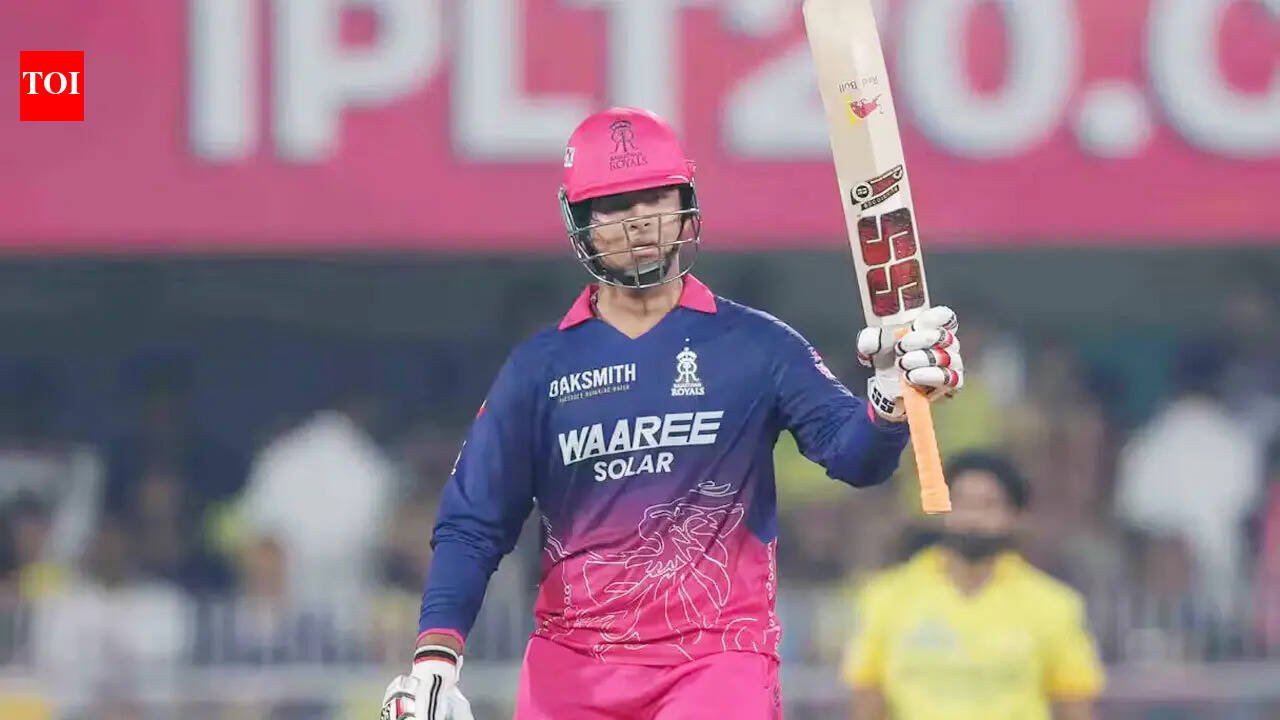
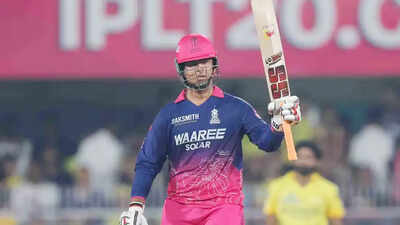
NEW DELHI: When will Vaibhav Sooryavanshi make his India debut? When will the 15-year-old play for the senior Indian team? These questions are once again being asked by former cricketers and fans. The buzz has picked up pace after the teenager hammered a 17-ball 52 in Rajasthan Royals’ opening game of IPL 2026 against Chennai Super Kings.Now, former England captain Michael Vaughan has joined the conversation and wants the youngster from Samastipur, Bihar, to be part of the senior India setup.Vaughan believes Sooryavanshi should be picked for the England white-ball tour, scheduled in July. India are set to play five T20Is and three ODIs on that tour.

Watch

KKR Depart from Mumbai after losing to Mumbai Indians

“When will he make his Indian debut? And I’m just looking, and I know we’re probably getting ahead of ourselves. It’s only the first innings of the IPL, but there’s a white-ball tour to England in a few months’ time. And if I was Indian cricket, I would get him on that tour. Not necessarily, he’s going to get into players that are in the team at the moment, but the one thing that he’s going to need is he’s going to need to be brought into the Indian team and the kind of surroundings of what Indian cricket is. Just bring him in, and if he plays one or two games, fantastic, but get him on a tour. Is he allowed to go on tours as a 15-year-old?” Vaughan said on Cricbuzz.“I’d be giving him a little bit of experience with that Indian team. Not necessarily, as I said, jumping straight into the side, but just having him around. He’s good enough to play. I do not doubt that,” he added.After RR bowlers bundled out CSK for a modest 127, the spotlight once again shifted to Sooryavanshi when he walked out to open the innings.And he did what he does best — sending bowlers on a leather hunt.Sooryavanshi stitched a 75-run opening stand with Yashasvi Jaiswal and smashed 52 off just 17 balls, including five sixes and four fours, to help RR thrash CSK by eight wickets.“When you think he’s batting with someone at the other end, who I have in the last few years, he’s right up there with the best, in terms of all format players. Yashasvi Jaiswal, I think he’s a wonderful player. And I’m not saying he made Jaiswal look mediocre tonight, but there was a gulf in kind of fearlessness. You could see Jaiswal looking at the ball, just trying to play. This kid’s just looking at the ball to launch it into the stands. He just has remarkable freedom,” said Vaughan.“The two innings were a contrast. You had Sooryavanshi, who just went pure modern sixes. And I respected Jaiswal, because I don’t think he was seeing it as well as he could see it. So he didn’t just give it away. His strike rate wasn’t huge, but he’s had a little bit of time in the middle,” he added.Ahead of the IPL, Sooryavanshi had played a magnificent 175-run knock in the final against England to help India lift the Under-19 World Cup title.Also See: PBKS vs GT Live


Source link

Identity on trial: Why India’s new transgender law is facing backlash | India News


Identity on trial: Why India's new transgender law is facing backlash

‘Cause shade never made anybody less gay’ – Taylor Swift, You Need to Calm DownLast week, two contrasting developments related to the LGBTQ+ community made global headlines. One, in the German city of Munich, Dominik Krause was elected mayor, the first openly gay man to hold a constitutional office in a European country.Second, at the same time Krause was celebrating his victory with his partner and the public, in India, Parliament passed a legislation – The Transgender Persons (Protection of Rights) Amendment bill, 2026 – striking away the statute of self-determination.That translates to taking away the individual’s right to self identification, a Constitutional guarantee, and liberty over one’s own body.

Cause shade never made anybody less gay (X)

On Monday, March 30, President Droupadi Murmu assented to the bill, making the proposed legislation the law and bringing it into effect. Ironically, the ‘rights’ of the very community it claims to ‘protect’ have since risen in protest, taking to the streets to vociferously and legally push back against the proposed propositions challenging it. Not just that, the passage of the controversial bill itself created a massive uproar in both Houses of Parliament.In Lok Sabha, it was taken up last Tuesday, stopping the discussion on the Finance bill midway with Union Parliamentary affairs minister Kiren Rijiju insisting the bill needed to be passed the very day. And it did, with a voice vote amidst the din in the House, opposition walking out and an exhaustive two-minute-long reply by the concerned minister for social justice and empowerment Virendra Kumar.The story was no different the next day in the Upper House, the proposed legislation passed while the opposition demanded that it be sent to the select committee.

Fauzia Khan in Parliament

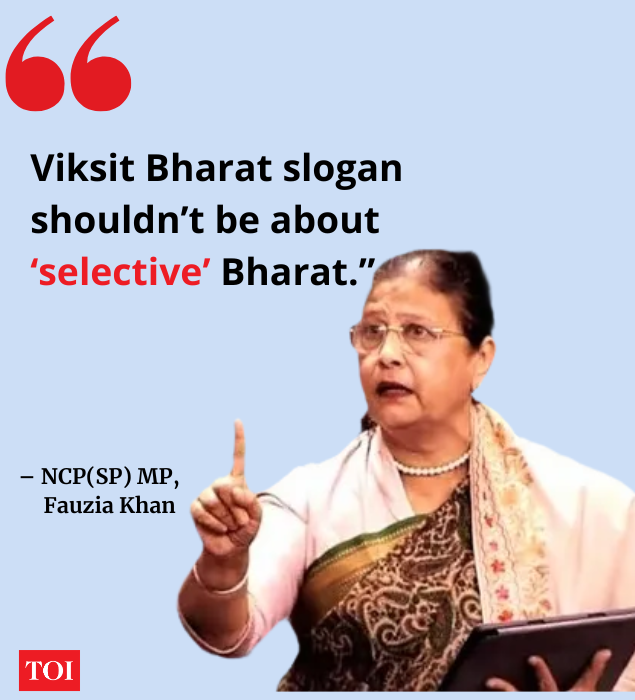
Speaking on bill, NCP(SP) MP Fauzia Khan said “Viksit Bharat slogan shouldn’t be about ‘selective’ Bharat.” Replying to which Kumar argued, every person’s emancipation and empowerment, asserting that the amendment will ensure that transgender persons continue to get legal recognition and protection. But, with a caveat, that a ‘magistrate’ and a ‘medical board’ would somehow determine if you are a trans person and qualify for rights, and that they would be protected.Anish Gwande, LGBTQ+ rights activist and national spokesperson of NCP(SP), also first openly gay person to hold such office for a major political party in India, speaking to TOI described the bill as “illegal, unconstitutional and illogical” adding “it is unfortunate that the bill was passed by both houses of Parliament without any substantive discussion within 24 hours.” He went on to question the timing of the bill, “It is bizarre to see governments focus on amendments to the trans bill, instead of war in West Asia, on LPG crisis in the country, on the depreciating Rupee.”

The gender question

For many the world exists in two colours – ‘black and white’, but it still leaves a population embracing the ‘greys’. The greys believe in facets of being agathokakological – the in-between areas, complexity, nuance, mixed feelings, or situations that aren’t purely one thing. A concept alien to the binaries. Similarly, what and how an individual feels about their ‘own’ body, nobody else can understand or tell but that particular individual. To understand this, it becomes essential to distinguish between sex and gender, terms often used interchangeably but conceptually distinct.

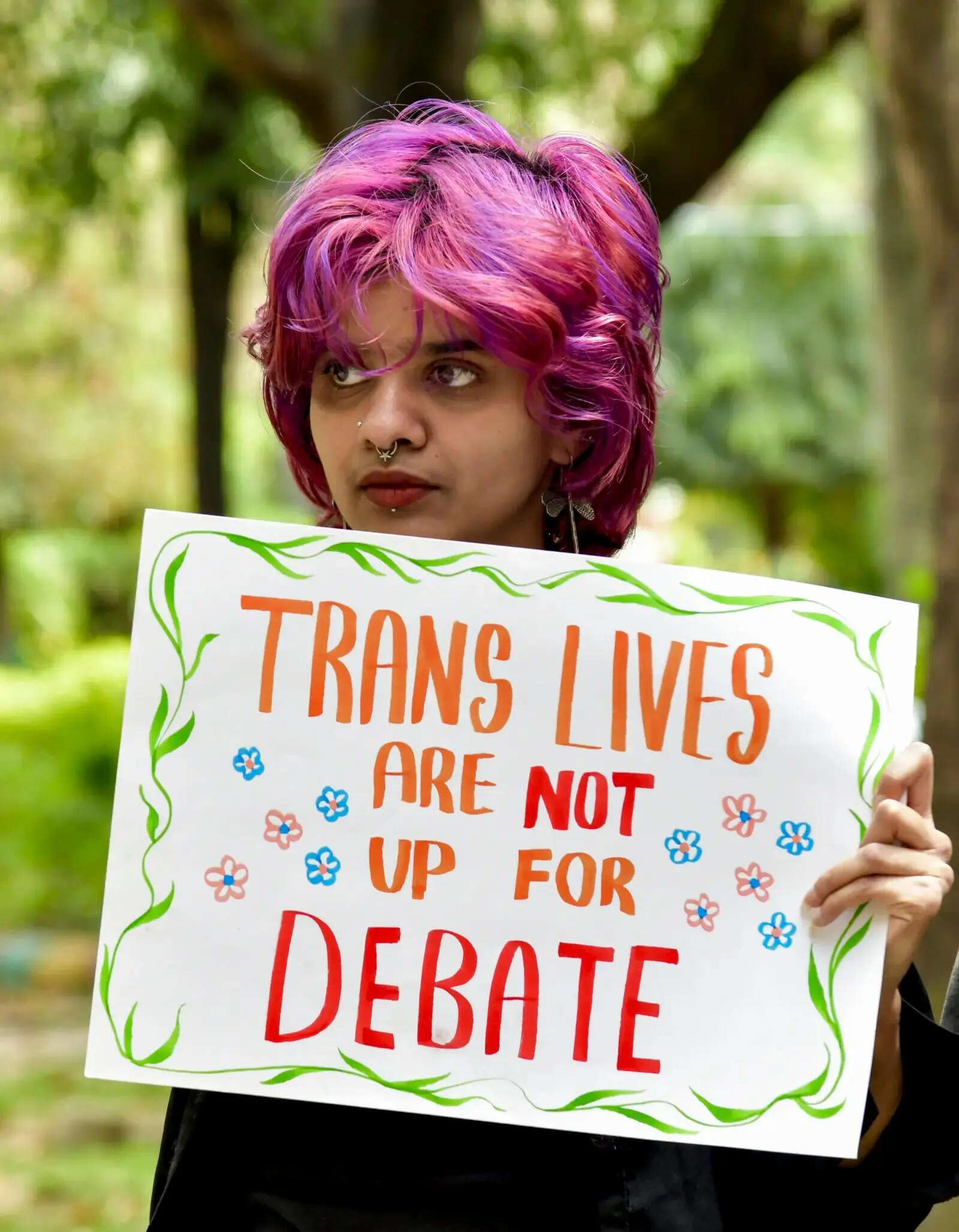
Protest against Transgender Persons bill (PTI)

Biological sex typically refers to physical attributes such as chromosomes, hormones, and reproductive anatomy, usually categorised as male or female. Gender, however, is understood in scholarly literature as a social and psychological construct that encompasses identity, roles, expressions, and lived experience. As philosopher Judith Butler argues, gender is not something one simply is, but something one does – a continuous process shaped by social norms and personal agency.Similarly, the World Health Organization defines gender as the characteristics of women, men, girls and boys that are socially constructed, including norms, behaviours, and roles associated with being a particular gender. This understanding moves beyond rigid binaries and acknowledges that gender exists along a spectrum. The American Psychological Association further recognises gender identity as a deeply felt, inherent sense of being male, female, a blend of both, or neither, an internal experience that may or may not align with the sex assigned at birth.In this context, the idea of the ‘greys’ is not merely poetic but empirically grounded. Contemporary gender studies consistently affirm that human identity resists strict categorisation. What appears as ambiguity to the binary lens is, in fact, a legitimate and lived reality for many.Thus, gender is not a fixed endpoint but an evolving narrative, one that is deeply personal, socially mediated, and often negotiated within structures that struggle to accommodate its fluidity.

The Transgender persons (protection of rights) amendments Act 2026

What the Act entails

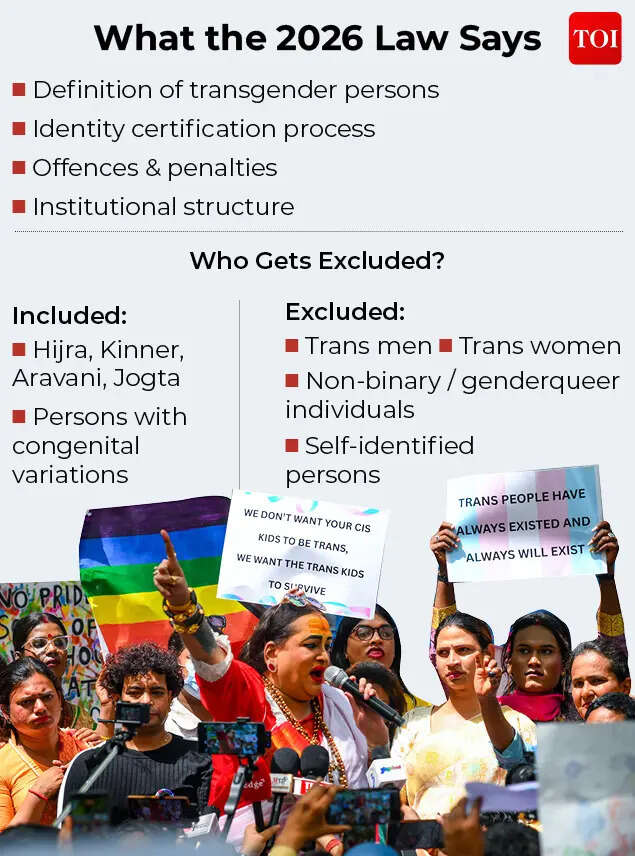
The legislation introduces changes across four key areas:

  • Definition of transgender persons
  • Process of identity certification
  • Offences and penalties
  • Composition and functioning of institutional bodies

The government’s Statement of Objects and Reasons argues that the earlier definition was “vague” and made it difficult to identify “genuine oppressed persons.” It further clarifies that protections should not extend to “self-perceived identity” or what it terms “acquirable characteristics.”

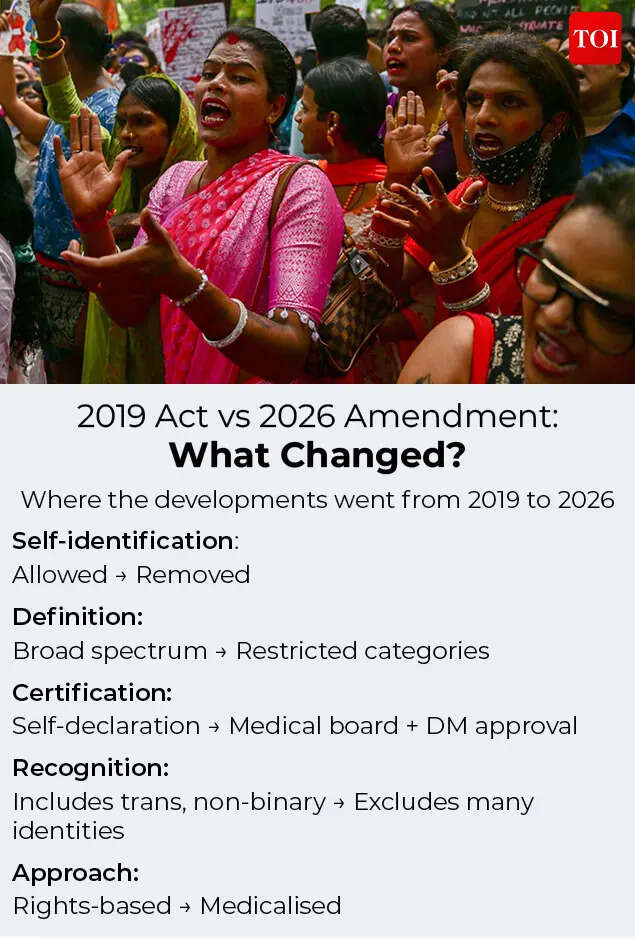
2019 Act vs 2026 Amendment

This framing signals a shift in legislative intent, from recognising identity as self-determined to one that is externally verified.

Key changes in the provisions

A narrower definition

The Act replaces the broader 2019 definition with a more restrictive one. It identifies transgender persons under two categories:

  1. Those belonging to specific socio-cultural groups, such as kinner, hijra, aravani and jogta, or individuals with congenital variations in sexual characteristics, including differences in chromosomes, genitalia, hormones or gonadal development.
  2. It also includes a category of persons who have allegedly been compelled, “by force, allurement, inducement, deceit or undue influence, either with or without consent”, to assume or present a transgender identity, reeking of the underlying premise of the Act.

Notably, it excludes persons with “self-perceived gender identity” and those with different sexual orientations. As a result, trans men, trans women and genderqueer individuals who do not fall within these listed categories are effectively excluded. The inclusion of the term “eunuch”, a classification historically rooted in the Criminal Tribes Act, 1871, where it was defined in medicalised and derogatory terms, marks a notable shift in a contemporary rights framework.The amendment also removes a distinct recognition of intersex persons, subsuming them under a clinical category termed “congenital variation,” thereby reinforcing a medicalised lens.The replacement of the term “intersex” with “congenital variation” reflects a shift towards a medicalised framework that frames such identities as conditions requiring diagnosis or correction. This approach sits in contradiction with existing administrative systems, such as birth registration, which continue to operate within a strict male–female binary and do not accommodate intersex identities.Sneha, a Delhi-based doctor, says, “The congenital variations basically refer to conditions which can be fixed with medical treatments, but pulling that in to refer to people of different gender makes no sense, how would you fix it and beyond that, what if someone just isn’t willing to get it changed?”It also raises concerns around autonomy and privacy, as it introduces the possibility of mandatory medical scrutiny for identity recognition. In doing so, the framework risks reducing inherently personal and lived experiences of identity to clinical evaluation, rather than recognising them as legitimate expressions of self. The Act’s treatment of socio-cultural identities has also drawn criticism for being selective and exclusionary. While it recognises a limited set of traditionally acknowledged identities, several region-specific and culturally rooted identities, particularly from the northeast and parts of south India, find no mention, like the Nupa Maanba or Nupi Maanbi, which are traditional socio-cultural identities existing in Manipur. This omission raises concerns about the erasure of diverse lived realities that fall outside the listed categories. Questions have also been raised over the lack of consultation with statutory advisory bodies meant to represent transgender persons, further deepening apprehensions that the law does not adequately reflect the diversity within the community it seeks to regulate.

Medical board for certification

Under the 2019 law, individuals could apply for identity certificates based on self-declaration. The amendment introduces a medical board, led by a Chief Medical Officer, whose recommendation becomes central to the process. The district magistrate will be the final person to decide on the recommendation and may also seek further medical opinions.

Mandatory reporting by hospitals

Hospitals performing gender-affirming surgeries must now report details of such procedures to authorities, including district magistrates and medical boards.

Stricter penalties

The Act introduces stringent punishments for offences such as coercing individuals into transgender identity, with penalties ranging up to life imprisonment depending on the nature of the crime and the age of the victim.Gwande, said it is plainly absurd that the law will introduce something “which would only discourage the people who work for and with the community, by criminalizing it in a manner as such when there is no clarity as to what would amount as allurement, or coercing.”

What are the major departures from the 2019 law?

At the heart of the 2019 Act was the principle that gender identity is self-perceived. It explicitly recognised a wide spectrum, including trans men, trans women, non-binary and genderqueer persons, and did not mandate medical intervention.The 2026 amendment removes this foundation.By eliminating the provision for self-perceived identity, the law narrows eligibility and excludes large sections of the transgender community. It also introduces a retrospective clause stating that such identities “shall not include, nor shall ever have been so included,” raising concerns about the status of thousands already recognised under the previous law.

2019 Act vs 2026 Amendment- What Changed

Legal experts note that this shift moves away from the Supreme Court’s 2014 judgment in National Legal Services Authority (NALSA) vs Union of India, which held that self-determination of gender is a fundamental right under Article 21.

Why has the Act faced fierce opposition?

The opposition from the transgender community has been swift and widespread.“From the start to the end this bill is completely arbitrary, nonsense, and it violates every kind of human right that is possible on the planet,” said Baadal, a trans activist.

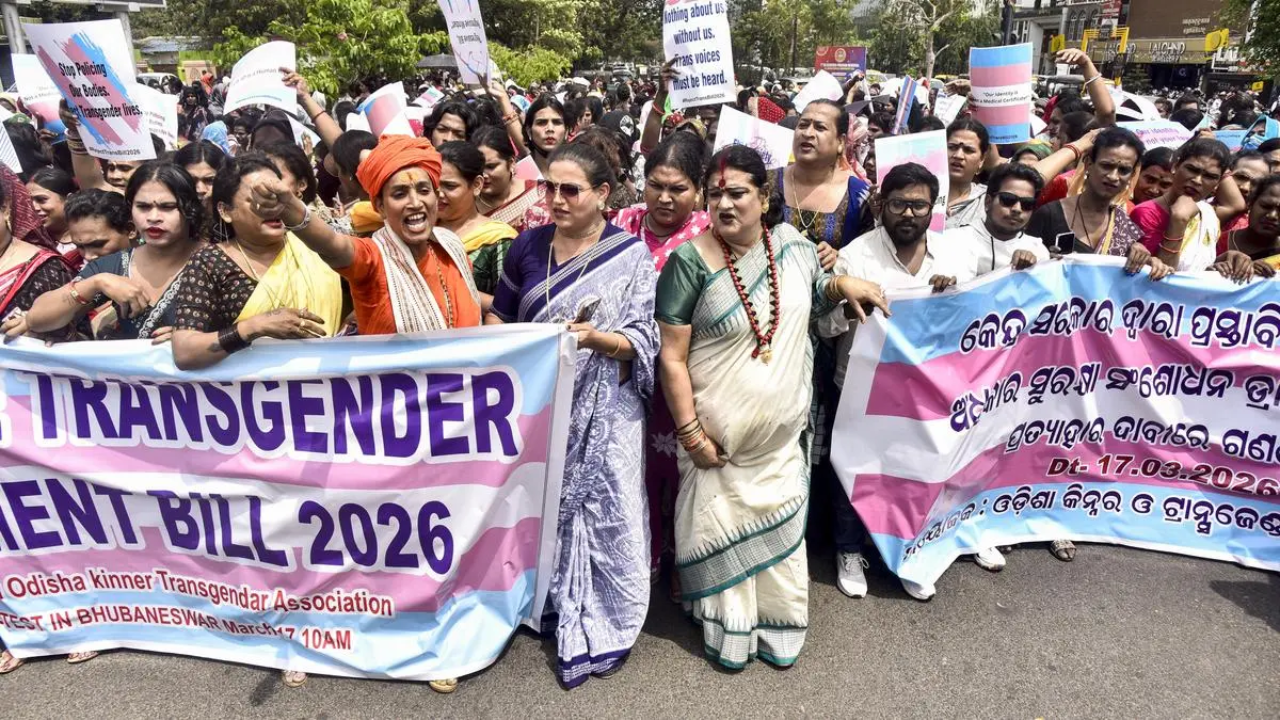
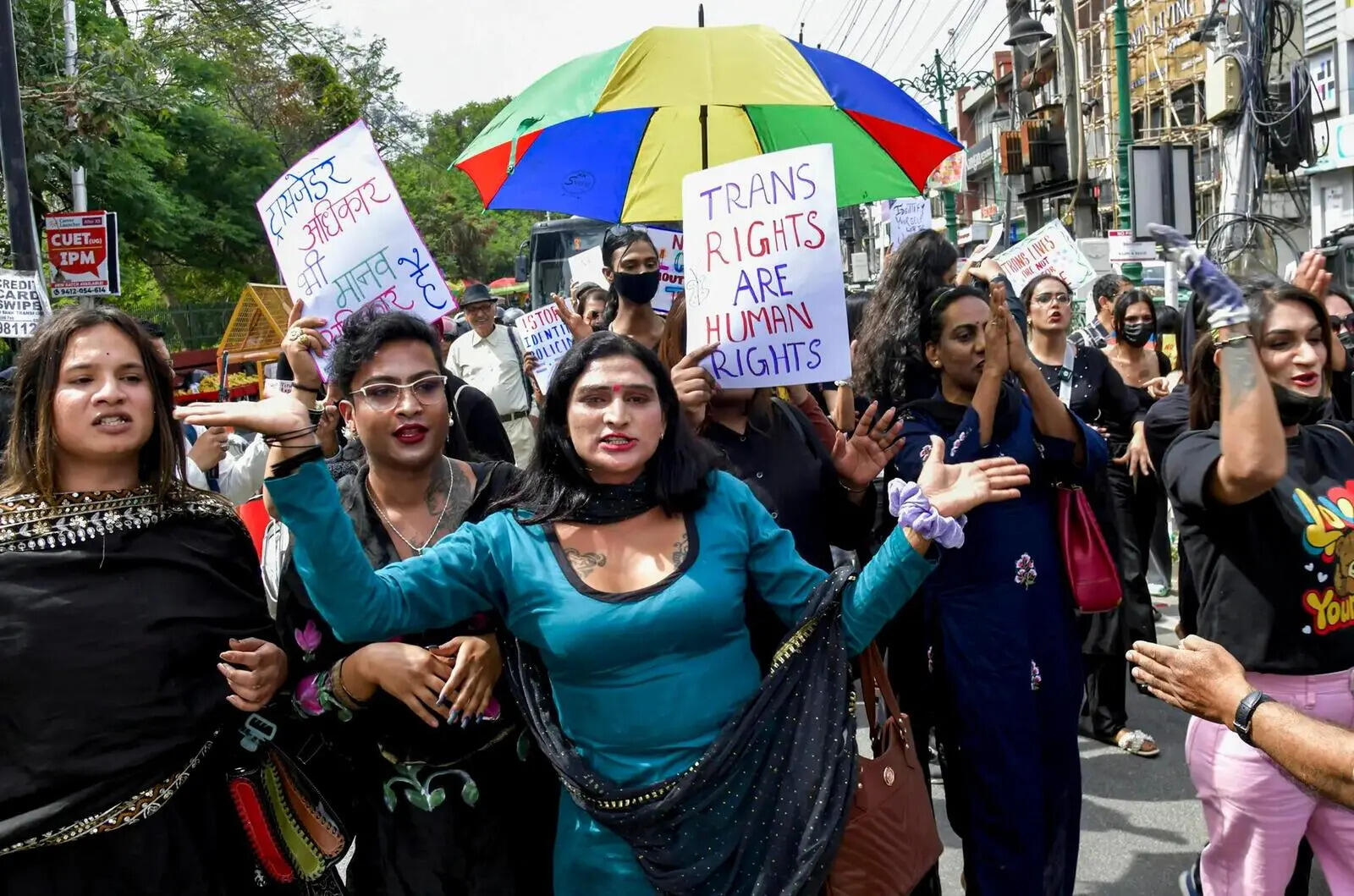
Protest against the changes

At the core of the protests is the removal of self-identification. Activists describe the introduction of medical boards as “medical gatekeeping,” arguing it places identity under institutional scrutiny.Mumbai Queer Pride, in a statement, said the law risks erasing transgender persons “under the guise of medical scrutiny.” Another major concern is the lack of consultation. Members of the National Council for Transgender Persons reportedly said they were not consulted before the bill was introduced.Gwande said they have asked for an unconditional apology from the officials of ministry of social justice and empowerment for “refusing to meet the representatives of the community and also insulting them.”Two members of the National Council of Transgender Persons (NCTP), Kalki Subramanium and Rituparna Neog, stepped down from their positions after the Rajya Sabha approved the controversial bill. Describing the bill as “regressive” and “existential,” they stated they could not continue being part of a council that the government chose not to consult.In her resignation letter addressed to minister Virendra Kumar, Subramanium, who represented the southern states on the council, said that “the recent introduction and passage of the Transgender Persons (Protection of Rights) Amendment bill” has “created an untenable position” for her.She further wrote, “As a statutory representative, my primary mandate is to advise the Government on legislation affecting our lives. The decision to move this bill forward without any formal consultation with myself or other community representatives of the NCTP undermines the very purpose for which this Council was established.”Highlighting her recent engagements, she added, “I have spent the last several weeks in constant dialogue with the transgender and intersex communities across the Southern Indian states and throughout the nation. The consensus is absolute: this bill is seen as a step backward for our fundamental rights to self identification and dignity.”

Legal tenability

Legal experts argue that the Act may face constitutional challenges.The NALSA judgment had explicitly rejected biological tests for determining gender and affirmed self-identification as a constitutional right.It also drew from international frameworks such as the Yogyakarta Principles, which state that no one should be forced to undergo medical procedures for legal recognition of gender identity.Karan Singh, a lawyer, talking about the legal standing of Act said, “on face of it the legislation itself seems to fall flat on multiple legal grounds, it stands in straight contradiction/violation of the NALSA judgement, the privacy of people choosing to undergo procedures is at stake, again violative of right to privacy, dignity under Article 19, and also the doctor-patient confidentiality is seemingly being violated as well.

Protest against Transgender Persons bill (PTI)

The introduction of mandatory medical certification and reporting requirements raises concerns around privacy as well. In KS Puttaswamy vs Union of India (2017), the Supreme Court recognised informational privacy as a fundamental right.Critics argue the Act does not clearly establish a legitimate state interest for collecting sensitive medical data, nor does it define safeguards.A Supreme Court-constituted advisory committee on transgender rights had urged the Centre to withdraw the bill, immediately after it was passed by Parliament, citing concerns that key provisions violate established legal principles. The panel, headed by former Delhi High Court judge Justice Asha Menon, wrote to Minister Virendra Kumar on last Wednesday.In its resolution, the committee flagged that the proposal to deny the right to self-identification of gender runs contrary to the Supreme Court’s 2014 NALSA v Union of India judgment, which recognised this right without requiring medical intervention. The panel cautioned that replacing self-identification with a state-controlled certification process, mandating assessment by a medical board, marks a significant departure from the court’s ruling.The committee was set up by the Supreme Court in October 2025 while hearing a case involving the dismissal of a transgender woman from teaching jobs in Uttar Pradesh and Gujarat. It was tasked with identifying gaps in the implementation of the Transgender Persons Act, 2019, and recommending measures to ensure equal participation and “reasonable accommodation” for transgender persons.

Impact on privacy, acceptance, individuality

Beyond legality, the Act’s implications extend to everyday life.Identity certificates are gateways to welfare schemes, healthcare, and employment opportunities. By making certification more complex, activists say the law may limit access to these benefits.The requirement for hospitals to share details of gender-affirming procedures has raised concerns about surveillance and stigma.“There is no medical test to prove anyone’s gender,” said Sneha. “But we are asked to prove it.”Activists also warn of a “chilling effect”, where social workers, NGOs, and even families may hesitate to support transgender individuals due to fear of legal consequences.While speaking on bill in Rajya Sabha Congress MP Renuka Chowdhury asked a pertinent question, pointing to treasury benches she said, “do you know what LGBTQ+ is? Can even four people sitting in the house tell me the meaning, I’ll accept the amendment.”She further added, “When there isn’t enough awareness in the Parliament, how is it gonna be on the streets and society?”

The road ahead

While the government maintains that the amendments strengthen protections, the response from the community suggests otherwise.“If it becomes law, we will challenge it,” Gwande said. He had also expressed hope that the President would not give her assent to the bill, after multiple rights organizations had written to her asking to return the bill to Parliament for reconsideration. But, the bill got Presidential assent on Monday. For many, the issue goes beyond a single piece of legislation. It touches upon the fundamental question of autonomy.As the Supreme Court observed in NALSA, “the moral failure lies in the society’s unwillingness to contain or embrace different gender identities.”The current conditions suggest that the question remains unresolved, and is now being tested in law.


Source link