Breaking News
Who killed Nancy Grewal? Family in Punjab alleges conspiracy after influencer’s murder in Canada | Chandigarh News


Who killed Nancy Grewal? Family in Punjab alleges conspiracy after influencer’s murder in Canada

JALANDHAR: Mother of Punjabi social media influencer Nancy Grewal, 45, who was murdered in LaSalle, Ontario, Canada, alleged that three persons could be involved in her murder, and named them. Speaking to the media at her Deol Nagar residence in Jalandhar, her mother, Shinderpal Kaur, said that she regularly received threats and she informed the police there. She said that her house also burnt a few months back.Nancy regularly spoke on different issues, often using acrimonious language. While she spoke against Khalistanis, both living in India and in other countries, and political leaders, she often commented on current issues. In recent weeks, she posted videos against Radha Soami Satsang Beas chief Baba Gurinder Singh Dhillon, after he called on Akali leader Bikram Singh Majithia in Nabha jail a few weeks back. Like other videos, she used some strong epithets against the dera chief as well. Some time back, she also spoke against Akal Takht jathedar.Shinderpal alleged that the main conspirator, an old man, was involved in a local gurdwara in Windsor, Ontario. She alleged that one of the three came to her house earlier with his face covered for the purpose of recce. “She had CCTV cameras in and outside her house. Once Nancy spotted him, he was badly frightened. If there were no CCTV cameras, she could have been killed on that day also,” she alleged.“Lately, she was raising an issue of gold belonging to a man who died there and hailed from Phagwara. She was threatened that she should stop raising the issue, but she remained firm on helping that man’s family. She also insisted that the particular gurdwara there should have CCTV cameras, to which some people objected,” Shinderpal alleged.She said that Nancy worked as a caregiver, with two shifts a day, with 2 companies. “She shared with me everything, from her experience with patients to the threats she faced and complaints she made to the police. That is the reason I am fully aware of those who nursed grudges against her,” she said.“She was keen to speak the truth on different issues and often tried to help the poor or those seeking justice. I said that if she got satisfaction from speaking the truth, she should carry on,” she said.“When I got up, I checked her CCTV cameras to see if she was back. She did not take my calls on March 3, and then we contacted the police there and came to know what happened to her. She was stabbed repeatedly and very badly. The woman, to whose house she went, spotted that she was being attacked and she informed the police,” Shinderpal said.She said that Nancy went to Canada after her marriage to a singer who lived there. She wanted a career in singing but could not make it and anchored stage shows. “Though it was the boy who sought her hand in marriage, after reaching there they fell out after some time and she had to fend for herself,” she said.LaSalle Police service had on Wednesday evening posted, “Shortly before 9:30 p.m. on March 3, 2026, emergency services responded to the 2400 block of Todd Lane for a report of a stabbing. A 45-year-old female was located with injuries. She was transported by Essex-Windsor Emergency Medical Services to the hospital where she later succumbed to her injuries. Her identity is being withheld pending next-of-kin notification.On Thursday morning, the police confirmed her identity. “To ease public concern, we are sharing that investigators are viewing this as an isolated incident,” the police said while urging people for tips, information and video survelliance.


Source link

Access Denied


Access Denied

You don’t have permission to access “http://www.ndtv.com/india-news/iran-israel-war-only-military-conflict-no-solution-to-any-issue-pm-modi-on-iran-ukraine-wars-11171398” on this server.

Reference #18.c4f5d217.1772703197.fa587089

https://errors.edgesuite.net/18.c4f5d217.1772703197.fa587089


Source link

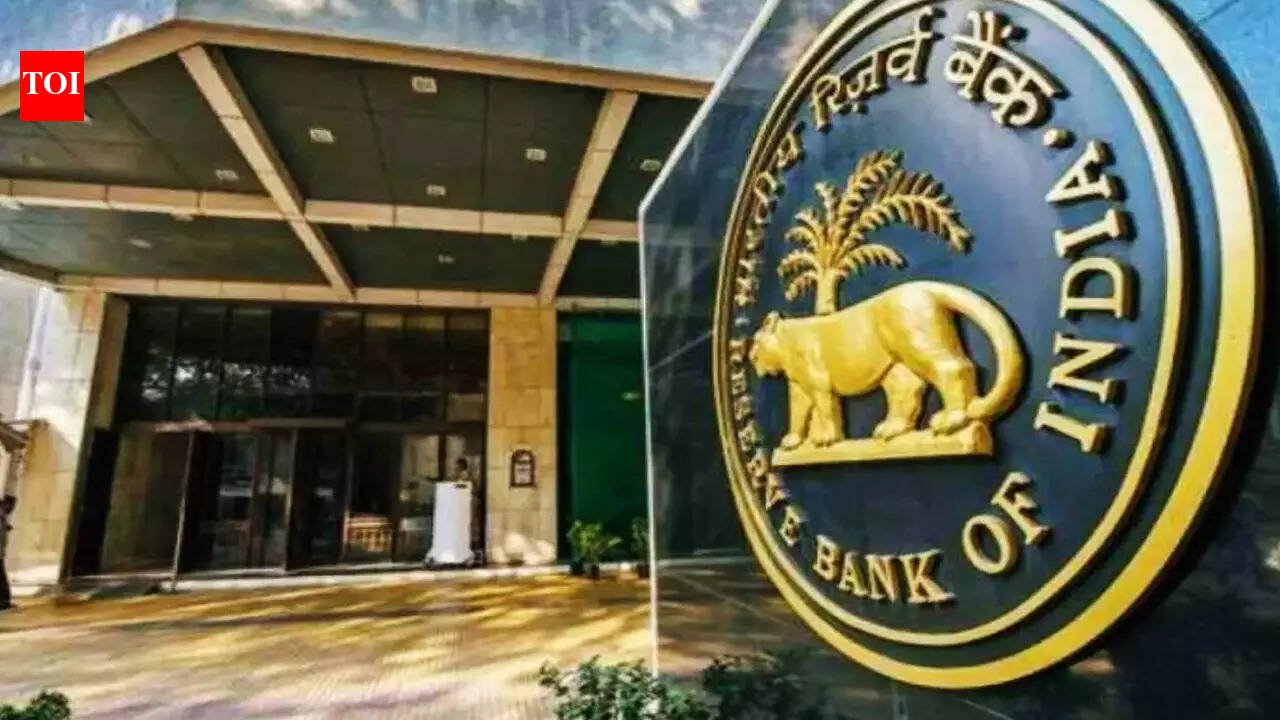
RBI’s new mis-selling rules could mark a turning point – if enforcement follows


RBI's new mis-selling rules could mark a turning point - if enforcement follows
Until these regulations take effect and prove their worth through actual enforcement, your best defence is radical simplicity.

For years, I have been writing about how the personal finance system is designed to extract money from ordinary savers rather than serve them. Just a few weeks ago, I discussed a book by John Campbell and Tarun Ramadorai that makes this case with rigorous academic evidence. They argue that the financial industry does not profit despite your mistakes–it profits because of them. In fact, they deliberately induce these mistakes. Shortly after, I wrote about how our regulations, however well-drafted, remain toothless because the consequences of violating them are trivial compared to the profits to be gained.Now comes news that the Reserve Bank of India has issued draft norms that, if (a huge if) rigorously implemented, could fundamentally change this calculus. The proposed rules would require banks not merely to obtain customer consent before selling third-party products such as insurance and mutual funds, but also to ensure that these products are appropriate for the customer. More significantly, if mis-selling is established, banks would have to refund the entire amount paid by the customer and provide additional compensation for any financial loss suffered.This last provision is what makes these draft norms potentially revolutionary. For the first time, the regulator is proposing consequences that might actually hurt. According to data compiled from annual reports, the share of insurance income in other income for the top five private sector banks rose to 10 per cent in FY25, up from 8.2 per cent in FY19. Income from insurance products sold by the top ten banks increased two-and-a-half times to Rs 16,747 crore in FY25 from Rs 6,381 crore six years earlier. These are not trivial sums. Banks have linked employee incentives and sales targets to the sale of these products precisely because they are so profitable.The question that matters now is whether this draft becomes a serious rule with genuine enforcement, or another addition to our impressive collection of regulations that exist mainly on paper. The difference between a law that works and one that does not lies entirely in the certainty of consequences. A little bit of a fine, a warning, some paperwork by your legal team–banks take these merely as costs of doing business. What actually deters misconduct is the prospect of genuine damage.What the RBI is proposing goes in the right direction. Requiring full refunds plus compensation changes the mathematics of mis-selling entirely. If every fraudulent sale carries the risk of being returned not just the premium but also additional damages, the expected value of cheating could become negative. This is exactly what I meant when I wrote that we need enforcement that genuinely hurts.Of course, I’ve seen many failed revolutions like this, so I have a good deal of scepticism. A draft norm is not a final rule. Final rules require implementation. Implementation requires investigation of complaints. The investigation requires proof of what was said during sales conversations, which typically leave no paper trail. At each stage, the system offers opportunities for dilution. Banks will lobby for softening. Insurance companies that depend on bank distribution will press their case. The machinery of business has many ways of grinding down well-intentioned regulations.The very fact that banking industry sources are already expressing concern about these norms suggests they recognise the threat as genuine. When an industry complains that regulations will hurt their business, it is usually a sign that the regulations might actually work. The head of retail banking at a private bank quoted in news reports acknowledged that the new rules will make banks “cautious” about selling third-party products.For ordinary investors, the lesson is unchanged from what I have long maintained: complexity is not your friend. Until these regulations take effect and prove their worth through actual enforcement, your best defence is radical simplicity–term insurance for protection, a few well-chosen mutual funds for investment, and the discipline to ignore everything else. But it would be wonderful if, for once, words grew some teeth.(Dhirendra Kumar is Founder and CEO of Value Research)If you have any queries for Dhirendra Kumar you can drop us an email at: toi.business@timesinternet.in


Source link

Petrol and diesel prices today: What does Middle East crisis mean for fuel cost? Check city-wise list of current rates


Petrol and diesel prices today: What does Middle East crisis mean for fuel cost? Check city-wise list of current rates

As the Middle East crisis escalates, concerns have grown over a possible rise in petrol and diesel prices. However, despite a sharp increase in global crude oil prices, fuel rates in major Indian cities have remained unchanged. Consumers can breathe a sigh of relief as retail petrol and diesel prices in the country are not expected to rise in the immediate future, according to government sources cited by PTI. The government is reportedly following a calibrated strategy that allows oil marketing companies to improve their margins when international crude prices are low, while shielding consumers when global prices increase.According to a Nomura report, oil marketing companies (OMCs) may absorb part of the increase, instead of passing it fully to consumers. The report stated that the government’s earlier decision not to cut retail petrol and diesel prices when global crude prices had fallen has created a buffer for OMCs to handle the impact of the latest rise in oil prices. In theory, a 10% jump in global crude prices could add around 50 basis points to inflation if the entire increase is passed on to consumers, compared with the earlier estimate of 30 basis points. However, such pass-through rarely happens immediately. “Retail prices of petrol and diesel are unofficially pegged, with OMCs absorbing the impact through their balance sheets,” the report noted.Crude oil prices have already climbed notably amid geopolitical tensions. Since the US/Israel attacks on Iran, Brent crude has risen 16.8%, while WTI crude has increased by 14%.

Petrol, disel prices today: Check rates in your city

As of 05 March 2026, petrol and diesel prices in major cities were as follows:

  • New Delhi: Petrol Rs 94.77 per litre, Diesel Rs 87.67 per litre
  • Hyderabad: Petrol Rs 107.46 per litre, Diesel Rs 95.70 per litre
  • Bengaluru: Petrol Rs 102.92 per litre, Diesel Rs 90.99 per litre
  • Chennai: Petrol Rs 100.84 per litre, Diesel Rs 92.39 per litre
  • Kolkata: Petrol Rs 105.45 per litre, Diesel Rs 92.02 per litre
  • Lucknow: Petrol Rs 94.69 per litre, Diesel Rs 87.81 per litre
  • Jaipur: Petrol Rs 104.72 per litre, Diesel Rs 90.21 per litre


Source link

What is Minuteman III missile? The ‘doomsday’ weapon US tested amid war with Iran


What is Minuteman III missile? The 'doomsday' weapon US tested amid war with Iran

The United States on Tuesday tested its nuclear-capable intercontinental ballistic missile Minuteman III off the California coast amid the ongoing strikes in the Middle East.Referred to as “doomsday missile,” Minuteman III is capable of carrying nuclear warheads up to 20 times more powerful than the atomic bombs dropped on Hiroshima in 1945.The test launch was conducted from Vandenberg Space Force Base near Santa Barbara at 11 pm.According to US Space Force, the unarmed rocket – GT 254 – hit its intended target near the Marshall Islands in the west-central Pacific Ocean. According to the press release, the missile was fired to “verify the effectiveness, readiness and accuracy,” according to the Air Force Global Strike Command.“It allowed us to assess the performance of individual components of the missile system,” Lt. Col. Karrie Wray, commander of the 576th Flight Test Squadron said in a statement.“By continually assessing varying mission profiles, we are able to enhance the performance of the entire [Intercontinental Ballistic Missile] fleet, ensuring the maximum level of readiness for the land-based leg of the nation’s nuclear triad,” it added.What is Minuteman III missile?The Minuteman III missile is one part of America’s nuclear triad, which include the ability to launch world-destroying weapons from the land, sea and air. The missiles are stored in silos scattered across the American west — and designed to deter nuclear armageddon, but ensuring that the US will be able to strike back if it is ever hit with an atomic attack.A Minuteman III missile was also launched in November after President Trump called for restarting the nuclear weapons tests.The missile can travel 6,000 miles at speeds of more than 15,000 mph and strike anywhere in the world.The test comes amid the ongoing escalation in the Middle East after the joint forces of US and Israel launched an airstrike on Iran, killing the nation’s supreme leader, Ayatollah Ali Khamenei.


Source link

‘Safety risks’: US orders non-emergency staff in Pakistan to leave Karachi, Lahore consulates


The United States on Wednesday ordered the departure of non-emergency staff and family members from its consulates in Lahore and Karachi, citing “safety risks” amid escalating tensions following US-Israeli strikes on Iran and Tehran’s subsequent retaliation.In a statement, the US Embassy in Pakistan said the State Department had directed non-essential government personnel to leave the two missions. It added that there has been no change in the status of the US Embassy in Islamabad.Separately, Washington also authorised the voluntary departure of staff from its diplomatic missions in Saudi Arabia, Cyprus and Oman as a precautionary measure.On Tuesday, the department said it was taking “historic action” to assist citizens who wish to leave the Middle East and return to the United States.It added that in the past several days, more than “9,000 American citizens have safely returned from the Middle East, including over 300 from Israel.”

Still Reeling From India’s Strikes, Pakistan’s Nur Khan Air Base Hit Again By Taliban Drones

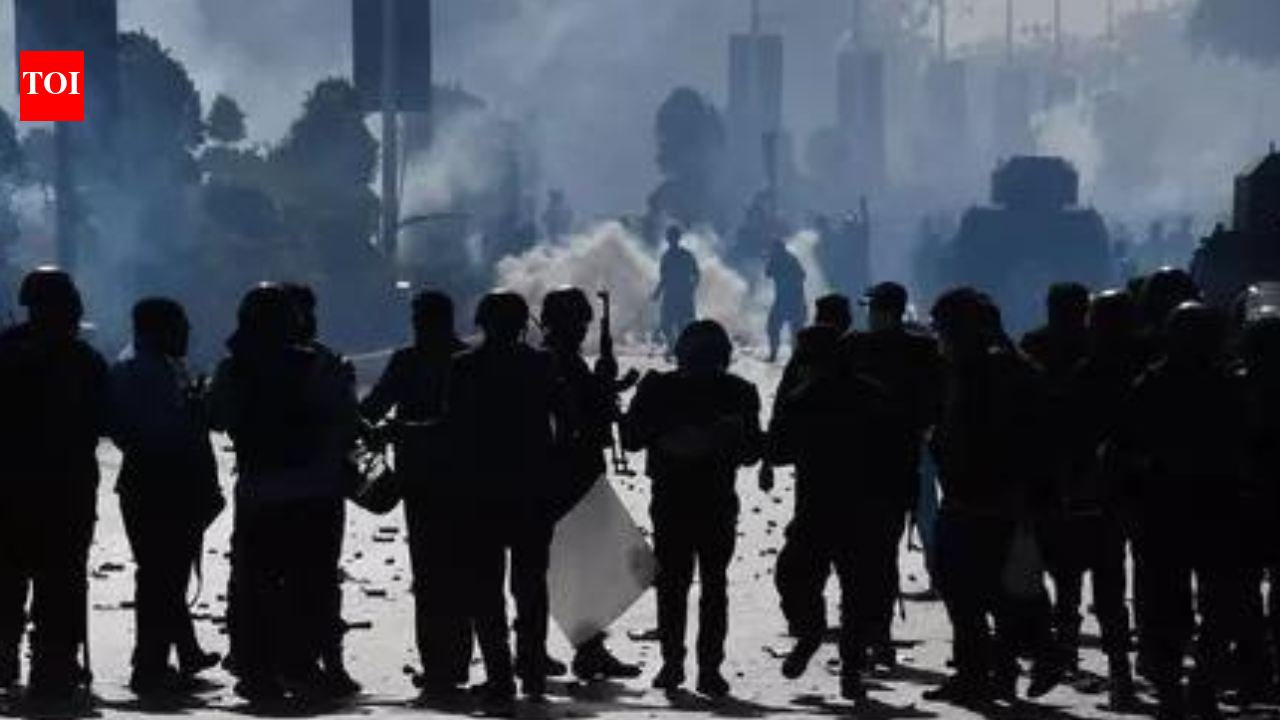
Ayatollah Ali Khamenei, the supreme leader of the Islamic Republic, was killed in US-Israeli strikes on Saturday, triggering the current conflict.In the aftermath, protesters attempted to storm the US Consulate in the southern city of Karachi and clashed with police outside the diplomatic enclave in Islamabad, where the US Embassy is located. United Nations offices in northern cities were also attacked.At least 34 people were killed in clashes with security forces, and more than 120 others were injured, according to officials.


Source link

Daryl Mitchell’s catch to dismiss Aiden Markram in T20 World Cup 2026 semi-final triggers debate among fans


The atmosphere at the Eden Gardens in Kolkata was nothing short of electric on Wednesday, as South Africa and New Zealand clashed in the first semi-final of the T20 World Cup 2026. With a spot in the final on the line, every run and every wicket carried the weight of a nation’s dreams. However, the match and perhaps the tournament, reached a fever pitch of controversy during the eighth over of the Proteas’ innings. What should have been a standard dismissal turned into a global debating point, centering on South African captain Aiden Markram and a sliding effort from New Zealand’s Daryl Mitchell.

Daryl Mitchell’s catch sends Aiden Markram packing in T20 World Cup semi-final 1

The incident occurred at the 7.4-over mark with South Africa looking to rebuild at 55/2. Rachin Ravindra, continuing his stellar tournament form, dragged a delivery slightly short at 83 km/h. Markram, looking to break the shackles, attempted a powerful heave across the line. The ball failed to find the middle of the bat, instead catching the bottom edge and looping toward cow corner.

Mitchell sprinted in from the boundary, diving forward to intercept the dipping ball. As Mitchell tumbled, he immediately signaled for the third umpire to check the cleanliness of the take, while a stunned Markram stood his ground at the crease.

The stadium fell silent as the big screen displayed the slow-motion replays. The footage showed the ball entering Mitchell’s cupped hands, but the point of contention was a subtle bobble as his knuckles hit the turf. After multiple angles, Third Umpire Nitin Menon concluded that Mitchell’s fingers were successfully wedged underneath the ball. The Out signal flashed, and Markram was forced to depart for 18 off 20 balls, leaving South Africa reeling at 55/3.

Did Mitchell take it cleanly? Markram’s dismissal divides fans

As Markram trudged off the field, the digital world exploded. Within minutes, #T20WorldCup and #Markram were trending globally as fans and former cricketers dissected the frame-by-frame footage. The core of the debate rests on the soft signal philosophy and the visual ambiguity of a ball touching grass versus a ball resting on leather-covered fingers.

Supporters of the Black Caps argued that Mitchell’s honesty, signalling for the review himself showed integrity. They pointed to the zoomed-in side angle which appeared to show the ball wedged between Mitchell’s ring and middle fingers, never actually making contact with the Eden Gardens blades of grass.

Proteas fans were understandably livid, claiming the ball clearly pinched the turf as Mitchell’s hands hit the ground. Many argued that the benefit of the doubt should always go to the batter in high-stakes knockout games, suggesting the footage was too inconclusive to overturn the on-field uncertainty.

The controversy has reignited calls for even higher-frame-rate technology in ICC events. While the record books will show a catch for Mitchell and a wicket for Ravindra, the debate over whether the ball touched the ground will likely linger long after the final ball of this World Cup is bowled.

Also READ: Aiden Markram reveals key reasons behind South Africa’s crushing defeat to New Zealand in T20 World Cup 2026 semi-final

Here’s how fans reacted:

Also READ: Netizens go wild as Finn Allen smashes a record-breaking century to power New Zealand into the T20 World Cup 2026 final with a win over South Africa


Source link

‘Nirantar’ Nitish turns a new page, set for Rajya Sabha after decades as Bihar CM | India News


Big Bihar Surprise: CM Nitish Kumar To Contest Rajya Sabha Polls, BJP Set to Rule Bihar

.

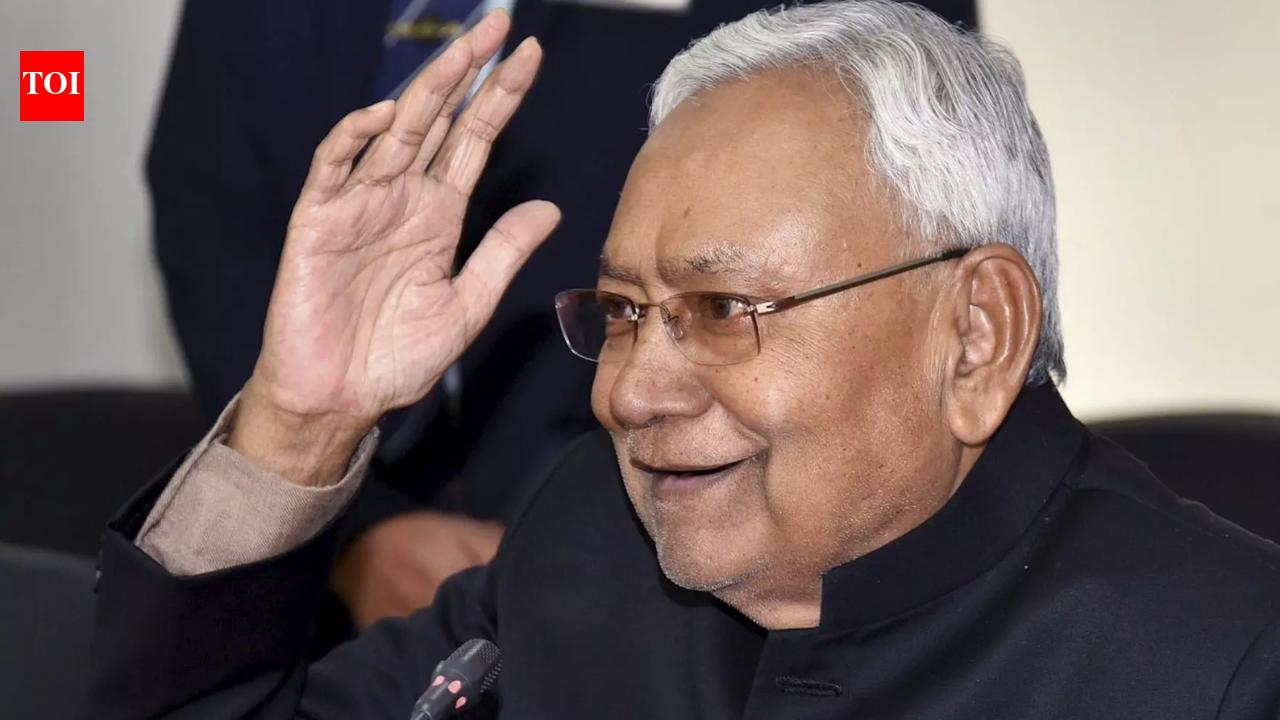
NEW DELHI: Just four months after leading the NDA to a sweeping victory in the Bihar elections, chief minister Nitish Kumar has once again rewritten his political script.The veteran leader on Thursday announced his decision to step down from the state’s top job and head to the Rajya Sabha, marking a significant transition for a politician who has dominated Bihar’s politics for most of the past two decades.

Big Bihar Surprise: CM Nitish Kumar To Contest Rajya Sabha Polls, BJP Set to Rule Bihar

Nitish said he had long harboured a desire to become a member of both Houses of the Bihar Legislative Assembly as well as both Houses of Parliament.“For more than two decades, you have consistently placed your trust and support in me, and it is on the strength of that trust that we have served Bihar and all of you with complete dedication,” he said on his social media account.“It was the power of your faith and support that has enabled Bihar today to present a new dimension of development and dignity. For this, I have expressed my gratitude to you on several occasions in the past as well.”The decision comes less than four months after Nitish led the NDA to a sweeping victory in the 2025 Bihar Legislative Assembly election, securing a massive majority of 202 seats. On November 20, 2025, he took oath for a record tenth term as chief minister, a milestone that reaffirmed his hold over the state’s politics.

.

At 75, he now steps away from the chief minister’s chair after what many saw as an emphatic electoral endorsement. His move to the Rajya Sabha is expected once the new term begins after April 9, when outgoing members retire.Within the NDA, the transition is being seen as a carefully timed change of guard that could allow a new leadership team to settle in before the next political cycle. With Nitish shifting to Parliament, the door is open for the Bharatiya Janata Party to appoint its own chief minister in Bihar for the first time.Potential successors include Bihar deputy chief minister Samrat Choudhary and Union minister Nityanand Rai, both seen as strong contenders if the BJP takes over the top post.At the same time, speculation has grown over the possible political debut of Nitish’s son, Nishant Kumar. Some within the alliance believe he could be considered for a deputy chief minister’s role, though there is no clarity yet about his position or responsibilities.

The ‘nirantar’ Nitish

For years, Nitish Kumar has remained the central figure in Bihar’s politics- a leader who repeatedly returns to the top despite doubts, criticism and shifting alliances.His image as “Sushasan Babu,” associated with development, stability and restored law and order, has long shaped his political identity, even as critics argued that policy stagnation and political fatigue had begun to dull that sheen.Yet in 2025, the verdict was emphatic.Despite being written off many times, Nitish once again emerged victorious with what supporters described as a “lion majority”, reaffirming his place at the centre of the state’s politics.

From engineer to political strategist

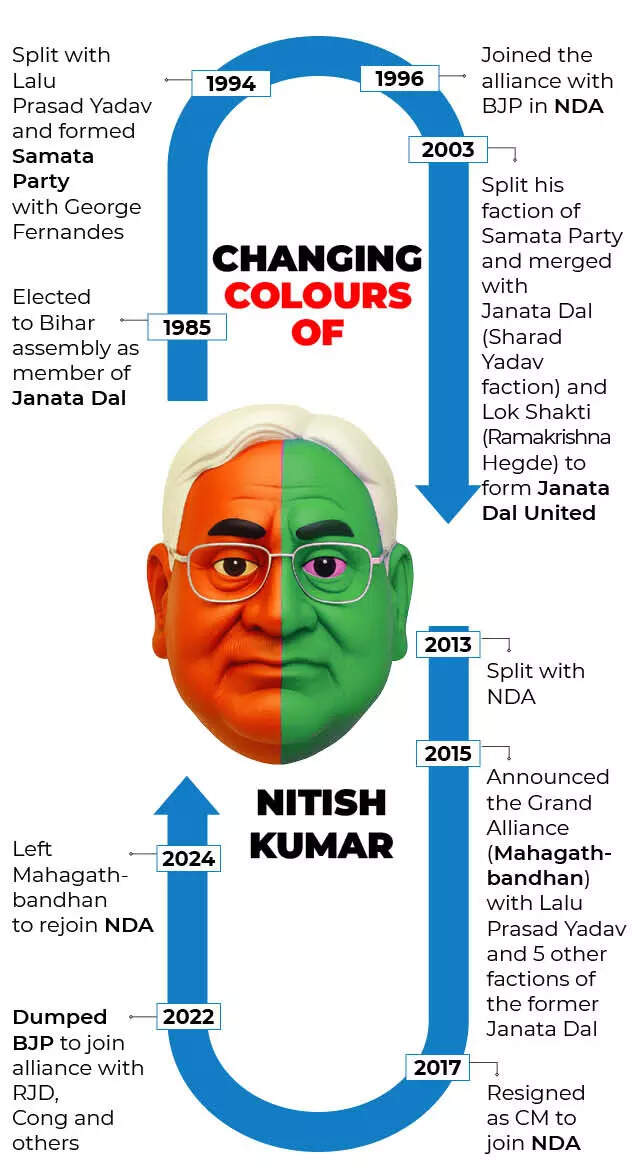
Born on March 1, 1951, in Bakhtiarpur, Nitish Kumar did not begin with political ambition. Trained as an electrical engineer, he eventually found his calling in public life.His political roots were shaped during the Emergency in India imposed during the era of Indira Gandhi. As part of the movement led by Jayaprakash Narayan, Nitish was among the thousands jailed during that period.He won his first assembly election in 1985 from Harnaut and briefly supported Lalu Prasad Yadav in 1989 before breaking away, beginning a rivalry that would define Bihar politics for decades.In 1994 came a decisive turning point. Fourteen MPs broke away under George Fernandes in the first major rebellion against Lalu. Insiders widely saw Nitish as the strategist behind the move.The group soon formed the Samata Party, marking a decisive shift in his political trajectory.Two years later, Nitish made another major move by aligning with the BJP in 1996, the beginning of a partnership that would form, break and reform repeatedly over the next three decades.He later entered the cabinet of Atal Bihari Vajpayee, holding the railway ministry and other portfolios between 1998 and 2004. His administrative approach and emphasis on law and order gradually helped build his technocratic image.His first attempt at becoming chief minister came in 2000, but the NDA lacked numbers and his government fell in just seven days.

Era that shaped Bihar

In 2005, Nitish returned to power, ending Lalu Prasad Yadav’s 15-year rule- a period often described by critics as “jungle raj”.His victory in 2010 further consolidated his political dominance and established him as the face of development-oriented politics in the state.Women-centred welfare initiatives including bicycles, uniforms, prohibition, jobs and cash transfers became a major pillar of his governance model, creating what some scholars describe as a maternal welfare state.Yet Nitish Kumar’s political career has been defined not only by governance but also by dramatic shifts in alliances.Since 1999, he has switched between the National Democratic Alliance and opposition formations such as the UPA or Mahagathbandhan multiple times.The frequent realignments earned him the nickname “Paltu Kumar”.Now, with his move to the Rajya Sabha, another chapter in that long and unpredictable political journey begins.


Source link

Celebrating 35 years of stage magic: Lillete Dubey’s Salaam Noni Appa shines at the Royal Opera House | Mumbai News


Primetime Theatre Company celebrated 35 years with a heartwarming staging of ‘Salaam Noni Appa’ at the Royal Opera House. The play, adapted from Twinkle Khanna’s story, beautifully explores love and self-discovery in later life. Lillete Dubey’s direction and stellar cast brought a tale of second chances and quiet joy to life, leaving audiences touched and inspired.

In a radiant tribute to a life in theatre, Lillete Dubey’s Primetime Theatre Company marked the culmination of its 35-year journey with a heart-warming staging of Salaam Noni Appa at the iconic Royal Opera House. Lillete, whose acting and directorial career has traversed continents and languages, brought down the curtain on the festival with an evening of laughter, nuance, and theatrical soul that perfectly reflects her ethos as an artist. For theatre lovers across the city, the past months have been a celebration of story and stagecraft. The Primetime Theatre Company’s festival showcased an array of landmark productions – from powerful ensemble works like 9 Parts of Desire to classics such as Dance Like a Man – all of which have been staged in Mumbai as part of the company’s ongoing legacy. But it was Salaam Noni Appa that captured both critics’ and audiences’ hearts as the festival’s grand finale. A STORY OF SECOND CHANCES AND QUIET JOY Adapted from the short story Salaam Noni Appa by Twinkle Khanna, this play adapted for the stage by Adhir Bhat. brings to life a story about age, love and freedom later in life, striking a rare and irresistible chord with contemporary audiences. Originally published as part of The Legend of Lakshmi Prasad, the tale’s transition from page to stage remains remarkably faithful to its source — retaining its humour, warmth and subtle poignancy. Set in the twilight of its protagonist’s life, the play follows Noni Appa, a widow navigating the unexpected world of companionship, passion, and self-discovery. What could have been a gentle comedy becomes something much more profound in Lillete’s hands: a meditation on freedom, friendship, and the courage to rewrite life’s second chapter. A CAST THAT ELEVATES EVERY MOMENT At the heart of the production was Lillete Dubey, who played Noni Appa with her striking elegance, seamlessly weaving together humor, fragility, and quiet resilience in a way that reflected her depth of experience. Well-known actress Jayati Bhatia brought lively comedic flair to the role of Binnie, Noni’s sister, while Yateen Karyekar offered a nuanced and heartfelt portrayal of Anandji, the man who gently pushes Noni beyond her comfort zone. Rounding out the cast, Rishi Khurana and Gillian Pinto contributed thoughtful, well-measured performances that enriched the narrative while keeping its emotional focus firmly intact Audiences and critics alike remarked on how the adaptation captured the spirit of Twinkle Khanna’s original prose — particularly its celebration of life’s unpredictability and the joyous assertion that “love doesn’t retire.” Indeed, as one audience member put it, it was a piece that “made us laugh, made us think, and reminded us that theatre, at its best, reflects our own hidden hopes.” A FITTING END TO THREE AND A HALF DECADES ON STAGE As Lillete and her cast took their bows beneath the historic chandeliers of the Royal Opera House, there was a palpable sense of not just closure but continuing possibility. Over the last three and a half decades, Lillete’s theatre company has staged an impressively diverse body of work in Mumbai and across international venues; spanning modern Indian storytelling to reimagined world classics, all marked by sensitivity and artistic polish. For those who have followed her artistic path — beginning with her formative years at Barry John’s Theatre Action Group and leading to the present — the company’s growth unfolds like a living chronicle, each production and performer representing a meaningful chapter. With Salaam Noni Appa, the celebration became more than a tribute to history; it reaffirmed that meaningful theatre does not dwell solely on what has been, but continually urges audiences to look ahead — to view themselves and the world with greater empathy and renewed curiosity.


Source link

China boosts military budget by 7%, aims to carry out ‘major defence-related projects’


China boosts military budget by 7%, aims to carry out 'major defence-related projects'

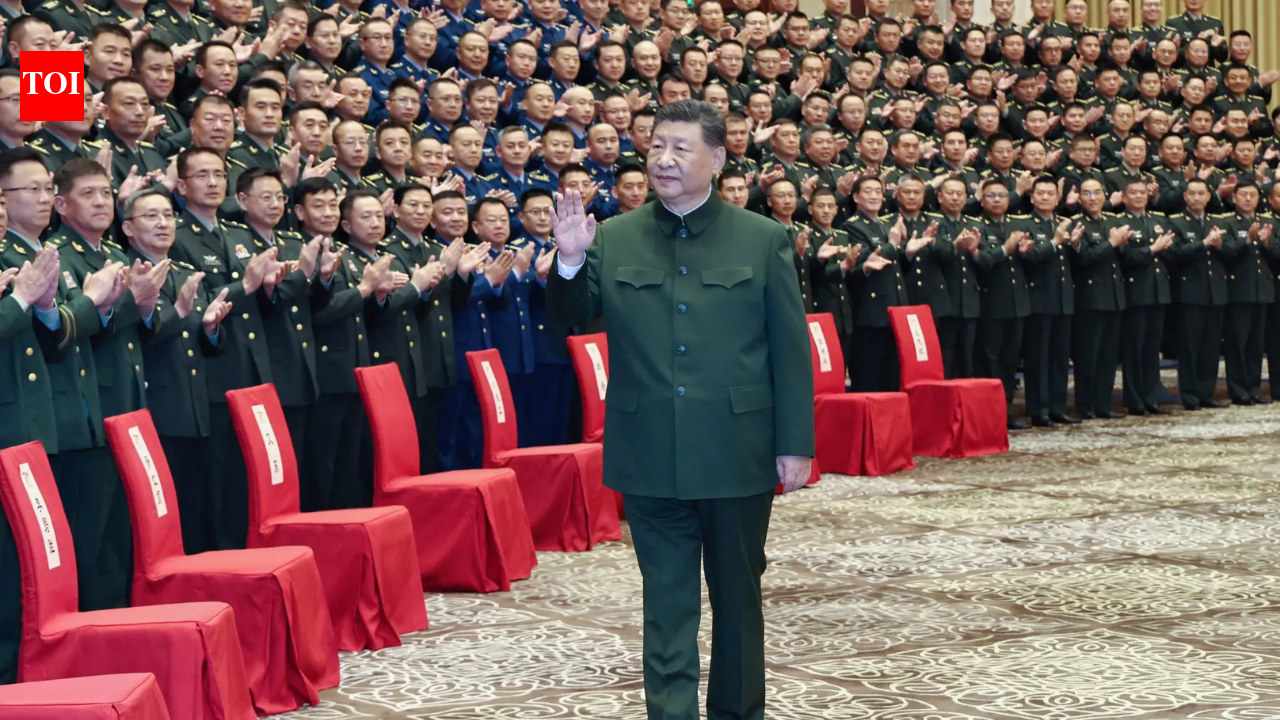
China on Thursday announced a 7% increase in its defence budget for 2026, as it continues to step up its military capabilities to counter the United States and strengthen its claims over Taiwan and the South China Sea. The hike will take the country’s defence spending to about 1.9 trillion yuan, or $276.8 billion, according to a report released at the opening of the annual “Two Sessions” parliamentary meeting.China has been steadily increasing its defence spending in recent years, making it the world’s second-largest military spender, only after the United States. Last year, China increased its defence budget by 7.2% to $249 billion, almost $17 billion higher than 2024.With the latest increase, Beijing’s defence budget remains roughly a third of that of the US, which spent about $997 billion on defence in 2024, according to the Stockholm International Peace Research Institute. Where will the funds be used?Presenting the figures at the National People’s Congress (NPC), Chinese Premier Li Qiang said that over the next five years, the country would continue efforts to strengthen its armed forces and “carry out major defence-related projects.”Analysts cited in the report said that the additional funds are expected to support a range of activities including military salary increases, training programmes, manoeuvres around Taiwan, the development of cyberwarfare capabilities and the procurement of advanced equipment.The increase also comes as Beijing pursues an anti-corruption campaign within the military that has led to the removal of several senior officials, including top general Zhang Youxia earlier this year.Steady defence build-upOfficials from Beijing said that the country’s defence spending remains comparatively modest when compared against indicators such as its share of GDP. According to SIPRI data, back in 2024, China’s defence budget accounted for about 1.7% of its GDP, compared with 3.4% in the United States and 7.1% in Russia.China has maintained annual increases of around 7% to 8% in its defence spending since 2016 as it continues the modernisation of the People’s Liberation Army (PLA).Dragon aims to ‘fully restore’ Chinese jurisdiction Military commentator Song Zhongping, a former Chinese army instructor, said that strong defence capabilities are necessary for the country’s diplomatic independence.“China pursues an independent and self-reliant foreign policy. However, without robust military capabilities and technological prowess, our diplomatic stance would inevitably be subject to coercion or even dictated by certain nations, including the United States,” he told AFP.“China is unwilling to be a vassal state,” Song said, adding that Japan and South Korea “only submit to American dictates”.He also said the PLA must strengthen its capabilities to “fully restore” Chinese jurisdiction over the disputed Spratly Islands in the South China Sea, which are also claimed by the Philippines and are believed to hold vast natural resources.Despite Beijing’s assertion that its defence policy is focused on protecting its territory, including what it considers part of China such as self-ruled Taiwan, the country’s growing military capabilities have raised concerns among neighbouring states.China currently operates only one overseas military base in Djibouti, in contrast to the several hundred bases maintained by the United States worldwide.Niklas Swanstrom, director of the Stockholm-based Institute for Security and Development Policy, said China’s spending level was consistent with the size of its economy but still significant.“That is proportional to its economy and legitimate defence needs,” he said, while noting that “the absolute spending level (second globally) and rapid capability development concern neighbours”.Countering US influenceChina’s military expansion has also prompted countries in the region to deepen defence cooperation with Washington. In Taiwan, leader Lai Ching-te has called for increased military spending in response to Beijing, which has not ruled out the use of force to take control of the island.Philippines has granted the United States access to more of its military bases, while Japan has begun easing its long-standing pacifist stance, approving a record defence budget worth $58 billion in December for the coming fiscal year.Meanwhile, though the Chinese navy is believed to have more ships than any other country, it still trails the US Navy in terms of overall tonnage, nuclear-powered submarines and aircraft carriers.Swanstrom noted that Washington also holds several other advantages, including stronger global logistics networks, more advanced submarines and stealth technology, a larger nuclear arsenal, combat-experienced personnel and a wide network of alliances.He added that the balance could look very different closer to China’s coastline if the US Navy were to intervene militarily, for instance in support of Taiwan.“The US remains the world’s first-class armed forces both in terms of its military hardware and the hard operational experience of its personnel,” said James Char, a Chinese military specialist at Nanyang Technological University in Singapore.“Most critically, neither side could ‘win’ meaningfully,” he said, adding, that economic “devastation, casualties, and nuclear escalation risks would be catastrophic for all parties.”


Source link