Breaking News
50 Israeli jets strike, destroy Iran Supreme Leader Ali Khamenei’s underground military bunker; IDF shares video


The Israeli Defence Forces (IDF) on Friday shared footage showing air strikes on the underground military bunker that was sometimes used by former Iranian Supreme Leader Ali Khamenei. The IDF claimed that 50 Israeli jets dismantled the underground military bunker in Tehran.“50 Israeli Air Force fighter jets dismantled Ali Khamenei’s underground military bunker beneath the Iranian regime’s leadership compound in Tehran,” IDF said sharing the ariel footage.The Israeli military further informed in a statement that the underground bunker, constructed beneath the compound as a secure emergency facility where the leader could direct combat operations, was destroyed before it could be used during Operation “Roar of the Harrier.” Following Khamenei’s assassination, the compound continued to serve as a base for senior officials of the Iranian regime.

IRGC Unleashes Missile Wave Against Israeli & U.S Targets; Pieces Of Destroyed Israeli Drone Paraded

Fresh strikes hit Iran and Lebanon on Friday as Israel pledged to escalate the conflict into a new phase of the Middle East war, which has rapidly expanded across the region and beyond.Now in its seventh day, the war has drawn in global powers, disrupted the world’s energy and transport sectors, and spread turmoil even to areas of the region that are usually relatively calm.Loud explosions echoed across the skies over Iran’s capital, Tehran, early Friday as Israel said it was targeting “regime infrastructure” in the city.Internet connectivity has dropped to around one percent, according to monitoring group Netblocks, severely restricting information about how the war is affecting ordinary Iranians.In Tehran, normally congested roads have largely emptied, but residents told AFP that security forces are maintaining tight control over the population.


Source link

AUS-W vs IND-W: Fans erupt as Annabel Sutherland lights up Perth with record-breaking century on Day 2 of the one-off Test


Australia Women’s star all-rounder Annabel Sutherland delivered a sensational performance on Day 2 of the one-off Day-Night Test against India Women at the WACA in Perth, smashing a magnificent century and sending fans into a frenzy on social media.

After making a major impact with the ball on the opening day, Sutherland continued her dominance with the bat, producing a brilliant 133-ball hundred that helped Australia build a commanding position in the match. Her remarkable effort not only strengthened Australia’s lead but also highlighted her growing stature as one of the most influential players in women’s Test cricket.

Bowling brilliance to batting masterclass: Annabel Sutherland produces all-round show

Sutherland had already laid the foundation for Australia’s strong position with the ball on Day 1. The talented all-rounder picked up 4 wickets for 46 runs in 17 overs, playing a key role in restricting India Women to 198 in their first innings.

Australia finished the opening day on 96/3, with experienced batter Ellyse Perry and Sutherland holding fort at the crease. The duo had already added 38 runs in the final session before stumps, setting up an intriguing Day 2.

When play resumed, the pair continued to build momentum for the hosts. Perry and Sutherland extended their partnership with confident stroke play and smart running between the wickets. The partnership added another 90 runs, putting pressure firmly back on the Indian bowlers.

India finally managed to break the stand when Deepti Sharma dismissed Perry, but by then the damage had already been done. Sutherland remained unfazed and continued to dominate the bowling attack.

Sutherland’s century strengthens Australia’s grip

Following Perry’s dismissal, Sutherland stitched together another crucial partnership with Beth Mooney, ensuring Australia moved past India’s first-innings total.

The highlight of her innings came when she brought up her century in just 133 balls, a moment that drew loud cheers from the crowd at the WACA. Her knock combined elegance with authority, featuring crisp drives, powerful pulls, and confident footwork against both pace and spin.

The hundred marked several personal milestones for the 23-year-old star. It was Sutherland’s fourth international century in Tests for Australia Women and notably her first against India. Her previous centuries had come against England and South Africa.

Even more impressively, the knock marked her third consecutive Test century, underlining her extraordinary form in the longest format. All three of those centuries have come on Australian soil, where she continues to maintain a remarkable average of over 100.

Also WATCH: AUS-W vs IND-W : Darcie Brown cleans up Harmanpreet Kaur with a beauty on Day 1 of the one-off Test

Sutherland’s stunning innings quickly became one of the biggest talking points online, with fans, analysts, and cricket pages praising the young all-rounder’s brilliance. Several posts on X celebrated her growing reputation as one of the finest all-rounders in the game. Many fans highlighted how rare it is to see a player dominate with both bat and ball in the same Test match.

Here’s how fans reacted:

Also READ: Australia vs India, Women’s one-off Test: Schedule, Team News, Broadcast and Live Streaming Details

This article was first published at WomenCricket.com, a Cricket Times company.


Source link

‘Give him a break’: Ex-India batter urges India to drop Abhishek Sharma for T20 World Cup final | Cricket News


'Give him a break': Ex-India batter urges India to drop Abhishek Sharma for T20 World Cup final

Former India batter Mohammad Kaif has urged the team management to consider a bold change ahead of the T20 World Cup 2026 final, suggesting that out-of-form opener Abhishek Sharma should be rested for the title clash against New Zealand national cricket team. India will face the Kiwis in the summit clash at the Narendra Modi Stadium in Ahmedabad on Sunday.Kaif believes the Indian think tank, led by head coach Gautam Gambhir and captain Suryakumar Yadav, should not hesitate to make a change for such a crucial game. Abhishek has endured a difficult campaign in the tenth edition of the tournament, crossing the 50-run mark only once and repeatedly struggling against spin bowling.

T20 World Cup Final: Greenstone Lobo predicts India vs New Zealand winner | Astrological analysis

Opposition teams have targeted this weakness by introducing spinners during the powerplay. On four occasions in the tournament, Abhishek has fallen to spin, often while trying to attack from the outset. The aggressive approach that usually defines his batting has not paid off this time, and he has struggled to adapt by rotating the strike or taking time to settle at the crease.The situation has also been complicated by a health issue before the tournament began. Abhishek suffered a stomach infection and had to be hospitalised shortly before the competition started. The illness resulted in noticeable weight loss, and the lack of physical strength appears to have affected his bat swing and overall confidence. His struggles have also extended to the field, with the left-hander dropping two catches during India’s Super 8s encounter against the West Indies cricket team.Considering these factors, Kaif believes the team could benefit from bringing in Rinku Singh for the final.“India can give Abhishek Sharma a break. He has played many matches now. There is no harm in making changes. You can make changes in the shortest format. Roston Chase opened against India as Brandon King was out of form. They backed him for five or six matches, but they gave him a break for a big match. I believe that, like you brought in Sanju, and he did a great job, so that change worked in your favour,” Kaif said on his YouTube channel.“India have proven players. Rinku Singh scores runs everywhere, be it Tests, Ranji Trophy, or the IPL. Kuldeep Yadav and Mohammed Siraj also take wickets everywhere. When you look in the dugout to see who can replace Abhishek Sharma, you see Rinku Singh sitting there. So, bring him in. A guy is struggling, and another guy is sitting outside despite doing well,” he added.Abhishek’s lack of runs at the top also prompted the team management to reintroduce Sanju Samson into the playing XI. The wicketkeeper-batter responded impressively, producing match-winning knocks against the West Indies and the England cricket team and earning Player of the Match awards in both games.Kaif also pointed out that Samson’s experience in high-pressure tournaments sets him apart from Abhishek, who is still relatively new to global events.“The biggest difference between Abhishek Sharma and Sanju Samson is that Abhishek Sharma is still quite new to ICC events. He has a fantastic record, if you leave ICC events aside. There is a big difference when playing in an ICC event like the World Cup,” said Kaif.“Sanju has scored over 8000 runs in T20S. Be it the runs or six-hitting ability, his name comes in the top 10 in the IPL. He is already an established player. Abhishek Sharma is still young and has to work on his game. He is not a finished product. Don’t compare him with Sanju. Sanju is already a finished product. He made his India debut 11 years ago,” he concluded.


Source link

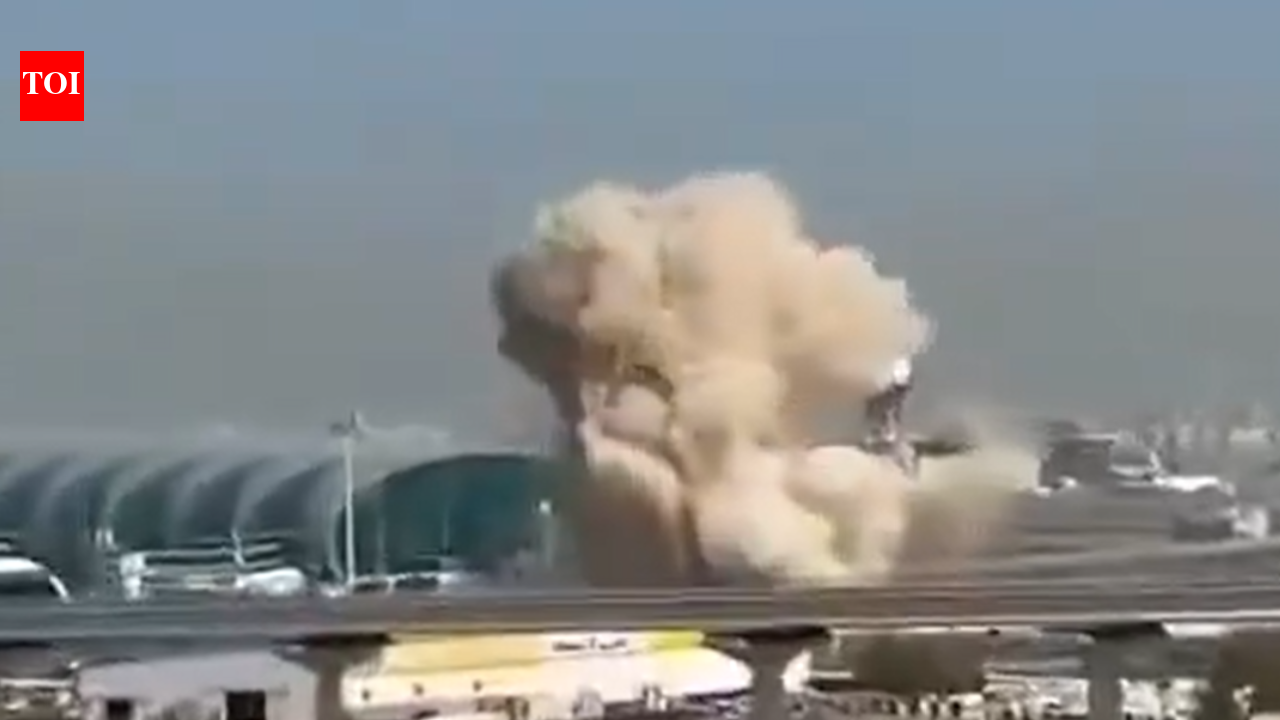
Watch: Moment Iranian drone struck Dubai International Airport’s runway


Watch: Moment Iranian drone struck Dubai International Airport's runway

Flight operations were suspended at Dubai airport after an aerial interception during attacks from Iran.In a video, a huge plume of smoke was seen rising after an object fell near one of the airport’s terminals of the airport after the aerial interception.According to witnesses, a loud explosion was heard followed by a huge cloud of smoke. The government’s Dubai Media Office, in a social media post, said, “For the safety of passengers, airport staff, and airline crew, operations at Dubai International (DXB) have been temporarily suspended.”Meanwhile, the Flightradar24 tracking website earlier showed planes circling above the airport in an apparent holding pattern.Additionally, Emirates, the largest airline in the Middle East, also announced on Saturday that it was suspending all its flights to and from Dubai until further notice. “Please do not go to the airport,” the airline said.The Dubai government said in a post that there had been “a minor incident resulting from the fall of debris after an interception”, which caused no injuries. It also denied “information circulating on social media regarding incidents at Dubai International Airport”, without elaborating.“The air defences of the United Arab Emirates are currently responding to missile and drone threats coming from Iran,” the Emirati Ministry of Defence said, without specifying the targets of the attacks.Hours after the incident, Dubai airport partially resumed its services. “We have partially resumed operations from today, 7 March, with some flights operating out of DXB and DWC,” it said, referring to Dubai’s main airport as well as the city’s Dubai World Central – Al Maktoum International Airport.“Please do not travel to the airport unless you have been contacted by your airline that your flight is confirmed, as schedules continue to change,” it told passengers, after an aerial interception in the area during attacks from Iran forced the airport to suspend operations.Last Saturday, four staff members were injured and a concourse was damaged at Dubai airport, as war erupted following US-Israeli strikes against Iran. Iranian attacks have also hit the upmarket Palm Jumeirah development and the Burj Al Arab luxury hotel, while drone debris caused a fire at the US consulate in Dubai on Tuesday.


Source link

Implementation gaps remain in Maharashtra’s women’s policies; working-class, minority women lag behind | Mumbai News


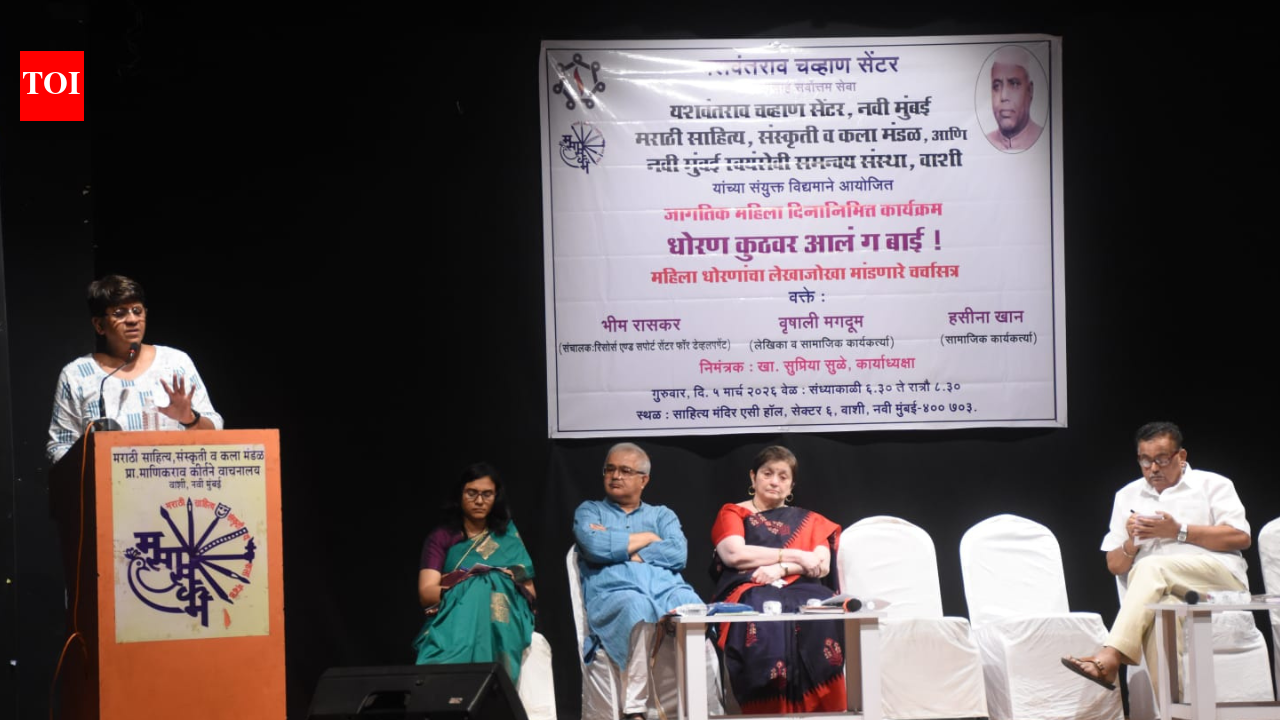
MUMBAI: Speakers at a seminar reviewing Maharashtra’s four women’s policies said that while the policies have expanded women’s participation in governance, their implementation remains uneven and many sections—particularly working-class and minority women—have yet to benefit fully.The discussion, titled “Dhoran Kuthevar Aala Ga Bai!” (Where has the policy reached?), was organised on Thursday at Sahitya Mandir Hall in Navi Mumbai as part of a statewide series of seminars marking International Women’s Day. The initiative was organised by the women’s wing of the Yashwantrao Chavan Centre to review the progress of four women’s policies adopted by the state over the years.Bhim Raskar, director of the Resource and Support Centre, said the policies had led to significant changes, such as entrusting women representatives, ASHA workers and anganwadi workers with responsibilities in local governance. “A few years ago, it was difficult to find women candidates for elections, but today competition among women in politics has increased,” he said.However, Raskar noted that many women representatives later take “U-turns” on issues and that women are still not adequately included in the budgeting process. He also called for increasing the number of women spokespersons within political parties and suggested that parties formulate internal gender policies. The provisions of the POSH (Prevention of Sexual Harassment) law should also apply to political parties, he added, while advocating campaigns such as the Jyotiba Putra Abhiyan to build support systems among men.Senior social activist Hasina Khan said that although the policies are meant for all women, Muslim women are often overlooked during implementation. “They continue to be neglected in mainstream education and employment opportunities as well,” she said.Vrushali Magdum, trustee of Stree Mukti Sanghatana, reviewed key aspects of the four policies, particularly in education, health, gender equality and violence against women. She said that although 32 years have passed since the first women’s policy was introduced in the state, its benefits have yet to reach large sections of working women.Magdum pointed out that although the law against domestic violence came into force in 2005, cases of domestic abuse and dowry-related deaths continue even in 2026. “For effective implementation of these policies, efforts are needed not only from the government but also from social organisations and ordinary citizens,” she said, adding that complete implementation would remain difficult until broader social change takes place.The seminar was jointly organised by the Navi Mumbai district centre of the Yashwantrao Chavan Centre, the Navi Mumbai Marathi Sahitya, Sanskruti and Kala Mandal, and the Navi Mumbai Voluntary Organisations Coordination Committee.The event was chaired by Subhash Kulkarni, president of the Navi Mumbai Marathi Sahitya, Sanskruti and Kala Mandal. Pramod Karnad, president of the Yashwantrao Chavan Centre’s Navi Mumbai centre, welcomed the gathering, while honorary programme manager Datta Balsaraf proposed the vote of thanks.The session was introduced and moderated by women’s wing head Sadhana Tippanakaje. More than 100 social activists from Navi Mumbai, along with office-bearers of the Chavan Centre and Yashaswini Navi Mumbai coordinator Manisha Desai, attended the event.


Source link

Middle East tensions force England to move T20 World Cup camp from Abu Dhabi to South Africa | Cricket News


Middle East tensions force England to move T20 World Cup camp from Abu Dhabi to South Africa
Dubai international cricket stadium

England’s women’s cricket team has moved its T20 World Cup preparatory camp to South Africa after cancelling plans to train in Abu Dhabi due to security concerns linked to the ongoing conflict involving the United States, Israel and Iran.Around 30 players will now gather in Pretoria for the camp. They will be split into two squads of 15 each for a five-match intra-squad series scheduled from March 10 to 27.The two teams are named after former England players Jan Brittin and Rachael Heyhoe-Flint, who were part of World Cup-winning sides on home soil.England captain Nat Sciver-Brunt will lead Team Brittin. The side will be coached by former Durham batter and England Women assistant coach Jon Lewis. Vice-captain Charlie Dean will captain Team Heyhoe-Flint, with assistant coach Luke Williams in charge of the team.Head coach Charlotte Edwards will oversee both squads during the camp. She said the series will help players compete for places in the squad ahead of the T20 World Cup at home.“This is a big opportunity for every player involved to put their hand up and demonstrate that they’re an invaluable part of our World Cup plans,” Edwards said in a release, as cited by news agency PTI.“It’s the same chance for every player, whether they’re new to the team or they’ve played 100 games. We want to use this series as a chance to stretch ourselves and put ourselves under pressure in competitive match situations.“We’ve had two training camps this year, in Oman and Stellenbosch, which focused on skills. Adding a more competitive element is our next step and I’m really pleased with how the group is coming along ahead of a massive summer.”This will be England’s second training camp in South Africa this year after skill-focused camps in Oman in January and Stellenbosch last month.England are scheduled to host New Zealand and India in white-ball series before the T20 World Cup, which will be held from June 12 to July 5. They will then play India in a women’s Test at Lord’s.Team Heyhoe-Flint: Em Arlott, Tammy Beaumont, Tilly Corteen-Coleman, Charlie Dean (capt), Sophie Ecclestone, Mahika Gaur, Dani Gibson, Jodi Grewcock, Amy Jones, Heather Knight, Emma Lamb, Grace Potts, Grace Scrivens, Alexa Stonehouse, Danni Wyatt-Hodge.Team Brittin: Lauren Bell, Maia Bouchier, Alice Capsey, Sophia Dunkley, Lauren Filer, Freya Kemp, Charis Pavely, Davina Perrin, Paige Scholfield, Nat Sciver-Brunt (capt), Linsey Smith, Rhianna Southby, Ellie Threlkeld, Mady Villiers, Issy Wong.


Source link

Bombay High Court: Why Bombay high court said Cross or statue of Jesus cannot prove conversion to Christianity


Why Bombay high court said Cross or statue of Jesus cannot prove conversion to Christianity

In a significant ruling on caste verification and allegations of religious conversion, the Bombay high court held that the mere presence of a Cross or a statue of Jesus Christ in a household cannot be treated as proof that a person has converted to Christianity or abandoned their Hindu caste identity.The decision came from the Nagpur Bench of the Bombay high court, where a division bench of MS Jawalkar and Nandesh S Deshpande set aside an order passed by the District Caste Certificate Verification Committee, Akola. The committee had earlier rejected a college student’s claim that he belonged to the “Mang” Scheduled Caste on the ground that his ancestors had allegedly converted to Christianity.Allowing the petition, the court observed that allegations of religious conversion must be supported by concrete documentary evidence. It held that authorities cannot infer conversion merely from religious symbols in a household or isolated entries in records without proof of formal religious rites such as baptism.The ruling came in a petition filed by a 19-year-old student from Akola challenging the committee’s decision that invalidated his caste claim despite the presence of multiple pre-constitutional documents showing that his family belonged to the Mang caste.

Background of the case

The case arose from a petition filed by Stavan Wilson Sathe, a student from Akola, who challenged an order dated September 27, 2023, passed by the District Caste Certificate Verification Committee, Akola. The committee had invalidated his claim that he belonged to the Mang community, which is listed as a Scheduled Caste at serial number 46 in Maharashtra.The petitioner had submitted several documents in support of his caste claim, including school leaving certificates of his great-grandfather Ganpat Bhika dated August 10, 1932, and of Chattarsingh Bhikaji dated July 16, 1934, both recording the caste as Mang. His caste validation proposal had been forwarded through Rajashri Shahu College, Paradhi in Jalna.The case was subsequently referred to the Vigilance Cell for verification. The Vigilance Cell raised objections based on certain records indicating that the petitioner’s grandfather was described as Christian in a school certificate and on statements suggesting that the family professed Christianity.Despite the petitioner submitting explanations and additional documents, including a certificate issued by Alliance Church, Akola in 2009 stating that the family belonged to the Matang caste, the scrutiny committee rejected the caste claim.

Appellant’s arguments

The petitioner argued that the scrutiny committee had wrongly ignored substantial documentary evidence showing that his ancestors belonged to the Mang caste. He relied on several official records, including school certificates and service documents, which consistently recorded the caste as Mang or Matang.He further explained that the entry showing Christian religion in a school record relating to his grandfather was made due to social circumstances. According to the petitioner, his grandfather faced caste discrimination while studying in school and therefore shifted to another school where the religion was recorded as Christian to avoid harassment. However, the family never actually converted to Christianity.The petitioner also relied on several judicial precedents, including decisions in Tejashree Mangilal Dambale, Bhanudas Hona Gajbhiv, Parvi Ashish Chakravarti and Suvarna Vijay Kharat, to argue that mere references to Christian identity in records or the presence of religious symbols cannot be treated as proof of conversion.

Response of respondents

The State opposed the petition and supported the findings of the scrutiny committee. It argued that the petitioner’s ancestors had converted to Christianity and therefore the petitioner could not claim the benefit of Scheduled Caste status.The government relied on certain entries in the family records and statements indicating that the petitioner’s grandfather and father had accepted Christianity. It also referred to judicial precedents such as Kiranlata Wamanrao Sontakke and C. Selvarani vs Special Secretary-cum-District Collector to justify the committee’s decision.According to the authorities, once a family had converted to Christianity, they could not continue to claim benefits reserved for Scheduled Castes.

High court’s analysis

After examining the documents and the family records, the high court found that the scrutiny committee had failed to properly evaluate the evidence on record. The bench noted that except for one entry describing the family as Christian, all other documents consistently recorded the caste as Mang or Matang.The court also observed that the petitioner had produced important supporting documents, including a caste validity certificate issued earlier to a relative and old school records showing Mang caste.Addressing the committee’s reasoning regarding the presence of Christian symbols, the court held that such circumstances alone cannot establish that a person has converted to Christianity. The bench emphasised that allegations of conversion must be supported by clear evidence of formal religious practices.Citing earlier judicial decisions, the court noted that proof of conversion generally requires evidence such as baptism or other religious ceremonies formally accepting the Christian faith. In the present case, there was no such evidence on record.The bench also observed that even visiting a church or having religious symbols in a house cannot be treated as proof that a person abandoned their original caste identity.

Legal significance

The ruling reinforces the principle that caste claims cannot be rejected merely on the basis of assumptions about religious conversion. Authorities dealing with caste verification must rely on concrete documentary evidence and not on symbolic or circumstantial indicators.The judgment also clarifies that proof of religious conversion must involve evidence of formal religious rites or official documentation. Without such proof, authorities cannot conclude that a person has abandoned their original caste identity.

The final order

Allowing the writ petition, the high court set aside the order dated September 27, 2023, passed by the Akola Caste Scrutiny Committee that had invalidated the petitioner’s caste claim.The court declared that the petitioner belongs to the Mang Scheduled Caste and directed the concerned authorities to issue a caste validity certificate within two months.

Key takeaways from the judgment

• Presence of a Cross, painting or statue of Jesus Christ in a house cannot be treated as proof of conversion to Christianity.• Religious symbols alone cannot establish that a person abandoned their original caste identity.• Authorities must rely on concrete documentary evidence to prove religious conversion.• Proof of conversion generally requires evidence such as baptism or other formal religious rites.• Caste scrutiny committees must carefully evaluate documentary evidence before rejecting caste claims.• The Akola scrutiny committee’s decision was found to be legally unsustainable.

Why this matters

The ruling has broader implications for caste verification proceedings across the country. It highlights the need for authorities to adopt a careful and evidence-based approach when examining allegations of religious conversion in caste claims.By clarifying that symbolic religious markers cannot substitute for documentary proof, the judgment strengthens procedural safeguards in caste verification cases and prevents arbitrary denial of constitutional benefits available to Scheduled Castes.

Read full judegement:



Source link

US-Israel conflict with Iran: Is India exploring alternative energy options amid crisis?


US-Israel conflict with Iran: Is India exploring alternative energy options amid crisis?

NEW DELHI: As geopolitical tensions escalate in the Middle East, India is exploring alternative energy sources to strengthen its energy security, with countries such as Australia and Canada offering additional gas supplies, according to official sources cited by PTI on Saturday.With ships and oil tankers avoiding the Strait of Hormuz in the Persian Gulf amid fears of attacks, one of the world’s key energy transit routes has been disrupted.

‘Trump Told India To Go Ahead Because…’: Mehek Cooke On US’ Russian Oil Waiver Amid Iran War

However, these officials said the ongoing US-Israel conflict with Iran and the disruption in the Strait of Hormuz have not affected India’s energy supplies, as the country now relies on a diversified network of crude import routes.The sources said that only around 40% of India’s crude oil imports pass through the Strait of Hormuz, while the remaining 60% are transported through other supply routes, which remain unaffected by the current crisis.They emphasised that India’s energy strategy has evolved significantly, ensuring that disruption in a single corridor does not lead to a supply emergency.Also read:Why US ‘agreed to let’ India resume buying Russian oil temporarily

Which countries have offered additional supplies?

According to officials, crude supplies from Russia, West Africa, the Americas, Central Asia and non-Gulf Middle Eastern routes have allowed India to manage sourcing adjustments smoothly even during global disruptions.Several countries, including Australia and Canada, have offered additional gas supplies as India continues to expand its energy partnerships.Officials added that India has also recently entered into new energy supply arrangements with the United States and the United Arab Emirates to ensure stable long-term energy availability.Over the past decade, India has significantly broadened its energy supplier base, increasing it from 27 to 40 countries across six continents.Sources said this diversification means that India’s energy security is no longer tied to a single maritime chokepoint.According to the officials, India’s crude procurement strategy remains guided by national interest or “wherever supplies are available.”“We source crude from wherever supplies are available, competitively priced, and deliverable, and we will continue to do so. This has been our consistent position across administrations and across geopolitical cycles,” a senior government official told PTI, adding that the recent US statements are meant for the country’s domestic audience.Explained:How Iran war is driving sharp rise in oil and gas prices

US waiver on Russian Oil

The remarks come after US Treasury Secretary Scott Bessent on Friday announced a 30-day waiver allowing Indian refiners to continue purchasing Russian oil, calling India an essential partner in global energy markets.Officials noted that India has complied with all 18 rounds of the G7 price cap rules since they were introduced.The waiver, they said, removes unnecessary friction and acknowledges the stabilising role played by India’s refining and procurement capacity in global energy markets.Sources added that India remains in close coordination with major global oil and gas suppliers as well as international energy organisations such as the International Energy Agency (IEA) and the Organisation of the Petroleum Exporting Countries (OPEC).Officials reiterated that India’s energy transactions have remained within “international regulations.” “India acted within international law throughout. Every transaction used compliant shipping, audited channels, and legal traders. India did not break the rules. India stabilised markets and the record of global crude prices during a period when India was actively procuring is the clearest evidence of that,” the official added.Sources also pointed out that fuel prices in India have remained relatively stable compared with several other countries. According to officials, petrol prices during the same period rose by about 55% in Pakistan, 22% in Germany, 19% in France and 11.54% in the United States, while India’s petrol prices increased by less than 1% .India currently holds nearly eight weeks of total inventory cover for crude oil and petroleum products, including strategic reserves. This includes approximately 25 days of crude oil stocks and around 25 days of petrol and diesel inventory.Officials said government decisions in the petroleum sector continue to be guided by three key criteria: affordability, availability and sustainability, ensuring stable fuel supply for consumers.


Source link

Uttarakhand ranks first in country in effective implementation of new criminal laws | India News


Uttarakhand ranks first in country in effective implementation of new criminal laws

DEHRADUN (UTTARAKHAND): Marking a historic milestone in the modernization of India’s judicial and law-enforcement system, Uttarakhand has secured the first position in the national implementation of the Inter-Operable Criminal Justice System (ICJS) 2.0, according to data up to January 2026.This remarkable achievement reflects the visionary guidance of Union Home Minister Shri Amit Shah and his commitment to building a technology-driven justice system.According to the latest CCTNS/ICJS Progress Dashboard of the National Crime Records Bureau (NCRB), Uttarakhand has ranked first at the national level with an outstanding score of 93.46. The performance of the top five states in the national ranking has been highly commendable: Uttarakhand leads with 93.46, followed by Haryana with 93.41, Assam with 93.16, Sikkim with 91.82, and Madhya Pradesh with 90.55.Uttarakhand’s success is the result of the effective leadership and continuous monitoring by chief minister Pushkar Singh Dhami. To ensure the implementation of the new laws–Bharatiya Nyaya Sanhita (BNS), Bharatiya Nagarik Suraksha Sanhita (BNSS), and the Bharatiya Sakshya Adhiniyam (BSA)–on the ground, the Chief Minister personally took charge.CM Dhami held continuous review meetings with senior government officials as well as field officers at the district level. This top-to-bottom monitoring helped in resolving technical challenges in time and enabled the police department to successfully adapt to the new legal framework.The foundation of this achievement lies in the “One Data, One Entry” mechanism under ICJS 2.0. Through this system, seamless data flow has been ensured among Police (CCTNS), e-Courts, e-Prisons, e-Prosecution, and e-Forensics. Once data is entered, it becomes instantly available to all concerned departments, reducing paperwork and accelerating the disposal of cases.To ensure transparency, videography of crime scenes and secure storage of digital evidence have been made mandatory through the “e-Sakshya” app.More than 23,000 police personnel in the state have been given intensive training on the provisions of the new laws. Facilities such as virtual court hearings through “Nyaya Shruti” and the availability of forensic mobile vans have been prioritized for technological strengthening.Confirming the ranking, Uttarakhand Police spokesperson and Inspector General of Police (Crime and Law and Order) Sunil Kumar Meena stated that the state has set a record not only in implementing the technological infrastructure but also in real-time data entry.Union home minister Amit Shah has specifically appreciated Uttarakhand’s efficiency in the “One Data, One Entry” system during high-level meetings. With this coordination and commitment, Uttarakhand has emerged as an ideal model of “smart policing” for the country, reflecting the visionary guidance of the Union home minister and his commitment to building a technology-driven justice system.


Source link

‘Who gave you authority to drag us into war?’: UAE billionaire Khalaf Al Habtoor questions Trump over Iran strike


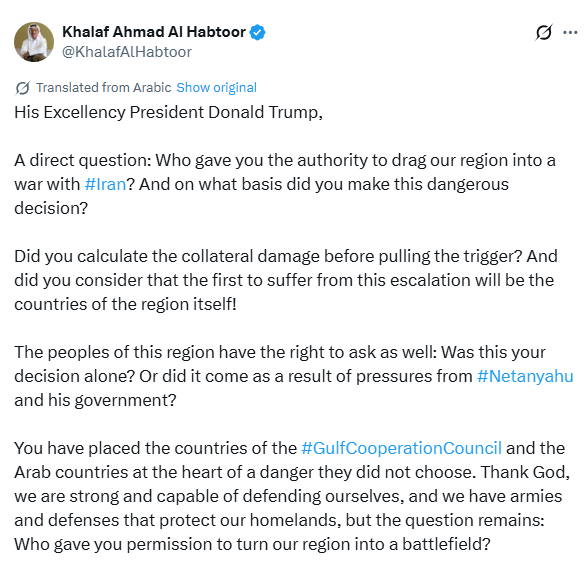
UAE billionaire Khalaf Al Habtoor on Thursday wrote an open letter to US President Donald Trump, questioning his authority to drag the Gulf and the Middle East into the ongoing military conflict with Iran.The founder of Al Habtoor Group raised questions in the open letter, authored in Arabic and shared on the social media platform X, asking Trump whether it was solely his decision to go to war or whether he was influenced by the Israeli Prime Minister Benjamin Netanyahu.

Khalaf Ahmad Ak Habtoor's post on X

The US and Israel launched attacks against Iran on Saturday, targeting its leadership and military infrastructure. Following the US-Israel attack, Iran launched missile and drone attacks on the UAE and other Gulf countries. The majority of those missiles and drones were intercepted and destroyed.

Iran Decoy Trick? Viral Footage Sparks Debate Over IDF Strike On ‘Painted Helicopter’

The UAE and its neighbouring countries have been calling on all parties to end the conflict and engage in peace talks.“You have placed the Gulf Cooperation Council and the Arab countries at the heart of a danger they did not choose. Thank God, we are strong and capable of defending ourselves. We have armies and defences that protect our homelands. But the question remains: Who gave you permission to turn our region into a battlefield?” said Al Habtoor.He said the US decision to go to war with Iran threatened the people of the region and the American people, whom he promised peace and prosperity.“And here they are today, finding themselves in a war funded from their money and taxes, with costs ranging, according to the Institute for Policy Studies (IPS), between 40-65 billion dollars for direct military operations, and could reach 210 billion dollars including economic impacts and indirect losses if it lasts four to five weeks, not to mention the sacrifice of Americans themselves in a war in which they have neither camel nor she-camel.Al Habtoor Group has been vocal in sharing its views on local, regional and global issues. He also funds a think tank to highlight and bring solutions to topical issues.Al Habtoor said the US President broke his promises of not getting involved in wars.“You ordered foreign military interventions during your second term in seven countries: Somalia, Iraq, Yemen, Nigeria, Syria, Iran, and Venezuela, in addition to naval operations in the Caribbean and the eastern Pacific Ocean. You directed more than 658 foreign airstrikes in your first year in office, which equals the total strikes in (ex-US President Joe) Biden’s entire term, for which you directed your arrows of criticism for involving the United States in foreign wars.He warned the US President that his approval ratings among Americans declined by about nine per cent in just 400 days as a result of these decisions.“These numbers say something clear: Even within the US, there is growing concern about being dragged into a new war, and about exposing the lives of Americans, their economy, and their future to unnecessary risks… If these initiatives were launched in the name of peace, then we have the right today to demand full transparency and clear accountability,” said Al Habtoor.In another message shared on X, Khalaf Al Habtoor questioned who would be held accountable for the damages inflicted on the Gulf and Middle East.“Who will pay the price for the tensions imposed on us as a result of a conflict we have no part in among Iran, America and Israel?” he said, adding that the entire region bears the consequences of the war involving three countries.“Our economies, our security, and the stability of our peoples are not arenas for settling scores among the great powers. We are advocates of stability and peace, and we did not choose to be part of this confrontation. Yet we find ourselves paying the price for an escalation we did not create,” he added.“The question that must be asked clearly today is: Who is responsible and who will compensate for the losses incurred by the region’s countries and peoples due to the conflicts of others? The region needs a cool head, not more reactions that fan the flames higher,” he concluded.


Source link