Breaking News
Blast at US embassy in Oslo: Explosion causes minor damage; probe under way


BREAKING: Loud Explosions Rock US Embassy In Oslo Amid Iran War; Shockwaves Hit NATO Nation

Explosion at US embassy in Oslo.

An explosion struck the consular section entrance of the United States Embassy in Norway capital Oslo in the early hours of Sunday, police said, adding that no injuries were reported and the cause remains under investigation.The blast occurred at around 1.00 am local time (5.30 am IST), according to a statement from the Oslo Police Department.

BREAKING: Loud Explosions Rock US Embassy In Oslo Amid Iran War; Shockwaves Hit NATO Nation

Police incident commander Michael Dellemyr told Norwegian public broadcaster NRK that the explosion hit the entrance to the embassy’s consular section.“At around 1.00 am we received several reports of an explosion. We arrived shortly afterwards and confirmed that there had been an explosion that hit the US embassy,” Dellemyr said, adding that the damage appeared to be minor.Authorities declined to disclose further details about the nature of the blast. “We are not going to comment on the type of damage or what may have exploded because it is very early in the investigation,” he said.Dellemyr later told TV2 Norway that police believe the incident may have been an act carried out by an individual, though investigations are ongoing. Officers are currently speaking with witnesses, while a bomb squad was also deployed at the scene.Police confirmed they are in contact with officials at the US embassy, and a large security presence was established in the area following the explosion.Residents living near the embassy reported hearing a loud blast. A 16-year-old witness identified as Edvard told TV2 that he initially thought the sound came from his own house.“My mother and I first thought it came from our house, but then we saw flashing lights outside the window and a lot of police,” he said, describing the presence of police dogs, drones, armed officers and helicopters.Authorities cordoned off a large area around the embassy and stopped vehicles approaching the site, according to local media reports.The incident comes as US diplomatic missions remain on heightened alert in several regions following recent American military operations targeting Iran, which have raised concerns about retaliatory attacks.However, Dellemyr said there is currently no indication that the Oslo explosion is linked to the conflict.


Source link

Water balloon, mob attack, murder: How Delhi’s Uttam Nagar tragic Holi incident unfolded | Delhi News


A minor Holi water balloon incident in Uttam Nagar escalated into a fatal mob attack, resulting in the death of 26-year-old Tarun Butolia

NEW DELHI: A seemingly minor splash of Holi water turned deadly in Uttam Nagar on March 4, leaving 26-year-old Tarun Butolia dead and the southwest Delhi neighbourhood on edge. What began as a child’s playful act escalated into a brutal attack with communal undertones, highlighting how quickly festive celebrations can spiral out of control.

The call that led Tarun back

The trouble started when an 11-year-old girl from Tarun’s family, playing Holi on their terrace, accidentally threw a water balloon that landed on a woman from the neighbouring family, splashing coloured water on her. Although Tarun’s family immediately apologised, the woman reportedly called her relatives, escalating tensions.

Delhi’s Uttam Nagar On Edge After Holi Killing Sparks Tension, Vehicles Torched As Arrests Rise To 8

About an hour later, Tarun, who had gone to a Holi party, received a phone call claiming his parents were under attack. Alarmed, he rushed back on his bike. His mother, Sunita Butolia, recounted, “They called my son and told him we were being beaten up. He came to save us, but they were waiting for him.”

Poll

Should there be stricter laws to prevent violence during public celebrations like Holi?

When he reached the narrow lane near his home, the neighbourhood was in chaos. Locals tried pleading with the attackers to stop, but their appeals went unanswered.

Neighbourhood pleas ignored

Despite the repeated pleas, the mob continued its assault. Tarun, trained at the gym, tried to defend himself, but seven to eight men overwhelmed him. Even after he fell unconscious, the attackers allegedly kept hitting and stabbing him.Sunita described the horrifying scene, “We had locked ourselves inside the house because the mob just wouldn’t stop. They were beating our family members with rods, bats, and hockey sticks. My son had nothing to do with the fight. When he came back, he was on his bike at the end of the lane while we were all trapped inside. The attackers continued to hurl stones at the house and damaged the railings. Even when Tarun started bleeding and fell unconscious, they didn’t stop. They kept hitting and stabbing him. He only came to save us. Someone deliberately called him there knowing what would happen.”His father, Mamraj Butolia, added, “He used to go to the gym and lift weights. But seven or eight men attacked him together with rods, bats, bricks, and stones. It took several of them to bring him down. Even after he slipped and lost consciousness, they didn’t stop.”

A life of ambition cut short

Tarun’s sister, Rekha, remembered her brother as a dreamer, “My father takes whitewash contracts, but my brother’s dreams were bigger than this colony. He studied BCA and was pursuing an online course in digital architecture and design. He created maps and house designs, imagining how houses should bebuilt.”She added, “Women, men, the elderly, everyone was pleading with folded hands, but the mob wouldn’t stop. Within minutes, over 50 people filled the lane to attack my brother for something he didn’t do. A small girl in our family unintentionally splashed water on someone. It was a child’s mistake during a festival. They targeted us. How is this fair: a child’s mistake is paid for with murder.”His cousin Rahul noted, “Tarun had a lot to look forward to. He was just waiting to finish his course so he could start a career.”

Aftermath and escalating tensions

In the days following the attack, two days after March 4, a car and a motorcycle, allegedly belonging to relatives of the accused, were torched in Uttam Nagar, heightening fears of retaliation. Security has been tightened, with CRPF personnel deployed, barricades erected, and drones monitoring the area.Police said eight people, including a minor, have been arrested so far, but Tarun’s family continues to demand a CBI probe, fearing some attackers remain free.

Protests and calls for justice

Residents and family members blocked major roads, raised slogans, and demanded justice. Members of Hindu outfits, including Bajrang Dal and Vishwa Hindu Parishad, joined the demonstrations, amplifying the tension. Authorities have maintained a strong presence to prevent further escalation, reviewing CCTV footage and recording witness statements.The tragic death of Tarun Butolia underscores how a seemingly small splash of water during Holi escalated into a deadly incident, leaving a community shaken, families grieving, and neighbours fearful.


Source link

How the ‘funniest chart in tech right now’ shows how almost all analysts were ‘very wrong’ on Apple


How the 'funniest chart in tech right now' shows how almost all analysts were 'very wrong' on Apple

A chart from A16Z titled “Apple on Capex: ‘Nah, we’re good'” might be the most humbling visual Wall Street has seen in a while. Sourced from FactSet data as of February 9, 2026, it shows Apple’s quarterly capex sitting nearly flat since 2016—down 19% year-over-year—while Amazon (+42%), Microsoft (+89%), Alphabet (+95%), and Meta (+48%) have each rocketed into the $20–40 billion-per-quarter range. Together, these four hyperscalers are on track to spend roughly $635–700 billion on capex in 2026, most of it poured into AI data centres and GPU clusters. Apple’s projected budget for the entire year? A little over $14 billion—essentially flat year-over-year.The chart’s been called “the funniest in tech right now.” But the real joke landed on the analysts who spent two years calling Apple’s restraint a strategic disaster.

The consensus got Apple’s AI playbook backwards

Through 2024 and into mid-2025, the conventional narrative was that Apple was losing the AI race. Siri delays, no proprietary frontier model, and zero appetite for warehouse-scale GPU buildouts drew downgrades and warnings that the company was one to two years behind competitors. Apple’s Q4 2025 capex actually dropped 17% to just $2.4 billion—a rounding error next to what peers were burning per quarter.What analysts missed was that Apple wasn’t sitting out the AI era. It was building for a different version of it. The M-series unified memory architecture—optimised for edge inference since the M1 launched in 2020—turns out to be exactly what on-device AI needs. An OpenClaw-fuelled ordering frenzy has created genuine Mac shortages, with high unified memory Mac Studio orders now stretching to 54-day wait times. The new M5 Max, with 128GB of unified memory and 614GB/s bandwidth, runs a Llama 70B model quantized to Q6 entirely on a laptop—no data centre in sight. Early benchmarks show it hitting 30 tokens per second on Llama 70B, outperforming clusters that cost $40,000 just eighteen months ago.Apple also struck a deal to use Google’s Gemini to power the next generation of Siri and Apple Intelligence—reportedly worth about $1 billion a year. That’s access to a top-tier model for pennies on the dollar compared to building one from scratch.

The balance sheet tells the rest of the story

Apple posted record Q1 fiscal 2026 revenue of $143.8 billion, up 16% year-over-year, with diluted EPS of $2.84—a 19% jump. It held $145 billion in cash and returned $32 billion to shareholders in a single quarter. The hyperscalers, meanwhile, had a rougher time. Amazon, Google, and Microsoft saw a combined $900 billion in market value erased after earnings reports, as investors grew uneasy about the gap between AI spending and actual returns.Whether Apple’s spending gap represents a failure of vision or an exercise of it depends on a question nobody can answer yet: will AI models become interchangeable commodities? Apple appears to be betting they will. If it’s right, the flattest line on the graph was the smartest one all along.


Source link

IND vs NZ, T20 World Cup 2026 Final: Narendra Modi Stadium Pitch Report, T20I Stats and Records


The stage is set for a captivating showdown as defending champions India prepare to take on New Zealand in the ICC Men’s T20 World Cup 2026 final at the iconic Narendra Modi Stadium in Ahmedabad on Sunday. With more than 130,000 spectators expected to fill the stands and millions of fans tuning in from around the world, the summit clash promises to be one of the most memorable nights in modern cricket.

India enter the final with the opportunity to script history. If they manage to lift the trophy, they will become the first team ever to successfully defend a T20 World Cup title. It would also mark the first time a host nation has won the Men’s T20 World Cup. On top of that, India would become the first side to claim three titles in the tournament’s history, adding the 2026 triumph to their earlier victories in 2007 and 2024.

Mitch Santner‘s New Zealand, however, will be equally motivated. The Black Caps are chasing their maiden T20 World Cup crown after finishing as runners-up in the 2021 edition. Sunday’s clash will be only their second appearance in a T20 World Cup final, and they will be eager to go one step further this time.

Narendra Modi Stadium Pitch Report

The Narendra Modi Stadium in Ahmedabad holds a special place in Indian cricket, but it also carries memories that many fans would rather forget. Over the years, the venue has been associated with some significant moments involving Team India, making the conditions there a topic of great interest whenever a major match is played. As the Men in Blue prepare for the T20 World Cup 2026 final under the leadership of Suryakumar Yadav, the nature of the pitch has once again become a key talking point.

Reports suggest that the summit clash will take place on a mixed-soil surface, which is quite different from the black-soil pitch used during the 2023 ODI World Cup final between India and Australia. This time, the pitch is expected to consist of roughly 70 percent red soil and 30 percent black soil, a combination that could produce an interesting balance between bat and ball.

Such a surface is likely to provide good bounce and some assistance to fast bowlers, especially in the early stages of the game. At the same time, batters should also find enough pace on the wicket to play their shots freely once they settle in. Another important factor is that the pitch remains relatively fresh, having last been used for the Canada vs South Africa match on February 9.

In a high-pressure final, teams batting first may aim to post a 200-plus total to feel secure. While aggressive batting in the powerplay could prove crucial, the middle overs might present challenges due to uneven bounce, forcing batters to adjust their approach carefully.

Also READ: IND vs NZ – ICC names the umpires and match referee for T20 World Cup 2026 final

Narendra Modi Stadium T20I Stats and Records

  • Total matches played: 17
  • Matches won batting first: 11
  • Matches won bowling first: 6
  • Average 1st innings score: 174
  • Average 2nd innings score: 150
  • Highest total recorded: 234/4 (20 Overs) by India vs New Zealand
  • Lowest total recorded: 66/10 (12.1 Overs) by New Zealand vs India
  • Highest score chased: 178/3 (17.1 Overs) by South Africa vs New Zealand
  • Lowest score defended: 107/7 (20 Overs) by West Indies Women vs India Women

Also READ: IND vs NZ, T20 World Cup 2026 Final Match Prediction – Who will win today’s game between India and New Zealand?


Source link

‘Oil imports in full flow from non-Hormuz routes’: Hardeep Singh Puri’s message as Middle East tensions roil energy markets


‘Oil imports in full flow from non-Hormuz routes’: Hardeep Singh Puri's message as Middle East tensions roil energy markets

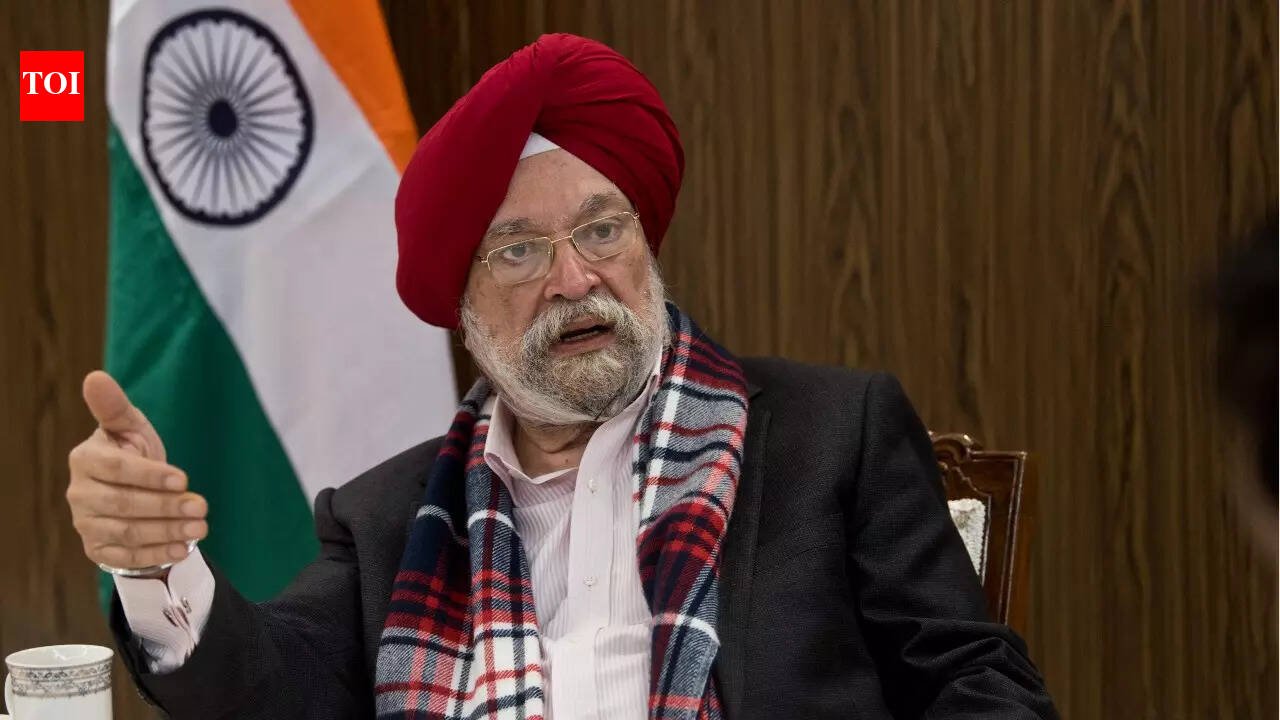
Union petroleum minister Hardeep Singh Puri has assured that oil imports to India are continuing smoothly through alternative routes as the Middle East conflict enters its second week and concerns are growing over the country’s energy supplies. The minister, on social media platform X, confirmed that inflows are “full flow from all non-Hormuz routes” and requirements of all citizens are also fulfilled.Speaking to reporters, he talked about government’s strategy to manage energy availability, affordability and sustainability amid ongoing geopolitical tensions. Minister Puri later shared details of the interaction on X, stressing that there was no cause for concern regarding supplies. “In my excellent interaction with members of the media fraternity today, we discussed how India is navigating the trilemma of energy availability, affordability and sustainability even in the face of the current geopolitical challenges. Energy imports into the country are in full flow from all Non-Hormuz routes.”

US Allows India To Buy Russian Oil As Allies Offer Gas Supplies Amid Iran War And Hormuz Tensions

Talking about ongoing worries surrounding the inflows, the minister confirmed, “the energy requirements of our citizens are being fully met. India is in a comfortable position. There is no room for anxiety or speculation in this regard.”Officials also indicated that India has received assurances from Qatar regarding liquefied natural gas (LNG) supplies. According to government sources, the country has been informed that deliveries will resume immediately once the shipping route reopens. “We are assured by Qatar that they will start supplying to India on the very first minute once the route is open,” the sources said.Authorities added that India currently has adequate LNG reserves and continues to receive offers from multiple countries willing to supply the fuel. “We have surplus stock of LNG” and “We have got offer of LNG from a large number of countries,” officials said.The disruption in supplies from Qatar has largely been linked to the situation around the Strait of Hormuz, a crucial maritime passage connecting the Persian Gulf with open seas. The route has been significantly affected by the ongoing conflict involving Iran, United States and Israel.However, officials suggested that movement of cargo vessels near the strait could resume soon.Government sources said the “cargo movement near the Strait of Hormuz may start soon,” adding that the development follows a statement from Iran indicating it would not target neighbouring countries unless attacked from their territory.Officials further noted that India has worked to reduce risks to its energy supply chain by diversifying import routes and lowering dependence on the volatile Strait of Hormuz.


Source link

President Murmu unhappy over venue change, PM Modi calls it an ‘insult’; Mamata hits back — what triggered Santal conference row | India News


President Murmu unhappy over venue change, PM Modi calls it an 'insult'; Mamata hits back — what triggered Santal conference row

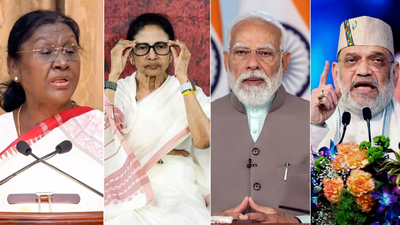
NEW DELHI: A political row has erupted over the recent International Santhal Conclave in West Bengal after the state government changed the venue for the event at the last minute. The controversy intensified after President Droupadi Murmu, who was scheduled to attend the event, publicly expressed displeasure over the decision and also noted the absence of chief minister Mamata Banerjee and other ministers during her visit.President Murmu said authorities informed her that the venue was shifted because the original location was congested. However, she questioned the reasoning, saying the new venue made it difficult for members of the Santhal community to attend the gathering.Later, Murmu visited the original venue and challenged the claim made by authorities. “When I came here I found the field was big enough to accommodate 5 lakh people,” she said, adding that she felt very sad about the last-minute change in location.Addressing the International Santhal Council, the president also suggested that attempts were being made to prevent the community from progressing. “Someone doesn’t want Santhal to get united, to progress, to get educated…someone doesn’t want Santhal to become strong. However, I know Santhals have scarifised their lives for the nation.”Murmu, who herself belongs to the Santhal community, also said that the community’s contribution to India’s freedom struggle has not received proper recognition. “I know how much the Santals have contributed to the country’s freedom struggle. But the names of Santal legends have not deliberately been included in history,” she said, while stressing the need for education for Santhal children.The issue quickly escalated into a political confrontation between the ruling Trinamool Congress in West Bengal and the BJP-led central leadership.

BJP using President to malign Bengal’: Mamata

Chief minister Mamata Banerjee questioned Murmu’s concern for tribal issues and accused the BJP of politicising the matter. “Why don’t you protest when atrocities are committed against tribals. Why don’t you protest when it happens in Madhya Pradesh or Chhattisgarh?… First do something for them, then say anything,” Banerjee said.“Don’t play politics at the time of the election, as per the BJP’s advice,” she added, further alleging that the BJP was using the president to target the state government. “BJP has stooped so low that it is using President Droupadi Murmu to malign West Bengal,” Banerjee said.The controversy also drew sharp reactions from several BJP leaders, including Prime Minister Narendra Modi.

‘Shameful and unprecedented’: PM Modi

PM Modi criticised the West Bengal government, calling the episode “shameful and unprecedented.” “Everyone who believes in democracy and the empowerment of tribal communities is disheartened. The pain and anguish expressed by Rashtrapati Ji, who herself hails from a tribal community, has caused immense sadness in the minds of the people of India. The TMC Government of West Bengal has truly crossed all limits. Their administration is responsible for this insult to the President,” he said in a post on X.“It is equally unfortunate that a subject as important as Santhal culture is treated so casually by the West Bengal Government. The office of the President is above politics and the sanctity of this office should always be respected. One hopes better sense prevails among the West Bengal Government and TMC,” he added.

‘New lows in TMC’s anarchic conduct’: Amit Shah

Union home minister Amit Shah also attacked the Mamata government over the incident. “The Trinamool government of West Bengal has sunk to new lows today through their anarchic conduct. By showing utter disregard for protocol, they have insulted the President of India. This incident has laid bare the deep rot within the Trinamool government.”He added, “A government that tramples on citizens’ constitutional rights at will does not hesitate to dishonour the nation’s highest constitutional office—the President. This affront to the President at an event organised by our tribal brothers and sisters is an insult to our nation and the values of our constitutional democracy. Every citizen who believes in democracy today is deeply hurt and anguished.”

‘Raises questions about conduct’: Dharmendra Pradhan

Union education minister Dharmendra Pradhan also criticised the arrangements made during the president’s visit. “When the President is compelled to express disappointment over the arrangements made, it raises serious questions about the conduct and preparedness of the authorities responsible. The sanctity of constitutional offices must remain above politics,” he said.Odisha chief minister Mohan Charan Majhi also condemned the developments, saying they had hurt the sentiments of the tribal community. “Such actions raise serious concerns and convey an unfortunate message when an event, where the Hon’ble President herself was to grace the occasion as the Chief Guest, is subjected to such disruptions,” he said.Calling the episode insensitive, Majhi added: “As a member of the Santal community, this hurtful action of the TMC govt of West Bengal also created a deeper sense of anguish and hurt within me, and the entire Odia populace.”The controversy has now turned into a broader political battle between the BJP and the Trinamool Congress, with both sides accusing each other of politicising the issue involving tribal communities and the office of the President.


Source link

Suryakumar Yadav: ‘Jhooth bol raha hai’: India skipper Suryakumar Yadav hits back at Mitchell Santner’s claim ahead of IND vs NZ final | Cricket News


'Jhooth bol raha hai': India skipper Suryakumar Yadav hits back at Mitchell Santner's claim ahead of IND vs NZ final

A day before the T20 World Cup final, the usual tension and mind games between teams have already started. India and New Zealand are set to clash for the title, and both captains had a few things to say during their pre-match press conferences.India head into the final with strong momentum after smashing 253/7 against England in the semifinal at the Wankhede Stadium. But New Zealand captain Mitchell Santner believes the key for his team is to stop India from posting another huge total.

Can India erase bad memories in Ahmedabad with T20 World Cup title? Pressure will be key!

Speaking ahead of the match, he said, “And at the end of the day, if it’s going to be flat like it was the other night, trying to restrict India to 220 instead of 250 might give us a good chance.”When India captain Suryakumar Yadav was asked about Santner’s comment, he responded with a smile and a bit of banter. “Jhooth bol raha hai (he’s lying). We will try to bat well. If we score 225 or 250, it will be good. But sometimes the wicket is different, and we have to play differently. We don’t predict from the dressing room that we have to score so much. Whatever the pitch demands, we have to play that way,” he said.Santner also spoke about the pressure India might feel while playing a final at home in front of a packed crowd. “That’s the goal – to silence the crowd – but there are a lot of challenges in cricket, and they are variable. I think there is a lot of pressure on India to win at home,” he said. At the same time, the Kiwi captain sounded confident about his team. “I am pretty excited. We have played here before. There are no secrets to it. The boys are buzzing for tomorrow. It is a one-game shootout. The boys are excited.”Santner’s remark reminded many of Pat Cummins’ famous comment before the 2023 ODI World Cup final about silencing the crowd. Suryakumar couldn’t resist poking fun at that as well, saying: “Sab hi same line chipka rahe hai. Kuch toh naya bolo (Everyone is now saying the same thing. Come up with something new).”


Source link

Celina Jaitly opens up about staying in abusive marriage with Peter Haag: ‘Abuse rarely begins with violence, it begins with love’ | Hindi Movie News


Months after filing a case against her husband Peter Haag, Celina Jaitly has once again opened up about the emotional realities of surviving an abusive marriage. The actress recently addressed a question often directed at survivors — “Why didn’t you just leave?” — sharing a deeply personal reflection on social media.

Months after filing a case against her husband Peter Haag, Celina Jaitly has once again opened up about the emotional realities of surviving an abusive marriage. The actress recently addressed a question often directed at survivors — “Why didn’t you just leave?” — sharing a deeply personal reflection on social media.

Celina reflects on why survivors don’t walk away immediately

In November 2025, Celina filed a case against her husband, Austrian entrepreneur and hotelier Peter Haag, before the Judicial Magistrate First Class court in Andheri, Mumbai. In her petition, she accused him of domestic violence, cruelty and manipulation, while also seeking Rs 50 crore and other financial compensation for the losses she claims to have suffered.

Celina Jaitly’s Legal Battle: Divorce, Abuse, And Survival

On Saturday, the actress took to Instagram to address the complex question many survivors face.“Why does someone successful, educated, stay in an abusive marriage for 15 years?” she wrote. “I have asked myself that question. Why didn’t I walk away after the first incident? Or the second… third. Was I blind? Weak? Used to it?”Celina explained that abuse often begins subtly rather than with immediate violence.“The truth is harder than people think. Abuse rarely begins with violence. It begins with love. Intensity. Promises. The slow building of dependency. You believe you’re building a future. Then something shifts,” she wrote.She added that the cycle of apologies and hope often keeps survivors emotionally trapped. “There are good days. Apologies. Tears. Change that almost feels real. Hope — and hope is addictive. You begin surviving on small windows of it.”

Mental and verbal abuse leaves no bruises’

The actor also spoke about the psychological impact of abuse, explaining how confidence erodes gradually.“Mental and verbal abuse leaves no bruises. Confidence erodes quietly. You adjust. Then over-adjust. Then question yourself,” she wrote, adding that fear about breaking a family, hurting children or starting over often complicates the decision to leave.Celina said motherhood added another layer of responsibility and hesitation. Referring to her children as her “4G — four greatest gifts,” she explained that decisions were no longer just about her.“You protect childhoods. Stability. What you believe is safety. Achievement does not protect you from manipulation. Degrees don’t stop gaslighting. Public strength doesn’t prevent private erosion,” she wrote.

Celina Jaitly’s Legal Battle: Divorce, Abuse, And Survival

‘Abuse isn’t always physical’

The actress also emphasised that abuse can take many forms beyond physical violence.“#Abuse isn’t always physical. Sometimes it’s silence. Humiliation. Control. Isolation. Making you doubt your own memory,” she wrote, adding that she had experienced multiple forms of it.She urged people to reconsider the way society frames the question. “Instead of asking, ‘Why didn’t you just walk away?’ ask what keeps accomplished, intelligent men and women trapped for years. Not incapability… psychological warfare.” Ending her note on a message of solidarity, she wrote, “If you’re still there, I see you. If you left, I respect you. If you’re preparing quietly, I understand you. Strength doesn’t always look like leaving immediately. Sometimes it looks like surviving until you can.”Celina married Haag in 2010. The couple has three sons — twins Winston and Viraaj, born in 2012, and Arthur, born in 2017. Another son, Shamsher, passed away due to a heart condition.


Source link

Ahmedabad braces for India vs New Zealand T20 World Cup 2026 final as police announce special traffic plan


The stage is set for a thrilling finale as India take on New Zealand in the ICC Men’s T20 World Cup 2026 final at the iconic Narendra Modi Stadium in Ahmedabad on Sunday. With two of the most consistent teams of the tournament locking horns for the coveted trophy, fans are expecting a high-voltage contest that could produce unforgettable moments.

The Narendra Modi Stadium, the world’s largest cricket venue, is expected to be packed to capacity for the summit clash. Supporters from across the country and abroad are likely to flock to Ahmedabad to witness the grand finale, creating a carnival-like atmosphere around the stadium.

India have enjoyed a remarkable run in the tournament and will aim to defend their title after winning the previous edition. Meanwhile, New Zealand have once again demonstrated their consistency on the global stage, setting up what promises to be a fascinating battle between two well-balanced sides.

With star players from both teams in form and the stakes at their highest, anticipation among cricket lovers has reached fever pitch. The final is not only expected to deliver intense on-field action but also a grand spectacle off the field.

International pop star Ricky Martin set to headline closing ceremony

Adding to the excitement surrounding the final, international music sensation Ricky Martin is set to perform during the closing ceremony of the tournament.

The International Cricket Council (ICC) confirmed that the Grammy-winning singer will take the stage at the Narendra Modi Stadium ahead of the final. The performance is scheduled to begin at 5:30 pm, giving fans inside the stadium a special entertainment experience before the match begins.

The closing ceremony is expected to feature dazzling visuals, music and celebrations marking the culmination of another successful edition of the T20 World Cup. Martin’s presence has already generated considerable buzz among fans, as global entertainment icons rarely perform at cricket events of this scale.

The ICC has increasingly integrated music and entertainment into major tournament finals to enhance the fan experience, and the upcoming performance is expected to add another layer of glamour to the occasion.

Also READ: India vs New Zealand T20 World Cup 2026 final: Reserve day, overs rule and who lifts the trophy if it rains

Ahmedabad Police announce traffic advisory ahead of the summit clash

With a massive crowd expected for the final and several VIP guests scheduled to attend the event, the Ahmedabad city police have issued a detailed traffic advisory to ensure smooth movement and security around the stadium.

According to a notification released by Ahmedabad Police Commissioner G. S. Malik, traffic restrictions will come into effect from 10:00 am on March 8 and will remain in place until midnight. In certain areas around the stadium, the restrictions could extend until 2:00 am on March 9.

Authorities have identified several routes near the Narendra Modi Stadium that will remain closed to general traffic during this period. These include the stretch between Janpath T-Junction and the main gate of the stadium, as well as the road from Krupa Residency T-Junction to Motera Gam T-Junction.

To help commuters navigate the area, the police have also announced alternative routes. Vehicles approaching from the Tapovan side are advised to travel via Tapovan Circle, ONGC Crossroads, Visat T-Junction, Janpath T-Junction, Powerhouse Crossroads and Prabodh Raval Circle.

Similarly, commuters reaching Krupa Residency T-Junction are recommended to divert through Sharan Status Crossroads and take the Bhat–Koteshwar Road towards Apollo Circle.

The city police have urged residents and visitors to strictly follow the advisory and cooperate with authorities to ensure a smooth experience for everyone on the day of the final. Officials also warned that strict action may be taken against those violating traffic rules.

Also READ: T20 World Cup 2026: Team India’s road to the final under Suryakumar Yadav


Source link

From oil to rice, here’s how Middle East crisis may spread across global economy


From oil to rice, here's how Middle East crisis may spread across global economy

The Middle East conflict is entering another week, and its ripple effects are already being felt across the global economy. As tensions intensify, trade flows, energy supplies and food production are coming under strain at a time when markets already spent the last year grappling with tariffs and other disruptions.Although the latest escalation began just a week ago, early signs of pressure are already emerging across global trade networks. Shipments of crucial commodities have been delayed, shipping routes disrupted and prices of critical inputs have spiked. According to economists cited by CNN, the ultimate economic damage will depend on how long the conflict continues.

‘India Were Good Actors’: Bessent’s Oil Waiver Remark Triggers Cong’s ‘Humiliation’ Attack On Modi

Before the United States and Israel carried out attacks on Iran over the weekend, the International Monetary Fund had projected global economic growth of 3.3% this year. The IMF has not yet revised this forecast, saying it is still “too early” to determine the full impact. However, the institution said it is “closely monitoring developments” and warned of several potential risks to the world economy, including further trade disruptions, “surges in energy prices” and “volatility in financial markets”.Dan Katz, deputy managing director at the IMF, said that the expanding conflict could have broad consequences, noting that it could be “very impactful on the global economy across a range of metrics,” including inflation and economic growth.Key ways the conflict could impact the global economyBased on early developments and industry assessments, the war could affect the global economy through several major channels:

1. Rising energy prices

Energy markets are at the centre of the economic risks. Concerns about supply disruptions have pushed Brent crude, the global oil benchmark, to its highest levels in more than 18 months.A major worry is the potential disruption of the Strait of Hormuz, a narrow waterway between Iran and Oman that serves as a vital route for global energy shipments. According to the US Energy Information Administration, around one-fifth of the world’s daily oil and liquefied natural gas production passes through this corridor.If the route becomes effectively impassable, the consequences for energy markets could be severe. Goldman Sachs estimates that European benchmark natural gas futures could more than double from levels seen before the conflict if shipments through the strait are halted for more than two months.Higher energy prices would likely feed into broader inflation across economies.In Europe, consumer inflation, which stood at 2% in January, could rise by more than one percentage point if the conflict lasts several months, according to Holger Schmieding, chief economist at Berenberg bank, as cited by CNN. In that scenario, economic growth in the European Union could also be reduced by up to half a percentage point.Fuel costs are already increasing. Germany has seen double-digit rises in petrol and diesel prices over the past week, according to the country’s largest automobile association, ADAC. Petrol prices have also risen in the United Kingdom, while in the United States they have climbed to their highest level in 11 months.Goldman Sachs estimates that if oil prices remain at current levels for several months, US consumer inflation could rise from 2.4% in January to 3% by the end of the year. That would make it harder for the Federal Reserve to cut interest rates.

2. Greater vulnerability for Asian economies

Asian economies may be particularly exposed to energy shocks linked to the conflict. Consultancy Capital Economics estimates that between 80% and 90% of the crude oil and liquefied natural gas transported through the Strait of Hormuz is headed for Asia.China is among the largest buyers of these supplies. The conflict comes at a sensitive moment for the country, which has recently set its lowest economic growth target in decades.Capital Economics said the attacks on Iran could push inflation higher across Asia. “Most economies in Asia are worse off and facing higher inflation as a result of the attacks on Iran,” the firm’s economists wrote in a note Tuesday.They added that inflation could increase by around half a percentage point in many Asian countries if Brent crude prices remain at their current levels.

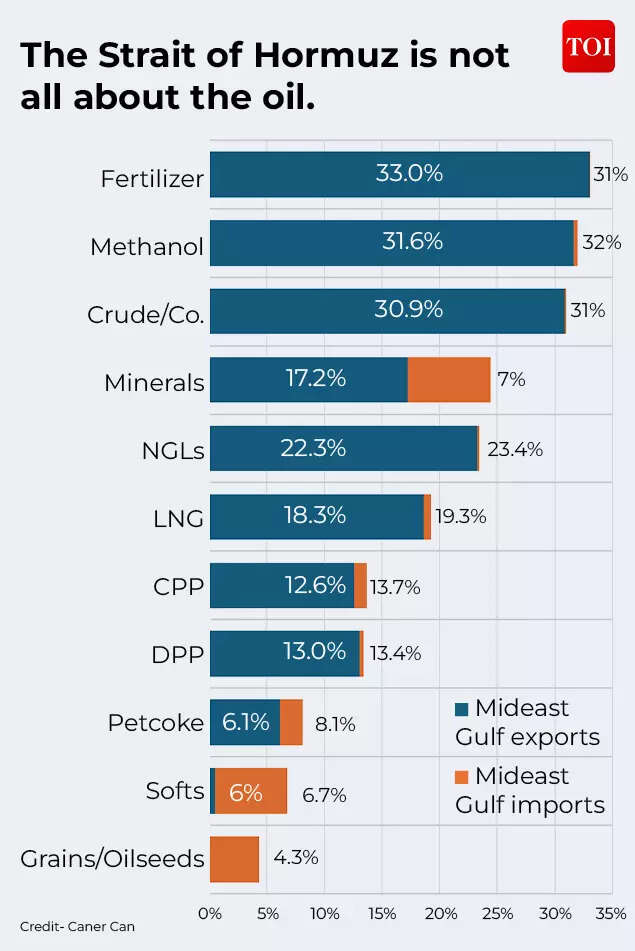
The Strait of Hormuz is not all about the oil.

3. Disruption to exports and global trade

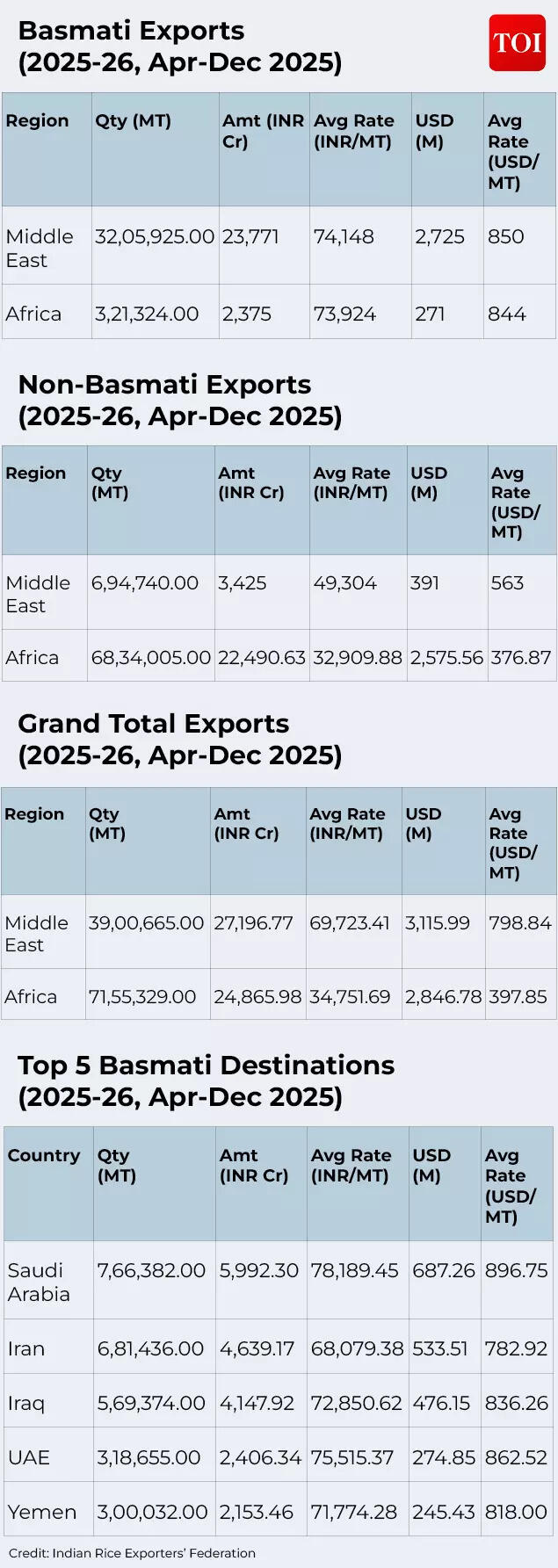
Trade flows are also starting to feel the impact of the conflict. Shipping disruptions across the Middle East have already begun affecting exports.India is one of the countries facing consequences with more than 400,000 metric tons of basmati rice grown in the country for export currently stuck at ports or in transit, because shipping routes through the region have been disrupted.According to Satish Goel, president of the All India Rice Exporters’ Association, around 75% of India’s annual basmati rice exports, roughly 6 million tons, are shipped to the Middle East.The region has become an important export destination for Asian economies that have faced higher tariffs from the United States. Deepali Bhargava, head of Asia-Pacific research at ING, said that if the conflict continues, exporters in India and China could suffer the most.

Basmati exports

4. Pressure on fertiliser supply and food production

Another critical concern is the impact on fertiliser supplies, a key component of global food production.Svein Tore Holsether, CEO of Norwegian chemical company Yara International, warned that the Strait of Hormuz is crucial for the fertiliser trade.“The Strait of Hormuz is essential for global food production,” he told CNN.Holsether noted that around one-third of the world’s urea exports, one of the most widely used fertilisers, pass through the strait. Significant volumes of other raw materials used in fertiliser production also move through the same route.“Fertilizers are not just another commodity – nearly half of global food production depends on them.”Prices are already reacting. Egyptian urea prices, a key benchmark, have surged 35% this week, according to data provider CRU Group. Prices of sulphur, another ingredient used in fertiliser production, have also risen sharply. Nearly half of global sulphur trade originates from Middle Eastern countries.

5. Shipping congestion and supply chain delays

Shipping networks are also beginning to experience disruptions.Containers bound for the Middle East are starting to accumulate at Indian ports after several major shipping companies suspended services to the region, according to Judah Levine, head of research at logistics firm Freightos.If the situation continues, container shortages and reduced shipping capacity could spread to other markets.Shipping analytics company Xeneta warned that the conflict is creating immediate uncertainty for logistics networks. “Escalating conflict in the Middle East is creating immediate uncertainty for supply chains, with vessel movements changing by the hour and shippers left managing cargo that may no longer reach its intended ports.”

6. Impact on air cargo and global trade flows

Air freight operations are also facing disruption. Many aircraft have been grounded in the Middle East while airspace across parts of the region has been heavily restricted.Sportswear company Adidas has already warned that some shipments transported by air freight may face delays.Middle Eastern carriers such as Emirates, Qatar Airways and Etihad together account for about 13% of global air cargo capacity, according to Freightos.Air freight plays a major role in global trade. The International Air Transport Association estimates that it carries roughly one-third of global trade by value, including high-value goods such as smartphones, microchips and electronics.With vessel routes shifting, shipments stalled and airspace restricted, the ongoing conflict is beginning to test the resilience of global supply chains, and the longer the disruption continues, the wider its economic effects could become.




Source link