Breaking News
How Iran’s strikes on Qatar’s Ras Laffan, world’s largest LNG hub & other Middle East oil & gas infra, will impact India


How Iran's strikes on Qatar's Ras Laffan, world's largest LNG hub & other Middle East oil & gas infra, will impact India
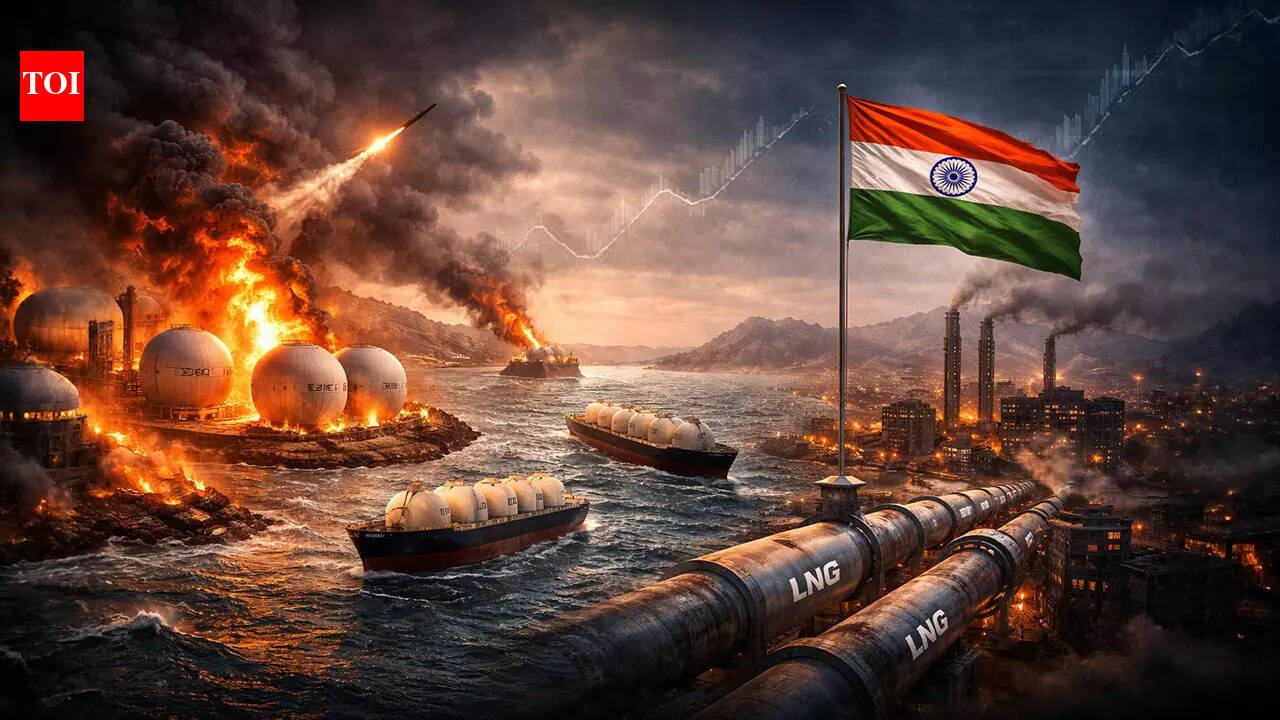
⁠India is a big importer of LPG and LNG and relies heavily on supplies from Middle Eastern countries such as Qatar. (AI image)

Middle East conflict impact: What happens when the world’s argest liquefied natural gas (LNG) hub suffers extensive damage? Qatar’s key gas hub, Ras Laffan, has sustained extensive damage after multiple strikes from Iran as part of the ongoing conflict in the Middle East that started after US-Israeli strikes on Iran. The strikes by Iran have caused such damage to the facility that Qatar says may take years to repair. Attacks on Ras Laffan and other energy installations on Thursday briefly pushed Brent crude up more than 10 per cent to above $119 per barrel before prices eased. Worryingly, QatarEnergy CEO Saad al-Kaabi has said that Iran’s attack has wiped out 17% of Qatar’s LNG capacity for up to 5 years!This has raised fresh concerns over global energy supplies as the Middle East conflict continues. According to a Financial Times report, under usual conditions, Ras Laffan supplies around a fifth of the world’s LNG supplies. In Europe gas prices have shot up by 35% and Asia too is vulnerable to long-lasting supply shocks.India gets around 40% of its LNG requirements from Qatar. Reacting to the damage to key energy infrastructure in the Middle East, External Affairs Ministry spokesperson Randhir Jaiswal said, “India had previously called for the avoidance of targeting civilian infrastructure, including energy infrastructure, across the region.”
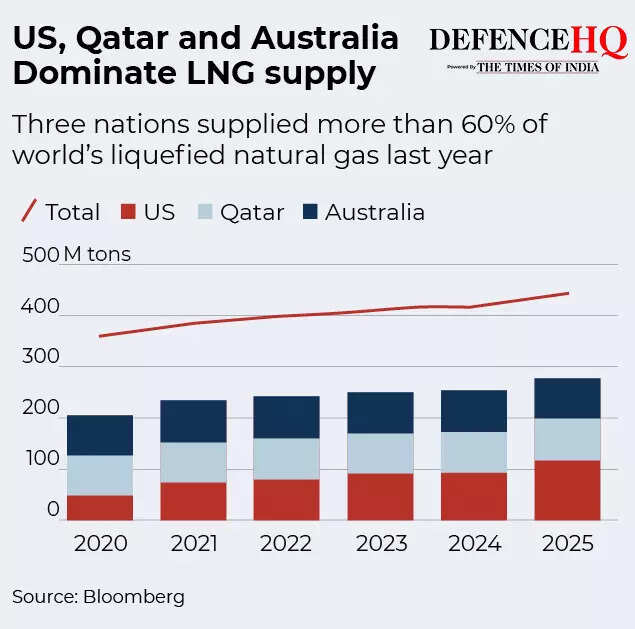
US, Qatar and Australia dominate LNG supply

“The recent attacks against energy installations in different locations across this region are therefore deeply disturbing and only serve to further destabilise an already uncertain energy scenario for the whole world,” he added.

Which Middle East oil & gas facilities have been hit?

QatarEnergy, which operates Ras Laffan, told Reuters that the damage can take 3 to 5 years to repair. It would possibly cost the company around $20 billion annual revenue loss and may even force it to cancel long term contracts with countries like China, Italy, Korea, and Belgium.Iran’s South Pars field, which is part of the world’s biggest gas reserve shared with Qatar has also been hit.Several other critical facilities across the region have also been targeted. Iran’s Kharg Island, a major crude export hub, was struck, while the UAE’s Ruwais refinery halted operations as a precaution after a drone incident.
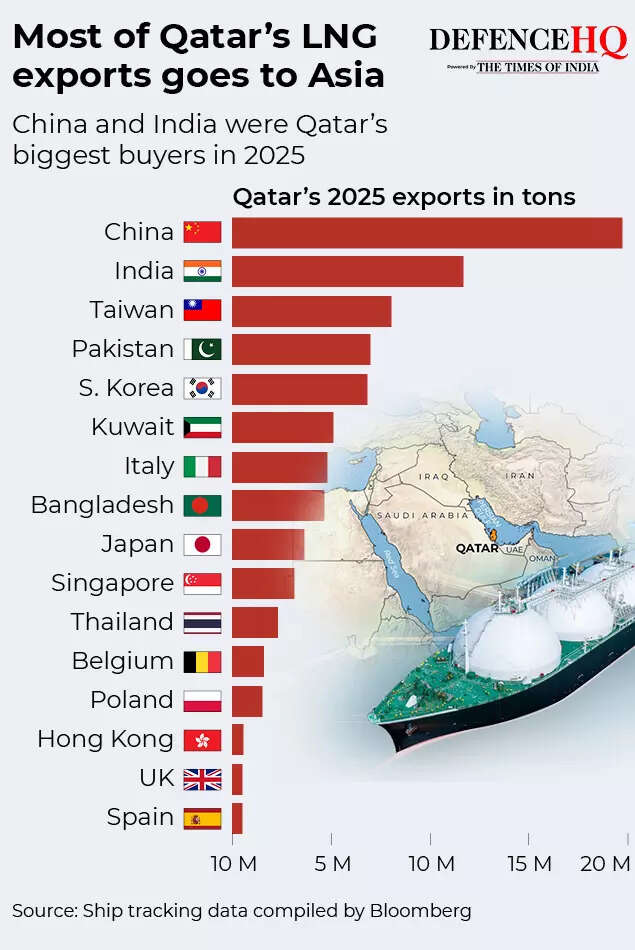
Most of Qatar's LNG exports goes to Asia

Saudi Arabia’s Ras Tanura refinery and Yanbu port facilities, key to oil processing and exports, have faced disruptions, alongside drone strikes on Kuwait’s Mina Abdullah and Mina Al-Ahmadi refineries, both of which later contained fires. The continued attacks have significantly reduced Gulf oil output and heightened fears of severe disruption to global energy markets.

What do attacks on Middle East oil & gas fields mean for India?

The most important point to note is that the top five major import sources of crude petroleum for India are Russia, Iraq, Saudi Arabia, UAE, and USA. The total share of these five countries in the quantity of imported crude oil was around 83% in fiscal 2025. ⁠India is a big importer of LPG and LNG and relies heavily on supplies from Middle Eastern countries such as Qatar, Saudi Arabia and the UAE. Hence, any supply disruption, whether it is due to passage threats in the Strait of Hormuz or closure of gas facilities in this region, has important ramifications for India. So, India is heavily exposed to the recent attacks on Middle Eastern oil and gas infrastructure, with key facilities in Qatar, the UAE, Iran, Saudi Arabia and Iraq – all major suppliers or transit points – coming under fire, says Sourav Mitra, Partner – Oil & Gas, Grant Thornton Bharat. He lists some startling facts:

  • More than 60% of India’s crude oil imports originate from the Persian Gulf, particularly from Iraq, Saudi Arabia, and the UAE, meaning a majority of India’s oil supply is linked to regions now directly affected by strikes.
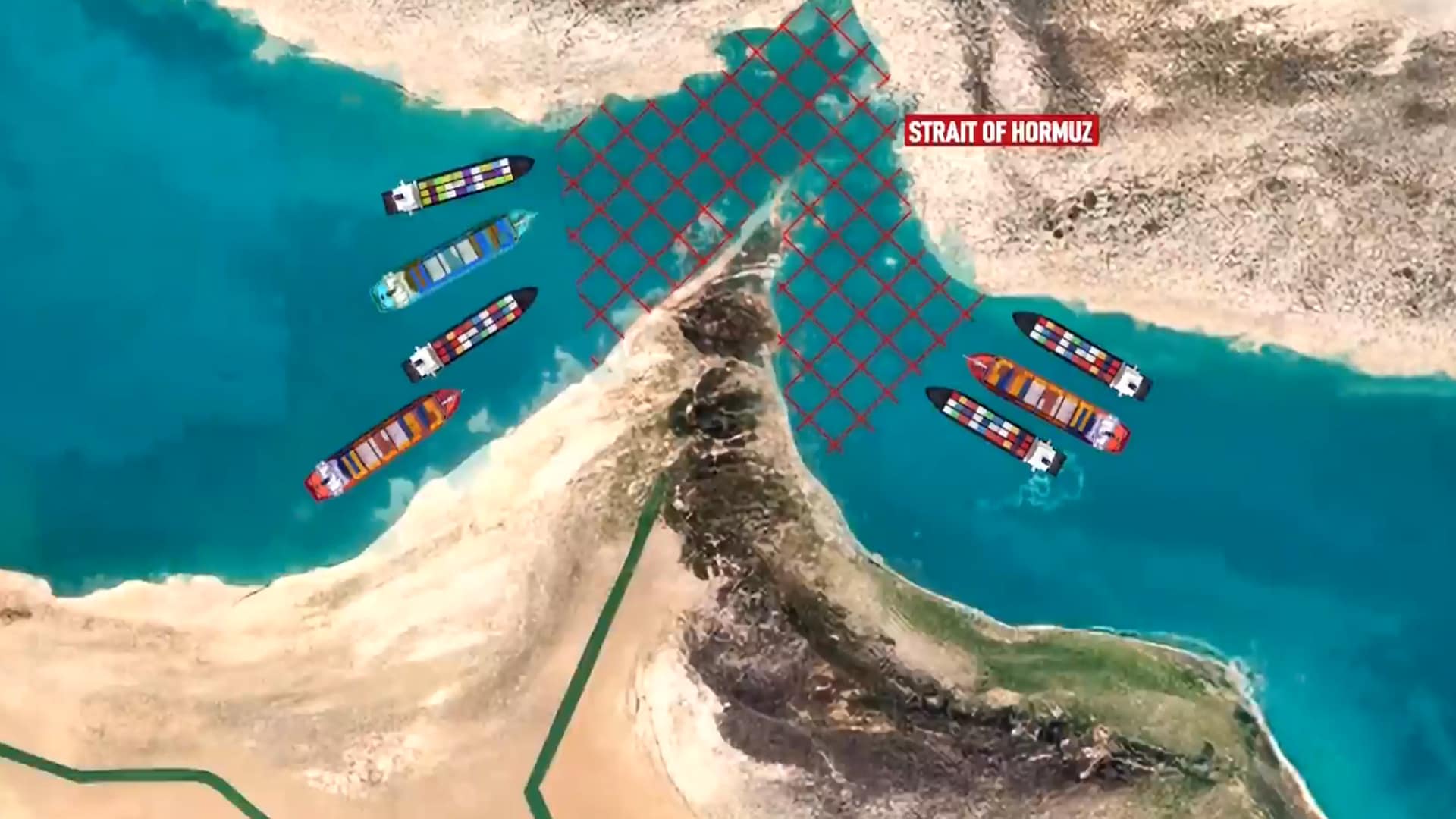
  • Additionally, 40% to 50% of India’s crude imports normally transit the Strait of Hormuz, which has been rendered nearly impassable due to Iranian attacks and heightened maritime risk, further tightening India’s supply chain exposure.
  • On the LNG side too, India relies heavily on the Gulf with Qatar – whose Ras Laffan LNG hub suffered extensive missile damage – alone being responsible for around 40% of India’s LNG.
  • Meanwhile, about 90% of India’s LPG imports travel through the Hormuz chokepoint, placing most of its household cooking‑fuel supply at risk as shipping disruptions intensify.

Simply put, these disruptions translate into heightened supply uncertainty, rising import costs with a weakening rupee, and increased pressure on domestic energy markets.“LNG production outages in Qatar and hits on UAE gas facilities have already forced Indian distributors to curtail supply and raise industrial gas prices. Crude prices have surged sharply following the attacks, with Brent fluctuating between $90-120 per barrel in the past few days, aggravating India’s import bill and risking further depreciation of the rupee in an economy that imports 85% to 90% of its oil,” notes Sourav Mitra. So what is India doing to tackle the unprecedented situation?India has been actively looking to ensure safe passage of its ships through Strait of Hormuz for oil and gas supplies and some tankers have managed to make their way through the passageway and dock in India. Diversification has also been a key strategy.On the issue of LNG supply, MEA spokesperson Randhir Jaiswal said, “With the latest attacks, the LNG supply is going to be impacted. It has been impacted because of the closure of the Strait of Hormuz. But we are in discussion with several countries. We are in touch with all the stakeholders there to see how best we can secure our energy needs.”He added, “We’re trying to buy LPG from everywhere, wherever it’s available. So if Russia is available, we’ll go there too. Because the current situation is such that we have to ensure that our people’s fuel needs are met… I can say that we want to have a wide range of options…”Sujata Sharma, Joint Secretary, Ministry of Petroleum and Natural Gas said on Thursday, “We are affected by the supplies of the Middle East… Anything which impacts the supplies from the Middle East impacts us… We are trying to pick up the cargoes from other sources. In crude oil, we have already diversified. Around 70% of our crude is coming from the area outside the Strait of Hormuz. Some of our LPG is also coming from the US. Qatar is definitely a very big supplier of LNG. But there are other suppliers also. For example, the US and Australia. There are other big suppliers as far as LNG is concerned…”Grant Thornton Bharat’s Mitra explains how India is responding by accelerating diversification, i.e., raising non‑Hormuz imports to around 70%, increasing crude purchases from Russia and securing additional cargoes from the US, West Africa and Latin America to offset Gulf disruptions. “Over the medium term, India is also turning to alternative LNG sources such as the US and Australia while expanding domestic buffers like strategic reserves and speeding up renewable adoption to reduce long-term dependence on conflict-prone regions. For LPG India has secured 1 MMT of LPG mainly from the US and is also actively working with Iran to secure passage from the Strait of Hormuz,” he says.“Meanwhile, replacement LNG volumes could come from the US, West Africa, Australia or Russia, but longer shipping distances mean higher freight costs and slower delivery times. In the near term, India’s priority will likely be ensuring supply security for critical sectors, particularly fertilizers with the sowing season approaching, as well as cooking gas and power generation,” says Sumit Ritolia, Lead Research Analyst, Refining and Modelling at Kpler.As per Ritolia, India sits among the most exposed buyers in the region. As per Kpler tracking, more than half of its LNG imports come via Hormuz (Qatar and the UAE), making the country particularly vulnerable to both physical supply disruptions and price shocks.“This dependence matters because many of India’s long-term LNG contracts are linked to oil prices, while any additional volumes typically need to be sourced from the spot market — often at significantly higher prices during supply disruptions,” says Ritolia.“If the disruption through Hormuz persists, Indian buyers may need to procure higher-priced spot cargoes or reduce consumption. Price-sensitive sectors, particularly industrial users and smaller gas distributors, could shift toward alternative fuels such as oil products, naphtha or petroleum coke,” he says.The shutdown of the Strait of Hormuz has already blocked India’s access to almost 60 per cent of its LPG. This has led to panic buying across the country. If shipments through the Middle East continue to be affected, India will need to source LPG cargoes from alternative suppliers such as the US or West Africa, though these supplies involve longer voyages and higher freight costs, says Ritolia.“In the short term, this means that the replacement costs may rise and create tighter regional balances, especially if multiple Asian buyers compete for limited alternative cargoes,” Ritolia tells TOI.Yet another measure is to get ⁠domestic refineries to maximise LPG yields. In fact, as per the government’s latest data, domestic LPG production from refineries has increased by about 36 per cent.


Source link

Access Denied


Access Denied

You don’t have permission to access “http://www.ndtv.com/world-news/iran-israel-war-in-big-step-on-hormuz-uk-france-say-ready-to-contribute-to-safe-passage-11239597” on this server.

Reference #18.17fdd417.1773939105.1b586fbc

https://errors.edgesuite.net/18.17fdd417.1773939105.1b586fbc


Source link

Iranian Oil Sanctions: US may unsanction 140 million barrels of Iranian oil to cool prices as Gulf war shakes energy markets


US may unsanction 140 million barrels of Iranian oil to cool prices as Gulf war shakes energy markets

File photo: US treasury secretary Scott Bessent (Picture credit: AP)

The Trump administration is considering lifting sanctions on around 140 million barrels of Iranian oil currently stranded on tankers in a bid to boost global supply and cool surging crude prices, as the war in the Gulf continues to hammer energy infrastructure and disrupt shipping through the Strait of Hormuz.US treasury secretary Scott Bessent said on Thursday that Washington could move within days to allow the oil to enter the market.“In the coming days, we may unsanction the Iranian oil that’s on the water. It’s about 140 million barrels,” Bessent told Fox Business Network’s Mornings with Maria programme.

Emergency energy move as oil stays above $100

As per Reuters, the US administration believes releasing the stranded Iranian barrels could help keep oil prices lower over the next 10 to 14 days, at a time when crude has remained above $100 per barrel for much of the past two weeks.Bessent said the move is part of a broader effort to deal with the supply shock caused by the closure of the Strait of Hormuz, which he described as creating a deficit of roughly 10 million to 14 million barrels per day in the physical market, according to Reuters.“So, to be clear, we’re not intervening in the financial markets. We are supplying the physical markets,” he said, as quoted by Reuters.He also stressed that the Treasury would “absolutely not” intervene in oil futures markets, instead focusing only on steps that increase actual supply.

White House signals ‘break the glass’ response

Bessent described the administration’s energy response as a “break the glass plan” being executed across the Treasury and the broader executive branch to manage immediate energy security risks.He said the stranded Iranian crude represents roughly 10 days to two weeks of supply that Iran had been shipping, much of which would otherwise have gone to China.“In essence, we will be using the Iranian barrels against the Iranians to keep the price down for the next 10 or 14 days as we continue this campaign,” Bessent said.Bessent signalled the administration still has “lots of levers” and “plenty more that we can do” to influence global energy pricing if the crisis deepens.

More SPR releases also on the table

Alongside the possible easing of sanctions on Iranian oil, the administration is also weighing another release from the US Strategic Petroleum Reserve (SPR).Bessent said the US could undertake a unilateral SPR release in addition to last week’s coordinated G7 release of 400 million barrels.Bessent called last week’s move the “largest coordinated SPR release in history” and said Washington could still do more on its own if needed.He also drew a comparison with a recent US decision to allow the sale of sanctioned Russian oil stranded on tankers, which added around 130 million barrels to global supplies.“We un-sanctioned Russian oil. We knew that there were about 130 million barrels on the water and we created supply that is beyond the Strait of Hormuz,” Bessent said.

Gulf energy attacks intensify global price shock

The discussion over emergency supply measures comes as the Gulf war continues to hit critical energy assets and send oil and gas prices sharply higher.Brent crude jumped nearly 10 per cent to $118 a barrel on Thursday morning, while European natural gas prices surged as much as 30 per cent, after tit-for-tat attacks across the Persian Gulf.Qatar said Iranian attacks damaged gas sites, including the Ras Laffan terminal, the world’s largest liquefied natural gas facility.Drone attacks caused fires at two state-owned refineries in Kuwait, a drone fell at a major Saudi export terminal, and the UAE said it had responded to incidents at gas facilities and an oil field caused by debris from missile interceptions.Oil prices have stayed elevated because Iran has closed the Strait of Hormuz to shipping and attacked tankers, compounding fears of a sustained supply crunch.

Allies being pressed to protect Hormuz

Bessent also used Thursday’s remarks to press US allies to take a bigger role in securing shipping lanes through the Strait of Hormuz.US President Trump was due to meet Japanese Prime Minister Sanae Takaichi at the White House later in the day to discuss Japan’s possible naval role in ensuring safe passage for vessels, given Japan’s heavy dependence on Gulf oil.“She’s very pro-US I think we’re going to have a very good discussion today,” Bessent said of Takaichi.Bessent further said, “When President Trump says our allies should join us in a coalition along the straits of Hormuz, they’re the ones who need this oil,” while noting that the US is now an oil exporter.He added it would be “very disappointing for those who benefit the most not to do something” to help escort ships through the strait.

Wider war context deepens market anxiety

The energy emergency is unfolding alongside a widening military campaign.US defence secretary Pete Hegseth said on Thursday that the US military had struck more than 7,000 targets in Iran since the war began nearly three weeks ago, damaging or sinking more than 120 Iranian navy ships and leaving its military ports “crippled.”“We’re winning decisively and on our terms,” Hegseth said, though he declined to say when the conflict might end.European leaders have grown increasingly alarmed by the strikes on energy infrastructure, with French President Emmanuel Macron warning in Brussels that the escalation was “reckless” and that destruction of production facilities could prolong the war’s economic fallout.


Source link

First time ever! India to host 2028 World Indoor Athletics Championships | More sports News


First time ever! India to host 2028 World Indoor Athletics Championships

NEW DELHI: India is set to host a major global athletics event, as the state of Odisha will stage the World Indoor Athletics Championships in 2028. The announcement was made by World Athletics president Sebastian Coe, marking a big moment for the country as it continues to grow its presence in international sports. This will be the first time India hosts a major event organised by World Athletics.

Watch

Cricket stars gather for Kuldeep Yadav’s grand wedding reception | Star-studded night

The championships are expected to take place in Bhubaneswar, which has modern facilities like the Kalinga Stadium complex, including an indoor arena. Coe, as quoted by news agency AFP, confirmed the decision, saying, “The World Athletics Council this morning awarded the next two editions of the event, the world indoor championships, to Odisha in India in 2028 and Astana, Kazakhstan, in 2030.”He added, “The future of the world indoor athletics championships is looking bright and assured.” This move highlights India’s growing ability to host top-level sporting events.“India will host the 2028 World Athletics Indoor Championships in Bhubaneswar. The global competition will be held at Kalinga’s Indoor Stadium,” the AFI president, Bahadur Singh Sagoo, stated.

Bigger plans for the future

India is also preparing to host the 2030 Commonwealth Games in Ahmedabad, which is seen as a stepping stone toward a possible bid for the Olympics in the future. Hosting these events shows the country’s long-term vision to become a major sports hub.Coe has previously supported this ambition, calling it a “powerful sign of a nation thinking boldly about its sporting future”.

Banner Insert


Source link

Iran: Fuel, food and finance: How distant US-Iran war might spill into your monthly household bills


Fuel, food and finance: How distant US-Iran war might spill into your monthly household  bills

Years ago it was the Covid pandemic, then Russia–Ukraine conflict, then came Trump’s tariffs and now the world is witnessing a raging crisis in the Middle East. Different timelines, different circumstances but each time, the impact lands closer home. In the first week of the raging conflict with Iran, the US spent $11.3 billion. But this isn’t really about America, Iran, or Israel in the abstract — it’s about you and how much you will have to pay!But what does a war thousands of kilometres away have to do with your monthly grocery bill, your child’s education abroad, or your savings? Well, the impact runs deeper.

Watch

Premium Petrol Prices Hiked By Up To ₹2.35 Per Litre In India Amid West Asia Conflict

After the US and Israel launched joint strikes on Iran on February 28, its ripple effects may land squarely on the Indian dinner table. As the US-Iran conflict tightens its grip on global energy routes, households are discovering that geopolitics doesn’t stay on maps, it shows up in kitchens, commutes, and bank balances. The big question: How will the Middle East war reshape your monthly budget? The crisis may start showing up in your bills through a range of spendings – let’s have a closer look at how your grocery bill might look!

Middle East tensions

First comes the LPG shock

The most immediate impact is being felt in the kitchen, even before the stove is turned on. With nearly 90% of India’s LPG imports routed through the Strait of Hormuz, supply disruptions have led to panic buying and reports of black marketing are also emerging. Earlier this month, LPG rates saw a sharp revision – as of March 10, 2026, a domestic 14.2 kg cylinder costs Rs 913, up from Rs 853 on March 1. Commercial cylinder prices have risen even more steeply, from Rs 1,768.50 to Rs 1,884.50, marking a Rs 115 hike. Rishi Shah, Partner and Economic Advisory Services Leader, Grant Thornton Bharat told TOI that “households may look to prepare for 15-20% effective fuel and cooking cost increases over the next quarter, if the disturbances persist. Fundamentally this is driven by global supply disruptions, something outside government control.”

Now pour in a little oil

Another reason why your grocery bill could suddenly feel heavier, could be cooking oil prices. According to a TOI report, Sunflower oil is now about Rs 15 more per litre while mustard oil costs Rs 10 more. Meanwhile, blended oils have seen a jump from roughly Rs 880 to Rs 1,000 for a five-litre can online, quietly adding to the strain on household budgets, the report said.Mumbai APMC grain market director Nilesh Veera told TOI that wholesale rates went up by Rs 5 per litre in the past few days, but then dropped slightly. “So the hike is now Rs 2-3 per litre which raises retail prices proportionately,” he said.The reason lies in India’s heavy import dependence,over 56% of its edible oil needs were met through imports in 2023–24.What makes it worse is the supply chain squeeze. Russia and Ukraine together account for 70–90% of the country’s sunflower oil imports, and disruptions in Black Sea routes, along with tensions around the Red Sea and Suez Canal, have tightened supplies and driven up freight costs. According to the Solvent Extractors’ Association (SEA), the risk of disrupted shipments from Russia and Eastern Europe, combined with higher transport costs for palm oil, is fuelling price hikes. “The risks of disrupted sunflower oil shipments from Russia and Eastern Europe, and higher freight costs for palm oil, have caused price hikes, forcing traders and consumers to closely monitor the situation to navigate supply chain risks,” SEA said

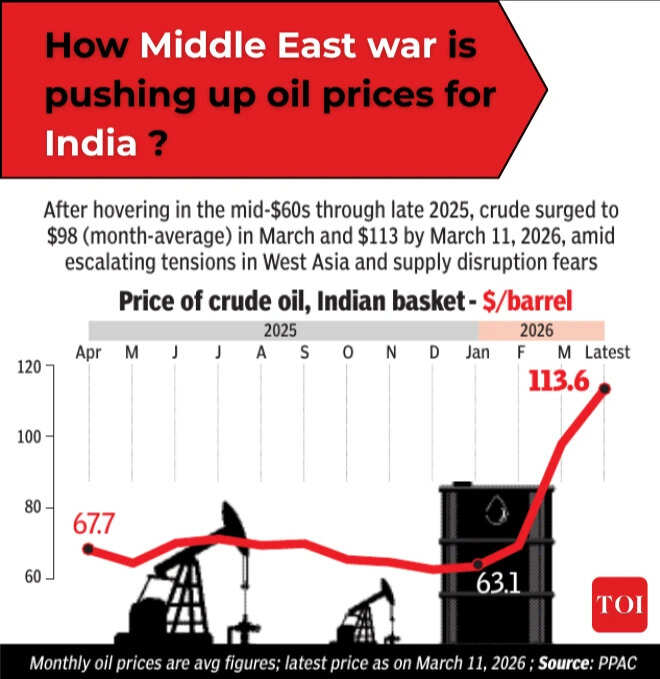
How Middle East war is pushing up oil prices for India

Now add the ingredients

Pulses may face pressure: Think your everyday dal is completely insulated from global tensions? Not really. India imports around 5–6 million tonnes of pulses each year: tur, urad, and lentils, from Myanmar, Canada, and parts of Africa. Now while supply lines remain largely intact, some pressure is coming from rising logistics costs. Higher freight charges, war-risk premiums, and increased insurance costs are pushing up the landed price of these imports, costs that are likely to trickle down to retail, potentially adding to food inflation.As Bimal Kothari, chairman of the India Pulses and Grains Association (IPGA), explains to ET, “Some cargo does pass through the Red Sea, so any disruption there could create constraints in imports. War risk premiums have also increased, pushing up insurance costs for container shipments.” “However, much of India’s pulse imports are unlikely to be directly affected,” the expert assured. Fruits and dry fruits: Your fruit basket could be next in line. India relies on competitively priced apple imports from Iran, and any disruption could quickly alter market dynamics. In 2024, Iran made up nearly 23% of India’s apple imports, along with a significant share in dry fruits like pistachios (around 60%) and almonds (about 39%). At the same time, anjeer, pista, saffron and apricots will also see the impact. With uncertainty around shipping routes and trade flows, traders are already turning cautious. “Traders are already factoring this uncertainty into future trading strategies. Given the price advantage of Iranian apples, any prolonged disruption leading to reduced imports could force a recalibration of sourcing strategies and reshape dynamics in India’s apple market,” Harish Chauhan, Convener, Himachal Pradesh’s Sanyukt Kissan Manch told ET.Expensive sweet tooth: Time for dessert? Your sweets might also get pricier. The surge in dry fruit prices is already hitting mithai makers and bulk buyers. As Vicky Jaisinghani of A-1 Sweets, Ulhasnagar, noted, imported Pishori pista has jumped from Rs 2,600 to Rs 3,400 per kg, while Iranian pista has risen from Rs 1,650 to Rs 2,400. Despite the spike, quality can’t be compromised, as premium ingredients are key to maintaining taste. Mayur Shah of Pravinchandra & Co. in Masjid Bunder said, “We have not hiked our rates, but may do so once existing stocks are over.”

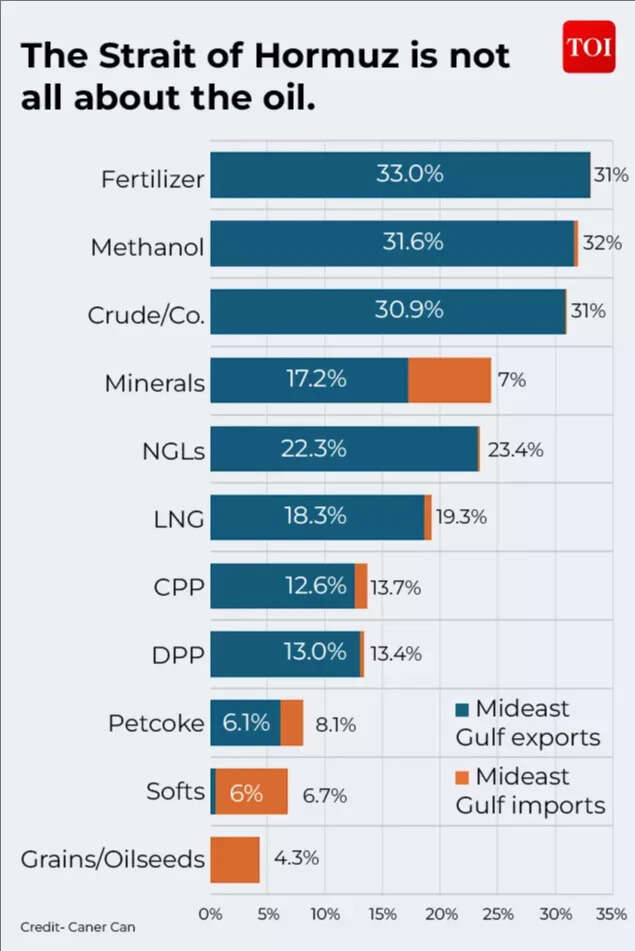
The Strait of Hormuz is not all about the oil

Daily used items might see hikes

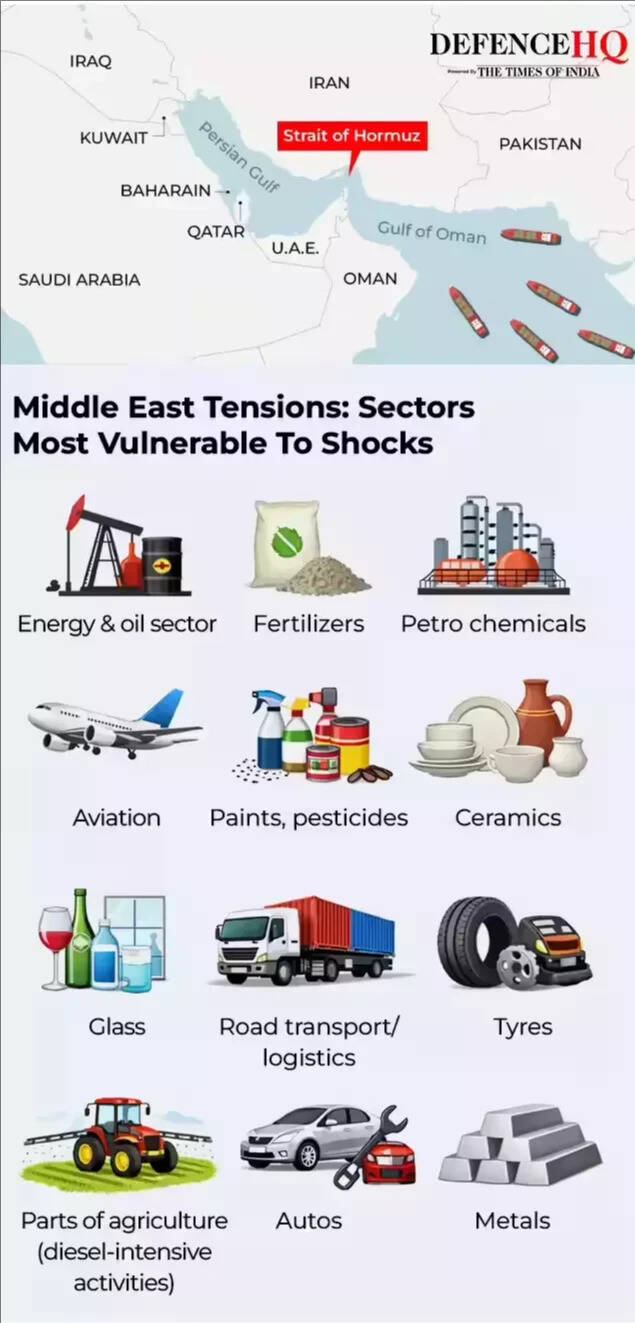
Petrochemical inputs are widely used across everyday products, from soaps and shampoos to creams, hair oils, and even packaging like bottles and tubes, making FMCG companies highly sensitive to crude price movements. These derivatives account for over a quarter of their input costs. According to company executives, prices of key crude derivatives such as plastics, resins, and polymers including polyethylene and polypropylene used in packaging, have surged by up to 25% in the past month. A similar spike has been seen in polyester staple fibre, further adding to cost pressures across the sector. And oh, your statement shoes? The are also set for a rollercoaster ride! Harkirat Singh, managing director of shoe brand Woodland India told ET that the company’s suppliers “are asking us to increase prices as they are buying raw materials at significantly higher costs.” From April, the company may increase prices by 8–12%.

Your home makeover may get pricier!

Painting your house could soon cost more, as soaring crude prices push up paint costs. Decorative paints may become 9–10% more expensive, according to ET. For instance, Berger Paints is set to raise prices by around 5% on average for solvent-based products, waterproofing emulsions, and industrial paints from March 25, as rising input costs begin to bite. CEO Abhijit Roy told ET that the company is closely monitoring raw material prices, which are fluctuating daily, and hinted that another round of hikes may follow if pressures persist.Planning to bring home a new TV or AC? You might want to brace for a higher bill. Consumer electronics and appliances are expected to become 5–6% costlier, largely due to their heavy reliance on plastic components, whose prices are rising sharply.“We will increase prices from April, possibly by 5–6%,” Kamal Nandi of Godrej Enterprises told ET. He noted that input costs have surged significantly over the past month, with plastic suppliers repeatedly hiking prices and hesitating to commit to long-term contracts, adding further uncertainty for manufacturers and, ultimately, consumers.

Commuting costs: Paying the ‘war surcharge’

India buys nearly 40% of its crude oil needs from the Middle East, although discounted Russian crude has offered some cushion in recent months. Still, global prices are surging, Brent crude has crossed the $100-per-barrel mark, and Iran has warned prices could spike to as high as $200 if the conflict escalates further.This has pushed up international prices of petrol, diesel, and aviation turbine fuel, with spot rates, what refiners actually pay, running even higher than futures. Refining margins, especially on diesel and ATF, have also risen sharply.Yet, domestic fuel prices have remained unchanged for now. This means state-run oil companies are absorbing losses on every litre sold. In the near term, the burden is likely to be shared between oil marketing companies and the government.

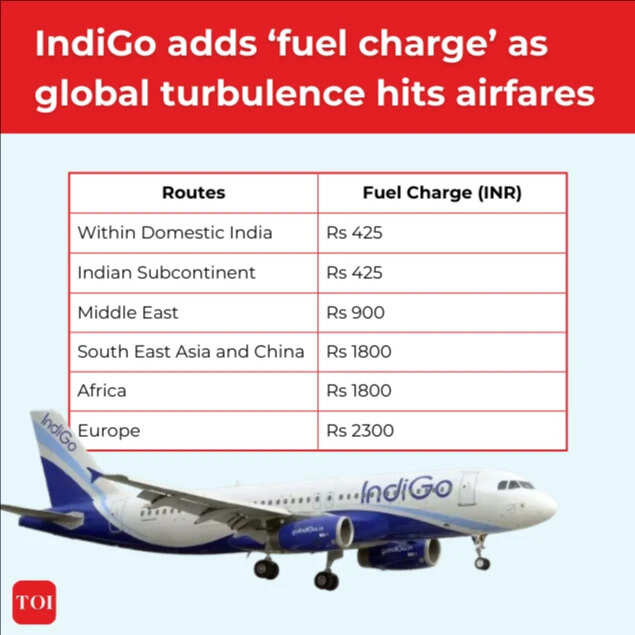
IndiGo adds 'fuel charge'

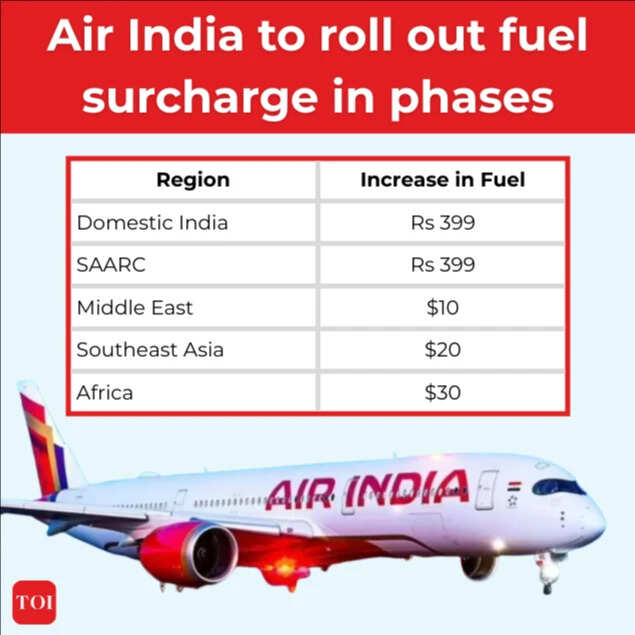
Meanwhile, air travel is getting costlier as airlines have begun passing on the impact of rising aviation turbine fuel (ATF) prices. IndiGo has introduced a fuel surcharge ranging from Rs 425 to Rs 2,300 on domestic and international flights, while Air India and Air India Express announced a Rs 399 surcharge on domestic tickets starting March 12. At the same time, Akasa Air also announced introducing a fuel surcharge ranging from Rs 199 to Rs 1,300 on domestic and international flight tickets. “There has been a significant increase in the price of aviation turbine fuel, driven by evolving geopolitical developments in the Middle East,” Akasa Air said in its statement.

Air India to roll out fuel surcharge in phases

Other carriers are signalling similar moves. SpiceJet has warned that fare hikes may be unavoidable if fuel prices remain high, with founder Ajay Singh stating that airlines will have “no choice” but to increase fares and urging the government to cut jet fuel taxes. With ATF costs surging amid Middle East tensions, flying is set to become more expensive in the coming weeks.

Car purchases to get expensive

So maybe no trips to far-off destinations—but what about buying a car, especially since petrol prices aren’t rising? You might want to hold off a bit, though, as automakers are preparing for price hikes of 2–3%. Luxury brands Mercedes-Benz and Audi have already announced increases of around 2% from April 1, while mass-market carmakers are still finalising their revisions. Industry leaders have warned that these hikes could dent recent sales gains driven by GST cuts, but say they have little choice as volatile supply chains continue to push costs higher.

Education: The indirect cost spiral

Planning to study abroad? You may need a bigger budget than expected. The escalating Middle East conflict has weakened the rupee, which has slipped to a record low of around 93.12 against the US dollar. A weaker currency makes everything, from tuition fees to accommodation and daily expenses, more expensive for Indian students paying in foreign currency, adding significant pressure on family finances. As Middle East tensions continue, families are becoming cautious about sending students to the region. While cancellations remain limited, some are considering deferrals or other destinations. Alternatives are getting costlier as the rupee weakens. Study abroad expenses have surged, for instance, a year at Harvard has risen from about Rs 53 lakh in 2021 to over Rs 78 lakh, according to a TOI analysis.

Portfolio loss

The shock on Dalal Street isn’t just a story for investors, it’s quietly hitting household finances too. The recent selloff triggered by the US-Iran conflict has wiped out nearly Rs 34 lakh crore in investor wealth within weeks, shrinking the value of stocks, mutual funds, and retirement savings. For many families, this means their portfolios are suddenly worth much less, forcing them to rethink spending, delay big purchases, or put off plans like buying a home or car.While the immediate impact has been severe, experts say the longer-term outlook for the Indian stock market remains relatively stable. Compared to other global economies, New Delhi’s exposure to oil shocks is somewhat cushioned, as energy imports form a smaller share of overall consumption. Lower dependence on foreign investor flows has also helped limit volatility. According to Moody’s Analytics, India has seen only moderate corrections in line with typical market cycles, suggesting that despite the current turbulence, the broader growth trajectory remains intact.Referring to countries like India and China, Moody’s report added, “although both economies are large net oil importers from Gulf Cooperation Council economies in absolute terms, energy imports account for a smaller share of domestic consumption, limiting their vulnerability to oil price shocks. Foreign investor participation in equity markets is also lower, and in China’s case, capital controls further limit volatility. These structural factors have helped shield their equity markets from sharper declines.” So, how will your bills look at the end of this month?The escalating, and more importantly US-Iran conflict could hit Indian households, driving up costs across almost every aspect of daily life. In the kitchen, LPG prices have risen while edible oils, pulses, lentils, and imported dry fruits could climb due to disrupted supply chains and higher logistics costs. Fuel inflation is adding to the burden, with crude crossing $100 a barrel, prompting petrol, diesel, and aviation turbine fuel surges, further pushing transportation costs. On Friday, state run oil marketing companies increased the price of their premium-grade power petrol by over Rs 2 per litre, while keeping the prices of regular petrol and diesel unchanged.For households, this turbulence is a reminder of how quickly global shocks can ripple through personal finances. While markets may stabilise over time, the immediate hit to savings and investments can influence spending decisions, delay financial goals, and heighten uncertainty. If volatility persists, families may continue to adopt a more cautious approach, cutting back on discretionary expenses and prioritising financial security, until clearer signals of stability emerge.


Source link

Relief Scheme For Exporters: Government launches Rs 497-crore RELIEF scheme to support exporters hit by Middle East conflict – all you need to know


Government launches Rs 497-crore RELIEF scheme to support exporters hit by Middle East conflict - all you need to know

The Centre on Thursday launched the RELIEF (Resilience & Logistics Intervention for Export Facilitation) scheme with an outlay of Rs 497 crore to support Indian exporters facing disruptions due to the ongoing conflict in the Middle East, as the government moved to cushion the impact of rising freight costs, insurance premiums and shipping delays.The scheme has been introduced under the Export Promotion Mission and will be implemented by the Export Credit Guarantee Corporation of India (ECGC).Commerce secretary Rajesh Agarwal said the package is aimed at helping exporters exposed to conflict-hit markets in the region.“We are announcing a new scheme under the Export Promotion mission, especially focused upon exporters exposed to these 17-18 geographies which have been impacted by the conflict to assuage some of the challenges that our exporters are facing,” he said, according to news agency PTI.

Daily monitoring mechanism set up amid trade disruptions

The government has also set up an inter-ministerial group (IMG) comprising the commerce ministry, ministry of petroleum and natural gas, ports and shipping, department of financial services, ministry of external affairs, RBI, CBIC and other departments to track the situation on a daily basis.The group is meeting every day to assess the evolving cargo movement situation and determine the need for further intervention.Commerce secretary described the situation as one where the “Middle East conflict has an impact” and acknowledged there are significant “challenges due to this conflict.”He added, “The government has come together to set up two inter-ministerial group in the Department of Commerce. We are meeting daily to assess the challenges. We are trying to listen to them and respond to them.”

Scheme targets Gulf and Middle East export corridors

The RELIEF scheme mainly covers consignments meant for delivery or trans-shipment to key Gulf and Middle East destinations, including the UAE, Saudi Arabia, Kuwait, Qatar, Oman, Bahrain, Iraq, Iran, Israel and Yemen.Urgency behind the scheme stems from disruptions around the Strait of Hormuz, which have triggered additional war-risk premiums and emergency conflict surcharges on maritime cargo.It added that freight rates on key routes had surged by nearly 90-100 per cent during the 2023-24 Red Sea crisis, and similar pressures are now weighing heavily on exporters, especially MSMEs with limited working capital.

Component I: Automatic export obligation relief and protection for existing shipments

The first component of the scheme offers automatic extension of export obligations for Advance Authorisations and EPCG authorisations falling due between March 1 and May 31, 2026, with the deadline now extended to August 31, 2026, without penalty.This component protects already insured shipments covered by ECGC in the immediate one-month window from February 14 to March 15, 2026.For exporters already insured by ECGC during that period, the government will top up compensation for war and political risk losses beyond normal policy cover, while keeping premiums at pre-disruption levels. The estimated support under this component is Rs 56 crore.

Component II: Enhanced ECGC cover for upcoming exports

The second component is designed for upcoming export consignments over the three-month period from March 16 to June 15, 2026, and aims to encourage and facilitate ECGC coverage.This component will provide stable premiums and enhanced insurance cover of up to 95 per cent for fresh shipments into the affected region. The estimated support under this segment is Rs 159 crore.

Component III: MSME support for freight and insurance shock

The third and largest component specifically targets MSME exporters that do not have ECGC cover.It will partly reimburse extraordinary freight and insurance costs over the one-month period from February 14 to March 15, 2026, shielding smaller exporters from sudden surcharge shocks.This segment will reimburse up to 50 per cent of the additional freight and insurance burden for non-ECGC-insured MSME exporters shipping to the affected markets. It said this component carries the biggest allocation of the package, with an estimated outlay of Rs 282 crore.

Govt says aim is to keep exports moving and protect market share

The commerce secretary underlined that the support package is meant not just as relief, but as a strategic step to preserve India’s position in key overseas markets during the crisis.“There is a dependence on our exports in these countries, and we are trying to see that even in these difficult circumstances, whatever exports we are able to do, we are trying to support that also,” he said, as quoted by ANI.ECGC will maintain a real-time monitoring dashboard for claims processing and fund utilisation, while an EPM Steering Committee will oversee the scheme and can reallocate funds depending on how the situation evolves.Taken together, the RELIEF package signals that the government expects the Middle East conflict to keep pressuring trade routes and logistics costs in the near term. The immediate goal appears to be to prevent shipment disruptions, avoid order cancellations and ensure Indian exporters, particularly MSMEs, do not lose market share in a strategically important region.


Source link

Access Denied


Access Denied

You don’t have permission to access “http://www.ndtv.com/india-news/drunk-woman-shouts-screams-brings-traffic-to-halt-outside-gujarat-hospital-11239385” on this server.

Reference #18.77fdd417.1773932366.3bd8293b

https://errors.edgesuite.net/18.77fdd417.1773932366.3bd8293b


Source link

Fire breaks out in Kasheli area of Bhiwandi in Maharashtra, damaging several furniture warehouses | Mumbai News


Bhiwandi: A major fire broke out in the Kasheli area of Bhiwandi on Thursday morning, gutting several furniture warehouses in what is known as the largest and most affordable furniture market in Thane district. The blaze, which reportedly started in a single godown at the Chamunda Complex, quickly spread to nearby units due to the highly combustible materials stored inside.Fire officials said the flames engulfed around seven to ten adjoining warehouses within a short span, triggering panic among traders in the busy market area. The incident, occurring on the day of Gudi Padwa, dealt a significant blow to the owners of the warehouses.Teams from the Bhiwandi and Thane fire stations rushed to the spot and pressed multiple fire engines into service. Fire officer Bapu Sonawane said that the fire broke out at around 11.30 am and was brought under control after nearly five hours, around 5 pm. “No casualties have been reported in the incident. However, the fire caused extensive damage to multiple warehouses, with losses estimated to run into several crores,” a fire official said.Firefighters initially faced difficulties due to a shortage of water, which briefly hampered operations. The situation improved after additional water tankers were brought in from the Thane Municipal Corporation, officials added.Authorities also said that firefighting operations had to be carried out cautiously due to high-tension power lines passing over the affected structures.The exact cause of the fire is yet to be ascertained, officials said, adding that further investigations are underway.


Source link

Trump-Netanyahu split out in open? Intel chief says Israel’s goals in Iran not same as US


Trump-Netanyahu split out in open? Intel chief says Israel's goals in Iran not same as US

US intelligence chief Tulsi Gabbard on Thursday said that United States and Israel have different objectives during the military campaign in Iran.During a hearing in front of the House of intelligence committee, Gabbard said that Trump’s objective are to destroy Iran’s ballistic missiles launching capabilities and their navy.“The objectives that have been laid out by the president are different from the objectives that have been laid out by the Israeli government.”“We can see through the operations that the Israeli government has been focused on disabling ⁠the Iranian leadership. The president has stated that his objectives are to ⁠destroy Iran’s ballistic missiles launching capability, their ballistic ⁠missile production capability, and their navy,” she added.Earlier in the day, US defence secretary Pete Hegseth said that there was no “time frame” for ending the war against Iran.“It will be at the president’s choosing, ultimately, where we say, ‘Hey, we’ve achieved what we need to,'” he told reporters.‘Immense blessing for Israel’Meanwhile, an Israeli minister said that strikes on Iran were “an immense blessing” for Israel.Zeev Elkin, a member of Prime Minister Benjamin Netanyahu’s right-wing Likud party, said, “The debate should not be about when (the war) will end, but about how we are going to prolong and deepen the damage caused,” said Zeev Elkin, a member of Prime Minister Benjamin Netanyahu’s right-wing Likud party.”“Every day of the campaign is an immense blessing for the State of Israel,” Elkin added, speaking on army radio.An Israeli minister said on Thursday that the US-Israeli strikes against Iran were “an immense blessing” for Israel, nearly three weeks into the Middle East war. Israel and the United States launched strikes on Iran on February 28, triggering a war that has since engulfed the Middle East. Trump distances US from Israel’s attack on South Pars gas fieldEarlier in the day, Trump distanced US from Israel’s attack on Iran’s South Pars gas field, describing his Israeli allies as having “violently lashed out” at the facility and promising that it would not happen again if Tehran refrains from attacking Qatar. He claimed Iran responded without full information, launching what he described as an unjustified strike on part of Qatar’s LNG infrastructure.Trump said the US had “nothing to do” with the strike on the offshore gasfield facilities in Iran’s Bushehr province on Wednesday, which was followed by Iran pledging to strike energy facilities in Qatar, Saudi Arabia and the United Arab Emirates.In a social media post, Trump said Israel had targeted a section of the major gas facility “out of anger” over developments in the Middle East, stressing that Washington had no prior knowledge of the attack and that Qatar was “in no way” involved.“Israel, out of anger for what has taken place in the Middle East, has violently lashed out at a major facility known as South Pars Gas Field in Iran. A relatively small section of the whole has been hit. The United States knew nothing about this particular attack, and the country of Qatar was in no way, shape, or form, involved with it, nor did it have any idea that it was going to happen,” wrote Trump.“Unfortunately, Iran did not know this, or any of the pertinent facts pertaining to the South Pars attack, and unjustifiably and unfairly attacked a portion of Qatar’s LNG Gas facility. No more attacks will be made by Israel pertaining to this extremely important and valuable South Pars Field unless Iran unwisely decides to attack a very innocent, in this case, Qatar – In which instance the United States of America, with or without the help or consent of Israel, will massively blow up the entirety of the South Pars Gas Field at an amount of strength and power that Iran has never seen or witnessed before,” he said.“I do not want to authorize this level of violence and destruction because of the long term implications that it will have on the future of Iran, but if Qatar’s LNG is again attacked, I will not hesitate to do so. Thank you for your attention to this matter,” added Trump.Meanwhile, Israel has continued targeting senior Iranian leadership, including the reported killing of intelligence minister Esmail Khatib and other top security figures. Iran has retaliated with missile barrages on Israel, including strikes that caused casualties in the occupied West Bank.


Source link

Ravindra Jadeja vs Vaibhav Suryavanshi: WATCH – Who comes out on top in RR’s IPL 2026 practice clash?


The IPL 2026 season is pulse-pounding even before the first ball is bowled, and the Rajasthan Royals (RR) are currently the epicentre of the hype. As the franchise shifts its base to Guwahati for their season opener on March 30, the training camps have produced a moment that has the cricketing world talking: A high-stakes generational battle in the nets between a legend and a prodigy.

Battle of skills between Ravindra Jadeja and Vaibhav Suryavanshi steals the show in RR nets

In a video that has since gone viral across social media, the legendary Ravindra Jadeja, who made a sensational homecoming to the Royals via a massive pre-season trade from CSK, faced off against the 14-year-old sensation Vaibhav Suryavanshi. Jadeja, known for his relentless accuracy and clever variations, threw everything at the youngster, but the results were unexpected.

Suryavanshi, fresh off a Player of the Tournament performance in India’s U19 World Cup 2026 victory where he smashed a 175-run masterpiece in the final, showed zero nerves. The southpaw treated Jadeja’s deliveries with the disdain of a veteran, launching the ball to all corners of the practice facility.

While Jadeja attempted to lure the teenager into a trap with his signature sliding deliveries, Suryavanshi remained unfazed, reading the length with precision. Apart from one delivery that drifted slightly wide, the youngster dominated the exchange. The battle reached a point where even Jadeja couldn’t help but offer a smile of genuine amusement at the sheer audacity of the kid. For RR, this wasn’t just a net session; it was a glimpse into a future where their ₹1.1 crore investment looks like the bargain of the century.

Here’s the video:

Also READ: IPL: Complete list of all Rajasthan Royals (RR) captains so far ft. Riyan Parag and Sanju Samson

Rajasthan Royals to enter IPL 2026 under the new leadership of Riyan Parag

While the nets are buzzing with individual brilliance, the bigger story in the Royals’ camp is the seismic shift in leadership. After a decade-long association, Sanju Samson has moved to Chennai, paving the way for a local hero to take the throne. The Rajasthan Royals have officially entered the Riyan Parag era, appointing the Assam-born all-rounder as their full-time captain for IPL 2026.

This move marks a historic moment for Northeast India, as Parag becomes the first player from the region to lead an IPL franchise. Having served as a stand-in skipper and vice-captain in previous seasons, Parag’s promotion is a homecoming of a different sort, especially with RR playing their initial home games at the Barsapara Stadium in Guwahati.

Head coach Kumar Sangakkara has been vocal about this transition, emphasizing a collaborative partnership between the youth-heavy squad and the coaching staff.

I like a relaxed attitude, people having fun and smiling. But when you’re doing work, remember we all need to get something out of the time we’re here,” Sangakkara noted during his first team address.

Under Parag’s leadership, and with a squad bolstered by the likes of Sam Curran and the returning Jadeja, the Royals are betting on a fearless and smart brand of cricket. With the youngest captain and the youngest player in the league, the 2026 season promises to be a high-octane journey for the Pink Army.

Also READ: Robin Uthappa explains why IPL 2026 will be a challenging season for Vaibhav Suryavanshi


Source link