Breaking News
Bank holiday today: Are banks closed on March 20, 2026 for Eid-ul-Fitr? Check state-wise list


Bank holiday today: Are banks closed on March 20, 2026 for Eid-ul-Fitr? Check state-wise list

March 2026 bank holidays: Planning to visit the bank today? There is a lot of confusion among customers who are planning to visit the bank regarding the bank holiday for Ramadan 2026. The date of the Eid festival may vary from state to state depending on the timing of the sighting of the moon. Therefore, customers are advised to check the holiday schedule in advance to avoid any inconvenience. The Reserve Bank of India has announced the bank holidays in several states on March 20 and 21.

Bank holiday on March 20:

Banks are closed in Srinagar and Andhra Pradesh to celebrate Eid-Ul-Fitr (Ramzan)/Jumat-ul-Vida.Digital banking services, including ATMs, UPI, online banking and mobile apps, will continue to function on holidays, allowing fund transfers, bill payments and other routine financial activities without interruption. Services that require branch visits, such as cheque clearances, large cash deposits or demand draft issuance, will not be accessible today.

Upcoming bank holidays on March 2026

Date States Holiday
21 March Assam, Gujarat, Mizoram, Maharashtra, Karnataka, Madhya Pradesh, Odisha, Chandigarh, Tamil Nadu, Uttarakhand, Sikkim, Manipur, Arunachal Pradesh, Rajasthan, Uttar Pradesh, Jammu & Kashmir, Nagaland, West Bengal, Delhi, Goa, Bihar, Jharkhand, Chhattisgarh, Meghalaya, Srinagar Ramzan-Id (Id-Ul-Fitr) / Khutub-E-Ramzan / Sarhul
26 March Mizoram, Maharashtra, Karnataka, Tamil Nadu, Uttarakhand, Rajasthan, Uttar Pradesh, Chandigarh, West Bengal, Madhya Pradesh, Mumbai, Nagpur, Jharkhand, Himachal Pradesh Shree Ram Navami
27 March Madhya Pradesh, Odisha, Sikkim, Telangana, Bihar, Andhra Pradesh Shree Ram Navami (Chaite Dasain)
31 March Gujarat, Maharashtra, Karnataka, Madhya Pradesh, Tamil Nadu, Arunachal Pradesh, Uttar Pradesh, West Bengal, Delhi, Bihar, Chhattisgarh, Jharkhand Mahavir Janmakalyanak / Mahavir Jayanti


Source link

8-year-old boy dies after falling into water-filled construction pit in Mumbai | Mumbai News


MUMBAI: An eight-year-old boy died after falling into a water-filled construction pit in Malad East on Thursday evening.The incident took place at Chagan Patel Chawl in Ambewadi, Kurar Village.According to civic officials, the child — identified as Divyansh Rajesh Mourya — had ventured near the site around 8 pm to retrieve a ball when he accidentally slipped into the pit, which had been excavated by a private contractor.Local police personnel rushed to the spot and rescued the boy, who was then taken to the civic run BDBA Hospital in Kandivali. However, doctors declared him dead on arrival.Civic officials from Kurar Village police station said the pit was filled with water, which may have contributed to the fatality. Further inquiry is underway.


Source link

IPL 2026: 5 players CSK could target as replacements for injured Nathan Ellis | Cricket News


IPL 2026: 5 players CSK could target as replacements for injured Nathan Ellis
Nathan Ellis (X-Cricbuzz)

Chennai Super Kings have suffered a significant setback ahead of IPL 2026, with Australian pacer Nathan Ellis ruled out of the tournament due to a hamstring injury.The 31-year-old fast bowler was last seen in action for Tasmania during the Australian One-Day Cup final in Hobart, where he returned figures of 2/26 from five overs in a losing cause against New South Wales. While the exact moment of his injury remains unclear, Ellis had earlier been dealing with a hamstring issue that forced him to miss the knockout stage of the Big Bash League, where he captained the Hobart Hurricanes.Ellis was expected to play a crucial role for CSK as their primary death bowler and was set to be their specialist in that phase, especially after the franchise parted ways with Matheesha Pathirana before the auction. His absence now leaves a major void, forcing the team management to explore alternatives.Here are five players who could step in as replacements for Ellis:Ottneil Baartman (South Africa)Perhaps the closest like-for-like replacement, Baartman has earned high praise, with South Africa spinner Keshav Maharaj calling him the best death bowler in the country. He played a key role in Sunrisers Eastern Cape’s back-to-back SA20 title wins in 2023 and 2024 and also contributed to South Africa’s run to the T20 World Cup final in 2024. Having gone unsold at the IPL 2026 auction and with prior links to Texas Super Kings, he represents a seamless fit for CSK.Sean Abbott (Australia)A proven performer in T20 cricket, Abbott aligns well with CSK’s preference for experienced Australian quicks. He holds the record for most wickets in BBL history with 165 scalps, underlining his consistency, especially in pressure situations. His accuracy and experience at the death make him a strong candidate to fill Ellis’ role.Gerald Coetzee (South Africa)Coetzee offers a high-impact but slightly risky option. He was South Africa’s leading performer at the 2023 ODI World Cup, registering the most wickets by a South African in a single edition. Known for his pace and ability to move the ball, he can be effective both upfront and in the death overs. However, injuries remain a concern, as he missed the T20 World Cup 2026 and played only three matches in SA20 2026. If fit, he could be a match-winning addition. He also has IPL experience, having played for the Mumbai Indians.Shamar Joseph (West Indies)Joseph brings an element of unpredictability but also immense potential. He made headlines with his 7/68 in Brisbane, helping West Indies secure a historic win over Australia after 27 years. While primarily known for his red-ball exploits, his raw pace and skiddy action could translate well into T20 cricket. Unsold at the IPL 2026 auction after being released by Lucknow Super Giants, he remains an intriguing option.Fazalhaq Farooqi (Afghanistan)The left-arm pacer has prior IPL experience with Rajasthan Royals and continues to be a regular in Afghanistan’s T20 setup. Though he has taken six wickets in 12 IPL matches, his economy rate of 10.32 has been a concern. Nevertheless, his ability to provide variety as a left-arm seamer could appeal to CSK, and he is also a viable option for death bowling.

Banner Insert


Source link

Access Denied


Access Denied

You don’t have permission to access “http://www.ndtv.com/world-news/iran-us-war-explained-chinks-in-f-35-stealth-jet-armour-that-iran-likely-exploited-11241627” on this server.

Reference #18.34a21ab8.1773988752.9f173fc

https://errors.edgesuite.net/18.34a21ab8.1773988752.9f173fc


Source link

Why coconuts are not allowed on flights and the surprising reason behind it |


There are many rules and regulations associated with air travel. These rules and regulations include no carrying of sharp objects, no carrying of large quantities of liquids, and no carrying of inflammable items. However, some rules and regulations seem unusual. The case of carrying coconuts is one such case. Coconuts are commonly found and are associated with religious, food, and everyday activities. However, there is a restriction on carrying coconuts on an aircraft.What makes this restriction particularly interesting is that it combines multiple safety concerns rather than just one. From chemical properties to practical handling challenges, coconuts fall into a grey area where everyday items intersect with strict aviation safety protocols.Many people face difficulties and are surprised when they are not allowed to carry coconuts during air travel. The seemingly harmless item poses many risks and hazards. The risks associated with carrying coconuts in an aircraft include the risk of fire and pressure. The reasons behind this restriction will show how ordinary items can pose risks and hazards.

Why are coconuts considered a safety risk

The main reason for this restriction on coconuts in flights is that they are high in oil. Dry coconuts are also known as copra, and they are high in oil, which is highly flammable. In certain conditions, this oil may catch fire in front of sparks or in hot conditions. According to international aviation safety standards set by the International Air Transport Association (IATA), materials that are flammable or capable of self-heating are restricted on flights, and dried coconut can fall into this category due to its high oil content.The cargo area and cabin area in flights are strictly regulated, and any small fire risk is taken seriously. As part of aviation safety, we focus more on preventing rather than reacting.

The risk of fire and self-heating

It is not only flammable but may also have the ability to produce heat on its own in certain circumstances. Some materials have the ability to produce heat due to their oil content and may even catch fire after a series of slow chemical reactions.This is one of the reasons why dried coconut is considered a dangerous material in the guidelines related to air travel.

Pressure and structural concerns

Another lesser-known reason has something to do with the air pressure. It is already known that during a flight, the air pressure may affect objects with liquid or air pockets. A coconut has both.As the pressure differs, there is a small possibility that the shell of the coconut might crack or leak. Although it does not seem like a big deal, any unexpected leak of the coconut shell might cause complications during the flight.

Security and scanning challenges

Airport security also makes extensive use of X-ray scanning to detect possible threats. However, the hard outer covering of coconuts makes it hard for X-ray scanners to get a good view of what is inside them.This lack of visibility may also spark suspicion, as it is hard for authorities to easily ascertain whether the item is safe or not. In places like airports, which are highly sensitive, any item that cannot be scanned easily may be forbidden.

Could coconuts be used as a physical hazards

Besides chemical hazards, coconuts are also solid and heavy objects. When in situations such as turbulence, anything that is loose and hard could become a threat.The hard shell of coconuts could also become a source of damage should it suddenly change position. Although this may not be the main reason for banning coconuts, it is just another reason for aviation authorities to worry about.

Are coconuts allowed in any form

There are a few exceptions depending on the airlines’ rules and regulations. In some cases, carrying coconuts is allowed as long as they are cut into small pieces and packed in the checked baggage.However, carrying whole coconuts and dried copra is not allowed in either the cabin baggage or the checked baggage. The best advice that a traveller should follow is not to carry coconuts at all.


Source link

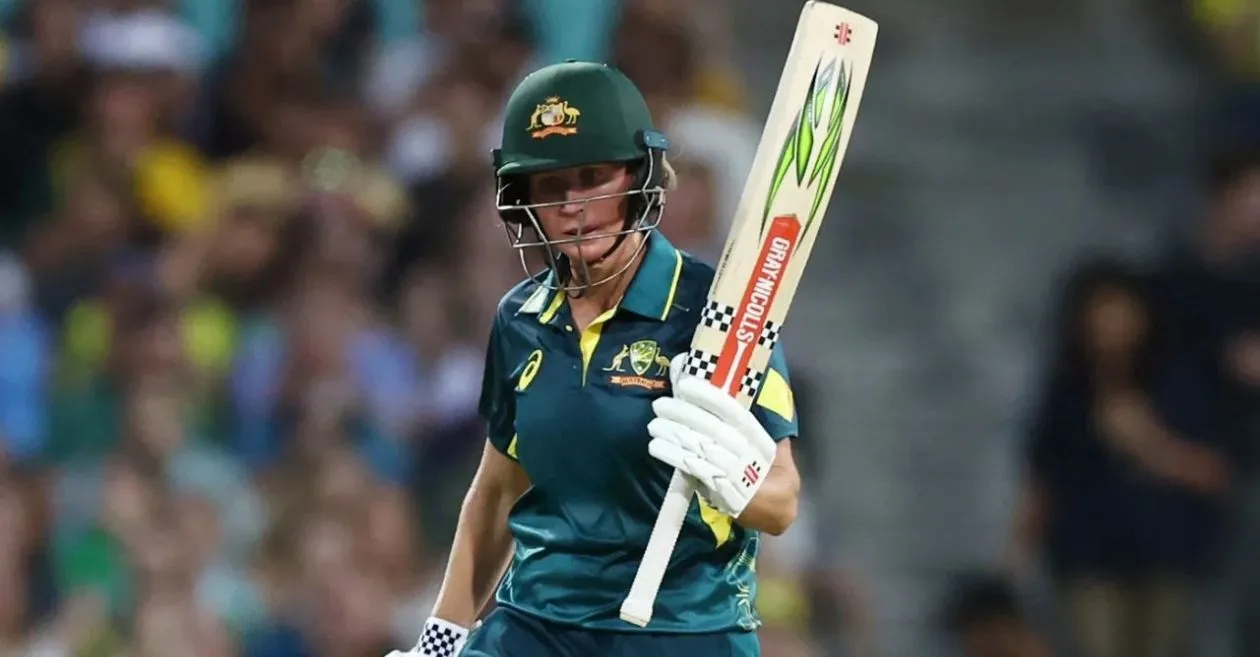
Beth Mooney’s explosive innings powers Australia to dominant win over West Indies in Women’s T20I opener


Australia Women kickstarted their T20I tour of the West Indies with a clinical performance in Kingstown on March 19, 2026, defeating the hosts by 43 runs. In a match defined by individual brilliance and collective bowling pressure, the world champions proved too strong for a resilient but ultimately outmatched West Indies side. The victory was built on the back of a masterclass from opener Beth Mooney, whose ability to anchor an innings while maintaining a high strike rate remains the gold standard in the shortest format of the game.

Beth Mooney’s batting masterclass sets the tone for Australia in the series opener

Opting to bat first, Australia faced early jitters as the West Indies bowling attack, led by the returning Deandra Dottin, struck quickly. Georgia Voll (8) and Phoebe Litchfield (6) fell within the powerplay, leaving Australia at a precarious 34/2 after 5.3 overs. However, Mooney remained unphased, finding a reliable partner in the veteran Ellyse Perry.

Mooney played a blistering yet calculated knock, scoring 79 off just 55 deliveries. Her innings was a perfect blend of placement and power, featuring 8 fours and 3 towering sixes. Alongside Perry, who contributed a solid 36 off 32 balls, Mooney stitched together a vital 99-run partnership for the third wicket. This stand shifted the momentum entirely, taking Australia from a cautious 56/2 at the drinks break to a commanding position.

Despite a late flurry of wickets including Mooney falling in the 18th over to Chinelle Henry, Australia finished with a robust total of 164/6. Dottin was the pick of the Caribbean bowlers, finishing with figures of 3/35, but the target of 165 always looked a mountain to climb against the disciplined Australian attack.

Also READ: West Indies vs Australia, Women’s T20I Series: Schedule, Squads, Broadcast and Live Streaming details

Disciplined Australian bowling stifles the West Indies chase

The West Indies chase began with promise but lacked the sustained aggression needed to overhaul Australia’s total. Openers Qiana Joseph and Hayley Matthews navigated the powerplay safely, reaching 33/0 after six overs. However, once the fielding restrictions were lifted, the Australian spinners tightened the noose.

Alana King turned the game on its head with a mesmerizing spell of leg-spin. She dismissed the dangerous Matthews (11) and followed up by trapping Shemaine Campbelle (15) LBW. The collapse was exacerbated when King clean-bowled Dottin for a duck, leaving the West Indies reeling. King finished with remarkable figures of 3/14 from her 4 overs, including a maiden, effectively ending the hosts’ hopes of a comeback.

Joseph top-scored for the West Indies with a valiant 45 off 39 balls, but she found little support at the other end. The Australian bowlers were relentless; Kim Garth (1/17) provided exceptional control, while Georgia Wareham (2/14) cleaned up the tail, dismissing Stafanie Taylor (28) and Jahzara Claxton in the final over. The West Indies were restricted to 121/6 as the required run rate climbed out of reach. With this 43-run win, Australia take a 1-0 lead in the series, fuelled by Mooney’s Player of the Match performance and a bowling unit that refused to give an inch under the lights in Kingstown.

Also READ: Tahlia Wilson earns maiden call-up as Australia Women announce squad for West Indies white-ball tour

This article was first published at WomenCricket.com, a Cricket Times company.


Source link

Rupee breaches 93 per dollar for first time amid Iran war oil shock; down 19 paise in early trade


Rupee breaches 93 per dollar for first time amid Iran war oil shock; down 19 paise in early trade

The rupee fell to a record low of 93.12 against the US dollar on Friday, pressured by rising global uncertainty and higher crude oil prices amid the ongoing Iran war.The domestic currency declined 0.55% to breach its previous low of 92.63 recorded yesterday, extending losses to nearly 2% since tensions in the Middle East escalated. Global energy supply disruptions from the Mideast continue to threaten Asia’s third-largest economy by impacting its growth-inflation balance.Despite the currency weakness, domestic equity markets saw a recovery. The BSE Sensex rose over 900 points, or around 1%, while the Nifty 50 gained about 300 points, or 1.35%.Oil prices jumped close to $120 per barrel on Thursday after attacks on major energy infrastructure in the Gulf but retreated on Friday. Prices eased as Brent crude futures dropped as much as 3.39% to an intraday low of $104.96 per barrel, while US West Texas Intermediate (WTI) crude fell 3.22% to $92.47.However, crude prices remain elevated. As the conflict entered its third week, Brent crude has risen nearly 40%, from $77.74 on March 2 to $108.65 on March 19, adding to inflationary pressures and weighing on currency markets.Several European countries and Japan have offered to help ensure safe passage for ships through the Strait of Hormuz, while the US has announced measures to boost oil supply.The rupee is likely to remain under pressure, as concerns over rising oil prices have led foreign investors to withdraw more than $8 billion from Indian equities so far in March, marking the largest monthly outflows since January 2025. Economists warn that a sustained rise in energy costs could weigh on India’s growth and push up inflation.(With inputs from agencies)


Source link

UAE, Qatar, Kuwait & more: DGCA asks airlines to avoid 9 airspaces amid escalating Middle East tensions | India News


UAE, Qatar, Kuwait & more: DGCA asks airlines to avoid 9 airspaces amid escalating Middle East tensions

NEW DELHI: Aviation regulator body the Directorate General of Civil Aviation (DGCA) on Thursday directed airlines to avoid nine airspaces in the war-engulfed Gulf region and put in place strong contingency plans, citing heightened risks following the ongoing conflict in the region.In an advisory, the DGCA asked carriers to steer clear of the airspaces of Bahrain, Iran, Iraq, Israel, Jordan, Kuwait, Lebanon, Qatar and United Arab Emirates.Indian airlines may continue operating over Oman and Saudi Arabia, subject to conditions. The regulator said flights must not operate below FL 320, or 32,000 feet, in specified parts of these airspaces.About the nine airspaces, the DGCA asked airlines to “refrain from operating within the affected airspace…at all flight levels and altitudes”.

Watch

900 Indians Flee Iran Chaos, Rush Home Via Armenia And Azerbaijan Escape Routes: MEA

Any continued operations would be at the discretion of the operator based on their safety risk assessment, it added.“Operations to airports in the affected region, where other international carriers are currently operating, must involve robust contingency planning to cover all eventualities, as part of the safety risk assessments by the operators,” the DGCA said, according to news agency PTI.The advisory takes immediate effect and will remain valid until March 28 unless reviewed or superseded.“Operators are advised to provide their flight crew with information regarding latest NOTAMs, airspace restrictions affecting flight that are already airborne,” it said.NOTAMs, or Notice to Airmen, provides real-time updates on airspace and airport conditions.“Recent military strikes conducted by the United States and Israel against targets within Iranian territory have led to a high-risk environment for civil aviation. In response to these strikes, Iran has announced retaliatory measures,” the DGCA said, warning that the situation poses critical hazards to civil flight operations.


Source link

‘Dilli hai bhai sabki dhadkan’: Delhi falls back in love with football after 7 years | Football News


'Dilli hai bhai sabki dhadkan': Delhi falls back in love with football after 7 years
SC Delhi played their first home game of the season against Jamshedpur FC in the Indian Super League on March 19, 2026. (Image: Tanuj Lakhina/TimesofIndia.com)

New Delhi: There was rain in the air on Thursday evening in New Delhi. After a day of heavy rain, the drizzle had brought the mercury down. At the Jawaharlal Nehru Stadium, only a few seats were occupied before the momentous occasion: a Delhi-based club playing a home game in Indian football’s top division. It had been 2587 days since Delhi’s own – Delhi Dynamos then – entertained the city’s locals. Now, SC Delhi’s red adorned the stadium with signage, banners and visuals at the main gates. They looked to make the most of this home return for their first win of the season against second-placed Jamshedpur FC in this truncated season of the Indian Super League.An hour before the kick-off, the most noise was made by a group of teenagers on the athletics track who were practising their dance synchronisation to the beats of the dhol. Alongside, multiple youngsters kept the athletics track busy despite the nip in the air. Further along, a group of young men and women posed for selfies as they distributed the club jerseys to one another.

Watch

Football returns to Delhi! SC Delhi gear up for first ISL home game

Large banners of Nora Fernandes, Rafael Ribeiro, Mohammed Aimen, Ayush Adhikari, Lamgoulen Hangshing and Karanjit Singh hung from the ceiling. Close by, kids lined up to side foot the ball into a tiny goal. Each successful attempt was cheered on, and players of the future were slowly being created.Gate 1 welcomed the club ownership, their invitees and the VIPs. Away from the glitterati, over on the opposite side of the humongous multi-purpose facility, on Gate 10, is where the actual fans queued up to get inside as the clock ticked on.A small queue at 7pm — half an hour before kick-off — started to get longer in 15 minutes. One after another, QR codes were scanned, and the sound of beeps filled in. As is the norm with stadiums across the country, arguments broke out over what is allowed and what isn’t. Fans jostled with security as the size of the bags dictated what went in and what remained out.

SC-Delhi-JLN-3-1280

Banners featuring SC Delhi players at the Jawaharlal Nehru Stadium. (Image: Tanuj Lakhina/TimesofIndia.com)

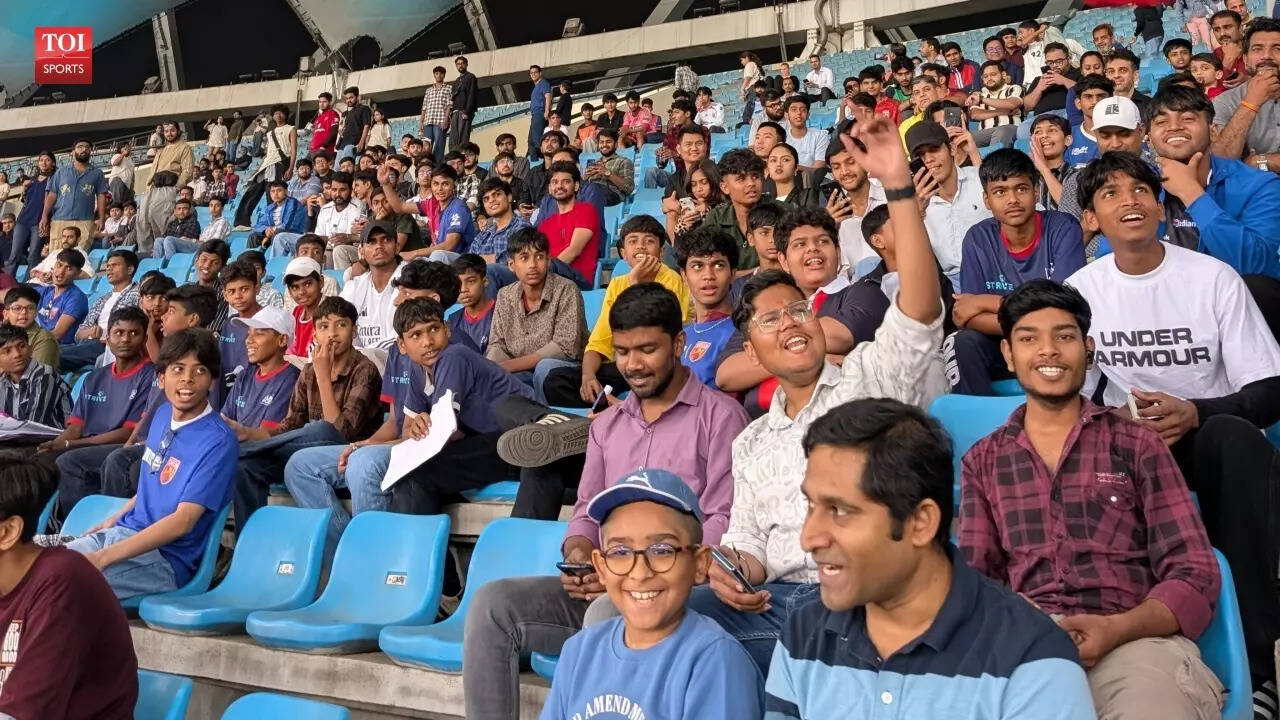
Inside, after another quick check of the digital ticket, a large chunk of fans took their place in one section while a smaller group, possibly of away supporters, were stationed in another section. Chants reverberated in the stadium as players took the field – Delhi in red and black and Jamshedpur FC in the whites. A young man egged the fans on to follow his “purab, paschim, uttar, dakshin” with “Dilli hai bhai sabki dhadkan”, and the crowd chimed in with the same level of excitement.One section in the stadium made way for another as more people trickled in, even when the game kicked off. Teenagers, groups of friends and families with young kids were all part of this experience.The stadium started to bounce in the 21st minute as Joseph Sunny put the hosts ahead, capitalising on an Albino Gomes mistake. A bit of mis-clearance by Matija Babovic presented the ball to Sunny, whose left-footed strike made its way into the top-left corner.
SC-Delhi-JLN-2-1280

Fans at the ISL game between SC Delhi and Jamshedpur FC in Delhi. (Image: Tanuj Lakhina/TimesofIndia.com)

As the evenly-contested game continued, the crowd persisted and stayed in their seats – for the most part. Some seemingly bored individuals resorted to making paper planes, and the action shifted from on-the-pitch to aerial tarmacs.Yet, the decibel level rose as SC Delhi went up in attack or made crucial interventions in defence. The boos were equally loud when Jamshedpur FC made numerous forays in the second half. A group of kids chanted “Free kick! Free kick!” towards the referee whenever an SC Delhi player was brought down.With rain getting heavier and affecting the lower-level seats, fans walked their way to seats higher up, but never made their way out in abundance. However, their – and SC Delhi’s – hopes of seeing the first win of the season, the first 3 points, the first home win in 7 years, were dashed by a Nikola Stojanovic equaliser in the 89th minute.

SCD V JFC 5

Jamshedpur FC players celebrate after scoring against SC Delhi in the ISL. (Image: AIFF)

With 90 seconds remaining on the clock, the Serb’s effort from outside the box took the slightest of deflections and made its way into the back of the net.The 6,732 fans who made their way to the JLN Stadium on Thursday would still count this as an evening well spent, and manager Tomasz Tchorz acknowledged their presence later.“There are places in India where you can say that people want football, and Delhi is one of them, so I’m very happy. We are very happy that a lot of fans came today. We all have experience of playing with the crowd because either we played away in stadiums which were full or we were working for other clubs with huge fan bases. So I think the presence of fans only helped us today, nothing else,” said the Polish manager, who had called the home support the ’12th Player’ ahead of the fixture.

Banner Insert


Source link

Mohsin Naqvi slammed as ‘weakest ever PCB’ tag fuels Pakistan cricket turmoil | Cricket News


Mohsin Naqvi slammed as 'weakest ever PCB' tag fuels Pakistan cricket turmoil
Pakistan’s Interior Minister and Chairman of Pakistan Cricket Board Mohsin Naqvi and head coach Mike Hesson (AP Photo/Anjum Naveed)

Pakistan cricket’s recurring pattern of hype followed by disappointment and backlash has resurfaced once again after another underwhelming run. An early exit from the ICC Men’s T20 World Cup 2026 at the Super Eight stage was followed by a 1-2 ODI series loss in Bangladesh, triggering sharp criticism from former opener Ahmed Shehzad.Shehzad’s remarks were not limited to selection debates or leadership questions. Instead, he targeted what he believes is a deeper structural issue within the Pakistan Cricket Board. According to him, the board spent years promoting a select group of players as the faces of both the national team and the Pakistan Super League, only to find itself struggling when results began to decline.

Watch

EXCLUSIVE: Rahul Dravid on iconic Eden Gardens win against Australia in 2001

“The calibre of your players is not at that level, which was built up as a baran by the Pakistan Cricket Board for the Pakistan Super League (PSL) 5 and 7 years ago. These 6-8 boys they are also the face of the PSL. They are also the face of our Pakistan team. Will they change Pakistan’s desitny?” Ahmed Shehzad questioned in a video posted on his YouTube channel.He further accused the board of heavily backing this core group through endorsements, leadership roles, and financial support, while failing to ensure accountability.“You provided all the sponsorships to those boys, endorsed them, and invested money in them. You have them captaincies in the PSL, right? You made them the thumb of the Pakistan team. You handed over the entire Pakistan cricket team to those 6 boys and their agents. And what have they done now? The fire they have lit in the jungle, the fun and parties they have had, the pockets they have filled, the enjoyment they have had, they haven’t given Pakistan any wins by doing so,” Shehzad said.His criticism reflects a long-standing concern around Pakistan cricket’s approach, where certain players are repeatedly elevated as central figures without consistent results to justify that backing. Shehzad argued that the issue is not just performance but the lack of responsibility shown by the players.“Such is the audacity that even today, they are ready to admit that we are responsible. Not a single one of those players. Even today, they play the blame game. Even today, their ego is such that it isn’t breaking. So weak is the Pakistan Cricket Board now,” he added.He also questioned the board’s authority, suggesting it has lost control over the very players it empowered.“Whenever you talk about any player, they start spinning stories. I have never seen the Pakistan Cricket Board this weak in my life, as weak as this PCB is. They have power, right? But in their decision-making, they appear to be kneeling before their players. This PCB can’t do anything. The work they were supposed to do – bringing in new faces – they didn’t. What they do is, after every event, they try to pull a new trick, but the public has now caught their pattern,” he said.For Shehzad, the issue goes far beyond a single series defeat or tournament exit. He believes Pakistan cricket is grappling with a larger systemic problem, where star-making has taken precedence over renewal and accountability, leaving the team stuck in a cycle it has struggled to break.

Banner Insert


Source link