Breaking News
Def council clears Rs 2.4L cr proposals for procurement of more S-400 units, transport aircraft, desi Bofors | India News


Def council clears Rs 2.4L cr proposals for procurement of more S-400 units, transport aircraft, desi Bofors

NEW DELHI: In a major push for defence acquisition, the Rajnath Singh-led Defence Acquisition Council on Friday granted approvals to various proposals worth around Rs 2.38 lakh crore, including for additional units of the Russian-made S-400 long-range surface-to-air missile system and 155mm Dhanush — howitzer — gun systems.“The decisions taken in the Defence Acquisition Council (DAC) will help in further strengthening India’s defence preparedness. It’s heartwarming to note that in the financial year 2025-26, AoN for 55 proposals, amounting to Rs 6.73 lakh crore, has been accorded by DAC. Moreover, capital procurement contracts have been signed for 503 proposals amounting to Rs 2.28 lakh crore in the current fiscal year. This is the highest number in any given financial year,” Rajnath said in a post on X.

Watch

India Signs ₹445 Crore Tunguska Air Defence Deal To Boost Short-Range Protection

The approval for additional S-400 ‘Sudarshan’ systems, which had helped neutralise Pakistani missiles during last year’s conflict in May and had also to its credit the world’s longest-range kill of an enemy aircraft, has come at a time when IAF teams are in Russia to receive the fourth squadron under the earlier contract for five such systems.The fourth system is likely to arrive by May while the fifth squadron is expected by Dec.Another big approval is the nod for procurement of medium transport aircraft, most probably 60 of them, to replace IAF’s ageing transport fleet AN32 and IL-76 that help the force meet strategic, tactical and operational airlift requirements of the military. Brazilian firm Embraer, American company Lockheed Martin and Russian manufacturer Ilyushin are the main contenders vying for the mega contract.For the Army, the defence council has given approval for air defence tracked systems, armoured piercing tank ammunition, high-capacity radio relay, runway independent aerial surveillance system and 155mm Dhanush gun systems. For air defence tracked systems, reports indicate India could acquire Russian Pantsir-S1 systems to protect India’s S-400 assets from low-flying threats and drones.“The air defence tracked system will provide real-time air defence control and reporting capability, while the high-capacity radio relay will provide reliable and fail-proof communication,” a statement from the defence ministry said. The runway independent aerial surveillance system will provide surveillance capabilities to Army units, with armoured piercing tank ammunition enhancing lethality of anti-tank ammunition.The 155mm Dhanush howitzers, which have been deployed along the borders with Pakistan and China, will enhance the artillery’s capabilities to engage targets at longer ranges in all terrains with enhanced lethality and accuracy. The desi guns, whose design is based on the Bofors howitzers, have already been inducted into the Army, as 114 guns were ordered a few years ago.For the IAF, the DAC has approved remotely piloted strike aircraft and overhaul of Su-30 aero engine aggregates to increase the service life of IAF’s mainstay combat aircraft. Remotely Piloted Strike Aircraft will enable undertaking offensive counter and coordinated air operations and provide stealth intelligence, surveillance and recognition activities.For the Indian Coast Guard, DAC accorded AoN for heavy-duty air cushion vehicles. These vehicles will be used for multipurpose maritime coastal operational roles, including high-speed coastal patrolling, reconnaissance, search and rescue operations.


Source link

‘Punjab Kings will lift the cup’: PBKS batter’s bold IPL 2026 prediction | Cricket News


‘Punjab Kings will lift the cup’: PBKS batter’s bold IPL 2026 prediction

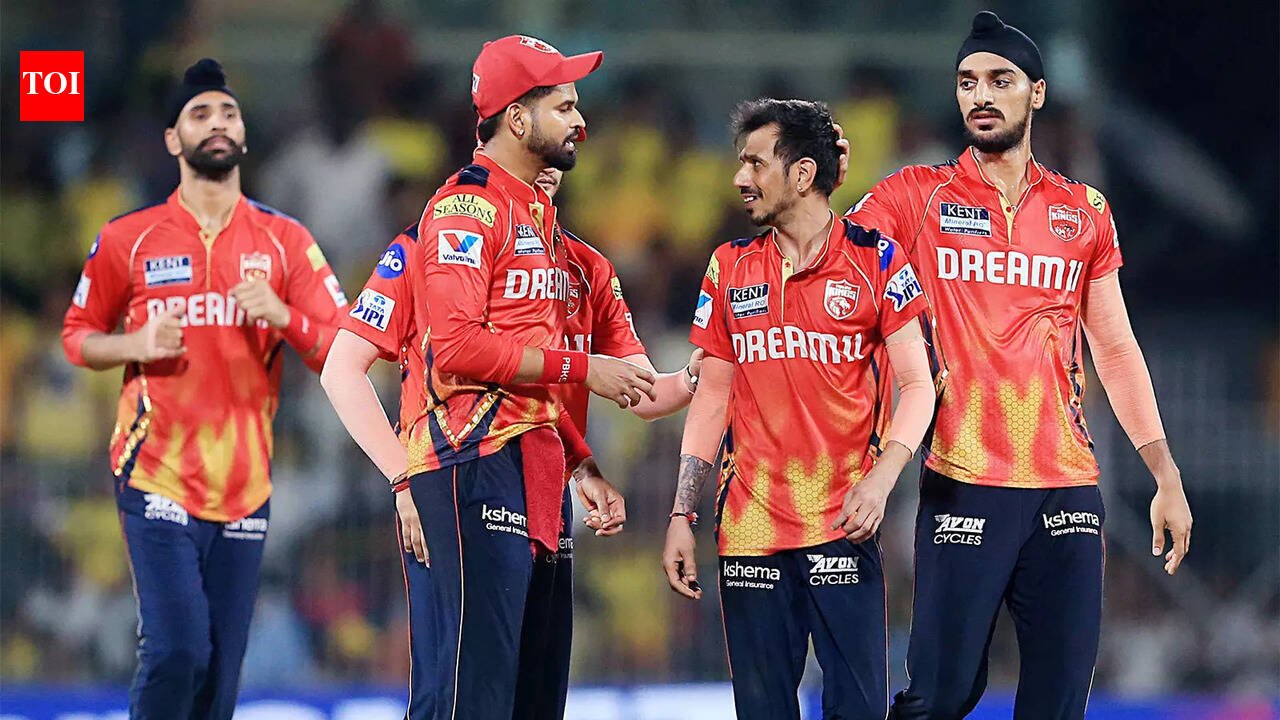
After falling just short in the 2025 final, Shashank Singh is convinced that Punjab Kings will go one step further this season and lift the Indian Premier League trophy.Punjab Kings had ended a decade-long wait to reach the final last year, only to lose by six runs to Royal Challengers Bengaluru in a closely fought title clash. Despite that heartbreak, Shashank is confident the outcome will be different this time, with the final scheduled for May 31 at the Chinnaswamy Stadium in Bengaluru.

Watch

IPL 2026: Shubman Gill hits back at critics – ‘I don’t need to prove my worth’

“I know that on May 31st, we will be playing at the Chinnaswamy and lifting the cup. It’s not just a feeling, I know this. This will happen,” Shashank said.“It’s the self belief and team belief. Everyone is on the same page. There is confidence in everyone.”PBKS had an impressive campaign in 2025, finishing top of the league stage with nine wins from 14 matches before defeating Mumbai Indians in Qualifier 2 to secure a place in the final.Looking ahead, Shashank stressed the importance of staying grounded rather than dwelling on last season’s success.“We will take it match by match because ultimate aim is to get a trophy.”“If we keep thinking we reached the final last year, there will be a lot of pressure on us. So our immediate aim is to prepare for our first game against GT, then against CSK and KKR,” he said during the ‘JioStar Press Room’.Under the leadership of Shreyas Iyer and head coach Ricky Ponting, the franchise has retained 21 players from last season, maintaining a stable core.“To play the final and win is the ultimate goal. But we have to focus on every match, rectify our mistakes that will be easier. We are very motivated and excited that we are the same group. We are better prepared than last year.”Shashank also spoke about embracing his role in the lower middle order, saying it has played a crucial part in his development.“It’s important to love the role. Earlier I also used to think I am a top-order batter and I have been thrown down the order. But then I fell in love with the role.”“The most important thing to prosper in this role is to get the backing (of the team management and dressing room) because you need freedom to play high risk cricket.”Reflecting on his preparation, the 34-year-old revealed that personal milestones will take a backseat this season.“It is more a mental game than skill game during the IPL. The past year didn’t go well for me as I had a spate of injuries and I couldn’t play competitive cricket much.”“My biggest goal is to make an impact for the team. Individual goal will be secondary because I want the team to win and I want a photo with the cup.”“I don’t like batting much in the nets, and I prefer to bat in the games because my role requires to use the mind more than the skill set, stay calm under pressure.”Shashank also acknowledged the added scrutiny on emerging players such as Vaibhav Sooryavanshi and Priyansh Arya, both of whom impressed last season.“It won’t be difficult but teams will be better prepared and there will be pressure of performance this year. We all know what IPL is. There will be expectation from them.”Drawing from his own experience, Shashank emphasised the importance of backing up a strong debut season.“Like last year for me, I didn’t want to be a one-year wonder, a lot of time we see that happening. Those who do well in one season their second season become really important because every team is planning for us and there is fan, owner, franchise pressure, performance pressure to match the previous season,” he added.


Source link

‘Alive & protesting’: MP in Janata regime turns 100 | India News


'Alive & protesting’: MP in Janata regime turns 100

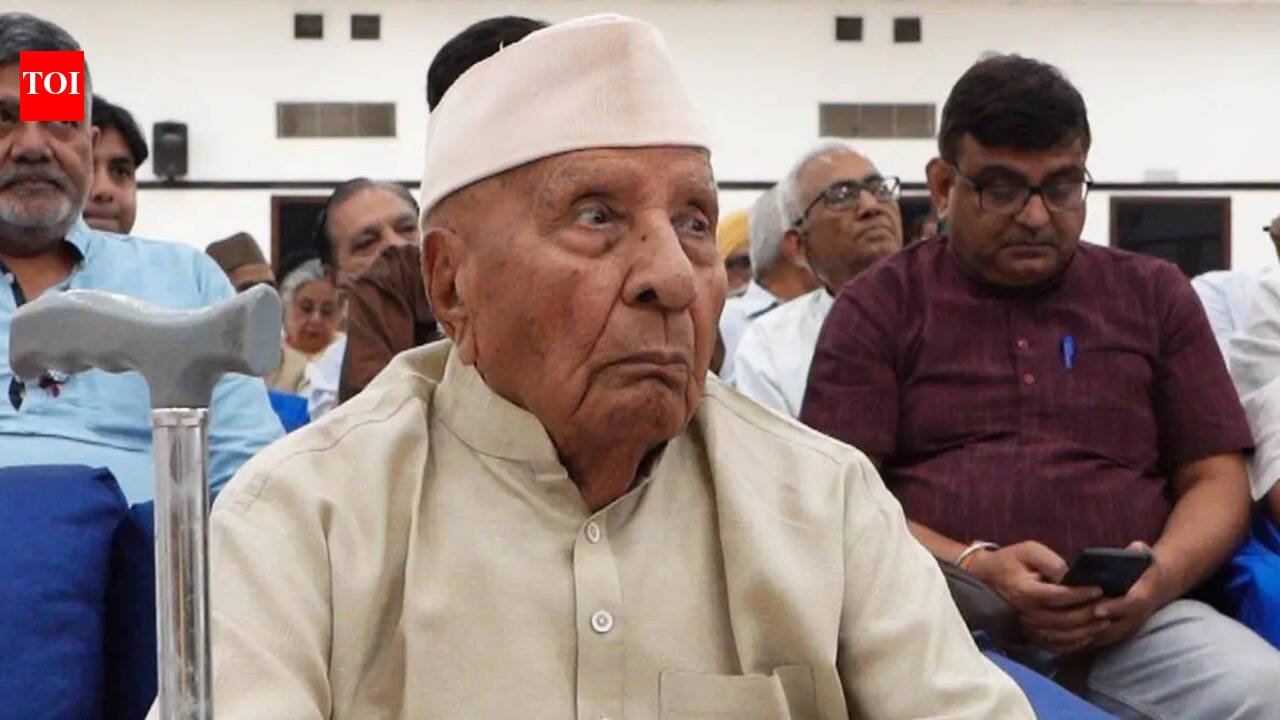
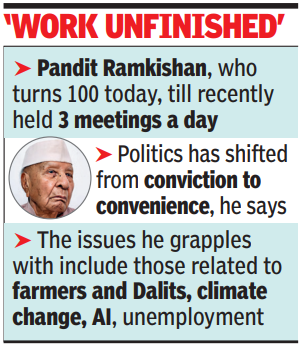
NEW DELHI: A month ago, Pandit Ramkishan sat on a dharna in Rajasthan, demanding better quality water for his home district, Bharatpur. One of India’s oldest former MPs (he was in Parliament in 1977), he told TOI on Friday, a day before he turned 100, that he will always remain a socialist. “That’s what I learnt from Ram Manohar Lohia.”Sitting in his Bharatpur home, the veteran, “Lohia’s oldest disciple” as he likes to call himself, speaks with the authority of one who has not just witnessed history, but shaped it. Until a recent fall briefly hospitalised him, he was holding three meetings a week.What keeps him going is unfinished work.“The day I stop thinking about a better India, that’s the day I will stop living. I am alive now and my voice will be heard,” he insists. “The values we fought for — equality, integrity, dialogue — are under strain. We need to speak up.” Aptly named, his autobiography, out last year, said just that — Main Zinda Hoon.

'Work unfinished'

First half of life defined by ideology, second has seen its erosion: PanditjiBut why continue agitations that are physically taxing, sitting under the sun, sometimes without food and water, with a failing knee and the weight of a century behind him? “It comes naturally to me,” Pandit Ramkishan says simply.A participant in the Quit India movement of 1942, “and shaped by Lohia and Jayaprakash Narayan”, Panditji, as people call him fondly, was jailed during the Emergency, from which, he says, he came out wiser.Not born into politics, he was a farmer’s son for whom Independence meant “freedom from fear, from ‘lagaan’ and scarcity, and freedom from a system that kept the common man on edge”.He recalls looking for Mahatma Gandhi in his youth. As a student in Bharatpur, he one day travelled to Delhi with a few coins collected among friends, hoping to hear Gandhi speak. Panditji was not impressed. “We had gone looking for revolutionary ideas.”Today, he believes, the idea of freedom itself is unsettled. If the first half of his life was defined by ideology, the second, he says, has seen its erosion. Politics, he argues, has shifted from conviction to convenience.Panditji left the Congress when the socialist bloc split — and never returned. He remembers repeated attempts to bring him over, including offers to head the state of Rajasthan. He refused. “It was difficult — but necessary…opportunity or pressure should never override principle.”So, what are the modern issues he grapples with these days? “Quite a few,” he says. “From problems concerning farmers and Dalits to climate change, unemployment and artificial intelligence.” What unsettles him, though, is “what politics now has lost”. He tells a story. “I was contesting against Union minister Babu Raj Bahadur, who once stopped mid-journey to help me during my campaign when my vehicle broke down. We were fighting elections, but there was no enmity.Today, he says, the opponent is treated as an enemy, not as part of governance. “Criticism is meant to strengthen democracy — not invite hostility.”Is he hopeful?Panditji pauses. There is pessimism when he speaks of communal polarisation and political opportunism. But also a refusal to give up. “The solution will not come from political parties. It’s the common people who have to understand what affects the country’s progress, and in turn, their own,” he said.


Source link

‘Evidence insufficient’: Spl Delhi court clears ex-MP Darda, son & others in coal ‘scam’ case | India News


‘Evidence insufficient’: Spl Delhi court clears ex-MP Darda, son & others in coal ‘scam’ case

NEW DELHI: A special Delhi court on Friday acquitted former Congress MP Vijay Darda, his son Devendra, ex-coal secretary H C Gupta and others in a coal block allocation case, ending over a decade of trial after finding the evidence “highly insufficient” to prove charges of cheating, conspiracy, or misconduct.The case stemmed from the allocation in Maharashtra’s Bandar and led to the first CBI chargesheet in the larger coal block controversy dating back to the time Congress-led UPA was in office. The FIR was filed in 2012 and the chargesheet in 2014.

Coal ‘scam’ case: Former MP Darda, ex-secy acquitted

Judge Sunena Sharma held that there was no proof of criminal conspiracy, noting the case was based on conjectures and lacked evidence of a “meeting of minds” or illegal agreement. The others cleared included AMR Iron and Steel Private Ltd, which had bagged the block in Maharashtra’s Bander, its director Manoj Kumar Jayaswal and two others. Advocate Mudit Jain appeared for Jayaswal, the Dardas and AMR, while lawyer Rahul Tyagi represented Gupta.Sharma observed that the material on record was too sparse to conclusively establish any of the essential ingredients — viz deception, inducement, dishonest intention or cheating under Section 420 of IPC.CBI had alleged that AMR, in conspiracy with Gupta, submitted false information to a screening committee of the Union coal ministry to secure the allocation. According to CBI, then Rajya Sabha MP Vijay wrote to various departments allegedly reiterating misrepresentations to influence the allocation process and received Rs 24.6 crore as illegal gratification.Strictly follow rule on not naming survivor: SCSC said: “Clearly, the intent of this Section has been given a miss in these proceedings. The name of the survivor is treated like that of any other witness and is freely used throughout the record. This must be deprecated in the strongest terms. In fact, this court has noticed earlier also that the mandate of this provision is not being followed”.The court said that a copy of this judgment be sent to all high courts to ensure strict compliance with the apex court’s order.“This has been the long-standing position in law but it has not been followed. The primary reason there amongst, one supposes, is the general indifference of the courts below and possibly even the lack of awareness of the deep stigma that follows such offences,” the Supreme Court said.Supreme Court, while convicting the accused and setting aside the acquittal order of Uttarakhand high court, said courts must not give undue importance to minor discrepancies.“A truthful witness may make honest mistakes or omit immaterial details, and such normal variation should not result in wholesale rejection of evidence. However, when omissions or contradictions relate to material facts that form the foundation of the prosecution’s version, they assume significance and may create reasonable doubt….We may observe that the approach adopted by the high court is one of attempting to pick holes in a case that otherwise has withstood the test of cross-examination. The prosecutrix has positively identified the respondent-accused and has unequivocally stated that it was he who forced himself upon her,” it said.


Source link

Supreme Court rebukes courts for naming rape survivors | India News


Supreme Court rebukes courts for naming rape survivors

NEW DELHI: Supreme Court has rebuked trial and high courts for disclosing the identity of rape survivors in their orders and directed them to ensure that names of survivors and family members are not mentioned in court records, reports Amit Anand Choudhary.A bench of Justices Sanjay Karol and N K Singh expressed concern that despite statutory safeguards and repeated directions from SC, such lapses persist. The court made the observation while convicting a rape accused, noting that the name of the minor survivor was mentioned in lower court orders.“The legislature had as far back as 1983 introduced a provision into IPC seeking to protect the identity of the victim of the offence under Section 376 IPC. The amendment was made apparently to address a specific mischief that emerged starkly from the way sexual offence cases were handled: the public disclosure of a survivor’s identity.”Morality won’t guide court for protection of citizen’s rights: HCThe court rejected the argument of the woman’s family. “There is no offence of the kind where a married man, staying with an adult in a live-in relationship, by consent of the other person, can be prosecuted for any offence whatsoever,” the bench said. “Morality and law have to be kept apart. If there is no offence under the law made out, social opinions and morality will not guide the action of the court for protecting the rights of citizens.The couple told the court that the woman’s family members had threatened her with death and they feared an honour killing attempt. The district police chief allegedly took no action.The court reminded the authorities that it was the fundamental duty of police to protect two adults living together. Finding a prima facie case, the bench admitted the petition, issued notices to respondents, and granted the state counsel two weeks to file a counter-affidavit.Granting immediate interim relief to the couple, the court also directed that the petitioners not be arrested “until further orders”. The case against the man had been registered under Section 87 of BNS, which criminalises kidnapping, abduction or inducement of a woman to compel her into marriage or illicit sexual relations, with penalties of up to 10 years’ imprisonment and fines.To ensure protection, the court restrained the informant and all members of the woman’s family from causing any harm to the couple in life or limb, from entering their home and contacting them directly, through electronic means, or through others. The district SP would be personally responsible for ensuring the petitioners’ safety and security, the court said.


Source link

Jewar in the crown: PM to open NCR’s 2nd international airport today | India News


PM Modi To Inaugurate Noida International Airport Phase 1 On March 28: All You Need To Know

Noida International Airport

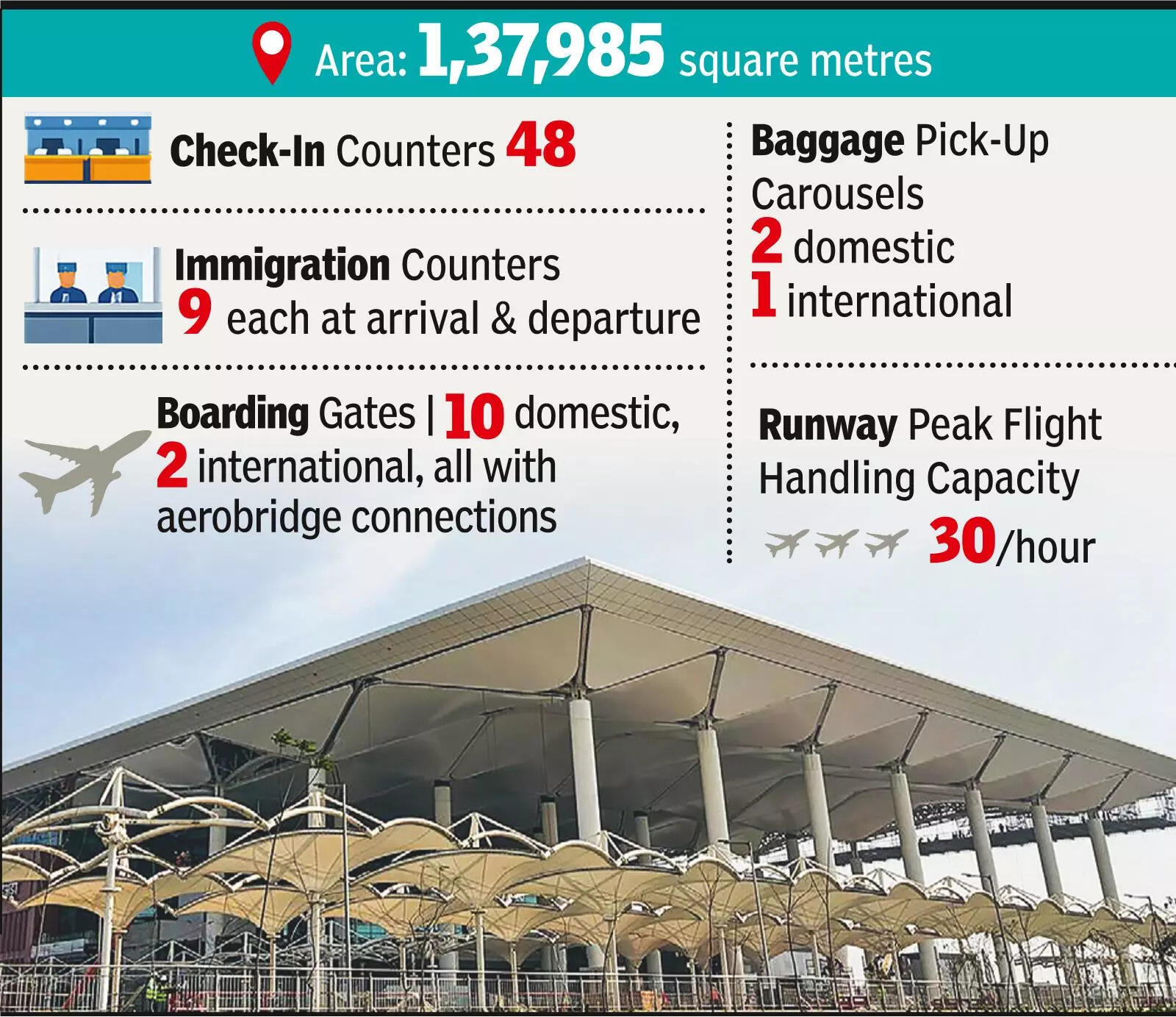
NOIDA: Delhi-NCR’s second international airport will be formally inaugurated on Saturday, adding Jewar to the country’s aviation map and creating both space and means for the national capital — already India’s largest aviation hub — to play a much bigger role in connectivity with the world. A day before the inauguration, PM Modi on Friday said Noida International Airport will not just strengthen commerce and connectivity, but also ease pressure on IGI Airport in Delhi.

Jewar in the crown: PM to open NCR’s 2nd int’l airport today

Flight Operations Likely To Begin Only In May

“Tomorrow, March 28, is a day of immense importance for the people of Uttar Pradesh and the NCR,” Modi wrote on X. “Phase I of Noida International Airport will be inaugurated… Noida airport is among key greenfield projects in our nation. In addition to passenger services, it will have a robust cargo ecosystem, thus boosting the logistics sector,” he added, attaching photographs of the terminal with the post.

Watch

PM Modi To Inaugurate Noida International Airport Phase 1 On March 28: All You Need To Know

Flight operations from NIA are likely to begin in May.The PM is scheduled to arrive at the airport at 11.30am on Saturday, go on a walkthrough of the terminal building, and formally inaugurate the airport around noon before addressing a public gathering. The event is expected to draw large crowds from Noida, Greater Noida, Ghaziabad, Bulandshahr and other parts of western UP. Three pandals have been set up to accommodate more than one lakh people.NIA will add a capacity of 1.2 crore fliers annually to Delhi-NCs airport infrastructure, allowing carriers more room for expansion and giving flyers more options.Chief minister Yogi Adityanath, who will accompany the PM on Saturday, posted on X that NIA will help the state emerge as a global connectivity hub. “This airport will open new doors of economic progress and will also give fresh momentum to the state’s journey of development and prosperity,” he said. Last week, the CM reviewed preparations for the airport’s inauguration.


Source link

Strait Of Hormuz: Indian seafarers face GPS jams, mine alerts in Hormuz | India News


China Bound LPG Tanker Diverted To India As Hormuz Crisis Forces Delhi To Tap Iran LPG Again

NEW DELHI: Indian seafarers navigating Strait of Hormuz are grappling with GPS disruptions, warnings of underwater mines and the absence of a clear navigation authority.Ships in the region are reporting repeated radio broadcasts over maritime channels warning vessels against transit. “Attention all ships… This is the Sepah Navy… navigation through Strait of Hormuz is forbidden… no ship is allowed to pass until further notice,” the radio messages repeatedly blare. Crews attributed these announcements to Iran’s Islamic Revolutionary Guard Corps (IRGC) Navy.

Watch

China Bound LPG Tanker Diverted To India As Hormuz Crisis Forces Delhi To Tap Iran LPG Again

At sea, these real-time instructions are shaping decisions. Captains describe a volatile situation marked by confusion and increasing reliance on manual navigation as satellite-based systems become unreliable.Captain Manish Kumar, an Indian master mariner with 28 years of experience commanding a chemical tanker currently awaiting safe passage from the Strait of Hormuz, told TOI on Thursday: “Navigation is severely affected due to GPS. It is very difficult to determine the position of the vessel… If you miss the position in such narrow waters, the vessel can be grounded or collide.”Modern shipping depends heavily on GPS for route plotting and collision avoidance, making such disruptions particularly dangerous in constricted passages like Hormuz.Adding to the risk are warnings of naval mines — explosive devices that can be triggered by contact or proximity. Kumar said ships are being given maps marking specific transit corridors. “There are arrows, entry and exit routes marked. It’s like a designated passage,” he said.Kumar described the current situation as unprecedented. “This combination — GPS issues, unclear timeline, and real threats out there — this is new.”The risks are amplified by the nature of cargo. Most vessels transiting Hormuz are oil or chemical tankers with flammable cargo. If anything happens, it can turn into a big explosion.Shipping companies have begun issuing daily “conflict intelligence briefs” directly to vessels. These combine military advisories, open-source tracking and proprietary risk assessments into real-time operational guidance.A March 25 ‘Middle East Conflict Daily Security Intelligence Update’ warned of “extreme caution”, noting GPS interference, elevated port security levels and unco-nfirmed concerns over mine-laying activity. The report compiled real-time battlefield developments, maritime incidents, airspace closures and energy disruptions.A March 24 advisory by Joint Maritime Information Center, a US-led multinational coordination body, flagged the regional maritime threat level as “critical”. It cited 21 confirmed incidents since March 1 and ongoing “navigation interference” across Strait of Hormuz, Gulf of Oman and Arabian Gulf.Traffic through the strait has dropped from an average of around 138 vessels a day to single digits.


Source link

NCERT reset, AI push: Pradhan spells out education roadmap | India News


NCERT reset, AI push: Pradhan spells out education roadmap
Dharmendra Pradhan (File photo)

NEW DELHI: The Centre will revise a contentious NCERT textbook chapter on the judiciary under the supervision of a committee led by former Supreme Court judge Indu Malhotra, Union education minister Dharmendra Pradhan said.The minister said the move follows guidance from the Supreme Court, adding that the effort aims to ensure transparency and balance in school education.On the recent controversy involving UGC regulations aimed at maintaining standards, quality and equity in Indian higher education, Pradhan refrained from detailed comment, noting the matter is sub judice. “The govt’s responsibility is to ensure that no one faces injustice or discrimination. We will abide by whatever directions court issues,” he said.Outlining the ministry’s broader priorities, Pradhan said the education system currently serves around 30 crore students, placing significant responsibility on policymakers. He emphasised expanding access to quality resources, including tech-driven learning, improved infrastructure and stronger research ecosystems.Highlighting recent trends, the minister said India’s presence in global university rankings has increased sharply over the past decade, with the number of institutions featured in QS rankings rising from 54 before 2014 to around 290 now. He attributed the growth to sustained policy focus on higher education reforms.Pradhan also stressed the role of emerging technologies, noting that artificial intelligence will be integrated into learning systems both as a subject and as a tool. “Students must be equipped for future challenges through modern technologies,” the minister said.


Source link

Dhurandhar 2: Dhurandhar signals a cultural reset. Will Indian cinema catch up to its audience? |


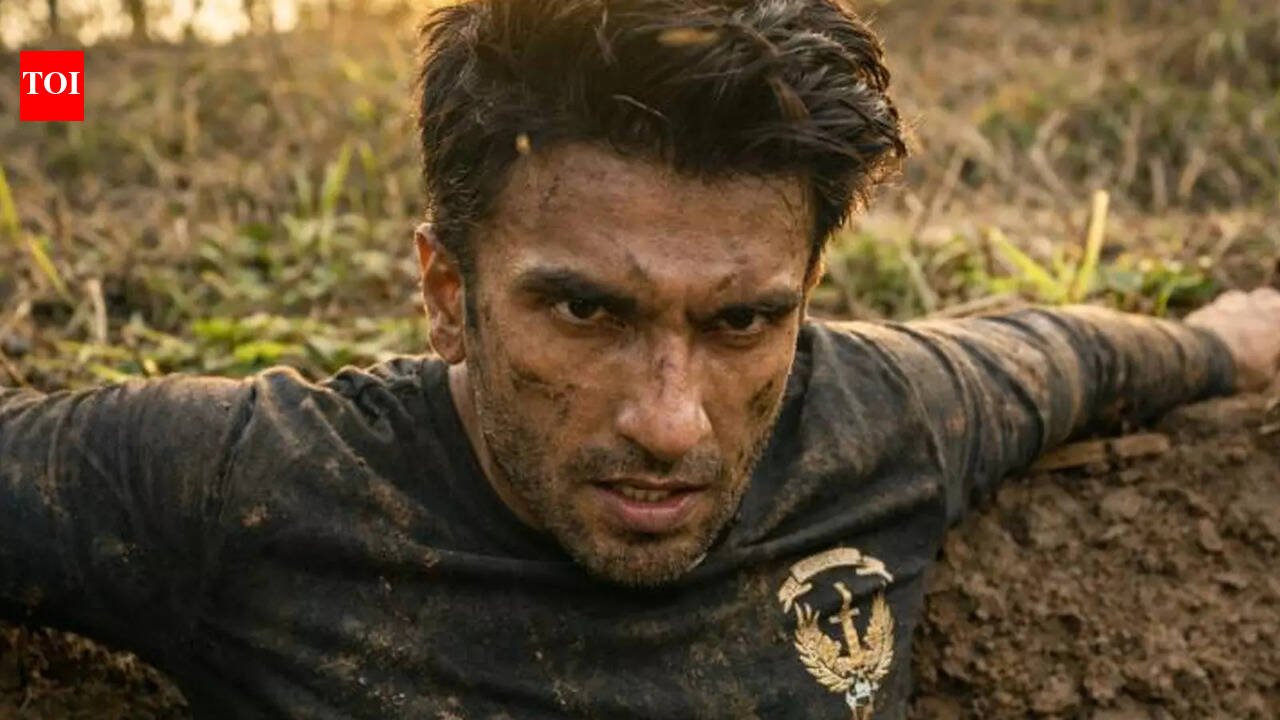
Let’s begin with the opening acts of Dhurandhar The Revenge. No, this article does not contain spoilers but it does give you an insight into the first chapter of this eagerly-awaited second part to the juggernaut called Dhurandhar, that released last December. This is the story of Jaskirat Singh Rangi before he became Hamza Ali Mazari. The opening scene shows Jaskirat, and his family, in a happy moment trying to fit everyone in a frame for a family photo. In the next scene, when we watch Jaskirat, there’s a sense that something’s amiss. And this is a long scene. Then there’s another that shocks the audience to the core. In fact, the shock is so brutal that for a moment one may think “is this violence for violence’s sake?”. This is one criticism that has been prevalent since the first part came out. More on that later. But you’d be wrong to think on those lines. It’s the scene that follows the mind-boggling and gory action sequence, where the audience truly gets to know what actually happened to Jaskirat Singh Rangi. This is not a justification of any kind of violence; rather a deep-dive into the craft of writing that forgoes every expected formulaic, tedious scripts that have preceded Dhurandhar.You see, our Bollywood-trained minds think, and understand scenes and stories in sequence – what cinema experts call a linear form of storytelling. That’s also how we humans have evolved. The story shouldn’t jump back and forth. So we get surprised when a master storyteller jumps back and forth and still keeps us engaged. We have been hearing of director Aditya Dhar “flipping the Bollywood-formula script” since the first Dhurandhar released December 5 last year…

… But what is a script flip?

Compared to all the ways Dhar has torn apart any audience expectations and handed the audience a new rule book (that actually has intelligent craft and no rules), Jaskirat’s first chapter of revenge was a small deviation. But a deviation that must have had hours of great writing and a steadfast focus on the art of storytelling. If you aren’t paying attention, you won’t think much of this script-flip except in hindsight. In hindsight, it’ll come to you that a particularly violent scene had an immense impact – not for the sake of violence, but because the director didn’t give you the explanation as to why it was happening before it happened. Because those are the kind of movies we have been used to watching – build all the scenarios that lead to justifying the hero’s anger, pump up the audience who bays for revenge, and then give them the expected catharsis, with gravity defying action sequences. This movie that’s actually titled, Dhurandhar The Revenge, ironically, doesn’t do that. For the sake of avoiding spoilers, nothing more can be said about the story; but a lot can be said about how much time was spent writing this film. This is what director of ’90s gritty gangster flicks, like Satya, Company, and Shiva, Ram Gopal Varma meant when he wrote on his account on X: “Unlike how most films explain, Dhurandhar withholds. Long stretches of silence explode what pages of exposition cannot do in other films. It treats violence not as spectacle but as a psychological blow… the action director doesn’t care about giving claptrap moments but he integrates the characters and their current states of mind into every ounce of its violence.” That is why Varma called this film “the reset button for Indian cinema that establishes a new benchmark, that renders typical templated films completely obsolete.

Iron throne to the throne of Lyari

The last time such a seismic shift occurred, albeit not in the world of cinema but in the world of books, was when author George RR Martin wrote the first book in his series called the The Song of Ice and Fire. The name of the first book is also the name of the now world-famous TV series called Game of Thrones. Sci-fi and fantasy writer Martin’s book is set in a medieval world full of gore, violence and corruptible people vying for power (the Iron Throne). He established a righteous hero called Lord Eddard Stark (fondly called Ned Stark) amidst powerful antagonists, and then killed him at the end of the first book, in a shocking twist that no one saw coming. The year was 1996. We all watched it on TV in 2011. A beheaded Ned Stark still haunts us, as does The Red Wedding, and everything that followed. Martin, apart from being an author, was also a journalism professor and script writer for Hollywood. When asked about writing the unexpected and the relentless violence that makes an impact with readers, he said in a NYT interview in 2014, “I will say that my philosophy as a writer…has been one of ‘show, don’t tell’. Whatever might be happening in my books, I try to put the reader in the middle of it, rather than summarizing the action.” Dhar followed the same idea.

AI Generated

From the Iron Throne to the throne of Lyari, uneasy lies the head that wears the crown (AI Generated)

The reason for comparing this particular book series to Dhurandhar is because gratuitous violence is a criticism that Martin has faced several times over the years, just as Dhar is facing for his film. Martins’s answer to completely undoing or redoing what was expected of the fantasy genre was: “I don’t like predictable books, predictable TV shows, predictable movies.” He was talking about the fantasy genre in books and Hollywood scripts. Bollywood, too, has been in a rut of predictable and formulaic scripts for a long time. Just like Martin flipped the book on it, Dhar has flipped the script of Indian cinema with Dhurandhar. At times, a seismic change is required to reset a button that’s become so rusty that it’s not attracting people to cinema halls.

Flip the script on everything

The “script-flip” in the above-mentioned paras is most evident in how Dhar handles the protagonist’s agency – be it Jaskirat Singh Rangi or Hamza Ali Mazari. For Dhar, the same agency belongs to his whole team that was a part of his film, but mostly, it belongs to the audience for whom the movie was made. They are the ones who will buy tickets to watch the film. He has given everyone a free rein to think and take back what they seem fit. The retrospective realisation of the first chapter of the film, named ‘A Burnt Memory’, forces the viewer to engage actively with the writing, rather than passively consuming a pre-justified revenge arc. In the superhit formula world of Bollywood, where heroines swirl in rainbow lehengas and heroes punch through glass ceilings to thumping beats, audiences have long been fed a predictable diet: three hours of songs, dances, overblown action, and glycerine tears. Formulaic plots recycle the same tropes: romantic misunderstandings, larger-than-life villains, and cathartic monologues… all the while the script makes sure that the star power eclipses substance. This is done by design because there is this general attitude: “India mein yahi sab chalta hai” Or worse, “the star/actor wants it that way”.Yet, last December, something shifted. Dhar’s Dhurandhar, a gritty spy thriller starring Ranveer Singh, stormed the box office to the tune of over 1,300 crore and became a Netflix phenomenon. Its success wasn’t accidental. It tapped into a deep, unspoken hunger. A hunger for cinema that respects the viewer’s intelligence, that trades spectacle for craft, and that weaves real-world complexity into a taut, immersive narrative. Dhar’s movie directly challenges the previous Indian cinema status quo by prioritising craft over celebrity, and atmospheric dread over easy catharsis. The first installment, a staggering 3 hours and 34 minutes long, eschewed the standard intermission-to-intermission pacing in favour of a procedural, almost documentary-like immersion into the underworld of Karachi’s Lyari district. It did so by sewing retro songs and even an item number, a romantic subplot into the plot, not as pacing interruptions. This set a new benchmark for narrative cohesion.By prioritising writing as king, sidelining the main character in service of the story, and elevating editing and music over easy emotional manipulation, Dhurandhar—and its 2026 sequel—did what few recent Bollywood films have dared: it broke barriers and proved that substance can sell. So much so that Akshaye Khanna emerged as a larger character than the protagonist, played by Ranveer Singh. For example, in Dhurandhar, the setting of Lyari is portrayed not as a stylised backdrop but as a suffocating, living entity. The dialogue is stripped of artifice, using expletives and technical jargon that reflect the harsh reality of its characters. The character of Rehman Dakait, played by Khanna, serves as a primary example of this shift. Dakait is not a caricatured villain but a layered antagonist whose intelligence and “clique-lipped” delivery command the screen. The dynamic between Hamza and Dakait is one of calculated observation, a choice that respects the viewer’s patience and demand for realism.The success of Part 1 was underpinned by a collaboration across technical departments that prioritised the story’s “internalised” nature. Now, this is a point to note because our typical passive audience-trained minds aren’t ideally supposed to understand technical details that add to the movie’s canvas. Except, everyone did. Dhar didn’t treat his audience as passive watchers, he respected their intelligence. If the Twitter chatter on this film seems over-the-top even for a moment, we are quickly reminded WHY. It’s because cinematographer Vikas Nowlakha utilised a visual language mirroring Hamza’s psychological state and his transition from an outsider to a central figure in the Lyari nexus. Editor Shivkumar V. Panicker’s choices were described as “insanely creative” by fans, particularly in sequences where the camera lingers on a character’s face to capture silent, internal transformations, such as Hamza’s gradual adoption of his Pakistani identity. Dhar told the audience that there’s a reason cinema is an audio-visual medium. A plot can be taken forward through smart editing and cinematography without a single dialogue by the protagonist. He brought to the fore what was thus far behind the scenes – cinematographers, editors, costume designers, make-up team et al. He made all of his team as much a part of the storytelling, as the script he had written. So when we watched a mostly silent Ranveer Singh as Hamza in Part 1, we were taken aback, but in a good way. In a way never seen before.

Now, let’s come to the soundtrack…

Traditional Bollywood treats songs and dances as mandatory pit stops and lavish interruptions that halt momentum. Dhurandhar flips the script musically too. There are no choreographed extravaganzas. Every single frame is part of the story. It’s not a break where you can go out and grab popcorn. Instead Dhar and music composer Shashwat Sachdev integrate retro Hindi songs seamlessly into the fabric of the characters and their world. A character hums a forgotten melody during a tense stakeout; a radio crackles with an old tune as blood spills in the shadows. These aren’t distractions. They heighten the atmosphere, reveal psyche, and root the story in a lived-in cultural reality. Music here isn’t filler; it’s a narrative tool, much like the haunting background score by Sachdev that pulses with dread and precision. In this film, Sachdev’s score was not merely background music but a throbbing force that heightened the sense of dread without relying on orchestral swells to manipulate emotion. We all love Bollywood music, but what Sachdev did with his retro-meet-hip-hop hybrid, is that he utilised retro Hindi tracks in a way that felt organic to the setting of Karachi. Instead of elaborate dance sequences, these songs appear as part of the world’s texture. For e.g., ‘Na Toh Karvan Ki Talash Hai’, a classic qawwali from ‘Barsaat Ki Raat’, was remixed with cinematic swells and atmospheric synths. It was used not for a romantic moment, but to underscore the spiritual intensity and the moral grey areas of Hamza’s mission. In the same way, ‘Hawa Hawa’, the iconic track by Hasan Jahangir, was used to introduce SP Aslam (Sanjay Dutt), effectively establishing his flair and style as he confronts criminals in a stark desert landscape. This is filmmaking that trusts the audience to connect dots, not spoon-feed them.

The audience is the biggest superstar

While Part 1 focused on the quiet erosion of a man’s soul, Dhurandhar: The Revenge embraced a maximalist approach. It leaned into stylised violence and a hyper-masculine hero arc, yet maintained a level of intelligent craft that separated it from typical action film. The narrative choice to open with the character of Jaskirat Singh Rangi, long before his transformation into Hamza Ali Mazari, also serves as a pivotal deviation from standard sequel structures. The audience took note of all of it. They didn’t need to be told anything in terms of lazily-written dialogues by the protagonist or antagonists. Every department of filmmaking was a tool to take this story forward. The Indian audience finally heaved a sigh of relief that they were treated as equals to the superstars on screens. They were trusted to understand silences as much as any unexplained bout of violence because they too have agency. And to Dhar, the audience was the biggest superstar.
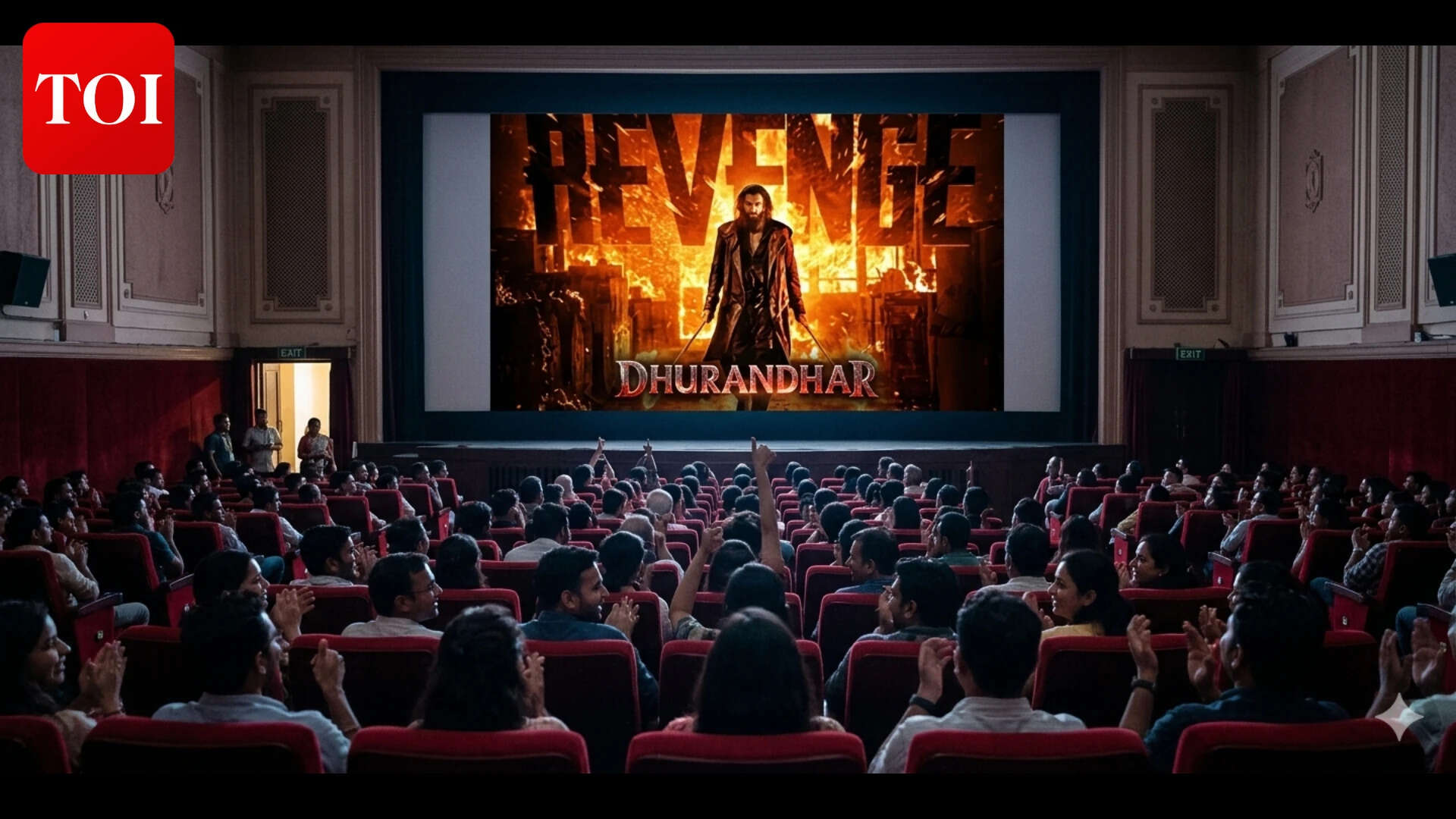
AI generated

In Aditya Dhar’s Dhurandhar, the audience is the real superstar (AI generated)

At its core, Dhurandhar is a masterclass in “show, don’t tell”. Dhar presents a sequence of real-life-inspired events—echoes of the 1999 IC-814 hijacking, the 2001 Parliament attack, and the 2008 Mumbai assaults—folded into a tight espionage narrative. By now, we all know that the story follows Hamza Ali Mazari, an undercover Indian operative, who infiltrates the crime-ridden lanes of Lyari to dismantle an ISI-linked terror nexus. But unlike the chiselled heroes of yore, Hamza starts in the background. He’s not the flashy saviour striding into frame with a one-liner. Instead, he’s a ghost in the machine: observing, adapting, rising through the ranks with lethal precision while the camera lingers on the ecosystem around him – the power struggles, the betrayals, the banal evil of everyday brutality. This mirrors the raw authenticity of Varma’s Satya (1998), which the film openly nods to in its first half. Lyari feels alive and ominous, a dog-eat-dog underworld where crime isn’t glamorous but a currency of survival. Dialogue is sparse, cold, and organic, laced with loose language that feels earned, not shocking. The two-hour build-up in Part 1 is patient, procedural, documentary-like in its detail. No grand speeches about the right path; just the quiet erosion of a man’s soul as he becomes what he hunts. Writing reigns supreme here, distilling geopolitical complexities—Pakistan’s terror infrastructure, proxy wars, institutional complicity —into a visceral, character-driven thriller. Viewers aren’t lectured; they’re embedded.

Shock & awe and slow burn move hand-in-hand

This restraint establishes Dhar’s credentials and primes audiences for what comes next. Dhurandhar The Revenge leans further into stylised violence and gratuitous gore. The director, now assured of his grip on viewers, broadens the canvas. Where Part 1 whispered threats, Part 2 roars with choreographed carnage: slow-motion bullets ripping through flesh, close-ups of shattered bones, and a hyper-masculine hero’s arc that delivers the bloody satisfaction action fans crave. Yet even here, Dhar doesn’t fully abandon intelligence for pandering. He tones down just enough—shifting from pure “show, don’t tell” to “show and tell” with descriptive dialogues and explanatory sequences—to make the labyrinth of ISI operations accessible. The politics of it all, Indian and Pakistani, is not brushed under the carpet but exposed in their full glory. This is done on purpose so that people unfamiliar with Pakistan’s underworld or cross-border espionage can follow the threads without a PhD in geopolitics. If you look at Part 1 and Part 2 at one glance, it may seem like Dhurandhar was the setting of the stage and Dhurandhar The Revenge is the climax. In one sense, it’s true. But in hindsight, this script is also flipped. Dhurandhar was actually the shock, a shock to jolt the audience out of formulaic Bollywood nuisance. Dhurandhar The Revenge, is actually the slow burn despite the relentless and ruthless action sequences. It’s only in hindsight that one realizes that Hamza’s anger is actually a very long stretch of unending grief. If Part 1 humanized the antagonist, Dakait, Part 2, gives you a second or so to ask whether Major Iqbal, played brilliantly by Arjun Rampal, would have been as ruthless and heartless if not goaded into violence from his childhood by someone close to him. One might think it was inevitable. That genetic memory and trauma makes all of us who we are. The real smartness and empathy of the moviemaker lies in the fact that both the protagonist, Hamza and the antagonist, Iqbal, are displayed as people capable of inflicting the same degree of violence—though their targets are different. Varma points this out in an interview. He says, “Take the countries and geopolitics away, and how different is Hamza from a Dakait or an Iqbal? They are all violent men, living in morally grey zones.” This is the realism that cinephiles are rooting for.

Collective fatigue with Bollywood’s emotional shorthand

Ranveer’s transformation, once subtle, becomes a force of nature in Part 2, but the story never cedes center stage to star wattage. Real events remain the backbone. Fictionalised yet grounded. We have seen the headlines that turn into human stakes in Part 2. What makes Dhurandhar resonate so profoundly is how it satisfies a collective fatigue with Bollywood’s emotional shorthand. For decades, films have leaned on predictable fare: the teary family reunion, the item song to titillate, the climax fight scored to dhinchak BGM. Emotions are manufactured. Big close-ups of quivering lips, swelling strings to cue tears, rather than earned through lived moments. Action is cartoonish, detached from consequence. Dhurandhar demands more from its audience and rewards them for it. The A-certificate rating signals maturity; its 214-minute runtime in Part 1 dares you to stay immersed. No comic relief sidekicks cracking jokes mid-tension. No forced romance to soften the edges. Instead, it delivers intellectual thrill: the slow dread of infiltration, the moral gray of espionage, the quiet horror of systemic terror. Audiences, long starved for this, are responding in droves. Word-of-mouth has amplified its reach: families debating its politics, cinephiles dissecting its craft on social media. It wasn’t just a hit; it was a cultural reset, proving that intelligent storytelling isn’t niche. It’s commercial gold when executed with vision.The duology’s success signals a wider audience ready for realism. Even its controversies, from debates over political messaging to real-life inspirations has fuelled discourse rather than derailing it. In the end, Dhurandhar didn’t just catch the audience’s thirst. It ignited it. Not just for the songs living rent free in our minds, but for the stories that linger in our minds too. As sequels and imitators loom, one thing is clear: Bollywood’s future belongs to those bold enough to prioritise the pen, the cut, and the subtle note over the spectacle. Dhurandhar hasn’t just raised the bar. It has shot the bar high up in the sky. And the audiences are more than ready to leap and meet it. The only question that remains is, ladies and gentlemen, are Bollywood Bigwigs ready for this change?



Source link

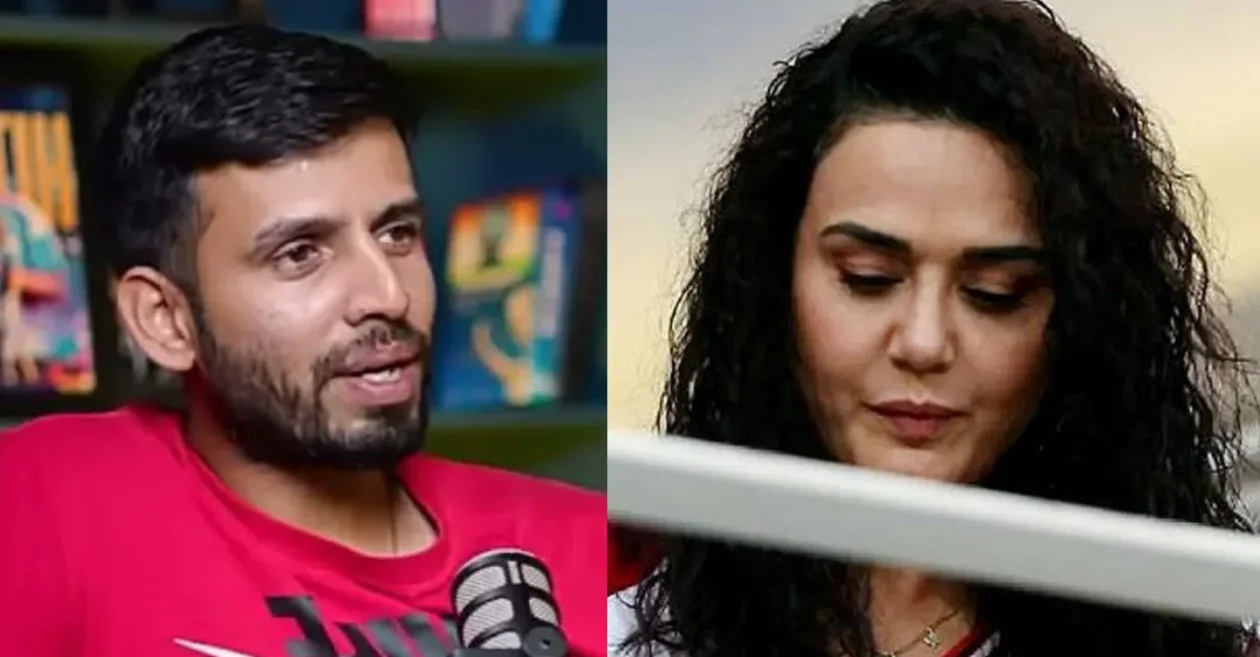
IPL 2026: Here’s why PBKS co-owner Preity Zinta apologised to Jitesh Sharma


In a heartwarming story ahead of IPL 2026, Jitesh Sharma shared how Punjab Kings co-owner Preity Zinta reached out to him with genuine warmth even after he left the franchise. The RCB wicketkeeper-batter revealed that Preity made a personal phone call to apologise because she could not bring him back in the auction.

Jitesh, who played for Punjab Kings from 2022 to 2025, moved to Royal Challengers Bengaluru before the 2025 season and played a key role in their title-winning campaign. Despite his success with RCB, the bond he shared with Preity Zinta clearly remains strong.

Jitesh Sharma shares the heartening incident involving Priety Zinta

Speaking on Ranveer Allahbadia’s podcast, Jitesh narrated the emotional moment. After the auction, Preity called him and said, “I am very sorry, I couldn’t get you in the auction.” Jitesh added that she treats him like her younger brother and has always been supportive.

Jitesh also shared that both he and Preity come from Himachal Pradesh and would often talk for hours about life, beyond cricket. This small gesture shows the personal relationships that often develop between players and franchise owners in the IPL. While the league is highly competitive and business-driven, moments like these highlight the human side of cricket.

Also READ: Jitesh Sharma takes a dig at his former side PBKS ahead of IPL 2026

Jitesh’s journey from PBKS to RCB success

Jitesh had a rollercoaster journey with Punjab Kings. He started as a backup keeper, gradually earned more opportunities, and even captained the side briefly. However, it was his move to RCB that brought the best out of him. His finishing and sharp glove work played an important part in helping RCB lift their maiden IPL trophy.

Even after the move and the title win, Preity’s call reflects the respect and affection she holds for Jitesh. Jitesh himself sounded grateful while sharing the story and made it clear that there are no hard feelings.

Also READ: Irfan Pathan flags ‘key concern’ in Arshdeep Singh’s bowling ahead of IPL 2026


Source link