Breaking News
‘Five days, no apology’: BJP attacks AAP over controversial comment on girls | India News


NEW DELHI: The BJP’s Delhi unit on Sunday intensified its attack on the Aam Aadmi Party (AAP), accusing its leaders of misogyny and demanding an apology from senior AAP leader Saurabh Bharadwaj over remarks allegedly made about girls, as the political row escalated on social media ahead of upcoming elections.In a post on X, the BJP’s Delhi account said, “Five days have passed… But Saurabh Bharadwaj ji, you haven’t yet apologised for the vile statement you made about Delhi’s daughters?” It added, “Making such shameful remarks against little girls and shamelessly sticking to them shows just how vile and low the AAP’s mindset is.”BJP’s Delhi account had earlier, in a lengthy post on X, accused AAP leader and the party of having a “misogynistic approach” while claiming that the BJP government is working day and night to empower women. The remarks come in response to a statement attributed to Bharadwaj, as the BJP said, “Unemployed leader Saurabh Bharadwaj said yesterday, the government will give bicycles to those girls, and we will have them campaign for Akhilesh ji in UP. We will hand them brooms.”Citing AAP leader Saurabh Bharadwaj’s words, it said, “This vile statement from Saurabh Bharadwaj shows that every leader of yours is misogynistic.” The post also targeted AAP chief Arvind Kejriwal, saying, “Kejriwal had Swati Maliwal beaten up in the CM’s residence while he was CM. When he himself was in Tihar on corruption charges, he did make Atishi CM out of compulsion, but didn’t let her sit on Kejriwal’s chair; it remained vacant.”It further added, “We’ve seen before how your other leaders, be it Somnath Bharti who abused and behaved indecently with a TV anchor on live TV, or other AAP leaders – the bigger they are, the more misogynistic they are.”The party contrasted its position with that of AAP, saying, “On one side, the BJP government is working to educate daughters, to give them wings, to encourage them, while on the other side, leaders like your Saurabh Bharadwaj are mocking them. Have some shame!”


Source link

IPL 2026 [WATCH]: Heartwarming proposal in the stands steals the show during MI vs KKR game at Wankhede


The IPL 2026 clash between Mumbai Indians and Kolkata Knight Riders at the iconic Wankhede Stadium had everything fans could ask for—big runs, electric atmosphere, and unforgettable moments. While Mumbai Indians thrilled supporters with a record-breaking chase on the field, it was a touching off-field incident in the stands that truly captured hearts across social media.

Amid the roaring crowd and high-octane action, a simple yet emotional gesture turned into a viral sensation, reminding everyone that cricket is as much about human connections as it is about competition.

A proposal to remember… with an unexpected twist

In a video that quickly went viral, a young man decided to turn the thrilling cricket match into a life-changing moment by proposing to his girlfriend right there in the stands. As the cameras rolled and nearby fans began to notice, he went down on one knee, holding out a ring and asking the big question.

However, what followed added an unexpected twist to the romantic moment. As he bent down, he briefly lost his balance, and the ring slipped out of the box, disappearing beneath the rows of seats. For a few tense seconds, panic set in as the man scrambled to locate the ring, clearly worried that his special moment might be slipping away.

But in a beautiful display of camaraderie, fellow spectators quickly stepped in to help. Fans around him joined the search, scanning the area under the chairs until someone finally spotted the ring and handed it back. The relief on his face said it all.

Determined not to let the mishap overshadow the moment, the man gathered himself and proposed again—this time with a steady hand. He carefully placed the ring on his girlfriend’s finger, and she responded with a joyful smile, clearly overwhelmed by the gesture. The couple then shared a warm hug as the surrounding crowd erupted in applause, turning the stands into a celebration of love and spontaneity. It was a scene that perfectly captured the spirit of IPL—where strangers become part of unforgettable moments.

Here’s the video:

Also READ: MI Coach Mahela Jayawardene explains why Suryakumar Yadav played as impact player in IPL 2026 clash against KKR

Mumbai Indians script history with long-awaited opening win

While the proposal created a buzz in the stands, Mumbai Indians ensured fans had plenty to celebrate on the field as well. The five-time champions pulled off a sensational chase, successfully hunting down a daunting 221-run target against Kolkata Knight Riders.

This remarkable effort not only marked Mumbai’s highest successful run chase in IPL history—surpassing their previous best of 219—but also set a new benchmark at the Wankhede Stadium.

More significantly, the win ended a long-standing trend for the franchise. Mumbai Indians had not won their opening match of an IPL season since 2012, making this victory their first opening-game triumph in 14 years—a gap of 5,107 days. It was only the fifth time in the tournament’s history that Mumbai managed to start their campaign with a win, with all previous instances coming between 2009 and 2012.

Also WATCH: Shardul Thakur’s slower ball masterclass dismisses Finn Allen in MI vs KKR IPL 2026 clash


Source link

5 IPL records that look impossible to break, but not for Vaibhav Sooryavanshi | Cricket News


5 IPL records that look impossible to break, but not for Vaibhav Sooryavanshi
Vaibhav Sooryavanshi is set to play his first full IPL season this year (IPL/BCCI Photo)

Vaibhav Sooryavanshi has been on a record-breaking/setting spree over the last year or so and, as he prepares for his second IPL season, expectations are sky-high from the 15-year-old boy wonder. While the jury is still out on whether he can overcome the second-season blues – with teams better prepared to tackle his savagery with the bat – Sooryavanshi is not one to back down or get bogged down. He showed glimpses last season that he can hang with the best in the IPL, scoring 252 runs in seven matches, including a century and a fifty, at a strike rate of 206.56. So, what can we expect from Sooryavanshi in his first full season? A lot – plus these five iconic IPL records, which were once thought unbeatable, could very well fall to the 15-year-old teenager.

Highest individual score – 175 (Chris Gayle)*

The highest individual score in the IPL belongs to the iconic Chris Gayle, when he unleashed a literal hailstorm – or ‘Gaylestorm’, if you want to put it that way – at the M Chinnaswamy Stadium, Bengaluru, against a hapless Pune Warriors bowling attack with a sensational 175 not out off just 66 deliveries in the 2013 edition. Clobbering 13 fours and 17 sixes, it was a tour de force innings that has not been seen since, and many believe this is one record that could stand the test of time.But with Vaibhav Sooryavanshi smashing all kinds of records left, right and centre, is that Gayle record finally in danger? It could very well be. Sooryavanshi has a penchant for going really, really big when he gets in. Sample this:His highest score in Youth T20s is 144 off just 42 balls – and he got out in the 15th over. His highest score in Youth ODIs is 175 off 80 balls in the final of the 2026 Under-19 World Cup – and he got out in the 26th over. His next-best 171 came in the Under-19 Asia Cup off just 95 balls, and once again he got out in the 33rd over. And he smashed 190 off 84 balls in the Vijay Hazare Trophy, getting out in the 27th over. Need any proof that this breakout beast can bring down Chris Gayle’s unrivalled record of the highest individual score in the IPL?

Most sixes in an innings – 17 (Chris Gayle)

Again, the record belongs to Gayle, courtesy the aforementioned innings. Seventeen sixes in a team’s T20 innings itself is an insane feat, but to clobber that all alone is once again beyond comparison. Then again, records are meant to be broken, and if there is someone who can eclipse the Great Gayle, it is the savage Sooryavanshi.Back to the samples: Sooryavanshi hit 15 sixes during his 144-run knock in the Youth T20 game, and again 15 in the Under-19 World Cup final, and 15 more in that innings of 190 in the Vijay Hazare Trophy. It should be a fair bet, then, that Sooryavanshi can go three better this IPL.

Most sixes in an edition – 59 (Chris Gayle)

And if we are betting on Sooryavanshi to break the record for most sixes in an innings, let’s take it one notch further and extend that to the most sixes in an IPL season as well. The record, not surprisingly, is held by Gayle, who smoked 59 sixes in the 2012 edition. Andre Russell managed 52 for KKR in the 2019 edition. Only two players have managed to hit more than 50 sixes in a single edition, with Gayle managing it twice (51 in the 2013 season).In his inaugural season, Sooryavanshi clobbered 24 sixes in seven games. So, if he gets a full season of 14 matches, it would be modest to expect him to hit 50 sixes if he gets going.

Highest strike rate in a season – 234.34 (Jake Fraser-McGurk)

Now, this will be a tricky record to break down and would need some kind of a parameter. Taking into consideration that Vaibhav Sooryavanshi plays all 14 games or close to it, and manages to face at least 10 balls each game, we put the marker at a minimum of 100 balls in a season to determine the best strike rate.Going by this, Jake Fraser-McGurk’s whirlwind 2024 season tops the list, with a strike rate of 234.34 in nine matches having faced 141 deliveries in total. And why do we think Sooryavanshi can eclipse this? Well, last season Sooryavanshi came close. He finished with a strike rate of 206.55 in the seven matches he played facing 122 deliveries. So if he has a windfall season this time around, Sooryavanshi has a real possibility to top the charts when it comes to strike rates as well – but the rider here is the considerable number of balls faced.

Six sixes in an over

And finally, a record we have seen set in first-class cricket, List A and T20s – barring the IPL: six sixes in an over. The best in the IPL is five sixes in an over, witnessed five times. Gayle was the first to do it in 2012, hitting Rahul Sharma of Pune Warriors for five sixes. Rahul Tewatia entered IPL folklore by clobbering West Indies international Sheldon Cottrell for five sixes in 2020, and Ravindra Jadeja repeated the feat in 2021 against RCB’s Harshal Patel – with a four as well – equalling the most runs scored in an over.Rinku Singh then produced the most thrilling finish ever in IPL history, hitting Yash Dayal for five sixes in the final over to win the match for KKR, and in 2025, Riyan Parag smoked five sixes off KKR’s Moeen Ali. Will Sooryavanshi – not just add his name to this list – but complete the set with six sixes in an over – the first ever in the IPL?


Source link

Only 1 in 3 schoolchildren meets basic fitness levels | Mumbai News


Report reveals only 34% of Indian schoolchildren meet aerobic fitness benchmarks, highlighting poor cardiovascular endurance nationwide.

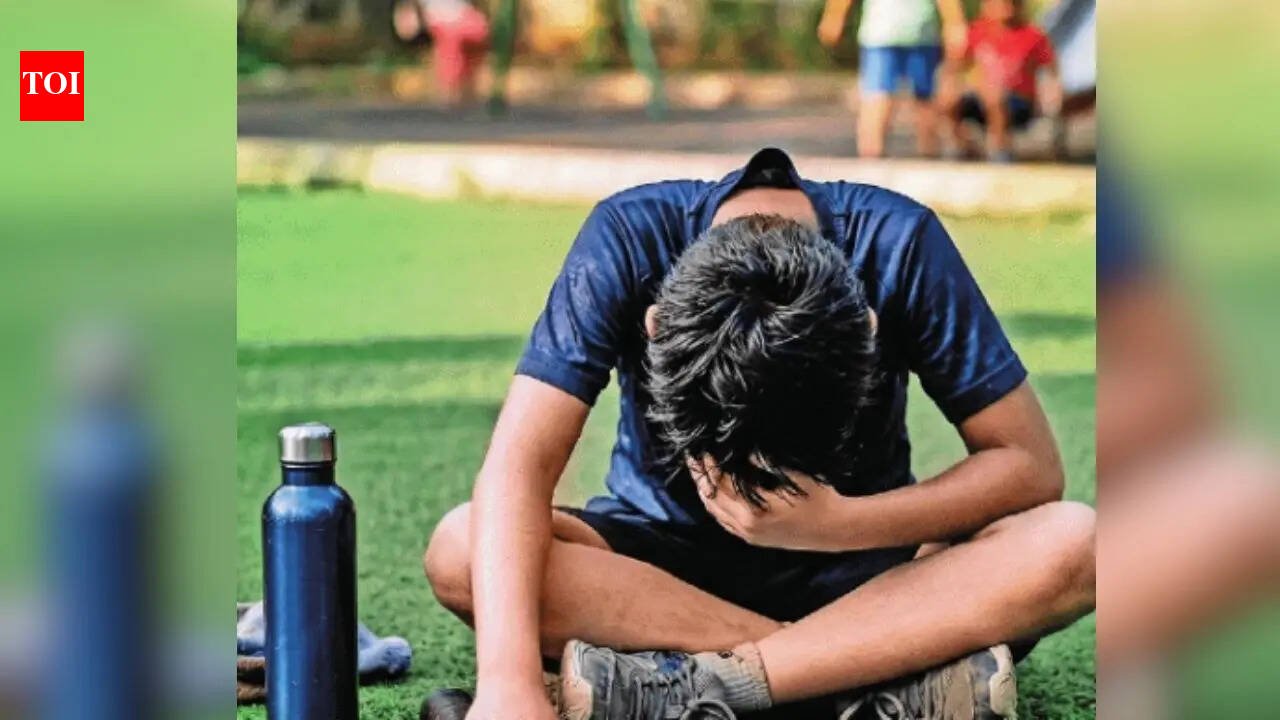
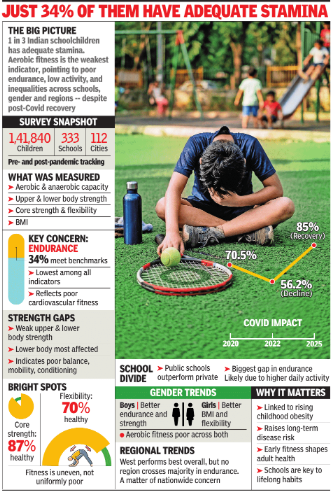
Just one in three Indian schoolchildren has adequate stamina, with only 34% meeting aerobic fitness benchmarks — the weakest among all indicators — according to a report evaluating over 1.4 lakh children across 333 schools in 112 cities. The findings highlight poor cardiovascular endurance, weak muscle strength, and disparities across school types, even as overall fitness levels recover steadily after the Covid-19 slump. The report presents a mixed picture: while flexibility and core strength show relatively strong outcomes, the overall fitness profile remains uneven.Aerobic capacity is the most alarming weakness, with just 34% meeting healthy standards. This reflects low cardiovascular fitness and limited ability to sustain physical activity. “The main reason children are underperforming in aerobic abilities is rising obesity, which is becoming more common every day,” said bariatric surgeon Dr Sanjay Borude.

Just 34% of them have adequate stamina

Just 34% of them have adequate stamina

Beyond endurance, upper and lower body strength remain consistently poor across age groups and regions. Lower body strength is a particular concern, indicating issues with balance, mobility, and overall conditioning.Dr Aashish Contractor, director of rehabilitation and sports medicine at Sir HN Reliance Foundation Hospital, linked these trends to environmental and behavioural factors. “During childhood, the capacity for physical activity is the highest, but one of the biggest barriers today is the lack of open spaces and access to sporting facilities,” he said. “At both a family and institutional level, physical exercise cannot be treated as an afterthought -it must be an integral part of a child’s daily routine.”In contrast, flexibility (70%) and core strength (87%) show better outcomes, suggesting some aspects of fitness are being maintained. The findings are part of the 14th Annual Health Survey released by Sportz Village. Public school students outperform private school students in five of seven fitness parameters. The gap is most visible in endurance metrics like aerobic and anaerobic capacity, suggesting higher daily physical activity among public school children. This may be linked to more opportunities for free play and movement.However, lower body strength remains weak across both systems, indicating structural gaps. Diet may also play a role. “Another reason for lack of strength is inadequate protein intake. Diets, especially vegetarian ones, may not always provide the necessary protein required for muscle development,” Dr Borude said. Gender differences are also evident. Boys perform better in aerobic capacity and lower body strength, indicating stronger endurance. Girls show healthier BMI levels and better flexibility, suggesting better body composition and joint mobility. Despite these differences, poor aerobic fitness is common across both groups.Regionally, western India performs best across most indicators, ahead of the North, East, and South.However, no region reports a majority of children meeting endurance benchmarks, underscoring the nationwide scale of the problem. The report tracks a sharp pandemic-related decline in fitness. Levels dropped from 70.5% in 2020 to 56.2% in 2022 due to school closures, reduced activity, and increased screen time. Recovery has since been strong, with levels rising to around 85% by 2025 after schools reopened. “Since the pandemic, I have observed in my patients that they have become more conscious of their health and have a better understanding of how to preserve it,” Dr Borude said.Children with more than 80 physical education sessions annually perform better across all parameters. “From a preventive healthcare perspective, structured physical education and sports are critical,” said Dr Ranjani Harish, senior scientist at the Madras Diabetes Research Foundation.“Regular physical activity improves cardiovascular health, controls body weight, enhances insulin sensitivity, strengthens bones and supports mental well-being.”She added that these benefits reduce long-term risks of diseases like diabetes, heart disease, hypertension, and obesity. “Schools play a central role in shaping lifelong health behaviours. Children who are physically active early in life are far more likely to remain active as adults,” she said.Emphasising urgent lifestyle changes, Dr Contractor recommends a “steep reduction in ultra-processed foods and controlled and regulated screen time.”


Source link

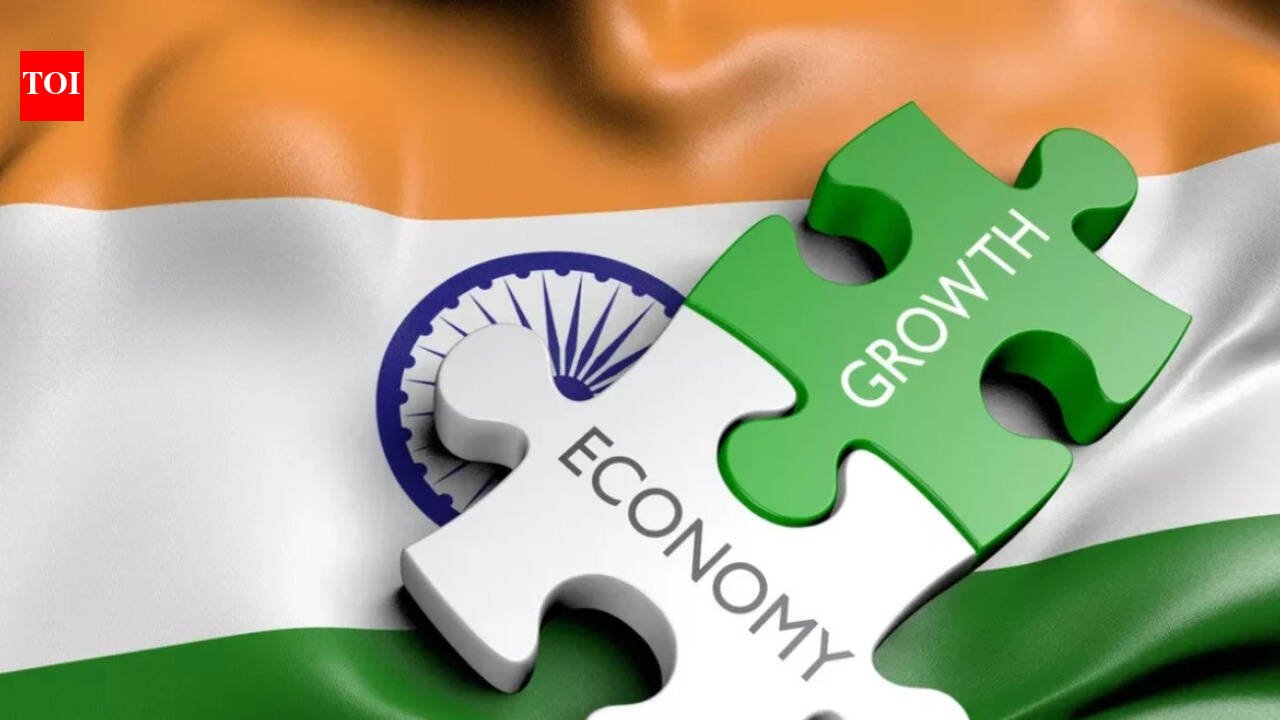
Will Middle East tensions affect Indian economy? What Morgan Stanley said in its report


Will Middle East tensions affect Indian economy? What Morgan Stanley said in its report

India’s economic outlook continues to be supported by strong domestic demand and improving high-frequency indicators, even as rising geopolitical tensions in the Middle East add a fresh layer of global uncertainty and raise the risk of stagflation, Morgan Stanley said in its recent report.The report said that “domestic demand remains resilient; however, headwinds are emerging as ongoing geopolitical tensions create a stagflationary risk,” adding that while macroeconomic stability indicators are currently favourable, “prolonged disruption poses downside risks to growth and could worsen macro stability.”Meanwhile, on domestic front, high-frequency indicators point to broad-based economic strength. The report highlighted an improvement in auto sales across segments, alongside rising credit growth, signalling sustained consumption and lending activity.It further pointed to resilient GST collections, reflecting steady economic activity. The manufacturing PMI has improved, while the services PMI has edged down, indicating some moderation in the services sector.Alongside, labour market conditions are improving in CY2025 and CYTD26, with a gradual rise in employee expenses among BSE-500 companies, indicating strengthening employment trends.Corporate performance has remained steady, with revenues holding up in the December 2025 quarter. The report also said that nominal growth is expected to improve in FY2027E.Financial flows continue to support economic activity. Monthly SIP flows remain upbeat, indicating sustained retail investor participation, while fund flows to the commercial sector remain healthy, pointing to adequate credit availability for businesses.On the policy side, the Reserve Bank of India has taken proactive steps to manage liquidity. The report noted that the RBI has conducted proactive liquidity management, with the policy rate currently at 5.25%, and interbank liquidity remaining in surplus, ensuring adequate system liquidity.However, the report also cautioned that India is still exposed to external risks, particularly due to developments in the Middle East. It noted that the country is vulnerable to volatility in global commodity prices, especially energy. At the same time, the region also remains crucial for India’s external sector, with exports to the region accounting for around 15% of total exports, while it contributes 38% of India’s remittances.


Source link

Satsang, spotlight, stardust: An ode to Tesseract | Mumbai News


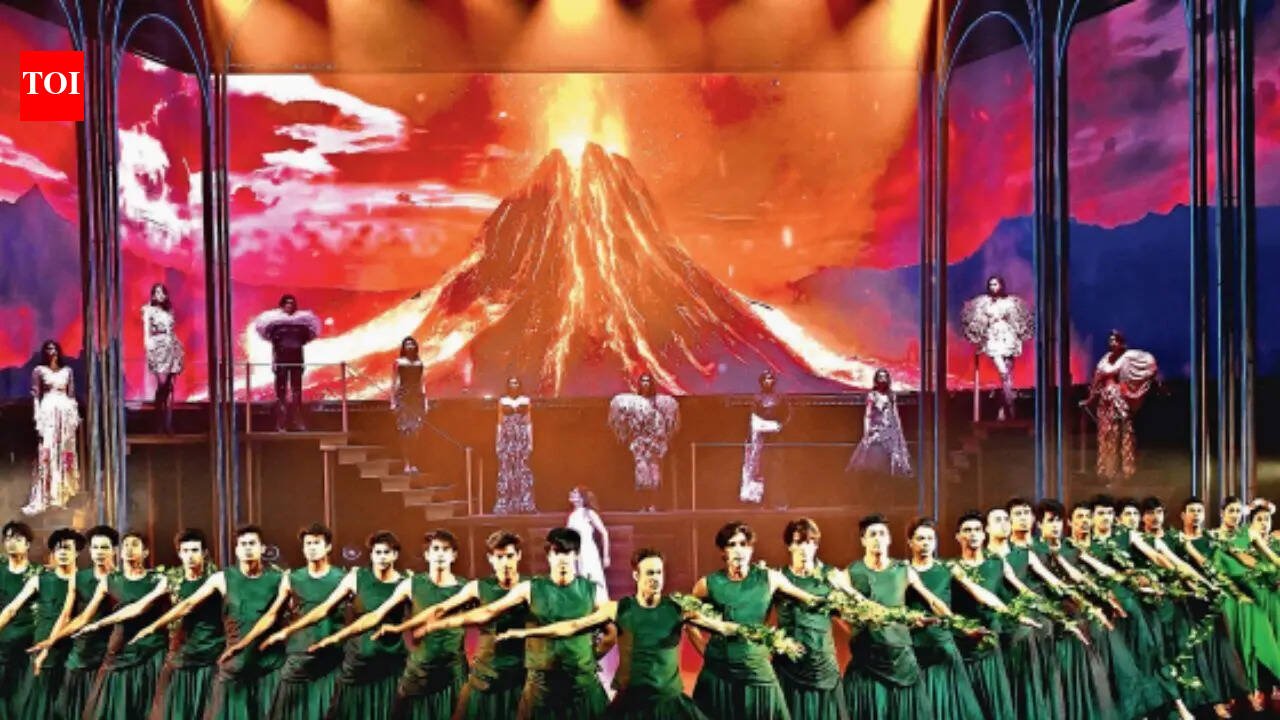
TOI’s magical musical Tesseract can be viewed as that rare star, which visits once every few decades. But unlike the ones that burn bright and vanish, this one sticks around, quietly glowing long after. In minds, hearts, and souls.A paradox opened the evening. In a week when Timothée Chalamet offered a hair-brained cultural provocation – that opera and ballet are “obsolete,” that “no one cares” – Tesseract answered not with a clapback, but with choreography: an elegant, assertive inclusion of ballet so ravishing it felt less like rebuttal, and more like revelation. Meera Jain’s curatorial genius, perhaps unwittingly, reframed legacy as living organism, not museum piece, placing ballet where it has always belonged: in the bloodstream of the present. Art demonstrates what argument cannot.The evening’s spell began at the threshold: interstellar music seemed to bend the hallway into a time tunnel, and a gallery of headlines and archives unfolded like a living prologue: premonitory whispers that we were entering a theatre of multiple dimensions.Within minutes, I lost the ordinary measure of time; three and a half hours dissolved with the hush and rush of a lucid dream. Trays full of treats and a bevy of beverages from the redoubtable kitchens of Indian Accent helped too.I am writing after days of reflection and dreaming: reflecting like the shards and mirrors of the Man in the Mirror sequence, dreaming like Sophia, whose journey and her alter ego’s formed a double helix of identity. Their oscillation was so seamless I often felt the protagonist flicker between two bodies of light, two musics of intention; a quiet triumph of performance craft and directorial design.Satsang: Association with truthWhat lingered were not effects but after-effects: layers that adhere to the mind’s inner surfaces and keep releasing meaning. That peeling and unpeeling has not stopped. My spirit felt stirred; my imagination conscripted; new quadrants of thought opened, new coordinates for feelingrevealed. The production felt like a transmission channeling the long arc of Meera and Samir Jain, their thoughts, their values, their hospitality to courage…not as signature, but as atmosphere.

4 (1) (1)

.

Even when the show vaulted into spectacle, what gleamed most was restraint: the discipline that makes technology serve emotion, not smother it; that lets light reveal rather than blind; that turns movement into syntax rather than ornament. The press, surprisingly, got this right. They called it immersive, interdisciplinary, and a philosophical theatre event rather than a mere extravaganza.However, unsurprisingly, they missed out on seeing and feeling beyond the obvious. Forgive the metaphor, but Tesseract was the most exquisite narcotic for the soul. The benevolent kind, the satsang kind. It had the unmistakable charge, vibrations, and high, of a congregation gathered to listen for truth, to dwell in the company of those who have made a life of seeking it. In this sense, the show became a civic ritual: a room of seekers aligning, for a few hours, around questions that are older than the nation-state and younger than each new dawn.It entered my sleep the way good art does – in rapid succession of dreams and visions, and it stirred the REM wilderness Samir Jain once nudged me to research; a reminder that inner archives can be as unruly (and as luminous) as outer ones.And then that finale: like Kairos’s origami, each crease and fold converged until the very idea of the tesseract revealed itself; not as a stunt, but as the geometry of a thought (and truth) that had been quietly forming all night. The eye for detail was relentless. The section on beauty and art, in particular, pinned me to my seat with its tenderness; it was an aria about what makes us human, and why the aesthetic is not indulgence but oxygen. It connected with such elegance to everything I know of the Times of India Group, of satsang, and of Evoke… a skein of beliefs, mythologies of meaning, turned into a theatre of belonging. Spotlight: Shining light on the truthThe stagecraft, from sets, to lighting, and automation, was cutting-edge in the only way that matters: ideas first, then electronics. Having worked closely with Meera Jain, I know her appetite for the frontier; the cutting edge.This went further – it felt pioneering: rooted in Indian ethos, yet speaking fluently to the world; interweaving journalism’s archive with theatre’s alchemy and technology’s sleight of mind. The show assembled global expertise and integrated live performance with large-scale LED, ARenvironments, illusion design, and a sweeping sound architecture… the kind of interdisciplinary rigour that does not imitate “international standards,” but sets them.Threaded through it all was an Indic grammar of courage: the old vow that truth is not a decree but a discipline. Our epics remind us that the boldest journeys are often into ambiguity, and that to “know” is not to arrive but to abide in inquiry. And I found myself wondering – heresy though it may be to a masthead I love – whether TOI’s line might graduate from “Let Truth Prevail” to “The Geometry of Truth.” After all, what is “prevail” if the unasked question is ‘what is truth?’, and ‘who gets to officiate it?’ A quest into Kairos’s origami-like geometry invites us to seek, to question, to listen, to platform polyphonies of approach and opinion. That feels like the paper, and the production, Iwitnessed: “Ekaṁ sat viprā bahudhā vadanti.”Stardust: Tryst with truthIf there is a roadshow destiny, Tesseract must meet it. Tour the country. Cross oceans. Reach for the stars.May Act 2 bloom into Part 2, with the “future of the planet” chapter dilated into its own deep meditation. Imagine a movement from archival intelligence, which we now shorthand as artificial intelligence, into an epoch of planetary intelligence; where biodiversity, species empathy, and human-animal kinship are re-lit as central plotlines rather than footnotes.The rare and inspirational ability to take the personal, make it political, and then sublimate it into art, too, is why Tesseract moved me so much: it insisted that love scale into responsibility, and pain transform into purpose. As a work of language and light, Tesseract oscillates between surrealism, pop art, and Kafkaesque narratives, visuals, motifs.It is a composograph of cosmic intelligence; its architectonic, symbolic, haptic, figurative elements gather into a grammar of awe-someness. It is a show tinged with the aura of spiritual reverence and multi-sensorial engagement.It is saturated with and by illusion and illumination; pulsing with a transcorporeal rhythm and murmur that recalls the oldest theatre there is: the human body and mind convincing itself it can hold more truth than yesterday.And then the ending… the sprinkling of stardust. In Meera Jain’s opening invocation of her son and grandson, the evening disclosed its lineage: pregnant with poise and panache; and yet, nine months of gestation for a vision like this feels, in hindsight, inevitable. A theatre-child born of travel, agency, care, curiosity, beauty, empathy, love, and familial imagination.Not perfect, but pure. Not bound, but beautiful. Not tangible, but true.


Source link

AIFF general body to decide on bids after thorough evaluation | Goa News


Indian Super League (ISL) clubs will get a share of the revenue only after the commercial partner recovers the investment

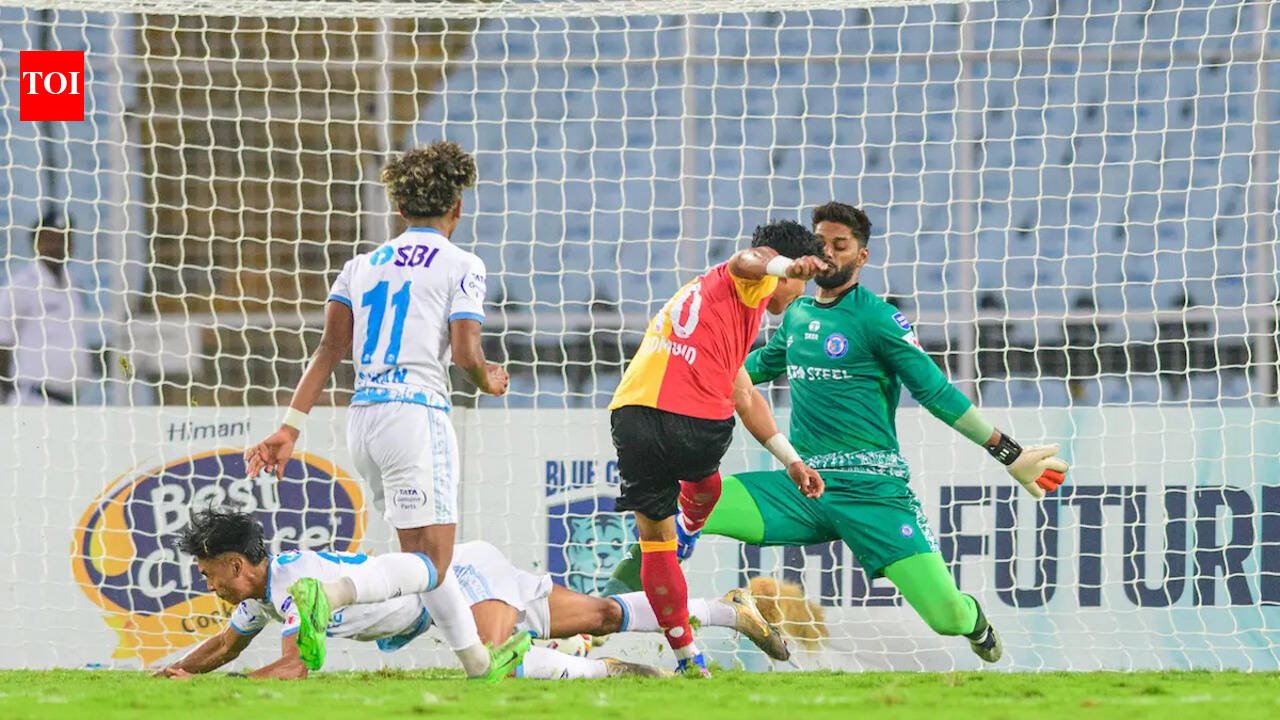
Panaji: The All India Football Federation (AIFF) has asked accounting firm KPMG to “prepare comprehensive comparison tables evaluating the feasibility and key aspects of the two bids” for the Indian Super League (ISL) and Federation Cup, the two most important domestic men’s football competitions.According to sources, purely on numbers, AIFF is in favour of Genius Sports’ bid that totals approximately ₹2,130 crore for commercial rights of the two competitions, for the next 20 years. The London-headquartered company will offer $7 million or Rs 64.4 crore annually in the first year with 5% annual increment. The federation is guaranteed of approx. ₹12.4 crore annually in “administrative fees” if Genius gets the nod.The second bid of ₹36.6 crore is from FanCode, the federation’s marketing partners for ISL this season.“The executive committee members were happy with the three bids (including one from Capri Sports for women’s football competitions) and we’ve informed them that it’s better to send it to the general body for approval,” AIFF deputy secretary general M Satyanarayantold TOI. “Since this is an important matter, we want the (general body) members to have the final say.”As per AIFF Constitution, any arrangement for a period longer than four years and/or arrangement exceeding amount of Rs. 5 crore “must be approved at an AGM/SGM by at least 75% of members present and eligible to vote.”“The ISL clubs wanted to speak with the bidders and we are more than happy to allow that, to ensure greater clarity and transparency in the process. Whatever queries the clubs have will be addressed directly by the bidders,” said Satyanarayan.A day prior to the executive committee meeting, ISL clubs had urged AIFF not to take any “binding decision” on the new long-term commercial rights holder. The clubs cited lack of meaningful opportunity to evaluate the bidders since the Request for Quotations (RFQ) document was shared with them just 12 hours prior to the bids being opened.Club officials have a bitter-sweet feeling of the bids, given that they will get a share of the revenue only after the commercial partner recovers the investment“If Genius Sports has bid Rs 64 crore, 20% of this amount will straightway go to AIFF as administrative fees. The rest is left for Genius to spend on commercialising the league. Once revenue starts coming in, the model states that Genius can recoup their investment first (of Rs 64 crore), and post that, whatever is left, is split in 60-30-10 ratios (between the clubs, commercial partner and AIFF).“For clubs to see any form of revenue, Genius has to bring back Rs 64 crore worth of revenue. If the commercial partner does not recoup its initial investment, then the tender terms allow them to move that loss into next year’s targets. Apply the same (principle) to Fancode and the threshold for FanCode is much lower since they have bid only Rs 36 crore,” explained a senior club official.AIFF officials said they have asked experts from KPMG to evaluate the two bids and submit a report. One of the big four accounting firms, KPMG was on board to prepare the RFQ.


Source link

Ball-tampering in PSL 2026: Haris Rauf, Shaheen Afridi, Fakhar Zaman under fire after viral clip


The Pakistan Super League (PSL) 2026 has found itself at the centre of a major controversy after a dramatic ball-tampering incident during the clash between Lahore Qalandars and Karachi Kings on Sunday (March 29) at Gaddafi Stadium.

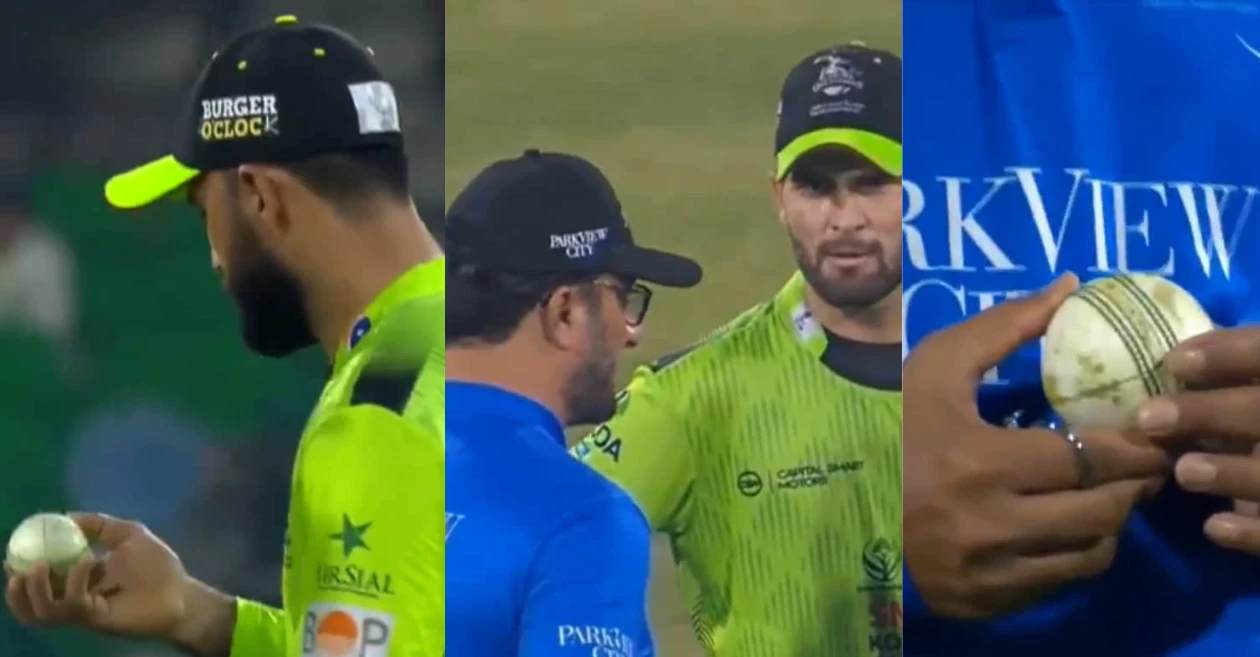
What should have been a tense, low-scoring finish quickly turned into one of the most talked-about moments of the tournament. The spotlight fell on three prominent Pakistan cricketers – Fakhar Zaman, Shaheen Shah Afridi and Haris Rauf – after a viral clip showed them handling the ball moments before the decisive final over.

PSL 2026 rocked by ball-tampering row as Fakhar Zaman, Shaheen Afridi & Haris Rauf face scrutiny

The incident unfolded at a critical stage. Karachi Kings needed 14 runs off the final over while chasing a modest 128. As Rauf prepared to bowl, cameras captured the trio in discussion at the top of the run-up, with the ball being passed between them. It was a brief exchange, but enough to catch the attention of on-field umpire Faisal Afridi.

Sensing something unusual, Afridi immediately intervened, called for the ball, and conducted a detailed inspection. After consulting square-leg umpire Sharfuddoula, the officials concluded that the condition of the ball had been altered.

The decision was swift and impactful. Five penalty runs were awarded to Karachi Kings, and the ball was replaced. Suddenly, the equation shifted from 14 required to just 9 in the final over- tilting the balance firmly in Karachi’s favour.

Here’s the video:

Despite an early wicket in the last over, Karachi held their nerve. Abbas Afridi struck a boundary and a six to seal a four-wicket win with three balls remaining, turning a tense chase into a memorable finish.

Also READ – From Carlos Brathwaite to Wasim Akram: Star-studded commentary panel announced for PSL 2026

Disciplinary action and players reaction 

The controversy didn’t end on the field. Soon after the match, the Pakistan Cricket Board (PCB) initiated disciplinary proceedings. Match referee Roshan Mahanama charged Fakhar Zaman with a Level 3 offence under Article 2.14 of the PSL Code of Conduct.

According to the rules, “It is an offence for any player to take any action which changes the condition of the ball.” While players are allowed to shine the ball naturally, any artificial alteration is strictly prohibited. If found guilty, Fakhar could face a suspension ranging from one to two matches.

Fakhar, however, has strongly denied the allegations and appeared for an initial hearing. A second hearing is scheduled within 48 hours, after which a final verdict will be announced.

Meanwhile, reactions from players added more layers to the controversy. Lahore captain Shaheen Afridi kept his response measured, saying: “I don’t know about this. We will see if it’s there in the camera and discuss what it is. Actually, five runs were taken, and we can’t do anything.”

All-rounder Sikandar Raza also questioned the decision, stating: “You have to ask the umpires why they changed the ball. When we asked them why they changed the ball, they told us to go away. There was never any attempt on my part to change the condition of the ball, or even to try.”

He further clarified that he was only attempting to dry and shine the ball when the umpires intervened.

As clips of the incident continue to circulate online, opinions remain divided. Some believe the umpires acted correctly based on what they observed, while others argue that the evidence may not conclusively point to deliberate tampering – especially given that multiple players handled the ball.

In a separate incident from the same match, Hasan Ali was fined 10% of his match fee for a Level 1 breach related to his on-field behaviour after dismissing a batter. He accepted the charge without contest.

Also WATCH: David Warner pulls up Shaheen Afridi and Mohammad Rizwan over inattentive behaviour at PSL 2026 conference


Source link

Access Denied


Access Denied

You don’t have permission to access “http://www.ndtv.com/india-news/jewar-airport-inauguration-real-estate-investment-property-buy-good-returns-greater-noida-flat-land-11285586” on this server.

Reference #18.adf5d217.1774869669.44ce74e1

https://errors.edgesuite.net/18.adf5d217.1774869669.44ce74e1


Source link

Mustafa Suleyman: Microsoft AI CEO Mustafa Suleyman: For the next couple years at least, entire AI industry is going to be defined by… |


Microsoft AI CEO Mustafa Suleyman: For the next couple years at least, entire AI industry is going to be defined by...
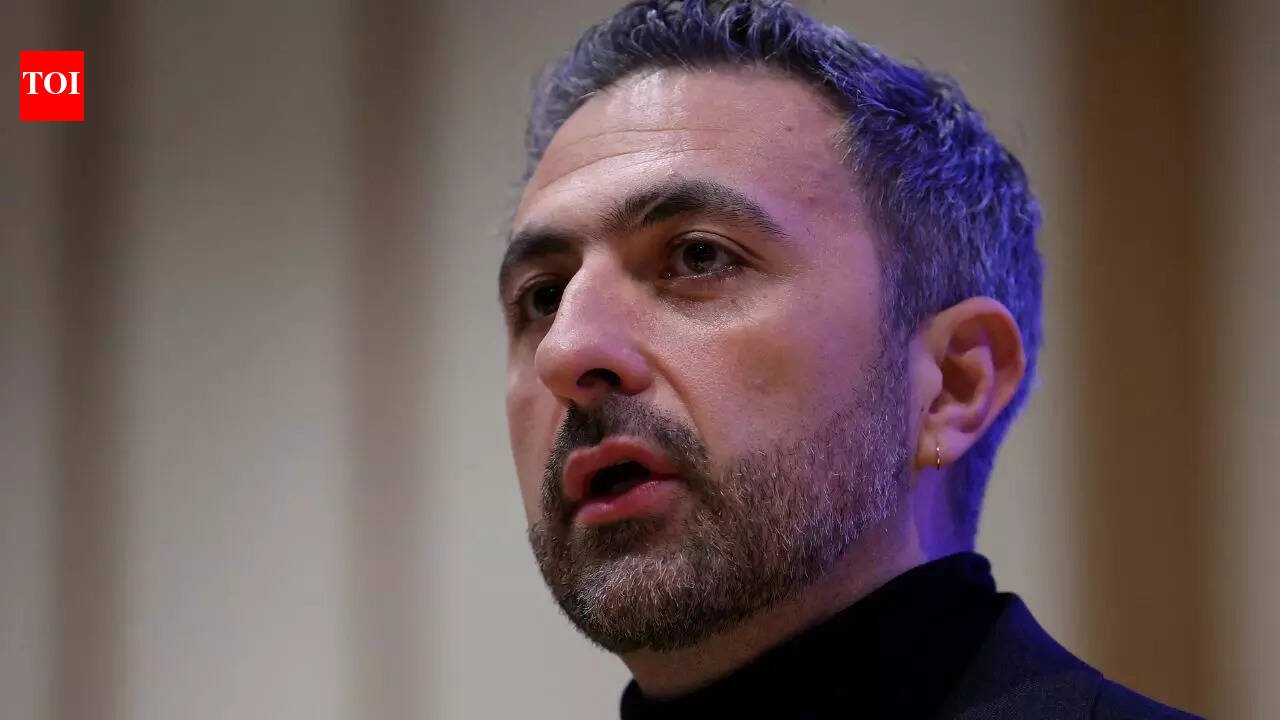
Microsoft AI CEO Mustafa Suleyman asserts that the AI industry’s future hinges on who can afford to run models at scale, not just who builds the smartest ones. He argues that inference compute scarcity will define winners for the next few years, with high-margin products gaining a significant edge through a data-driven improvement flywheel.

Microsoft AI CEO Mustafa Suleyman says the AI industry’s next chapter won’t be written by whoever builds the smartest model. It’ll be written by whoever can afford to run one at scale. And right now, that’s a very short list. In a post on X, Suleyman laid out a sharp, economics-first thesis—arguing that inference compute scarcity, not model intelligence, will define winners and losers for the next two to three years. The companies with the margins to buy tokens pull ahead. Everyone else gets rationed out.“For the next couple years at least, the entire AI industry is going to be defined by this fact: demand is going to wildly outstrip supply, and so what matters is which companies / products have margin to pay for tokens,” he wrote. The products that can pay, he added, will improve fastest—because lower latency drives retention, retention generates data, and that data spins a flywheel of model improvement and adoption.

Watch

Microsoft CEO ‘Thrilled’ About India’s Growing Data Centre Capacity, Details Meet With PM Modi

Why inference compute, not AI model training, is the real bottleneck in 2026

Suleyman’s argument flips the dominant AI narrative. For years, the industry obsessed over training bigger foundation models. But the acute crisis in 2026 is on the serving side—running those models for millions of users in real time.Inference workloads now eat up roughly two-thirds of all AI compute spending, per Deloitte’s 2026 TMT Predictions. GPU lead times have stretched to nearly a year. High-bandwidth memory from major suppliers is sold out through 2026. And of the 16 GW of global data-centre capacity slated for this year, only about 5 GW is actually under construction—the rest remains announcements on paper.

How Mustafa Suleyman’s AI ‘flywheel’ gives high-margin products a compounding edge

This scarcity is where Suleyman’s flywheel logic takes over. Products with fat gross margins—enterprise legal tools, healthcare SaaS, Microsoft 365 Copilot—can absorb premium inference costs. That buys them lower latency. Lower latency keeps users coming back. Returning users generate rich, proprietary workflow data. That data fine-tunes and improves models. Better models drive more adoption and revenue. Repeat, faster each cycle.Suleyman has used this exact framing before—at the October 2024 IA Summit, he said the winners in vertical AI would be those who “nailed the fine-tuning loop” and got their data flywheel spinning. Microsoft’s own numbers back it up: paid Copilot seats hit 15 million in Q2 FY2026, up 160% year-on-year, though still just 3.3% of the 450 million M365 commercial user base.

Consumer AI apps and low-margin AI startups face a token rationing problem

The uncomfortable corollary is that consumer AI apps and cash-strapped startups face a squeeze. Without the margins to buy premium inference, they get slower responses, weaker retention, and a flywheel that never starts spinning.

Poll

Which type of AI applications do you believe will struggle the most due to token rationing?

Some in the thread pushed back—arguing intelligence-per-dollar matters more, or that open-source and on-device models could crash inference costs entirely. But Suleyman’s bet is clear and well-funded. With Microsoft pouring over $80 billion a year into AI infrastructure, he’s banking on the idea that for the next couple of years, the business that can pay for tokens wins the intelligence race first.


Source link