Breaking News
Why rupee breached 95 versus dollar mark despite RBI’s move to stem fall


Why rupee breached 95 versus dollar mark despite RBI's move to stem fall
The Indian rupee has been battered since the start of the US-Iran war, and continues to depreciate versus the US dollar driven by a multitude of factors. (AI image)

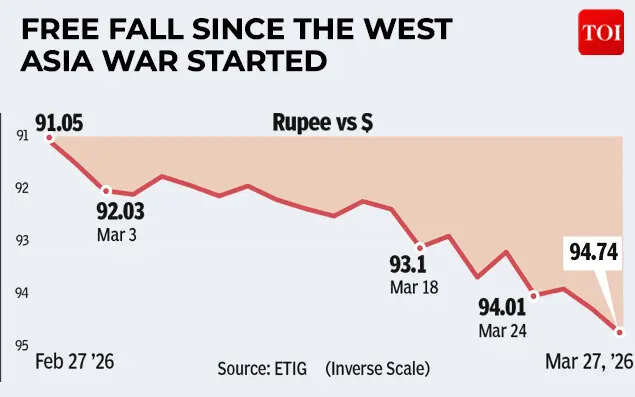
The Indian rupee on Monday breached the 95 mark for the first time versus the US dollar. In fact, in this financial year, the rupee has depreciated by a record 9.88 per cent, the steepest fall seen in 14 years. The currency closed at 94.78 against the dollar. Incidentally, today’s intraday low of 95 came after a smart recovery in morning trade, when the rupee appreciated 128 paise versus the dollar. The recovery came despite global crude oil prices rising. Usually, higher global crude oil prices increase import bill, which in turn raises demand for US dollars, hence putting downward pressure on the rupee. At the same time, higher oil prices fuel inflation, which in turn widens the current account deficit, further weakening the currency.The Indian rupee has been battered since the start of the US-Iran war, and continues to depreciate versus the US dollar driven by a multitude of factors. Market participants noted that the domestic currency opened on a stronger footing as banks, which typically hold long positions, are now expected to pare these exposures in line with the central bank’s directive.

RBI Moves To Protect Rupee

The Reserve Bank of India moved to limit the overnight net open position that banks can maintain to $100 million.Under a circular issued on March 27, 2026, the Reserve Bank capped the Net Open Position (NOP-INR) for banks at $100 million, with compliance mandated by April 10.“As banks begin adjusting their positions, they are likely to sell dollars in the market, which can temporarily support the rupee. This creates a phase of relief, driven by position unwinding, not by a major shift in fundamentals, but still meaningful in the near term,” CR Forex Advisors MD Amit Pabari said.The Reserve Bank of India’s decision to stabilise the rupee by directing banks to reduce their foreign exchange exposures beyond $100 million was expected to check the currency’s slide towards the 95 level.
Rupee's free fall

The measure is also likely to result in losses for banks holding large open positions. Over the weekend, lenders approached the central bank seeking either relaxation of the rule or an extension of the timeline. However, with the RBI maintaining its stance, banks are now required to begin trimming their positions from Monday in order to comply with the April 10 deadline.Previously, banks were allowed to maintain net open positions of up to 25% of their net worth. In reality, several large institutions had built substantial long dollar exposures, in some cases exceeding $1 billion, anticipating further depreciation of the rupee. The revised cap now necessitates a swift reduction in these positions. By April 10, 2026, banks must scale down their exposures to $100 million, effectively forcing them to offload dollars and purchase rupees to rebalance their books.Uday Kotak described the step as “an unconventional policy action” prompted by a West Asia crisis that has moved into “uncharted territory”. “Reminds me of Bimal Jalan play book as RBI Governor in 1998 when the rupee was depreciating sharply post Asian crisis. If things get worse geo politically, is there an opportunity for a new version of FCNR (B) scheme?” he said.Some bankers, however, remain doubtful about the effectiveness of special measures aimed at attracting dollar inflows.

Why rupee declined despite RBI move

The central bank’s action initially triggered a sharp appreciation in the rupee during early trade on Monday. However, much of these gains were later erased as strong demand for the US dollar from oil companies weighed on the currency, according to market participants.Forex traders noted significant volatility in the USD/INR pair, which fluctuated within a wide range of 165 paise during intra-day trading, as the West Asia conflict entered its 31st day and continued to unsettle energy markets.“Rupee rose, but again fell due to some big corporate buying, squaring up of position in NDF, Nationalised banks buying and oil companies buying,” said Anil Kumar Bhansali, head of treasury and executive director at Finrex Treasury Advisors LLP.Analysts indicated that the rupee is likely to move within a broad range of 92 to 97 against the US dollar in the near term.“Outlook depends on three variables: oil, flows, and global rates. The new normal is higher volatility plus gradual depreciation, not stability around a fixed band. In FY27, for the USD/INR pair, 92-97 remains the broader range play,” said Sunal Sodhani, head of treasury in India at South Korean lender Shinhan Bank.According to forex market participants, the domestic unit remains under pressure due to persistent outflows by foreign investors and the strengthening of the US dollar, driven by ongoing uncertainty linked to the West Asia conflict. Traders noted that sustained demand for the dollar, coupled with inflation risks stemming from elevated energy prices, continues to weigh heavily on the rupee. They added that the overall trend is likely to stay weak unless there is a meaningful correction in crude oil prices.Earlier initiatives to mobilise foreign currency relied on offering assured returns to non-resident Indians, who would borrow at lower rates overseas and invest in India. Such approaches may have limited appeal now, given the broader availability of structured investment options. Bankers noted that raising dollars through rupee-dollar swap mechanisms may prove more cost-effective for the RBI.


Source link

Delhi-bound humanitarian aid flight hit in US strike, claims Iran | India News


Delhi-bound humanitarian aid flight hit in US strike, claims Iran

A plane was reportedly by a US air strike as it was flying towards India to collect humanitarian aid. “Mahan Air aircraft was hit by the US in an airstrike at Mashhad Airport. The plane was reportedly scheduled to fly to Delhi for humanitarian aid,” said Iran sources, as quoted by ANI.This comes weeks after the first shipment sent by India was delivered and received by the Iranian Red Crescent Society earlier this month. The assistance comes as Iran continues to grapple with casualties and pressure on its healthcare system amid the ongoing US-Israel conflict. Meanwhile, in a symbolic gesture, Iran also launched missiles toward Israel carrying messages of gratitude to those who gave support to Tehran, including one thanking the people of India.In the overall context of conflict, the Iran–US–Israel war has intensified into a multi-front confrontation, with ongoing strikes, missile attacks and expanding regional fallout even as diplomatic efforts remain uncertain. Iran has denied participating in mediation initiatives, including those proposed by Pakistan, while continuing retaliatory attacks on infrastructure in Israel and Gulf states. The US and Israel have sustained military pressure on Iranian targets, alongside signals of possible negotiations. The escalating hostilities have also rattled global energy markets, with rising oil prices driven by fears of disruption in the Strait of Hormuz.


Source link

$1 billion a day: The escalating cost of America’s war with Iran


$1 billion a day: The escalating cost of America’s war with Iran

The financial and human cost of the United States’ involvement in the Iran conflict is mounting rapidly, with early estimates pointing to tens of billions already spent.Data tracked by Iran Cost Ticker suggests US expenditure has crossed $35 billion since the strikes began, with roughly $11.3 billion spent in the first six days alone and costs continuing at about $1 billion per day. That translates to tens of thousands of dollars every second, underlining the scale of the ongoing military commitment even without a full-scale ground invasion.Beyond operational spending, the damage to US military assets has been significant. A report by The Wall Street Journal estimates losses and repair costs between $1.4 billion and $2.9 billion within the first three weeks, largely due to Iranian missile and drone attacks targeting American and allied infrastructure across the Middle East.High-value equipment losses have driven much of the cost. Three F-15E fighter jets, each worth around $100 million, were mistakenly shot down in a friendly fire incident, while an F-35A—valued at over $80 million—was forced into an emergency landing after reportedly coming under threat. Aerial refuelling capabilities have also been hit, with a deadly mid-air collision involving a KC-135 tanker and further damage to multiple aircraft in missile strikes.Unmanned systems have not been spared. More than a dozen MQ-9 Reaper drones, costing up to $30 million each in newer variants, have been destroyed either in the air or on the ground. Meanwhile, critical radar and missile defence systems—some valued at hundreds of millions or even $1 billion—have been damaged in strikes across the region.The human toll is also rising. At least 13 US service members have been killed and 200 wounded, while Iranian casualties run into thousands, including military personnel and civilians.US President Donald Trump has dismissed concerns over rising global prices, warning that Washington could escalate further by targeting Iran’s oil infrastructure if Tehran does not agree to a deal. Such threats have already rattled energy markets, with oil prices surging sharply and analysts warning they could spike to historic highs if the conflict widens.


Source link

RR vs CSK: Here’s why Dewald Brevis is not playing today’s match in IPL 2026


Chennai Super Kings (CSK) have been dealt an early setback in the Indian Premier League (IPL) 2026 season, with young star Dewald Brevis missing their clash against Rajasthan Royals (RR).

RR vs CSK: Why Dewald Brevis is not playing today’s match?

The South African batter was ruled out after suffering a side strain during a training session in the lead-up to the match in Guwahati. It’s an unfortunate blow for both Brevis and CSK, especially considering the excitement around his inclusion in the squad this season.
According to reports from the team camp, the injury occurred during routine practice, raising immediate concerns among the support staff. Head coach Stephen Fleming later confirmed that Brevis would not be available for selection and is currently undergoing rehabilitation.

While the franchise has not provided an exact recovery timeline, there is optimism that the injury is not too serious. However, side strains can be tricky, often requiring careful management to avoid aggravation. For now, CSK are taking a cautious approach, prioritizing Brevis’ long-term fitness over a rushed return.

The youngster’s absence is particularly disappointing given his aggressive batting style and ability to shift momentum in the middle overs – qualities CSK were hoping to utilize early in the tournament.

Injury woes mount for CSK

Brevis’ injury adds to a growing list of concerns for CSK, who are already dealing with multiple fitness issues at the start of their campaign.

New Zealand pacer Nathan Ellis has been ruled out of the entire tournament, leaving a gap in the pace department. Meanwhile, veteran skipper MS Dhoni is also unavailable for the first couple of weeks due to a calf strain, further complicating team combinations.

With key players missing, CSK now face the challenge of reshuffling their lineup and finding the right balance. The absence of Brevis not only reduces their batting depth but also limits their flexibility in the middle order.

Despite these setbacks, CSK have a reputation for adapting under pressure. The team management will be hoping that their experienced core can step up while younger players seize the opportunity to make an impact.

Also READ: RR vs CSK, IPL 2026 – Match Prediction: Who will win today’s game between Rajasthan Royals and Chennai Super Kings?

RR vs CSK: Playing of both teams

Chennai Super Kings: Sanju Samson (wk), Ruturaj Gaikwad (c), Ayush Mhatre, Matthew Short, Shivam Dube, Kartik Sharma, Jamie Overton, Noor Ahmad, Matt Henry, Anshul Kamboj, Khaleel Ahmed

Rajasthan Royals: Yashasvi Jaiswal, Vaibhav Sooryavanshi, Riyan Parag (c), Dhruv Jurel (wk), Shimron Hetmyer, Ravindra Jadeja, Jofra Archer, Nandre Burger, Sandeep Sharma, Ravi Bishnoi, Brijesh Sharma

Impact substitutes for both teams

Chennai Super Kings Impact subs: Sarfaraz Khan, Prashant Veer, Rahul Chahar, Gurjapneet Singh, Ramakrishna Ghosh

Rajasthan Royals Impact subs: Donovan Ferreira, Lhuan-dre Pretorius, Ravi Singh, Sushant Mishra, Tushar Deshpande

Also READ: RR vs CSK, IPL 2026 – Barsapara Stadium Pitch Report and Guwahati Weather Forecast


Source link

13 political party members appointed to Mumbai Tree Authority | Mumbai News


Mumbai: Thirteen members from various political parties were appointed to the BMC’s Tree Authority on Monday, with mayor Ritu Tawde announcing the names in the Municipal House. The authority is responsible for making key decisions on tree conservation, tree-cutting permissions, and the city’s green policies.Among those appointed, the BJP is represented by Ganesh Khankar, Sayali Raghunath Kulkarni, Rohan Rathod, Siddharth Sharma and Harsh Bhargav Patel.From the Shiv Sena (Uddhav faction), Kishori Pednekar, Milind Vaidya, Pramod Sawant and Harshala More were included in the committee. The Shiv Sena (Shinde faction) has nominated Varsha Swapnil Tembulkar and Bhaskar Shetty, while Congress has appointed Ibrahim Qureshi, and Vijay Ubale represents AIMIM. Additionally, Hetal Gala, as the chairperson of the Market and Garden Committee, will be an ex-officio member of the Tree Authority.The Tree Authority is considered a crucial body for decisions related to the protection of trees in the city. It plays a key role in granting permissions for tree felling linked to development projects and ensuring compensatory plantation measures. With the appointment of new members, some pending proposals will be expedited.


Source link

Vijay declares assets worth Rs 640.51 crore in poll affidavit; here is the breakup | Chennai News


Vijay declares assets worth Rs 640.51 crore in poll affidavit; here is the breakup

CHENNAI: Actor-turned-politician and TVK president Vijay has declared assets worth Rs 640.51 crore held in his name and that of his spouse, according to an affidavit filed before the Perambur returning officer on Monday.The disclosure shows Rs 404 crore in movable assets, including cash, investments, gold, and vehicles. The vehicles listed include a Toyota Lexus, Vellfire, BMW, Maruti Swift, and a TVS XL Super two-wheeler.Vijay has also declared Rs 220 crore in immovable assets, comprising self-acquired and inherited properties in Chennai and Kodaikanal, as per the affidavit summary.His spouse Sangeetha has declared movable assets worth Rs 15 crore and immovable assets valued at Rs 25 lakh.


Source link

Who is Brijesh Sharma? J&K pacer making his IPL debut for RR against CSK | Cricket News


Who is Brijesh Sharma? J&K pacer making his IPL debut for RR against CSK

Brijesh Sharma made his IPL debut on Monday after being named in the playing XI of the Rajasthan Royals for their match against the Chennai Super Kings.Rajasthan Royals had picked the Jammu and Kashmir pacer at his base price of Rs 30 lakh in the IPL 2026 auction. At that time, he had not played senior cricket in any format, but his performances in the 2025 Bengal Pro T20 League had brought him into focus.A right-arm medium pace bowler, Sharma finished joint-fifth on the wickets list in that tournament, taking 11 wickets in seven matches while playing for Smashers Malda.

From J&K to RR via Bengal

His journey to professional cricket has come through several challenges. He grew up in the Dandial area as the son of a labourer and faced financial issues while pursuing the sport. He started by representing Jammu and Kashmir at the Under-19 and Under-25 levels.To improve his game, he later moved to Delhi, where he trained under Deepak Punia at the Unique Sports Club. The shift helped him develop better control and prepare for higher levels of competition.His performance in the Bengal Pro T20 League in 2025 played a key role in his rise. Playing at Eden Gardens, he was among the leading wicket-takers and showed his ability in both the Powerplay and the final overs, finishing with 11 wickets in seven matches.That run led to his selection by Rajasthan Royals for IPL 2026. The impact of Brijesh Sharma extends beyond his statistics; he has become a symbol of hope for aspiring cricketers from Jammu and Kashmir, following in the footsteps of regional icons like Umran Malik and Auqib Nabi these days.In the match, Rajasthan Royals won the toss and elected to bowl against Chennai Super Kings in their Indian Premier League opener here on Monday.Royals have beaten CSK four times in their last five matches. Both teams struggled in the 2025 season.CSK are without charismatic MS Dhoni, who has been sidelined for at least two weeks due to a calf injury.Follow live updatesTeams:Chennai Super Kings: Ruturaj Gaikwad (C), Sanju Samson (wk), Ayush Mhatre, Matt Short, Shivam Dube, Kartik Sharma, Jamie Overton, Noor Ahmad, Matt Henry, Anshul Kamboj, and Khaleel Ahmed.Rajasthan Royals: Riyan Parag (C), Vaibhav Sooryavanshi, Yashasvi Jaiswal, Dhruv Jurel (wk), Shimron Hetmyer, Ravindra Jadeja, Jofra Archer, Nandre Burger, Sandeep Sharma, Ravi Bishnoi, and Brijesh Sharma.


Source link

US stock markets today (March 30, 2026): Wall Street rebounds after selloff amid Iran war, oil and inflation worries persist


US stock markets today (March 30, 2026): Wall Street rebounds after selloff amid Iran war, oil and inflation worries persist

Wall Street’s main indices edged higher in choppy trade on Monday, recovering from the previous session’s sharp losses, even as the Middle East conflict widened and kept investors cautious.The Dow Jones Industrial Average rose 0.48 per cent, the S&P 500 gained 0.32 per cent, and the Nasdaq Composite advanced 0.19 per cent in early trade, according to Reuters.The rebound came after US President Donald Trump said Washington was in serious discussions with a “more reasonable regime” to end the war, while reiterating warnings that Iran must reopen the Strait of Hormuz or face US strikes on its oil and power infrastructure.Tensions escalated further after Yemen’s Iran-backed Houthi militia entered the conflict over the weekend.Energy stocks led gains, with the S&P 500 Energy Index rising 1.5 per cent. Shares of Exxon Mobil climbed 3 per cent, while Chevron added 1.5 per cent.“The S&P 500 is still down less than 10% (since the war began). In many ways, investors have been affected less by the implications of the Strait of Hormuz being closed than I would have thought,” said Sam Stovall, chief investment strategist at CFRA Research, quoted Reuters.“Today’s action is probably more of a technical bounce because many sectors and sub-industries are in oversold condition,” he added.Financial stocks also moved higher, with the sector gaining 0.8 per cent after the US Department of Labor issued guidelines clarifying how trustees can include alternative assets such as private equity and cryptocurrencies in 401(k) retirement plans.Asset managers advanced, with Blackstone up 1.7 per cent, KKR gaining 1.4 per cent, and Apollo Global Management rising 1 per cent.Overall, nine of the 11 major S&P 500 sectors traded in positive territory.Despite the uptick, major US indices including the Dow, Nasdaq and Russell 2000 remain in correction territory since the conflict began.Morgan Stanley downgraded global equities to “equal weight” from “overweight”, but noted that capital flows into US equities and bonds have strengthened, suggesting the US may regain its safe-haven appeal.Investors are now awaiting remarks from Federal Reserve Chair Jerome Powell and New York Fed President John Williams later in the day, alongside key labour market data this week, including March nonfarm payrolls.Rising oil prices linked to the conflict have reignited inflation concerns, with market participants now pricing out any Federal Reserve rate cuts this year, compared to expectations of two cuts before the war, according to CME Group’s FedWatch Tool.Among individual stocks, Sysco plunged 12 per cent after announcing a $29 billion acquisition of Jetro Restaurant Depot, including debt.Metal stocks rallied as aluminium prices hovered near four-year highs, with Alcoa and Century Aluminum surging 12 per cent and 13.6 per cent, respectively.US markets will remain closed on Friday for the Good Friday holiday.Advancing stocks outpaced decliners by a ratio of 2.69-to-1 on the NYSE and 1.49-to-1 on the Nasdaq. The S&P 500 recorded 19 new 52-week highs and four lows, while the Nasdaq saw 17 new highs and 121 new lows.


Source link

Post office small savings schemes: What is the latest interest rate for PPF, NSC, SSY, SCSS for April-June 2026 quarter?


Post office small savings schemes: What is the latest interest rate for PPF, NSC, SSY, SCSS for April-June 2026 quarter?
Small Savings Schemes Interest rates (AI image)

Latest Small Savings Interest Rates: The Finance Ministry announces the interest rates for post office and small savings schemes every quarter after a review. The interest rates for Public Provident Fund (PPF), Sukanya Samriddhi Yojana (SSY), Senior Citizens Savings Scheme (SCSS), National Savings Certificates (NSC) etc are decided on a quarterly basis.The Finance Ministry has released the latest interest rates for the first quarter of the new financial year FY 2026-27 from April to June. The interest rates for all small savings schemes have been kept unchanged.

Latest Small Savings Interest Rates (Q1 FY 2026-27)

The existing rates will continue to apply for the April–June 2026 quarter. In an official notification, the ministry said that the interest rates for various small savings schemes for the first quarter of FY 2026–27, beginning April 1, 2026 and ending June 30, 2026, will remain the same as those announced for the preceding quarter of FY 2025–26.According to the notification, the Sukanya Samriddhi Scheme will continue to offer an interest rate of 8.2%, while the rate on three-year term deposits remains unchanged at 7.1%.

Instruments Rate of Interest w.e.f 01.04.2026 to 30.06.2026 Compounding Frequency
Post Office Savings Account 4.00% Annually
1 Year Time Deposit 6.9% (Annual Interest ₹708 for ₹10,000/-) Quarterly
2 Year Time Deposit 7.0% (Annual Interest ₹719 for ₹10,000/-) Quarterly
3 Year Time Deposit 7.1% (Annual Interest ₹729 for ₹10,000/-) Quarterly
5 Year Time Deposit 7.5% (Annual Interest ₹771 for ₹10,000/-) Quarterly
5 Year Recurring Deposit Scheme 6.70% Quarterly
Senior Citizen Savings Scheme 8.2% (Quarterly Interest ₹205 for ₹10,000/-) Quarterly and Paid
Monthly Income Account 7.4% (Monthly Interest ₹62 for ₹10,000/-) Monthly and paid
National Savings Certificate (VIII Issue) 7.7% (Maturity Value ₹14,490 for ₹10,000/-) Annually
Public Provident Fund Scheme 7.10% Annually

Experts say that interest rates on small savings schemes are often influenced by several key factors. Among these, yields on government securities are the most critical, as higher bond yields generally lead to higher returns on these schemes. Inflation also plays a role, as the government aims to maintain attractive real returns for investors. Additionally, monetary policy actions by RBI, particularly changes in the repo rate and liquidity conditions, impact G-Sec yields and, in turn, small savings rates.However, despite the market-linked framework, experts are of the view the government does not strictly adhere to the formula every quarter. Protecting small savers, particularly senior citizens and retirees who rely on these schemes for stable income, is a key factor behind maintaining steady rates.Interest rates on these schemes have remained unchanged for an extended period. The last revision was made for the January–March quarter of FY 2023–24.


Source link

Access Denied


Access Denied

You don’t have permission to access “http://www.ndtv.com/offbeat/chinese-woman-spends-rs-1-6-lakh-on-dogs-kindergarten-internet-reacts-11287046” on this server.

Reference #18.c4f5d217.1774882028.456681bb

https://errors.edgesuite.net/18.c4f5d217.1774882028.456681bb


Source link