Breaking News
Sushasan, switches and survival: End of an era in Bihar as Nitish Kumar moves to Rajya Sabha | India News

Sushasan, switches and survival: End of an era in Bihar as Nitish Kumar moves to Rajya Sabha

In a surprising turn of events, Bihar chief minister Nitish Kumar filed his nomination for the Rajya Sabha on Thursday in Patna. The sudden move has pushed Bihar into a major political shift while ending the tenure of the state’s longest chief minister.Nitish Kumar, who has served as Bihar’s longest-tenured chief minister for more than two decades, informed of his decision to contest Rajya Sabha elections via social media post.

‘Desire In My Heart’: Nitish Kumar’s Rajya Sabha Decision Sparks Protest, Anger Inside JD(U) Ranks

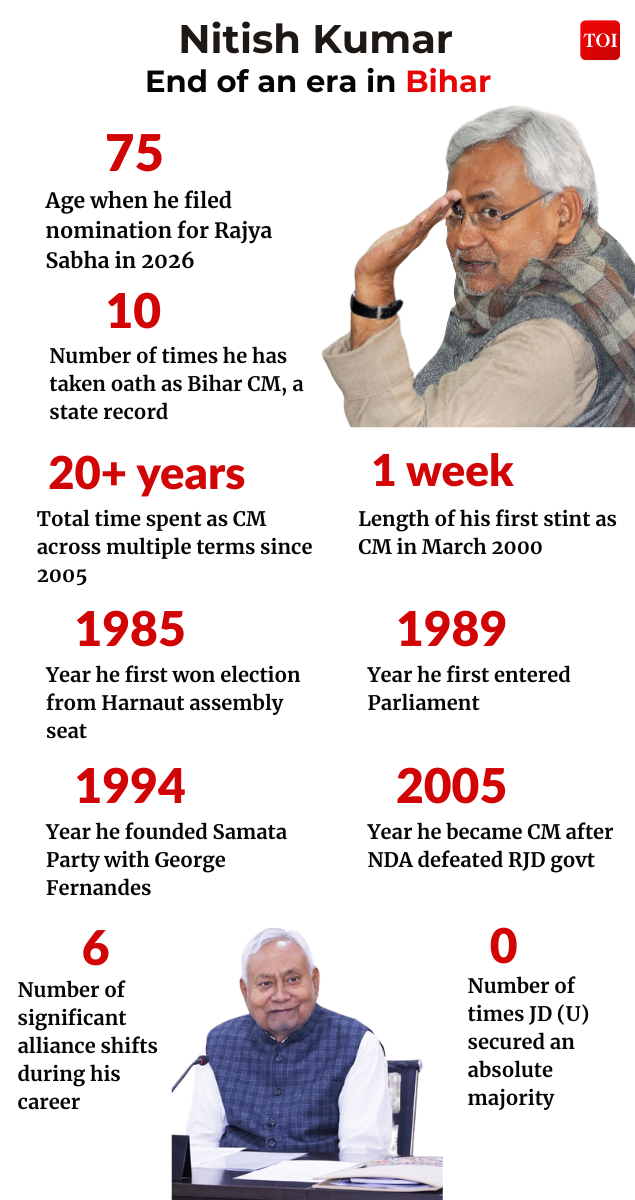
“I seek to become a member of the Rajya Sabha in the elections being held this time. I want to assure you with complete honesty that my relationship with you will continue in the future as well, and my resolve to work together with you to build a developed Bihar will remain steadfast. The new government that will be formed will have my full cooperation and guidance,” the 75-year-old politician wrote on X.
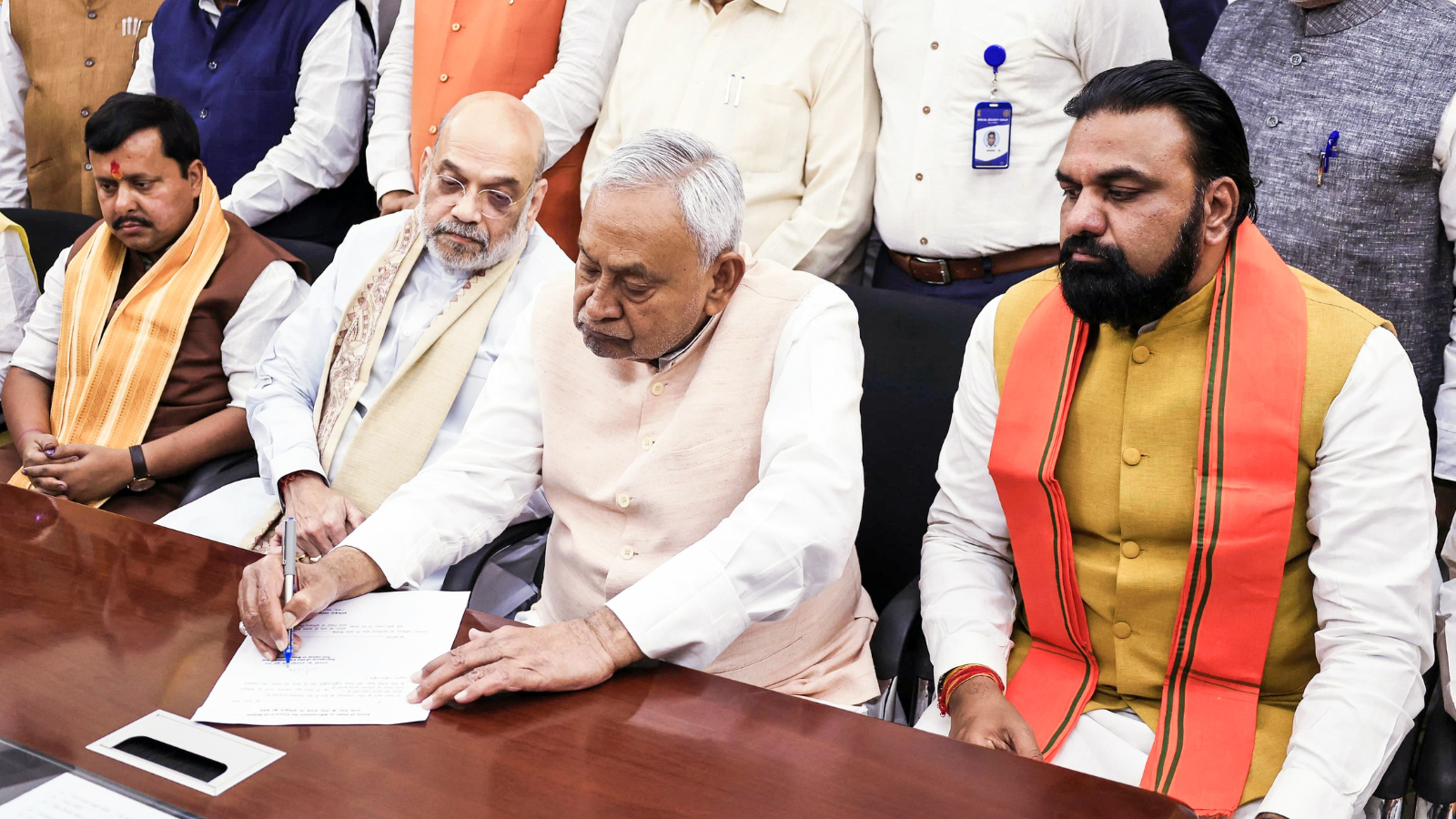
Nitish Kumar filed his nomination papers for Rajya Sabha in Patna on Thursday. (ANI photo)

For nearly two decades, Nitish has been in power in Bihar through coalitions. And one of the most intriguing paradoxes of Nitish’s long political career is that he governed Bihar for longer than any of his predecessors despite never leading a party that secured an outright majority in the state assembly.
End of an era in Bihar.

His party, the Janata Dal (United), consistently relied on alliances with larger or equally powerful partners to remain in government.This unusual political equation made Nitish Kumar a master negotiator.Power in Bihar during his tenure depended not merely on electoral strength but on the ability to stitch together coalitions across caste blocs and ideological divides. Nitish Kumar excelled at precisely that. His ability to maintain political relevance even as the relative strength of his party fluctuated turned him into one of the most skilled negotiator of Indian politics.Supporters often describe this as evidence of his political acumen. Critics, however, argue that his survival depended more on opportunistic alliances than on a stable electoral mandate.Within the JD(U), the reaction to his decision has been one of disbelief.
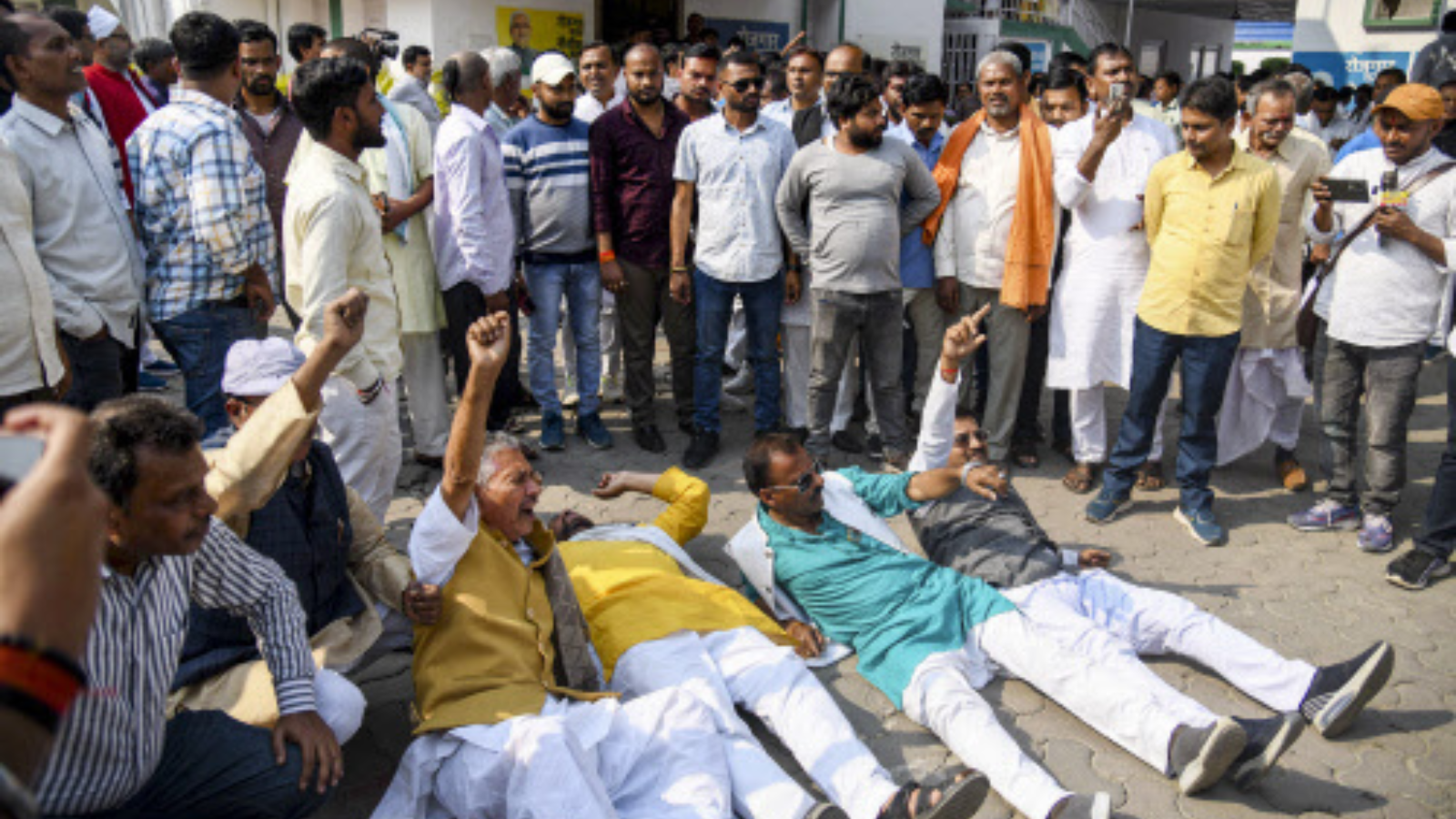
JD(U) workers and supporters staged protest after Nitish Kumar announced that he will be contesting the Rajya Sabha polls. (PTI photo)

Senior party leader and Bihar’s social welfare minister Madan Sahni publicly questioned whether the move truly reflected Nitish Kumar’s personal choice. “We are stunned to see whatever is happening. It is hard to believe that this could have been Nitish Kumar’s own decision,” news agency PTI quoted Sahni as saying.According to Sahni, Nitish Kumar had long expressed a desire to serve in all three legislative arenas of the democracy: the state assembly, the Lok Sabha and the Rajya Sabha. His move to the Upper House, therefore, was being presented as the fulfilment of that ambition.But for many within the JD(U), the transition felt less like a voluntary decision and more like the end of an era forced by changing political realities.Outside the party office in Patna, JD(U) workers gathered in anger and disbelief. Police were deployed to prevent supporters from marching toward the chief minister’s residence.Some refused to believe that the leader they had followed for decades would step down so abruptly.For years, even political rivals acknowledged Nitish Kumar’s stature. The late Sushil Kumar Modi, one of the BJP’s most prominent leaders in Bihar, had once described him as “prime minister material.”To many supporters, therefore, his exit from the chief minister’s office feels like a fall from a position once seen as nationally significant.Opposition leaders, however, see the moment differently.Tejashwi Yadav, leader of the opposition and son of Lalu Prasad Yadav, argued that Nitish Kumar’s predicament was the result of his own political decisions.“The BJP has done a Maharashtra in Bihar,” Tejashwi said, referring to controversial power shifts seen in other states. “But Nitish Kumar has only himself to blame. While in alliance, we supported him as chief minister despite having more MLAs, but he chose to walk away on two occasions.”

Entry into politics

Nitish Kumar was born on March 1, 1951, in Bakhtiarpur in Bihar’s Patna district. His father, Ram Lakhan Singh, was an Ayurvedic practitioner and a freedom fighter who had been associated with the Congress during the independence movement.He studied electrical engineering at the Bihar College of Engineering in Patna, now known as the National Institute of Technology (NIT) Patna. He briefly worked at the Bihar State Electricity Board before turning to politics.Nitish Kumar’s political identity was forged in the turbulence of the 1970s and 1980s.Like many leaders of his generation, he emerged from the socialist movement led by Jayaprakash Narayan during the anti-Emergency agitation. The movement produced a generation of politicians who would dominate north Indian politics for decades.Among them were Nitish Kumar and Lalu Prasad Yadav. Both leaders rose within the same political tradition. Both belonged to backward caste communities empowered by the Mandal revolution of the 1990s.Yet their political styles could not have been more different.
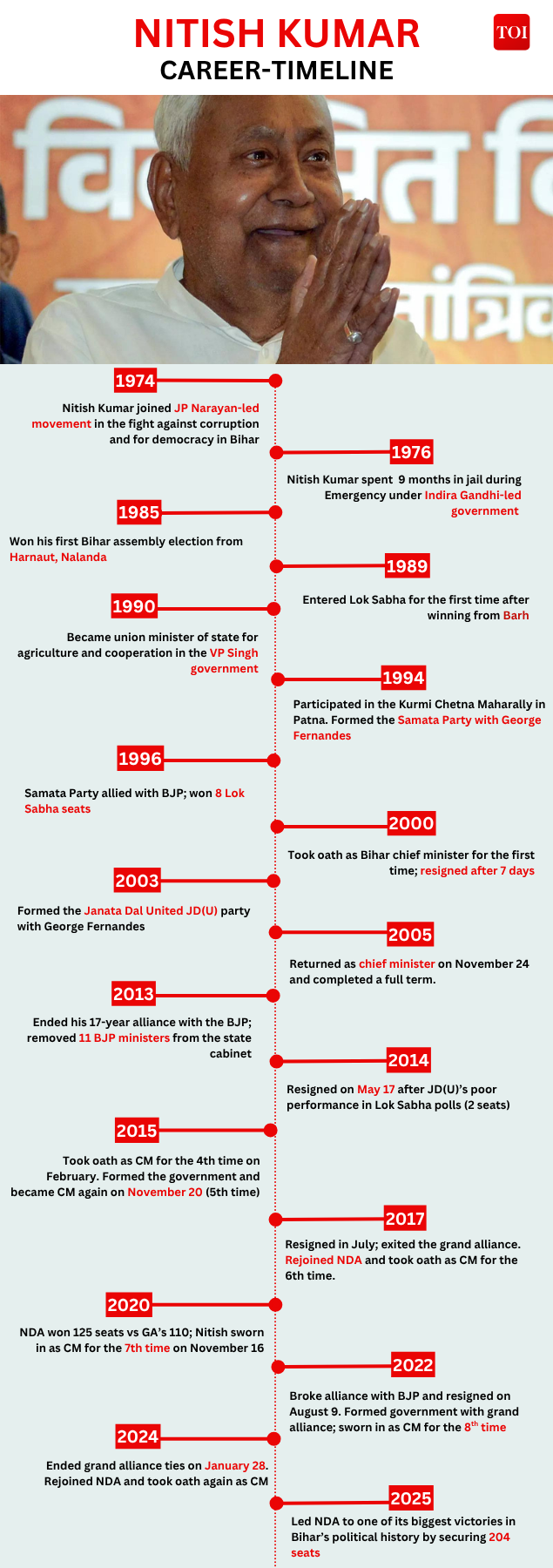
Nitish Kumar timeline

Lalu thrived on mass mobilisation, humour and confrontational politics. Nitish preferred administrative detail, negotiation and strategic positioning.The divergence became clearer as Lalu Prasad Yadav consolidated power in Bihar after becoming chief minister in 1990, following the implementation of the Mandal Commission recommendations by Prime Minister VP Singh.Lalu’s arrest of Lal Krishna Advani during the 1990 Ram Rath Yatra cemented his reputation as a defender of secular politics and a champion of backward caste empowerment.But as Lalu’s popularity grew, Nitish Kumar grew increasingly uneasy with what he saw as the concentration of power within one leader’s personality.In 1995, he finally broke away from the Janata Dal.The split marked the beginning of a long political rivalry that would define Bihar politics for decades.

Experimentation before BJP alliance

After leaving the Janata Dal, Nitish Kumar experimented with several political strategies in his quest to build an alternative to Lalu Prasad Yadav.Along with socialist leader George Fernandes, he founded the Samata Party.In his search for allies, Nitish Kumar briefly explored cooperation with the radical left-wing party CPI(ML) Liberation, which was then an emerging political force in parts of Bihar.The experiment reflected Kumar’s ideological roots in socialist politics. But the attempt soon revealed the limits of ideological alliances in a state where electoral arithmetic was dominated by caste coalitions.
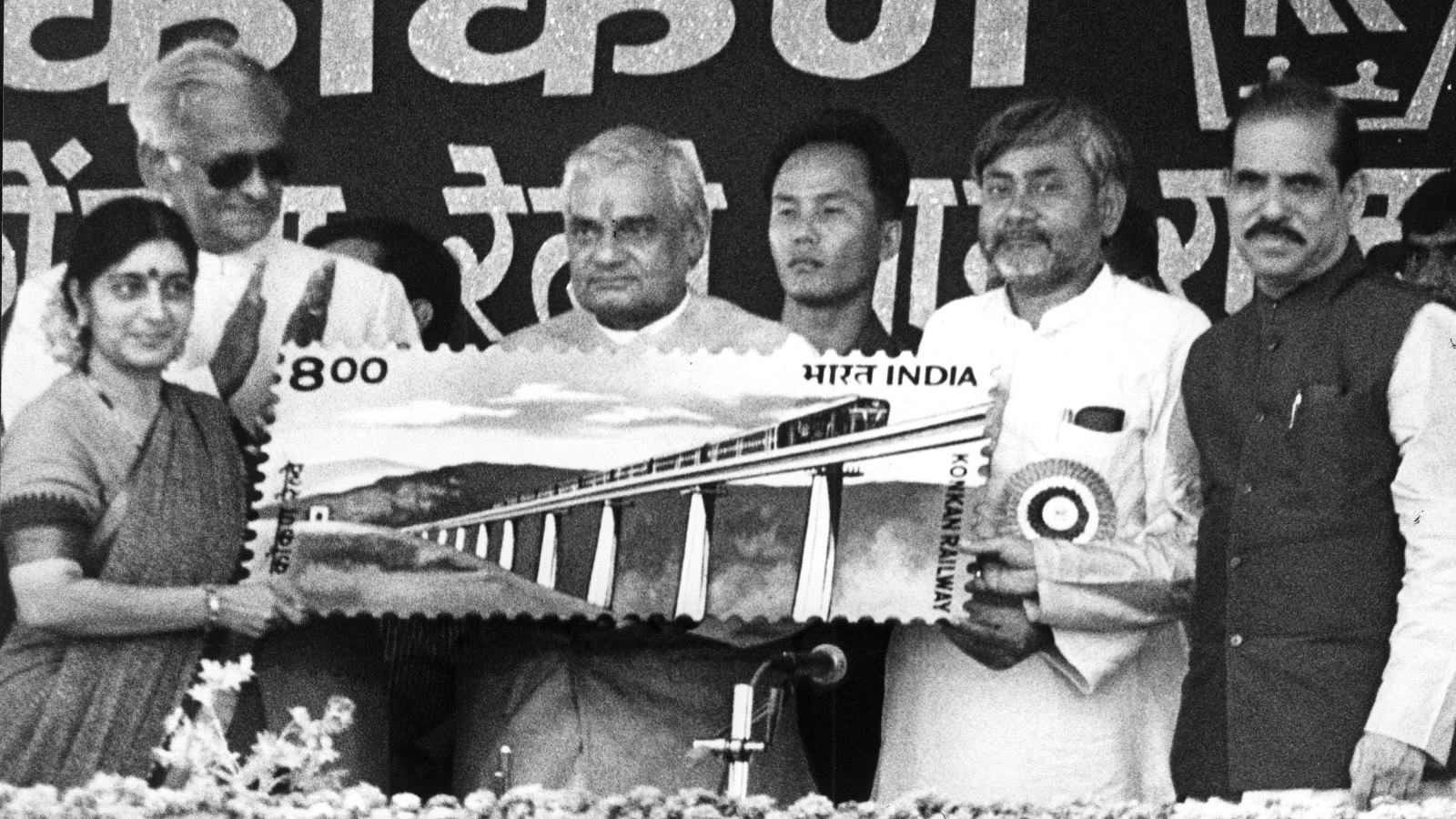
He entered the Vajpayee cabinet, holding the railway ministry and other portfolios from 1998–2004.

Nitish Kumar eventually concluded that defeating Lalu Prasad Yadav required a broader political alliance.That calculation led him toward the Bharatiya Janata Party (BJP). In 1996, he contested the Lok Sabha elections as part of an alliance with the BJP.

The creation of JD(U)

One of Nitish Kumar’s most consequential political moves came when he persuaded veteran socialist leader Sharad Yadav to unite their factions.The merger created the Janata Dal (United).The new party became the central pillar of the BJP-led National Democratic Alliance in Bihar. At the time, the BJP recognised that its own social base in Bihar remained limited. It was widely perceived as a party dominated by upper castes.Nitish Kumar, by contrast, came from the Kurmi community and had credibility among backward caste voters. As a result, the BJP agreed to allow the JD(U) to contest more seats than the BJP itself in the assembly elections of 2005.The strategy proved decisive.After a fractured verdict earlier that year, a fresh election in November 2005 delivered a comfortable victory for the NDA. Nitish Kumar finally became the chief minister.

The longest-serving CM

Over the course of his political career, Nitish Kumar became the longest-serving chief minister in Bihar’s history, holding the office for more than two decades across multiple terms.Kumar first assumed office as chief minister briefly in March 2000, though that government lasted only a week after he failed to prove a majority in the assembly. His enduring tenure began in November 2005, when the alliance between the Janata Dal (United) and the Bharatiya Janata Party secured a clear mandate in the assembly elections.From then on, Kumar remained the central figure in Bihar politics, returning to the chief minister’s office multiple times through changing alliances and political realignments. His long tenure spanned dramatically different political phases — from the early push to restore law and order after the 1990s to the later years of coalition bargaining and shifting alliances.Last year in November, Nitish finally took oath as chief minister of Bihar for a record-extending tenth time.

‘Paltu Ram’: Flip-flops that defined Nitish’s career

If governance made Nitish Kumar a respected administrator, his shifting alliances made him one of the most controversial political figures.His first major break with the BJP came in 2013, when Narendra Modi was elevated within the party and widely expected to become its prime ministerial candidate. Nitish Kumar ended his party’s 17-year alliance with the BJP, arguing that the country required inclusive leadership.But the decision proved politically costly.In the 2014 Lok Sabha elections, the JD(U) suffered a humiliating defeat, winning only two seats in Bihar.Accepting responsibility, Nitish Kumar resigned as chief minister, taking “moral responsibility” for the party’s performance.Yet his political instincts soon resurfaced.Within months, he regained power after installing Jitan Ram Manjhi as chief minister and later replacing him with the support of his former rival Lalu Prasad Yadav.The alliance between the two leaders culminated in the 2015 Mahagathbandhan victory, one of the BJP’s most significant electoral defeats in the Modi era.
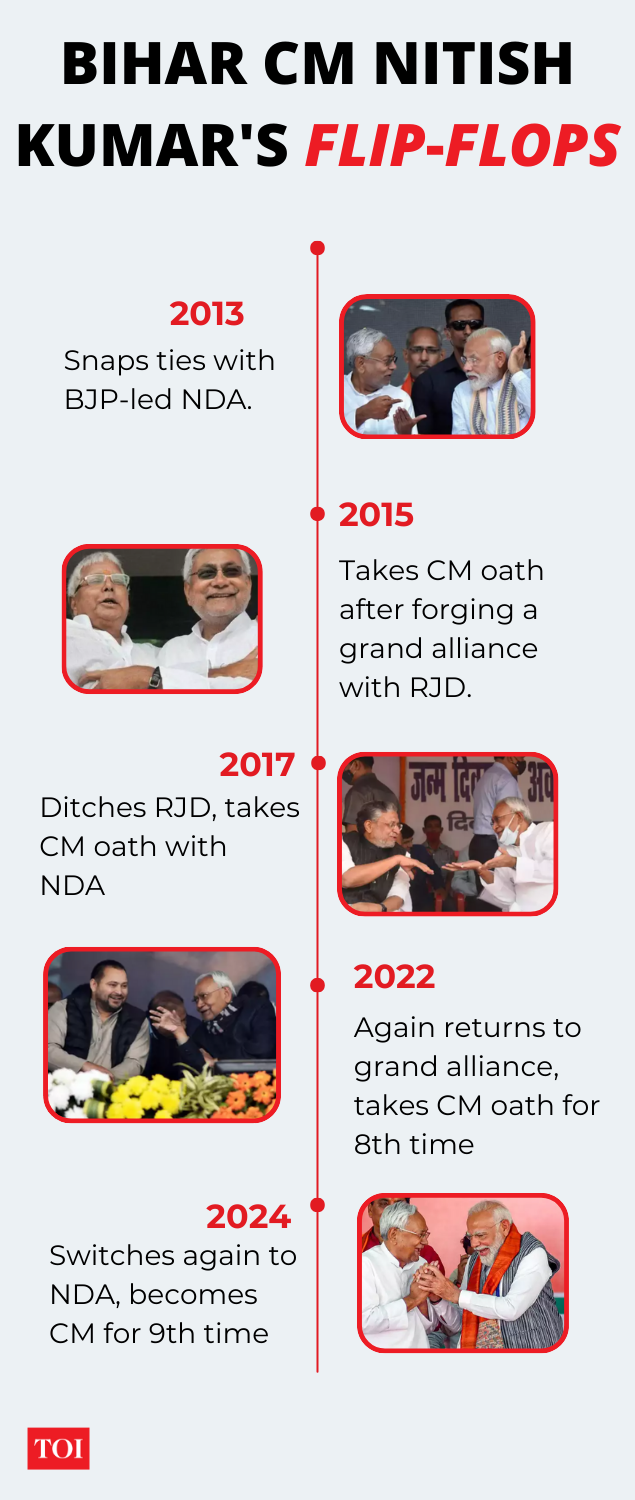
Nitish's flip-flops

But the partnership collapsed in 2017, when Nitish Kumar once again switched sides and returned to the BJP-led NDA.Another shift followed in 2022, when he broke away from the BJP again, only to return to the alliance once more in 2024.The repeated realignments earned him a nickname that became inseparable from his public image: “Paltu Ram.”These flip-flops became one of the defining features of Nitish Kumar’s career.

The ‘Sushasan Babu’ of Bihar

Despite political controversies and shifting alliances, Nitish Kumar built a reputation for governance that earned him the popular nickname ‘Sushasan Babu’, or the man of good governance.When he first assumed office as chief minister in 2005, Bihar faced widespread criticism for poor infrastructure, weak law and order and sluggish economic growth.Nitish’s government focused on improving policing, speeding up criminal trials and expanding road and bridge construction across the state.His administration also launched several social welfare initiatives, including the Mukhyamantri Balika Cycle Yojana, which provided bicycles to schoolgirls to encourage education. The scheme significantly increased enrolment of girls in secondary schools and became one of the most widely cited symbols of his governance model.Other measures included reservations for women in local bodies and government jobs, as well as welfare programmes targeting extremely backward classes and Mahadalits.The masterstroke came after his government banned liquor in the state. The women voters, since then, have rallied behind Nitish making his party a winner every election.These initiatives also helped change Bihar’s governance narrative and restore a sense of administrative stability after years of turmoil and violence.

A CM who rarely fought assembly elections

Another distinctive aspect of Nitish Kumar’s political career has been his repeated use of the Legislative Council route to remain chief minister.After becoming CM in November 2005, Kumar did not contest an assembly election immediately. Instead, he entered the Bihar Legislative Council as a Member of the Legislative Council (MLC), the upper house of the state legislature, allowing him to continue in office without being elected to the assembly.He followed a similar route during subsequent terms, often choosing to remain an MLC rather than contest assembly polls directly. Under the Constitution, a person who is not a member of the legislature can serve as chief minister for six months, within which they must secure membership in either the assembly or the council.Kumar repeatedly used this provision by getting elected or nominated to the Legislative Council, ensuring continuity in office while avoiding the need to contest constituency-level elections.Although he did contest the 2015 Bihar assembly election from the Harnaut seat, winning comfortably, much of his time as chief minister was spent as a member of the legislative council.Supporters say this reflected his role as a statewide leader focused on governance rather than constituency politics. Critics, however, argued that the MLC route allowed him to remain in power while largely avoiding direct electoral contests in the assembly.

The dynasty question

For years, Nitish Kumar distinguished himself from many politicians by criticising “parivaarvaad”, or dynasty politics.He often argued that political leadership should emerge from public service rather than family inheritance.But as his son Nishant Kumar, now in his late forties, prepares to enter public life, that position may face its toughest test. If Nishant formally enters politics, Nitish Kumar could confront the same criticism he once directed at rival leaders.What remains undisputed, however, is his extraordinary ability to remain at the centre of Bihar’s politics for more than three decades.
Source link

IND vs ENG: Rohit Sharma caught chatting with India captain Suryakumar Yadav ahead of toss at T20 World Cup semi-final | Cricket News


IND vs ENG: Rohit Sharma caught chatting with India captain Suryakumar Yadav ahead of toss at T20 World Cup semi-final
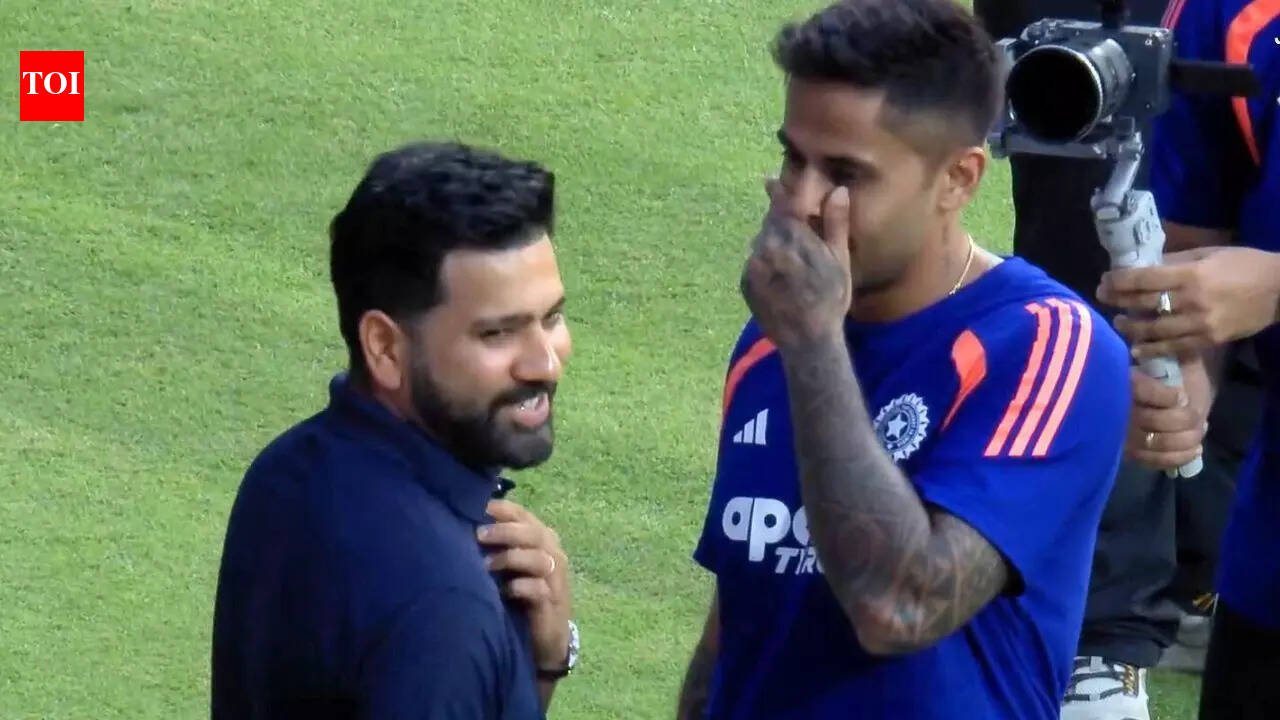
Rohit Sharma and Suryakumar Yadav (Screengrab)

India faced England in the T20 World Cup semi-final at Wankhede Stadium on Thursday, with an interesting moment before the toss as Rohit Sharma, India’s T20 World Cup 2024-winning captain, was seen chatting with current skipper Suryakumar Yadav. The conversation caught the attention of fans and cameras just before the crucial match began.At the toss, England captain Harry Brook won and chose to bowl first. India’s captain Suryakumar Yadav said his team would have preferred to bat as well, believing the pitch looked good and conditions were suitable for batting.“We were looking to bat first. Semifinal, big game, and there’s wind around too. Don’t think there will be much dew. Looks a good one (the pitch). The best one. Credit to all the curators and groundsmen. Same team,” Surya said at the toss.Watch Rohit Sharma attending IND vs ENG T20 World Cup semi-final:Brook explained England’s decision and admitted India had more experience at the venue.“We’re going to have a bowl. Looks like a good wicket, hopefully we can get off to a good start with the ball. They’ve obviously got a lot more experience on this ground than us. T20 cricket is such a fickle game, you never know what’s going to happen. Hopefully we can keep them quiet (the crowd). Overton comes in for Rehan.”Looking at their journey to the semi-finals, India had a mixed campaign. They started with a narrow win over USA, followed by victories against other teams in the group stage. However, they suffered a heavy loss to South Africa in the Super-8 round before bouncing back with important wins against Zimbabwe and West Indies to secure a place in the last four.England’s path was also uneven at first. They scraped past Nepal, lost to West Indies, and struggled in wins over Scotland and Italy. But their form improved in the Super-8 stage with strong victories against Sri Lanka, Pakistan, and New Zealand, which helped them become the first team to qualify for the semi-finals.At Wankhede, England had played two earlier matches with a 1–1 record, while India had won their only game at the venue against USA by 29 runs. Historically, the two sides are evenly matched at this ground, with England winning in 2012 and India returning the favour in 2025.


Source link

India’s tea exports to UAE, Iran and Iraq face risk amid Strait of Hormuz disruptions


India’s tea exports to UAE, Iran and Iraq face risk amid Strait of Hormuz disruptions

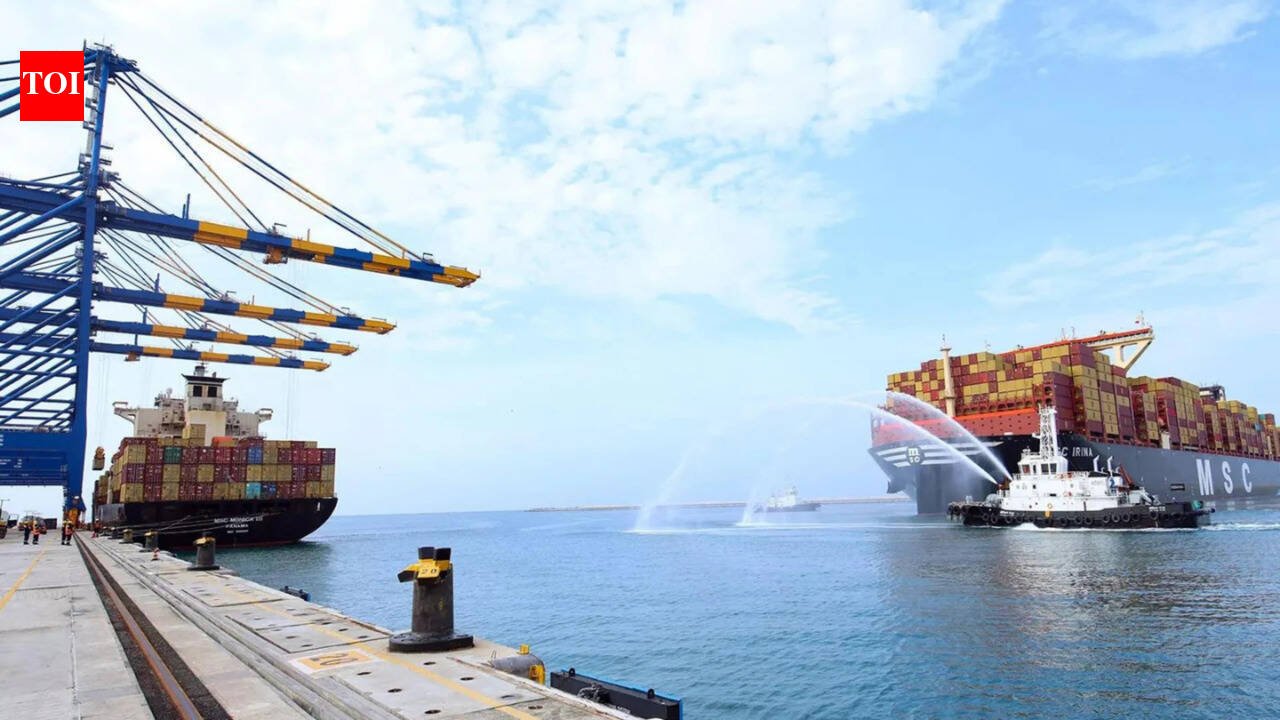
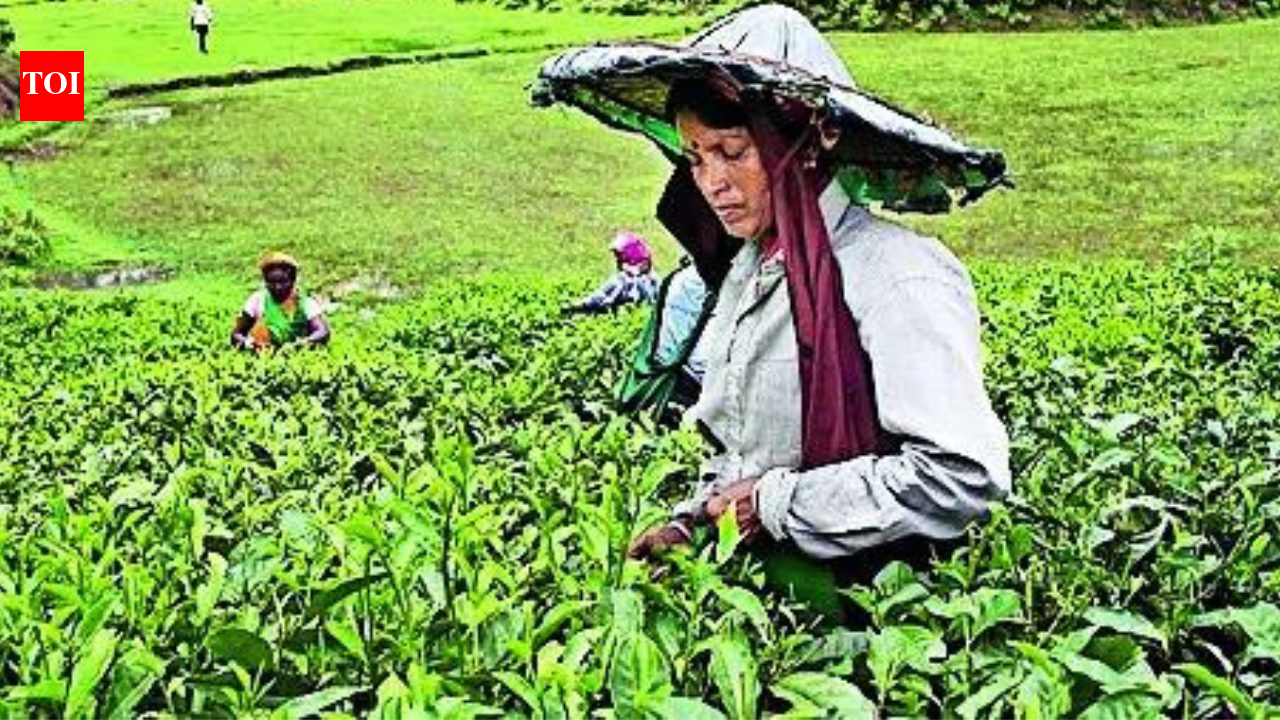
Rising tensions in West Asia and the possibility of disruption to shipping through the Strait of Hormuz could pose a serious threat to India’s tea exports to key Gulf markets, industry representatives have warned.The Tea Association of India said a large share of the country’s tea shipments to the Persian Gulf region moves through the strategically important strait, making exports vulnerable if the conflict escalates, reported PTI.

‘Hormuz Is Ours’: Iran Claims U.S. Vessel Attacked In Gulf After Submarine Torpedoes Iranian Warship

The association noted that major destinations for Indian tea in the region include Iraq, Iran, Kuwait, Saudi Arabia, Bahrain, Qatar and the United Arab Emirates.Iran has stated that vessels will not be allowed to pass through the strait except those carrying Chinese cargo, raising concerns for global trade routes.According to the Tea Association of India, the country exported about 280 million kg of tea in 2025. Of this, nearly 41 per cent — around 115 million kg — was shipped to the UAE, Iran and Iraq.“Therefore, any disruption or suspension of trade through the Strait of Hormuz due to the ongoing war will have a serious impact on Indian tea exports,” Tea Association of India President Shailja Mehta said in a statement.The association said the recent rise in India’s tea exports has been largely driven by higher shipments of orthodox teas, particularly from Assam.Around 50 per cent of Assam orthodox tea exports are destined for markets such as Iran, Iraq and the UAE, making the segment particularly exposed to any disruptions in shipping through the Gulf region.The industry body also pointed out that the Assam government recently increased the subsidy for orthodox tea production from Rs 10 per kg to Rs 15 per kg, a move expected to boost exports.However, the ongoing conflict in West Asia could undermine the expected gains.“Amid reports of possible closure of the Strait of Hormuz, even though there are assurances from the US on insurance coverage and keeping the route open, the outlook for Indian tea exports appears grim for now,” Mehta added.


Source link

TechGig announces ‘she builds the future 2026’: A high-impact leadership initiative redefining the technology landscape | India News


TechGig announces ‘she builds the future 2026’: A high-impact leadership initiative redefining the technology landscape

NEW DELHI: March 5, 2026 – TechGig, India’s largest community of over 5.6 million developers and tech enthusiasts, today announced its flagship International Women’s Day initiative: “She Builds the Future: Power, Presence & Progress.” Scheduled for 7–8 March 2026, this two-day virtual leadership summit moves beyond symbolic celebration to address the critical need for robust leadership pipelines in a rapidly evolving global economy.As AI, automation, and hybrid work models redefine the corporate world, TechGig’s initiative focuses on the practical mechanics of leadership. The event brings together a powerhouse lineup of women leaders from global giants including Fiserv, Wipro, Siemens, Wells Fargo, and OpenText to discuss scaling high-performance teams and driving measurable business outcomes.“Leadership today is no longer defined solely by hierarchy; it is characterized by influence, visibility, and measurable progress,”Shalini Tewari, Head of TechGig & Chief Operating Officer – CoolBoots Media. “‘She Builds the Future’ is conceptualized to spotlight the next generation of leaders who are navigating shorter product cycles and distributed teams with vision and resilience.”A two-day roadmap (7–8 March)The initiative, hosted via the Airmeet platform, features three core sessions designed for engineering leads, HR professionals, and aspiring executives:

  • Opening Panel (7th March, 12:00 PM IST): Focuses on progress and gaps in engineering, data, and business excellence with leaders from Fiserv, Nucleus Software, Wipro, Siemens, and GlobalLogic.
  • Cross Talk (8th March, 11:30 AM IST): An intimate conversation on executive presence and cross-functional influence featuring senior leaders from OpenText and C5i.
  • Closing Panel (8th March, 4:00 PM IST): A forward-looking session on building future-ready organizations with experts from Wells Fargo, Societe Generale GSC, Epsilon India, and CoolBoots Media.

Continuing the momentum throughout Women’s Day month, TechGig will host an exclusive podcast session on 16th March 2026 featuring Harnidh Kaur. The session, titled “Building AI-Ready, Future-Proof Careers: Why Women Must Lead the AI Shift,” will dive deep into how women can position themselves at the forefront of the technological transition to AI.Why it matters in 2026With the tech ecosystem evolving faster than ever, “She Builds the Future” focuses on three defining pillars:

  • Power: Strategic influence and decision-making authority.
  • Presence: Credibility and visibility in high-stakes environments.
  • Progress: Building cultures that foster sustainable, long-term growth.

Registration and participationRegistrations for the summit and subsequent sessions are now open to engineering leaders, HR professionals, and stakeholders across the enterprise ecosystem.To register, visit: https://www.techgig.com/she-builds-the-future-2026


Source link

Rashid Khan sacked as Afghanistan’s captain after poor T20 World Cup show; replacement named | Cricket News


Rashid Khan sacked as Afghanistan's captain after poor T20 World Cup show; replacement named

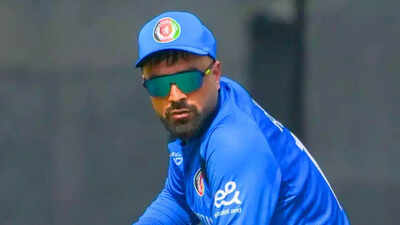
NEW DELHI: Ibrahim Zadran has been appointed the new T20I captain of the Afghanistan national cricket team for the upcoming white-ball series against Sri Lanka national cricket team. The decision was announced by the Afghanistan Cricket Board after the team’s disappointing performance in the ICC Men’s T20 World Cup 2026, where Afghanistan were eliminated in the league stage. Zadran replaces star leg-spinner Rashid Khan, who previously led the team in the format.

Stars shine at Arjun Tendulkar’s Sangeet | Mumbai witnesses grand celebration

Zadran had been serving as vice-captain and now steps into the leadership role as part of broader changes within the team following the tournament. Explaining the decision, chief selector Ahmad Shah Sulimankhil said, “Rashid Khan’s tenure as the T20I captain brought immense success to the team, particularly highlighted by the team’s remarkable journey in the 2024 edition of the T20 World Cup, where we reached the semi-finals.”He added that the move is part of a long-term plan for the team’s future. “In alignment with the ACB’s long-term strategic vision and following recent changes in our Team Management, including the appointment of a new head coach, we have made the thoughtful decision to transition the leadership within the T20I setup,” he continued.“Ibrahim Zadran, who has served as Rashid Khan’s deputy, will assume the role as Afghanistan’s regular captain in this format. We extend our heartfelt gratitude to Rashid Khan for his valuable contributions and wish Ibrahim Zadran every success in this important new role.”The squad has also seen several changes, with players like Fazal Haq Farooqi, Gulbadin Naib and Mohammad Ishaq left out. Meanwhile, new names such as Noor Rahman, Sharafuddin Ashraf and Fareed Ahmad have been included in the T20I squad.“In addition, our long-term goal is to adequately prepare the team for the upcoming two World Cup events,” he remarked. “We are hopeful that, under this new leadership, the National Team will not only flourish but also showcase outstanding performances and build a strong and competitive bench strength for the crucial challenges that lie ahead.”Meanwhile, the ACB said it is monitoring the regional situation due to the Israel–Iran conflict. The board added, “Although a final decision will be made in a couple of days, the ACB’s initial approach, in coordination with the ECB and venue authorities, is to proceed with the originally scheduled dates. Should circumstances necessitate a change, the ACB will consider exploring alternative options for both the host country and the event schedule.”


Source link

‘Sacred Games’ actress Rajshri Deshpande opens up on battling grade 1 breast cancer post surgery: ‘Recovering beautifully’ | Hindi Movie News


Rajshri Deshpande (Angry Indian Goddesses, Manto) underwent surgery after early breast cancer detection. Instagram update from hospital: “Recovering beautifully,” thanking Dr. Nadkarni. Celebs like Kiran Rao, Lauren Gottlieb cheered; fans wished speedy recovery.

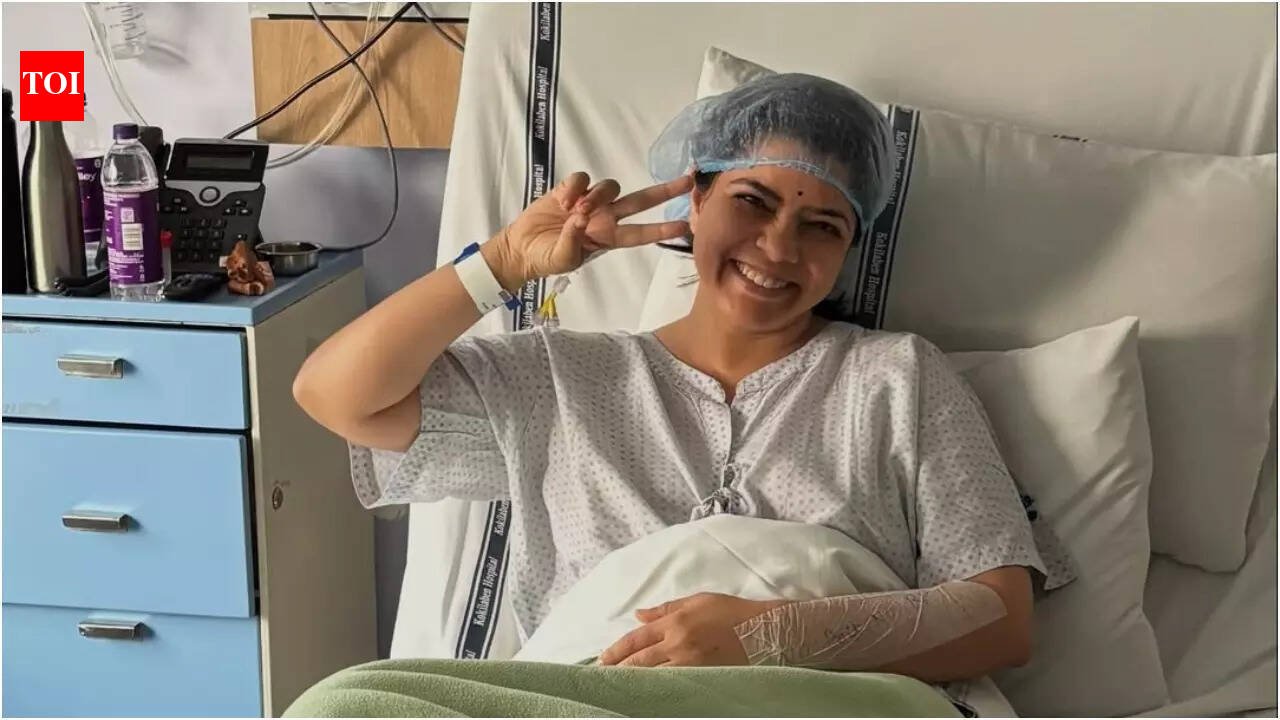
Rajshri Deshpande, the talented actress from ‘Angry Indian Goddesses’, ‘Manto’, and ‘Sacred Games’, recently faced a grade 1 breast cancer diagnosis and underwent surgery. She opened up about it on social media on March 4, sharing that her recovery after the procedure is going beautifully.

Rajshri Deshpande’s hospital update

The actress posted a hospital bed selfie on Instagram, updating fans on her health. She explained that the diagnosis came early during a routine check-up, offering her a ‘fighting chance’. In her caption, she wrote, “As you’re reading this it means I’ve finally found the courage to tell my parents that I have been diagnosed by Infiltrating ductal carcinoma (NOS) a grade 1 Breast cancer. Now it’s time you all know. We fortunately caught this early in a routine checkup which gave us a fighting chance. Tons of tests and surgery felt like a rollercoaster ride , but trust me it was everyone’s love and warmth that carried me through. And seeing my Aai and papa’s faces after surgery melted my fears into unbreakable strength. With everyone’s support I feel am ready to take on the world.”She further thanked her doctor and wrote, “Now, I’m recovering beautifully and soon heading home from the hospital. A huge thank you to Dr. Mandar Nadkarni @nadkarnim (@kokilabenhospital) his expertise and care made this journey far gentler. Your love truly is my greatest medicine. Here’s to healing, hope and all the brighter days ahead.”

Support for Rajshri Deshpande

Deshpande’s heartfelt post quickly drew an outpouring of love from fellow stars in the comments. Kiran Rao penned, “Wishing you a smooth recovery, and hoping you’re back to health and being the champion that you are as soon as possible. All my love.” Lauren Gottlieb cheered, “Sending you so much love you strong woman!!” Adarsh Gourav offered, “Speedy recovery and prayers.” Amruta Khanvilkar added warmth with, “Sending u love n strength my girl.” Even fans joined in, flooding the section with hopes for her swift healing.

Breast Cancer: Early signs of the disease one must never ignore

Rajshri Deshpande’s film career

Rajshri Deshapnde, whose Bollywood journey began with a cameo in the 2012 film ‘Talaash’, most recently starred in Mani Ratnam‘s ‘Thug Life’. The cast also includes heavyweights like Kamal Haasan, Trisha Krishnan, Silambarasan, Aishwarya Lekshmi, and Ashok Selvan.Disclaimer: This article mentions cancer and personal experiences related to the disease, which readers may find sensitive. The information shared is based on personal accounts or reported events and is for general awareness only. It is not intended to substitute for professional medical advice, diagnosis, or treatment. Always seek the advice of a qualified health provider regarding any questions you have about a medical condition.


Source link

3 reasons behind South Africa’s crushing defeat against New Zealand in T20 World Cup 2026 Semi-Final clash


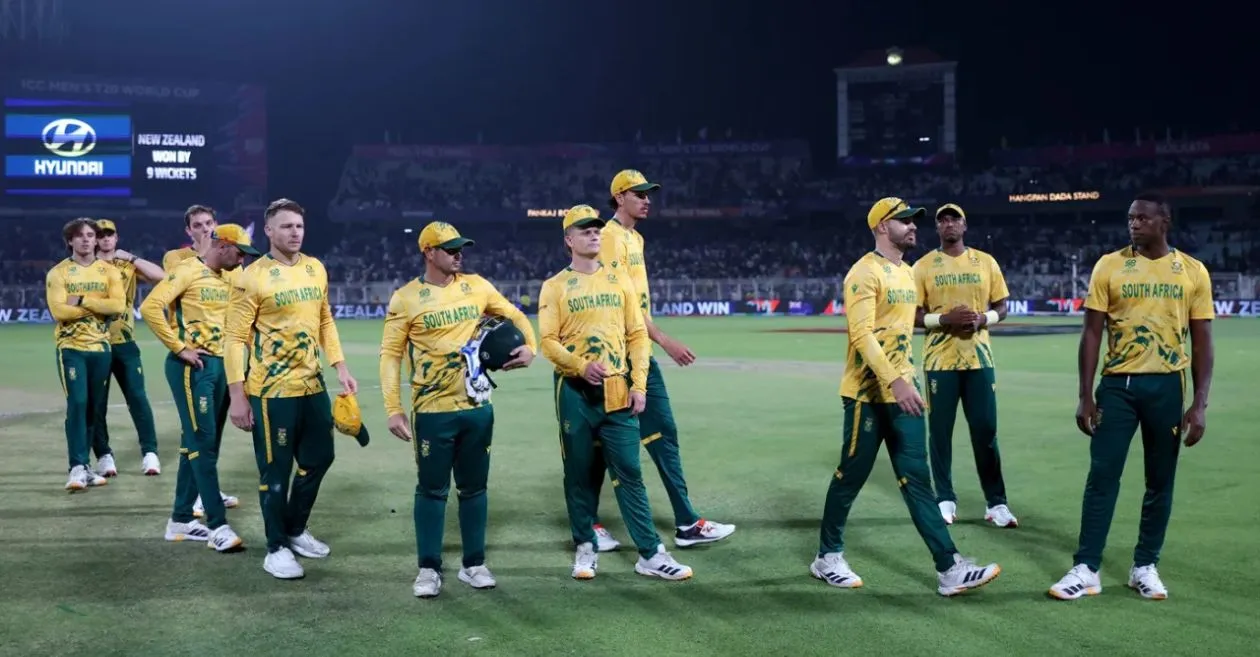
In a stunning turn of events at the iconic Eden Gardens in Kolkata, South Africa’s unblemished run in the T20 World Cup 2026 came to a screeching halt on March 4, 2026. Entering the first semi-final as the heavy favorites, the Proteas were not just defeated; they were dismantled by a clinical New Zealand side that secured a 9-wicket victory with a staggering 43 balls to spare. While South Africa managed to post a fighting 169/8 behind Marco Jansen’s late-innings heroics, the total proved to be mere target practice for a Kiwi batting lineup that seemed to be playing on a different surface altogether.

The loss has once again sparked the ‘chokers’ debate, though head coach Shukri Conrad was quick to dismiss the term, calling the defeat a bloody walloping rather than a collapse under pressure. From a tactical perspective, several factors contributed to this lopsided result that sent the Black Caps into their second T20 World Cup final.

Three primary reasons behind South Africa’s big defeat against New Zealand

  1. Top-order paralysis against tactical spin

The foundation of South Africa’s defeat was laid in the first two overs of the match. Mitchell Santner pulled off a masterstroke by introducing off-spinner Cole McConchie as early as the second over. The gamble paid off instantly as McConchie removed the dangerous Quinton de Kock and Ryan Rickelton on consecutive deliveries. This double-blow left the Proteas reeling at 12/2, stripping them of the aggressive start they had relied on throughout the tournament.

The struggle continued as New Zealand’s spin trio—Santner, McConchie, and Rachin Ravindra—strangled the middle order. The Proteas found it impossible to generate momentum on a pitch that offered subtle grip, crawling to 77/5 by the 11th over. By the time Jansen (55* off 30) and Tristan Stubbs (29) staged a recovery, the damage to the run rate was already terminal.

Also READ: IND vs ENG: Ravichandran Ashwin names the decisive player battle for T20 World Cup 2026 semifinal

  1. The Finn Allen hurricane

If the first half of the match was a slow burn, the second half was an explosion. New Zealand opener Finn Allen produced what many are calling the greatest T20 World Cup innings of all time. Chasing 170, Allen decimated the South African pace attack, reaching his century in a record-breaking 33 balls, the fastest in the history of the T20 World Cup.

Allen’s assault was so comprehensive that it rendered South Africa’s bowling plans obsolete within the powerplay. Alongside Tim Seifert (58 off 33), Allen put on a 117-run opening stand in just 9.1 overs. The sheer velocity of this partnership meant that by the time Kagiso Rabada finally bowled Seifert, the required run rate had plummeted to a point where a New Zealand victory was a mathematical formality.

  1. Failure to adapt to Eden Gardens’ conditions

A subtle but significant reason behind the defeat was South Africa’s inability to adapt to the Kolkata conditions after spending much of the tournament playing in Ahmedabad. Captain Aiden Markram admitted post-match that the team expected the wicket to play more consistently. Instead, the ball stopped and held in the surface during the first innings, catching the South African batters off guard.

In contrast, New Zealand’s bowlers exploited the surface perfectly, using cutters and varying pace to prevent the Proteas from hitting through the line. By the time the dew set in during the chase, making the ball slide onto the bat for Allen and Seifert, South Africa had already left 20–30 runs on the table, a deficit that proved impossible to defend against such an aggressive onslaught.

Also READ: Daryl Mitchell’s catch to dismiss Aiden Markram in T20 World Cup 2026 semi-final triggers debate among fans


Source link

Stock market today: Which are top gainers and losers in Nifty50 and BSE Sensex on March 5? Check list


Stock market today: Which are top gainers and losers in Nifty50 and BSE Sensex on March 5? Check list

Benchmark indices Sensex and Nifty rebounded sharply on Thursday, rising more than 1 per cent as Indian equities tracked a rally in global markets following recent heavy losses triggered by the conflict in West Asia.Snapping a four-session losing streak, the 30-share BSE Sensex surged 899.71 points or 1.14 per cent to close at 80,015.90. During the session, the index climbed as much as 1,187.64 points or 1.50 per cent to 80,303.83.The NSE Nifty also ended higher, gaining 285.40 points or 1.17 per cent to settle at 24,765.90, breaking its three-day decline.

Nifty50 top gainers

  • Adani Ports SEZ (4.53%)
  • L&T (4.03%)
  • Hindalco (3.60%)
  • NTPC (3.35%)
  • RIL (3.31%)
  • Coal India (3.28%)
  • BEL (2.95%)
  • Shriram Finance (2.93%)
  • JSW Steel (2.90%)
  • InterGlobe Aviation (2.73%)

Nifty50 top losers

  • Tech Mahindra (-1.33%)
  • HCL Tech (-0.73%)
  • Kwality Wall’s (-0.60%)
  • ICICI Bank (-0.58%)
  • SBI (-0.43%)
  • TCS (-0.35%)
  • HUL (-0.28%)
  • Eternal (-0.25%)
  • ONGC (-0.22%)
  • Axis Bank (-0.17%)

BSE Sensex top gainers

  • Adani Ports SEZ (4.53%)
  • L&T (4.03%)
  • NTPC (3.35%)
  • RIL (3.31%)
  • BEL (2.95%)
  • InterGlobe Aviation (2.73%)
  • Power Grid (2.57%)
  • M&M (2.57%)
  • Tata Steel (1.96%)
  • Sun Pharma (1.95%)

BSE Sensex top losers

  • Tech Mahindra (-1.33%)
  • HCL Tech (-0.73%)
  • Kwality Wall’s (-0.60%)
  • ICICI Bank (-0.58%)
  • SBI (-0.43%)
  • TCS (-0.35%)
  • HUL (-0.28%)
  • Eternal (-0.25%)
  • Axis Bank (-0.17%)

“Indian equity markets ended the session with over 1 per cent gain, managing to snap a sharp multi-day losing streak. With the Middle East conflict entering its sixth day, uncertainty over whether the situation will move toward resolution or further escalation kept market participants cautious, resulting in a consolidation-driven trading session. The extreme panic that characterised previous sessions began to ease, reflected in India VIX plunging more than 15% from recent highs,” Ponmudi R, CEO of Enrich Money, an online trading and wealth tech firm, said, PTI quoted.Broader markets also ended higher. The BSE smallcap index advanced 1.74 per cent, while the midcap index gained 1.36 per cent.Among sectoral indices, services rose the most by 2.84 per cent, followed by utilities (2.58 per cent), power (2.41 per cent), metal (2.32 per cent), industrials (2.32 per cent), auto (1.95 per cent), realty (1.91 per cent), energy (1.83 per cent) and commodities (1.72 per cent).Information Technology and BSE Focused IT were the only laggards.On the BSE, 2,803 stocks advanced, while 1,453 declined and 141 remained unchanged.Asian markets also ended higher. South Korea’s Kospi rebounded sharply by 9.63 per cent, while Japan’s Nikkei 225, China’s Shanghai SSE Composite and Hong Kong’s Hang Seng index also closed with gains.European markets were trading higher, while US markets had ended Wednesday’s session in positive territory.Foreign Institutional Investors (FIIs) sold equities worth Rs 8,752.65 crore on Wednesday, while Domestic Institutional Investors (DIIs) bought stocks worth Rs 12,068.17 crore, according to exchange data.


Source link

India in ‘comfortable position’ on energy amid Middle East crisis; Australia, Canada offer gas supplies: Report


India in ‘comfortable position’ on energy amid Middle East crisis; Australia, Canada offer gas supplies: Report

NEW DELHI: India on Thursday reiterated that it’s in a comfortable position with regards to energy supply, amid the Middle East tensions.Country’s energy situation is being reviewed twice a day and remains in a comfortable position on energy security despite the escalating tensions in West Asia, government sources, cited by ANI, said.Officials maintained that there is no global shortage of crude oil, LNG or LPG, and India continues to engage with multiple suppliers to ensure steady inflows. Only about 40 per cent of India’s crude imports pass through the Strait of Hormuz, reducing the country’s vulnerability to potential disruptions in the region. The remaining 60 per cent is sourced through alternative routes.India currently holds nearly eight weeks of total inventory cover for crude oil and petroleum products, including strategic reserves. This includes approximately 25 days of crude oil stocks and around 25 days of petrol and diesel inventory.ANI sources also said diversified sourcing and adequate reserves have positioned India to manage any short-term supply-side shocks, even as it continues to closely monitor developments in the region.Government sources further clarified that there are no plans to ration petrol or diesel, reiterating that sufficient stocks are available across the country to meet domestic demand. Officials maintained that fuel supplies remain stable and that there is no cause for public concern.Sources also noted that Qatar accounts for nearly 20 per cent of global LNG supplies. QatarEnergy has declared force majeure, a contractual provision that allows a supplier to suspend or reduce obligations due to extraordinary circumstances beyond its control.In this context, GAIL (Gas Authority of India Limited) is also expected to invoke force majeure in order to manage supply commitments and prioritise deliveries to critical sectors.Officials added that these measures are precautionary and aimed at ensuring uninterrupted supplies to essential sectors amid evolving regional uncertainties.

Offers from other countries

Australia and Canada have offered to supply gas to India as New Delhi explores alternative energy sources amid the escalating tensions in West Asia, further stated the government sources.India currently imports around 195 million metric standard cubic metres per day (mmscmd) of gas, of which approximately 60 mmscmd comes from Qatar. With supply risks under watch, the government is actively scouting additional markets to ensure continuity and diversification.Officials said India is also engaging with major oil producers and global traders for crude oil and LPG procurement. Discussions are underway with the International Energy Agency (IEA) and the Organization of the Petroleum Exporting Countries (OPEC) to assess market stability and supply outlook. In parallel, talks with the US are focused on securing insurance coverage for Indian vessels operating in sensitive maritime corridors.As part of its broader diversification strategy, India recently signed new energy agreements with the UAE and the US to strengthen and rebalance its energy basket.Earlier reports also suggested that Russia also also offered help to send crude oil to India. “We have been open to supplying crude oil to India,” said Russian Ambassador Denis Alipov.Additionally, according to a Bloomberg report, ship-tracking data shows that two Russian crude cargoes originally destined for East Asia have changed course and are now headed to India.Vessel monitoring data from Kpler and Vortexa indicate that the two tankers are carrying a combined 1.4 million barrels of Urals crude and are expected to discharge at Indian ports later this week. Earlier voyage signals had pointed to East Asian destinations before the ships altered their route.Read more: Russian crude to rescue! Ships carrying Russia’s oil head to India amid Middle East supply shock – Report


Source link

MS Dhoni to Yuvraj Singh: Cricket’s biggest names attend Arjun Tendulkar’s wedding – Full list | Off the field News


From MS Dhoni to Yuvraj Singh: Cricket’s biggest names attend Arjun Tendulkar’s wedding - Full list
From MS Dhoni to Yuvraj Singh: Cricket’s biggest names attend Arjun Tendulkar’s wedding (Photo- X)

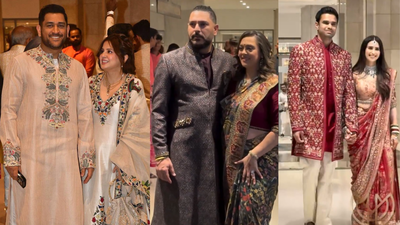
The wedding of Arjun Tendulkar, son of legendary India batter Sachin Tendulkar, turned into a grand gathering of cricket’s biggest names as several stalwarts from across generations arrived in Mumbai on Thursday to celebrate the occasion.Among the most prominent guests was former India captain Mahendra Singh Dhoni, who attended the ceremony with his wife Sakshi Dhoni. Former India all rounder Suresh Raina was also present at the celebrations alongside his wife Priyanka Raina.

Stars shine at Arjun Tendulkar’s Sangeet | Mumbai witnesses grand celebration

India head coach Gautam Gambhir made an appearance at the wedding with his wife Natasha Jain Gambhir, just hours before India’s T20 World Cup semifinal against England cricket team.The guest list also featured several key administrators and cricket officials. Jay Shah, chairman of the International Cricket Council, was among the dignitaries who attended the ceremony. Former India head coach Ravi Shastri arrived with his family, while Rajiv Shukla, vice president of the Board of Control for Cricket in India, was also present.Former India captain and ex head coach Rahul Dravid, who guided India to the ICC Men’s T20 World Cup 2024 title, attended the ceremony with his wife. Veteran commentator Harsha Bhogle was also among the notable guests.Several former India cricketers marked their presence at the celebration. These included Kiran More, Venkatesh Prasad, Ajit Agarkar, who currently serves as India’s chief selector, Zaheer Khan and Ashish Nehra. Current India batter Ajinkya Rahane and former opener turned commentator Aakash Chopra were also present along with their spouses.Former World Cup winning all rounder Yuvraj Singh, Irfan Pathan also joined the celebrations, adding further star power to the gathering of Indian cricket personalities.Arjun tied the knot with Saaniya Chandhok, who comes from a prominent business background. She is the granddaughter of industrialist Ravi Ghai, chairman of the Graviss Group, and has shared a close bond with the Tendulkar family for several years, especially with Arjun’s sister Sara Tendulkar.The 26 year old left arm pacer has played five matches in the Indian Premier League, picking up three wickets during his stint with Mumbai Indians. He was first bought by the franchise in the 2021 mini auction and eventually made his IPL debut in the 2023 season.Arjun later continued with Mumbai Indians across multiple seasons before being traded to Lucknow Super Giants ahead of the IPL 2026 mini auction. He is set to represent the franchise in the upcoming season.Currently playing domestic cricket for the Goa cricket team after making his debut for the Mumbai cricket team in 2021, Arjun now begins a new chapter in his personal life with a wedding that brought together some of the biggest names in Indian cricket.


Source link