Breaking News
BFI selection criteria questioned after female boxers allege favouritism | Boxing News


BFI selection criteria questioned after female boxers allege favouritism
File picture of Neeraj Phogat (PTI Photo)

NEW DELHI: The Boxing Federation of India’s (BFI) selection criteria to pick the national team for the forthcoming Asian Championships in Ulaanbaatar on Monday ran into a controversy after two leading female boxers, Neeraj Phogat and Jyoti Gulia, alleged favouritism and manipulation of results in the selection of the 20-member contingent for the continental meet, scheduled from March 28 to April 11 in the Mongolian capital. Go Beyond The Boundary with our YouTube channel. SUBSCRIBE NOW!As per the BFI’s policy, the finalists at the Asian meet in approved weight categories will be selected as India’s direct entries for the Glasgow CWG and Aichi-Nagoya Asian Games, to be held later this year. Both Neeraj and Jyoti missed out on selection for the Ulaanbaatar meet after failing a month-long evaluation test conducted by the BFI. The federation discontinued the practice of holding an open selection trial for boxers, as had been the norm, and instead introduced a performance-based assessment process, where the BFI officials and coaches have a final say. Former Youth World champion Jyoti finished third in rankings behind Nikhat Zareen and Nitu Ghanghas in the 51kg category. World Boxing Cup (WBC) Finals’ bronze winner Neeraj lost her place in the national camp after finishing outside the ranking bracket in her 65kg weight division. The four boxers selected in her weight class were Ankushita Boro, Sneha, Pranjal Yadav and Kajal. “While certain procedures may appear compliant with BFI guidelines on paper, in practice, there is evident favouritism, manipulation, and misuse of authority. Policies are being drafted and implemented in a manner that disproportionately benefits certain preferred boxers, particularly from the Services team, thereby compromising transparency and fairness in the selection process,” Neeraj wrote in her complaint to SAI director general (DG) Hari Ranjan Rao. “I request your office to order a thorough and impartial inquiry into the above-mentioned irregularities; constitute a high-level independent committee to investigate the selection procedures and review and revoke the current evaluation process and reinstate transparent open trials,” she added. Jyoti, too, wrote a mail to Target Olympic Podium Scheme (TOPS) CEO, N S Johal, and requested a review of assessment and trial bouts while alleging favouritism. “During the competition trials, I convincingly outperformed my opponents with a clear margin (approximately 15–20 points), which can be objectively verified through the official video recordings. Despite these performances, I was placed at Rank 3 in my weight category. This outcome has caused me serious concern, as it does not appear to reflect the performance demonstrated during both the assessment tests and the trial bouts. In the interest of fairness and justice, I request a thorough and impartial review of my trial videos, assessment scores, and evaluation criteria applied in my case,” she said.


Source link

Asian stocks today: Nikkei falls over 1,400 points, Kospi plunges 4%; markets continue to fall amid Middle East tensions


Asian stocks today: Nikkei falls over 1,400 points, Kospi plunges 4%; markets continue to fall amid Middle East tensions

Asian stocks plunged on Tuesday as investors reacted to the ongoing tensions in Iran and its potential impact of regional energy supplies. In Hong Kong, HSI was down 74 points or 0.29% to 25,985. South Korea’s Kospi index also opened sharply lower after Monday’s holiday, plunging 4.88% to 5,939.Shanghai and Shenzhen also fell 0.07% and 1.05% respectively. Japan’s Nikkei 225 declined 2.4% or 1,427 points, landing at 56,629 by 10:10 am. Analysts noted that Japan, which relies heavily on oil and natural gas shipments through the Strait of Hormuz, could face supply challenges. However, the country’s stockpile of over 200 days of energy means the immediate threat remains limited. Japanese energy shares were hit particularly hard, with Eneos Corp. falling nearly 6% and Idemitsu Kosan down almost 4%. Defence stocks, which had recently gained on expectations of increased spending under Prime Minister Sanae Takaichi, retreated, with Mitsubishi Heavy Industries down 5% and IHI losing 4%. Oil prices continued to climb amid concerns over supply disruptions. Benchmark US crude rose 77 cents to $72.00 a barrel, while Brent crude added $1.10 to $78.84 a barrel. Both contracts remain higher than pre-conflict levels despite Monday’s fluctuations. On Wall Street trading, airline stocks were among the hardest hit, pressured by rising fuel costs and regional travel disruptions. In Asia, ANA shares fell 2.4%, Japan Airlines dropped 5.2%, Korean Air lost 8.9%, and Qantas Airways declined 2.9%. On Monday, the S&P 500 fluctuated but ended nearly unchanged at 6,881.62. The Dow Jones Industrial Average dipped 0.1% to 48,904.78, while the Nasdaq rose 0.4% to 22,748.86. Gold climbed 1.2% as investors sought safer assets, while US officials reassured markets that the conflict is unlikely to be prolonged. Rising oil prices boosted energy stocks, with Exxon Mobil up 1.1% and Marathon Petroleum rising 5.9%. Defence contractors also strengthened: Northrop Grumman climbed 5.9%, RTX gained 4.7%, and Palantir Technologies rose 5.8%. Nvidia led Big Tech gains with a 2.9% increase. In the bond market, the 10-year Treasury yield rose to 4.04% from 3.97%, aided by stronger-than-expected US manufacturing data. In currencies, the US dollar slipped to 157.32 yen from 157.47 yen, while the euro inched up to $1.1693 from $1.1690.


Source link

Amazon update on fire at two datacentres in UAE and one in Bahrain, ‘admits’ drone attacks; warns: Instability is likely to continue, making operations …


Amazon update on fire at two datacentres in UAE and one in Bahrain, 'admits' drone attacks; warns: Instability is likely to continue, making operations ...

Amazon acknowledged late Monday, March 3, that two of its data centers in the United Arab Emirates (UAE) and a facility in Bahrain were damaged by drone strikes, taking the facilities offline. Amazon Web Services (AWS) update at 7:19 p.m. EST said that the outages were caused by drone strikes tied to the “ongoing conflict in the Middle East.” AWS said, “In the UAE, two of our facilities were directly struck, while in Bahrain, a drone strike in close proximity to one of our facilities caused physical impacts to our infrastructure.” It added, “These strikes have caused structural damage, disrupted power delivery to our infrastructure, and in some cases required fire suppression activities that resulted in additional water damage.”The company warned that instability is likely to continue in the Middle East, making operations “unpredictable.” AWS added notices to the top of its marketplaces in Israel, Saudi Arabia, Kuwait, Bahrain and the UAE alerting customers of an “extended delivery time in your area.”The incident occurred March 1 morning, with the company posting to its Amazon Web Services health dashboard at the time that “objects” hit data centers in the UAE, causing “sparks and fire”. In an update to its AWS health dashboard, the company said that two facilities in the United Arab Emirates were “directly struck” by drones on Sunday, causing extensive damage. A site in Bahrain was damaged due to a drone strike that occurred nearby.

Operational issue – Multiple services (UAE); Services impacted: Multiple services; Severity: Disrupted

Mar 02 4:19 PM PST: We are providing an update on the ongoing service disruptions affecting the AWS Middle East (UAE) Region (ME-CENTRAL-1) and the AWS Middle East (Bahrain) Region (ME-SOUTH-1). Due to the ongoing conflict in the Middle East, both affected regions have experienced physical impacts to infrastructure as a result of drone strikes. In the UAE, two of our facilities were directly struck, while in Bahrain, a drone strike in close proximity to one of our facilities caused physical impacts to our infrastructure. These strikes have caused structural damage, disrupted power delivery to our infrastructure, and in some cases required fire suppression activities that resulted in additional water damage. We are working closely with local authorities and prioritizing the safety of our personnel throughout our recovery efforts.In the ME-CENTRAL-1 (UAE) Region, two of our three Availability Zones (mec1-az2 and mec1-az3) remain significantly impaired. The third Availability Zone (mec1-az1) continues to operate normally, though some services have experienced indirect impact due to dependencies on the affected zones. In the ME-SOUTH-1 (Bahrain) Region, one facility has been impacted. Across both regions, customers are experiencing elevated error rates and degraded availability for services including Amazon EC2, Amazon S3, Amazon DynamoDB, AWS Lambda, Amazon Kinesis, Amazon CloudWatch, Amazon RDS, and the AWS Management Console and CLI. We are working to restore full service availability as quickly as possible, though we expect recovery to be prolonged given the nature of the physical damage involved.In parallel with efforts to restore the physical infrastructure at the affected sites, we are pursuing multiple software-based recovery paths that do not depend on the underlying facilities being fully brought back online. For Amazon S3 and Amazon DynamoDB, we are actively working to restore data access and service availability through software mitigations, including deploying updates to enable S3 to operate within the current infrastructure constraints and remediating impaired DynamoDB tables to restore read and write availability for dependent services. Our focus on restoring these foundational services is deliberate, as recovery of Amazon S3 and Amazon DynamoDB will in turn enable a broad range of dependent AWS services to recover. For other affected service APIs, we are deploying targeted software updates to reduce error rates and restore functionality where possible, independent of the physical recovery timeline. We are also working to restore access to the AWS Management Console and CLI through network-level changes that route traffic away from the affected infrastructure. While these software-based mitigations can address many of the service-level impacts, some recovery actions are constrained by the physical state of the affected facilities — meaning that full restoration of certain services will require the underlying infrastructure to be repaired and brought back online. Across all services, our teams are working in parallel on both the physical restoration of the affected facilities and these software-based mitigations, with the goal of restoring as much customer access as possible as quickly as possible, even ahead of full infrastructure recovery. In addition, we are prioritizing the restoration of services and tools that enable customers to back up and migrate their data and applications out of the affected regions.Finally, even as we work to restore these facilities, the ongoing conflict in the region means that the broader operating environment in the Middle East remains unpredictable. We recommend that customers with workloads running in the Middle East consider taking action now to backup data and potentially migrate your workloads to alternate AWS Regions. We recommend customers exercise their disaster recovery plans, recover from remote backups stored in other regions, and update their applications to direct traffic away from the affected regions. For customers requiring guidance on alternate regions, we recommend considering AWS Regions in the United States, Europe, or Asia Pacific, as appropriate for your latency and data residency requirements.We will continue to provide updates as recovery progresses and as the situation evolves. Our next update will be provided by 9:00 PM PST on March 2, 2026, or sooner if new information becomes available.Mar 02 1:36 PM PST: We continue to work towards recovery of the two impaired Availability Zones (mec1-az2 and mec1-az3) in the ME-CENTRAL-1 Region. We have partially restored access to the AWS Management Console, however, some pages will continue to load unsuccessfully until we have recovered core services and power. In parallel to the power and recovery efforts, we are working to restore access to tools and utilities to allow customers to backup and migrate their data. We have no updated guidance on expected recovery times, and still expect this to take at least a day to fully restore power and connectivity. We continue advising customers enact their disaster recovery plans and recover from remote backups into alternate AWS Regions. We will provide you with another update by 6:00 PM PST, or sooner if new information becomes available.Mar 02 9:59 AM PST: We continue to work towards recovery of the two impaired Availability Zones (mec1-az2 and mec1-az3) in the ME-CENTRAL-1 Region. The impact is causing elevated errors rates for both the Management Console and CLI. Our current expectation is that recovery will take at least a day to complete. We continue to recommend customers enact their disaster recovery plans and recover from remote backups into alternate AWS Regions. We will continue to provide periodic updates on recovery efforts. Our next update will be by 2:00 PM PST or sooner if new information becomes available.Mar 02 6:22 AM PST: We continue to work towards recovery of the two impaired Availability Zones (mec1-az2 and mec1-az3) in the ME-CENTRAL-1 Region. We are expecting recovery to take at least a day, as it requires repair of facilities, cooling and power systems, coordination with local authorities, and careful assessment to ensure the safety of our operators. EC2, Amazon DynamoDB and other AWS Services continue to experience significant error rates and elevated latencies.We recommend customers enact their disaster recovery plans and recover from remote backups into alternate AWS Regions, ideally in Europe. Further, we strongly advise customers to update their applications to ingest S3 data to an alternate AWS Region. We will provide an update by 11:00 AM PST on March 2, or sooner if we have additional information to share.Mar 02 2:53 AM PST We wanted to provide more information on Amazon S3 given that there are two impaired Availability Zones (mec1-az2 and mec1-az3) in the ME-CENTRAL-1 Region. Amazon S3 is a regional service and designed to withstand the total loss of a single Availability Zone while maintaining S3’s durability and availability. When the mec1-az2 AZ was powered off at approximately 4:00 AM PST on Sunday, March 1, S3 continued to operate normally. As the second AZ became impaired, S3 error rates increased. With two Availability Zones significantly impacted, customers are seeing high failure rates for data ingest and egress. We strongly advise customers to update their applications to ingest S3 data to an alternate AWS Region. As soon as practically possible, we will begin the restoration of our two Availability Zones which will include a careful assessment of data health and any repair of storage if necessary.In addition, we can confirm that the AWS Management Console and command line interface (CLI) are disrupted by the failure of two Availability Zones. We continue to work towards recovery across all services, and we will provide an update by 6:00 AM PST on March 2, or sooner if we have additional information to share.Mar 02 12:52 AM PST: We continue to work on a localized power issue affecting multiple Availability Zones in the ME-CENTRAL-1 Region (mec1-az2 and mec1-az3). Customers are experiencing increased EC2 API errors and instance launch failures across the region, and it is not currently possible to launch new instances; existing instances in mec1-az1 should not be affected. Amazon DynamoDB and Amazon S3 are also experiencing significant error rates and elevated latencies. We are actively working to restore power and connectivity, after which we will begin recovery of affected resources; full recovery is still expected to be many hours away. We recommend that affected customers failover, and backup any critical data, to another AWS Region. We will provide an update by 2:00 AM PST, or sooner if the situation changes.Mar 01 10:46 PM PST: We can confirm that a localized power issue has affected another Availability Zone in the ME-CENTRAL-1 Region (mec1-az3). Customers are also experiencing increased EC2 APIs and instance launch errors for the remaining zone (mec1-az1). At this point it is not possible to launch new instances in the region, although existing instances should not be affected in mec1-az1. Other AWS Services, such as DynamoDB and S3 are also experiencing significant error rates and latencies. We are actively working to restore power and connectivity, at which time we will begin to work to recover affected resources. As of this time, we expect recovery is multiple hours away. For customers that can, we recommend failing away to another AWS Region at this time. We will provide an update by 12:00 AM PST, or sooner if we have additional information to share.Mar 01 9:59 PM PST: We are investigating additional connectivity issues and error rates in the ME-CENTRAL-1 Region.Mar 01 6:01 PM PST We confirm the recovery of the AssociateAddress API requests. We have also applied a change that enables customers to disassociate Elastic IP addresses from resources that are impacted by the underlying power issue. With these mitigations, customers can now successfully create and associate new network addresses in the unaffected AZs as well as re-associate Elastic IPs from resources in the affected zone to resources in the unaffected zones. We still do not have an ETA for power restoration at this time. For customers that can, we recommend using alternate Availability Zones or other AWS Regions where applicable. We will provide another update by 10:00 PM, or sooner if we have additional information to share.Mar 01 4:26 PM PST: We are seeing significant signs of recovery for AssociateAddress requests, and continue to work toward fully mitigating this issue. This combined with the earlier recovery of the AllocateAddress API means customers can now successfully create and associate new network addresses in the unaffected AZs. Other AWS Services are also now observing sustained improvement as a result of the EC2 Networking APIs recovery. We are now focusing on implementing a change that will allow customers to Disassociate Elastic IP addresses from resources that are impacted by the underlying power issue. We expect this specific mitigation to take another hour to complete. We do not have an ETA for power restoration at this time. For customers that can, we recommend using alternate Availability Zones or other AWS Regions where applicable. We will provide another update by 6:30 PM, or sooner if we have additional information to share.Mar 01 2:28 PM PST: We are seeing positive signs of recovery for many of the EC2 APIs, such as Describes and AllocateAddress. We recognize that customers are still experiencing errors when attempting to call the AssociateAddress API, and are unable to disassociate addresses from resources that are affected by the underlying power issue. We continue to work on multiple parallel paths to mitigate both of these issues. We recommend continuing to retry requests wherever possible. We expect our current mitigation efforts for these specific issues to complete within the the two to three hours. As we progress with these mitigation efforts, customers will observe higher success rates for these operations. Additionally, we are investigating ways to speed up these specific mitigation efforts, but are ensuring we do so safely. As of this time, power restoration is still several hours away. We will provide another update by 5:30 PM PST, or sooner if we have additional information to share.Mar 01 12:14 PM PST: We are aware that some customers are experiencing errors when calling EC2 APIs, specifically networking related APIs (AllocateAddress, AssociateAddress, DescribeRouteTable, DescribeNetworkInterfaces). We are actively working on multiple paths to mitigate these issues. For customers experiencing throttling errors on the AllocateAddress APIs, we recommend retrying any failed API requests. We are deploying a configuration change to mitigate the AssociateAddress API errors and expect recovery in the next few hours. DescribeRouteTable and DescribeNetworkInterfaces API calls without specifying zone, Interface or Instance IDs are expected to fail until we restore the impacted zone. We recommend customers to pass these IDs explicitly in these API requests. For customers that can, we recommend considering using alternate AWS Regions. We will provide another update by 3:30 PM PST, or sooner if we have more to share.Mar 01 9:41 AM PST: We want to provide some additional information on the power issue in a single Availability Zone in the ME-CENTRAL-1 Region. At around 4:30 AM PST, one of our Availability Zones (mec1-az2) was impacted by objects that struck the data center, creating sparks and fire. The fire department shut off power to the facility and generators as they worked to put out the fire. We are still awaiting permission to turn the power back on, and once we have, we will ensure we restore power and connectivity safely. It will take several hours to restore connectivity to the impacted AZ. The other AZs in the region are functioning normally. Customers who were running their applications redundantly across the AZs are not impacted by this event. EC2 Instance launches will continue to be impaired in the impacted AZ. We recommend that customers continue to retry any failed API requests. If immediate recovery of an affected resource (EC2 Instance, EBS Volume, RDS DB Instance, etc.) is required, we recommend restoring from your most recent backup, by launching replacement resources in one of the unaffected zones, or an alternate AWS Region. We will provide an update by 12:30 PM PST, or sooner if we have additional information to share.Mar 01 8:59 AM PST: We continue to work toward restoring power in the affected Availability Zone in the ME-CENTRAL-1 Region (mec1-az2). In parallel, we are actively working on improving error rates and latencies that some customers are observing for EC2 Networking and EC2 Describe APIs. Due to increased demand in the unaffected Availability Zones, customers may experience longer than usual provisioning times or may need to retry requests for certain instance types, or pick an alternative instance type. We will provide an update by 10:30 AM PST, or sooner if we have additional information to share.Mar 01 7:09 AM PST: We wanted to provide some additional information on the isolated power issue. At this time, most AWS Services have weighted away from the affected Availability Zone (mec1-az2) and are seeing recovery for their affected operations and workflows. For EC2 Instances, EBS Volumes, and other resources that are impacted in the affected Zone, we will have a longer tail of recovery. At this time, power has not yet been restored to the affected AZ. For now, we recommend continuing to retry any failed API requests. If immediate recovery is required, we recommend customers restore from EBS Snapshots and/or replace affected resources by launching replacement resources in one of the unaffected zones, or an alternate region. As of this time, recovery is still several hours away. We will provide an update by 8:30 AM PST, or sooner if we have additional information to share.Mar 01 6:09 AM PST: We can confirm that a localized power issue has affected a single Availability Zone in the ME-CENTRAL-1 Region (mec1-az2). EC2 Instances, DB Instances, EBS Volumes, and others resources are currently unavailable and will experience connectivity issues at this time. Other AWS Services are also experiencing error rates and latencies for some workflows. We have weighed away traffic for most services at this time. We recommend customers utilize one of the other Availability Zones in the ME-CENTRAL-1 Region at this time, as existing instances in other AZ’s remain unaffected by this issue. We are actively working to restore power and connectivity, at which time we will begin to work to recover affected resources. As of this time, we expect recovery is multiple hours away. We will provide an update by 7:15 AM PST, or sooner if we have additional information to share.Mar 01 5:19 AM PST: We are investigating connectivity and power issues affecting APIs and instances in a single Availability Zone (mec1-az2) in the ME-CENTRAL-1 Region due to a localized power issue. Existing instances in this zone will also be affected. Other AWS Services may also be experiencing increased errors and latencies for their workflows, and we are working to route requests away from this affected Availability Zone. We recommend customers make use of other Availability Zones at this time. Targeting new launches using RunInstances in the remaining AZs should succeed. Existing instances in the other AZs are not affected.Mar 01 4:51 AM PST: We are investigating issues with AWS services in the ME-CENTRAL-1 Region.




Source link

PM Modi’s YouTube account crosses 30 million subscribers, remains most followed world leader on platform | India News


PM Modi's YouTube account crosses 30 million subscribers, remains most followed world leader on platform

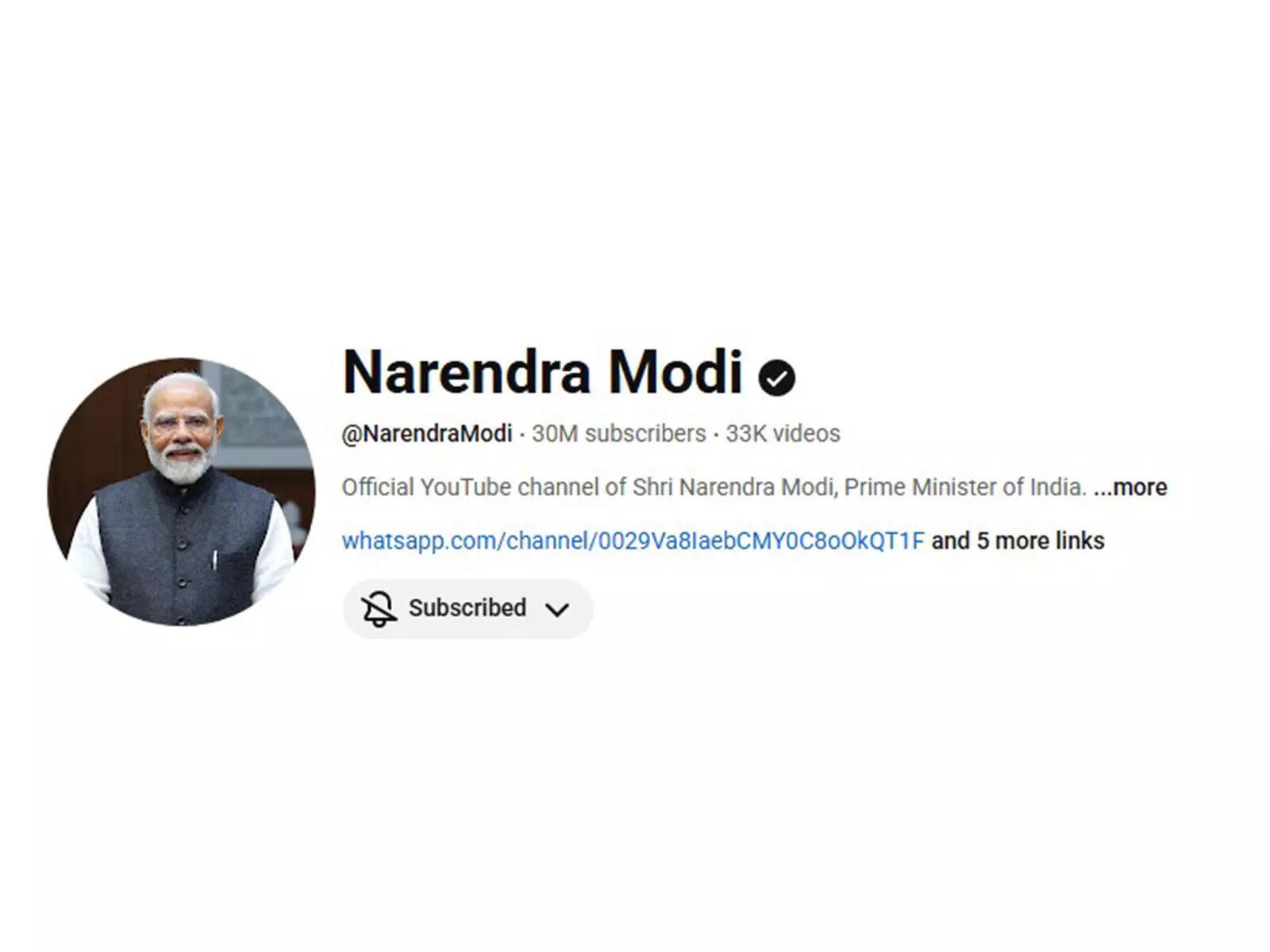
NEW DELHI: Prime Minister Narendra Modi crossed 30 million subscribers on YouTube, further strengthening his position as the most-followed world leader on the platform.Among global leaders, PM Modi has the highest number of subscribers on YouTube. His subscriber base is more than seven times that of US President Donald Trump, highlighting the scale of his digital outreach worldwide.

,

30 million and rising: PM Modi sets global benchmark of subscribers on YouTube

Former Brazilian President Jair Bolsonaro, who ranks second among world leaders on the platform has about one-fourth of PM Modi’s subscriber count.Within India, PM Modi’s YouTube subscriber base is nearly three times that of Rahul Gandhi and more than four times higher than the official channels of the Aam Aadmi Party (AAP) and the Indian National Congress (INC) individually.With over 30 million subscribers, his YouTube channel is currently the most subscribed among world leaders globally.This milestone came after PM Modi’s achievement of crossing 100 million followers on Instagram, becoming the first world leader and politician to reach that mark on the Meta-owned platform.Having joined Instagram in 2014, PM Modi now has more than twice the followers of Donald Trump, who stands second with 43.2 million followers.Indonesian President Prabowo Subianto has 15 million followers, Brazil’s president has 14.4 million, Turkish President Recep Tayyip Erdogan has 11.6 million, and Argentine President Javier Milei has 6.4 million.In India, he is also far ahead of other political leaders on Instagram. Uttar Pradesh chief minister Yogi Adityanath holds the second position with around 16.1 million followers, followed by Rahul Gandhi with approximately 12.6 million.According to data compiled by Statista, PM Modi has around 106.3 million followers on X. Elon Musk tops the list with 235.3 million followers, followed by former US President Barack Obama with 119.1 million, and US President Donald Trump with 110.1 million. The platform’s most-followed accounts are largely dominated by political leaders, celebrities and business figures.


Source link

Ahaan Panday Shoulder Surgery: Ahaan Panday opens up about secret shoulder surgery after Saiyaara; says doctor warned his body would ‘go back to zero’ | Hindi Movie News


Ahaan Panday, who made headlines with his debut film Saiyaara, is now preparing for his next big outing — an untitled action-romance directed by Ali Abbas Zafar, opposite Sharvari. As part of the prep, the actor is undergoing a major physical transformation. In a recent interview, Ahaan revealed that he underwent a major shoulder surgery after the release of Saiyaara — something he had chosen to keep private until now.

Ahaan Panday, who made headlines with his debut film Saiyaara, is now preparing for his next big outing — an untitled action-romance directed by Ali Abbas Zafar, opposite Sharvari. As part of the prep, the actor is undergoing a major physical transformation.In a recent interview with Esquire India, Ahaan revealed that he underwent a major shoulder surgery after the release of Saiyaara — something he had chosen to keep private until now.

Ahaan Panday’s Cool Factor Hits New Heights On Instagram

‘It’s one of the most painful surgeries you can do’

Ahaan shared that the surgery stemmed from a snowmobile accident a few years ago that resulted in a shoulder subluxation. The injury hampered his ability to train properly, especially when he needed peak fitness for an action film.“I actually got a whole surgery done after the release of Saiyaara last year. And it’s one of the most painful surgeries you can do, with the longest recovery time,” he said.

‘My body would go back to zero’

The actor revealed that doctors had cautioned him about the physical toll the procedure would take.“He told me my body would ‘go back to zero’,” Ahaan said, explaining that he would have to rebuild everything from scratch — muscle, strength, mobility — at a time when he needed to look action-ready.Speaking about the challenge, he added, “I used to feel motivated by actors who had dramatic gym transformations. But that was usually from a certain unhealthy body type to a healthy one. This was different; I went from being injured, to not being able to move, to not being able to lift, to being able to lift.”

Ahaan Panday Drops Bold New Look Ahead Of Ali Abbas Zafar Film

Months in a cast — and fans had no clue

Ahaan also revealed that he spent months in a cast during recovery, yet managed to stay away from public attention.“I don’t know how nobody realised!” he said.A few fans, however, sensed something was amiss and reached out to his mother, Deanne Panday, wondering why he was losing weight.“Since I’m not online too much they started asking her because she’s into fitness and all. They were like, why is he losing so much weight,” he shared. Now back in training, Ahaan seems ready to convert his most painful setback into a powerful comeback.


Source link

Sanju Samson’s wife: All you need to know about star batter’s pillar of strength Charulatha Remesh


In the high-octane world of Indian cricket, where the spotlight relentlessly follows every boundary and wicket, Sanju Samson has carved a niche as a silent assassin. However, standing firmly behind the Rajasthan Royals captain and Indian wicket-keeper is a woman who embodies a similar sense of quiet strength and grace. Charulatha Remesh, Samson’s wife, is much more than just a supportive spouse; she is a professional entrepreneur and the foundational pillar of strength for one of India’s most naturally gifted cricketers.

While many celebrity couples thrive on constant media visibility, Sanju and Charulatha have cultivated a life rooted in privacy, academic excellence, and mutual respect. Let us deep dive into the life of Charulatha, exploring her journey from a science student in Kerala to a modern entrepreneur and the steady anchor in Sanju’s life.

(Image source: X)

Lesser known facts about Charulatha Remesh

Sanju and his wife Charulatrha 4
(Image source: X)

Despite the immense fame surrounding her husband, Charulatha has consciously chosen to maintain an aura of mystery and independence. Her life is a testament to the fact that one can be part of the cricketing elite while staying true to their own identity and professional goals.

Born on October 19 in Thiruvananthapuram, Kerala, Charulatha comes from a family with deep roots in media and public service. Her father, B. Ramesh Kumar, is a veteran in the industry, serving as the Chief News Editor for the prestigious Malayalam newspaper, Mathrubhumi. Her mother, Rajshri Ramesh, brings a background of disciplined service through her work at LIC India.

One of the most defining aspects of Charulatha’s personality is her poise. She is known among fans for her silent prayers in the stands during high-pressure matches. Interestingly, while Sanju is a Christian, Charulatha is a Hindu Nair. Their 2018 wedding became a beautiful symbol of interfaith harmony, as they chose to marry under the Special Marriage Act, emphasizing a bond that transcends religious boundaries.

Also READ: Shikhar Dhawan’s wife: All you need to know about the Irish beauty Sophie Shine

Education and academic excellence

Sanju and his wife Charulatrha 5
(Image source: X)

Unlike many who might pivot toward the entertainment industry following a high-profile marriage, Charulatha’s path was paved with academic rigor. She completed her schooling at Arya Central School in Trivandrum, an institution known for its discipline.

Her higher education took place at Mar Ivanios College, where she pursued a Bachelor of Science (B.Sc.) in Chemistry. It was within these college corridors that her path first crossed with Sanju’s. However, she didn’t stop at a bachelor’s degree; her drive for professional growth led her to the Loyola College of Social Sciences, where she completed her Postgraduate studies in Human Resources (HR). This solid educational foundation has been the catalyst for her independent career as an entrepreneur.

Professional career and entrepreneurship

Sanju and his wife Charulatrha 2
(Image source: X)

Charulatha is often described in media reports as a career-driven individual who manages her own business ventures. While she keeps the specifics of her entrepreneurial work private, her background in Chemistry and Human Resources suggests a versatile professional portfolio.

She has notably avoided the typical influencer route, rarely engaging in brand endorsements or commercial collaborations. Instead, she focuses on her professional autonomy, proving that her identity is not defined solely by her husband’s career. Her ability to balance her business commitments while traveling with Sanju for IPL seasons and international tours is a feat many of her followers admire.

Sanju and his wife Charulatrha
(Image source: X)

The fairy tale relationship with Samson

sanju wife 8
(Image source: X)

The love story of Sanju and Charulatha is a modern-day classic that began long before the fame and the “Captain” tag. It started with a simple Facebook friend request sent by Sanju at 11:11 PM on August 22, 2013.

From that day till now, almost 5 years I have waited to put a picture with her, and tell the world that I am in love with this special girl,” Sanju once wrote in a heartfelt post.

The couple dated for five years, keeping their relationship entirely under the radar of the paparazzi. They eventually tied the knot on December 22, 2018, in an intimate ceremony at a resort in Kovalam. The wedding was attended by only about 30 close family members, reflecting their preference for meaningful connections over grand displays.

Sanju and his wife Charulatrha 6
(Image source: X)

Life in India and social media presence

Sanju and his wife Charulatrha 3
(Image source: X)

Charulatha’s social media presence is a refreshing departure from the curated lifestyles often seen online. Her Instagram is a window into her love for travel, family moments, and profound reflections.

In 2025, she gained significant praise for a transformation video where she promoted self-love and body positivity, telling her followers to “just love yourself, be happy, and enjoy your life” regardless of physical changes.

Also READ: Sanju Samson reflects on his batting performance that powered India into the T20 World Cup 2026 semifinals


Source link

Trump open to ‘boots on the ground’ in Iran – what does the military phrase mean?


Trump open to 'boots on the ground' in Iran - what does the military phrase mean?
US President Donald Trump. (AP photo)

US President Donald Trump has said he would not rule out ‘boots on the ground’ in Iran, if the situation demands it.In an interview with the New York Post on Monday, Trump said he was keeping all military options open following the launch of operations against Iran over the weekend.“I don’t have the yips with respect to boots on the ground — like every president says, ‘There will be no boots on the ground.’ I don’t say it,” Trump told the NY Post in one of several brief interviews since Saturday’s action.He added that ground troops would “probably” not be necessary, but stressed they could be used if required. “I say ‘probably don’t need them,’ [or] ‘if they were necessary,’” he said.

What does ‘boots on the ground’ mean?

“Boots on the ground” is a military expression referring to the deployment of combat troops physically present in a foreign country, rather than relying solely on airstrikes, drones, or naval forces.In simple terms, it means sending soldiers into active combat zones. Linguistically, the phrase is an example of synecdoche — a figure of speech in which a part (boots) represents the whole (soldiers).The phrase has previously been used by leaders such as Barack Obama and David Cameron, particularly during debates over military interventions in Iraq, Afghanistan and Syria.During World War I, “boot” was sometimes used informally to mean a soldier, and military training became known as “boot camp.”A similar phrase, “Feet on the Ground,” appeared in a 1966 book by British counter-insurgency expert Sir Robert Grainger Ker Thompson about Malaya and Vietnam. However, the earliest confirmed use of the exact phrase “boots on the ground” dates to 1980, during the Iranian hostage crisis.


Source link

‘Dukhi mat ho bhai’: Rohit Sharma’s hug, four words that changed Sanju Samson’s World Cup – WATCH | Cricket News


'Dukhi mat ho bhai': Rohit Sharma's hug, four words that changed Sanju Samson's World Cup - WATCH

NEW DELHI: When Sanju Samson stood tall after his match-winning 97 against the West Indies, it was more than just a comeback knock — it was the fulfilment of a promise made at the very start of the T20 World Cup.Despite being India’s first-choice T20I opener for over a year, Samson found himself out of the playing XI for the tournament opener against the United States of America (USA) at the Wankhede Stadium. Ishan Kishan’s strong form meant Samson had to wait.

T20 World Cup: Gautam Gambhir on Sanju Samson, Jasprit Bumrah and record chase vs West Indies

What followed is now going viral.Ahead of that opening game, Rohit Sharma walked up to Samson, put an arm around him, and offered words that would define the rest of his tournament.“Kaisa hai? Dukhi mat ho bhai. It is a long tournament, kabhi bhi mauka aa sakta hai (“How are you? Don’t be disheartened. It is a long tournament. The opportunity can come at any moment),” Rohit had said to Samson, as revealed in a video posted by the official Instagram account of the International Cricket Council (ICC).At that moment, Samson was on the sidelines. But Rohit’s reassurance proved prophetic.After India’s defeat to South Africa opened the door for changes, Samson returned. He first made an impact with a fiery cameo against Zimbabwe before scripting something far bigger — an unbeaten 97 under pressure to anchor a daunting 196-run chase against the West Indies, sealing India’s highest-successful run chase in T20 World Cup history.His journey to that moment had been anything but smooth.Earlier in the season, being pushed down the order during the Asia Cup disrupted his rhythm. Then came a difficult New Zealand series where scores of 10, 6, 0, 24 and 6 led to criticism and doubts.But Samson never stopped observing, learning and believing.After his masterclass against the West Indies, he acknowledged the influence of Rohit and Virat Kohli.“Playing IPL for around 10 to 12 years and being with the Indian team for the last 10 years… I have not always been playing, but I was looking from the dugout, learning from greats like Virat Kohli and Rohit Sharma. It was very important to observe, learn, and see what they were doing,” Samson said.From being dropped to delivering one of the most memorable knocks in India’s T20 World Cup campaign, Samson’s resurgence now carries the imprint of Rohit’s hug and those four simple words — “Dukhi mat ho bhai.”With a five-wicket win over the West Indies, India marched into the semifinals and will now face England at the Wankhede Stadium on Thursday — the same ground where Samson had once watched from the sidelines, waiting for his moment.


Source link

Sensex falls 1,048 pts on war in West Asia, fear index up 25%


Sensex falls 1,048 pts on war in West Asia, fear index up 25%

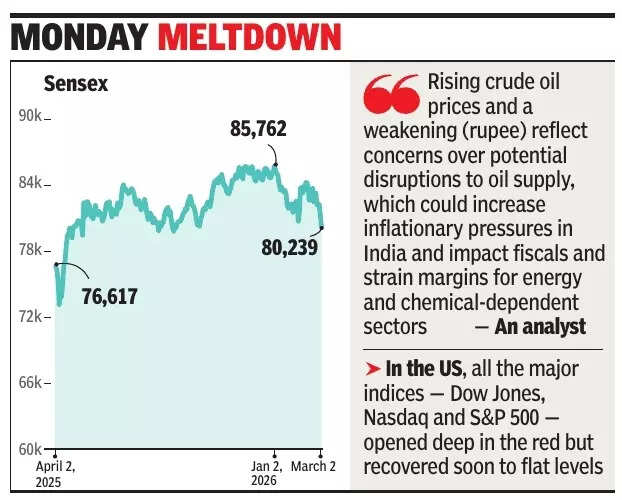
MUMBAI: The escalating war in West Asia took a heavy toll on investors on Dalal Street as stocks crashed on Monday that left them poorer by Rs 6.6 lakh crore. With the war between the US-Israel and Iran elevating geopolitical risks, the sensex closed 1,048 points (1.3%) lower at 80,239 points, a closing level not seen in almost six months.The day’s session started with the sensex down nearly 3,000 points, as a knee-jerk reaction to the US-Israel combined attack on Iran on Saturday morning. But soon buying emerged at lower levels and the index recovered some of the early losses.At the end of a choppy session that saw NSE’s volatility index (VIX) jump 25%, the close for the sensex was much above the intra-day low at 78,544 points. Nifty on NSE followed a similar path to close 313 points (1.2%) lower at 24,866 points. The sharp uptick in VIX, also called the fear index, indicates increased uncertainty and risk aversion among market participants, market players said.

.

Foreign funds led the selling with the day’s net outflow at almost Rs 3,300 crore, BSE data showed. The day’s slide in stock prices left investors poorer by Rs 6.6 lakh crore with BSE’s market capitalisation now at Rs 456.9 lag crore, official data showed.According to Vinod Nair, head of research, Geojit Investments, rising geopolitical tensions in West Asia unsettled global markets, with concerns over possible extension of the situation given the killing of Iran’s supreme leader. “Rising crude oil prices and a weakening (rupee) reflect concerns over potential disruptions to oil supply, which could increase inflationary pressures in India and impact fiscals and strain margins for energy and chemical-dependent sectors.On Monday, most markets across the globe slid, starting with Asia. At close, Nikkei in Japan was down 1.4% while Hang Seng in Hong Kong closed 2.1%. Shanghai in China, however, bucked the trend to close 0.5% higher. In Europe, in late trades FTSE in UK was down 1.3% while Dax in Germany was trading 2.6% lower.Of the 30 sensex stocks, 27 closed in the red. Among these, L&T and RIL contributed the most to the sensex’s slide. Only BEL, Sun Pharma and ITC closed with gains.Oil marketing companies were among the worst hit. Indian Oil closed 4.5% down, Petronet LNG 4.4% and Adani Total Gas 3.7%. Crude oil producers, Oil India and ONGC, closed higher. BSE’s oil & gas index was down 2.3%.


Source link

Eric Dane Death Cause: How did Eric Dane pass away? ‘Grey’s Anatomy’ actor’s official cause of death confirmed |


'Grey's Anatomy' Star Eric Dane’s Loved Ones Issue Moving Message After Actor's Death

Eric Dane, famous for his performances on ‘Grey’s Anatomy’ and ‘Euphoria’, passed away on February 19, 2026, at 53, surrounded by his family. After almost a year fighting amyotrophic lateral sclerosis (ALS), his family has confirmed his official cause of death.Read on to know more.

‘Grey’s Anatomy’ Star Eric Dane’s Loved Ones Issue Moving Message After Actor’s Death

Eric Dane’s demise: The official cause of death

Per People, the ‘Grey’s Anatomy’ star passed away from respiratory failure. Dane was suffering from Amyotrophic lateral sclerosis (ALS), which has been listed as an underlying cause of death.According to Mayo Clinic, ALS, often called Lou Gehrig’s disease, attacks nerve cells in the brain and spinal cord. It slowly paralyzes the muscles you need to walk, talk, swallow, and breathe. The symptoms usually include your hand feeling weak, or your speech changing and slurring a bit. At an advanced stage, the muscles weaken, and eventually, the patient can’t move, speak, or breathe without help. Treatments can slow it down, but they can’t stop it, as there’s no cure for ALS yet.ALS gradually weakens the muscles involved in movement and breathing, and in advanced stages can lead to the inability to maintain independent respiration. This means the lungs and breathing muscles can no longer function adequately, eventually leading to respiratory failure.Dane leaves behind his wife, Rebecca Gayheart, and their daughters, Billie Beatrice and Georgia Geraldine. Upon his passing, his family shared a statement: “With heavy hearts, we share that Eric Dane passed on Thursday afternoon following a courageous battle with ALS. He spent his final days surrounded by dear friends, his devoted wife, and his two beautiful daughters, Billie and Georgia, who were the center of his world.

Eric Dane: Life, career, and legacy

Born Eric William Melvin on November 9, 1972, in San Francisco, he grew up loving the stage. He lost his dad early, which hit him hard, but he turned that pain into drive. In the early ‘90s, he started landing TV roles on ‘Saved by the Bell’ and other shows. However, it was 2006 when his breakthrough finally came. Dane joined ‘Grey’s Anatomy’ as Dr. Mark Sloan (“McSteamy”), which became a sensation overnight. With his charm and sharp wit, he quickly became a fan favorite and pop culture icon.After leaving ‘Grey’s Anatomy’, Dane kept busy. He took on major roles in TV and film, including Cal Jacobs on ‘Euphoria’ and a lead part in ‘The Last Ship’. He never stuck to just one type of part, showing he could do way more than just play the heartthrob.Dane went public with his ALS diagnosis in April 2025, less than a year before he passed away. He revealed, “I have been diagnosed with ALS. I am grateful to have my loving family by my side as we navigate this next chapter.” He also shared that he felt lucky to keep working and was looking forward to returning to ‘Euphoria’.Even in his last months, Dane talked openly about ALS and how it affected him, things like weakness in his right hand and the loss of use of some limbs. That didn’t stop him from acting when he could or from speaking out for ALS awareness and research. He used his voice to talk about ALS, push for more research, and remind people that these stories matter.


Source link