Breaking News
‘Complete nonsense’: Nihal Sarin on Dutch No. 1 Anish Giri ‘drawish’ tag before Candidates | Exclusive | Chess News


‘Complete nonsense’: Nihal Sarin on Dutch No. 1 Anish Giri ‘drawish’ tag before Candidates | Exclusive
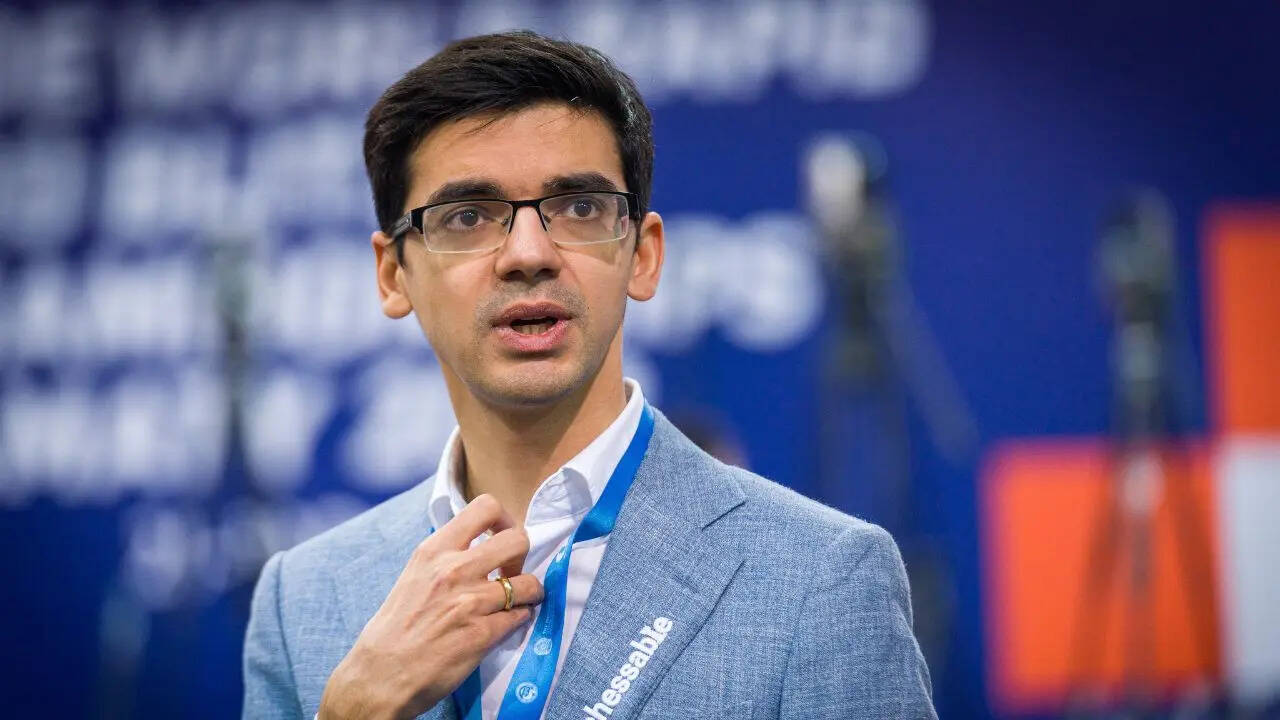
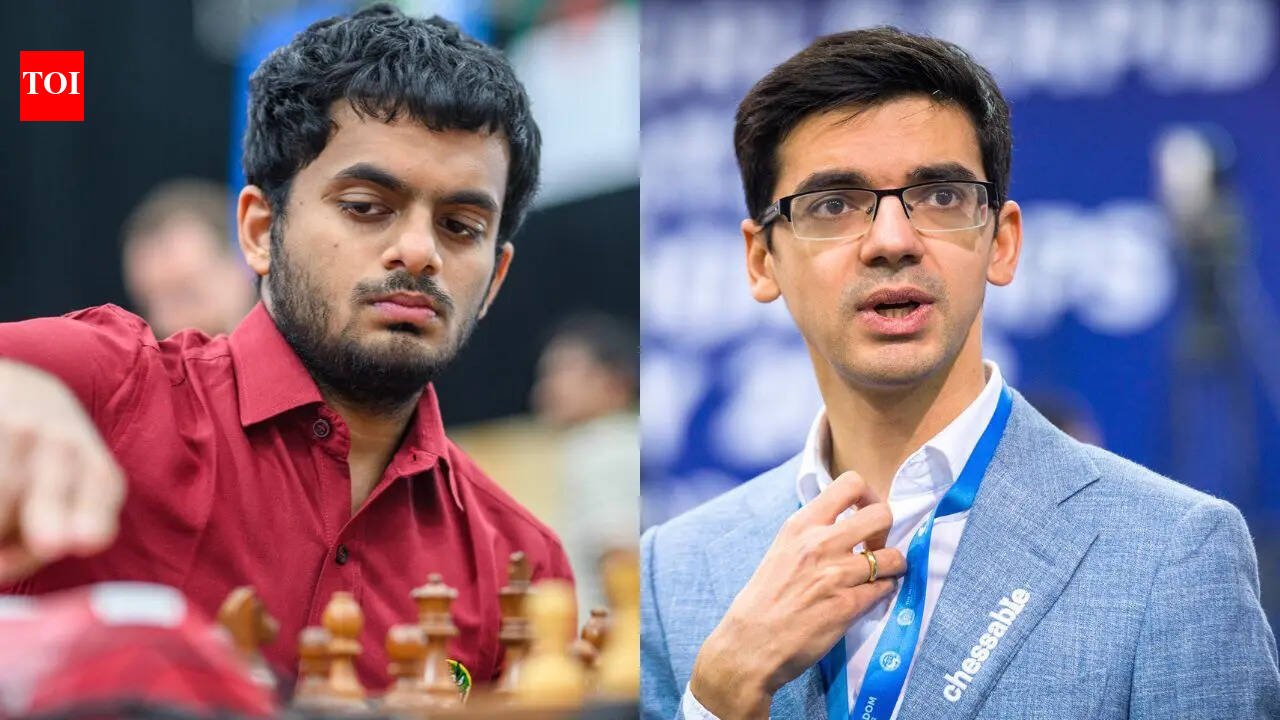
Nihal Sarin and Anish Giri (Photos by Michal Walusza, Lennart Ootes and FIDE)

NEW DELHI: As the chess world descends upon Cyprus for the 2026 Candidates, the name Anish Giri continues to be synonymous with a singular, frustrating memory from the past. 14 draws in 14 games. That legendary run in the 2016 Candidates birthed the “King of Draws” moniker for the current Dutch No. 1.But as the 31-year-old eyes the Candidates crown 10 years later, and with it the right to challenge Dommaraju Gukesh, Indian Grandmaster Nihal Sarin points out that “Drwaish Giri” is a tired stereotype that ignores the realities of elite chess.“I very, very strongly believe that people saying Anish is a drawish player is complete nonsense, honestly,” Nihal told TimesofIndia.com in an exclusive interview on the eve of the tournament. “I believe he’s a huge fighter, actually. The draw thing is definitely a bit of a myth.”

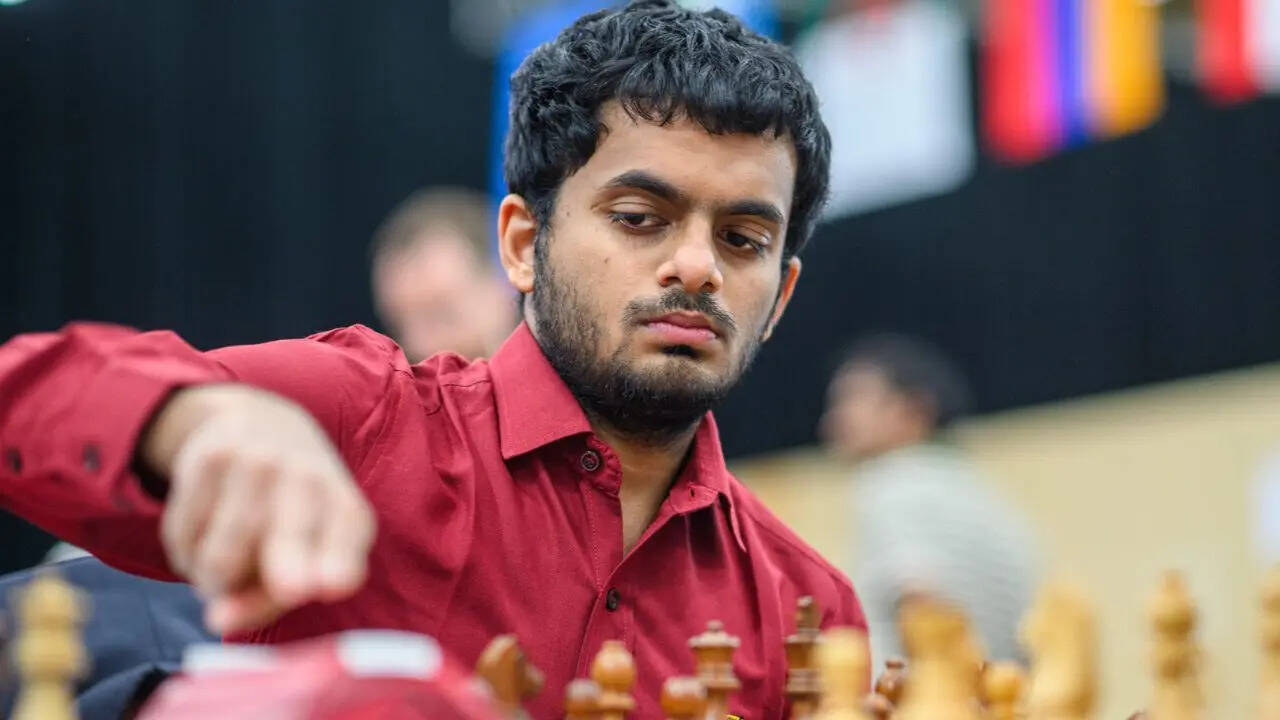
Embed_Nihal Sarin (Photos by Michal Walusza)

The “myth” of the Draw KingGiri himself is well aware of the narrative. Speaking about his preparation to TimesofIndia.com, the Dutch No. 1 revealed the unique hurdles of a Candidates cycle, noting that he had to wait to hire seconds (coaching assistants) because his top choices were so good they ended up qualifying for the tournament themselves.“I understand really well what makes a good second because that second was so good he became my opponent,” Giri joked.

Embed_Anish Giri (Photos by Lennart Ootes)

Nihal points to Giri’s triumph at the 2025 FIDE Grand Swiss, where he finished unbeaten (with five wins and six draws) to qualify for this very event, as proof of his winning intent.“To win the tournament by half a point, he clearly did win a fair few games as well,” Nihal noted. “A lot of draws happen when top players are clashing because that is what chess is. If both play to their absolute potential, it will be a draw. Chess is like that only”Nihal’s Candidates 2026 predictionWhile many experts are hyper-focused on Fabiano Caruana or Hikaru Nakamura, Nihal Sarin’s evaluation of the 2026 field suggests a much more volatile “open” race.While he respects the established American giants, he threw a spotlight on Uzbekistan’s Javokhir Sindarov.“If I had to make a guess, maybe Fabi or Sindu [Sindarov],” Nihal told this website. “Sindarov is having a great year so far and playing some amazing chess. And of course, if Pragg has a good event, then absolutely. You can also never count Hikaru out.”Nihal also cautioned against sidelining the two-time European Champion, Matthias Bluebaum. While some call Bluebaum’s style pragmatic, Nihal sees a dangerous trap.“He’s insanely good at being kind of safe. Not drawish, but safe. He is extremely good at punishing if opponents try to go berserk against him. That is a very smart way of winning games,” Nihal remarked.A closely packed women’s fieldTurning his attention to the Women’s Candidates, Nihal believes the tournament is even more unpredictable than the Open section.“I really wouldn’t be surprised at all whoever wins. I think everyone can beat everyone there,” he said.However, he leaned toward experience as the deciding factor.“I would guess probably Aleksandra Goryachkina or Tan Zhongyi is likely to win because they have done it before. I believe it’s a bit easier having that belief, that because you have done it before, you can do it again.”As the marathon begins on Saturday, reputations like “Drawish Giri” or “underdog Bluebaum” mean very little. In Nihal’s words, “Absolutely everybody can win.”


Source link

Middle East crisis: Two India-bound LPG tankers crossing Strait of Hormuz | India News


Middle East crisis: Two India-bound LPG tankers crossing Strait of Hormuz

Two liquefied petroleum gas (LPG) tankers, BW Elm and BW Tyr, are currently transiting the Strait of Hormuz en route to India, according to ship-tracking data from LSEG and Kpler cited by Reuters, signalling a cautious resumption of movements through the strategic waterway. Shipping through the Strait has been severely disrupted amid the ongoing US-Israeli conflict with Iran. However, Tehran indicated earlier this week that “non-hostile vessels” could pass through the corridor if they coordinate with Iranian authorities. Data shows the two India-flagged vessels have already crossed the Gulf and are now in the eastern stretch of the Strait. Their movement comes as India steps up efforts to evacuate stranded LPG cargoes from the region. So far, four tankers—Shivalik, Nanda Devi, Pine Gas and Jag Vasant—have been moved out. Despite these efforts, several Indian vessels remain stuck. As of Friday, 20 Indian-flagged ships, including five LPG carriers, were still stranded in the Gulf, according to Rajesh Kumar Sinha, special secretary in the shipping ministry. Additional carriers such as Jag Vikram, Green Asha and Green Sanvi remain positioned in the western Strait of Hormuz, LSEG data shows. The disruption has raised concerns around India’s energy supplies. India consumed 33.15 million metric tonnes of LPG last year, with imports meeting around 60 per cent of demand. Nearly 90 per cent of these imports originate from the Middle East.


Source link

Saba Azad hospitalised after being diagnosed with parasite Cyclospora cayetanensis, says Hrithik Roshan is keeping her spirit up |


Actor Saba Azad has been hospitalised after being diagnosed with the parasite Cyclospora cayetanensis. Taking to Instagram on Friday, she shared a photo of herself lying in a large hospital bed, looking visibly frail, and described the ordeal as the “worst 14 days” of her life. She also mentioned that Hrithik Roshan has been a constant source of support during this time.Posting the picture, Saba wrote, “Worst 14 days of my life. Cyclospora cayetanensis you nasty piece of work!! For somone who only ever eats home food, carries her water bottle everywhere, this bug came outa nowhere, that too at the busiest time of the year for me. Iv lost 4 kgs that I didn’t have spare in two weeks and I can barely walk.”She further shared how the illness drastically affected her physical strength. “One day im training twice a day, doing pull-ups, lifting heavy and the next im half my size, without strength to lift a goddamn toothpick leave alone weights. So pls for the love of your gut wash your salad leaves and veg like your life depends on it – cause sometimes it really does!! Our new method is Baking soda + veggie wash (Herbal Strategi has a good one),” wrote Saba.Concluding her note, she credited Hrithik for lifting her spirits, “(camera emoji) by @hrithikroshan who’s kept my very grumpy sprits up and always manages to find humour in the darnest situations. PS – I haven’t shrunk quite as much as it may seem here, the bed is supersized and the angle is wide.”

Watch

Hrithik Roshan overflows with pride: ‘My heart is full. I love you’ — a loving tribute to Saba Azad

Hrithik was previously married to Sussanne Khan from 2000 to 2014. They have two sons, Hrehaan and Hridhaan, born in 2006 and 2008. They separated in 2013, with their divorce finalised a year later, and have since maintained an amicable relationship while co-parenting.Hrithik and Saba began dating in 2022 and celebrated four years together in October 2025. Their relationship became public after they were spotted together at dinner outings and at Karan Johar’s 50th birthday celebration.


Source link

WATCH: Shubman Gill, Ishan Kishan engage in hilarious banter ahead of the IPL 2026


Indian Premier League (IPL) has always been as much about the camaraderie off the field as it is about the intense rivalries on it. As the 2026 edition looms, two of India’s brightest stars and notorious best friends, Shubman Gill and Ishan Kishan have set social media ablaze with a side-splitting exchange. While fans are gearing up for the high-octane season opener between Royal Challengers Bengaluru (RCB) and Sunrisers Hyderabad (SRH) on March 28, this pre-season captain’s roast has provided the perfect comedic prelude to the cricketing festivities.

Shubman Gill and Ishan Kishan trade playful jibes before IPL 2026

Sitting down for a promotional shoot with Star Sports, the duo’s natural chemistry was on full display. Gill, the Gujarat Titans (GT) captain and India’s established leader in the longer formats, didn’t waste a second before taking a playful jab at Kishan’s new role with SRH. When host Sahiba Bali introduced them, Gill cheekily labelled Kishan as a ‘half captain,’ referencing the fact that Kishan is leading the side in the temporary absence of Pat Cummins. The roast intensified when Gill dismissively added, “I only give advice to full captains,” leaving the room and eventually the internet in splits.

Kishan, never one to back down from a verbal volley, gave as good as he got. Fresh off a dominant stint in the Syed Mushtaq Ali Trophy (SMAT), where he led his side to silverware, Kishan retorted that he certainly didn’t need Gill’s tactical input. He even went as far as predicting a dismal outing for the GT skipper when their two sides eventually clash.

However, beneath the laughter lies a season of immense personal stakes for Kishan. After a stellar T20 World Cup campaign where he amassed 317 runs, the dynamic southpaw is using IPL 2026 as a launchpad for an all-format comeback. With a vacant spot for a second wicketkeeper in the ODI squad and a looming battle with Dhruv Jurel for the Test gloves, Kishan’s stint as the SRH spearhead is his golden ticket. Leading a franchise that hasn’t tasted trophy success since 2016 is a heavy mantle, but Kishan’s recent form suggests he is more than ready to transition from ‘half-captain’ to a full-time national mainstay.

Here’s the video:

Also READ: IPL 2026 Squads: Complete list of Indian and overseas players in all 10 teams

Gill’s quest for the orange cap and GT’s redemption in IPL 2026

While Kishan is fighting for a permanent spot in the national side, Gill is playing with a chip on his shoulder. Despite being India’s ODI and Test captain, Gill found himself on the sidelines during the recent T20 World Cup. For the Gujarat Titans talisman, IPL 2026 is about reclaiming his status as the premier T20 opener in the country.

The statistics favour the Prince of Ahmedabad. Since joining the Titans, Gill has been a run-machine, aggregating 2,449 runs for the franchise, including a historic 890-run season in 2023. With opening partners like Jos Buttler and Sai Sudharsan experiencing fluctuations in form, the pressure on Gill to anchor the GT innings is higher than ever.

As the tournament kicks off at the Chinnaswamy Stadium, the banter between Gill and Kishan serves as a reminder of the unique spirit of the IPL. It is a league where friends become foes for seven weeks, and where a half-captain might just end up lifting the full trophy by the end of May.

Also READ: BCCI announces schedule for the second phase of IPL 2026


Source link

David Sacks on reports linking Anthropic ban to Pentagon CTO Emil Michael’s stake in Aravind Srinivas’ Perplexity AI; says: There is no …


David Sacks on reports linking Anthropic ban to Pentagon CTO Emil Michael's stake in Aravind Srinivas' Perplexity AI; says: There is no ...

Venture capitalist David Sacks has now pushed back against the reports linking Pentagon chief technology officer Emil Michael’s investment in Perplexity AI to the government’s move against Anthropic. According to a report by Bending, speaking on the All-In Podcast, Sacks called the allegations a ‘smear campaign’, arguing that Perplexity is not a direct competitor to Anthropic and does not sell to the Pentagon. He further added that Michael’s holdings had been cleared by ethics regulators. “It reminds me of what happened to me… all of a sudden there was that hit piece,” Sacks said, suggesting the timing of the report was politically motivated.

Sacks accused Anthropic of political maneuvering

Sacks also accused the AI giant Anthropic of running a political operation in Washington. “They’ve hired a number of very seasoned… political operatives,” he said, adding that the company can be “quite ruthless” despite its image as a safety-focused AI firm. The remarks from Sacks came days after US District Judge Rita Lin granted a preliminary injunction blocking the Pentagon from designating Anthropic as a “supply chain risk”. The court also found the designation likely unlawful and potentially retaliatory, enabling Anthropic to continue working with defense contractors. Pentagon CTO Emil Michael has also criticised the ruling on social media platform X (formerly known as Twitter) calling it “a disgrace” and claiming it contained “dozens of factual errors” rushed out during a time of conflict. He argued the decision undermines presidential authority and disrupts military operations. “There are dozens of factual errors in the 42 page judgment rushed out in 48 hours DURING A TIME OF CONFLICT that seeks to upend the @POTUS role as Commander in Chief and disrupt @SecWar full ability to conduct military operations with the partners it chooses. A disgrace,” wrote Michael.

AI policy clash intensifies

At the heart of the dispute is Anthropic’s refusal to deploy its AI in autonomous weapons or mass surveillance, positions that have put it at odds with defense officials. Backed by Amazon and Google, Anthropic now sits at the center of a high-stakes debate over how AI should be used in national security.Sacks, who recently stepped down as Trump’s AI and crypto czar after completing his 130-day term, will continue to influence policy as co-chair of the President’s Council of Advisors on Science & Technology.


Source link

Delhi civic fines set for overhaul; fines for dogs without leash set at Rs 1,000 | India News


Delhi civic fines set for overhaul; fines for dogs without leash set at Rs 1,000

NEW DELHI: Letting a pet dog roam without a leash in public places could become expensive in Delhi, with a penalty set to rise from Rs 50 to Rs 1,000 under proposed amendments to municipal laws.The change is part of the Jan Vishwas (Amendment of Provisions) Bill, 2025, introduced in the Lok Sabha on Friday by Minister of State for Commerce and Industry Jitin Prasada. The bill seeks to revise penalty provisions under the Delhi Municipal Corporation Act, 1957, with a broader push to rationalise fines and decriminalise minor offences.A number of civic violations are set to see significant increases in penalties. Tethering cattle on public roads and defacing house numbers would also attract fines of Rs 1,000, up from Rs 100 and Rs 50 respectively. Sanitation-related offences, including failing to arrange garbage collection or obstructing municipal officials, would carry fines of Rs 500. Dumping waste or allowing filth to flow into streets would invite penalties of Rs 200.Fireworks that pose a danger would be fined at Rs 500, while the general penalty for violations without a specified fine is proposed to increase from Rs 100 to Rs 500, with a higher daily fine for continuing offences.The bill also tightens rules around building safety. Failing to vacate a dangerous structure when ordered, or occupying a building without a completion certificate, would now attract fines of Rs 1,000, up from Rs 200.At the same time, certain provisions are proposed to be removed or modified. The existing maximum penalty for starting construction without notice will be scrapped, while some offences, such as failing to report births and deaths, will no longer attract fines. Operating a market without a licence would draw a penalty of Rs 2,000.The legislation also seeks to decriminalise select offences. For instance, the provision allowing imprisonment of municipal sweepers for absence without notice will be replaced with a civil penalty of Rs 500.However, some violations will face stricter consequences. Acts such as dumping items on streets, erecting structures that obstruct public ways, or opening roads without permission could lead to imprisonment of up to six months and/or a fine of Rs 5,000.In a key procedural shift, most violations would be adjudicated by designated municipal officers of at least assistant commissioner rank instead of criminal courts. The bill also proposes a 30-day window for appeals and a six-month deadline for their disposal.


Source link

TOI journalist gets Ramnath Goenka award for civic reportage | India News


TOI journalist gets Ramnath Goenka award for civic reportage

PUNE Sandip Dighe, a special correspondent with The Times of India, Pune, was presented with the Ramnath Goenka Excellence in Journalism Award in the Prakash Kardaley Memorial Award for Civic Journalism category on Friday.Vice-President CP Radhakrishnan presented the award to Dighe for the year 2024 at a function in New Delhi. Dighe received the award for his extensive reportage in 2024 on irregularities in Old Grant Bungalows in the Pune and Khadki cantonment board areas.His reports highlighted discrepancies like the use of these residential properties for commercial activities, unauthorized constructions and, in some cases, the sale of bungalows to builders, violating orders for a no-objection certificate from the competent defence authority. He also reported on several civic issues afflicting both cantonment areas.The series of reports drew the attention of the Directorate General of Defence Estates, the state Inspector General of Registration, and Army authorities who then took appropriate action to stop such transactions.


Source link

‘Misinformed opinions’: Mitchell Starc hits back at critics over delayed IPL arrival | Cricket News


'Misinformed opinions': Mitchell Starc hits back at critics over delayed IPL arrival
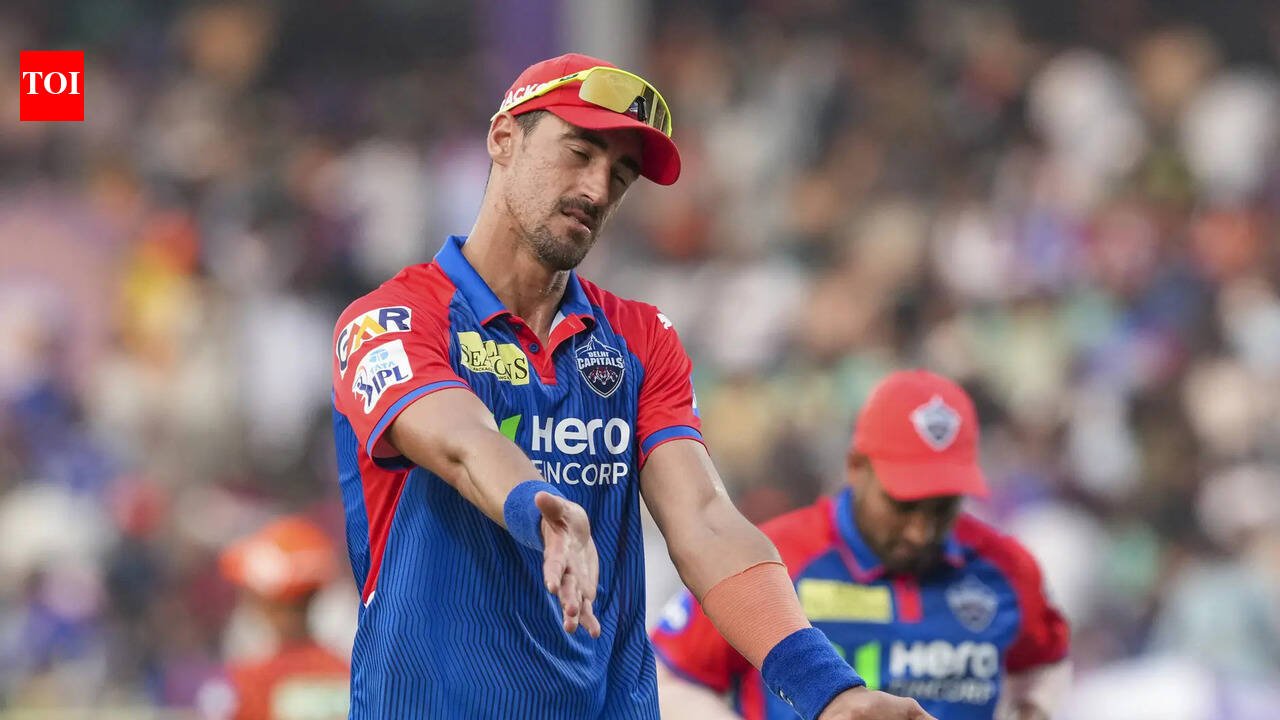
Delhi Capitals’ Mitchell Starc (PTI Photo)

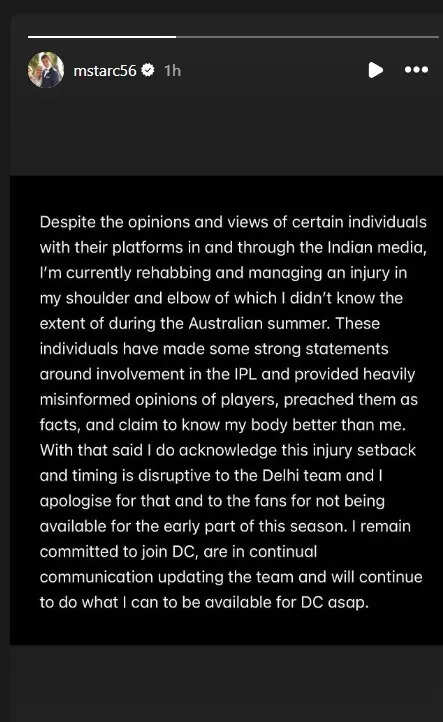
Mitchell Starc has responded strongly to criticism surrounding his absence from the early phase of Indian Premier League 2026, confirming that an elbow injury has delayed his arrival in India.The left-arm quick is set to miss the opening games for Delhi Capitals, triggering debate around the commitment of overseas players. Among those raising concerns were former India captain Sunil Gavaskar and former India batter Aakash Chopra.However, Starc clarified that the decision was injury-driven, with Cricket Australia already confirming that he, along with Josh Hazlewood and Pat Cummins, would miss the initial phase of the tournament due to workload management.His absence also sparked discussion among fans, with questions raised about his availability. Alyssa Healy, Starc’s wife, addressed the issue via Instagram, indicating that he is currently recovering from injury.Breaking his silence, Starc pushed back against the narrative around his absence, revealing that the extent of his injury became clear only after the Australian summer.

Starc insta story

Starc insta story

“Despite the opinions and views of certain individuals with their platforms in and through the Indian media, I’m currently rehabbing and managing an injury in my shoulder and elbow of which I didn’t know the extent of during the Australian summer,” Starc stated.He also criticised what he described as inaccurate commentary around his situation.“These individuals have made some strong statements around involvement in the IPL and provided heavily misinformed opinions of players, preached them as facts, and claim to know my body better than me,” he added.

Starc reaffirms commitment to Delhi Capitals

Despite the setback, Starc reiterated his commitment to the franchise and apologised for missing the early part of the season.“With that said I do acknowledge this injury setback and timing is disruptive to the Delhi team and I apologise for that and to the fans for not being available for the early part of this season. I remain committed to join DC, are in continual communication updating the team and will continue to do what I can to be available for DC asap,” he concluded.


Source link

The battle beyond the battlefield: Narrative warfare and mind games in the US-Iran conflict


The battle beyond the battlefield: Narrative warfare and mind games in the US-Iran conflict

War beyond kinetics: The cognitive battlespace

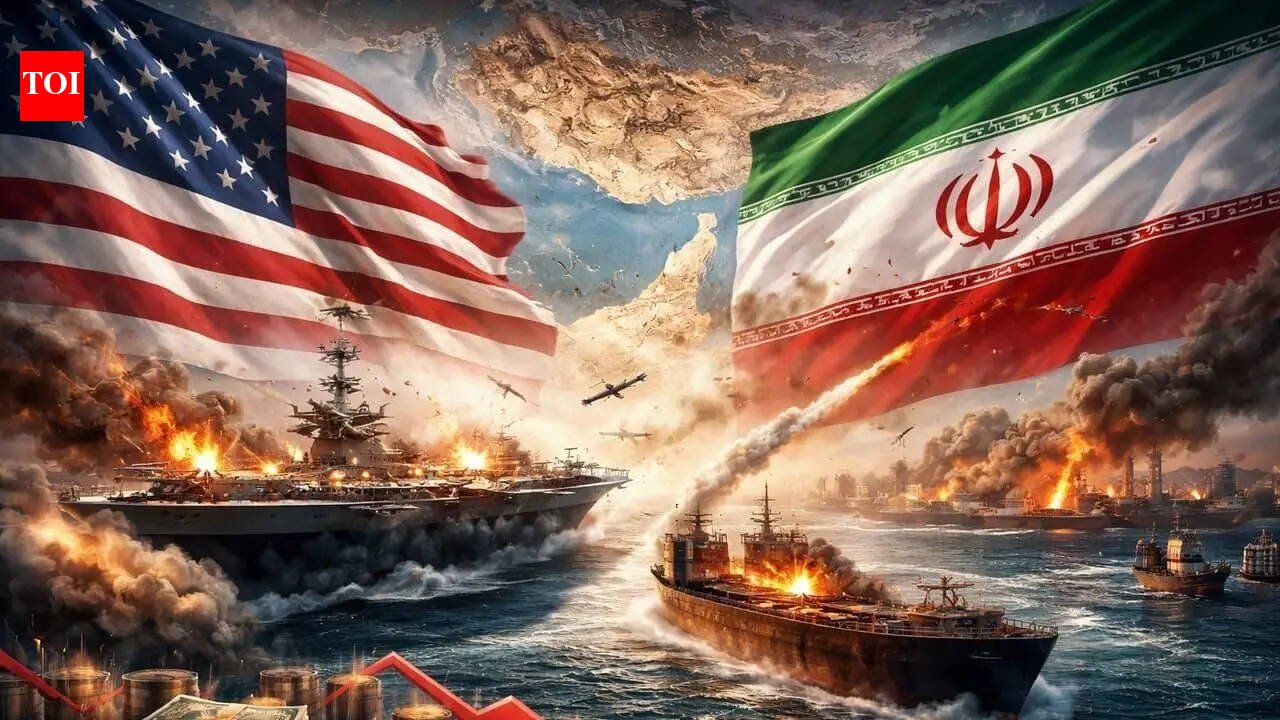
The ongoing confrontation between the United States and Iran is no longer defined solely by missiles, drones, or precision strikes. It has evolved into a far more complex contest—one that is being fought simultaneously in the cognitive, informational, and psychological domains. While the physical battlefield remains active, the decisive struggle is unfolding in the realm of perception, where narratives, signalling, and calculated mind games shape the trajectory of conflict.This transformation reflects a deeper shift in the nature of warfare. As Carl von Clausewitz observed, war is fundamentally political. In the contemporary context, that political dimension is increasingly executed through strategic communication and perception management, turning narratives into operational weapons.

Narrative warfare: Competing realities

At the heart of the U.S.–Iran conflict lies a clash of narratives. Each side is not merely reporting events—it is constructing a version of reality designed to influence audiences at multiple levels.The United States projects a narrative of controlled escalation and operational dominance. Its messaging emphasizes precision strikes, degradation of Iranian capabilities, and a posture of strategic restraint combined with readiness for negotiation. This framing is intended to reassure allies, maintain domestic confidence, and signal inevitability to Tehran—that continued resistance will only deepen its strategic disadvantage.Iran, by contrast, advances a narrative rooted in resistance and endurance. It portrays itself as a victim of aggression while simultaneously demonstrating its capacity to retaliate through sustained missile and drone operations. The emphasis is not on immediate victory but on survival, resilience, and moral legitimacy. In this framing, the mere ability to continue fighting becomes a form of strategic success.These competing narratives are not static; they are continuously adapted in response to battlefield developments, international reactions, and domestic pressures. The result is a dynamic contest to define the meaning of events, rather than just the events themselves.

Strategic Communication as a force multiplier

Strategic communication has emerged as a critical instrument in amplifying or mitigating battlefield outcomes. It operates through carefully calibrated messaging that integrates political objectives with military actions.The United States employs coercive communication, combining demonstrations of capability with signals of diplomatic openness. This dual approach is designed to create psychological pressure—projecting strength while leaving space for negotiation.Iran, on the other hand, leverages asymmetric communication, emphasizing its ability to absorb damage and continue operations. This approach seeks to undermine the credibility of U.S. claims and shift the narrative from dominance to stalemate.As Sun Tzu famously noted, “All warfare is based on deception.” In the current conflict, deception is not limited to battlefield manoeuvres; it is embedded within the very structure of communication.

Mind Games: The invisible battlefield

Beneath the visible layer of narrative warfare lies a more subtle and decisive dimension—the domain of strategic mind games. These are deliberate efforts to manipulate the adversary’s perception, distort decision-making processes, and influence strategic choices without direct confrontation.Mind games are not improvised tactics; they are structured instruments designed to shape how the opponent interprets reality. Their effectiveness lies in their ability to operate below the threshold of overt conflict, influencing outcomes without triggering escalation.In the U.S.–Iran context, mind games manifest in multiple forms, each targeting specific psychological vulnerabilities.

Perception engineering and the construction of reality

One of the primary mechanisms of mind games is perception engineering—the deliberate construction of a reality that serves strategic objectives. Both sides selectively highlight successes, downplay setbacks, and frame events in ways that reinforce their narratives.For the United States, this involves projecting technological superiority and operational control. For Iran, it involves demonstrating resilience and continuity of capability. The objective in both cases is to influence not just what the adversary knows, but how the adversary interprets what it knows.When perception is successfully engineered, it begins to shape decision-making. The adversary responds not to objective reality, but to the constructed version of reality presented to it.

Strategic ambiguity and psychological pressure

Another critical element of mind games is strategic ambiguity. By withholding clarity and introducing uncertainty, actors create psychological pressure on their opponents.Ambiguous troop movements, unexplained political statements, and partial disclosures generate a state of cognitive tension. Decision- makers are forced to operate under uncertainty, constantly reassessing risks and intentions. This uncertainty can lead to hesitation, overreaction, or miscalculation—all of which can be exploited.In the current conflict, both sides have used ambiguity as a signalling tool, ensuring that the adversary remains uncertain about thresholds, intentions, and next moves.

Controlled escalation: Calibrated psychological stress

The pattern of escalation in the U.S.–Iran conflict reflects a deliberate strategy of calibrated pressure. Rather than pursuing full-scale confrontation, both sides engage in limited, targeted actions designed to signal capability without crossing critical thresholds.This creates a cyclical pattern of tension and release, maintaining constant psychological pressure. The adversary is never allowed to settle into a stable equilibrium, and the risk of escalation remains ever- present.Such controlled escalation serves as a mind game by: Keeping the opponent off balance, sustaining uncertainty about future actions and reinforcing perceptions of capability and resolve.

Information saturation and cognitive overload

The modern information environment amplifies mind games through sheer volume. The conflict is accompanied by a continuous barrage of statements, images, analyses, and counter-claims.This information saturation produces cognitive overload, making it difficult for both decision-makers and the public to distinguish between signal and noise. In such conditions, perception becomes more susceptible to manipulation, and narratives gain influence over facts.The result is a battlespace where control of attention becomes as important as control of territory.

Targeting leadership psychology

Mind games are ultimately aimed at influencing leadership decisions. By manipulating perception, actors seek to alter how their adversaries assess risk, timing, and strategic options.This involves: Inflating perceived risks to deter action, creating uncertainty to delay decisions, imposing time pressure to force errors and raising reputational stakes to constrain choices.In high-stakes conflicts, leaders operate under significant psychological stress. Mind games exploit these conditions, turning cognitive limitations into strategic vulnerabilities.

Game theory and the logic of the standoff

The US–Iran confrontation can be understood through the lens of game theory, particularly the Game of Chicken, where two actors move toward collision and the one who yields first loses credibility. However, mind games complicate this framework. Each side uses signalling, ambiguity, and narrative construction to influence the other’s perception of payoffs and risks. The objective is not just to avoid collision, but to compel the opponent to yield without appearing to do so.Narratives act as commitment devices, locking actors into positions that are difficult to reverse. This increases the cost of de-escalation and prolongs the standoff.

The escalation trap and risks of miscalculation

While mind games provide strategic advantages, they also introduce significant risks. Misinterpretation of signals can lead to unintended escalation. Overconfidence in one’s narrative can distort strategic judgment. And once narratives become entrenched, they can limit the flexibility needed for de-escalation.In the current conflict, both sides are navigating a narrow path— seeking psychological advantage without triggering uncontrollable escalation. The margin for error is minimal, and the consequences of miscalculation are severe.

Domestic audiences and narrative constraints

Narratives are not directed solely at adversaries; they are equally important for domestic audiences. Public perception shapes political legitimacy and constrains leadership choices.In the United States, the narrative emphasizes control and precision to avoid perceptions of another prolonged conflict. In Iran, the narrative of resistance reinforces national unity and legitimizes continued engagement.These domestic narratives act as both force multipliers and constraints, limiting the ability of leaders to alter course without incurring political costs.

Winning the mind game

Victory in the current conflict will depend not only on military outcomes but on cognitive dominance—the ability to shape perceptions, maintain credibility, and influence decision-making. This requires: Consistent and coherent messaging, alignment between narrative and action, adaptability to changing conditions and strategic patience. The side that successfully imposes its narrative framework onthe conflict will gain a decisive advantage, shaping both immediate outcomes and long-term perceptions.

Conclusion: The silent decider

The US–Iran conflict underscores a fundamental reality of modern warfare: the decisive battle is often invisible. It is fought not with weapons alone, but with ideas, perceptions, and psychological strategy. Mind games have become central to this contest, influencing how decisions are made, how risks are assessed, and how outcomes are interpreted. They operate silently but powerfully, shaping the course of conflict in ways that are not immediately apparent.As Sun Tzu observed, “The supreme art of war is to subdue the enemy without fighting.” In today’s strategic environment, that subjugation may occur not through decisive military victory, but through the gradual dominance of one narrative over another.Until then, the conflict remains a test of endurance—not just of military capability, but of psychological resilience. And in that test, the ultimate question persists:Who will win the mind game—and who will blink first?

Source link

Explained: Why ISL clubs want FanCode over Genius Sports as commercial partner | Football News


Explained: Why ISL clubs want FanCode over Genius Sports as commercial partner
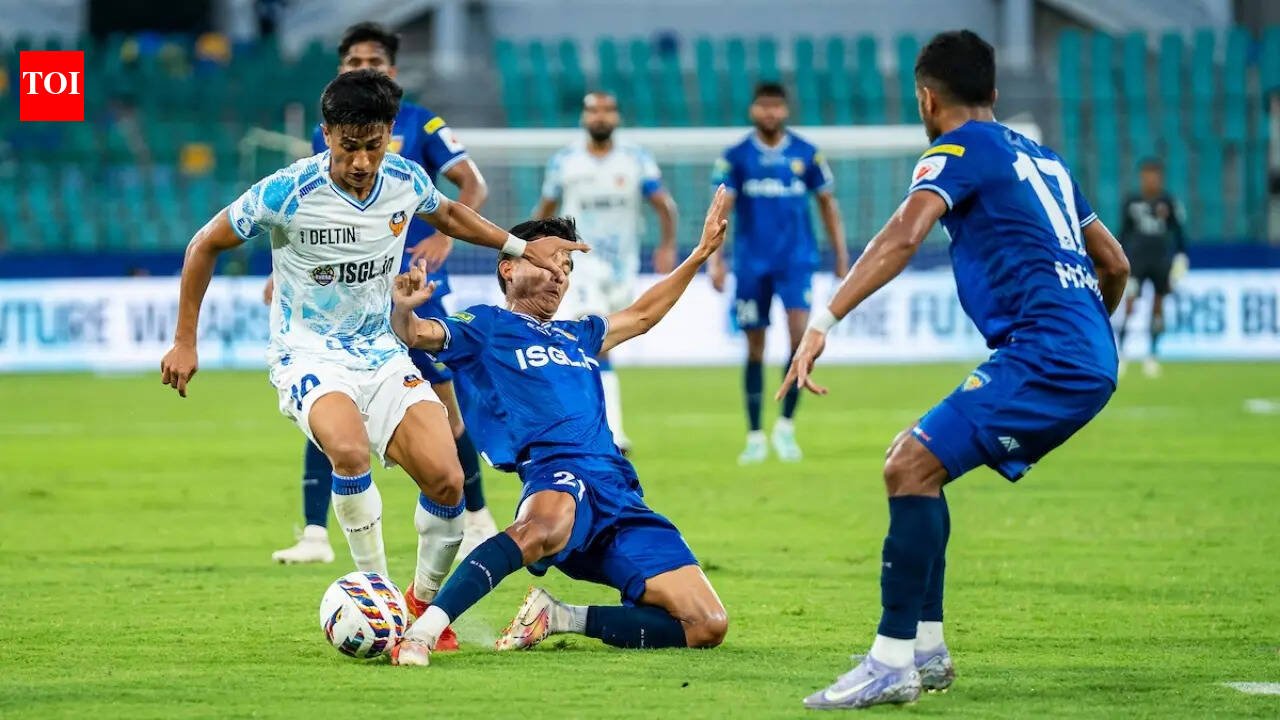
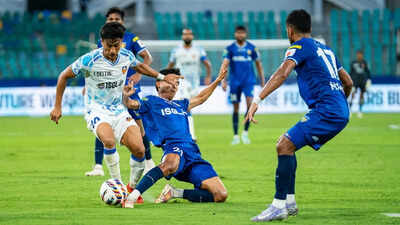
FC Goa vs Chennaiyin FC during the ongoing Indian Super League season. (Image: AIFF)

NEW DELHI: London-based Genius Sports has bid Rs 64.39 crore per year, or approximately Rs 2,129 crore over 20 years, for the commercial rights of the Indian Super League (ISL) and Federation Cup. FanCode’s bid for the same properties stands at roughly half of that: Rs 36 crore for the first year, or Rs 1,190 crore over 20 years. These are the two options in front of the All India Football Federation (AIFF) and the 14 ISL clubs after the tender bids were opened on Friday (March 27).Both stakeholders in Indian football are at different ends over the two bids. Because of the structure of the two bids, the ISL clubs feel FanCode is a better deal, while the AIFF, which is running the league and had invited the bids, finds the Genius Sports offer to be more favourable.

Watch

Football returns to Delhi! SC Delhi gear up for first ISL home game

The difference lies in the details of how the commercial rights pool will be allocated between AIFF, clubs and the eventual winner of the tender.

How the revenue will be shared

Under the revenue sharing model proposed in the tender, AIFF will take home a fixed 20 per cent of the amount that the bidder puts in. Thereafter, at the end of the season, 70 per cent of the net revenue will be shared with the AIFF and rest will go to the commercial partner. Of that 70 per cent that AIFF received, 60 per cent will go to the clubs involved.It must also be taken into account that in the case of net losses, they get transferred to the next year. So, the challenge gets compounded for the second year as the challenge of breaking even, let alone making profit, becomes even higher.

AIFF

File photo of the Indian jersey with the AIFF logo.

Why AIFF want Genius Sports

On the face of it, Genius Sports is the bigger bid and helps the cash-strapped football body. They make money regardless of what happens at the end of a season. However, with the sports tech company putting in Rs 64.39 crore each year, the challenge of bringing that back and more will be higher. In that scenario, clubs will get smaller, if any, share of funds.

Why clubs prefer FanCode

Clubs and the Dream11-owned company both are targeting a long-term approach and a feasible financial structure. Because FanCode will put in Rs 36-plus crore every year, the chances of breaking even and making profit are higher. In that scenario, clubs have the chances of making money although it means AIFF’s direct and immediate share is smaller.

BIDS AND AIFF’S TAKE HOME

1. FanCodeFirst year spend: Rs 36 croreAnnual increments: 5 per centTotal spending over 20 years: Rs 1,190 crore (approximately)AIFF’s share in the first year: Rs 7.2 crore (20 percent)AIFF’s share over 20 years: Rs 238 crore (approximately)2. Genius SportsFirst year spend: Rs 64.39 croreAnnual increments: 5 per centTotal spending over 20 years: Rs 2,129 crore (approximately)AIFF’s share in the first year: Rs 12.87 crore (20 per cent)AIFF’s share over 20 years: Rs 425.80 crore (approximately)

Why invite 15+5 year bids in the first place?

ISL match 1

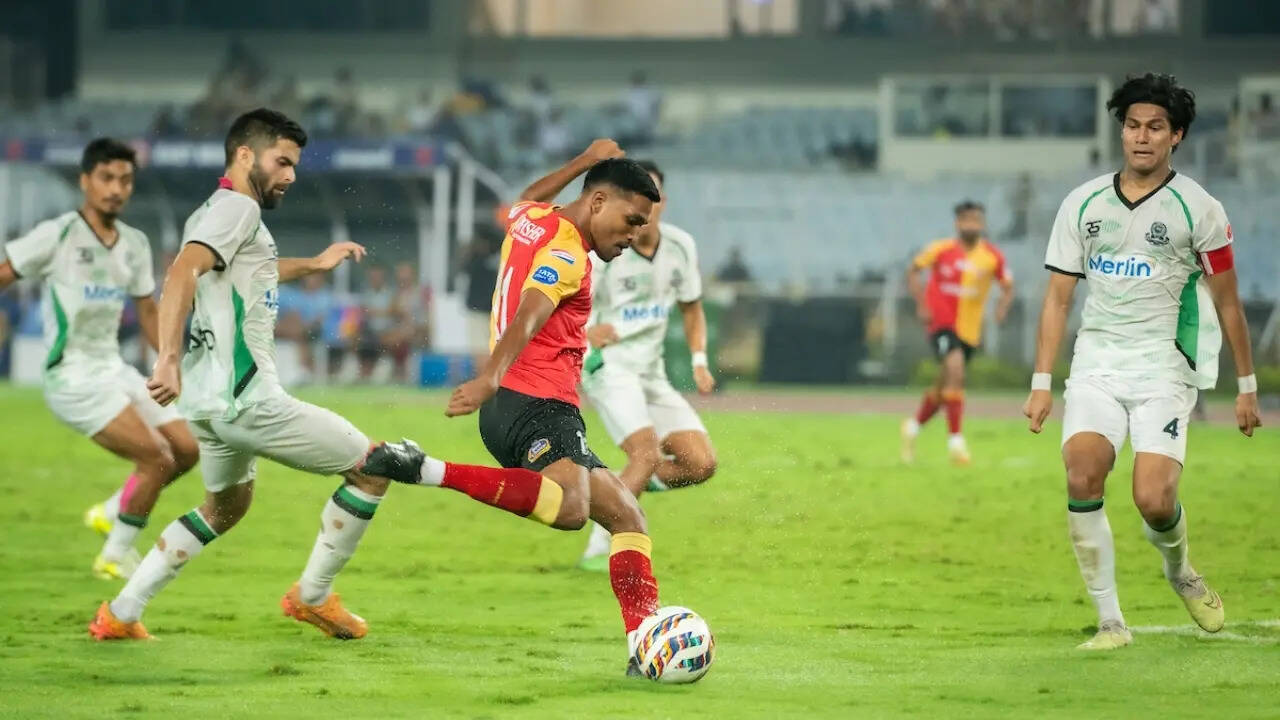
East Bengal vs Mohammedan Sporting during the ongoing ISL season. (Image: AIFF)

In most sports, or even with most brand associations, short term deals are preferred over long term associations. CEAT Tyres has been linked with the Indian Premier League (IPL) since 2015, having first come on as ‘strategic timeout’ sponsor for three seasons at a reported Rs 12-15 crore. In 2018, the contract was renewed for five seasons. And by 2024, when it was renewed again, the valuation was at Rs 240 crore for five years or Rs 48 crore a year — a four-time increase in nine years.Returning to Indian football, AIFF are selling rights to their properties for 15-20 years at prevailing rates when the market is not favourable to the sport’s future, considering we’re admist a truncated season that got underway five months late.

Shaji Prabhakaran

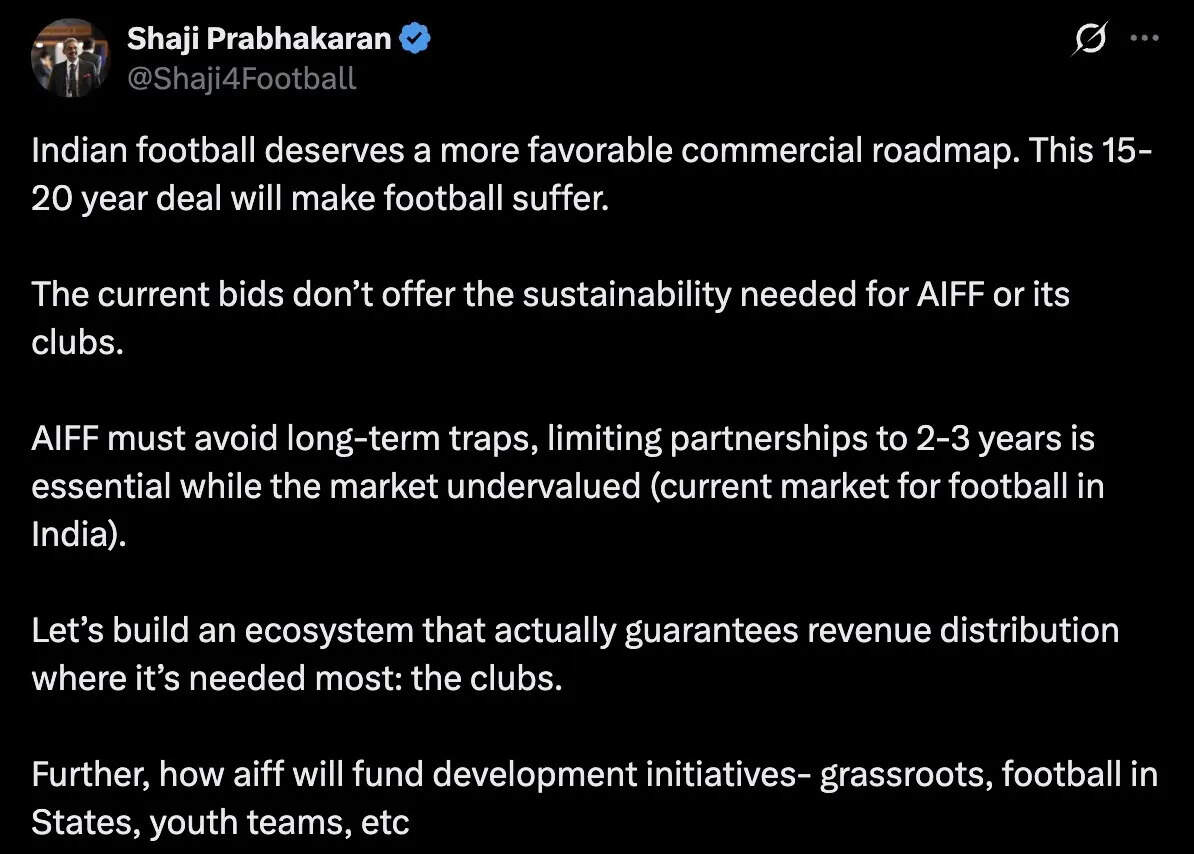
Former AIFF General Secretary Shaji Prabhakaran has advocated for a smaller commercial rights window. (Image: X)

Former AIFF General Secretary Shaji Prabhakaran made the same arguement on social media. “Indian football deserves a more favorable [sic] commercial roadmap. This 15-20 year deal will make football suffer,” he wrote on X.“The current bids don’t offer the sustainability needed for AIFF or its clubs. “AIFF must avoid long-term traps, limiting partnerships to 2-3 years is essential while the market undervalued (current market for football in India).“Let’s build an ecosystem that actually guarantees revenue distribution where it’s needed most: the clubs,” he continued.Now, the onus is on the ISL clubs, which have been bleeding money already, to discuss and share their views with the AIFF on what the roadmap for the next two decades of Indian football will be. This enormous decision could be taken as early as Sunday when the AIFF Executive Committee are presented with the bid evaluation report.


Source link