Breaking News
Helium And India: Up, up and away: Is the world running out of Helium gas?


Up, up and away: Is the world running out of Helium gas?

Helium isn’t something most people think about, unless you’re in a lab, running an MRI, building chips, or inhaling it for that squeaky balloon voice. But what if the world suddenly runs out of this invisible gas? As exaggerating as the question may sound, it’s exactly what’s raising concerns right now. As tensions in the Middle East shake up supply chains, helium has quietly floated into the middle of a global crisis, one that could affect everything from hospital scans to high-tech factories in ways few expected.Earlier this month, the global helium supply chain took a big hit. Iranian drone and missile strikes on Qatar’s Ras Laffan industrial city, the world’s largest hub for helium production, forced a shutdown that knocked out nearly one-third of the global supply overnight. The disruption was further compounded by Tehran’s tightened grip on the Strait of Hormuz to Western commercial shipping, forcing vessels to reroute around the Cape of Good Hope, significantly increasing transit times and losses.While this already sounds like a problem, it’s even worse for liquid helium, which has to be kept at extremely low temperatures and can’t easily survive long journeys without significant “boil-off” losses. As a result, the ongoing crisis, often referred to as “helium shortage 5.0,” has moved beyond a theoretical risk to become a systemic global supply disruption.
What is Helium?

How is Helium used

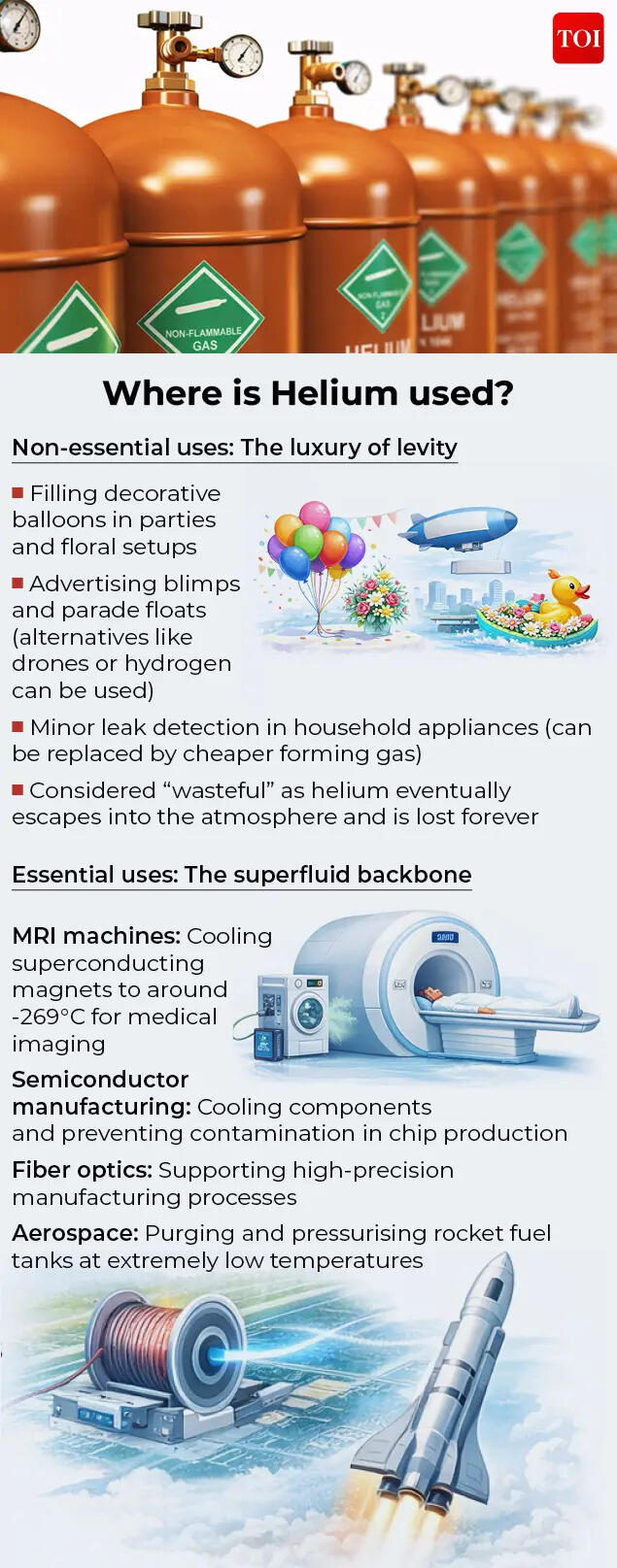
Non-essential uses: The luxury of levityThe most common non-essential use of helium is in the party and floral industry for filling decorative balloons. While culturally popular, this application is a primary source of “waste,” as the gas eventually leaks into the atmosphere and escapes into space, never to be recovered. Similarly, its use in advertising blimps and parade floats is considered non-essential because these functions can be served by alternative technologies like drone displays or, in some cases, hydrogen gas. Additionally, using helium for minor leak detection in household appliances is often deemed non-critical, as cheaper “forming gas” (nitrogen-hydrogen mixes) can often perform the same task without depleting the world’s rare helium reserves.Essential uses: The superfluid backboneHelium is indispensable in healthcare, specifically for MRI machines. It is the only element capable of cooling superconducting magnets to -269°C, a temperature required to keep the magnets operational for life-saving diagnostic scans. Beyond medicine, it is critical in semiconductor manufacturing and fiber optics. Its inert nature and high thermal conductivity allow it to cool components rapidly and prevent chemical contamination during the production of the microchips that power our global digital infrastructure. Meanwhile in aerospace, helium is used to purge and pressurize rocket fuel tanks, as it remains a gas even at the extreme cryogenic temperatures of liquid oxygen and hydrogen.This raises an important question, especially as countries rush to secure their energy supply: why can’t this element simply be replaced?
Where is Helium used?

The chemistry of scarcity — Can’t we just make more Helium?

To understand why this shortage is so critical, it is essential to understand helium’s unique physical properties. Although helium is the second most abundant element in the universe, it is extremely rare on Earth. Unlike nitrogen or oxygen, it cannot be extracted from the atmosphere. Instead, helium is a non-renewable by-product formed over billions of years through radioactive decay deep within the Earth’s crust. It becomes trapped in natural gas reservoirs and is recovered during gas processing.Once released into the atmosphere, helium is effectively lost forever. Being extremely light, it escapes Earth’s gravitational pull and drifts into space. There is no known method to manufacture helium at scale, nor any viable substitute for its unique properties. Every unit consumed, whether in industrial applications or even party balloons, is permanently depleted.The impact of the helium crisis is already being felt across major economies. Countries such as South Korea, Japan, Taiwan and China, among Qatar’s largest importers of helium, are facing growing uncertainty over supplies as disruptions in the Middle East ripple through the global market. Even North American consumers, despite domestic production, remain partly dependent on Gulf helium, highlighting the truly global nature of the supply chain strain.

Hormuz trouble hits Helium bubble

This widespread impact has laid bare the structural vulnerability of the global helium market, which remains heavily concentrated in a handful of regions. Historically, supply has rested on a “tripod” of the United States, Qatar and Russia, with Qatar alone contributing around for over 30% of global production, most of it centred in the Ras Laffan industrial complex. At the same time, United States remains the largest producer globally, generating around 81 million cubic metres, over 40% of total supply.
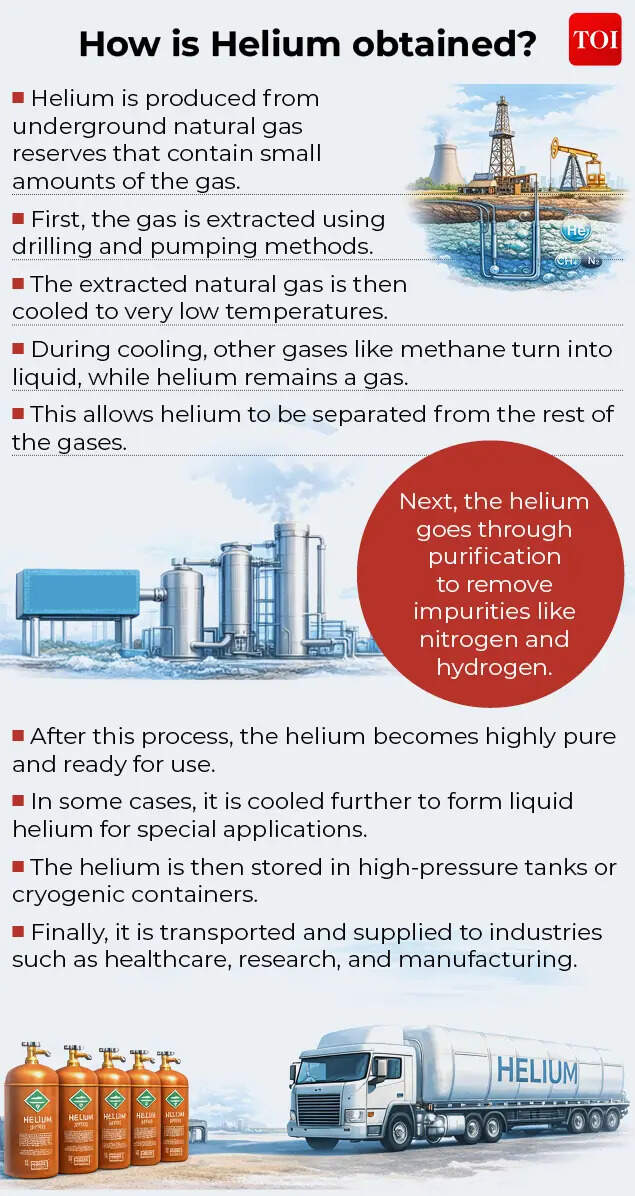
How is Helium obtained?

A key reason behind the crisis lies in how helium is produced. It is not extracted independently but as a by-product of liquefied natural gas (LNG) processing, making its availability directly proportional to the stability of gas infrastructure.“The global helium market has a considerable degree of exposure to the Middle East, mainly on Qatar which accounts for somewhere between 30% to 35% of global helium supply,” said Sourav Mitra, partner – oil and gas at Grant Thornton Bharat. “The majority of its output is concentrated in the Ras Laffan industrial complex,” the expert told TOI.Mitra highlighted that helium’s dependence on maritime logistics adds another layer of risk. “Considering that helium is a low-density gas that must be shipped in specialized cryogenic containers, it relies entirely on stable maritime trade routes. Any conflicts that threaten the Strait of Hormuz… create immediate global shortages,” he said. Unlike crude oil, there are no significant global strategic reserves of helium that can cushion such disruptions.The situation has been further complicated by damage to LNG infrastructure. “Helium is obtained as a by-product of gas processing… if the LNG ecosystem slows or shuts down, helium production automatically halts,” Mitra explained.Reports indicate that around 17% of Qatar’s LNG export capacity has been damaged, sidelining approximately 12.8 million tonnes of production for the next three to five years. This is expected to translate into a 14–15% reduction in liquid helium exports. Pranav Master, senior practice leader and director at Crisil Intelligence, told TOI that global helium production, estimated at around 190 million cubic metres annually, is highly concentrated, led by the United States at approximately 43% and Qatar at about 34%.“Qatar’s exports are reliant on the Strait of Hormuz, which is currently a critical chokepoint… recent disruptions in LNG infrastructure, particularly at Ras Laffan, can lead to constrained global supply,” he said, adding that sectors such as semiconductors, MRI systems and other cryogenic applications are particularly vulnerable. He also pointed to the 2017 Qatar blockade as a precedent, when similar disruptions led to production halts and price spikes.

No Helium, try replacing it?

Despite its critical role, helium has no easy substitute, which makes the current crisis even more severe.Helium is a non-renewable resource formed over billions of years through radioactive decay deep within the Earth’s crust. It is trapped in natural gas fields and released during extraction. Once it escapes into the atmosphere, it is lost forever, as its extremely light atoms drift into space.
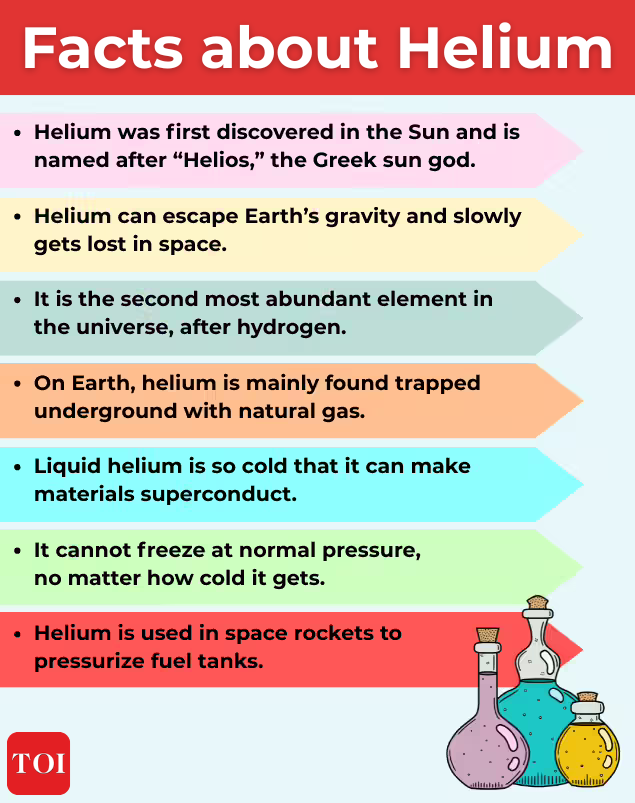
Helium - Facts

This means existing reserves are all that humanity currently has to meet demand. Unlike other industrial gases, helium cannot be manufactured in a lab at scale, nor can it be easily replaced in applications that require its unique properties, such as ultra-low temperature cooling and inert environments.The ongoing crisis has accelerated efforts to diversify helium supply and develop alternatives.New “primary helium” exploration projects are being pursued in countries such as Tanzania, Canada and the United States, where helium is extracted as the primary resource rather than as a by-product of natural gas.Russia’s Amur gas processing plant, designed to be a major global supplier, is expected to expand capacity with an additional production train by the third quarter of 2026. However, geopolitical tensions and sanctions complicate its accessibility for many countries.In India, Engineers India Limited has signed an agreement to establish the country’s first helium recovery demonstration plant in Kuthalam, Tamil Nadu. Meanwhile, researchers at NIT Durgapur are exploring helium extraction from geothermal hot springs in West Bengal and Jharkhand, where concentrations are significantly higher than typical gas fields.Technological innovation is also underway. Companies such as Siemens and Philips are developing low-helium or helium-free MRI systems using closed-loop cooling technologies. However, these systems currently account for less than 5% of the global installed base, limiting their immediate impact.
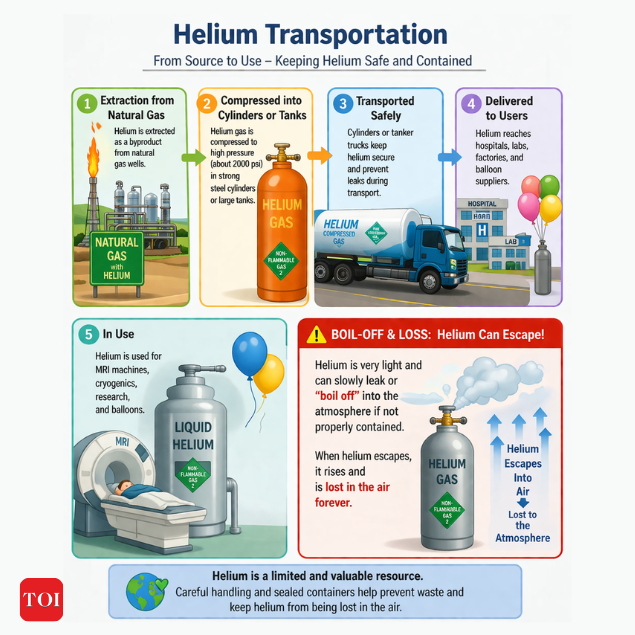
Transporting Helium

The 2026 crisis has therefore highlighted a deeper issue, not just scarcity, but the lack of alternatives. As supply chains tighten and disruptions continue, industries across healthcare, semiconductors and advanced technology are left grappling with a resource that is both essential and irreplaceable.

What Helium supply crunch could mean for India

For India, the helium crisis may result in tangible consequences. As the country heavily relies on imports from Qatar for this non-renewable gas used to cool MRI magnets, hospitals and imaging centres are preparing for tighter supplies as inventories stay low and global logistics grow increasingly uncertain. According to Master, “key downstream industries which may get affected due to restricted helium supply include semiconductors, MRI/medical, other industries requiring helium as cryogenic coolant. Consequently, geopolitical disruptions in the Middle East can affect helium supply across critical high-tech and healthcare industries.”Healthcare impact: What will happen to MRI scannings?India’s healthcare system is heavily dependent on helium for magnetic resonance imaging (MRI). Each MRI scanner requires approximately 2,000 litres of liquid helium to maintain superconducting magnets at around 4 kelvin (-269°C).As of March 2026, helium spot prices in India have surged by 70–100%, forcing diagnostic centres to reassess costs and operations. There are growing concerns about “quenched” magnets, a failure that occurs when cooling is lost, causing superconductivity to break down and resulting in expensive repairs.
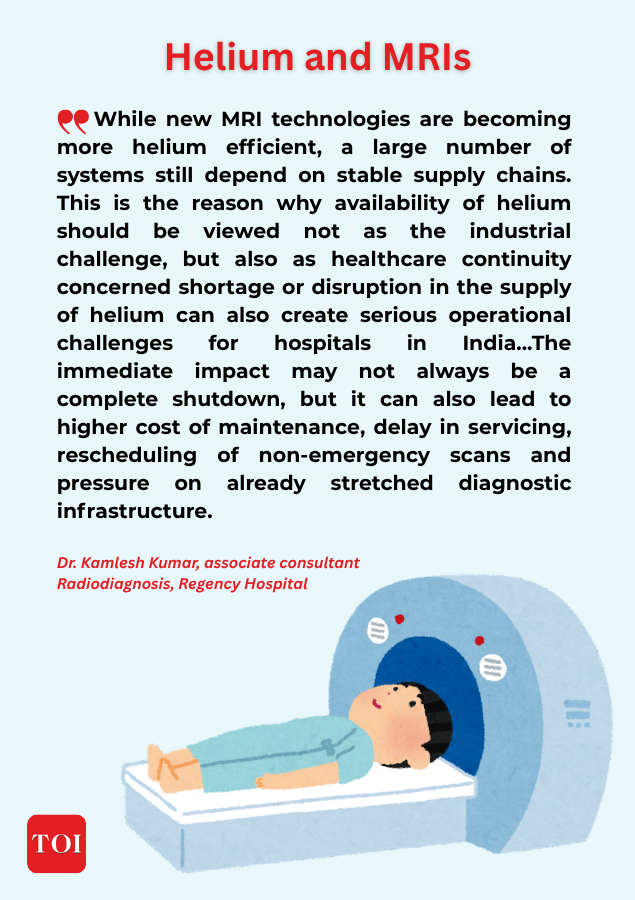
Helium in MRIs

“Helium is not only a technical requirement for MRI systems; it is also important to keep the magnet superconductive and the machine functional,” Dr. Kamlesh Kumar, associate consultant, radiodiagnosis at Regency Hospital told TOI.“Any prolonged shortage or disruption… can create serious operational challenges for hospitals… leading to higher maintenance costs, delays in servicing, rescheduling of non-emergency scans and pressure on diagnostic infrastructure,” the doctor further added.He added that in India, where timely diagnosis often determines treatment outcomes, even temporary disruptions can significantly affect patient care. While newer MRI technologies are becoming more helium-efficient, a large installed base still depends on stable supply chains.India’s semiconductor sector The helium shortage also threatens India’s semiconductor ambitions at a critical juncture. Back in August 2025, the government approved four semiconductor manufacturing units with investments worth Rs 4,600 crore.Helium plays a vital role in semiconductor production. It is used for wafer cooling during high-temperature processes, maintaining inert environments to prevent contamination, and detecting microscopic leaks in high-vacuum systems due to its extremely small atomic size.Without a steady supply of ultra-high-purity helium, these processes cannot function reliably, raising concerns about delays and disruptions in the country’s efforts to become a global chip manufacturing hub.
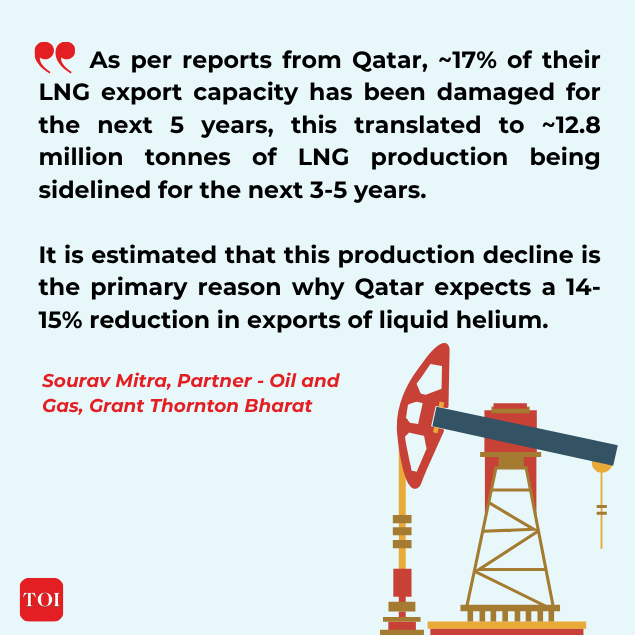
Qatar's Helium crunch

Global tech ecosystem faces bottlenecks

The impact of the helium shortage is being felt across the global technology ecosystem.High-capacity data storage devices, particularly hard drives above 10 terabytes, rely on helium-filled enclosures to reduce internal friction and improve efficiency. Manufacturers have already indicated that production capacity for 2026 is fully allocated, leaving limited room for additional demand.Helium is also used in advanced cooling systems for large-scale data centres and high-performance computing clusters, including those used to train next-generation artificial intelligence models.In the semiconductor sector, major manufacturers such as those in South Korea depend heavily on Qatari helium supplies. With limited inventory buffers, prolonged disruptions could lead to production slowdowns, potentially affecting the global supply of consumer electronics such as smartphones and laptops.
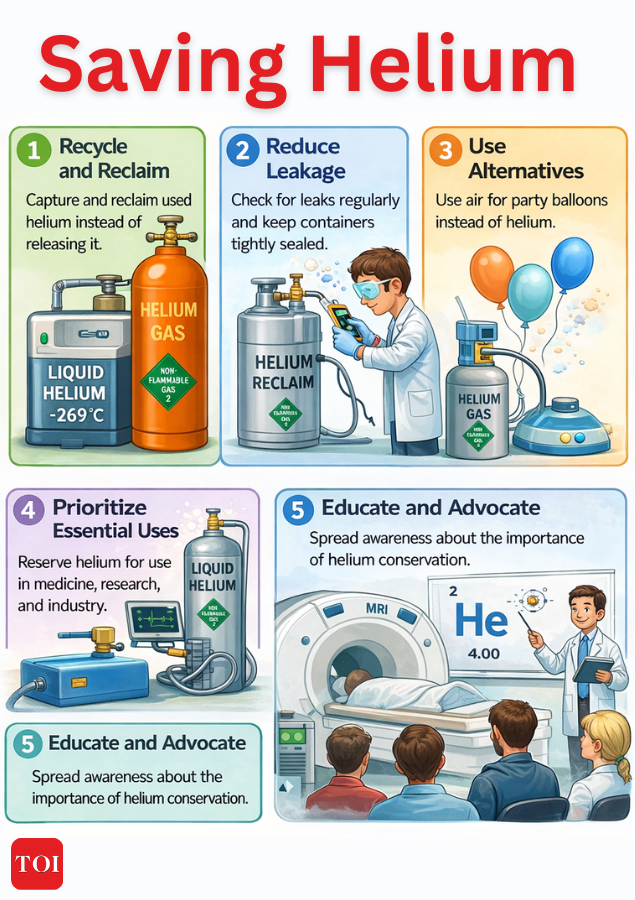
Helium

Bottom line: Is the world running out of Helium?

And the answer is no, technically. However, logistically and economically, it is almost a strong yes.It all comes down to the nature of the element itself. The Earth isn’t about to run out of helium completely. it is still being produced slowly over time through the radioactive decay of elements like uranium and thorium, which release alpha particles that form helium-4. There are also known reserves in places like Tanzania, Canada and the United States.But here’s the catch: that’s all we have. Helium cannot simply be manufactured in a lab or scaled up on demand, let alone the little element takes million of years to form. Once it’s used and released, it’s gone for good. So while a total wipeout isn’t on the cards, shortages very much are, and already happening.So the world is not really running out of Helium, but scrambling with Helium shortage. The real issue isn’t just how much helium exists, but how fragile the system is that delivers it.Helium production, liquefaction and transport run on a tightly choreographed, just-in-time setup with almost no room for error. The Middle East crisis has shown just how quickly things can fall apart when key infrastructure is hit or critical trade routes are disrupted.And unlike oil, there’s no big emergency stash to fall back on. That leaves industries. from hospitals and chipmakers to AI labs, surprisingly exposed to a tiny, invisible gas that the world can’t afford to lose.


Source link

Anduril founder Palmer Luckey is clear on when he would sell weapons to North Korea: If …


Anduril founder Palmer Luckey is clear on when he would sell weapons to North Korea: If ...

Anduril founder Palmer Luckey has now made it clear that his company’s arms sales will always align with US government policy even if it that meant selling weapons to North Korea, according to a report by Fortune. “If the U.S. asks me to, yes,” Luckey told Fortune at the Singapore Airshow in February. He added: “I’m never going to promise to do something the US wouldn’t do.Parlmer Luckey founded Anduril in 2017 after his departure from Facebook. His defense startup quickly became America’s most closely watched defense startups. Anduril’s products include the Fury drone, designed to fly alongside fighter jets, and the Ghost Shark submarine, already contracted by Australia for $1.1 billion. The company is riding a global defense spending boom, with revenues projected at $4.3 billion this year and a potential valuation of $60 billion in upcoming funding rounds.

Anduril to align with US policy

Luckey’s stance that arms markers should act as extensions of US foreign policy which places him at the centre of debates about alliance politics in Asia, the rise of Chinese military hardware, and the role of tech billionaires in matters of war and peace. He also emphasise that Anduril will not act independently of Washington, “If a country asks me ‘commit to supporting this even if the U.S. doesn’t want to,’ all I can say is no. I’m not willing to go to prison to sell you spare parts.”

Anduril’s global expansion plans and pushback

For the uninitiated, Anduril has signed deals with Japan, South Korea, and Taiwan moves which prompted Beijing to sanction both the company and Luckey personally. While allies see Anduril as a partner in strengthening defense, critics worry about the Implications of a private tech firms wielding such influence over military supply chains.Luckey has also reportedly warned that the US risks falling behind China in defense manufacturing. He also stresses on the fact that China focuses on mass producible, easily repairable systems which mirrors America’s World War II strategy, while the U.S. today builds “exquisite systems without regard for manufacturability.” To counter this, Anduril is building a 5-million-square-foot “Arsenal-1” factory in Ohio to mass-produce drones and weapons by 2026.

Luckey’s views reflect a broader shift in Silicon Valley

The latest comments made by Luckey highlight the broader shift in Silicon Valley, where companies are increasingly embracing defense work. He has criticized rivals like Anthropic, which refused Pentagon requests to loosen restrictions on its AI, saying: “At the end of the day, you have to believe…that our imperfect constitutional republic is still good enough to run a country without outsourcing the real levers of power to billionaires and corpos.


Source link

‘Tough call’: Sam Curran reveals injury that forced IPL 2026 withdrawal | Cricket News


‘Tough call’: Sam Curran reveals injury that forced IPL 2026 withdrawal

NEW DELHI: Sam Curran has opened up on the groin injury that ruled him out of IPL 2026, admitting the issue had been building for a while before finally forcing a “tough decision” to withdraw.Go Beyond The Boundary with our YouTube channel. SUBSCRIBE NOW!The England all-rounder, who was set to represent Rajasthan Royals after a trade move, pulled out just ahead of the tournament following the T20 World Cup, where England reached the semi-finals.

Watch

IPL 2026 should be audition for the next India T20I captain

Curran revealed he had been carrying the injury through the global tournament. “It’s an injury that I’ve kind of been battling with a little bit. It has gradually got fractionally worse,” he said, in a conversation with BBC.ALSO READ: ‘Two-year ban not working’: Sunil Gavaskar calls for stricter IPL pullout rulesPost-tournament scans confirmed the extent of the damage. “I went for a couple of scans, and it showed reasonable damage, so I had to make the tough decision. It was hindering me quite a bit,” he added.The 27-year-old said missing the IPL was particularly frustrating given his excitement about joining a new franchise. “To miss the IPL was very disappointing… but now I have a rehab block of trying to get strong and fit,” he noted.Focus shifts to recoveryCurran is now undergoing rehabilitation in England and admitted that his return timeline remains uncertain. “It’s all going to come down to symptoms. It is obviously still a way off from that,” he said, casting doubt over his participation in upcoming domestic assignments.He is also unlikely to feature immediately for Surrey and remains unsure about leading the side in the T20 Blast. “It is probably my first time to do a bit of rehab back in England,” he said.Despite the setback, Curran remained pragmatic. “It will be tough to watch the IPL because I know that I’d like to have been there, but injuries are part of sport,” he added.Rajasthan have since named Dasun Shanaka as his replacement for the season.Curran’s withdrawal adds to a growing list of high-profile absentees this year, underlining the physical toll of a packed cricket calendar.


Source link

Strait of Hormuz chokehold: What is happening to petrol prices in India and neighbouring nations amid oil supply crunch?


Strait of Hormuz chokehold: What is happening to petrol prices in India and neighbouring nations amid oil supply crunch?

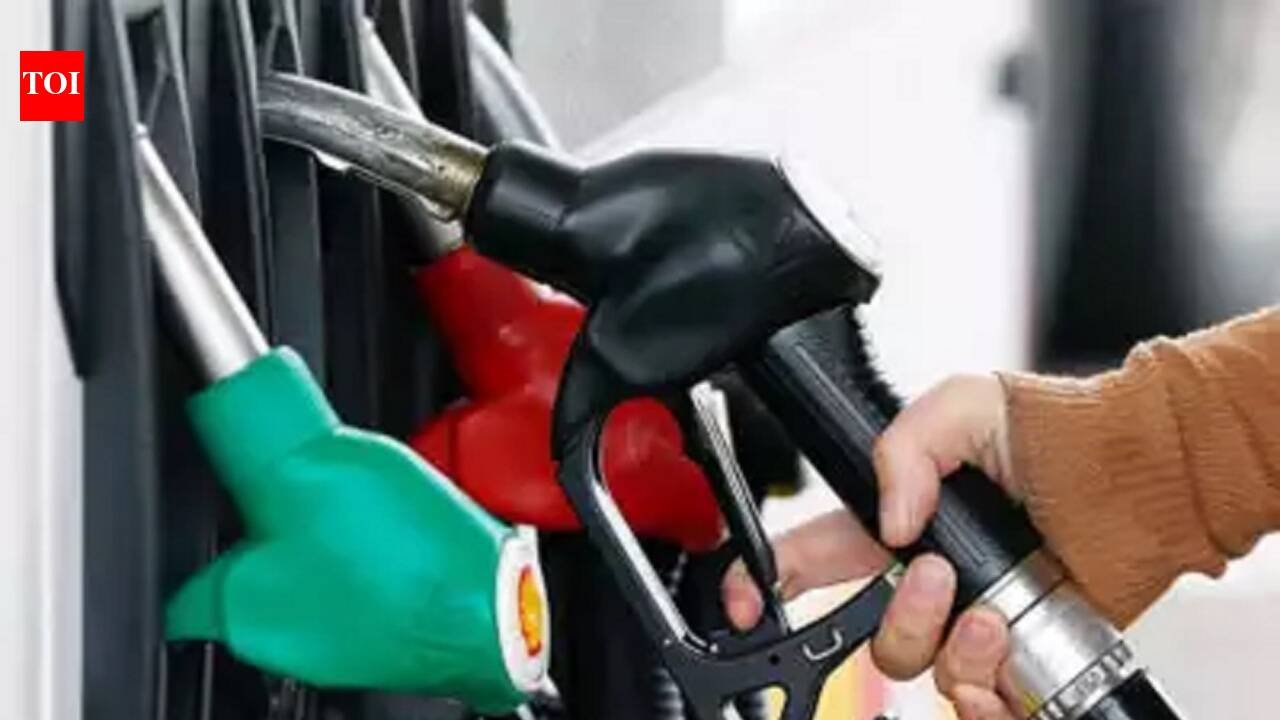
A month into the Middle East conflict, global crude markets remain under strain, with prices rising nearly 50% since the United States and Israel launched strikes on Iran on February 28, triggering a strong response from Tehran. Oil prices had earlier surged to as high as $119 per barrel amid heightened tensions involving Iran, before easing to around $100 per barrel. The ripples have now hit fuel prices and supplies across the globe.India, which meets about 88% of its crude oil demand and nearly half of its natural gas needs through imports, much of it routed via the Strait of Hormuz, faces growing pressure as elevated prices and supply concerns ripple through global energy markets. At the same time, neighbouring nations like Nepal, Sri Lanka and others have also introduced measures to deal with the supply crisis.India:The Centre stepped in to cushion both consumers and oil companies from the sharp rise in crude prices, lowering excise duty on petrol and diesel, a decision expected to cost the exchequer Rs 1.3 lakh crore. Fuel retailers such as IndianOil, Hindustan Petroleum and Bharat Petroleum are currently incurring losses of about Rs 24 per litre on petrol and Rs 30 per litre on diesel.To ease this burden, the government cut the special additional excise duty on both fuels by Rs 10 per litre. At the same time, it imposed export duties of Rs 21.5 per litre on diesel and Rs 29.5 per litre on aviation turbine fuel (ATF) to curb windfall gains.The government has said alternative arrangements are in place to reduce dependence on imports, especially from the Middle East. India imports nearly 90 per cent of its crude oil, about 60 per cent of LPG, and over half of its natural gas. While the country has reserves for up to 74 days, current availability is around 60 days.Nepal: Kathmandu saw a fresh round of fuel price revisions, with the Nepal Oil Corporation increasing petrol and diesel/kerosene rates by Rs15 per litre. The move comes less than two weeks after the previous revision on March 15.Petrol now ranges between Rs 184.50 and Rs 187 per litre across categories, with Kathmandu at the top end. Diesel and kerosene are priced between Rs 164.50 and Rs167 per litre. The corporation cited rising international purchase costs behind the price hikes, noting that petrol prices rose by Rs 76 per litre and diesel by Rs143 per litre between March 1 and 24.Bhutan:Bhutan is considering fuel-saving steps such as work-from-home arrangements and targeted rationing to conserve supplies as global prices rise. Authorities have said existing reserves are sufficient for now but may roll out stricter measures if the situation worsens, with a focus on prioritising essential services and limiting consumption.Pakistan:Pakistan has increased kerosene prices by PKR 4.66 per litre to PKR 433.40, while keeping petrol and diesel cost PKR 321.17 and PKR 335.86 per litre. Authorities said the decision aims to shield consumers, with the government continuing to absorb part of the cost burden by compensating oil marketing companies. Pakistan’s recent fuel price increases, along with earlier rises in petrol and diesel rates, have added to cost-of-living pressures, driving up transport fares and the prices of everyday essentials such as fruits and vegetables.Aviation fuel prices also surged, with jet fuel reaching PKR 476.97 per litre after repeated hikes. The rise has pushed up airfares, with both domestic and international ticket prices increasing amid supply constraints. Sri Lanka: Sri Lanka has raised fuel prices by around 25%, marking its second increase in a week and third since March 1. Diesel, petrol, and kerosene have all recorded sharp rises, bringing prices close to levels seen during the 2022 economic crisis. The increase has raised concerns among transport operators, with private bus owners warning of large-scale disruptions. The country also introduced a midweek public holiday for schools, universities and non-essential workers to conserve fuel. Alongside this, it reinstated the QR-based National Fuel Pass system, enforcing strict weekly limits on fuel purchases.China:China, the world’s largest producer and consumer of coal, has expanded its coal capacity in recent years to boost energy security and continues to depend on it even as it scales up clean energy.Myanmar:In Myanmar, rising fuel prices have led to shortages and restrictions, including limits on private vehicle use based on licence plate numbers. Petrol stations have seen long queues, while railway stations are witnessing increased footfall as commuters shift to trains. Additional train services have been introduced to manage the demand. Bangladesh: Meanwhile, as the energy supply crunch is sending ripples across the globe, Bangladesh has moved to step up diesel imports from India, with plans to bring in an additional 45,000 tons by April. Initial shipments have already arrived, with more expected after procedural formalities are completed. Supplies are being transported via the Bangladesh-India Friendship Pipeline from Numaligarh Refinery Limited to the Parbatipur depot. Imports through the pipeline had briefly halted but have now resumed. Meanwhile, universities, foreign curriculum schools and coaching centres have shifted to online classes. The situation has also led to five-hour rolling blackouts and the shutdown of most fertiliser plants due to gas shortages.Countries like Venezuela, Egypt, Vietnam and others have also stepped in to protect consumers while balancing the supply chain disruptions with measures like work from home, electricity cuts, oil rationing etc. As Iran tightens its grip over the Strait of Hormuz, a vital 29-nautical-mile-wide passage linking key regional waters, global energy flows remain at risk. The route carries nearly 20 million barrels of oil daily, making up about a quarter of global seaborne trade. Any disruption has widespread impact, prompting countries to respond through a mix of price hikes and tax measures to manage supply pressures and shield consumers.


Source link

MMRDA earns top rank in Maharashtra | Mumbai News


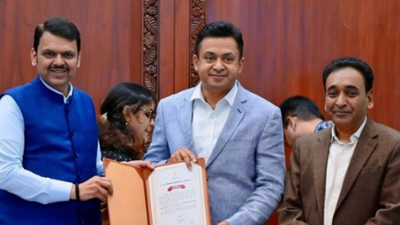
MUMBAI: The Mumbai Metropolitan Region Development Authority (MMRDA) secured the top position in the state under the 150 Days Sevakarmi Plus Programme, official said on Sunday. It was also ranked fourth in the state in the 150 Days E-Governance Reform Programme of the Government of Maharashtra.Commendation certificates were presented to MMRDA Commissioner Sanjay Mukherjee by Chief Minister Devendra Fadnavis.Participating government agencies were assessed on nine parameters related to personnel development and compliance with service rules for the Sevakarmi Plus Programme award. They were also evaluated on seven parameters concerning the use of innovative digital governance for the E-Governance Reform award.


Source link

‘BJP says can’t eat fish, meat’: Mamta Banerjee campaigns in Purulia | West Bengal Election News


'BJP says can't eat fish, meat': Mamta Banerjee campaigns in Purulia
Mamta Banerjee (PTI file photo)

NEW DELHI: Mamata Banerjee on Sunday launched a sharp attack on the BJP at an election rally in Purulia, alleging that the party would restrict Bengali food habits, including fish and meat, if it comes to power. Addressing the rally, she said, “BJP says can’t eat fish, meat, eggs; they don’t believe in any religion; they resort to riots; Adivasis are exploited, women attacked in BJP-ruled states.” Her remarks are in line with the TMC’s campaign pitch, which presents the BJP as out of touch with Bengal’s cultural traditions.Stepping up her attack on the saffron party, she said, “A big BJP leader has unleashed his ‘chargesheet’ against TMC; a ‘chargesheet’ should be filed against them. There were so many riots in Gujarat,” referring to Amit Shah, who on Friday in Kolkata released the BJP’s 15-year “chargesheet” against TMC rule.Praising TMC’s Lakshmir Bhandar scheme, she warned, “Women have benefited. BJP will give some money before the polls, but close it after.”Banerjee also slammed the EC’s Special Intensive Revision (SIR), claiming 1.2 crore voter names were deleted, targeting her supporters.“EC has removed almost everyone who worked with me; IAS, IPS were humiliated,” she said, referring to the recent transfers of officers.The elections, for 294 seats in West Bengal, will be held in two phases: April 23 (152 constituencies) and April 29 (142), with results scheduled for May 4, in what is expected to be a closely watched contest between the TMC and BJP.

Elections 2026 mark a pivotal year for democratic processes across various regions in India and globally. This includes key state assembly elections, local body polls, and by-elections that could significantly impact national-level politics. Get real-time updates, important dates, voting procedures, and verified news — all in one place. Whether you’re tracking results or exploring candidate profiles, this is your go-to hub for Elections 2026.


Source link

Rcb Vs Srh: IPL 2026’s first controversy! SRH’s Klaasen fumes over ‘debatable’ boundary catch | Cricket News


NEW DELHI: The opening weekend of the new IPL season didn’t take long to deliver its first flashpoint, with a contentious boundary call overshadowing an otherwise dominant win for Royal Challengers Bengaluru at M Chinnaswamy Stadium, Bengaluru on Saturday.Go Beyond The Boundary with our YouTube channel. SUBSCRIBE NOW!The incident unfolded in the 14th over of Sunrisers Hyderabad’s innings when Heinrich Klaasen attempted a pull off a short delivery from Romario Shepherd. The ball soared towards deep mid-wicket where Phil Salt settled under it near the boundary cushions.

Watch

Axar Patel questions Impact Player rule: ‘All-rounders lose value’

While Salt completed the catch, replays raised doubts about whether his foot had brushed the boundary sponge. The third umpire, Rohan Pandit, examined limited angles and noted no visible movement of the cushions before ruling Klaasen out.However, subsequent visuals hinted at slight movement in a cushion bearing the ‘Kingfisher’ logo, intensifying the debate. The controversy deepened when a top-angle replay emerged after the broadcast break, prompting widespread scrutiny.Watch:Former England captain Michael Vaughan questioned the decision publicly: “Looked to me like the foot had touched the boundary sponge… that’s a big call… Not sure how you can give that out and be absolutely sure no part of the foot touched the sponge.”The dismissal proved pivotal, halting SRH’s momentum despite a strong partnership between Heinrich Klaasen and stand-in skipper Ishan Kishan. Klaasen was seen in an animated exchange with on-field officials near the boundary as the third umpire reviewed the replays.

Kohli powers RCB to win after emotional tribute

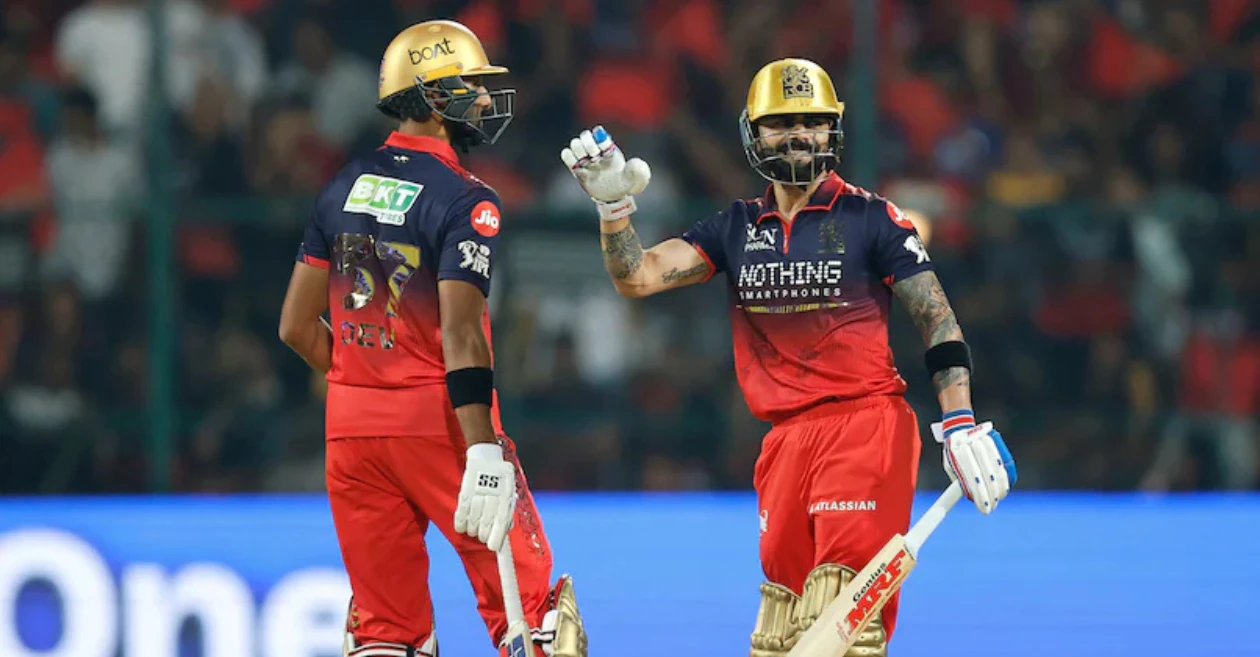
Amid the controversy, Royal Challengers Bengaluru delivered a commanding performance to chase down 202 in just 15.4 overs, powered by a vintage knock from Virat Kohli.Kohli remained unbeaten on 69 off 38 balls, striking five fours and five sixes, including a towering straight hit that electrified the Bengaluru crowd.Earlier, Sunrisers Hyderabad posted 201/9, with Kishan leading the charge with a fluent 80. Debutant Jacob Duffy impressed for RCB with figures of 3/22, removing key top-order batters.Impact substitute Devdutt Padikkal then turned the chase on its head with a blistering 61 off 26 balls, adding 101 runs with Kohli.The match also carried emotional weight, with players observing a minute’s silence and wearing black armbands in memory of 11 fans who died in a stampede during last year’s celebrations.


Source link

Fewest overs taken to chase down 200 plus total in IPL ft. RCB


The Indian Premier League (IPL) has always been a batsman’s paradise, but chasing a 200-plus total used to be considered a monumental task. Over the years, teams have redefined what’s possible, turning seemingly impossible targets into mere formalities. The question every cricket fan asks is: what is the least overs taken to complete a 200-plus chase in IPL?

Today, let’s dive into the fastest 200-plus chases in IPL history, the teams that achieved them, and the breathtaking knocks that made them possible.

RCB’s blitz in IPL 2026

As of March 2026, the record for the fastest 200-plus chase in IPL belongs to Royal Challengers Bengaluru (RCB). On March 28, at the M. Chinnaswamy Stadium in Bengaluru, RCB chased down a target of 202 runs against Sunrisers Hyderabad (SRH) in just 15.4 overs.

This was a jaw-dropping effort that left 26 balls to spare. The previous record of 15.5 overs—set by Rajasthan Royals (RR) in 2025 – was shattered in the very next season, highlighting how the batting firepower in the IPL continues to evolve.

The chase was powered by a vintage Virat Kohli, who remained unbeaten on 69 off 38 balls. But the real accelerator was Devdutt Padikkal, who smashed 61 off just 26 deliveries, reaching his fifty in only 21 balls. Their partnership turned a competitive target into a one-sided affair, setting a new benchmark for the least overs taken to chase 200 or more.

Top 5 fastest 200-plus chases in IPL history

To understand the magnitude of RCB’s achievement, let’s look at the top five fastest instances where teams successfully chased down 200-plus targets with the most overs to spare.

Team Target Overs taken Balls remaining Against Season
Royal Challengers Bengaluru 202 15.4 26 Sunrisers Hyderabad 2026
Rajasthan Royals 210 15.5 25 Gujarat Titans 2025
Royal Challengers Bengaluru 201 16.0 24 Gujarat Titans 2024
Mumbai Indians 200 16.3 21 Royal Challengers Bengaluru 2023
Delhi Capitals 209 17.3 15 Gujarat Lions 2017

Also READ: IPL 2026 – Fans go gaga as Jacob Duffy, Virat Kohli and Devdutt Padikkal humble SRH,  powering RCB to an emphatic win

What makes a 200-plus chase so fast?

Completing a 200-plus run chase in under 16 overs requires more than just big hitting. It demands a calculated yet fearless approach from ball one.

Powerplay dominance: In all the record chases listed above, teams scored heavily in the first six overs, often exceeding 80 or 90 runs without losing early wickets.

Match-up exploitation: Modern IPL teams use data to target specific bowlers. When a team chases a high total in record time, it usually means they have successfully targeted the opposition’s weakest bowling links.

Unconventional shots: The rise of 360-degree batting allows players to score boundaries on almost every delivery, eliminating dot balls and keeping the required rate manageable despite the high target.

Also WATCH: Virat Kohli blows flying kiss to Anushka Sharma after RCB’s emphatic win in IPL 2026 opener against SRH


Source link

‘Two-year ban not working’: Sunil Gavaskar calls for stricter IPL pullout rules | Cricket News


‘Two-year ban not working’: Sunil Gavaskar calls for stricter IPL pullout rules
Sunil Gavaskar and Ben Duckett

NEW DELHI: Sunil Gavaskar has called for tougher punishment for last-minute IPL withdrawals, insisting the current rules are failing to deter overseas players after Ben Duckett pulled out of IPL 2026 despite being picked by Delhi Capitals.Duckett, bought for Rs 2 crore, opted out just days before the tournament to focus on his England commitments, leaving DC’s preparations in disarray and reigniting the debate around player accountability in the league.Go Beyond The Boundary with our YouTube channel. SUBSCRIBE NOW!Gavaskar did not hold back in his assessment of the situation, questioning the effectiveness of the existing punishment. “It is a tough one… one can understand that he wants to focus on his England Test career,” Gavaskar told India Today, acknowledging Duckett’s priorities after a demanding international schedule.

Watch

Greenstone Lobo predicts IPL 2026 winner

However, he stressed that understanding the decision does not mean accepting its impact on the league. “What should be done is something for the BCCI to think about, because a two-year ban is obviously not working,” he said.The former India captain emphasised that the current rule lacks real consequences. “You have to look at something that will have an impact. As long as it’s not having an impact on the player and his chances of coming back to the IPL, it won’t work,” he added.Withdrawals spark fresh debateThe IPL currently imposes a two-year ban on overseas players who withdraw after being picked at the auction without valid injury reasons. However, repeated cases have raised doubts about its effectiveness.Duckett’s withdrawal follows similar instances, including that of Harry Brook, who is already serving a ban after pulling out in a previous season.The England opener defended his decision, saying it reflected his commitment to national duty. “Turning down a good chunk of money… is a step in the right direction to show how much playing for England means to me,” Duckett said.While the league continues to attract global stars, such last-minute exits disrupt team balance and planning. Gavaskar hinted that unless the BCCI enforces stricter penalties, the trend may continue.


Source link

FIR filed against 6 CNG pump staff in Maharashtra for assaulting officer, overcharging consumers | Mumbai News


VASAI: The Pelhar police have registered an FIR against six staff members of a CNG pump located in Dhanivbaug, Nalasopara East, for allegedly assaulting a government officer and overcharging customers. The case has been filed under sections related to assault, causing grievous hurt to a public servant on duty, along with provisions of the Essential Commodities Act and the Petroleum Act.The complainant, Bhagwat Sonar, a Food Supply Inspection Officer from Vasai, had conducted a raid at the pump on Saturday afternoon following multiple complaints of overcharging. During the inspection on Saturday afternoon, Sonar allegedly found that customers were being charged Rs 30 to Rs 50 extra per refill despite fixed government rates.According to the FIR, the situation escalated when Sonar questioned the staff about the malpractice. The staff allegedly behaved aggressively, argued with the officer, and disobeyed his instructions. In a video recorded by Sonar, the employees can be seen confronting him in a hostile manner. He further alleged that his movement was restricted and that he was physically assaulted during the incident.One of the staff members also reportedly helped a colleague escape from the spot, who was allegedly involved in collecting the excess cash from customers. Following the incident, Sonar alerted the Pelhar police, who reached the location and intervened.Speaking on the incident, Sonar said that the raid was conducted after receiving several complaints. He added that the staff appeared to be taking advantage of rumours about a possible shortage of CNG supply to overcharge customers. They also feel that this overcharging may have been going on for some time. He also confirmed that the action taken report will be shared with the state government with a proposal to cancel the licence of this pump.Police officials confirmed that further investigation is underway to determine the extent of the malpractice and whether more individuals were involved in the racket.


Source link